

The DOI matches its Crossref record; 18 of the 18 references it cites were found in a registry or an index.
A modular computational framework for medical digital twins
Open accessAbstract
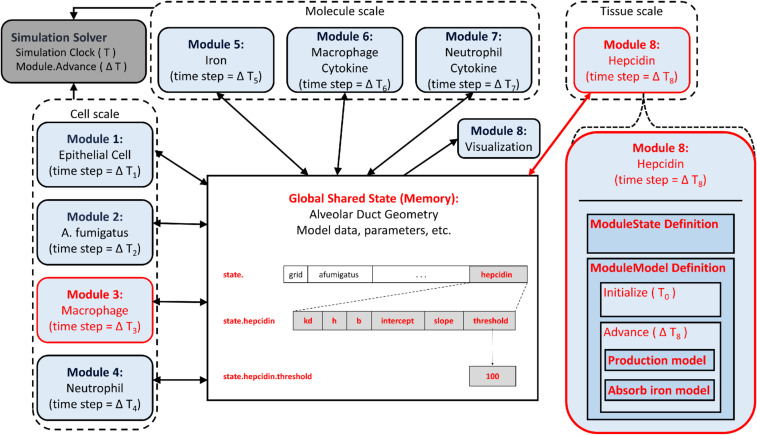
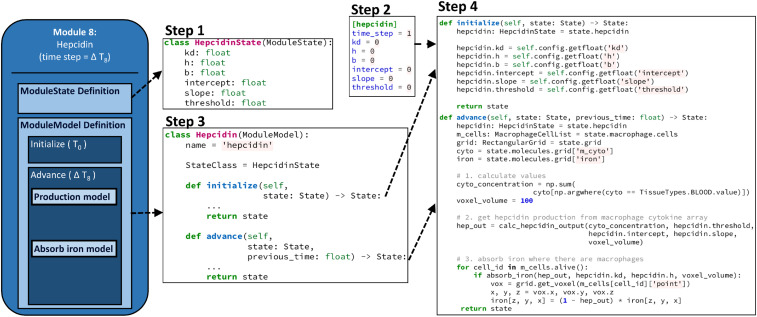
Significance: The digital twin paradigm holds great promise for medicine, even though many technical and scientific challenges remain to be overcome, most importantly the efficient integration of many heterogeneous component models. This is an unsolved problem even in industry. It has long been understood that such models need to be built in a modular fashion, connecting together component models of individual biological processes. In conventional implementations, however, the dependency structure of the modules reflects the dependencies among these processes, making it all but impossible to modify or expand the digital twin without breaking it. This paper presents a fundamental reorganization of the internal digital twin architecture into a hub-and-spokes design that completely circumvents this dependency problem.
Overview
The claims and statistics of this paper haven’t been checked yet.
Run the check — free, no account needed. It reads the open-access text and checks the sources it cites.
Integrity signals
Registry
Cites
Statistics
Figures
Verification
Claims the paper makes
The claims and statistics of this paper haven’t been checked yet.
Run the check — free, no account needed. It reads the open-access text and checks the sources it cites.
Claims other papers make about this one
Each is checked against this paper’s own text: does it say what the citing paper says it does?
The cited source says what the claim attributes to it.
In the citing paper
“An open-source modular framework has also been proposed for the development of medical digital twin models 69 .”
From Multimodal biomedical AI (2022) · cites this paper as [69]
Self-check
Percentages, sums and reported differences re-computed from the paper’s own numbers.
The self-check needs the paper’s full text.
Citations
Cites
The NumPy Array: A Structure for Efficient Numerical Computation
van der Walt, S., Colbert, S. C., & Varoquaux, G. (2011) · Computing in Science & Engineering · doi:10.1109/mcse.2011.37 · Cited by 9,381
Docker: lightweight Linux containers for consistent development and deployment
Merkel, D. (2014) · Linux journal · Cited by 3,191
Hucka, M., Finney, A., Sauro, H. M., Bolouri, H., Doyle, J. C., Kitano, H., Arkin, A. P., Bornstein, B. J., Bray, D., Cornish-Bowden, A., et al. (2003) · Bioinformatics · doi:10.1093/bioinformatics/btg015 · Cited by 3,060
The ODD protocol: A review and first update
Grimm, V., Berger, U., Deangelis, D. L., Polhill, G. J., Giske, J., & Railsback, S. F. (2010) · Ecological Modelling · doi:10.1016/j.ecolmodel.2010.08.019 · Cited by 2,471
The ‘Digital Twin’ to enable the vision of precision cardiology
Acero, J. C., Margara, F., Marciniak, M., Rodero, C., Lončarić, F., Feng, Y., Gilbert, A., Fernandes, J. F., Bukhari, S. H. A., Wajdan, A., et al. (2020) · European Heart Journal · doi:10.1093/eurheartj/ehaa159 · Cited by 987
Tao, F., & Qi, Q. (2019) · Nature · doi:10.1038/d41586-019-02849-1 · Cited by 799
Digital Twins in Health Care: Ethical Implications of an Emerging Engineering Paradigm
Bruynseels, K., Santoni de Sio, F., & van den Hoven, J. (2018) · Frontiers in Genetics · doi:10.3389/fgene.2018.00031 · Cited by 704
Automatic Lip-Contour Extraction and Mouth-Structure Segmentation in Images
Gómez-Mendoza, J.-B., Prieto, F., & Redarce, T. (2010) · Computing in Science & Engineering · doi:10.1109/mcse.2010.145 · Cited by 187
Towards Digital Twin Implementation for Assessing Production Line Performance and Balancing
Fera, M., Greco, A., Caterino, M., Gerbino, S., Caputo, F., Macchiaroli, R., & D’Amato, E. (2019) · Sensors · doi:10.3390/s20010097 · Cited by 79
Lauzeral, N., Borzacchiello, D., Kugler, M., George, D., Rémond, Y., Hostettler, A., & Francisco Chinesta, C. (2019) · Computer Methods and Programs in Biomedicine · doi:10.1016/j.cmpb.2019.01.003 · Cited by 73
Modelling and simulation software to support individual-based ecological modelling
Lorek, H., & Sonnenschein, M. (1999) · Ecological Modelling · doi:10.1016/s0304-3800(98)00193-8 · Cited by 72
Cardiovascular models for personalised medicine: Where now and where next?
Hose, D. R., Lawford, P. V., Huberts, W., Hellevik, L. R., Omholt, S. W., & van de Vosse, F. N. (2019) · Medical Engineering & Physics · doi:10.1016/j.medengphy.2019.08.007 · Cited by 66
An in silico twin for epicardial augmentation of the failing heart
Hirschvogel, M., Jagschies, L., Maier, A., Wildhirt, S. M., & Gee, M. W. (2019) · International Journal for Numerical Methods in Biomedical Engineering · doi:10.1002/cnm.3233 · Cited by 40
Single-cell Digital Twins for Cancer Preclinical Investigation
Filippo, M. D., Damiani, C., Vanoni, M., Maspero, D., Mauri, G., Alberghina, L., & Pescini, D. (2019) · Methods in molecular biology · doi:10.1007/978-1-0716-0159-4_15 · Cited by 30
A computational model of invasive aspergillosis in the lung and the role of iron
Oremland, M., Michels, K. R., Bettina, A. M., Lawrence, C., Mehrad, B., & Laubenbacher, R. (2016) · BMC Systems Biology · doi:10.1186/s12918-016-0275-2 · Cited by 28
Self-citationUpdate schedules of sequential dynamical systems
Laubenbacher, R., & Pareigis, B. (2006) · Discrete Applied Mathematics · doi:10.1016/j.dam.2005.10.010 · Cited by 15
Self-citationMulti-timescale event-scheduling in multi-agent immune simulation models
Guo, Z., & Tay, J. C. (2007) · Biosystems · doi:10.1016/j.biosystems.2007.08.007 · Cited by 8
Multicenter Trial of Closed-Loop Control in Type 1 Diabetes
Hernández, J. A. Z., Castillo-Castro, C., & Rodríguez-Gutiérrez, R. (2020) · New England Journal of Medicine · doi:10.1056/nejmc1915995 · Cited by 7
Cited by
Sorted by citations
Acosta, J. N., Falcone, G. J., Rajpurkar, P., & Topol, E. J. (2022) · Nature Medicine · doi:10.1038/s41591-022-01981-2 · Cited by 1,365
Digital Twins: From Personalised Medicine to Precision Public Health
Kamel Boulos, M. N., & Zhang, P. (2021) · Journal of Personalized Medicine · doi:10.3390/jpm11080745 · Cited by 530
Building digital twins of the human immune system: toward a roadmap
Laubenbacher, R., Niarakis, A., Helikar, T., An, G. C., Shapiro, B. E., Malik‐Sheriff, R. S., Sego, T. J., Knapp, A., Macklin, P., & Glazier, J. A. (2022) · npj Digital Medicine · doi:10.1038/s41746-022-00610-z · Cited by 169
Self-citationConcepts and applications of digital twins in healthcare and medicine
Zhang, K., Zhou, H.-Y., Baptista‐Hon, D. T., Gao, Y., Liu, X., Oermann, E. K., Xu, S. H., Jin, S., Zhang, J., Sun, Z., et al. (2024) · Patterns · doi:10.1016/j.patter.2024.101028 · Cited by 185
Xames, M. D., & Topcu, T. G. (2024) · IEEE Access · doi:10.1109/access.2023.3349379 · Cited by 139
Metadata
- Authors
- Masison, J., Beezley, J., Mei, Y., Ribeiro, H., Knapp, A. C., Sordo Vieira, L., Adhikari, B., Scindia, Y., Grauer, M., Helba, B., Schroeder, W., Mehrad, B., & Laubenbacher, R.
- Affiliations
- UConn Health (US)
- Kitware (United States) (US)
- University of Michigan (US)
- Department of Medicine, University of Florida, Gainesville, FL 32611
- University of Florida (US)
- Corresponding author
- Laubenbacher, R.
- Venue
- Proceedings of the National Academy of Sciences
- Publisher
- National Academy of Sciences
- Published
- 2021-05-10
- Volume
- 118
- Issue
- 20
- ISSN
- 0027-8424 (ISSN-L)
- 1091-6490
- PMC
- PMC8157963
- OpenAlex
- W3163235749
- Cited by
- 98
- References
- 18
- Citations by year
- 2026: 14 · 2025: 25 · 2024: 18 · 2023: 19 · 2022: 19 · 2021: 3
- FWCI
- 16.25
- Type
- journal article
- Language
- en
- Open access
- hybrid
- doi.org
- Licence
- Locations
- Proceedings of the National Academy of Sciences (publishedVersion, cc-by)
- PubMed Central (publishedVersion, cc-by)
- PubMed (publishedVersion)
- Funders
- HHS | NIH | National Institute of Biomedical Imaging and Bioengineering (1U01EB024501-01)
- HHS | NIH | National Institute of Allergy and Infectious Diseases (1 R01AI135128-01)
- HHS | NIH | National Institute of General Medical Sciences (1R01GM127909-01)
- HHS | NIH | National Institute of Dental and Craniofacial Research (T-90DE021989)
- American Heart Association (18TPA34170486)
- Topics
- Health Sciences › Medicine › Public Health, Environmental and Occupational Health › Technology and Human Factors in Education and Health
- Physical Sciences › Mathematics › Modeling and Simulation › Modeling and Simulation Systems
- Social Sciences › Decision Sciences › Information Systems and Management › Scientific Computing and Data Management
- Keywords
- medical digital twins, modular software platform, precision medicine, patient-specific disease modeling, model integration, data-driven modeling, mechanistic modeling, open source software, respiratory fungal infection, personalized treatment
- MeSH terms
- Algorithms, Animals, Antifungal Agents, Aspergillosis, Aspergillus fumigatus, Humans, Software, Spores, Fungal, Computational Biology, Precision Medicine, Patient-Specific Modeling
About these checks
Registry, retraction, Cites and statistics results are computed, not judged, with one exception: a printed reference that no index lists is read once by a model before it counts as a citation error. Claims are extracted by a model and kept only when their quote appears verbatim in the text; each cited source is then checked, with a model’s help, for whether it says what the claim relies on. Those verdicts can be wrong — read the claim’s quote and the cited source before relying on one.
Statistics and arithmetic are recomputed, not judged.
Confidence bands are shown only for fields calibrated on our annotated test set. None is calibrated yet, so no band is shown.
What counts as a claim ›How we measure confidence ›How we check this ›
Are you an author, or do you see a problem with this page? Request a review
