

Estimating experienced racial segregation in US cities using large-scale GPS data
Open accessThe DOI matches its Crossref record; 55 of the 55 references it cites were found in a registry or an index.
Abstract
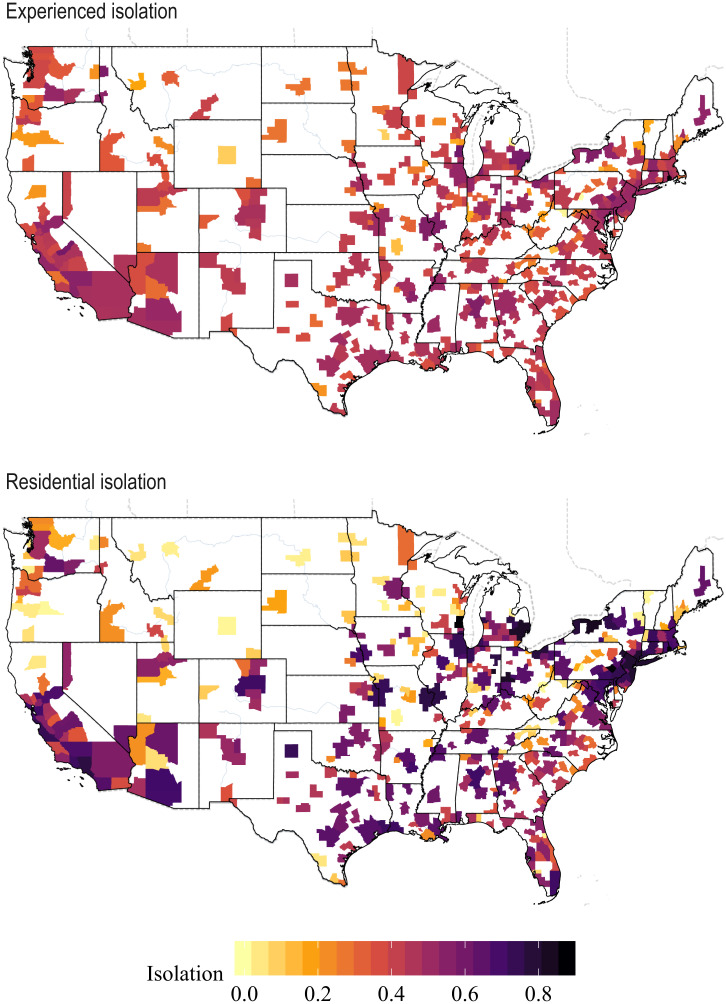
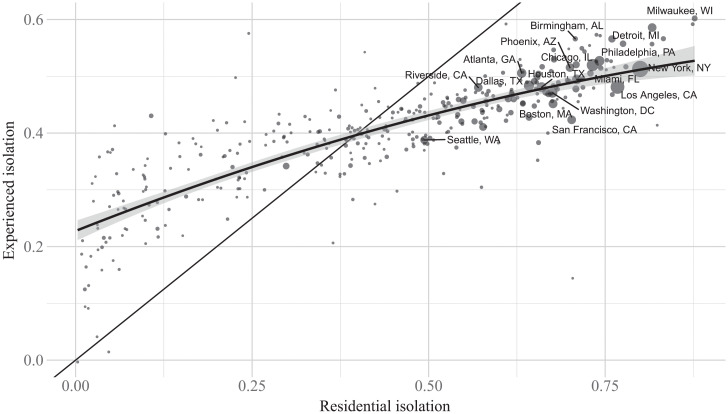
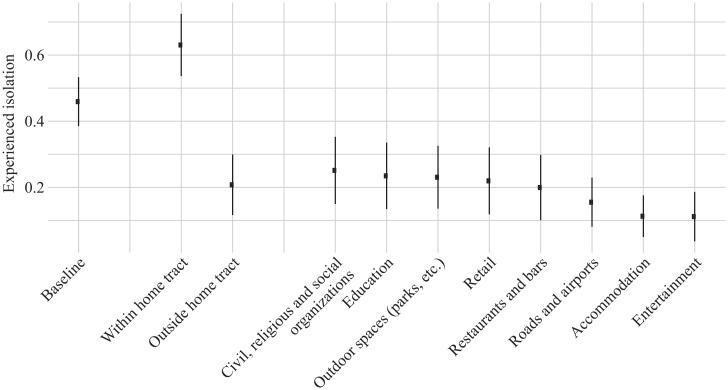
Significance: Racial segregation shapes key aspects of a healthy society, including educational development, psychological well-being, and economic mobility. As such, a large literature has formed to measure segregation. Estimates of racial segregation often rely on assumptions of uniform interaction within some fixed time and geographic space despite the dynamic nature of urban environments. We leverage Global Positioning System data to estimate a measure of segregation that relaxes these strict assumptions. Experienced segregation according to our measure is substantially lower than standard measures would suggest. By decomposing segregation by functions of a city, like entertainment, restaurants, and retail, we facilitate targeted policy making where segregation matters most.
Overview
The claims and statistics of this paper haven’t been checked yet.
Free: it reads the open-access text and checks the first 5 claims that cite a source we can check. Create a free account to check every claim.
Integrity signals
Registry
Cites
Statistics
Figures
Verification
Claims the paper makes
The claims and statistics of this paper haven’t been checked yet.
Free: it reads the open-access text and checks the first 5 claims that cite a source we can check. Create a free account to check every claim.
Claims other papers make about this one
Each is checked against this paper’s own text: does it say what the citing paper says it does?
The cited source says what the claim attributes to it.
In the citing paper
“While mobility has the potential to reinforce segregation, it can also connect diverse communities and facilitate interactions between residents from various neighborhoods (Athey et al. 2021;Candipan et al. 2021).”
From Visitation patterns across mobility groups: wandering, commuting, and exploring (2026) · cites this paper as Athey et al. 2021
Self-check
Percentages, sums and reported differences re-computed from the paper’s own numbers.
The self-check needs the paper’s full text.
Citations
Cites
Bowling alone: the collapse and revival of American community
(2000) · Choice Reviews Online · doi:10.5860/choice.38-2454 · Cited by 28,789
The Death and Life of Great American Cities
Row, A. T., & Jacobs, J. (1962) · The Yale Law Journal · doi:10.2307/794509 · Cited by 9,083
The Death and Life of Great American Cities
Jacobs, J. (2015) · Readings in Planning Theory · doi:10.1002/9781119084679.ch4 · Cited by 8,033
American Apartheid: Segregation and the Making of the Underclass.
Fernandez, R. M., Massey, D. S., & Denton, N. A. (1993) · Contemporary Sociology · doi:10.2307/2074502 · Cited by 6,193
Bowling Alone: The Collapse and Revival of American Community
Galston, W. A. (2001) · Journal of Policy Analysis and Management · doi:10.1002/pam.1035 · Cited by 3,897
The Dimensions of Residential Segregation
Massey, D. S., & Denton, N. A. (1988) · Social Forces · doi:10.1093/sf/67.2.281 · Cited by 3,483
American Apartheid: Segregation and the Making of the Underclass.
John, C. S., MASSEY, D. S., & Denton, N. A. (1994) · Social Forces · doi:10.1093/sf/73.1.358 · Cited by 2,788
American Apartheid: Segregation and the Making of the Underclass.
John, C. S., Massey, D. S., & Denton, N. A. (1994) · Social Forces · doi:10.2307/2579960 · Cited by 2,722
A Methodological Analysis of Segregation Indexes
Duncan, O. D., & Duncan, B. (1955) · American Sociological Review · doi:10.2307/2088328 · Cited by 2,554
Chetty, R., Hendren, N., & Katz, L. F. (2016) · American Economic Review · doi:10.1257/aer.20150572 · Cited by 2,315
Cited by
Items 101–160 of 160
Beyond residential terms: Estimating racial segregation in daily environments in the United States
Vachuska, K. F. (2024) · Social Sciences & Humanities Open · doi:10.1016/j.ssaho.2024.101138 · Cited by 1
Neighbors and visitors: impact of diversity on attitudes toward migrants
Hołubowska, O., Dementeva, D., & Poorthuis, A. (2025) · Ethnic and Racial Studies · doi:10.1080/01419870.2025.2539907 · Cited by 1
Deojain, S., & Lindequist, D. (2019) · European Economic Review · doi:10.1016/j.euroecorev.2026.105416 · Cited by 1
Device Tracking Privacy Regulations Lead to Unexpected Data Bias in Smartphone Trace DataPreprint
Bella, G., Dai, T., Kivestu, P., Nie, M., & Stathopoulos, A. (2024) · SSRN Electronic Journal · doi:10.2139/ssrn.4868119 · Cited by 1
Workplace Segregation between College and Non-college Workers
Dillon, F., Glaeser, E. L., & Kerr, W. R. (2025) · National Bureau of Economic Research · doi:10.3386/w33653 · Cited by 1
Opening Hours and Consumer Behavior: Evidence from GPS Data and DeregulationPreprint
Donna, J. D., Hinnosaar, M., Hinnosaar, T., & Trindade, A. (2025) · SSRN Electronic Journal · doi:10.2139/ssrn.5339594 · Cited by 1
Deconstructing Mobility Segregation: A Network Analysis of Racialized Flows in Pandemic-Era NYCPreprint
Nie, W., Ding, T.-R., Yan, X.-Y., Zhou, T., & Gao, Z.-Y. (2025) · arXiv (Cornell University) · doi:10.48550/arxiv.2508.17072 · Cited by 1
Planning for isolation? The role of urban form and function in shaping mobility in BrasiliaPreprint
Renninger, A. (2026) · arXiv (Cornell University) · doi:10.48550/arxiv.2603.10657 · Cited by 1
Visitation patterns across mobility groups: wandering, commuting, and exploring
Hołubowska, O., Smolak, K., Brum-Bastos, V., & Sila-Nowicka, K. (2026) · Journal of Geographical Systems · doi:10.1007/s10109-026-00501-x
The 15-Minute City Quantified Using Mobility DataPreprint
Abbiasov, T., Heine, C., Glaeser, E. L., Ratti, C., Sabouri, S., Miranda, A. S., & Santi, P. (2022) · arXiv (Cornell University) · doi:10.48550/arxiv.2211.14872
Caruso, H. M. (2023) · Social and Personality Psychology Compass · doi:10.1111/spc3.12848
Hopes and dreams for (future) better things: Medium, data, and ideas
Wolf, L. J., & Arribas‐Bel, D. (2024) · Environment and Planning B Urban Analytics and City Science · doi:10.1177/23998083241249551
Out‐of‐area home purchase and U.S. internal migration
Li, M., Liu, P., & Tang, C. (2024) · Journal of Regional Science · doi:10.1111/jors.12730
Neighborhood mismatch and visits
Lim, J. Z., & Shen, L. (2026) · Regional Science and Urban Economics · doi:10.2139/ssrn.5074990
McDaniel, T. W. (2025) · Socius Sociological Research for a Dynamic World · doi:10.1177/23780231251322006
Gauvin, L., & Randon‐Furling, J. (2025) · Understanding complex systems · doi:10.1007/978-3-031-82666-5_7
Estimating the Economic Cost of Floods: Evidence from Urban Mobility and Rental MarketsPreprint
Zheng, S., Lee, S., & Xibo, W. A. N. (2025) · SSRN Electronic Journal · doi:10.2139/ssrn.5502768
How transport systems create opportunities for social interactionPreprint
Manley, E., Yang, Y., Liu, E., & Jia, B. (2025) · Research Square · doi:10.21203/rs.3.rs-6716648/v1
The Influence of Neighborhood Design on the Sustainability of US SuburbsPreprint
Miranda, A. S. (2025) · arXiv (Cornell University) · doi:10.48550/arxiv.2511.13544
Additional file 1 of Amenity complexity and urban locations of socio-economic mixing
Juhász, S., Pintér, G., Kovács, Á. J., Borza, E. M., Mónus, G., Lőrincz, L., & Lengyel, B. (2023) · Figshare · doi:10.6084/m9.figshare.24098176
Essays in the Economics of Crime and Policing
Zhuo, Y. (2024) · eScholarship (California Digital Library)
Essays in Labor and Public Economics
Goldman, B. (2024) · Digital Access to Scholarship at Harvard (DASH) (Harvard University)
Intergroepexposure in tijd en ruimte Een kwantitatieve analyse van segregatie in activiteitenruimten
Holubowska, O. (2025) · Lirias (KU Leuven)
A Behavior-Informed and Geo-Context-Aware Home Detection Framework for Mobile Phone Positioning Data
Song, Y., Xiong, M., Zeng, X., & Zhu, D. (2025) · ACM SIGSPATIAL International Conference on Advances in Geographic Information Systems (SIGSPATIAL GIS) · doi:10.1145/3748636.3764171
A Relational Model of Neighborhood Mobility: The Role of Amenities and Cultural AlignmentPreprint
Silva, T. H., Silver, D., Santos, G., & Delgado, M. (2025) · arXiv (Cornell University) · doi:10.48550/arxiv.2512.11662
Promoting sustainable human mobility for income segregation mitigation
Chen, Y., Liao, C., Cai, Z., Wanru, W., Xia, Y., Chen, X. M., Wu, J., & Gao, Z. (2026) · Patterns · doi:10.1016/j.patter.2025.101477
Chen, L., Kunjie, C. A. I., & Zhao, Z.-D. (2026) · Physica A Statistical Mechanics and its Applications · doi:10.1016/j.physa.2026.131473
Public transport in the 15-minute cityPreprint
Zádor, Z., Pintér, G., Mizsák, M., Kovács, B., Felde, I., & Lengyel, B. (2026) · arXiv (Cornell University) · doi:10.48550/arxiv.2604.00699
Jin, C., Park, S., Lim, S., & Kim, J. (2026) · Applied Geography · doi:10.1016/j.apgeog.2026.104050
Unraveling structural and behavioral drivers of income segregation in daily urban mobility
Li, W., & Wang, Q. (2026) · Cities · doi:10.1016/j.cities.2026.107213
Empirical Trajectory Sparsity Biases Mobility-Informed Epidemic ModelingPreprint
Liao, Y. J., Delussu, F., Barreras, F., Alessandretti, L., & Watts, D. J. (2026) · Research Square · doi:10.21203/rs.3.rs-11088701/v1
Enhancing the Socioeconomic Understanding of Foundation Models with Urban MobilityPreprint
Guo, B., Li, D., Hong, Z., Sun, K., Huang, H., Prakash, A., & Wang, S. (2026) · arXiv (Cornell University) · doi:10.48550/arxiv.2606.01745 · Cited by 1
Neighbourhood design and the environmental and social costs of suburbanization
Miranda, A. S. (2026) · Nature Sustainability · doi:10.1038/s41893-026-01842-7
Where diverse populations gather: transit accessibility and the spatial structure of social mixing
Liao, Y. (2026) · Frontiers in Big Data · doi:10.3389/fdata.2026.1857064
Perceiving exposure segregation with open urban imageryPreprint
Zhang, Y., Ma, R., Zhang, X., Shang, Y., Xu, F., Xia, T., & Li, Y. (2026) · arXiv (Cornell University) · doi:10.48550/arxiv.2606.21858
Leveling Down: Competition and Discrimination in Service MarketsPreprint
Donkor, K. (2026) · SSRN Electronic Journal · doi:10.2139/ssrn.7156438
Built environment constraints on well-being in resource-based cities
Shuo, L., Yang, F.-C., Yu, J., & Zhang, W. (2026) · Building and Environment · doi:10.1016/j.buildenv.2026.115104
Economic Distance Structures Urban Mobility in 109 U.S. CitiesPreprint
Nie, W., Yan, X.-Y., Jia, B., Zhou, F., Liu, E., Zhou, T., & Gao, Z.-Y. (2026) · arXiv (Cornell University) · doi:10.48550/arxiv.2608.12180
The Isolation index and variations on relative exposure
de la Vega, C. L., & Volij, O. (2026) · Journal of Economic Theory · doi:10.1016/j.jet.2026.106229
Wang, G. (2026) · PhilPapers (PhilPapers Foundation) · doi:10.17613/3amkv-gav11
Zhang, M., Wu, Y., Li, Q., Cao, P., & Shen, T. (2026) · Computers Environment and Urban Systems · doi:10.1016/j.compenvurbsys.2026.102514
The scales of urban mobility shape socioeconomic mixingPreprint
Renninger, A., Kotov, E., & Cabrera-Arnau, C. (2026) · arXiv (Cornell University) · doi:10.48550/arxiv.2608.28734
Behavioral calibration of mobile-phone GPS data for population-representative analysesPreprint
Girardini, N. A., Kan, U., López, E., Lepri, B., Lucchini, L., & Centellegher, S. (2026) · arXiv (Cornell University) · doi:10.48550/arxiv.2609.01042
人の流れの規則性とゆらぎから考える都市の多様性とウェルビーイング
Shibuya, Y. (2025) · Institutional Repositories DataBase (IRDB) · doi:10.15083/0002014177
Revealing exacerbated socioeconomic stratification of urban mobility: A case study in Beijing, China
Chen, L., Chen, M., Li, W., Han, M., Xu, X., Tang, S., & Jiang, H. (2026) · Computers Environment and Urban Systems · doi:10.1016/j.compenvurbsys.2026.102529
Measuring Racial Disparities in Police Stops: Evidence from Telemetric Mobility Data
Gong, X., Han, Y., Parker, S., Ross, M. B., & Ross, S. L. (2026) · National Bureau of Economic Research · doi:10.3386/w35727
Experienced partisan segregation across patterns of mobility behavior in US citiesPreprint
Tonin, M., Tizzoni, M., Lepri, B., & Moro, E. (2026) · arXiv (Cornell University) · doi:10.48550/arxiv.2609.19285
Langle-Chimal, O., Cadavid-Aguilar, N., Meouchi-Vélez, A., & Ponce‐Lopez, R. (2026) · Frontiers in Big Data · doi:10.3389/fdata.2026.1942458
The role of social connections in the racial segregation of US cities
Diemer, A., Regan, T., & Tang, C. K. (2026) · Journal of Economic Geography · doi:10.1093/jeg/lbag060
Opening Hours and Consumer Behavior: Evidence From GPS Data and Deregulation
Donna, J. D., Hinnosaar, M., Hinnosaar, T., & Trindade, A. (2026) · Journal of Industrial Economics · doi:10.1111/joie.70047
瀧川, 裕. (2025) · Japanese Sociological Review · doi:10.4057/jsr.76.230
Who Marries Whom? The Role of Segregation by Race and Class
Goldman, B., Gracie, J., & Porter, S. R. (2026) · American Economic Review · doi:10.1257/aer.20250115
Mitigator or generator? A systematic review of how public transport shapes social segregation
Xie, S., Kamruzzaman, L., & Delbosc, A. (2026) · Transport Reviews · doi:10.1080/01441647.2026.2740072
Recommendation Feedback Loops Shape Urban Income Segregation and Venue VisitationPreprint
Weng, G., Chen, L., Beneduce, C., Mauro, G., Luca, M., Yabe, T., Lepri, B., Pappalardo, L., & Moro, E. (2026) · arXiv (Cornell University) · doi:10.48550/arxiv.2610.41911
Hołubowska, O., Siła-Nowicka, K., Chuang, I.-T., & Poorthuis, A. (2026) · Annals of the American Association of Geographers · doi:10.1080/24694452.2026.2740623
Wang, B., Sevtsuk, A., & Basu, R. (2026) · PNAS Nexus · doi:10.1093/pnasnexus/pgag341
Zhang, M., & Zhang, R. (2026) · Cities · doi:10.1016/j.cities.2026.107761
Metadata
- Authors
- Athey, S., Ferguson, B., Gentzkow, M., & Schmidt, T.
- Affiliations
- National Bureau of Economic Research (US)
- Stanford University (US)
- Corresponding author
- Athey, Susan
- Venue
- Proceedings of the National Academy of Sciences
- Publisher
- National Academy of Sciences
- Published
- 2021-11-10
- Volume
- 118
- Issue
- 46
- ISSN
- 0027-8424 (ISSN-L)
- 1091-6490
- PMC
- PMC8609621
- OpenAlex
- W3214435327
- Cited by
- 124
- References
- 53
- Citations by year
- 2026: 27 · 2025: 39 · 2024: 30 · 2023: 18 · 2022: 8
- FWCI
- 19.39
- Type
- journal article
- Language
- en
- Open access
- hybrid
- doi.org
- Licence
- Locations
- Proceedings of the National Academy of Sciences (publishedVersion, cc-by)
- PubMed Central (publishedVersion, cc-by)
- PubMed (publishedVersion)
- RePEc: Research Papers in Economics (submittedVersion)
- Funders
- Stanford Institute of Economic Policy Research (Research Assistant Funding)
- Topics
- Social Sciences › Sociology and Political Science › Urban, Neighborhood, and Segregation Studies
- Social Sciences › Transportation › Human Mobility and Location-Based Analysis
- Social Sciences › Transportation › Urban Transport and Accessibility
- Keywords
- racial segregation, residential isolation, GPS data, smartphone location data, urban diversity, public transport, income mobility, urban density, urban education, American cities
- MeSH terms
- Social Segregation, Cities, Humans, Residence Characteristics, Socioeconomic Factors, United States, Urban Population, Geographic Information Systems
About these checks
Registry, retraction, Cites and statistics results are computed, not judged, with one exception: a printed reference that no index lists is read once by a model before it counts as a citation error. Claims are extracted by a model and kept only when their quote appears verbatim in the text; each cited source is then checked, with a model’s help, for whether it says what the claim relies on. Those verdicts can be wrong — read the claim’s quote and the cited source before relying on one.
Statistics and arithmetic are recomputed, not judged.
Confidence bands are shown only for fields calibrated on our annotated test set. None is calibrated yet, so no band is shown.
What counts as a claim ›How we measure confidence ›How we check this ›
Are you an author, or do you see a problem with this page? Request a review
Data sources
Bibliographic data: Semantic Scholar, OpenAlex, Crossref.
Contains information from the Semantic Scholar Academic Graph Datasets, made available under the ODC Attribution License (ODC-BY 1.0).
Semantic Scholar’s data is described in: Kinney, R., et al. (2023). The Semantic Scholar Open Data Platform. arXiv:2301.10140.
