

Estimating experienced racial segregation in US cities using large-scale GPS data
Open accessThe DOI matches its Crossref record; 55 of the 55 references it cites were found in a registry or an index.
Abstract
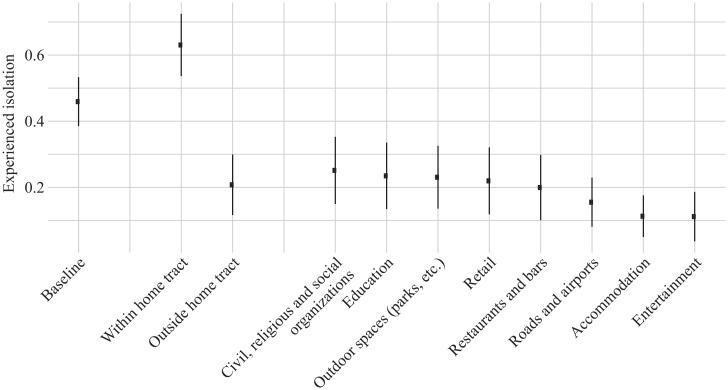
Significance: Racial segregation shapes key aspects of a healthy society, including educational development, psychological well-being, and economic mobility. As such, a large literature has formed to measure segregation. Estimates of racial segregation often rely on assumptions of uniform interaction within some fixed time and geographic space despite the dynamic nature of urban environments. We leverage Global Positioning System data to estimate a measure of segregation that relaxes these strict assumptions. Experienced segregation according to our measure is substantially lower than standard measures would suggest. By decomposing segregation by functions of a city, like entertainment, restaurants, and retail, we facilitate targeted policy making where segregation matters most.
Overview
The claims and statistics of this paper haven’t been checked yet.
Free: it reads the open-access text and checks the first 5 claims that cite a source we can check. Create a free account to check every claim.
Integrity signals
Registry
Cites
Statistics
Figures
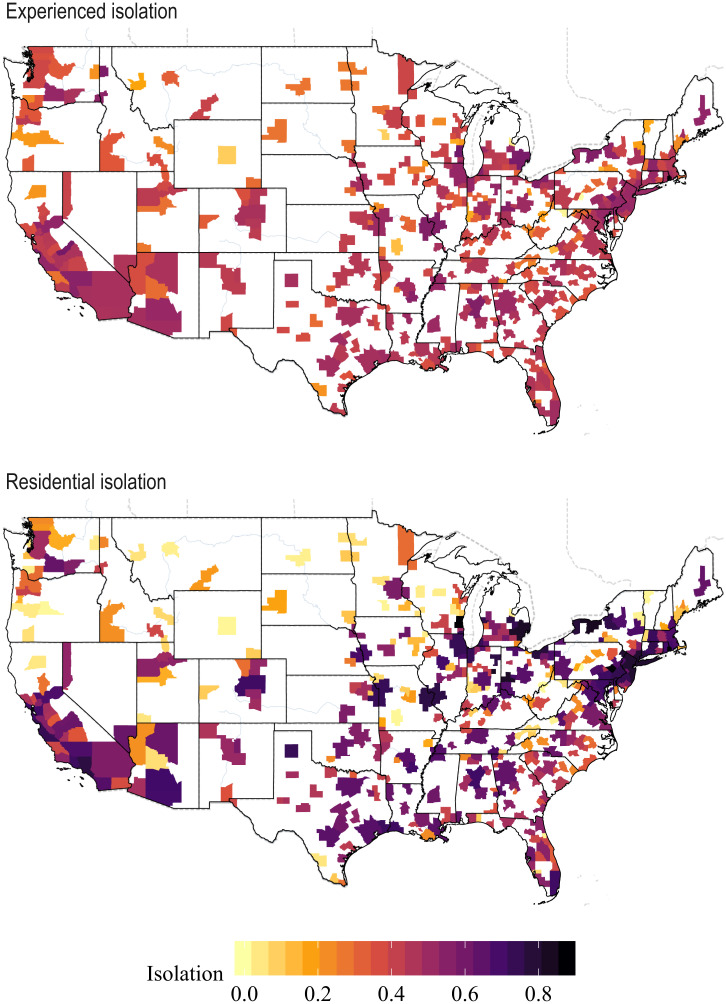
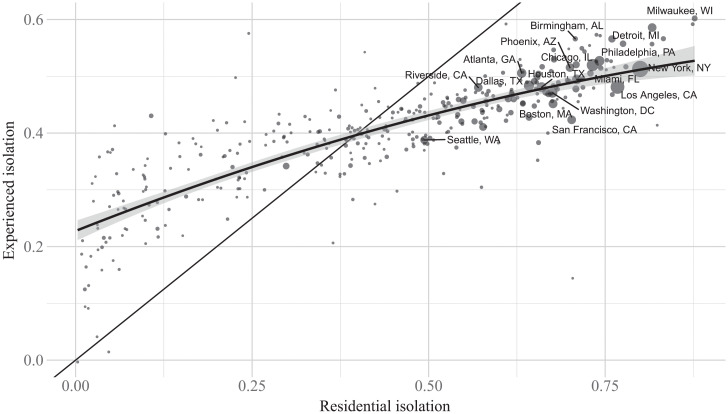
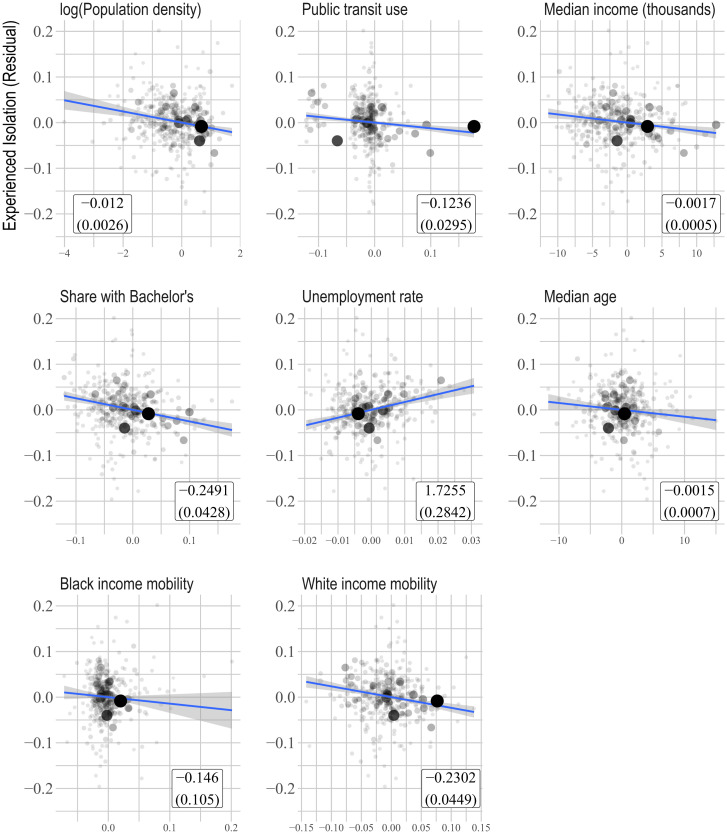
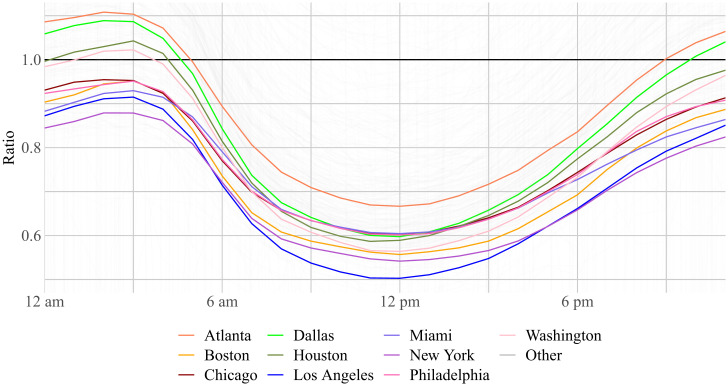
Verification
Claims the paper makes
The claims and statistics of this paper haven’t been checked yet.
Free: it reads the open-access text and checks the first 5 claims that cite a source we can check. Create a free account to check every claim.
Claims other papers make about this one
Each is checked against this paper’s own text: does it say what the citing paper says it does?
The cited source says what the claim attributes to it.
In the citing paper
“While mobility has the potential to reinforce segregation, it can also connect diverse communities and facilitate interactions between residents from various neighborhoods (Athey et al. 2021;Candipan et al. 2021).”
From Visitation patterns across mobility groups: wandering, commuting, and exploring (2026) · cites this paper as Athey et al. 2021
Self-check
Percentages, sums and reported differences re-computed from the paper’s own numbers.
The self-check needs the paper’s full text.
Citations
Cites
Bowling alone: the collapse and revival of American community
(2000) · Choice Reviews Online · doi:10.5860/choice.38-2454 · Cited by 28,789
The Death and Life of Great American Cities
Row, A. T., & Jacobs, J. (1962) · The Yale Law Journal · doi:10.2307/794509 · Cited by 9,083
The Death and Life of Great American Cities
Jacobs, J. (2015) · Readings in Planning Theory · doi:10.1002/9781119084679.ch4 · Cited by 8,033
American Apartheid: Segregation and the Making of the Underclass.
Fernandez, R. M., Massey, D. S., & Denton, N. A. (1993) · Contemporary Sociology · doi:10.2307/2074502 · Cited by 6,193
Bowling Alone: The Collapse and Revival of American Community
Galston, W. A. (2001) · Journal of Policy Analysis and Management · doi:10.1002/pam.1035 · Cited by 3,897
The Dimensions of Residential Segregation
Massey, D. S., & Denton, N. A. (1988) · Social Forces · doi:10.1093/sf/67.2.281 · Cited by 3,483
American Apartheid: Segregation and the Making of the Underclass.
John, C. S., MASSEY, D. S., & Denton, N. A. (1994) · Social Forces · doi:10.1093/sf/73.1.358 · Cited by 2,788
American Apartheid: Segregation and the Making of the Underclass.
John, C. S., Massey, D. S., & Denton, N. A. (1994) · Social Forces · doi:10.2307/2579960 · Cited by 2,722
A Methodological Analysis of Segregation Indexes
Duncan, O. D., & Duncan, B. (1955) · American Sociological Review · doi:10.2307/2088328 · Cited by 2,554
Chetty, R., Hendren, N., & Katz, L. F. (2016) · American Economic Review · doi:10.1257/aer.20150572 · Cited by 2,315
Cited by
Allcott, H., Boxell, L., Conway, J., Gentzkow, M., Thaler, M., & Yang, D. (2020) · Journal of Public Economics · doi:10.1016/j.jpubeco.2020.104254 · Cited by 999
Self-citationThe 15-minute city quantified using human mobility data
Abbiasov, T., Heine, C., Sabouri, S., Miranda, A. S., Santi, P., Glaeser, E. L., & Ratti, C. (2024) · Nature Human Behaviour · doi:10.1038/s41562-023-01770-y · Cited by 233
Human mobility networks reveal increased segregation in large cities
Nilforoshan, H., Looi, W., Pierson, E., Villanueva, B., Fishman, N., Chen, Y., Sholar, J., Redbird, B., Grusky, D., & Leskovec, J. (2023) · Nature · doi:10.1038/s41586-023-06757-3 · Cited by 162
“This approach, to our knowledge, provides the highest-resolution measure of exposure to date, compared with previous GPS-based studies 30,31,39 .”
BackgroundMethodResultInfluentialUsing human mobility data to quantify experienced urban inequalities
Xu, F., Wang, Q., Moro, E., Chen, L., Miranda, A. S., González, M. C., Tizzoni, M., Song, C., Ratti, C., Bettencourt, L. M. A., et al. (2025) · Nature Human Behaviour · doi:10.1038/s41562-024-02079-0 · Cited by 120
Behavioral changes during the COVID-19 pandemic decreased income diversity of urban encounters
Yabe, T., Bueno, B. G. B., Dong, X., Pentland, A., & Moro, E. (2023) · Nature Communications · doi:10.1038/s41467-023-37913-y · Cited by 109
Socio-spatial segregation and human mobility: A review of empirical evidence
Liao, Y. J., Gil, J., Yeh, S., Pereira, R. H. M., & Alessandretti, L. (2025) · Computers Environment and Urban Systems · doi:10.1016/j.compenvurbsys.2025.102250 · Cited by 85
JUE Insight: Urban flight seeded the COVID-19 pandemic across the United States
Coven, J., Gupta, A., & Yao, I. (2022) · Journal of Urban Economics · doi:10.1016/j.jue.2022.103489 · Cited by 75
Ellis‐Soto, D., Chapman, M., & Locke, D. H. (2023) · Nature Human Behaviour · doi:10.1038/s41562-023-01688-5 · Cited by 71
The Economics of Spatial Mobility: Theory and Evidence Using Smartphone Data
Miyauchi, Y., Nakajima, K., & Redding, S. J. (2025) · The Quarterly Journal of Economics · doi:10.1093/qje/qjaf038 · Cited by 59
Diversity beyond density: Experienced social mixing of urban streets
Fan, Z., Su, T., Sun, M., Noyman, A., Zhang, F., Pentland, A., & Moro, E. (2023) · PNAS Nexus · doi:10.1093/pnasnexus/pgad077 · Cited by 54
Big mobility data reveals hyperlocal air pollution exposure disparities in the Bronx, New York
Testi, I., Wang, A., Paul, S., Mora, S., Walker, E., Nyhan, M., Duarte, F., Santi, P., & Ratti, C. (2024) · Nature Cities · doi:10.1038/s44284-024-00093-x · Cited by 51
The Universal Neighborhood Effect Averaging in Mobility-Dependent Environmental Exposures
Cai, J., & Kwan, M. (2024) · Environmental Science & Technology · doi:10.1021/acs.est.4c02464 · Cited by 45
Urban highways are barriers to social ties
Aiello, L. M., Vybornova, A., Juhász, S., Szell, M., & Bokányi, E. (2025) · Proceedings of the National Academy of Sciences · doi:10.1073/pnas.2408937122 · Cited by 44
Towards a new paradigm for segregation measurement in an age of big data
Li, Q., Yue, Y., Gao, Q., Zhong, C., & Barros, J. (2022) · Urban Informatics · doi:10.1007/s44212-022-00003-3 · Cited by 42
Measuring spatial age segregation through the lens of co-accessibility to urban activities
Milias, V., & Psyllidis, A. (2022) · Computers Environment and Urban Systems · doi:10.1016/j.compenvurbsys.2022.101829 · Cited by 37
Urban mobility and the experienced isolation of students
Cook, C., Currier, L., & Glaeser, E. L. (2024) · Nature Cities · doi:10.1038/s44284-023-00007-3 · Cited by 36
Browning, C. R., Tarrence, J. A., Calder, C. A., Pinchak, N. P., & Boettner, B. L. (2022) · American Journal of Sociology · doi:10.1086/721666 · Cited by 36
Amenity complexity and urban locations of socio-economic mixing
Juhász, S., Pintér, G., Kovács, Á. J., Borza, E. M., Mónus, G., Lőrincz, L., & Lengyel, B. (2023) · EPJ Data Science · doi:10.1140/epjds/s13688-023-00413-6 · Cited by 33
Using graph neural networks to predict local culture
Silva, T. H., & Silver, D. L. (2024) · Environment and Planning B Urban Analytics and City Science · doi:10.1177/23998083241262053 · Cited by 30
Zhang, Y., Cheng, S., Li, Z., & Jiang, W. (2023) · Scientific Reports · doi:10.1038/s41598-023-36946-z · Cited by 27
How people are exposed to neighborhoods racially different from their own
de la Prada, À. G., & Small, M. L. (2024) · Proceedings of the National Academy of Sciences · doi:10.1073/pnas.2401661121 · Cited by 22
Wu, M., Liu, X., Qin, Y., & Huang, Q. (2023) · Computers Environment and Urban Systems · doi:10.1016/j.compenvurbsys.2023.102008 · Cited by 21
Urban segregation on multilayered transport networks: a random walk approach
Neira, M., Molinero, C., Marshall, S., & Arcaute, E. (2024) · Scientific Reports · doi:10.1038/s41598-024-58932-9 · Cited by 21
Cheng, S., Zhang, Y., & Shaw, J. (2025) · RSF The Russell Sage Foundation Journal of the Social Sciences · doi:10.7758/rsf.2025.11.1.07 · Cited by 21
Rubbing shoulders: Class segregation in daily activities
Massenkoff, M., & Wilmers, N. (2025) · Journal of Public Economics · doi:10.1016/j.jpubeco.2025.105335 · Cited by 22
The effect of limited mobility on the experienced segregation of foreign-born minorities
Liao, Y. J., Gil, J., Yeh, S., Pereira, R. H. M., & Alessandretti, L. (2025) · npj Sustainable Mobility and Transport · doi:10.1038/s44333-025-00046-4 · Cited by 21
Transport Infrastructure and Policy Evaluation
Donaldson, D. (2025) · Handbook of regional and urban economics · doi:10.1016/bs.hesreg.2025.06.004 · Cited by 22
Redding, S. J. (2024) · National Bureau of Economic Research · doi:10.3386/w33130 · Cited by 21
Cai, L., Browning, C. R., & Cagney, K. A. (2024) · Social Forces · doi:10.1093/sf/soae021 · Cited by 19
China’s commuting-based metropolitan areas
Chen, T., Gu, Y., & Zou, B. (2024) · Journal of Urban Economics · doi:10.1016/j.jue.2024.103715 · Cited by 19
The role of urban amenities in facilitating social mixing: Evidence from Stockholm
Heine, C., Abbiasov, T., Santi, P., & Ratti, C. (2024) · Landscape and Urban Planning · doi:10.1016/j.landurbplan.2024.105250 · Cited by 19
New Data and Insights in Regional and Urban Economics
Abramitzky, R., Boustan, L. P., & Storeygard, A. (2025) · National Bureau of Economic Research · doi:10.3386/w33561 · Cited by 19
Loo, B. P. Y., Fan, Z., & Moro, E. (2024) · Humanities and Social Sciences Communications · doi:10.1057/s41599-024-03963-w · Cited by 18
Chen, C., Wang, Q., Bansal, P., Chen, L., Uğurel, E., Zhang, Y., & Wu, X. (2025) · Transportation Research Part C Emerging Technologies · doi:10.1016/j.trc.2025.105416 · Cited by 18
Measuring and Modeling Neighborhoods
McCartan, C., Brown, J., & Imai, K. (2024) · American Political Science Review · doi:10.1017/s0003055423001429 · Cited by 18
The unequal connectivity of parks and tree canopy in 10 U.S. cities
Stuhlmacher, M., & Kim, Y. (2024) · Urban forestry & urban greening · doi:10.1016/j.ufug.2024.128332 · Cited by 17
Heterogeneous Preferences for Neighborhood Amenities: Evidence from GPS Data
Cook, C. (2025) · The Review of Economics and Statistics · doi:10.1162/rest_a_01551 · Cited by 17
Health Care Disparities in Pulmonary Arterial Hypertension
Bernardo, R. J., & Pérez, V. D. J. (2023) · Clinics in Chest Medicine · doi:10.1016/j.ccm.2023.03.010 · Cited by 15
Zhang, Y., Luo, F., & Dai, Y. (2025) · Habitat International · doi:10.1016/j.habitatint.2025.103430 · Cited by 15
US cities are defined by rings and pockets with limited socioeconomic mixing
Renninger, A., O’Clery, N., & Arcaute, E. (2025) · Nature Cities · doi:10.1038/s44284-025-00350-7 · Cited by 16
Demographic Preferences and Income SegregationPreprint
Couture, V., Dingel, J. I., Green, A., & Handbury, J. (2025) · SSRN Electronic Journal · doi:10.2139/ssrn.5112650 · Cited by 14
Quantifying barriers of urban mobility
Pintér, G., & Lengyel, B. (2025) · Cities · doi:10.1016/j.cities.2025.106322 · Cited by 13
Resilience of racialized segregation is an ecological factor: Baltimore case study
Pickett, S. T. A., Grove, J. M., Boone, C. G., & Buckley, G. L. (2023) · Buildings and Cities · doi:10.5334/bc.317 · Cited by 13
Sekara, V., Karsai, M., Moro, E., Kim, D., Delamónica, E., Cebrián, M., Luengo-Oroz, M. A., Jiménez, R. M., & García–Herranz, M. (2024) · Advances in Complex Systems · doi:10.48550/arxiv.2307.01891 · Cited by 12
Su, R., Newsham, N., & Dodge, S. (2024) · Computers Environment and Urban Systems · doi:10.1016/j.compenvurbsys.2024.102203 · Cited by 11
An experienced racial-ethnic diversity dataset in the United States using human mobility data
Xu, W., Wang, Z., Attia, N., Attia, Y., Zhang, Y., & Zong, H. (2024) · Scientific Data · doi:10.1038/s41597-024-03490-y · Cited by 11
Life Space and Activity Space Measurement: Making “Room” for Structural Racism
Szanton, S. L., Alexander, K. A., Kim, B., Li, Q., Gee, G. C., Bandeen‐Roche, K., Adkins‐Jackson, P. B., Hladek, M. D., Samuel, L. J., Haozous, E. A., et al. (2023) · The Gerontologist · doi:10.1093/geront/gnad160 · Cited by 10
Redding, S. J. (2025) · Handbook of regional and urban economics · doi:10.1016/bs.hesreg.2025.06.007 · Cited by 10
Political Consumerism and the Emergence of Rare Information on User-Generated Content Platforms
Ananthakrishnan, U. M., Xu, X., Mitkina, M., & Tan, Y. (2025) · Management Science · doi:10.1287/mnsc.2023.02789 · Cited by 10
Disparities in COVID-19 risk exposure: Evidence from geolocation data
Almagro, M., Coven, J., Gupta, A., & Orane-Hutchinson, A. (2023) · Regional Science and Urban Economics · doi:10.1016/j.regsciurbeco.2023.103933 · Cited by 10
Bank Branch Access: Evidence from Geolocation Data
Sakong, J., & Zentefis, A. (2023) · doi:10.21033/wp-2023-15 · Cited by 10
Visitation patterns reveal service access disparities for ageing populations in the USA
Han, Y., Liao, P., Li, W., & Wang, Q. (2025) · Nature Human Behaviour · doi:10.1038/s41562-025-02285-4 · Cited by 9
Yu, Y., Wang, Y., Zhang, Y., Qu, H., & Liu, D. (2025) · IEEE Transactions on Visualization and Computer Graphics · doi:10.1109/tvcg.2025.3567117 · Cited by 9
Zhou, Y., & Lü, Y. (2025) · Nature Communications · doi:10.1038/s41467-025-66585-z · Cited by 8
Spaces of Encounter: The Relationship Between Amenities and Visitor Diversity
Hołubowska, O., & Poorthuis, A. (2024) · Population Space and Place · doi:10.1002/psp.2879 · Cited by 8
Toward multidimensional activity space-based segregation research
Ta, N. (2023) · Transactions in Planning and Urban Research · doi:10.1177/27541223231164781 · Cited by 8
Urban Mobility and the Experienced Isolation of Students
Cook, C., Currier, L., & Glaeser, E. L. (2022) · National Bureau of Economic Research · doi:10.3386/w29645 · Cited by 8
What Drives Disparities in Bank Branch Use? A Geospatial AnalysisPreprint
Sakong, J., & Zentefis, A. (2023) · SSRN Electronic Journal · doi:10.2139/ssrn.4621778 · Cited by 8
Cai, L., Song, G., & Zhang, Y. (2024) · Humanities and Social Sciences Communications · doi:10.1057/s41599-024-02833-9 · Cited by 7
Complex systems for the most vulnerable
Omodei, E., García–Herranz, M., Paolotti, D., & Tizzoni, M. (2022) · Journal of Physics Complexity · doi:10.1088/2632-072x/ac60b1 · Cited by 8
Cities as Engines of Opportunities: Evidence from Brazil
Barza, R., Glaeser, E. L., Hidalgo, C. A., & Viarengo, M. G. (2024) · National Bureau of Economic Research · doi:10.3386/w32426 · Cited by 7
New data and insights in regional and urban economics
Abramitzky, R., Boustan, L., & Storeygard, A. (2025) · Handbook of regional and urban economics · doi:10.1016/bs.hesreg.2025.05.001 · Cited by 6
Experienced economic segregation and associated mental health inequalities across urbanicity
Zhou, Y., & Lü, Y. (2025) · Social Science & Medicine · doi:10.1016/j.socscimed.2025.118813 · Cited by 6
What Drives Disparities in Bank Branch Use? A Geospatial AnalysisPreprint
Sakong, J., & Zentefis, A. (2023) · SSRN Electronic Journal · doi:10.2139/ssrn.4349930 · Cited by 6
A visitor-enriched census in the U.S. cities using large-scale mobile positioning data
Xiong, M., Zhu, D., & Riper, D. C. V. (2025) · Scientific Data · doi:10.1038/s41597-025-05410-0 · Cited by 6
Fan, B., Chen, L., Li, S., Yuan, J., Xu, F., Hui, P., & Li, Y. (2025) · arXiv (Cornell University) · doi:10.48550/arxiv.2503.04773 · Cited by 6
The 15-Minute City Quantified Using Mobility DataPreprint
Abbiasov, T., Heine, C., Glaeser, E. L., Ratti, C., Sabouri, S., Miranda, A. S., & Santi, P. (2022) · SSRN Electronic Journal · doi:10.2139/ssrn.4306706 · Cited by 5
Measuring Local Consumption with Payment Cards and Cell Phone PingsPreprint
Klopack, B., & Luco, F. (2024) · SSRN Electronic Journal · doi:10.2139/ssrn.5053511 · Cited by 5
Who Marries Whom? The Role of Segregation by Race and Class
Goldman, B., Gracie, J., & Porter, S. R. (2026) · National Bureau of Economic Research · doi:10.3386/w35140 · Cited by 5
Urban transport systems shape experiences of social segregationPreprint
Yang, Y., Liu, E., Jia, B., & Manley, E. (2025) · arXiv (Cornell University) · doi:10.48550/arxiv.2505.16337 · Cited by 5
Beyond Distance: Mobility Neural Embeddings Reveal Visible and Invisible Barriers in Urban SpacePreprint
Weng, G., Kim, M., Ahn, Y., & Moro, E. (2025) · arXiv (Cornell University) · doi:10.48550/arxiv.2506.24061 · Cited by 5
Hidden patterns of urban mixing across five global cities
Fan, Z., Loo, B. P. Y., Duarte, F., Ratti, C., & Moro, E. (2026) · Nature Cities · doi:10.1038/s44284-026-00477-1 · Cited by 4
Mobility-Based Segregation in U.S. Metropolitan Areas
Zhang, Y., & Cheng, S. (2025) · Demography · doi:10.1215/00703370-12193739 · Cited by 4
Urban youth most isolated in largest cities
Couture, V. (2024) · Nature · doi:10.1038/d41586-023-04083-2 · Cited by 4
Segregation: What is in a Name? A Review of Segregation Measurement and a Prospective Framework
Wu, M., Wong, D. W. S., & Huang, Q. (2025) · Spatial Demography · doi:10.1007/s40980-025-00147-1 · Cited by 3
Behavioral responses to wildfire smoke: Insights from smartphone location data
Berestycki, C., & Chen, M. K. (2026) · Proceedings of the National Academy of Sciences · doi:10.1073/pnas.2527320123 · Cited by 3
Han, Y., Qiao, S., Yeh, A. G. O., & Zhang, X. (2026) · Journal of Transport Geography · doi:10.1016/j.jtrangeo.2026.104717 · Cited by 3
Causal inference and racial bias in policing: new estimands and the importance of mobility data
Huang, Z., Beck, B., & Antonelli, J. (2026) · Journal of the Royal Statistical Society Series A (Statistics in Society) · doi:10.1093/jrsssa/qnag013 · Cited by 3
Lutz, E., Heroy, S., Kaufmann, D., & O’Clery, N. (2025) · arXiv (Cornell University) · doi:10.48550/arxiv.2506.09311 · Cited by 3
Correcting temporal bias in mobility data using time-use surveysPreprint
Sanchez, S. A., Gibbs, H. P., Yabe, T., O'Brien, D. T., & Moro, E. (2026) · arXiv (Cornell University) · doi:10.48550/arxiv.2601.22330 · Cited by 3
Zhao, Y., Liu, Y., & Li, J. (2026) · Journal of Transport Geography · doi:10.1016/j.jtrangeo.2026.104658 · Cited by 2
Workplace Segregation between College and Noncollege Workers
Dillon, F., Glaeser, E. L., & Kerr, W. R. (2025) · AEA Papers and Proceedings · doi:10.1257/pandp.20251033 · Cited by 2
JUE Insight: Measuring local consumption with payment cards and cell phone pings
Klopack, B., & Luco, F. (2025) · Journal of Urban Economics · doi:10.1016/j.jue.2025.103798 · Cited by 2
Poorvahedi, E., & Smith‐Colin, J. (2026) · Journal of Urban Mobility · doi:10.1016/j.urbmob.2026.100188 · Cited by 2
Computational Approaches and the Future of Urban Crime Research
Campedelli, G. M., Jelveh, Z., Chalfin, A. J., Semenza, D. C., Piza, E. L., Zumel, A. A., Lepri, B., & Sharkey, P. T. (2026) · Nature · doi:10.1038/s41586-026-10622-4 · Cited by 2
Understanding Urban Economies, Land Use, and Social Dynamics in the City: Big Data and MeasurementPreprint
Sáiz, A., & Miranda, A. S. (2023) · SSRN Electronic Journal · doi:10.2139/ssrn.4597717 · Cited by 2
Duran-Sala, M., Balachandran, A. K., Morandini, M., Naushirvanov, T., Prabhakaran, A., Renninger, A., & Mazzoli, M. (2024) · arXiv (Cornell University) · doi:10.48550/arxiv.2407.01799 · Cited by 2
Measuring Local Consumption with Payment Cards and Cell Phone PingsPreprint
Klopack, B., & Luco, F. (2024) · SSRN Electronic Journal · doi:10.2139/ssrn.5055247 · Cited by 2
Due Diligence and the Allocation of Venture Capital
Fu, X., & Taylor, L. A. (2025) · National Bureau of Economic Research · doi:10.3386/w33987 · Cited by 2
Private space, public good: working together to deliver social infrastructure
Garling, O., Marks, R., & Craig, J. (2024) · Apollo (University of Cambridge) · doi:10.17863/cam.113146 · Cited by 2
Heat and experienced racial segregation
Baldenius, T., Klauber, H., & Koch, N. (2025) · Journal of Environmental Economics and Management · doi:10.1016/j.jeem.2025.103210 · Cited by 1
Towards Racial Housing Equity: The Role of CDBG Grants
Stokan, E., Overton, M., & Hatch, M. E. (2025) · Urban Affairs Review · doi:10.1177/10780874251359269 · Cited by 1
Switching exploration modes in human mobility
Zhong, L., Dong, L., Wang, Q., Song, C., & Gao, J. (2026) · Journal of The Royal Society Interface · doi:10.1098/rsif.2025.0817 · Cited by 1
Arbel, Y., Arbel, Y., Kerner, A., & Kerner, M. (2025) · Cogent Social Sciences · doi:10.1080/23311886.2025.2579522 · Cited by 1
The truly isolated: Spatial isolation of advantage in the United States
Rieger, S., Li, A., & Sharkey, P. T. (2025) · Urban Studies · doi:10.1177/00420980251387919 · Cited by 1
Stuhlmacher, M., & Kim, J. (2026) · Landscape and Urban Planning · doi:10.1016/j.landurbplan.2025.105576 · Cited by 1
Diversity and Prosociality in NYC Neighborhoods: Evidence from a Lost-Wallet Experiment
Rieger, S., Baldassarri, D., & Abascal, M. (2026) · American Journal of Sociology · doi:10.1086/741818 · Cited by 1
Jin, T., Cao, J., Zhang, J., Wang, K., Cheng, L., & Witlox, F. (2026) · Journal of Transport Geography · doi:10.1016/j.jtrangeo.2026.104838 · Cited by 1
7-day patterns in Black-White segregation in 49 metropolitan areas
Chae, J. (2024) · Scientific Reports · doi:10.1038/s41598-024-56257-1 · Cited by 1
Neighborhood Racial Composition and Unequal Exposure to Violent Crime in Everyday Contexts
Vachuska, K. F. (2024) · Journal of Urban Health · doi:10.1007/s11524-024-00868-6 · Cited by 1
Metadata
- Authors
- Athey, S., Ferguson, B., Gentzkow, M., & Schmidt, T.
- Affiliations
- National Bureau of Economic Research (US)
- Stanford University (US)
- Corresponding author
- Athey, Susan
- Venue
- Proceedings of the National Academy of Sciences
- Publisher
- National Academy of Sciences
- Published
- 2021-11-10
- Volume
- 118
- Issue
- 46
- ISSN
- 0027-8424 (ISSN-L)
- 1091-6490
- PMC
- PMC8609621
- OpenAlex
- W3214435327
- Cited by
- 124
- References
- 53
- Citations by year
- 2026: 27 · 2025: 39 · 2024: 30 · 2023: 18 · 2022: 8
- FWCI
- 19.39
- Type
- journal article
- Language
- en
- Open access
- hybrid
- doi.org
- Licence
- Locations
- Proceedings of the National Academy of Sciences (publishedVersion, cc-by)
- PubMed Central (publishedVersion, cc-by)
- PubMed (publishedVersion)
- RePEc: Research Papers in Economics (submittedVersion)
- Funders
- Stanford Institute of Economic Policy Research (Research Assistant Funding)
- Topics
- Social Sciences › Sociology and Political Science › Urban, Neighborhood, and Segregation Studies
- Social Sciences › Transportation › Human Mobility and Location-Based Analysis
- Social Sciences › Transportation › Urban Transport and Accessibility
- Keywords
- racial segregation, residential isolation, GPS data, smartphone location data, urban diversity, public transport, income mobility, urban density, urban education, American cities
- MeSH terms
- Social Segregation, Cities, Humans, Residence Characteristics, Socioeconomic Factors, United States, Urban Population, Geographic Information Systems
About these checks
Registry, retraction, Cites and statistics results are computed, not judged, with one exception: a printed reference that no index lists is read once by a model before it counts as a citation error. Claims are extracted by a model and kept only when their quote appears verbatim in the text; each cited source is then checked, with a model’s help, for whether it says what the claim relies on. Those verdicts can be wrong — read the claim’s quote and the cited source before relying on one.
Statistics and arithmetic are recomputed, not judged.
Confidence bands are shown only for fields calibrated on our annotated test set. None is calibrated yet, so no band is shown.
What counts as a claim ›How we measure confidence ›How we check this ›
Are you an author, or do you see a problem with this page? Request a review
Data sources
Bibliographic data: Semantic Scholar, OpenAlex, Crossref.
Contains information from the Semantic Scholar Academic Graph Datasets, made available under the ODC Attribution License (ODC-BY 1.0).
Semantic Scholar’s data is described in: Kinney, R., et al. (2023). The Semantic Scholar Open Data Platform. arXiv:2301.10140.
