

Empirical audit and review and an assessment of evidentiary value in research on the psychological consequences of scarcity
Open accessThe DOI matches its Crossref record; 18 of the 18 references it cites were found in a registry or an index; 3 of the 11 sources its claims cite were checked for support.
Abstract
Empirical audit and review is an approach to assessing the evidentiary value of a research area. It involves identifying a topic and selecting a cross-section of studies for replication. We apply the method to research on the psychological consequences of scarcity. Starting with the papers citing a seminal publication in the field, we conducted replications of 20 studies that evaluate the role of scarcity priming in pain sensitivity, resource allocation, materialism, and many other domains. There was considerable variability in the replicability, with some strong successes and other undeniable failures. Empirical audit and review does not attempt to assign an overall replication rate for a heterogeneous field, but rather facilitates researchers seeking to incorporate strength of evidence as they refine theories and plan new investigations in the research area. This method allows for an integration of qualitative and quantitative approaches to review and enables the growth of a cumulative science.
Overview
CoChat Summary
## TL;DR
This paper conducts an empirical audit of 20 replications from research on the psychological consequences of scarcity. The replications were mixed, but overall suggest that scarcity primes have minimal influence on cognitive ability, product attitudes, or well being, with the clearest effects appearing for financial/consumer decision tasks.
## Key findings
- The authors replicated 20 studies on scarcity priming and found considerable variability: some “strong successes” and other “undeniable failures.”
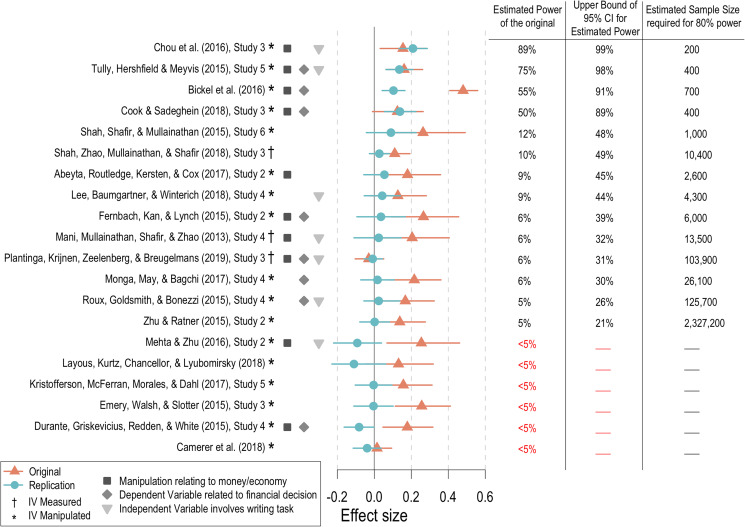
- In 80% of the 20 studies, replication effect sizes were smaller than the original effect sizes; in 30%, the replication effects were directionally opposite.
- Of the 20 original studies that were significant, only 4 replication attempts were significant.
- The authors estimate that only 9 of the original studies had 33% power included within the upper bounds of the 95% CIs from the replication-based power estimates, suggesting many original effects were too small to be detectably studied.
## Methods
- The paper uses an empirical audit and review design: it defines a topic area, selects a cross-section of studies, and conducts close replications to assess evidentiary value.
- The sample began with 198 articles citing Shah et al. (2012), narrowed to 32, then 23, and finally 20 studies selected for replication; only studies that involved scarcity, cited the seminal scarcity paper, and could be run with an online sample were eligible.
- Replications used original materials when possible, were preregistered, had IRB approval and online consent, and used 2.5 times the original sample size; analyses focused on replication effect sizes, significance, and implied power of the original studies.
## Limitations
- The authors state that their project has “neither the goal nor the capacity to ‘accept the null’” for the tests.
- Their inclusion criteria are a strength for definitional clarity, but also a weakness because they limit generalization; the paper notes that online studies may be inherently smaller or less replicable, and that some larger field effects are harder to replicate.
- Evident from the text: the findings apply to a specific subset of scarcity research—studies that could be replicated online and fit the authors’ selection rules—so the results may not generalize to all scarcity research.
Model-written summary. Check it against the paper before relying on it.
Integrity signals
Registry
Cites
Statistics
Figures
Verification
Claims the paper makes
3 Valid · 0 Not valid · 5 Not checked · 19 Own results and interpretations
The cited sources support only part of this claim — read each source’s verdict below.
In the paper
“is indifferent to the quality of the original evidence (14)”
§ Empirical audit and review and an assessment of evidentiary value in research on the psychological consequences of scarcity > Assessing the Evidence of a Literature
What the sources say
- Partly supportedcites [14] J. P. Ioannidis, The mass production of redundant, misleading, and conflicted systematic reviews and meta‐analyses. Milbank Q. 94, 485– 514 (2016). 27620683 PMC5020151 sourceExperimental — accuracy not yet measured
The Conclusion (page unavailable in our copy) says systematic reviews cannot be expected to correct deficiencies in primary evidence, supporting the concern behind the claim. But it also says they can reveal how unreliable published evidence is, so describing meta-analysis as simply indifferent to evidence quality overstates the paper's position. (LLM, conf=0.82)
plain- Asserted: passes — The authors put it forward as true.
- Checkable: passes — It can be checked against evidence.
- Load-bearing: passes — The paper’s conclusions depend on it.
- Based: passes — The paper gives a reason why it holds.
- Partly supported
Every source the paper cites for this claim was checked and supports it.
In the paper
“But meta-analysis risks reifying selectively reported findings (12)”
§ Empirical audit and review and an assessment of evidentiary value in research on the psychological consequences of scarcity > Assessing the Evidence of a Literature
What the sources say
- Supportedcites [12] I. Ahmed, A. J. Sutton, R. D. Riley, Assessment of publication bias, selection bias, and unavailable data in meta-analyses using individual participant data: A database survey. BMJ 344, d7762 (2012). 22214758 source
The Introduction says publication bias and selective outcome reporting can leave meta-analyses synthesising incomplete evidence and producing biased summary results. The Abstract warns against uncritically treating such meta-analyses as reliable, supporting the citing sentence's broader phrasing. (LLM, conf=0.90)
plainstates a cause- Asserted: passes — The authors put it forward as true.
- Checkable: passes — It can be checked against evidence.
- Load-bearing: passes — The paper’s conclusions depend on it.
- Based: passes — The paper gives a reason why it holds.
- Supported
The cited sources support only part of this claim — read each source’s verdict below.
In the paper
“a threat evident in large-scale replication efforts (10, 11).”
§ Empirical audit and review and an assessment of evidentiary value in research on the psychological consequences of scarcity > Assessing the Evidence of a Literature
What the sources say
- Partly supportedcites [10] Open Science Collaboration, Psychology. Estimating the reproducibility of psychological science. Science 349, aac4716 (2015). 26315443 sourceExperimental — accuracy not yet measured
In Insights on Reproducibility (p. 13), the paper says its large-scale replication results are consistent with publication, selection, and reporting biases in the original studies. That supports the selective-reporting concern, but the passage treats those biases as plausible explanations and does not establish p-hacking specifically. (LLM, conf=0.83)
- Not checked — no full text of the sourcecites [11] C. F. Camerer., Evaluating the replicability of social science experiments in Nature and Science between 2010 and 2015. Nat. Hum. Behav. 2, 637– 644 (2018). 31346273 source
plain- Asserted: passes — The authors put it forward as true.
- Checkable: passes — It can be checked against evidence.
- Load-bearing: unclear — It is unclear whether the paper’s conclusions depend on it.
- Based: passes — The paper gives a reason why it holds.
- Partly supported
A result the paper reports from its own data — it cites no other source for it, so there is none to check. The quote shows it is in the paper.
In the paper
“Three of the four successful replications involved priming participants with some type of financial constraint and then requiring them to engage in a financial or consumer decision task under these constraints.”
§ Empirical audit and review and an assessment of evidentiary value in research on the psychological consequences of scarcity > Results
plain- Asserted: passes — The authors put it forward as true.
- Checkable: passes — It can be checked against evidence.
- Load-bearing: passes — The paper’s conclusions depend on it.
- Based: passes — The paper gives a reason why it holds.
A result the paper reports from its own data — it cites no other source for it, so there is none to check. The quote shows it is in the paper.
In the paper
“directionally opposite for 30% of these 20 studies”
§ Empirical audit and review and an assessment of evidentiary value in research on the psychological consequences of scarcity > Results
plain- Asserted: passes — The authors put it forward as true.
- Checkable: passes — It can be checked against evidence.
- Load-bearing: passes — The paper’s conclusions depend on it.
- Based: passes — The paper gives a reason why it holds.
10 more claims
Create a free account to see all 27 claims and to verify the 1 reference still open.
- It may state two separate claims as one. 7
- Probably not a substantial claim. 7
Citations
Cites
Estimating the reproducibility of psychological science
Open Science Collaboration (2015) · Science · doi:10.1126/science.aac4716 · Cited by 8,515
Simmons, J. P., Nelson, L. D., & Simonsohn, U. (2011) · Psychological Science · doi:10.1177/0956797611417632 · Cited by 6,567
Self-citationPoverty impedes cognitive function.
Mani, A., Mullainathan, S., Shafir, E., & Zhao, J. (2013) · Science · doi:10.1126/science.1238041 · Cited by 2,967 · cited 1×
“Over the past decade, behavioral scientists have investigated how scarcity, or a lack of resources, changes how people think and behave, and how those changes can perpetuate poverty and other negative consequences such as reduced life expectancy (1), reduced cognitive ability (2), impulsiveness (3), and pain (4).”
BackgroundThe Association Between Income and Life Expectancy in the United States, 2001–2014
Chetty, R., Stepner, M., Abraham, S., Lin, S., Scuderi, B., Turner, N., Bergeron, A., & Cutler, D. (2016) · JAMA · doi:10.1001/jama.2016.4226 · Cited by 2,812
Some Consequences of Having Too Little
Shah, A. K., Mullainathan, S., & Shafir, E. (2012) · Science · doi:10.1126/science.1222426 · Cited by 1,567
Camerer, C. F., Dreber, A., Holzmeister, F., Ho, T.-H., Huber, J., Johannesson, M., Kirchler, M., Nave, G., Nosek, B. A., Pfeiffer, T., et al. (2018) · Nature Human Behaviour · doi:10.1038/s41562-018-0399-z · Cited by 1,521 · cited 1×
“Selective reporting of measures, treatments, and analyses, and the p-hacking they enable (7) has been identified as an existential threat to behavioral science (8, 9), a threat evident in large-scale replication efforts (10, 11).”
BackgroundThe Mass Production of Redundant, Misleading, and Conflicted Systematic Reviews and Meta‐analyses
IOANNIDIS, J. P. A. (2016) · The Milbank Quarterly · doi:10.1111/1468-0009.12210 · Cited by 1,483
Small Telescopes: Detectability and the Evaluation of Replication Results
Simonsohn, U. (2015) · Psychological Science · doi:10.1177/0956797614567341 · Cited by 742
Shah, A. K., Shafir, E., & Mullainathan, S. (2015) · Psychological Science · doi:10.1177/0956797614563958 · Cited by 433
Ahmed, I., Sutton, A. J., & Riley, R. D. (2012) · BMJ · doi:10.1136/bmj.d7762 · Cited by 404
Cited by
How Effective Is (More) Money? Randomizing Unconditional Cash Transfer Amounts in the USPreprint
Jaroszewicz, A., Jachimowicz, J., Hauser, O., & Jamison, J. (2022) · SSRN Electronic Journal · doi:10.2139/ssrn.4154000 · Cited by 100
Hilbert, L. P., Noordewier, M. K., & DIJK, W. W. V. (2022) · Journal of Economic Psychology · doi:10.1016/j.joep.2022.102546 · Cited by 57
İşler, O., & Yılmaz, O. (2022) · Behavior Research Methods · doi:10.3758/s13428-022-01984-4 · Cited by 81
“Second, an increasing number of high-powered replication failures suggests that many of the previously identified effects could have been artifacts of methodological weaknesses such as small sample size (e.g., O’Donnell et al., 2021).”
BackgroundTully, S. M., & Sharma, E. (2021) · Consumer Psychology Review · doi:10.1002/arcp.1073 · Cited by 36
Taking the Full Measure: Integrating Replication into Research Practice to Assess Generalizability
Urminsky, O., & Dietvorst, B. J. (2024) · Journal of Consumer Research · doi:10.1093/jcr/ucae007 · Cited by 31
Reckoning With Our Crisis: An Agenda for the Field of Social and Personality Psychology
Schiavone, S. R., & Vazire, S. (2022) · Perspectives on Psychological Science · doi:10.1177/17456916221101060 · Cited by 25
Scarcity and the Mindsets of Social Welfare Recipients: Evidence from a Field Experiment
Madsen, J. K., Bækgaard, M., & Kvist, J. (2022) · Journal of Public Administration Research and Theory · doi:10.1093/jopart/muac043 · Cited by 26
Denti, L., Sturén, E., & Johansson, L. (2024) · Frontiers in Psychology · doi:10.3389/fpsyg.2023.1333735 · Cited by 23
A toolbox to evaluate the trustworthiness of published findings
Adler, S. J., Röseler, L., & Schöniger, M. K. (2023) · Journal of Business Research · doi:10.1016/j.jbusres.2023.114189 · Cited by 21
Examining the replicability of online experiments selected by a decision market
Holzmeister, F., Johannesson, M., Camerer, C. F., Chen, Y., Ho, T., Hoogeveen, S., Huber, J., Imai, N., Imai, T., Jin, L. J., et al. (2024) · Nature Human Behaviour · doi:10.1038/s41562-024-02062-9 · Cited by 27
“…factor, sample size, effect size and importance) 25–28 , relying on cost–benefit considerations 29,30 , using Bayesian strategies 31,32 , determining the ‘repli-cation value’ 33 , adopting empirical audit and review 34 , selecting studies randomly 35 or using predictions from laypeople 36,37 .”
Recalling experiences of scarcity reduces children’s generosity relative to recalling abundance
Ahl, R. E., Amir, D., & McAuliffe, K. (2024) · Journal of Experimental Child Psychology · doi:10.1016/j.jecp.2024.105914 · Cited by 14
Scarcity in today´s consumer markets: scoping the research landscape by author keywords
Sun, H., & Teichert, T. (2022) · Management Review Quarterly · doi:10.1007/s11301-022-00295-4 · Cited by 23
“More specifically, psychological studies show that individuals tend to think and behave differently based on the perceived scarcity of resources (O’Donnell et al. 2021; Shah et al. 2015); this creates business opportunities (Shi et al. 2020).”
Advancing the psychology of social class with large-scale replications in four countries
Batruch, A., Sommet, N., & Autin, F. (2025) · Nature Human Behaviour · doi:10.1038/s41562-025-02234-1 · Cited by 25
Can ultimate recoverable resources (URRs) be assessed? Does analyzing declining ore grades help?
Wellmer, F., Scholz, R. W., & Bastian, D. (2023) · Mineral Economics · doi:10.1007/s13563-023-00368-0 · Cited by 11
“Aristotle’s concept of horror vacui —that nature abhors a vacuum—and the related fear of emptiness has been adopted by psychology (O’Donnell et al. 2021; Roux et al. 2015; Zhao and Tomm 2018).”
Evaluating replicability of ten influential research on sensory marketing
Motoki, K., & Iseki, S. (2022) · Frontiers in Communication · doi:10.3389/fcomm.2022.1048896 · Cited by 8
Present generation’s negotiators realize their interests at the cost of future generations
van Treek, M., Majer, J. M., Zhang, H., Zhang, K., & Trötschel, R. (2023) · Journal of Environmental Psychology · doi:10.1016/j.jenvp.2023.102126 · Cited by 10
Montoya, A. K., Charlton, A., Krefeld-Schwalb, A., Price, J., & Hilgard, J. (2021) · PsyArXiv (OSF Preprints) · doi:10.31234/osf.io/ck2r5 · Cited by 9
A scarcity literature mischaracterized with an empirical audit
Shah, A., Zhao, J., Mullainathan, S., & Shafir, E. B. (2023) · Proceedings of the National Academy of Sciences · doi:10.1073/pnas.2206054120 · Cited by 15
“(“ODAL”) (1) claim to audit the “scarcity literature” through a series of replications.”
BackgroundThe Psychology of Poverty: Current and Future Directions
Park, Y., Ho, Y. W., Hallez, K., Kaur, S., Srinivasan, M., & Zhao, J. (2024) · Current Directions in Psychological Science · doi:10.1177/09637214241283163 · Cited by 16
“Whether the bandwidth tax is a robust, replicable phenomenon remains a topic of much debate (e.g., O’Donnell et al., 2021; Shah et al., 2023).”
Poverty and perseverance: The detrimental effect of poverty on effort provision
Sharafi, Z. (2022) · Journal of Development Economics · doi:10.1016/j.jdeveco.2022.103040 · Cited by 14
Scarcity improves economic valuations when cognitively salient
İşler, O., Yılmaz, O., & Dulleck, U. (2023) · Journal of Economic Behavior & Organization · doi:10.1016/j.jebo.2023.02.019 · Cited by 8
A Tale of Open Science: Emergence of a New Normal
Soliman, M., Sarstedt, M., Adler, S. J., Siegfried, D., Genschow, O., & Imschloß, M. (2025) · Schmalenbach Journal of Business Research · doi:10.1007/s41471-025-00218-5 · Cited by 9
“Examples include the relationship between decision conflict and choice deferral (Evangelidis et al. 2022), the effects of product scarcity (O’Donnell et al. 2021) as well as estimates for TV advertising effectiveness (Shapiro et al. 2021).”
The effect of financial stress on inhibitory control and economic decisions
Hughes, B., Ludwig, R. M., Robles, K. E., & Berkman, E. T. (2024) · Journal of Experimental Social Psychology · doi:10.1016/j.jesp.2024.104621 · Cited by 13
“…from the empirical audit, the effects of financial stress are more prominent in economic decisions than they are in measures of executive function (O ’ Donnell et al., 2021), leading us to the same conclusion: future work in this area should focus on economic behavior rather than executive…”
BackgroundResultInfluentialThe Social Origins of Effort: How Incentives Reduce Socioeconomic Disparities among Children
Radl, J., Foley, W., Kröger, L. K., Lorente, P., Palacios-Abad, A., Solga, H., Stuhler, J. L., & Swarr, M. (2026) · American Sociological Review · doi:10.1177/00031224251401933 · Cited by 6
“However, this effect sometimes fails to replicate (O’Donnell et al. 2021).”
Götz, M., & O’Boyle, E. H. (2023) · Emerald Group Publishing Limited eBooks · doi:10.1108/s0742-730120230000041004 · Cited by 11
A Metatheoretical Review of Cognitive Load Lie Detection
Neequaye, D. A. (2023) · Collabra Psychology · doi:10.1525/collabra.87497 · Cited by 7
Artificial Intelligence Digital Audit System Under Machine Learning Technology
Liu, X., Ren, Y., Qi, G., Li, Y., & Fan, R. (2024) · International Conference on Artificial Intelligence and Autonomous Robot Systems (AIARS) · doi:10.1109/aiars63200.2024.00139 · Cited by 8
“O’Donnell M pointed out that empirical auditing and review are a method of evaluating the value of research fields, and he also stated that auditing is a necessary task in many fields [3].”
Predicting the replicability of social and behavioural science claims in COVID-19 preprints
Marcoci, A., Wilkinson, D. P., Vercammen, A., Wintle, B. C., Abatayo, A. L., Baskin, E., Berkman, H., Buchanan, E. M., Capitán, S., Capitán, T., et al. (2024) · Nature Human Behaviour · doi:10.1038/s41562-024-01961-1 · Cited by 21
“Over the past decade, several large-scale replication studies have called into question the reliability of published findings across disciplines including psychology, economics, computational social science, cancer biology and medicine 1–9 .”
Predicting the replicability of social and behavioural science claims in COVID-19 preprintsPreprint
Marcoci, A., Wilkinson, D. P., Abatayo, A. L., et al. (2023) · doi:10.31222/osf.io/xdsjf · Cited by 5
The Psychology of Poverty: Where Do We Stand?
Haushofer, J., & Salicath, D. (2023) · National Bureau of Economic Research · doi:10.3386/w31977 · Cited by 15
Scarcity affects cognitive biases: The case of the illusion of causality
Vinas, A., Blanco, F., & Matute, H. (2023) · Acta Psychologica · doi:10.1016/j.actpsy.2023.104007 · Cited by 8
A Scarcity Literature Mischaracterized with an Empirical AuditPreprint
Shah, A. K., Zhao, J., Mullainathan, S., et al. (2022) · doi:10.31234/osf.io/gphcz · Cited by 4
Vinas, A., Blanco, F., & Matute, H. (2025) · Scientific Reports · doi:10.1038/s41598-025-01043-w · Cited by 6
Auditing the value of empirical audits
Lynch, J. G., Fernbach, P. M., & Kan, C. (2023) · Proceedings of the National Academy of Sciences · doi:10.1073/pnas.2213200120 · Cited by 3
Rea, J. (2023) · International Journal of Social Psychology Revista de Psicología Social · doi:10.1080/02134748.2023.2236885 · Cited by 6
“Another study, which attempted to replicate findings from 20 studies on scarcity, led the authors to conclude that although poverty is ‘an enduring societal problem . . . behavioral scientists have not fully identified the underlying psychology’ (O’Donnell et al., 2021, p. 3).”
Psychology’s reform movement needs a reconceptualization of scientific expertise
Tunç, D. U., & Tunç, M. N. (2023) · Social Psychological Bulletin · doi:10.32872/spb.10303 · Cited by 3
“As steps in the right direction for targeting epistemic performance, we can give the curation framework (LeBel et al., 2018), false discovery risk indices (Schimmack, 2022), or empirical replicability audits (O’Donnell et al., 2021) as examples.”
Understanding Scarcity: From Marketing to Policy, Management, and Beyond
Cannon, C., Roux, C., & Goldsmith, K. (2024) · Foundations and Trends® in Marketing · doi:10.1561/1700000083 · Cited by 1
Mutheu, H., & Waga, C. S. (2024) · International Journal of Social Science and Humanities Research (IJSSHR) · doi:10.61108/ijsshr.v2i3.146 · Cited by 1
How often are replication attempts questioned?
Hensel, P. G. (2023) · Accountability in Research · doi:10.1080/08989621.2023.2198126 · Cited by 1
“The concerns regarding the less than satisfactory replicability of research in the field of psychology (O’donnell et al. 2021; Open Science Collaboration 2015) and other social sciences (Camerer et al. 2016, 2018) has resulted in a new impetus for supporting replication research (Hales, Wesselmann,…”
The unintended detrimental effects of pursuing a professional vocation: The case of veterinarians
Palma, M. A., Zhang, P., Cornell, K. K., Salois, M. J., Bain, B., & Neill, C. L. (2023) · PLoS ONE · doi:10.1371/journal.pone.0284583 · Cited by 1
“…al. (2021) review 20 studies using an empirical audit and review replication approach and while there are differences across studies, they conclude that there are only minimal effects of scarcity priming on cognitive load, but there are likely effects in other financial and consumer decisions [18].”
Reply to Shah et al. & Lynch et al.: In defense of replication
O'Donnell, M. P., Nelson, L. D., & Moore, D. A. (2023) · Proceedings of the National Academy of Sciences · doi:10.1073/pnas.2304251120 · Cited by 1
“We undertook a project that attempted to replicate 20 findings related to the theme of psychological scarcity (1).”
BackgroundSelf-citationThe Psychology of Poverty: Where Do We Stand?Preprint
Haushofer, J., & Salicath, D. (2023) · SSRN Electronic Journal · doi:10.2139/ssrn.4675165 · Cited by 1
Toward Open Science in Marketing ResearchPreprint
Deer, L., Adler, S. J., Datta, H., et al. (2024) · doi:10.31219/osf.io/f7a8c · Cited by 1
Consumer Bankruptcy, Mortgage Default and Labor Supply
Sharma, E., Tully, S. M., & Wang, X. (2022) · Working paper · doi:10.21799/frbp.wp.2022.27
Financial-Scarcity-Related Cues’ Impact on the Cognitive Performance of the Poor: a Meta-analysisPreprint
Szécsi, P., & Szászi, B. (2022) · doi:10.31234/osf.io/akfuh
Psychology’s Reform Movement Needs a Reconceptualization of Scientific ExpertisePreprint
Tunç, D. U., & Tunç, M. N. (2022) · doi:10.31234/osf.io/agk4b
A Review of Cognitive Load Lie DetectionPreprint
Neequaye, D. A. (2022) · PsyArXiv (OSF Preprints) · doi:10.31234/osf.io/yd45e
Virtual Reality Video Game for Depression Awareness
Morim, F., Oliveira, E., Braga, C., & Rodrigues, N. F. (2022) · SeGAH ... IEEE ... International Conference on Serious Games and Applications for Health/IEEE International Conference on Serious Games and Applications for Health · doi:10.1109/segah54908.2022.9978304
“However, empirical studies that assess the effects of contact with an out-group member in VR are still scarce [26].”
Backgroundİşler, O., Yılmaz, O., Maule, A. J., & Gächter, S. (2024) · Behavior Research Methods · doi:10.3758/s13428-024-02481-6 · Cited by 1
“While some studies have found effects on behavior in economic games, such as increased selfishness (Roux et al., 2015), these findings have been hard to replicate (O’Donnell et al., 2021), likely due to the reliance on small-sample studies with weak manipulation techniques (see Isler et al., 2023).”
Distracted Minds: How Poverty Induced Distress Affects Adolescents' Cognitive FunctionPreprint
Sharafi, Z. (2024) · SSRN Electronic Journal · doi:10.2139/ssrn.4989688
Why Poverty in the Present Matters for Intergenerational Concern and the Future of Humanity
Law, K. F., Syropoulos, S., Signorini, A., Capozzoli, C. J., Young, L., & O’Connor, B. B. (2026) · Personality and Social Psychology Bulletin · doi:10.1177/01461672261469612 · Cited by 5
Szécsi, P., Bognar, M., & Szászi, B. (2025) · Royal Society Open Science · doi:10.1098/rsos.251758
“The contrast between recent positive findings [2,4] and negative findings [18,20], including the high-powered null results presented in this article, suggests that scarcity theory fails to predict behaviour across different contexts and requires refinement.”
Harma, M., Şeker, F., Doğruyol, B., & Yılmaz, O. (2026) · Applied Cognitive Psychology · doi:10.1002/acp.70216
Ha, N., Roux, C., Cannon, C., & Goldsmith, K. (2026) · Oxford University Press eBooks · doi:10.1093/9780197859063.003.0028
Narváez, A. C., Underwood, A., Amadu, F. O., & Kijewski-Correa, T. (2026) · Discover Agriculture · doi:10.1007/s44279-026-00752-8
“While some of these findings have faced replication challenges [50], complementary frameworks such as conservation of resources theory reinforce the core mechanism, showing that those under chronic resource stress divert cognitive and emotional energy toward managing scarcity, leaving less for…”
Aboud‐Halabi, Y., Shamai, M., & Or‐Chen, K. (2026) · Journal of Poverty · doi:10.1080/10875549.2026.2734996
Metadata
- Authors
- O’Donnell, M., Dev, A. S., Antonoplis, S., Baum, S. M., Benedetti, A. H., Brown, N. D., Carrillo, B., Choi, A. L., Connor, P., Donnelly, K., Ellwood-Lowe, M. E., Foushee, R., Jansen, R., Jarvis, S. N., Lundell-Creagh, R., Ocampo, J. M., Okafor, G. N., Azad, Z. R., Rosenblum, M., Schatz, D., Stein, D. H., Wang, Y., Moore, D. A., & Nelson, L. D.
- Affiliations
- McDonough School of Business, Georgetown University, Washington, DC 20057;
- University of Miami (US)
- University of California, Berkeley (US)
- Airbnb (United States) (US)
- New York University (US)
- University of Chicago (US)
- University of Tübingen (DE)
- McKinsey & Company (United States) (US)
- Peking University (CN)
- ORCID
- O’Donnell, Michael
- Dev, Amelia S.
- Antonoplis, Stephen
- Benedetti, Arianna H.
- Brown, N. Derek
- Carrillo, Belinda
- Choi, Andrew L.
- Donnelly, Kristin
- Ellwood-Lowe, Monica E.
- Foushee, Ruthe
- Jansen, Rachel
- Jarvis, Shoshana N.
- Lundell-Creagh, Ryan
- Ocampo, Joseph M.
- Okafor, Gold N.
- Azad, Zahra Rahmani
- Rosenblum, Michael
- Stein, Daniel H.
- Wang, Yilu
- Moore, Don A.
- Nelson, Leif D.
- Venue
- Proceedings of the National Academy of Sciences
- Publisher
- National Academy of Sciences
- Published
- 2021-10-28
- Volume
- 118
- Issue
- 44
- ISSN
- 0027-8424 (ISSN-L)
- 1091-6490
- PMC
- PMC8612349
- OpenAlex
- W3208956304
- Cited by
- 56
- References
- 17
- Citations by year
- 2026: 7 · 2025: 5 · 2024: 13 · 2023: 16 · 2022: 13 · 2021: 2
- FWCI
- 10.62
- Type
- journal article
- Language
- en
- Update notices
- correction (2022-11-21)
- Open access
- hybrid
- doi.org
- Licence
- Locations
- Proceedings of the National Academy of Sciences (publishedVersion, cc-by-nc-nd)
- PubMed Central (publishedVersion, cc-by-nc-nd)
- PubMed (publishedVersion)
- Knowledge@UChicago (University of Chicago) (submittedVersion, cc-by-nc-nd)
- eScholarship (California Digital Library) (submittedVersion, cc-by-nc-nd)
- Funders
- National Science Foundation (DGE 1752814)
- Topics
- Social Sciences › Psychology › Experimental and Cognitive Psychology › Psychology Research and Bibliometrics
- Social Sciences › Decision Sciences › Statistics, Probability and Uncertainty › Meta-analysis and systematic reviews
- Social Sciences › Decision Sciences › General Decision Sciences › Decision-Making and Behavioral Economics
- Keywords
- replication, evidentiary value, pain sensitivity, resource allocation, materialism, cumulative science
- MeSH terms
- Food Insecurity, Humans, Pain Measurement, Research Design, Reproducibility of Results, Empirical Research, Resource Allocation
About these checks
Registry, retraction, Cites and statistics results are computed, not judged, with one exception: a printed reference that no index lists is read once by a model before it counts as a citation error. Claims are extracted by a model and kept only when their quote appears verbatim in the text; each cited source is then checked, with a model’s help, for whether it says what the claim relies on. Those verdicts can be wrong — read the claim’s quote and the cited source before relying on one.
The claim verdicts this report counts are experimental: their accuracy is not yet measured.
A language model drew the claims from the paper on 2026-10-09, under version 3 of the claim definition (model deepseek-v4.1-flash, prompt extract-v3).
A second model labelled each claim on 2026-10-09 (model jev-1.13-20260917, definition revision gold-guideline-v0.2).
Cited sources are checked with a language model’s help (gpt-6-sol).
Statistics and arithmetic are recomputed, not judged.
Confidence bands are shown only for fields calibrated on our annotated test set. None is calibrated yet, so no band is shown.
What counts as a claim ›How we measure confidence ›How we check this ›
Are you an author, or do you see a problem with this page? Request a review
Data sources
Bibliographic data: Semantic Scholar, OpenAlex, Crossref.
Contains information from the Semantic Scholar Academic Graph Datasets, made available under the ODC Attribution License (ODC-BY 1.0).
Semantic Scholar’s data is described in: Kinney, R., et al. (2023). The Semantic Scholar Open Data Platform. arXiv:2301.10140.
