

The DOI matches its Crossref record; 8 of the 8 references it cites were found in a registry or an index.
Intersectionality within the racial justice movement in the summer of 2020
Open accessAbstract
In an environment that is high in racial justice saliency, how do identities inform motivation for supporting specific issues in the crowd? This study examines the role that intersectionality played in mobilizing participants to join the mass demonstrations sparked by the murder of George Floyd. Building on recent studies that show how protest participants connect issue-based concerns with their identities to boost support for movements, we analyze data collected through surveys with a random sample of activists participating in the protests after George Floyd’s death in Washington, DC, in 2020. We find that intersectional motivations played a significant role in mobilizing protest participants. Analysis of these factors helps explain the diversity of the crowd and provides insights into how the movement may contribute to greater success for racial justice and the degree to which the movement has staying power.
Overview
The claims and statistics of this paper haven’t been checked yet.
Run the check — free, no account needed. It reads the open-access text and checks the sources it cites.
Integrity signals
Registry
Cites
Statistics
Figures
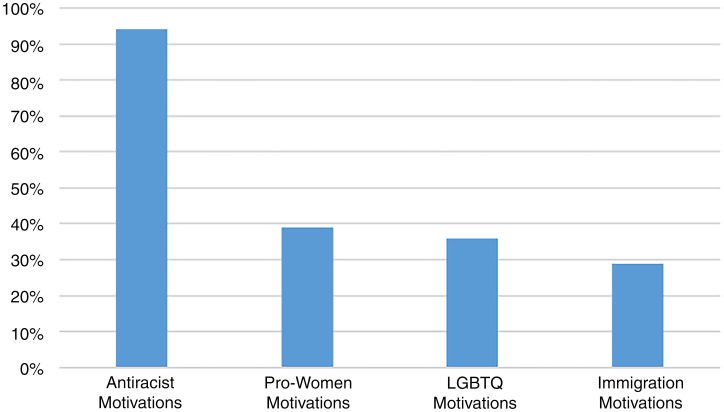
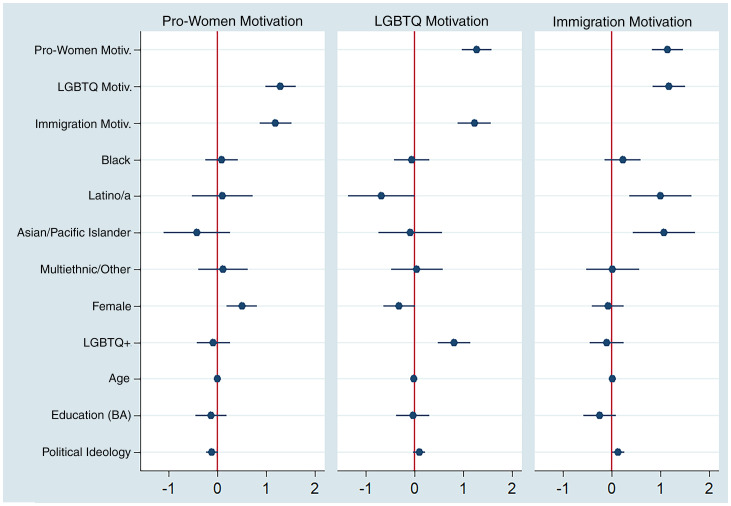
Verification
Claims the paper makes
The claims and statistics of this paper haven’t been checked yet.
Run the check — free, no account needed. It reads the open-access text and checks the sources it cites.
Claims other papers make about this one
Each is checked against this paper’s own text: does it say what the citing paper says it does?
The cited source says what the claim attributes to it.
In the citing paper
“This aligns with Fisher and Rouse's (2022) finding that these protests stimulated action by those motivated not just by race-based democratic violations (i.e., state-sponsored violence) but also by other types of inequalities, including those regarding women, LGBTQ+ individuals, and immigrants.”
From How to study democratic backsliding (2024) · cites this paper as Fisher and Rouse, 2022
Self-check
Percentages, sums and reported differences re-computed from the paper’s own numbers.
The self-check needs the paper’s full text.
Citations
Cites
Mapping the Margins: Intersectionality, Identity Politics, and Violence against Women of Color
Crenshaw, K. (1991) · Stanford Law Review · doi:10.2307/1229039 · Cited by 32,792
The Complexity of Intersectionality
McCall, L. (2005) · Signs: Journal of Women in Culture and Society · doi:10.1086/426800 · Cited by 6,682
Toward a Field of Intersectionality Studies: Theory, Applications, and Praxis
Cho, S., Crenshaw, K. W., & McCall, L. (2013) · Signs: Journal of Women in Culture and Society · doi:10.1086/669608 · Cited by 4,126
States of Injury: Power and Freedom in Late Modernity
Brown, W. (1995) · doi:10.1515/9780691201399 · Cited by 3,486
Uncivil Agreement: How Politics Became Our Identity
Mason, L. (2018) · doi:10.7208/chicago/9780226524689.001.0001 · Cited by 1,985
Hill Collins, P. (2002) · Routledge · doi:10.4324/9780203900055 · Cited by 1,532
Coalitions as a model for intersectionality: From practice to theory
Cole, E. R. (2008) · Sex Roles · doi:10.1007/s11199-008-9419-1 · Cited by 306
Laperrière, M., & Lépinard, E. (2016) · Politics · doi:10.1177/0263395716649009 · Cited by 67
Research works printed but not linked: 56
- 10.1073/pnas.2014750117 · DOI
- 10.1073/pnas.2020685118 · DOI
- D. McAdam, Political Process and the Development of Black Insurgency, 1930-1970 (University of Chicago Press, Chicago, ed. 2, 1982).
- 10.1017/CBO9781139381277 · DOI
- D. McAdam, K. Kloos, Deeply Divided: Racial Politics and Social Movements in Postwar America (Oxford University Press, New York, ed. 1, 2014).
- 10.1017/S000305542000009X · DOI
- 10.1177/0021934718764099 · DOI
- 10.1017/rep.2019.17 · DOI
- 10.4324/9780429292866-4 · DOI
- D. Q. Gillion, The Loud Minority: Why Protests Matter in American Democracy (Princeton University Press, Princeton, NJ, 2020).
- D. R. Woodly, Reckoning: Black Lives Matter and the Democratic Necessity of Social Movements (Oxford University Press, New York, 2021).
- D. Setter, Changes in support for US Black movements, 1966-2016: From civil rights to Black lives matter. Mobilization (S. Diego Calif.) 26, 475–488 (2021).
- 10.1177/2378023120971507 · DOI
- 10.1126/sciadv.aao1390 · DOI
- 10.1080/21565503.2019.1629318 · DOI
- D. R. Fisher, L. Jasny, D. M. Dow, Why are we here? Patterns of intersectional motivations across the resistance. Mobilization (S. Diego Calif.) 23, 451–468 (2018).
- 10.4324/9780429292866-9 · DOI
- K.-Y. Taylor, From #BlackLivesMatter to Black Liberation (Haymarket Books, Chicago, 2016).
- 10.1177/0003122416681031 · DOI
- 10.1007/s11199-012-0168-9 · DOI
- 10.1093/socpro/spv010 · DOI
- 10.1093/sp/jxz052 · DOI
- 10.1080/01419870.2017.1334934 · DOI
- 10.1080/07491409.2016.1226654 · DOI · Paper page
- 10.1111/j.1467-9558.2010.01370.x · DOI · Paper page
- 10.1177/1065912910379227 · DOI · Paper page
- 10.1017/S1537592707070065 · DOI
- 10.1086/669573 · DOI
- 10.1017/S1742058X13000210 · DOI
- 10.1177/1065912910376386 · DOI
- 10.1111/lasr.12248 · DOI
- C. D. Simpson, A. Walter, K. Ebert, Brainwashing for the right reasons with the right message: Ideology and political subjectivity in Black organizing. Mobilization (S. Diego Calif.) 26, 401–420 (2021).
- 10.1525/sp.2003.50.2.226 · DOI
- 10.1016/j.wsif.2018.04.008 · DOI
- 10.1080/0966369X.2017.1335290 · DOI
- 10.1017/S0003055420000544 · DOI · Paper page
- H. Tajfel, Human Groups and Social Categories: Studies in Social Psychology (CUP Archive, 1981).
- H. Tajfel, J. Turner, “An integrative theory of intergroup conflict” in Intergroup Relations: Essential Readings, M. A. Hogg, D. Abrams, Eds. (Psychology Press, London, 2001), pp. 94–109.
- 10.1093/0199251789.001.0001 · DOI
- 10.1002/9780470999103.ch15 · DOI
- 10.1111/0162-895X.00118 · DOI
- 10.1177/1065912907301708 · DOI
- 10.2307/3097043 · DOI
- 10.7312/fish18764 · DOI
- A. S. Boyles, You Can’t Stop the Revolution: Community Disorder and Social Ties in Post-Ferguson America (University of California Press, Oakland, 2019).
- P. Oliver, Introduction: Black lives matter in context. Mobilization (S. Diego Calif.) 26, 391–399 (2021).
- 10.1017/CBO9781316084007 · DOI
- 10.1017/CBO9780511628146 · DOI
- 10.1177/0003122416644414 · DOI
- W. Jung, B. G. King, S. A. Soule, Issue bricolage: Explaining the configuration of the social movement sector, 1960-1995. AJS 120, 187–225 (2014).
- 10.1177/1078087409332925 · DOI
- 10.1017/S1537592708081887 · DOI
- I. Bédoyan, P. Aelst, S. Walgrave, Limitations and possibilities of transnational mobilization: The case of EU summit protesters in Brussels, 2001. Mobilization (S. Diego Calif.) 9, 39–54 (2004).
- 10.1126/sciadv.aaw5461 · DOI
- S. Walgrave, J. Verhulst, Selection and response bias in protest surveys. Mobilization (S. Diego Calif.) 16, 203–222 (2011).
- S. Walgrave, R. Wouters, P. Ketelaars, Response problems in the protest survey design: Evidence from fifty-one protest events in seven countries. Mobilization (S. Diego Calif.) 21, 83–104 (2016).
Cited by
Sorted by citations
How to study democratic backsliding
Druckman, J. N. (2024) · Political Psychology · doi:10.1111/pops.12942 · Cited by 56
Metadata
- Authors
- Fisher, D. R., & Rouse, S. M.
- Affiliations
- University of Maryland, College Park (US)
- Corresponding author
- Fisher, Dana R.
- Venue
- Proceedings of the National Academy of Sciences
- Publisher
- National Academy of Sciences
- Published
- 2022-07-12
- Volume
- 119
- Issue
- 30
- Pages
- e2118525119-e2118525119
- ISSN
- 0027-8424 (ISSN-L)
- 1091-6490
- PMC
- PMC9335322
- OpenAlex
- W4285090531
- Cited by
- 41
- References
- 8
- Citations by year
- 2026: 4 · 2025: 11 · 2024: 11 · 2023: 13 · 2022: 2
- FWCI
- 13.31
- Type
- journal article
- Language
- en
- Open access
- hybrid
- doi.org
- Licence
- Locations
- Proceedings of the National Academy of Sciences (publishedVersion, cc-by-nc-nd)
- PubMed Central (publishedVersion, cc-by-nc-nd)
- PubMed (publishedVersion)
- RePEc: Research Papers in Economics (submittedVersion)
- OSF Preprints (OSF Preprints) (submittedVersion)
- Funders
- Russell Sage Foundation (G-2006-26272)
- Topics
- Social Sciences › Sociology and Political Science › Race, History, and American Society
- Social Sciences › Sociology and Political Science › Social Movements and Cultural Identity
- Social Sciences › Sociology and Political Science › Social and Intergroup Psychology
- Keywords
- intersectionality, racial justice movements, George Floyd, mass protests, protest participation, social movements
- MeSH terms
- Intersectional Framework, Humans, Motivation, Surveys and Questionnaires, Social Justice, Racial Groups, Racism
About these checks
Registry, retraction, Cites and statistics results are computed, not judged, with one exception: a printed reference that no index lists is read once by a model before it counts as a citation error. Claims are extracted by a model and kept only when their quote appears verbatim in the text; each cited source is then checked, with a model’s help, for whether it says what the claim relies on. Those verdicts can be wrong — read the claim’s quote and the cited source before relying on one.
Statistics and arithmetic are recomputed, not judged.
Confidence bands are shown only for fields calibrated on our annotated test set. None is calibrated yet, so no band is shown.
What counts as a claim ›How we measure confidence ›How we check this ›
Are you an author, or do you see a problem with this page? Request a review
