

Reliably assessing the electronic structure of cytochrome P450 on today’s classical computers and tomorrow’s quantum computers
Open accessThe DOI matches its Crossref record; 80 of the 80 references it cites were found in a registry or an index.
Abstract
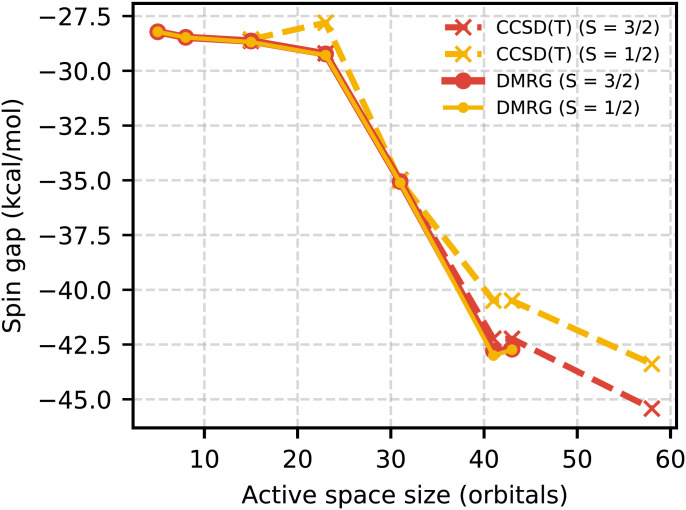
An accurate assessment of how quantum computers can be used for chemical simulation, especially their potential computational advantages, provides important context on how to deploy these future devices. To perform this assessment reliably, quantum resource estimates must be coupled with classical computations attempting to answer relevant chemical questions and to define the classical algorithms simulation frontier. Herein, we explore the quantum computation and classical computation resources required to assess the electronic structure of cytochrome P450 enzymes (CYPs) and thus define a classical–quantum advantage boundary. This is accomplished by analyzing the convergence of density matrix renormalization group plus n -electron valence state perturbation theory (DMRG+NEVPT2) and coupled-cluster singles doubles with noniterative triples [CCSD(T)] calculations for spin gaps in models of the CYP catalytic cycle that indicate multireference character. The quantum resources required to perform phase estimation using qubitized quantum walks are calculated for the same systems. Compilation into the surface code provides runtime estimates to compare directly to DMRG runtimes and to evaluate potential quantum advantage. Both classical and quantum resource estimates suggest that simulation of CYP models at scales large enough to balance dynamic and multiconfigurational electron correlation has the potential to be a quantum advantage problem and emphasizes the important interplay between classical computations and quantum algorithms development for chemical simulation.
Overview
The claims and statistics of this paper haven’t been checked yet.
Free: it reads the open-access text and checks the first 5 claims that cite a source we can check. Create a free account to check every claim.
Integrity signals
Registry
Cites
Statistics
Figures
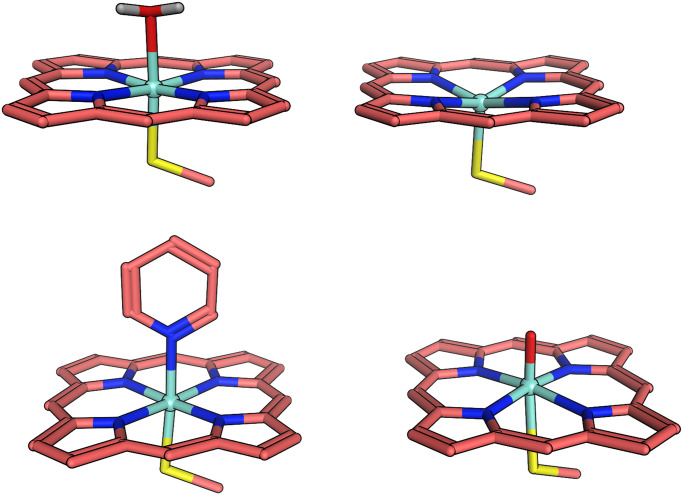
Verification
Claims the paper makes
The claims and statistics of this paper haven’t been checked yet.
Free: it reads the open-access text and checks the first 5 claims that cite a source we can check. Create a free account to check every claim.
Claims other papers make about this one
Each is checked against this paper’s own text: does it say what the citing paper says it does?
The cited source says what the claim attributes to it.
In the citing paper
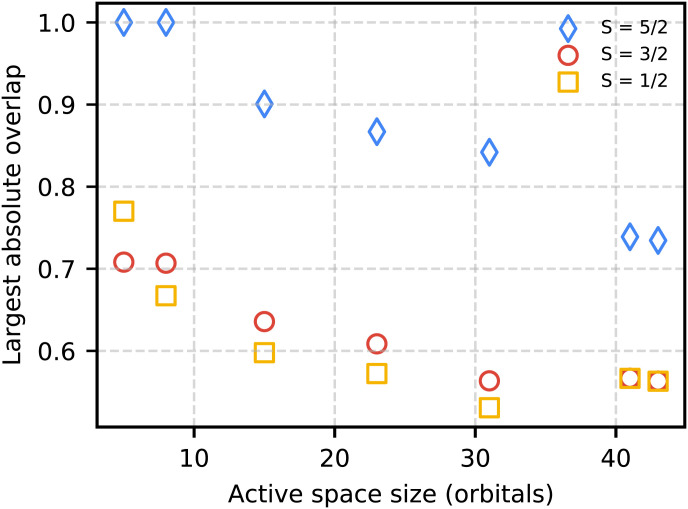
“The cost of estimating the correct ground state energy depends directly on the overlap of the initial state with the ground state, and it becomes progressively more expensive as the overlap with the correct ground state decreases [20, 48–50].”
From Drug design on quantum computers (2024) · doi:10.1038/s41567-024-02411-5 · cites this paper as [20]
Self-check
Percentages, sums and reported differences re-computed from the paper’s own numbers.
The self-check needs the paper’s full text.
Citations
Cites
Dunning, T. H. (1989) · The Journal of Chemical Physics · doi:10.1063/1.456153 · Cited by 31,648 · cited 1×
“To create the active-space models, the orbitals of the high-spin restricted open-shell Hartree-Fock (ROHF) state in the correlation-consistent polarized valence double zeta (cc-pVDZ) basis (44) were localized with the Pipek–Mezey localization scheme (45) to yield a set of local orbitals for each compound.”
Density matrix formulation for quantum renormalization groups
White, S. R. (1992) · Physical Review Letters · doi:10.1103/physrevlett.69.2863 · Cited by 7,702
A full coupled-cluster singles and doubles model: The inclusion of disconnected triples
Purvis, G. D., & Bartlett, R. J. (1982) · The Journal of Chemical Physics · doi:10.1063/1.443164 · Cited by 6,466
Coupled-cluster theory in quantum chemistry
Bartlett, R. J., & Musiał, M. (2007) · Reviews of Modern Physics · doi:10.1103/revmodphys.79.291 · Cited by 3,343
Second-order perturbation theory with a CASSCF reference function
Andersson, K., Malmqvist, P. A., Roos, B. O., Sadlej, A. J., & Wolinski, K. (1990) · The Journal of Physical Chemistry · doi:10.1021/j100377a012 · Cited by 3,331 · cited 1×
“Progress has been made with various flavors of multireference perturbation theory (17, 18) and multireference coupled-cluster theory (19), but a balanced description of electron correlation outside of the active space remains a major challenge.”
Čížek, J. (1966) · The Journal of Chemical Physics · doi:10.1063/1.1727484 · Cited by 3,074
Surface codes: Towards practical large-scale quantum computation
Fowler, A. G., Mariantoni, M., Martinis, J. M., & Cleland, A. N. (2012) · Physical Review A · doi:10.1103/physreva.86.032324 · Cited by 3,059
Many-Body Perturbation Theory and Coupled Cluster Theory for Electron Correlation in Molecules
Bartlett, R. J. (1981) · Annual Review of Physical Chemistry · doi:10.1146/annurev.pc.32.100181.002043 · Cited by 2,118
Introduction of n-electron valence states for multireference perturbation theory
Angeli, C., Cimiraglia, R., Evangelisti, S., Leininger, T., & Malrieu, J.-P. (2001) · The Journal of Chemical Physics · doi:10.1063/1.1361246 · Cited by 1,951
Pipek, J., & Mezey, P. G. (1989) · The Journal of Chemical Physics · doi:10.1063/1.456588 · Cited by 1,835 · cited 1×
“To create the active-space models, the orbitals of the high-spin restricted open-shell Hartree-Fock (ROHF) state in the correlation-consistent polarized valence double zeta (cc-pVDZ) basis (44) were localized with the Pipek–Mezey localization scheme (45) to yield a set of local orbitals for each compound.”
Research works printed but not linked: 1
- J. J. Goings., Data for “Reliably assessing the electronic structure of cytochrome P450 on today’s classical computers and tomorrow’s quantum computers.” Zenodo. https://zenodo.org/record/5941130. Deposited 1 February 2022. PMC9499570 36095200
Cited by
Quantum Algorithms: A Survey of Applications and End-to-end Complexities
Dalzell, A. M., McArdle, S., Berta, M., Bienias, P., Chen, C.-F., Gilyén, A., Hann, C. T., Kastoryano, M. J., Khabiboulline, E. T., Kubica, A., et al. (2023) · RWTH Publications (RWTH Aachen) · doi:10.18154/rwth-2026-02888 · Cited by 362
How to Build a Quantum Supercomputer: Scaling from Hundreds to Millions of QubitsPreprint
Mohseni, M., Scherer, A., Johnson, K. G., Wertheim, O., Otten, M., Anand, N., Aadit, N. A., Alexeev, Y., Ben-Shach, G., Bresniker, K., et al. (2024) · arXiv (Cornell University) · doi:10.48550/arxiv.2411.10406 · Cited by 237
The state of quantum computing applications in health and medicine
Flöther, F. F. (2023) · Research Directions Quantum Technologies · doi:10.1017/qut.2023.4 · Cited by 193
Alexeev, Y., Amsler, M., Barroca, M. A., Bassini, S., Battelle, T., Camps, D., Casanova, D., Choi, Y. J., Chong, F. T., Chung, C., et al. (2024) · Future Generation Computer Systems · doi:10.1016/j.future.2024.04.060 · Cited by 191
Benchmarking quantum computers
Proctor, T., Young, K., Baczewski, A. D., & Blume-Kohout, R. (2025) · Nature Reviews Physics · doi:10.1038/s42254-024-00796-z · Cited by 67
Initial State Preparation for Quantum Chemistry on Quantum Computers
Fomichev, S., Hejazi, K., Zini, M. S., Kiser, M., Fraxanet, J., Casares, P. A. M., Delgado, A., Huh, J., Voigt, A.-C., Mueller, J. E., et al. (2024) · PRX Quantum · doi:10.1103/prxquantum.5.040339 · Cited by 155
Quantum Algorithms: A Survey of Applications and End-to-end Complexities
Dalzell, A. M., McArdle, S., Berta, M., Bienias, P., Chen, C.-F., Gilyén, A., Hann, C. T., Kastoryano, M. J., Khabiboulline, E. T., Kubica, A., et al. (2025) · Cambridge University Press eBooks · doi:10.1017/9781009639651 · Cited by 147
Drug design on quantum computers
(2024) · doi:10.1038/s41567-024-02411-5 · Cited by 132
“In the next sections, we discuss the state of the art of drug design and where quantum computers could be used to solve the electronic-structure part of the problem for relevant pharmacological systems 14,20,48 .”
InfluentialSelf-citationPurification-based quantum error mitigation of pair-correlated electron simulations
O’Brien, T. E., Anselmetti, G.-L., Gkritsis, F., Elfving, V. E., Polla, S., Huggins, W. J., Oumarou, O., Kechedzhi, K., Abanin, D. A., Acharya, R., et al. (2023) · Nature Physics · doi:10.1038/s41567-023-02240-y · Cited by 127
Self-citationAkahoshi, Y., Maruyama, K., Oshima, H., Sato, S., & Fujii, K. (2024) · PRX Quantum · doi:10.1103/prxquantum.5.010337 · Cited by 121
Wang, G., França, D. S., Zhang, R., Zhu, S., & Johnson, P. D. (2023) · Quantum · doi:10.22331/q-2023-11-06-1167 · Cited by 117
“Solving this problem efficiently with a quantum computer would be of high value to areas including combustion [3], batteries [4, 5], and catalysts [6].”
Early Fault-Tolerant Quantum Computing
Katabarwa, A., Gratsea, K., Caesura, A., & Johnson, P. D. (2024) · PRX Quantum · doi:10.1103/prxquantum.5.020101 · Cited by 103
“001 (as is sometimes assumed for superconducting qubit resource estimates with the surface code [86]) we have 𝑄 maxphys = 10 .”
BackgroundMethodInfluentialHunting for quantum-classical crossover in condensed matter problems
Yoshioka, N., Okubo, T., Suzuki, Y., Koizumi, Y., & Mizukami, W. (2024) · npj Quantum Information · doi:10.1038/s41534-024-00839-4 · Cited by 105
“Additionally, Goings et al. conducted a comparison between quantum computers and the contemporary leading heuristic classical algorithm for cytochrome P450 enzymes, suggesting that the quantum advantage is realized only in computations extending beyond four days 13 .”
Hybrid Oscillator-Qubit Quantum Processors: Simulating Fermions, Bosons, and Gauge Fields
Crane, E., Smith, K. C., Tomesh, T., Eickbusch, A., Martyn, J. M., Kühn, S., Funcke, L., DeMarco, M. A., Chuang, I. L., Wiebe, N., et al. (2026) · Physical Review X · doi:10.1103/s5bn-z4jq · Cited by 100
Scalable Fault-Tolerant Quantum Technologies with Silicon Color Centers
Simmons, S. (2024) · PRX Quantum · doi:10.1103/prxquantum.5.010102 · Cited by 91
“Some of these algorithms are critical for useful tasks including quantum chemistry and the design of novel materials as they enable precise simulations of chemical processes in important technological applications ranging from catalysts [2] to batteries [3] and pharmaceuticals [4].”
BackgroundSimulating key properties of lithium-ion batteries with a fault-tolerant quantum computer
Delgado, A., Casares, P. A. M., dos Reis, R., Zini, M. S., Campos, R., Hernández, N. C., Voigt, A.-C., Lowe, A., Jahangiri, S., Martin-Delgado, M. A., et al. (2022) · Physical Review A · doi:10.1103/physreva.106.032428 · Cited by 92
Assessing the Benefits and Risks of Quantum ComputersPreprint
Scholten, T. L., Williams, C. J., Moody, D., Mosca, M., Hurley, W. L., Zeng, W. J., Troyer, M., & Gambetta, J. (2024) · arXiv (Cornell University) · doi:10.48550/arxiv.2401.16317 · Cited by 90
Effective quantum volume, fidelity and computational cost of noisy quantum processing experiments
Kechedzhi, K., Isakov, S. V., Mandrà, S., Villalonga, B., Mi, X., Boixo, S., & Smelyanskiy, V. (2024) · Future Generation Computer Systems · doi:10.1016/j.future.2023.12.002 · Cited by 42
“…quantum computers [8–19] have the potential to solve problems that are intractable for classical computers, including applications in factoring [20, 21], quantum simulation [22] of quantum chemistry [23– 26] and materials [27], quantum machine learning [28] and topological data analysis [29, 30].”
BackgroundFast Quantum Simulation of Electronic Structure by Spectral Amplification
Low, G. H., King, R., Berry, D. W., Han, Q., DePrince, A. E., White, A. F., Babbush, R., Somma, R. D., & Rubin, N. C. (2025) · Physical Review X · doi:10.1103/pb2g-j9cw · Cited by 81
“These reductions enable efficient ground-state energy estimation of classically intractable systems that are predicted to run on future, fault-tolerant quantum computers faster than lower-accuracy classical methods [10, 11].”
InfluentialSelf-citationPractical Quantum Advantage on Partially Fault-Tolerant Quantum Computer
Toshio, R., Akahoshi, Y., Fujisaki, J., Oshima, H., Sato, S., & Fujii, K. (2025) · Physical Review X · doi:10.1103/physrevx.15.021057 · Cited by 76
Resource Analysis of Low-Overhead Transversal Architectures for Reconfigurable Atom Arrays
Zhou, H., Duckering, C., Zhao, C., Bluvstein, D., Cain, M., Kubica, A., Wang, S.-T., & Lukin, M. D. (2025) · Proceedings - International Symposium on Computer Architecture/Proceedings · doi:10.1145/3695053.3731039 · Cited by 75
“To date, resource estimation has been primarily carried out with architectures based on lattice surgery or concatenated codes [2, 3, 7, 22, 41, 45, 47, 53, 59, 73, 76, 78, 80, 83, 92, 93, 97, 99, 105, 128].”
Grand Challenge of Quantum Applications
Babbush, R., King, R., Boixo, S., Huggins, W. J., Khattar, T., Low, G. H., McClean, J. R., O’Brien, T. E., & Rubin, N. C. (2026) · PRX Quantum · doi:10.1103/6r9l-lynr · Cited by 73
“While compelling molecular use cases like FeMoco [131] and P450 [132] exist, they are relatively rare in the context of all industrially relevant chemistry.”
Self-citationFault-Tolerant Quantum Simulation of Materials Using Bloch Orbitals
Rubin, N. C., Berry, D. W., Malone, F. D., White, A. F., Khattar, T., DePrince, A. E., Sicolo, S., Kühn, M., Kaicher, M., Lee, J., et al. (2023) · PRX Quantum · doi:10.1103/prxquantum.4.040303 · Cited by 67
Self-citationExponential Improvements in the Simulation of Lattice Gauge Theories Using Near-Optimal Techniques
Rhodes, M. L., Kreshchuk, M., & Pathak, S. (2024) · PRX Quantum · doi:10.1103/prxquantum.5.040347 · Cited by 65
Quantum computing for chemistry and physics applications from a Monte Carlo perspective
Mazzola, G. (2024) · The Journal of Chemical Physics · doi:10.1063/5.0173591 · Cited by 64
“16 88 The first crucial observation is that now even a ground-state calculation requires a black-box that implements real-time dynamics, or closely matching objects.”
BackgroundMethodCaesura, A., Cortes, C. L., Pol, W., Sim, S., Steudtner, M., Anselmetti, G.-L., Degroote, M., Moll, N., Santagati, R., Streif, M., et al. (2025) · PRX Quantum · doi:10.1103/yngp-5fpm · Cited by 63
“To that end, we perform a numerical optimization, for which we propose the BLISS-THC cost function, as a modification to the regularized cost function of Go-ings et al. [18], which includes prior knowledge of the computational cost of quantum phase estimation via the 1-norm weighted by the…”
Self-citationMenczer, A., Damme, M. V., Rask, A. E., Huntington, L. M. J., Hammond, J. R., Xantheas, S. S., Ganahl, M., & Legeza, Ö. (2024) · Journal of Chemical Theory and Computation · doi:10.1021/acs.jctc.4c00903 · Cited by 57
Loaiza, I., & Izmaylov, A. F. (2023) · Journal of Chemical Theory and Computation · doi:10.1021/acs.jctc.3c00912 · Cited by 57
Rocca, D., Cortes, C. L., Gonthier, J. F., Ollitrault, P. J., Parrish, R. M., Anselmetti, G.-L., Degroote, M., Moll, N., Santagati, R., & Streif, M. (2024) · Journal of Chemical Theory and Computation · doi:10.1021/acs.jctc.4c00352 · Cited by 55
“26 Within the double-factorized formalism, the Hamiltonian in second quantization can then be expressed as since the operators E kk and E ll are diagonal in the Jordan − Wigner representation, in practice, the two-body part of the Hamiltonian has been decomposed in N DF terms that are separately…”
BackgroundMethodSelf-citationAb Initio Methods in First‐Row Transition Metal Chemistry
Feldt, M., & Phung, Q. M. (2022) · European Journal of Inorganic Chemistry · doi:10.1002/ejic.202200014 · Cited by 54
Polylogarithmic-depth controlled-NOT gates without ancilla qubits
Claudon, B., Zylberman, J., Feniou, C., Debbasch, F., Peruzzo, A., & Piquemal, J. (2024) · Nature Communications · doi:10.1038/s41467-024-50065-x · Cited by 54
Accelerating Quantum Computations of Chemistry Through Regularized Compressed Double Factorization
Oumarou, O., Scheurer, M., Parrish, R. M., Hohenstein, E. G., & Gogolin, C. (2024) · Quantum · doi:10.22331/q-2024-06-13-1371 · Cited by 51
Quantum computing research in medical sciences
Alrashed, S., & Min‐Allah, N. (2024) · Informatics in Medicine Unlocked · doi:10.1016/j.imu.2024.101606 · Cited by 50
Quantum simulations of chemistry in first quantization with any basis set
Georges, T. N., Bothe, M., Sünderhauf, C., Berntson, B. K., Izsák, R., & Ivanov, A. V. (2025) · npj Quantum Information · doi:10.1038/s41534-025-00987-1 · Cited by 50
Fitzpatrick, A., Nykänen, A., Talarico, N. W., Lunghi, A., Maniscalco, S., García-Pérez, G., & Knecht, S. (2024) · The Journal of Physical Chemistry A · doi:10.1021/acs.jpca.3c05882 · Cited by 49
Quantum simulation of realistic materials in first quantization using non-local pseudopotentials
Berry, D. W., Rubin, N. C., Elnabawy, A. O., Ahlers, G., DePrince, A. E., Lee, J., Gogolin, C., & Babbush, R. (2024) · npj Quantum Information · doi:10.1038/s41534-024-00896-9 · Cited by 49
Self-citationAkahoshi, Y., Toshio, R., Fujisaki, J., Oshima, H., Sato, S., & Fujii, K. (2025) · PRX Quantum · doi:10.1103/93zr-1ykb · Cited by 49
Quantum computation of reactions on surfaces using local embedding
Gujarati, T. P., Motta, M., Friedhoff, T., Rice, J. E., Nguyen, N., Barkoutsos, P. K., Thompson, R. J., Smith, T., Kagele, M., Brei, M., et al. (2023) · npj Quantum Information · doi:10.1038/s41534-023-00753-1 · Cited by 48
Quantum computation for periodic solids in second quantization
Ivanov, A. V., Sünderhauf, C., Holzmann, N., Ellaby, T., Kerber, R. N., Jones, G. A., & Camps, J. (2023) · Physical Review Research · doi:10.1103/physrevresearch.5.013200 · Cited by 49
“However, numerical studies for molecular systems indicate that methods like THC provide the best asymptotic scaling with respect to the number of orbitals for molecules [120].”
BackgroundMethodDiscovering optimal fermion-qubit mappings through algorithmic enumeration
Chiew, M., & Strelchuk, S. (2023) · Quantum · doi:10.22331/q-2023-10-18-1145 · Cited by 45
“Fermions pose complex, often intractable computational challenges when studied with the aid of classical computers, such as the electronic structure problem [9], studying properties of gauge theories that govern strong interactions between quarks and gluons [10], determining ground state properties of fermionic Hamilt…”
BackgroundFault-tolerant quantum computation of molecular observables
Steudtner, M., Morley-Short, S., Pol, W., Sim, S., Cortes, C. L., Loipersberger, M., Parrish, R. M., Degroote, M., Moll, N., Santagati, R., et al. (2023) · Quantum · doi:10.22331/q-2023-11-06-1164 · Cited by 42
“Consequently, future algorithmic improvements together with more efficient Hamiltonian compression schemes [50, 5] could yield orders of magnitude improvements, as already seen for estimating the Hamiltonian’s ground-state energy [1, 2, 3, 4, 5, 6, 7, 8, 9, 10].”
BackgroundSelf-citationQuantum Algorithm Exploration using Application-Oriented Performance BenchmarksPreprint
Lubinski, T., Goings, J. J., Mayer, K., Johri, S., Reddy, N., Mehta, A., Bhatia, N., Rappaport, S., Mills, D., Baldwin, C. H., et al. (2024) · arXiv (Cornell University) · doi:10.48550/arxiv.2402.08985 · Cited by 42
“Although an exact solution to the electronic structure problem can be obtained with quantum phase estimation (QPE), the resource requirements of QPE are unattainable on today’s NISQ devices [45] due to high rates of error.”
BackgroundSelf-citationCMOS compatibility of semiconductor spin qubits
Stuyck, N. D., Saraiva, A., Gilbert, W., Pardo, J. C., Li, R., Escott, C. C., Greve, K. D., Voinigescu, S. P., Reilly, D. J., & Dzurak, A. S. (2026) · Nature Reviews Electrical Engineering · doi:10.1038/s44287-026-00283-w · Cited by 42
“And although this key could be cracked with a single execution of a quantum algorithm, quantum chemistry applications, which could deliver near-term commercial value in quantum computing, might require thousands of calculations to yield relevant results 3,4 — further augmenting the operating costs.”
Density Matrix Renormalization Group with Tensor Processing Units
Ganahl, M., Beall, J., Hauru, M., Lewis, A. G. M., Wojno, T., Yoo, J. H., Zou, Y., & Vidal, G. (2023) · PRX Quantum · doi:10.1103/prxquantum.4.010317 · Cited by 37
“…of DMRG with TPUs presented in this paper may have profound impacts in fields such as condensed matter physics [90, 102], quantum chemistry [16–29] and material science [30–32] to machine learning [42–49], where MPS and tensor network algorithms are either well established or rapidly gaining…”
BackgroundMethodInfluentialQuantum Algorithms for Quantum Molecular Systems: A Survey
Zhang, Y., Zhang, X., Sun, J., Lin, H., Huang, Y., Lv, D., & Yuan, X. (2025) · Wiley Interdisciplinary Reviews Computational Molecular Science · doi:10.1002/wcms.70020 · Cited by 38
“[270] discussed the resource cost for solving the electronic structure of P450, an enzyme relevant to electron charge transport.”
Merz, K. M., Shajan, A., Kaliakin, D. S., Liang, F., Otsuka, Y., Shirakawa, T., Broers, L., Xu, H., Tsuji, M., Sato, M., et al. (2026) · arXiv (Cornell University) · doi:10.48550/arxiv.2605.01138 · Cited by 36
“Current pre-fault-tolerant and projected early fault-tolerant quantum processors (QPUs) and the algorithms executing on these platforms can deliver systematically improvable SE solutions with a favorable tradeoff between accuracy and computational cost [2], [3].”
Penuel, J., Katabarwa, A., Johnson, P. D., Kuklinski, P., Rempfer, B., Farquhar, C., Cao, Y., & Garrett, M. C. (2024) · arXiv (Cornell University) · doi:10.48550/arxiv.2406.06323 · Cited by 35
Ollitrault, P. J., Cortes, C. L., Gonthier, J. F., Parrish, R. M., Rocca, D., Anselmetti, G.-L., Degroote, M., Moll, N., Santagati, R., & Streif, M. (2024) · Physical Review Letters · doi:10.1103/physrevlett.133.250601 · Cited by 36
“It has been recently demonstrated that such systems exhibit a complex electronic structure, thereby positioning them as promising candidates for exploration with future quantum computers [41].”
BackgroundMethodSelf-citationEfficient ground-state-energy estimation and certification on early fault-tolerant quantum computers
Wang, G., França, D. S., Rendon, G., & Johnson, P. D. (2025) · Physical Review A · doi:10.1103/physreva.111.012426 · Cited by 33
Babbush, R., Huggins, W. J., Berry, D. W., Ung, S. F., Zhao, A., Reichman, D. R., Neven, H., Baczewski, A. D., & Lee, J. (2023) · Nature Communications · doi:10.1038/s41467-023-39024-0 · Cited by 32
Self-citationJiang, T., O’Gorman, B., Mahajan, A., & Lee, J. (2025) · Physical Review Research · doi:10.1103/physrevresearch.7.013038 · Cited by 32
Self-citationModeling Heterogeneous Catalysis Using Quantum Computers: An Academic and Industry Perspective
Hariharan, S., Kinge, S., & Visscher, L. (2024) · Journal of Chemical Information and Modeling · doi:10.1021/acs.jcim.4c01212 · Cited by 31
Manenti, R., & Motta, M. (2023) · doi:10.1093/oso/9780198787488.001.0001 · Cited by 29
Toward density functional theory on quantum computers?
Senjean, B., Yalouz, S., & Saubanère, M. (2023) · SciPost Physics · doi:10.21468/scipostphys.14.3.055 · Cited by 28
Hierarchical Clifford Transformations to Reduce Entanglement in Quantum Chemistry Wave Functions
Mishmash, R. V., Gujarati, T. P., Motta, M., Zhai, H., Chan, G. K., & Mezzacapo, A. (2023) · Journal of Chemical Theory and Computation · doi:10.1021/acs.jctc.3c00228 · Cited by 29
LSQCA: Resource-Efficient Load/Store Architecture for Limited-Scale Fault-Tolerant Quantum Computing
Kobori, T., Suzuki, Y., Ueno, Y., Tanimoto, T., Todo, S., & Tokunaga, Y. (2025) · IEEE International Symposium on High-Performance Computer Architecture (HPCA) · doi:10.1109/hpca61900.2025.00033 · Cited by 26
“Thus, most FTQC proposals are based on this design [2], [9], [43], [58], [69], and the optimization of quantum algorithms and programs is dedicated to surface-code-based architectures [28], [33], [35], [41], [47], [68].”
Johnson, P. D., Kunitsa, A. A., Gonthier, J. F., Radin, M. D., Buda, C., Doskocil, E. J., Abuan, C. M., & Romero, J. (2022) · arXiv (Cornell University) · doi:10.48550/arxiv.2203.07275 · Cited by 27
“Motivated by this, previous work in resource estimation explored strongly correlated systems such as metalloenzyme cofactors [2, 7, 17], transition metal compounds [18], and the 2-D Fermi-Hubbard model [19].”
A Denser Planar Surface CodePreprint
Low, G. H., Huggins, W. J., Berry, D. W., Khattar, T., White, A. F., Rubin, N. C., & Babbush, R. (2026) · arXiv (Cornell University) · doi:10.48550/arxiv.2605.30455 · Cited by 29
Self-citationJensen, P. W. K., Kjellgren, E. R., Reinholdt, P., Ziems, K. M., Coriani, S., Kongsted, J., & Sauer, S. P. A. (2024) · Journal of Chemical Theory and Computation · doi:10.1021/acs.jctc.4c00069 · Cited by 27
“These problems include estimating ground-1–3 and excited-state energies, 4–6 molecular gradients, 7 response properties of molecules 8 and many others, with the potential to realize a runtime advantage compared to the classical counterparts.”
BackgroundBlock encoding bosons by signal processing
Kane, C. F., Hariprakash, S., Modi, N. S., Kreshchuk, M., & Bauer, C. (2025) · Quantum · doi:10.22331/q-2025-05-15-1747 · Cited by 26
“For many areas of interest, such as quantum chemistry [42], nuclear [81], or high-energy physics [12], fault-tolerant devices will be necessary to perform calculations of practical value.”
Google Quantum AI's Quest for Error-Corrected Quantum ComputersPreprint
AbuGhanem, M. (2024) · arXiv (Cornell University) · doi:10.48550/arxiv.2410.00917 · Cited by 26
Modeling the performance of early fault-tolerant quantum algorithms
Liang, Q., Zhou, Y., Dalal, A., & Johnson, P. D. (2024) · Physical Review Research · doi:10.1103/physrevresearch.6.023118 · Cited by 25
“[6] Joshua J Goings, Alec White, Joonho Lee, Christofer S Tautermann, Matthias Degroote, Craig Gidney, Toru Shiozaki, Ryan Babbush, and Nicholas C Rubin.”
BackgroundHigh Ground State Overlap via Quantum Embedding Methods
Eraković, M., Witteveen, F., Harley, D., Günther, J., Bensberg, M., Meitei, O. R., Cho, M., Voorhis, T. V., Reiher, M., & Christandl, M. (2025) · PRX Life · doi:10.1103/prxlife.3.013003 · Cited by 25
“…guiding states, and thereby the prospects for phase estimation, has not been explored systematically in previous work to the best of our knowledge; one work in this direction is [5], which computes guiding state overlaps for a range of active space sizes for phase estimation for a protein system.”
Fault-Tolerant Quantum Algorithm for Symmetry-Adapted Perturbation Theory
Cortes, C. L., Loipersberger, M., Parrish, R. M., Morley-Short, S., Pol, W., Sim, S., Steudtner, M., Tautermann, C. S., Degroote, M., Moll, N., et al. (2024) · PRX Quantum · doi:10.1103/prxquantum.5.010336 · Cited by 24
Self-citationFeasibility of accelerating homogeneous catalyst discovery with fault-tolerant quantum computersPreprint
Bellonzi, N., Kunitsa, A. A., Cantin, J. T., Campos-Gonzalez-Angulo, J. A., Radin, M. D., Zhou, Y., Johnson, P. D., Martínez-Martínez, L. Á., Jangrouei, M. R., Brahmachari, A. S., et al. (2024) · arXiv (Cornell University) · doi:10.48550/arxiv.2406.06335 · Cited by 24
“Prior studies permitted looser requirements, for example allowing a ∼ 10% failure rate per shot from hardware error, allowing a root-25 mean-square phase estimation error of 1 mHa, and neglecting costs associated with imperfect ground-state overlap [5, 7, 10].”
BackgroundMethodInfluentialExtending quantum computing through subspace, embedding and classical molecular dynamics techniques
Bickley, T. M., Mingare, A., Weaving, T., de la Bastida, M. W., Wan, S., Nibbi, M., Seitz, P., Ralli, A., Love, P. J., Chung, M. T., et al. (2025) · Digital Discovery · doi:10.1039/d5dd00225g · Cited by 23
Superconducting qubits in the millions: The potential and limitations of modularity
Saadatmand, S. N., Wilson, T. L., Hodson, M. J., Field, M., Devitt, S. J., Vijayan, M. K., Robertson, A., Le, T. P., Ruh, J., Paler, A., et al. (2026) · Physical Review Applied · doi:10.1103/k3d5-v43c · Cited by 22
“Recent studies suggest that future idealized FTQCs with 1-10 million physical qubits can address classically intractable problems in integer factoring [1] and molecular chemistry [2, 3], completing their assigned tasks in a matter of days.”
Auxiliary-field quantum Monte Carlo method with quantum selected configuration interactionPreprint
Yoshida, Y., Erhart, L., Murokoshi, T., Nakagawa, R., Mori, C., Miyanaga, T., Mori, T., & Mizukami, W. (2025) · arXiv (Cornell University) · doi:10.48550/arxiv.2502.21081 · Cited by 22
“Notably, this approximation has been utilized to estimate the quantum computational resources required for FTQCs [20–24].”
Feasibility of performing quantum chemistry calculations on quantum computers
Louvet, T., Ayral, T., & Waintal, X. (2026) · Physical review. B./Physical review. B · doi:10.1103/hpt6-9tnk · Cited by 21
“Similar conclusions were found in [73] for a larger compound.”
Mörchen, M., Low, G. H., Weymuth, T., Liu, H., Troyer, M., & Reiher, M. (2024) · arXiv (Cornell University) · doi:10.48550/arxiv.2409.08910 · Cited by 21
Loipersberger, M., Malone, F. D., Welden, A. R., Parrish, R. M., Fox, T., Degroote, M., Kyoseva, E. S., Moll, N., Santagati, R., & Streif, M. (2023) · Chemical Science · doi:10.1039/d2sc05896k · Cited by 20
Self-citationManenti, R., & Motta, M. (2023) · Oxford University Press eBooks · doi:10.1093/oso/9780198787488.005.0002 · Cited by 20
How to Use Quantum Computers for Biomolecular Free Energies
Günther, J., Weymuth, T., Bensberg, M., Witteveen, F., Teynor, M. S., Thomasen, F. E., Sora, V., Bro‐Jørgensen, W., Husistein, R. T., Eraković, M., et al. (2026) · Journal of Chemical Theory and Computation · doi:10.1021/acs.jctc.5c02088 · Cited by 19
“We first consider the case of an active space of 30 spatial orbitals, which has previously been identified as a point where comparison to traditional methods becomes relevant [27].”
Barroca, M. A., Gujarati, T. P., Sharma, V., Ferreira, R. N. B., Na, Y.-H., Giammona, M. J., Mezzacapo, A., Wunsch, B. H., & Steiner, M. B. (2026) · Scientific Reports · doi:10.1038/s41598-026-58228-0 · Cited by 19
“Hybrid quantum-classical approaches, also termed Quantum-centric Supercom-puting [3], offer an alternative pathway by leveraging quantum algorithms that, in principle, simulate electronic wavefunctions more efficiently than classical methods [4– 6].”
Constant-Factor Improvements in Quantum Algorithms for Linear Differential EquationsPreprint
Pocrnic, M., Johnson, P. D., Katabarwa, A., & Wiebe, N. (2025) · arXiv (Cornell University) · doi:10.48550/arxiv.2506.20760 · Cited by 19
“As quantum devices continue to improve, such non-asymptotic analyses have become increasingly important [12–16], shedding light on which applications might benefit most from quantum computing.”
High-precision and low-depth quantum algorithm design for eigenstate problems
Sun, J., Zeng, P., Gur, T., & Kim, M. S. (2026) · Science Advances · doi:10.1126/sciadv.aeb1622 · Cited by 18
“We further discuss the resource cost for the cytochrome enzyme (P450) molecule with the A-type active space specified in ( 46 ), as shown in Fig.”
Molecular Properties from Quantum Krylov Subspace Diagonalization
Oumarou, O., Ollitrault, P. J., Cortes, C. L., Scheurer, M., Parrish, R. M., & Gogolin, C. (2025) · Journal of Chemical Theory and Computation · doi:10.1021/acs.jctc.5c00194 · Cited by 18
Casares, P. A. M., Campos, R., & Martin-Delgado, M. A. (2022) · Quantum · doi:10.22331/q-2022-07-20-768 · Cited by 18
“This includes for instance computing chemical reaction rates [58, 69], and analyzing battery properties [21, 35] or biological enzymes [28].”
BackgroundBasic Energy Sciences (BES). Scientific User Facilities Division USDOE Office of Science (SC), Camps, D., Rrapaj, E., Klymko, K., Kim, H., Gott, K., Darbha, S., Balewski, J., Austin, B., & Wright, N. (2025) · OSTI OAI (U.S. Department of Energy Office of Scientific and Technical Information) · doi:10.2172/2588210 · Cited by 17
Hybrid Quantum-Classical AlgorithmsPreprint
Campos, R. (2024) · arXiv (Cornell University) · doi:10.48550/arxiv.2406.12371 · Cited by 17
Coupled cluster method tailored with quantum computing
Erhart, L., Yoshida, Y., Khinevich, V. E., & Mizukami, W. (2024) · Physical Review Research · doi:10.1103/physrevresearch.6.023230 · Cited by 17
Estimation of Electrostatic Interaction Energies on a Trapped-Ion Quantum Computer
Ollitrault, P. J., Loipersberger, M., Parrish, R. M., Erhard, A., Maier, C., Sommer, C., Ulmanis, J., Monz, T., Gogolin, C., Tautermann, C. S., et al. (2024) · ACS Central Science · doi:10.1021/acscentsci.4c00058 · Cited by 15
Self-citationFault-Tolerant Quantum Simulation of Generalized Hubbard Models
Bay-Smidt, A. J., Klausen, F. R., Sünderhauf, C., Izsák, R., Solomon, G. C., & Blunt, N. S. (2025) · PRX Quantum · doi:10.1103/gr4t-b1w5 · Cited by 16
“…significant advances in recent years, general electronic structure simulations of practically relevant and classically intractable systems are estimated to require millions of physical qubits and at least billions of T gates [5, 6], which is far beyond the capabilities of today’s quantum hardware.”
More quantum chemistry with fewer qubits
Günther, J., Baiardi, A., Reiher, M., & Christandl, M. (2024) · Physical Review Research · doi:10.1103/physrevresearch.6.043021 · Cited by 14
“Among the proposed applications of quantum computing, the simulation of physical systems (such as molecules or materials) of increasing size that are unreachable by traditional approaches seems to be one of the most promising ones [1–6].”
BackgroundQuantum information processing with superconducting circuits: A perspective
Wendin, G. P. (2023) · Elsevier eBooks · doi:10.1016/b978-0-323-90800-9.00226-2 · Cited by 14
Simon, S., Degroote, M., Moll, N., Santagati, R., Streif, M., & Wiebe, N. (2024) · arXiv (Cornell University) · doi:10.48550/arxiv.2402.14791 · Cited by 14
Self-citationWatts, T. W., Otten, M., Necaise, J., Nguyen, N., Link, B., Williams, K. S., Sanders, Y. R., Elman, S. J., Kieferová, M., Bremner, M. J., et al. (2024) · arXiv (Cornell University) · doi:10.48550/arxiv.2408.13244 · Cited by 14
Runtime reduction in lattice surgery utilizing timelike soft information
Akahoshi, Y., Toshio, R., Fujisaki, J., Oshima, H., Sato, S., & Fujii, K. (2026) · Physical Review Research · doi:10.1103/wz3p-sgdq · Cited by 14
Leveraging hardware-control imperfections for error mitigation via generalized quantum subspacePreprint
Ohkura, Y., Endo, S., Satoh, T., Meter, R. V., & Yoshioka, N. (2023) · arXiv (Cornell University) · doi:10.48550/arxiv.2303.07660 · Cited by 13
Spin-coupled molecular orbitals: chemical intuition meets quantum chemistryPreprint
Marti-Dafcik, D., Lee, N., Burton, H. G. A., & Tew, D. P. (2024) · arXiv (Cornell University) · doi:10.48550/arxiv.2402.08858 · Cited by 14
Enhancing the electron pair approximation with measurements on trapped-ion quantum computers
Zhao, L., Wang, Q., Goings, J. J., Shin, K., Kyoung, W., Noh, S., Rhee, Y. M., & Kim, K. (2024) · npj Quantum Information · doi:10.1038/s41534-024-00871-4 · Cited by 13
“Researchers have provided numerous resource estimates 7,8,14,15 for the compute time and number of qubits required to solve some of the hardest chemical problems with the precision that only a fault-tolerant quantum computer can achieve.”
Self-citationBrower, C., Bernabeu, S. R., Hammond, J. R., Gunnels, J. A., Xantheas, S. S., Ganahl, M., Menczer, A., & Legeza, Ö. (2026) · Journal of Chemical Theory and Computation · doi:10.1021/acs.jctc.6c00203 · Cited by 12
“For smaller D values a significant increase in performance becomes apparent on the Blackwell node, while after a crossover, a 10-15% decrease in performance is [106].”
Efficient Construction of Canonical Polyadic Approximations of Tensor Networks
Pierce, K., & Valeev, E. F. (2022) · Journal of Chemical Theory and Computation · doi:10.1021/acs.jctc.2c00861 · Cited by 12
“22 Lastly, the use of Laplace transform in the electronic structure 23 also leads to networks with CP-like hyperedges.”
MethodEvaluating the efficiency of ground-state-preparation algorithms
Gratsea, A., Sun, C., & Johnson, P. D. (2024) · Physical Review A · doi:10.1103/physreva.109.042425 · Cited by 12
Filippov, S. N., Sokolov, B., Rossi, M. A. C., Malmi, J., Borrelli, E.-M., Cavalcanti, D., Maniscalco, S., & García-Pérez, G. (2022) · arXiv (Cornell University) · doi:10.48550/arxiv.2212.10225 · Cited by 12
“Unfortunately, the fault-tolerant error-correcting quantum computers are currently unavailable and would require lots of ancillary physical qubits for exploring relevant quantum chemistry problems [16].”
BackgroundQuantum computing for faster enzyme discovery and engineering
Damborský, J., Kouba, P., Šivic, J., Vasina, M., Bednář, D., & Mazurenko, S. (2025) · Nature Catalysis · doi:10.1038/s41929-025-01410-w · Cited by 11
“Quantum mechanical calculations will then analyse reaction coordinates for thousands of enzyme–substrate complexes to identify highly active enzymes 67 .”
InfluentialQuantum Simulation of Nuclear Dynamics in First Quantization
Spagnoli, L., Lissoni, C., & Roggero, A. (2026) · Quantum · doi:10.22331/q-2026-09-02-2200 · Cited by 11
“[40] will require for the same systems at least one order of magnitude more T gates and logical qubits and is then more comparable to ground state simulation of molecules [75, 76] or factoring of 2048-bit RSA integers [77].”
Zhang, E., & Hirao, H. (2024) · The Journal of Physical Chemistry A · doi:10.1021/acs.jpca.4c04335 · Cited by 10
Kanasugi, S., Toshio, R., Maruyama, K., & Oshima, H. (2026) · PRX Quantum · doi:10.1103/863w-jxzp · Cited by 10
“We apply this framework to molecular models of practical relevance, including iron-sulfur clusters [19, 34, 50], cytochrome P450 active-site models [51], and ruthenium-based catalytic complexes for CO 2 utilization [22].”
InfluentialEvaluation of the Classical Hardware Requirements for Large-Scale Quantum Computations
Camps, D., Rrapaj, E., Klymko, K., Austin, B. M., & Wright, N. J. (2024) · ISC High Performance (ISC) · doi:10.23919/isc.2024.10528937 · Cited by 9
Metadata
- Authors
- Goings, J. J., White, A., Lee, J., Tautermann, C. S., Degroote, M., Gidney, C., Shiozaki, T., Babbush, R., & Rubin, N. C.
- Affiliations
- Google (United States) (US)
- Quantum Simulation Technologies, Inc., Boston, MA 02135
- Boehringer Ingelheim (Germany) (DE)
- Corresponding author
- Babbush, Ryan
- Rubin, Nicholas C.
- ORCID
- Venue
- Proceedings of the National Academy of Sciences
- Publisher
- National Academy of Sciences
- Published
- 2022-09-12
- Volume
- 119
- Issue
- 38
- Pages
- e2203533119-e2203533119
- ISSN
- 0027-8424 (ISSN-L)
- 1091-6490
- PMC
- PMC9499570
- OpenAlex
- W4295308763
- Cited by
- 127
- References
- 78
- Citations by year
- 2026: 18 · 2025: 28 · 2024: 33 · 2023: 42 · 2022: 6
- FWCI
- 8.97
- Type
- journal article
- Language
- en
- Open access
- hybrid
- doi.org
- Licence
- Locations
- Proceedings of the National Academy of Sciences (publishedVersion, cc-by)
- PubMed Central (publishedVersion, cc-by)
- PubMed (publishedVersion)
- arXiv (Cornell University) (submittedVersion)
- arXiv (Cornell University) (cc-by)
- Topics
- Physical Sciences › Computer Science › Artificial Intelligence › Quantum Computing Algorithms and Architecture
- Physical Sciences › Physics and Astronomy › Atomic and Molecular Physics, and Optics › Advanced Chemical Physics Studies
- Physical Sciences › Physics and Astronomy › Atomic and Molecular Physics, and Optics › Quantum many-body systems
- Keywords
- cytochrome P450, quantum advantage, quantum chemistry simulation, CCSD(T), spin gap, multireference character, phase estimation, surface code, quantum resource estimation, electron correlation
- MeSH terms
- Computer Simulation, Computers, Cytochrome P-450 Enzyme System, Electrons, Models, Chemical, Quantum Theory
About these checks
Registry, retraction, Cites and statistics results are computed, not judged, with one exception: a printed reference that no index lists is read once by a model before it counts as a citation error. Claims are extracted by a model and kept only when their quote appears verbatim in the text; each cited source is then checked, with a model’s help, for whether it says what the claim relies on. Those verdicts can be wrong — read the claim’s quote and the cited source before relying on one.
Statistics and arithmetic are recomputed, not judged.
Confidence bands are shown only for fields calibrated on our annotated test set. None is calibrated yet, so no band is shown.
What counts as a claim ›How we measure confidence ›How we check this ›
Are you an author, or do you see a problem with this page? Request a review
Data sources
Bibliographic data: Semantic Scholar, OpenAlex, Crossref.
Contains information from the Semantic Scholar Academic Graph Datasets, made available under the ODC Attribution License (ODC-BY 1.0).
Semantic Scholar’s data is described in: Kinney, R., et al. (2023). The Semantic Scholar Open Data Platform. arXiv:2301.10140.
