

Alpha-synuclein–mediated DNA damage, STING activation, and neuroinflammation in Parkinson’s disease
Open accessThe DOI matches its Crossref record; 15 of the 15 references it cites were found in a registry or an index.
Abstract
Proceedings of the National Academy of Sciences (PNAS), a peer reviewed journal of the National Academy of Sciences (NAS) - an authoritative source of high-impact, original research that broadly spans the biological, physical, and social sciences.
Overview
The claims and statistics of this paper haven’t been checked yet.
Free: it reads the open-access text and checks the first 5 claims that cite a source we can check. Create a free account to check every claim.
Integrity signals
Registry
Cites
Statistics
Figures
Verification
Claims the paper makes
The claims and statistics of this paper haven’t been checked yet.
Free: it reads the open-access text and checks the first 5 claims that cite a source we can check. Create a free account to check every claim.
Claims other papers make about this one
Each is checked against this paper’s own text: does it say what the citing paper says it does?
The cited source says what the claim attributes to it.
In the citing paper
“α-synuclein pathology was found to cause STING-dependent neuroinflammation and dopaminergic neurodegeneration.408,409”
From Role of neuroinflammation in neurodegeneration development (2023) · cites this paper as [409]
Self-check
Percentages, sums and reported differences re-computed from the paper’s own numbers.
The self-check needs the paper’s full text.
Citations
Cites
1 retracted
RETRACTED ARTICLE: Parkin and PINK1 mitigate STING-induced inflammation
Sliter, D. A., Martinez, J., Hao, L., Chen, X., Sun, N., Fischer, T. D., Burman, J. L., Li, Y., Zhang, Z., Narendra, D. P., et al. (2018) · Nature · doi:10.1038/s41586-018-0448-9 · Cited by 1,287
RetractedFeigin, V. L., Nichols, E., Alam, T., Bannick, M. S., Beghi, E., Blake, N., Culpepper, W. J., Dorsey, E. R., Elbaz, A., Ellenbogen, R. G., et al. (2019) · The Lancet Neurology · doi:10.1016/s1474-4422(18)30499-x · Cited by 5,644
The cGAS–STING pathway as a therapeutic target in inflammatory diseases
Decout, A., Katz, J. D., Venkatraman, S., & Ablasser, A. (2021) · Nature Reviews Immunology · doi:10.1038/s41577-021-00524-z · Cited by 2,309
Molecular mechanisms and cellular functions of cGAS–STING signalling
Hopfner, K.-P., & Hornung, V. (2020) · Nature Reviews Molecular Cell Biology · doi:10.1038/s41580-020-0244-x · Cited by 2,052 · cited 9×
“PNAS 2022 Vol. 119 No. 17 e2204058119 https://doi.org/10.1073/pnas.2204058119 1 of 2 COMMENTARY been developed to target the DNA binding site and active site of cGAS as well as to limit STING activation and oligomerization (12).”
BackgroundInfluentialObeso, J. A., Stamelou, M., Goetz, C. G., Poewe, W., Lang, A. E., Weintraub, D., Burn, D., Halliday, G. M., Bezard, E., Przedborski, S., et al. (2017) · Movement Disorders · doi:10.1002/mds.27115 · Cited by 859
Self-citationFanciulli, A., & Wenning, G. K. (2015) · New England Journal of Medicine · doi:10.1056/nejmra1311488 · Cited by 809
CD4 T cells mediate brain inflammation and neurodegeneration in a mouse model of Parkinson's disease
Williams, G. P., Schonhoff, A. M., Jurkuvenaite, A., Gallups, N. J., Standaert, D. G., & Harms, A. S. (2021) · Brain · doi:10.1093/brain/awab103 · Cited by 306
Self-citationSTING mediates neurodegeneration and neuroinflammation in nigrostriatal α-synucleinopathy
Hinkle, J. T., Patel, J., Panicker, N., Karuppagounder, S. S., Biswas, D., Belingon, B., Chen, R., Brahmachari, S., Pletnikova, O., Troncoso, J. C., et al. (2022) · Proceedings of the National Academy of Sciences · doi:10.1073/pnas.2118819119 · Cited by 240 · cited 4×
“(4) show that activation of cGAS/STING results in microglial up-regulation of proinflammatory chemokines including CXCL10, which is known to promote the trafficking of T cells to the area of inflammation.”
BackgroundInfluentialMitochondrial damage-associated inflammation highlights biomarkers in PRKN/PINK1 parkinsonism
Borsche, M., König, I. R., Delcambre, S., Petrucci, S., Balck, A., Brüggemann, N., Zimprich, A., Wasner, K., Pereira, S. L., Avenali, M., et al. (2020) · Brain · doi:10.1093/brain/awaa246 · Cited by 196 · cited 1×
“Consistent with these observations, in patients biallelic for either Parkin or PINK1 gene mutations there are increased levels of mitochondrial DNA in the serum as well as evidence of inflammation (8).”
BackgroundBido, S., Muggeo, S., Massimino, L., Marzi, M. J., Giannelli, S. G., Melacini, E., Nannoni, M., Gambarè, D., Bellini, E., Ordazzo, G., et al. (2021) · Nature Communications · doi:10.1038/s41467-021-26519-x · Cited by 190 · cited 1×
“Is the phagocytosis of these fibrils causing cellular dysfunction and organelle damage to the microglia? Previous studies have shown that α-syn fibrils cause decreases in microglia phagocytic capacity (14), but there is currently no other evidence that α-syn causes direct damage to microglia.”
Background
Cited by
Role of neuroinflammation in neurodegeneration development
Zhang, W., Xiao, D., Mao, Q., & Xia, H. (2023) · Signal Transduction and Targeted Therapy · doi:10.1038/s41392-023-01486-5 · Cited by 1,668
“αsynuclein pathology was found to cause STING-dependent neuroinflammation and dopaminergic neurodegeneration.(408,409) In PINK1 or PRKN deficient mice, mitochondrial stress induces mtDNA accumulation and increases the secretion of cytokines into the bloodstream which can be reversed by STING deletion.”
BackgroundMechanism and therapeutic potential of targeting cGAS-STING signaling in neurological disorders
Huang, Y., Liu, B., Sinha, S. C., Amin, S., & Gan, L. (2023) · Molecular Neurodegeneration · doi:10.1186/s13024-023-00672-x · Cited by 164
“In PD, PINK1 and PRKN mutations and αSyn preformed fibril (αSyn-PFF) can induce cGAS activation [24, 49].”
BackgroundMitophagy and cGAS–STING crosstalk in neuroinflammation
Zhou, X., Wang, J., Yu, L., Qiao, G., Qin, D., Yuen-Kwan Law, B., Ren, F., Wu, J., & Wu, A. (2024) · Acta Pharmaceutica Sinica B · doi:10.1016/j.apsb.2024.05.012 · Cited by 131
α-Synuclein pathology as a target in neurodegenerative diseases
Park, H.-J., Kam, T., Dawson, V. L., & Dawson, T. M. (2024) · Nature Reviews Neurology · doi:10.1038/s41582-024-01043-w · Cited by 126
Chung, S., Jeong, J.-H., Park, J.-C., Han, J. W., Lee, Y., Kim, J.-I., & Mook-Jung, I. (2024) · Experimental & Molecular Medicine · doi:10.1038/s12276-024-01295-y · Cited by 128
“However, increasing evidence implicates dysregulation of the cGAS-STING pathway in neurological disorders, including multiple sclerosis 15 , Parkinson ’ s disease 16 , amyotrophic lateral sclerosis (ALS) 17 , Huntington ’ s disease 18 , and recently, amyloidosis 19 and tauopathy 20 .”
STING-Triggered CNS Inflammation in Human Neurodegenerative Diseases
Ferecskó, A. S., Smallwood, M. J., Moore, A., Liddle, C., Newcombe, J., Holley, J., Whatmore, J., Gutowski, N. J., & Eggleton, P. (2023) · Biomedicines · doi:10.3390/biomedicines11051375 · Cited by 65
“Others have investigated this in human aortic endothelial cells (HAECs), in which the source of the DNA appeared to be predominantly mitochondrial [36,56,57].”
BackgroundXu, X., Sun, B., & Zhao, C. (2023) · Neurobiology of Disease · doi:10.1016/j.nbd.2023.106314 · Cited by 74
“Firstly, similar to AD, oxidative stress, mitochondria dysfunction, autophagy and neuroinflammation are welldocumented in PD progression, which are all considered as activators of PARP-1 (Castillo-Rangel et al., 2023; Imbriani et al., 2022; Malpartida et al., 2021; Standaert and Childers, 2022).”
Relationship between the cGAS−STING and NF-κB pathways-role in neurotoxicity
Zhong, S., Zhou, Q., Yang, J., Zhang, Z., Zhang, X., Liu, J., Chang, X., & Wang, H. (2024) · Biomedicine & Pharmacotherapy · doi:10.1016/j.biopha.2024.116698 · Cited by 69
Zhou, S., Li, T., Zhang, W. Y., Wu, J., Hong, H., Quan, W., Qiao, X.-Y., Cui, C., Qiao, C.-M., Zhao, W., et al. (2024) · Neural Regeneration Research · doi:10.4103/nrr.nrr-d-23-01684 · Cited by 47
The cytosolic DNA‐sensing cGAS – STING pathway in neurodegenerative diseases
Guo, X., Yang, L., Wang, J., Wu, Y., Li, Y., Du, L.-X., Li, L., Fang, Z., & Zhang, X. (2024) · CNS Neuroscience & Therapeutics · doi:10.1111/cns.14671 · Cited by 39
He, S., Li, X., Mittra, N., Bhattacharjee, A., Wang, H., Song, S., Zhao, S., Liu, F., & Han, X. (2025) · Advanced Science · doi:10.1002/advs.202410910 · Cited by 34
Liu, Y., Duan, R., Li, P., Zhang, B., & Liu, Y. (2024) · International Journal of Immunopathology and Pharmacology · doi:10.1177/03946320241229041 · Cited by 33
Gąssowska-Dobrowolska, M., Olech-Kochańczyk, G., Culmsee, C., & Adamczyk, A. (2024) · Journal of Inflammation Research · doi:10.2147/jir.s468609 · Cited by 31
Mitochondrial DNA: a molecular switch driving sterile neuroinflammation
Jauhari, A., Singh, T., Carlisle, D. L., & Friedlander, R. M. (2026) · Translational Neurodegeneration · doi:10.1186/s40035-026-00540-w · Cited by 23
Gao, X., He, D., Liu, Y., Cui, M., Li, Z., Li, J., He, Y. Z., Wang, H., Ye, B., Fu, S., et al. (2023) · International Immunopharmacology · doi:10.1016/j.intimp.2023.110739 · Cited by 20
Alipour-Khezri, E., Moqadami, A., Vahed, S. Z., & Barzegari, A. (2025) · Biomedicine & Pharmacotherapy · doi:10.1016/j.biopha.2025.118790 · Cited by 23
Introducing the Role of Genotoxicity in Neurodegenerative Diseases and Neuropsychiatric Disorders
Kisby, G. E., Wilson, D. M., & Spencer, P. S. (2024) · International Journal of Molecular Sciences · doi:10.3390/ijms25137221 · Cited by 18
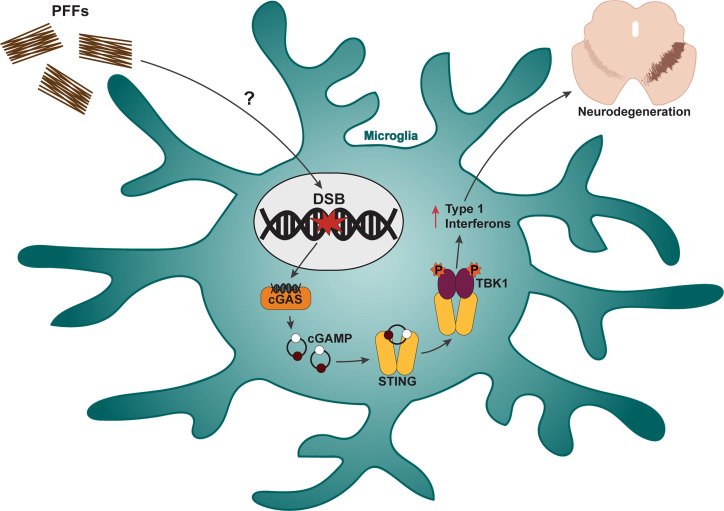
“Both genotoxic damage and microglial STING activation were reproduced in mice after intrastriatal injection of misfolded α -synuclein, features observed in PD brain tissue, as well [60].”
BackgroundPark, B., Nicaise, A. M., Tsitsipatis, D., Pirvan, L., Žucha, D., Munteanu, A., Prasad, P., Larraz, M., Bulgaru, C., Kollyfas, R., et al. (2025) · Neuron · doi:10.1016/j.neuron.2025.09.022 · Cited by 12
Solving the Amyloid Paradox: Unveiling the Complex Pathogenicity of Amyloid Fibrils
Sulatsky, M. I., Stepanenko, O. V., Stepanenko, O. V., & Sulatskaya, A. I. (2025) · Aggregate · doi:10.1002/agt2.70078 · Cited by 11
Solomon, J., Mandal, S., & Aran, K. R. (2026) · Gene · doi:10.1016/j.gene.2026.150000 · Cited by 10
The Role and Therapeutic Potential of the cGAS‐STING Signaling Pathway in Alzheimer's Disease
Li, X., Gao, W., Ye, Q., & Li, H. (2025) · Brain and Behavior · doi:10.1002/brb3.71130 · Cited by 9
“…research now highlights the significant implication of cGAS-STING signaling in major neurodegenerative disorders, including AD (Xie et al. 2023 ), Parkinson’s disease (Standaert and Childers 2022 ), Huntington’s disease (Jauhari et al. 2020 ), and amyotrophic lateral sclerosis (Tan et al. 2022 ).”
STING-triggered CNS inflammation in human neurodegenerative diseasesPreprint
Ferecskó, A. S., Smallwood, M. J., Moore, A., Liddle, C., Newcombe, J., Holley, J. E., Whatmore, J. L., Gutowski, N. J., & Eggleton, P. (2023) · Research Square · doi:10.21203/rs.3.rs-2264071/v2 · Cited by 9
Mi, S., Nakashima, H., & Nakashima, K. (2025) · Epigenomes · doi:10.3390/epigenomes9040038 · Cited by 8
“Moreover, aging-induced impairment of mitophagy–lysosomal flux and of genome maintenance increase endogenous DNA ligands (e.g., mtDNA, gDNA and L1 cDNA) in the cytosol that triggers cGAS–STING pathway activation [110–116].”
The role of autophagy in spinal cord injury: Mechanisms, crosstalk, and therapeutic strategies
Wang, R., Niu, Z., Tian, R.-Z., Chen, A., Liao, H., Kuang, R., Feng, Y., Chin, G., Xie, J., Zhu, P., et al. (2025) · Neural Regeneration Research · doi:10.4103/nrr.nrr-d-24-01467 · Cited by 8
The cGAS-STING pathway in aging and neurological diseases: From mechanisms to treatment
Li, Y., Chen, Y., Liu, Y., Wang, C., Fu, X., & Ren, M. (2025) · Cellular Signalling · doi:10.1016/j.cellsig.2025.111978 · Cited by 7
Zhong, S., Zhou, Q., Yang, J., Zhang, Z., Chai, X., Luo, J., Zhang, X., Liu, J., Yixi, Y., Shi, L., et al. (2026) · Environment & Health · doi:10.1021/envhealth.5c00504 · Cited by 5
Spotlight on cGAS-STING: role in disease pathogenesis and therapeutic potential
Yan, D., Hu, J., Liu, Z. H., & Ouyang, W. (2026) · Molecular Biomedicine · doi:10.1186/s43556-026-00478-5 · Cited by 4
“Pathological processes in NDs, such as Alzheimer’s disease and Parkinson’s disease, often involve mitochondrial dysfunction, leading to mitochondrial DNA leakage into the cytosol [107, 108].”
STING-triggered CNS inflammation in human neurodegenerative diseasesPreprint
Ferecskó, A. S., Smallwood, M. J., Moore, A., Liddle, C., Newcombe, J., Holley, J. E., Whatmore, J. L., Gutowski, N. J., & Eggleton, P. (2022) · Research Square · doi:10.21203/rs.3.rs-2264071/v1 · Cited by 4
Wu, Z., Jia, R., Zhang, Q., Huang, L.-Y., Yan, J.-T., Zhang, Y. H., & Fan, Y. (2026) · Biomarker Research · doi:10.1186/s40364-026-00906-2 · Cited by 3
Abdelaziz, A. M. (2026) · International Immunopharmacology · doi:10.1016/j.intimp.2026.116628 · Cited by 2
Kaya, Y., & Kırboğa, K. K. (2026) · Frontiers in Human Neuroscience · doi:10.3389/fnhum.2026.1768774 · Cited by 4
“Furthermore, genotoxic damage accumulation and STING activation in microglia after the intrastriatal injection of misfolded α -synuclein in mice highlight the importance of this mechanism in the pathogenesis of PD (Standaert and Childers, 2022).”
Organelle-orchestrated cGAS-STING signaling and its role in neurodegeneration
Liu, J.-Y., Sheng-ye, L., Ran, L.-X., Qiao, W., Zhang, F. Y., Zhang, K.-S., Liang, X.-X., Liu, M., Yu, Z.-H., Wei, M., et al. (2026) · Pharmacological Research · doi:10.1016/j.phrs.2026.108216 · Cited by 2
Targeting the cGAS–STING pathway mitigates Huntington disease pathogenesis in a knock-in mouse model
Kesharwani, A., Dagar, S., Zuniga, I., Monet, M. C., Halade, G. V., Upadhyay, G., Ramírez-Jarquín, U. N., López-Huerta, V. G., Mirza, E., Quan, N., et al. (2026) · Proceedings of the National Academy of Sciences · doi:10.1073/pnas.2535879123 · Cited by 2
“For example, cGAS/STING activation promotes neuroinflammation and neurodegeneration in Parkinson’s disease models, and inhibition of the pathway ameliorates dopaminergic injury and motor phenotypes (72, 73).”
Wang, M., Li, J., Wang, X., Chai, X., Luo, J., Zhang, Y., Chang, X., Sun, Y., & Wang, H. (2026) · Cytokine & Growth Factor Reviews · doi:10.1016/j.cytogfr.2026.101537 · Cited by 2
Bezrukova, A. I., Basharova, K. S., Galkina, E. S., Epifanivskaya, O. S., Baydakova, G. V., Zakharova, E. Y., Pchelina, S. N., & Т.С., У. (2026) · Biomeditsinskaya Khimiya · doi:10.18097/pbmcr1616 · Cited by 1
Li, M., Zhao, R., Wang, Q., Chen, J., Ma, X., Wang, H., & Li, J. (2026) · Journal of Agricultural and Food Chemistry · doi:10.1021/acs.jafc.6c07144
Liu, H., Zhang, Y., Zhuo, Z., Zhong, W., Yan, M., & 赵重波 (2026) · Experimental and Therapeutic Medicine · doi:10.3892/etm.2026.13286
“The Standaert group reported that misfolded α ‑syn can induce DNA damage in microglia and activate cGAS/STING‑mediated inflammation, thereby promoting neurodegeneration (76).”
Al-hakeem, M. A., Almajidi, Y. Q., Alshkarchy, S. S., Kareem, A. K., Rangaswamy, R., Al-Khafaji, Z. K. A., Nayak, P. P., Chennakesavulu, K., Sharma, R., & Kadhum, W. R. (2026) · European Journal of Neuroscience · doi:10.1111/ejn.70689
“…preformed fibrils can directly induce DNA double-strand breaks in dopaminergic neurons—potentially creating a feed-forward loop in which protein aggregation drives further somatic mutation, which in turn increases protein production and aggregation propensity (Standaert and Childers 2022).”
Usenko, T. S., Bezrukova, A. I., Basharova, K. S., Grigor’eva, E. V., Pavlova, S. V., Baydakova, G., Miliukhina, I. V., Zakharova, E. Y., & Pchelina, S. (2026) · Biochemistry (Moscow) · doi:10.1134/s0006297926601644
Lyu, P., Shen, W., Wang, Y., Chen, X., Liu, S., Zhang, Y., Mula, A., Jia, X., 张, 美., Bu, N., et al. (2026) · Molecular Neurobiology · doi:10.1007/s12035-026-06220-0
Metadata
- Authors
- Standaert, D. G., & Childers, G. M.
- Affiliations
- University of Alabama at Birmingham (US)
- Corresponding author
- Standaert, David G.
- Venue
- Proceedings of the National Academy of Sciences
- Publisher
- National Academy of Sciences
- Published
- 2022-04-21
- Volume
- 119
- Issue
- 17
- Pages
- e2204058119-e2204058119
- ISSN
- 0027-8424 (ISSN-L)
- 1091-6490
- PMC
- PMC9170025
- OpenAlex
- W4224210637
- Cited by
- 40
- References
- 15
- Citations by year
- 2026: 13 · 2025: 8 · 2024: 10 · 2023: 8 · 2022: 1
- FWCI
- 3.55
- Type
- journal article
- Language
- en
- Open access
- hybrid
- doi.org
- Licence
- Locations
- Proceedings of the National Academy of Sciences (publishedVersion, cc-by-nc-nd)
- PubMed Central (publishedVersion, cc-by-nc-nd)
- PubMed (publishedVersion)
- Funders
- Office of Extramural Research, National Institutes of Health (NS108675)
- Topics
- Health Sciences › Medicine › Clinical Neurology › Parkinson's Disease Mechanisms and Treatments
- Life Sciences › Neuroscience › Neurology › Neuroinflammation and Neurodegeneration Mechanisms
- Life Sciences › Biochemistry, Genetics and Molecular Biology › Molecular Biology › Nuclear Receptors and Signaling
- Keywords
- alpha-synuclein, DNA damage, STING activation, neuroinflammation, Parkinson's disease, innate immunity, neurodegeneration
- MeSH terms
- Neuroinflammatory Diseases, Animals, Disease Models, Animal, DNA Damage, Parkinson Disease, alpha-Synuclein
About these checks
Registry, retraction, Cites and statistics results are computed, not judged, with one exception: a printed reference that no index lists is read once by a model before it counts as a citation error. Claims are extracted by a model and kept only when their quote appears verbatim in the text; each cited source is then checked, with a model’s help, for whether it says what the claim relies on. Those verdicts can be wrong — read the claim’s quote and the cited source before relying on one.
Statistics and arithmetic are recomputed, not judged.
Confidence bands are shown only for fields calibrated on our annotated test set. None is calibrated yet, so no band is shown.
What counts as a claim ›How we measure confidence ›How we check this ›
Are you an author, or do you see a problem with this page? Request a review
Data sources
Bibliographic data: Semantic Scholar, OpenAlex, Crossref.
Contains information from the Semantic Scholar Academic Graph Datasets, made available under the ODC Attribution License (ODC-BY 1.0).
Semantic Scholar’s data is described in: Kinney, R., et al. (2023). The Semantic Scholar Open Data Platform. arXiv:2301.10140.
