

Amelioration of pathologic α-synuclein-induced Parkinson’s disease by irisin
Open accessThe DOI matches its Crossref record; 50 of the 51 references it cites were found in a registry or an index.
Abstract
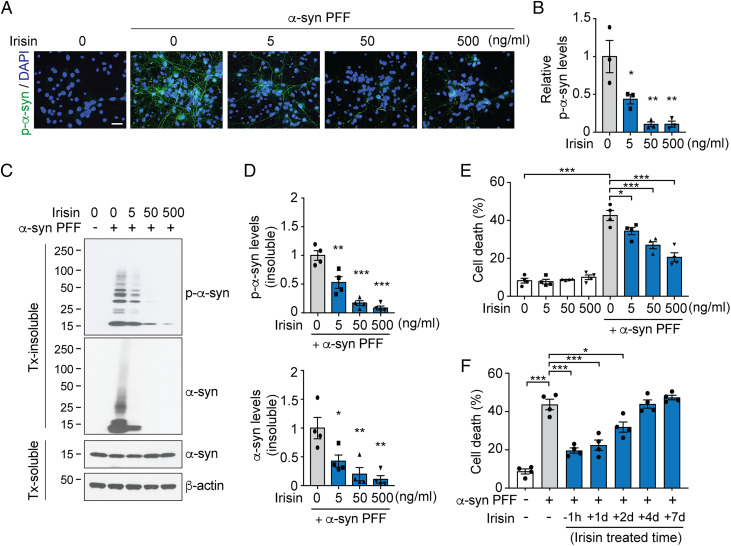
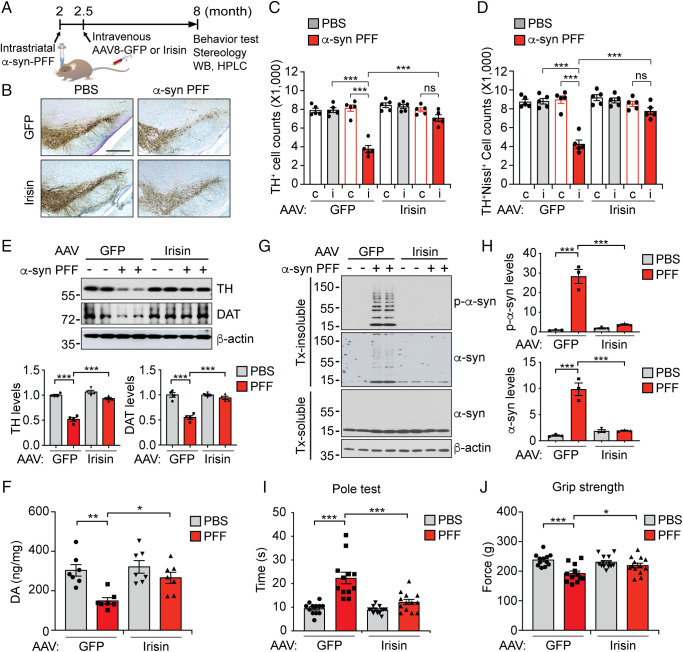
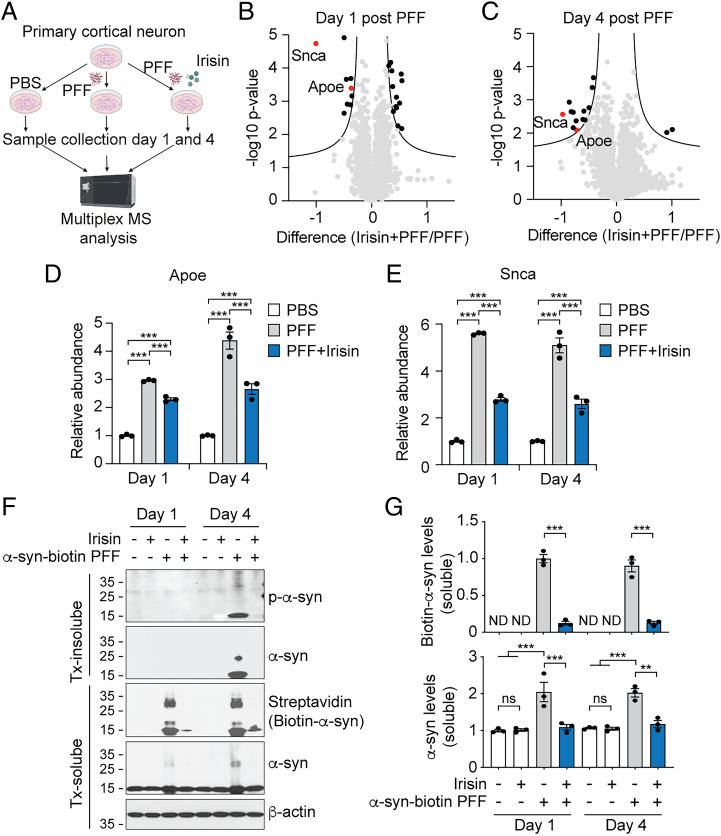
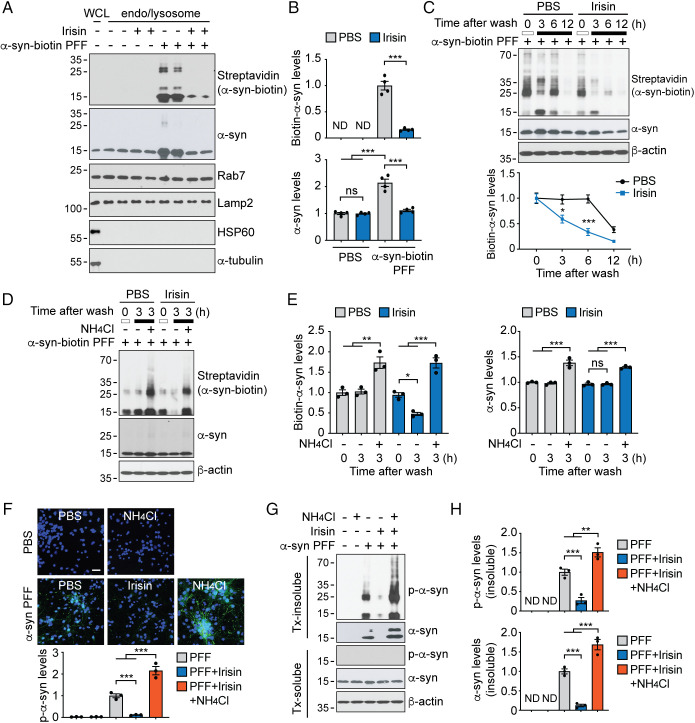
Physical activity provides clinical benefit in Parkinson’s disease (PD). Irisin is an exercise-induced polypeptide secreted by skeletal muscle that crosses the blood–brain barrier and mediates certain effects of exercise. Here, we show that irisin prevents pathologic α-synuclein (α-syn)-induced neurodegeneration in the α-syn preformed fibril (PFF) mouse model of sporadic PD. Intravenous delivery of irisin via viral vectors following the stereotaxic intrastriatal injection of α-syn PFF cause a reduction in the formation of pathologic α-syn and prevented the loss of dopamine neurons and lowering of striatal dopamine. Irisin also substantially reduced the α-syn PFF-induced motor deficits as assessed behaviorally by the pole and grip strength test. Recombinant sustained irisin treatment of primary cortical neurons attenuated α-syn PFF toxicity by reducing the formation of phosphorylated serine 129 of α-syn and neuronal cell death. Tandem mass spectrometry and biochemical analysis revealed that irisin reduced pathologic α-syn by enhancing endolysosomal degradation of pathologic α-syn. Our findings highlight the potential for therapeutic disease modification of irisin in PD.
Overview
The claims and statistics of this paper haven’t been checked yet.
Free: it reads the open-access text and checks the first 5 claims that cite a source we can check. Create a free account to check every claim.
Integrity signals
Registry
Cites
Statistics
Figures
Verification
Claims the paper makes
The claims and statistics of this paper haven’t been checked yet.
Free: it reads the open-access text and checks the first 5 claims that cite a source we can check. Create a free account to check every claim.
Claims other papers make about this one
Each is checked against this paper’s own text: does it say what the citing paper says it does?
The cited source says what the claim attributes to it.
In the citing paper
“Additionally, irisin reduces the formation of pathologic α-syn, prevents the loss of dopaminergic neurons, and improves α-syn-induced motor deficits.383”
From Antiageing strategy for neurodegenerative diseases: from mechanisms to clinical advances (2025) · cites this paper as [383]
Self-check
Percentages, sums and reported differences re-computed from the paper’s own numbers.
The self-check needs the paper’s full text.
Citations
Cites
The Perseus computational platform for comprehensive analysis of (prote)omics data
Tyanova, S., Temu, T., Sinitcyn, P., Carlson, A., Hein, M. Y., Geiger, T., Mann, M., & Cox, J. (2016) · Nature Methods · doi:10.1038/nmeth.3901 · Cited by 8,803
Parkinson's disease: clinical features and diagnosis
Jankovic, J. (2008) · Journal of Neurology, Neurosurgery & Psychiatry · doi:10.1136/jnnp.2007.131045 · Cited by 5,720
A PGC1-α-dependent myokine that drives brown-fat-like development of white fat and thermogenesis
Boström, P., Wu, J., Jedrychowski, M. P., Korde, A., Ye, L., Lo, J. C., Rasbach, K. A., Boström, E. A., Choi, J. H., Long, J. Z., et al. (2012) · Nature · doi:10.1038/nature10777 · Cited by 4,810
Self-citationElias, J. E., & Gygi, S. P. (2007) · Nature Methods · doi:10.1038/nmeth1019 · Cited by 3,925
Luk, K. C., Kehm, V., Carroll, J., Zhang, B., O’Brien, P., Trojanowski, J. Q., & Lee, V. M.-Y. (2012) · Science · doi:10.1126/science.1227157 · Cited by 2,563
α-Synuclein is phosphorylated in synucleinopathy lesions
Fujiwara, H., Hasegawa, M., Dohmae, N., Kawashima, A., Masliah, E., Goldberg, M. S., Shen, J., Takio, K., & Iwatsubo, T. (2002) · Nature Cell Biology · doi:10.1038/ncb748 · Cited by 2,132
Single-pot, solid-phase-enhanced sample preparation for proteomics experiments
Hughes, C. S., Moggridge, S., Müller, T., Sorensen, P. H., Morin, G. B., & Krijgsveld, J. (2019) · Nature Protocols · doi:10.1038/s41596-018-0082-x · Cited by 1,941
A tissue-specific atlas of mouse protein phosphorylation and expression
Huttlin, E. L., Jedrychowski, M. P., Elias, J. E., Goswami, T., Rad, R., Beausoleil, S. A., Villén, J., Haas, W., Sowa, M. E., & Gygi, S. P. (2010) · Cell · doi:10.1016/j.cell.2010.12.001 · Cited by 1,778
The role of apolipoprotein E in Alzheimer's disease
Kim, J., Basak, J. M., & Holtzman, D. M. (2009) · Neuron · doi:10.1016/j.neuron.2009.06.026 · Cited by 1,661
-Synuclein in Parkinson's Disease
Stefanis, L. (2012) · Cold Spring Harbor Perspectives in Medicine · doi:10.1101/cshperspect.a009399 · Cited by 1,446
Research works printed but not linked: 1
- T-I. Kam., Amelioration of pathologic α-synuclein-induced Parkinson’s disease by irisin. ProteomeXchange Consortium. http://proteomecentral.proteomexchange.org/cgi/GetDataset?ID=PXD032670. Deposited 20 March 2022. PMC9457183 36044549
Cited by
Items 101–124 of 124
Tanaka, R., Liao, J., Liu, Y., Zhu, W., Fukuzawa, K., Kondo, M., Sawahata, M., Mori, D., Mouri, A., Kubota, H., et al. (2026) · Molecular Psychiatry · doi:10.1038/s41380-026-03567-7 · Cited by 2
Organellar insights in ageing and longevity
Mannino, P., Park, M., & Wang, M. C. (2026) · Nature Cell Biology · doi:10.1038/s41556-026-01927-7 · Cited by 2
Wu, M., Wu, Y., Feng, X., Huang, Y., Chen, L., Li, G., Zhang, D.-Q., Zhao, W., & Chen, Y. (2026) · Peptides · doi:10.1016/j.peptides.2026.171491 · Cited by 1
IPEKTEN, E., Belviranlı, M., & Okudan, N. (2024) · Anais da Academia Brasileira de Ciências · doi:10.1590/0001-3765202420231132 · Cited by 1
Tanaka, R., Liao, J., Liu, Y., Zhu, W., Fukuzawa, K., Kondo, M., Sawahata, M., Mori, D., Mouri, A., Kubota, H., et al. (2024) · bioRxiv (Cold Spring Harbor Laboratory) · doi:10.1101/2024.09.16.613372 · Cited by 1
Jin, C., Jiang, Y., & Wu, H. (2023) · Parkinsonism & Related Disorders · doi:10.1016/j.parkreldis.2023.105771
RetractedMustafayev, N., Tunç, A., Elibol, B., Eren, K. U., & Uşak, Ş. T. (2024) · Turkish Journal Of Neurology · doi:10.55697/tnd.2024.8
From the Dance Floor to the Brain: The Effects of Music and Dance on Movement Disorders
Kojović, M. (2024) · Movement Disorders Clinical Practice · doi:10.1002/mdc3.14312
Asai, K., Gon, Y., Kimura, Y., Morishima, T., Mochizuki, H., & Miyashiro, I. (2025) · Brain Communications · doi:10.1093/braincomms/fcaf347
Developing Subcutaneous Formulations for Irisin as a Potential Therapeutic
Hu, G., Luan, X., Hageman, M. J., & Lou, H. (2025) · Pharmaceutical Research · doi:10.1007/s11095-025-03945-w
de Brito-Neto, J. G., Morais, P. L. A. D. G., Cavalcanti, J. R. L. D. P., Pinheiro, F. I., Gúzen, F. P., & Cobucci, R. N. (2026) · Pharmacy · doi:10.3390/pharmacy14010009 · Cited by 1
Lawson, P. H., Brown, O. S., & Moore, D. K. (2022) · Bulletin of pioneering researches of medical and clinical science · doi:10.51847/6dwbix6x7k
Exercise, exerkines, and muscle–brain crosstalk in Parkinson's disease
Páez‐García, S., Alvarado, E., Cuevas, A., Valverde, L., Salinas, E., O'Hara‐Veintimilla, K., Rodriguez-Oroz, M. C., & Borda, M. G. (2026) · Neuroprotection/Neuroprotection (Chichester, England. Print) · doi:10.1002/nep3.70032 · Cited by 1
Atalay, B., Erincik, K., Doğan, M. B., Gezgin, M., Yildiz, H., & Özdilek, B. (2026) · Clinical Neurology and Neurosurgery · doi:10.1016/j.clineuro.2026.109388
Jin, L., Li, R., Zhang, J., Ren, X., Li, B., Xiang, X., Liu, Y., Zhou, Y., & Song, Y. (2026) · Research Square · doi:10.21203/rs.3.rs-9467573/v1
Hu, A., Tang, X., Xu, Q., Yu, J., Zheng, S., Li, H., Zhang, J. X., & Ye, M. (2026) · Neuroscience & Biobehavioral Reviews · doi:10.1016/j.neubiorev.2026.106792
Zhai, T., Wang, H., An, Y., Deng, M., Zhang, K., Du, Y., Yang, C., Yu, L., & Guo, F. (2026) · The FASEB Journal · doi:10.1096/fj.202600011rr
Urso, D., & Logroscino, G. (2026) · Journal of Neural Transmission · doi:10.1007/s00702-026-03297-8
Shu, C., Huang, J., Pu, W., Liang, H., Xu, Z., Wang, X., & 李丽喜 (2026) · Frontiers in Aging Neuroscience · doi:10.3389/fnagi.2026.1918326
Potential role of irisin-mediated oxidative stress defense in systemic diseases
Xiao, X., 吴丽颖, Zhu, X., & Zhou, J. (2026) · Frontiers in Cell and Developmental Biology · doi:10.3389/fcell.2026.1996659
Correlation Between Cognitive Function and Serum Irisin Levels in Parkinson's Disease Patients
Gui, M., Qin, L., Lv, L., Huang, J., Hu, S., Chen, K., Wang, X., Zhou, Y., Tang, B., 张海南, et al. (2026) · Brain and Behavior · doi:10.1002/brb3.71848
Wang, X., Luo, H., Yi, G., Zhou, H., Wang, B., & Tu, Q. (2026) · Molecular Neurobiology · doi:10.1007/s12035-026-06284-y
Metadata
- Authors
- Kam, T.-I., Park, H., Chou, S.-C., Van Vranken, J. G., Mittenbühler, M. J., Kim, H., A, M., Choi, Y. R., Biswas, D., Wang, J., Shin, Y., Loder, A., Karuppagounder, S. S., Wrann, C. D., Dawson, V. L., Spiegelman, B. M., & Dawson, T. M.
- Affiliations
- Johns Hopkins University (US)
- Department of Cell Biology, Harvard Medical School, Boston, MA, 02215
- Harvard University (US)
- Corresponding author
- Spiegelman, Bruce M.
- Dawson, Ted M.
- ORCID
- Venue
- Proceedings of the National Academy of Sciences
- Publisher
- National Academy of Sciences
- Published
- 2022-08-31
- Volume
- 119
- Issue
- 36
- Pages
- e2204835119-e2204835119
- ISSN
- 0027-8424 (ISSN-L)
- 1091-6490
- PMC
- PMC9457183
- OpenAlex
- W4293785272
- Cited by
- 125
- References
- 51
- Citations by year
- 2026: 25 · 2025: 38 · 2024: 39 · 2023: 20 · 2022: 3
- FWCI
- 13.16
- Type
- journal article
- Language
- en
- Open access
- hybrid
- doi.org
- Licence
- Locations
- Proceedings of the National Academy of Sciences (publishedVersion, cc-by)
- PubMed Central (publishedVersion, cc-by)
- PubMed (publishedVersion)
- Funders
- JPB Foundation (N/A)
- Maryland Stem Cell Research Fund (2020-MSCRFL-5427)
- Damon Runyon Cancer Research Foundation (DRG 2359-19)
- Deutsche Forschungsgemeinschaft (461079553)
- Topics
- Health Sciences › Medicine › Clinical Neurology › Parkinson's Disease Mechanisms and Treatments
- Life Sciences › Biochemistry, Genetics and Molecular Biology › Molecular Biology › Nuclear Receptors and Signaling
- Life Sciences › Neuroscience › Cellular and Molecular Neuroscience › Alzheimer's disease research and treatments
- Keywords
- irisin, Parkinson's disease, alpha-synuclein, preformed fibrils, neurodegeneration, dopaminergic neurons, striatum, motor impairment, serine 129 phosphorylation, endolysosomal degradation, viral gene delivery, physical activity
- MeSH terms
- Animals, Corpus Striatum, Disease Models, Animal, Fibronectins, Parkinson Disease, Mice, alpha-Synuclein, Dopaminergic Neurons
About these checks
Registry, retraction, Cites and statistics results are computed, not judged, with one exception: a printed reference that no index lists is read once by a model before it counts as a citation error. Claims are extracted by a model and kept only when their quote appears verbatim in the text; each cited source is then checked, with a model’s help, for whether it says what the claim relies on. Those verdicts can be wrong — read the claim’s quote and the cited source before relying on one.
Statistics and arithmetic are recomputed, not judged.
Confidence bands are shown only for fields calibrated on our annotated test set. None is calibrated yet, so no band is shown.
What counts as a claim ›How we measure confidence ›How we check this ›
Are you an author, or do you see a problem with this page? Request a review
Data sources
Bibliographic data: Semantic Scholar, OpenAlex, Crossref.
Contains information from the Semantic Scholar Academic Graph Datasets, made available under the ODC Attribution License (ODC-BY 1.0).
Semantic Scholar’s data is described in: Kinney, R., et al. (2023). The Semantic Scholar Open Data Platform. arXiv:2301.10140.
