Student or educator? Sign up with your school email and get 6 months of Pro free.
CoChat

The DOI matches its Crossref record; 80 of the 80 references it cites were found in a registry or an index.

Bayesian inference in ring attractor networks

Open access
Kutschireiter, Anna, Basnak, Melanie A., Wilson, Rachel I., Drugowitsch, Jan · 2023 · Proceedings of the National Academy of Sciences

Published version of a preprint

Abstract

Working memories are thought to be held in attractor networks in the brain. These attractors should keep track of the uncertainty associated with each memory, so as to weigh it properly against conflicting new evidence. However, conventional attractors do not represent uncertainty. Here, we show how uncertainty could be incorporated into an attractor, specifically a ring attractor that encodes head direction. First, we introduce a rigorous normative framework (the circular Kalman filter) for benchmarking the performance of a ring attractor under conditions of uncertainty. Next, we show that the recurrent connections within a conventional ring attractor can be retuned to match this benchmark. This allows the amplitude of network activity to grow in response to confirmatory evidence, while shrinking in response to poor-quality or strongly conflicting evidence. This “Bayesian ring attractor” performs near-optimal angular path integration and evidence accumulation. Indeed, we show that a Bayesian ring attractor is consistently more accurate than a conventional ring attractor. Moreover, near-optimal performance can be achieved without exact tuning of the network connections. Finally, we use large-scale connectome data to show that the network can achieve near-optimal performance even after we incorporate biological constraints. Our work demonstrates how attractors can implement a dynamic Bayesian inference algorithm in a biologically plausible manner, and it makes testable predictions with direct relevance to the head direction system as well as any neural system that tracks direction, orientation, or periodic rhythms.

Overview

The claims and statistics of this paper haven’t been checked yet.

Free: it reads the open-access text and checks the first 5 claims that cite a source we can check. Create a free account to check every claim.

A few free checks a day · papers already verified open instantly · results are public

Integrity signals

Registry

Crossref · 10.1073/pnas.2210622120

Cites

80 of 80 references verified0 citation errors · 0 not checkable

Statistics

Figures

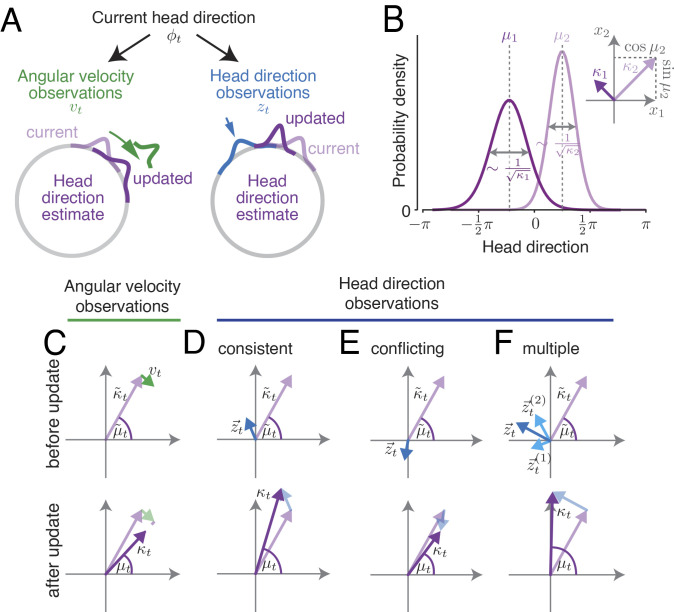
Fig. 1. Tracking HD with the circular Kalman filter. (A) Angular velocity observations provide noisy information about the true angular velocity ϕ˙t, while HD observations provide noisy information about the true HD ϕt. (B) At every point in time, the posterior belief p(ϕt) is approximated by a von Mises distribution, which is fully characterized by its mean μt (location of distribution’s peak) and its precision/certainty parameter κt. Interpreted as the polar coordinates in the 2D plane, these parameters provide a convenient vector representation of the posterior belief (inset). (C) An angular velocity observation vt is a vector tangent to the current HD belief vector. Angular velocity observations continually rotate the current HD estimate; meanwhile, noise accumulation progressively decreases certainty. (D) Each HD observation zt is a vector whose length quantifies the observation’s reliability. Adding this vector to the current HD belief vector produces an updated HD belief vector. HD observations compatible with the current HD estimate result in an increased certainty (i.e., a longer belief vector). (E) HD observations in conflict with the current belief (e.g., opposite direction of the current estimate) decrease the belief’s certainty. (F) Multiple HD cues can be integrated simultaneously via vector addition.
Fig. 1. Tracking HD with the circular Kalman filter. (A) Angular velocity observations provide noisy information about the true angular velocity ϕ˙t, while HD observations provide noisy information about the true HD ϕt. (B) At every point in time, the posterior belief p(ϕt) is approximated by a von Mises distribution, which is fully characterized by its mean μt (location of distribution’s peak) and its precision/certainty parameter κt. Interpreted as the polar coordinates in the 2D plane, these parameters provide a convenient vector representation of the posterior belief (inset). (C) An angular velocity observation vt is a vector tangent to the current HD belief vector. Angular velocity observations continually rotate the current HD estimate; meanwhile, noise accumulation progressively decreases certainty. (D) Each HD observation zt is a vector whose length quantifies the observation’s reliability. Adding this vector to the current HD belief vector produces an updated HD belief vector. HD observations compatible with the current HD estimate result in an increased certainty (i.e., a longer belief vector). (E) HD observations in conflict with the current belief (e.g., opposite direction of the current estimate) decrease the belief’s certainty. (F) Multiple HD cues can be integrated simultaneously via vector addition.CC BY-NC-ND · PubMed Central
Fig. 2. A recurrent neural network implementation of the circular Kalman filter. The HD belief vector (B; Fig. 1B) is the “vector representation” of the HD belief (C), and the “phasor representation” (obtained from linear decoding) of sinusoidal population activity (A; neurons sorted by preferred HD ϕi), here shown for HD estimate μ = π/4 (shift of activity/density) and different certainties κ (height of activity bump in A/sharpness of distribution in C). Using this duality between population activity and encoded HD belief, the circular Kalman filter can be implemented by three network motifs (D–F). (D) A cosine-shaped input to the network (strength = observation reliability κz) provides HD observation input. (E) Rotations of the HD belief vector are mediated by symmetric recurrent connectivities, whose strength is modulated by angular velocity observations. (F) Decay in amplitude, which implements decreasing HD certainty, arises from leak and global inhibition. (G) Rotation-symmetric recurrent connectivities (here, neurons are sorted according to their preferred HD) can be decomposed into constant, symmetric, asymmetric, and higher-order frequency components (here dots). (H) The dynamics of the Bayesian ring attractor implement the dynamics of the ideal observer’s belief, as shown in a simulation of a network with 80 neurons. The network received angular velocity observations (always) and HD observations (only in “visual cue” periods). (I) The Bayesian ring attractor network tracks the true HD with the same accuracy (Top; higher = lower average circular distance to true HD; 1 = perfect, 0 = random; Methods) as the circular Kalman filter (circKF, Eqs. 1 and 2) if HD observations are reliable and, therefore, more informative but with slightly lower accuracy once they become less reliable, and therefore less informative. This drop co-occurs with an overestimate in the belief’s certainty κt (Bottom). HD observation reliability is measured here by the amount of Fisher information per unit time. The accuracies and certainties shown are averages over 5,000 simulation runs (Methods for details).
Fig. 2. A recurrent neural network implementation of the circular Kalman filter. The HD belief vector (B; Fig. 1B) is the “vector representation” of the HD belief (C), and the “phasor representation” (obtained from linear decoding) of sinusoidal population activity (A; neurons sorted by preferred HD ϕi), here shown for HD estimate μ = π/4 (shift of activity/density) and different certainties κ (height of activity bump in A/sharpness of distribution in C). Using this duality between population activity and encoded HD belief, the circular Kalman filter can be implemented by three network motifs (D–F). (D) A cosine-shaped input to the network (strength = observation reliability κz) provides HD observation input. (E) Rotations of the HD belief vector are mediated by symmetric recurrent connectivities, whose strength is modulated by angular velocity observations. (F) Decay in amplitude, which implements decreasing HD certainty, arises from leak and global inhibition. (G) Rotation-symmetric recurrent connectivities (here, neurons are sorted according to their preferred HD) can be decomposed into constant, symmetric, asymmetric, and higher-order frequency components (here dots). (H) The dynamics of the Bayesian ring attractor implement the dynamics of the ideal observer’s belief, as shown in a simulation of a network with 80 neurons. The network received angular velocity observations (always) and HD observations (only in “visual cue” periods). (I) The Bayesian ring attractor network tracks the true HD with the same accuracy (Top; higher = lower average circular distance to true HD; 1 = perfect, 0 = random; Methods) as the circular Kalman filter (circKF, Eqs. 1 and 2) if HD observations are reliable and, therefore, more informative but with slightly lower accuracy once they become less reliable, and therefore less informative. This drop co-occurs with an overestimate in the belief’s certainty κt (Bottom). HD observation reliability is measured here by the amount of Fisher information per unit time. The accuracies and certainties shown are averages over 5,000 simulation runs (Methods for details).CC BY-NC-ND · PubMed Central
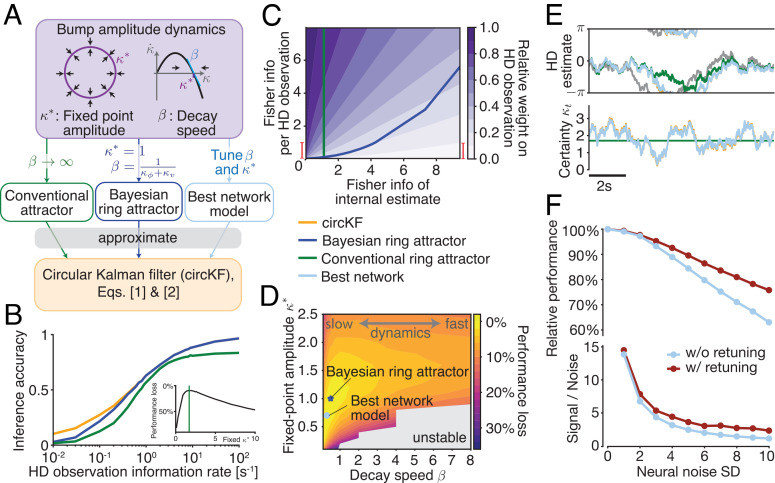
Fig. 3. Ring attractors with slow dynamics approximate Bayesian inference. (A) The ring attractor network in Eq. 4 can be characterized by fixed point amplitude κ* and decay speed β, which depend on the network connectivities. Thus, the network can operate in different regimes: a regime, where the bump amplitude is nearly constant (“conventional attractor”), a regime where amplitude dynamics are tuned to implement a Bayesian ring attractor, or a regime with optimal performance (“best network,” determined numerically). (B) HD estimation performance as measured by inference accuracy as a function of the HD observation information rate (as in Fig. 2I). κ* for the “conventional” attractor was chosen to numerically maximize average accuracy, weighted by a prior across HD information rates (Inset/Methods). (C) The weight with which a single observation contributes to the HD posterior belief varies with informativeness of both the HD observations (Fisher information for 10-ms observation) and the current HD posterior (weight 1 = HD observation replaces HD estimate; 0 = HD observation leaves HD estimate unchanged). The update weight of the Bayesian attractor is close to optimal, visually indistinguishable from the circKF; not shown here, but SI Appendix, Fig. S3. Fisher information per 10-ms observation is directly related to the Fisher information rate, and the vertical red bar shows the equivalent range of information rate shown in panel B. (D) Overall inference performance loss (compared to a particle filter; performance measured by average inference accuracy, as in B, 0%: same average inference accuracy as a particle filter, 100%: random estimates), averaged across all levels of observation reliability (Methods) as a function of the bump amplitude parameters κ* and β (only for κ* > 0 and β > 0 as infinite network weights arise otherwise). (E) Simulated example trajectories of HD estimate/bump positions of HD estimate/bump positions (Top) and certainties/bump amplitudes (Bottom). The Bayesian ring attractor (not shown) is visually indistinguishable from the circKF and best network. (F) Relative performance (Top; 100% = inference accuracy without neural noise; performance measured as in panel D) and signal-to-noise ratio (Bottom; average κt divided by κt SD due to neural noise) drop with increasing neural noise (noise SD for additive noise in the network of 64 neurons). Retuning β and κ* to maximize performance (purple vs. light blue = optimal parameters for noise-free network, panel D) reduces the drop in inference accuracy and S/N.
Fig. 3. Ring attractors with slow dynamics approximate Bayesian inference. (A) The ring attractor network in Eq. 4 can be characterized by fixed point amplitude κ* and decay speed β, which depend on the network connectivities. Thus, the network can operate in different regimes: a regime, where the bump amplitude is nearly constant (“conventional attractor”), a regime where amplitude dynamics are tuned to implement a Bayesian ring attractor, or a regime with optimal performance (“best network,” determined numerically). (B) HD estimation performance as measured by inference accuracy as a function of the HD observation information rate (as in Fig. 2I). κ* for the “conventional” attractor was chosen to numerically maximize average accuracy, weighted by a prior across HD information rates (Inset/Methods). (C) The weight with which a single observation contributes to the HD posterior belief varies with informativeness of both the HD observations (Fisher information for 10-ms observation) and the current HD posterior (weight 1 = HD observation replaces HD estimate; 0 = HD observation leaves HD estimate unchanged). The update weight of the Bayesian attractor is close to optimal, visually indistinguishable from the circKF; not shown here, but SI Appendix, Fig. S3. Fisher information per 10-ms observation is directly related to the Fisher information rate, and the vertical red bar shows the equivalent range of information rate shown in panel B. (D) Overall inference performance loss (compared to a particle filter; performance measured by average inference accuracy, as in B, 0%: same average inference accuracy as a particle filter, 100%: random estimates), averaged across all levels of observation reliability (Methods) as a function of the bump amplitude parameters κ* and β (only for κ* > 0 and β > 0 as infinite network weights arise otherwise). (E) Simulated example trajectories of HD estimate/bump positions of HD estimate/bump positions (Top) and certainties/bump amplitudes (Bottom). The Bayesian ring attractor (not shown) is visually indistinguishable from the circKF and best network. (F) Relative performance (Top; 100% = inference accuracy without neural noise; performance measured as in panel D) and signal-to-noise ratio (Bottom; average κt divided by κt SD due to neural noise) drop with increasing neural noise (noise SD for additive noise in the network of 64 neurons). Retuning β and κ* to maximize performance (purple vs. light blue = optimal parameters for noise-free network, panel D) reduces the drop in inference accuracy and S/N.CC BY-NC-ND · PubMed Central
Fig. 4. A Drosophila-like network implementing the circular Kalman filter. (A) Cell types in the Drosophila brain that could contribute to implementing the circular Kalman filter. (B) Connectivity between EPG, Δ7, and PEN1 neurons, as recovered from the hemibrain:v1.2.1 database (43). Neurons were sorted by their spatial position as a proxy for their preferred HD. The total number of synaptic connections between each cell pair was taken to indicate the functional connection strength between these cells. The polarity of Δ7 → Δ7 connections is unknown, and therefore, these connections are omitted. (C) The connectivity profile of a recurrent neural network (RNN) (Fig. 2D–F) that implements an approximate circKF is strikingly similar to the connectivity of neurons in the Drosophila HD system. To avoid confusion with actual neurons, we refer to the neuronal populations in this idealized RNN as head direction (HD), angular velocity (AV+ and AV-, in reference to the two hemispheres), inhibitory (INH), and external input (EXT) populations. (D) Differential activation of AV populations (left/right: high/low) across hemispheres as well as shifted feedback connectivity from AV to HD populations effectively implements the asymmetric (or shifted) connectivity needed to turn the bump position (here, clockwise shift for anticlockwise turn). (E) Broad excitation of the INH population by the HD population, together with a one-to-one multiplicative interaction between INH and HD population, implements the quadratic decay of the bump amplitude needed for the reduction in certainty arising from probabilistic path integration. (F) External input is mediated by inhibiting HD neurons with the preferred direction opposite to the location of the HD observation, effectively implementing a vector sum of belief with HD observation. (G and H) The inference accuracy of the Drosophila-like network is indistinguishable from that of the Bayesian ring attractor. Inference accuracy, certainty, and HD observation information rate are measured as for Fig. 2I.
Fig. 4. A Drosophila-like network implementing the circular Kalman filter. (A) Cell types in the Drosophila brain that could contribute to implementing the circular Kalman filter. (B) Connectivity between EPG, Δ7, and PEN1 neurons, as recovered from the hemibrain:v1.2.1 database (43). Neurons were sorted by their spatial position as a proxy for their preferred HD. The total number of synaptic connections between each cell pair was taken to indicate the functional connection strength between these cells. The polarity of Δ7 → Δ7 connections is unknown, and therefore, these connections are omitted. (C) The connectivity profile of a recurrent neural network (RNN) (Fig. 2D–F) that implements an approximate circKF is strikingly similar to the connectivity of neurons in the Drosophila HD system. To avoid confusion with actual neurons, we refer to the neuronal populations in this idealized RNN as head direction (HD), angular velocity (AV+ and AV-, in reference to the two hemispheres), inhibitory (INH), and external input (EXT) populations. (D) Differential activation of AV populations (left/right: high/low) across hemispheres as well as shifted feedback connectivity from AV to HD populations effectively implements the asymmetric (or shifted) connectivity needed to turn the bump position (here, clockwise shift for anticlockwise turn). (E) Broad excitation of the INH population by the HD population, together with a one-to-one multiplicative interaction between INH and HD population, implements the quadratic decay of the bump amplitude needed for the reduction in certainty arising from probabilistic path integration. (F) External input is mediated by inhibiting HD neurons with the preferred direction opposite to the location of the HD observation, effectively implementing a vector sum of belief with HD observation. (G and H) The inference accuracy of the Drosophila-like network is indistinguishable from that of the Bayesian ring attractor. Inference accuracy, certainty, and HD observation information rate are measured as for Fig. 2I.CC BY-NC-ND · PubMed Central

Verification

Claims the paper makes

The claims and statistics of this paper haven’t been checked yet.

Free: it reads the open-access text and checks the first 5 claims that cite a source we can check. Create a free account to check every claim.

A few free checks a day · papers already verified open instantly · results are public

Claims other papers make about this one

Each is checked against this paper’s own text: does it say what the citing paper says it does?

1 more claim about this paper

Create a free account to see every claim other papers make about this one.

See all claims — free account

Self-check

Percentages, sums and reported differences re-computed from the paper’s own numbers.

The self-check needs the paper’s full text.

Citations

Cites

Show all 79 references

Research works printed but not linked: 1

  1. P. E. Kloeden E. Platen Numerical Solution of Stochastic Differential Equations Applications of Mathematics (Springer Berlin ed. 3 2010) No. 23.

Cited by

See all 48

Metadata

Authors
Kutschireiter, A., Basnak, M. A., Wilson, R. I., & Drugowitsch, J.
Affiliations
Harvard University (US)
Corresponding author
  • Kutschireiter, Anna
  • Drugowitsch, Jan
Venue
Proceedings of the National Academy of Sciences
Published
2023-02-22
Volume
120
Issue
9
Pages
e2210622120-e2210622120
ISSN
  • 0027-8424 (ISSN-L)
  • 1091-6490
OpenAlex
W4321488001
Cited by
36
References
79
Citations by year
2026: 11 · 2025: 12 · 2024: 4 · 2023: 8
FWCI
5.23
Type
journal article
Language
en
Open access
Locations
  • Proceedings of the National Academy of Sciences (publishedVersion, cc-by-nc-nd)
  • bioRxiv (Cold Spring Harbor Laboratory) (acceptedVersion, cc-by-nc)
  • PubMed Central (publishedVersion, cc-by-nc-nd)
  • PubMed (publishedVersion)
Funders
  • HHS | National Institutes of Health (R34NS123819)
  • James S. McDonnell Foundation (220020462)
  • Swiss National Science Foundation (P2ZHP2 184213:P400PB 199242)
Topics
  • Life Sciences › Neuroscience › Cognitive Neuroscience › Memory and Neural Mechanisms
  • Life Sciences › Neuroscience › Cognitive Neuroscience › Neural dynamics and brain function
  • Physical Sciences › Computer Science › Artificial Intelligence › Neural Networks and Applications
Keywords
Bayesian inference, uncertainty representation, head direction, recurrent connectivity, evidence accumulation, working memory
MeSH terms
Bayes Theorem, Brain, Head, Memory, Short-Term, Models, Neurological, Neural Networks, Computer

About these checks

Registry, retraction, Cites and statistics results are computed, not judged, with one exception: a printed reference that no index lists is read once by a model before it counts as a citation error. Claims are extracted by a model and kept only when their quote appears verbatim in the text; each cited source is then checked, with a model’s help, for whether it says what the claim relies on. Those verdicts can be wrong — read the claim’s quote and the cited source before relying on one.

Statistics and arithmetic are recomputed, not judged.

Confidence bands are shown only for fields calibrated on our annotated test set. None is calibrated yet, so no band is shown.

What counts as a claim ›How we measure confidence ›How we check this ›

Are you an author, or do you see a problem with this page? Request a review

How to cite

Cite CoChat for the checks on this page, and the paper for its own findings.

This page
CoChat. (2026). Citation check: Bayesian inference in ring attractor networks. https://app.cochat.ai/papers/10.1073/pnas.2210622120
The paper
Kutschireiter, A., Basnak, M. A., Wilson, R. I., & Drugowitsch, J. (2023). Bayesian inference in ring attractor networks. Proceedings of the National Academy of Sciences. https://doi.org/10.1073/pnas.2210622120

Data sources

Bibliographic data: Semantic Scholar, OpenAlex, Crossref.

Contains information from the Semantic Scholar Academic Graph Datasets, made available under the ODC Attribution License (ODC-BY 1.0).

Semantic Scholar’s data is described in: Kinney, R., et al. (2023). The Semantic Scholar Open Data Platform. arXiv:2301.10140.