

Meta-analytic relations between personality and cognitive ability
Open accessThe DOI matches its Crossref record; 79 of the 80 references it cites were found in a registry or an index; 13 of the 81 sources its claims cite were checked for support.
Abstract
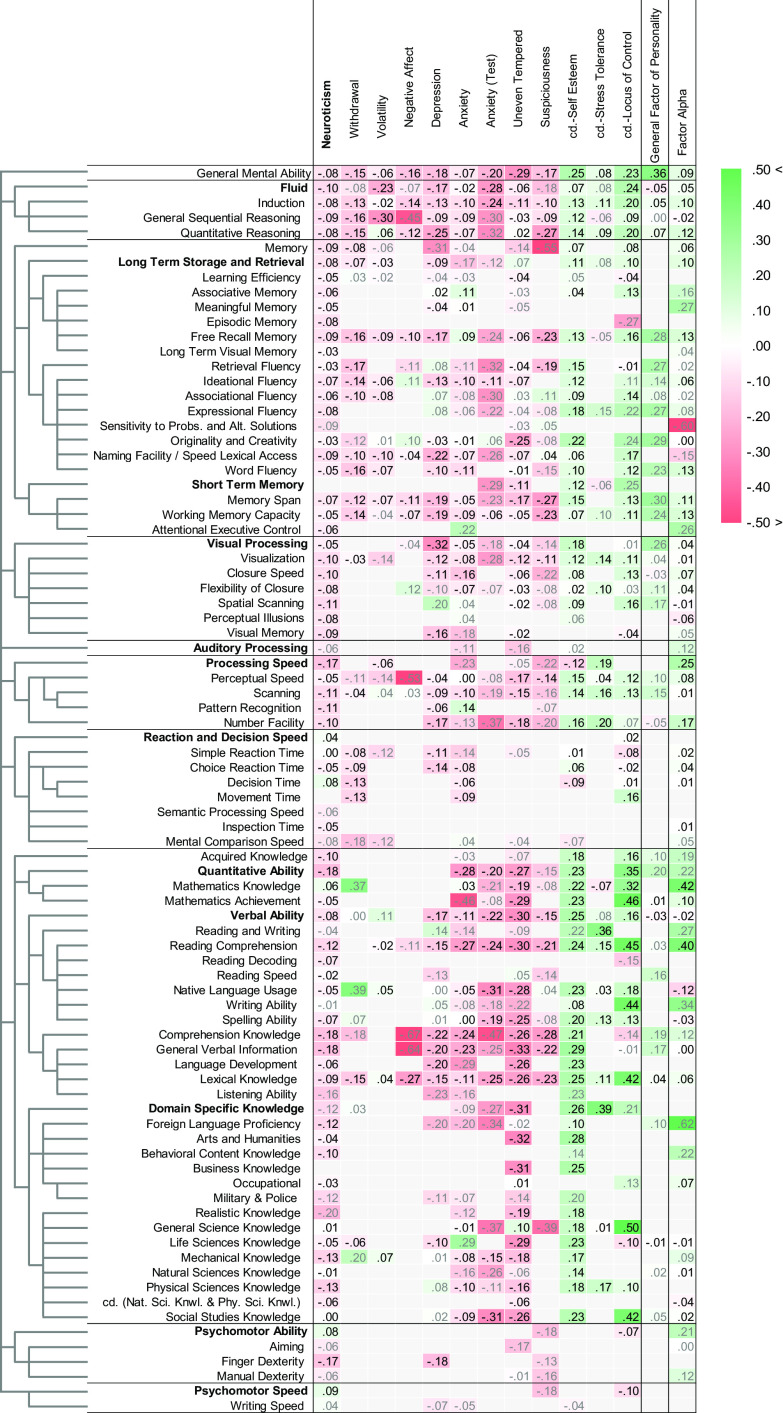
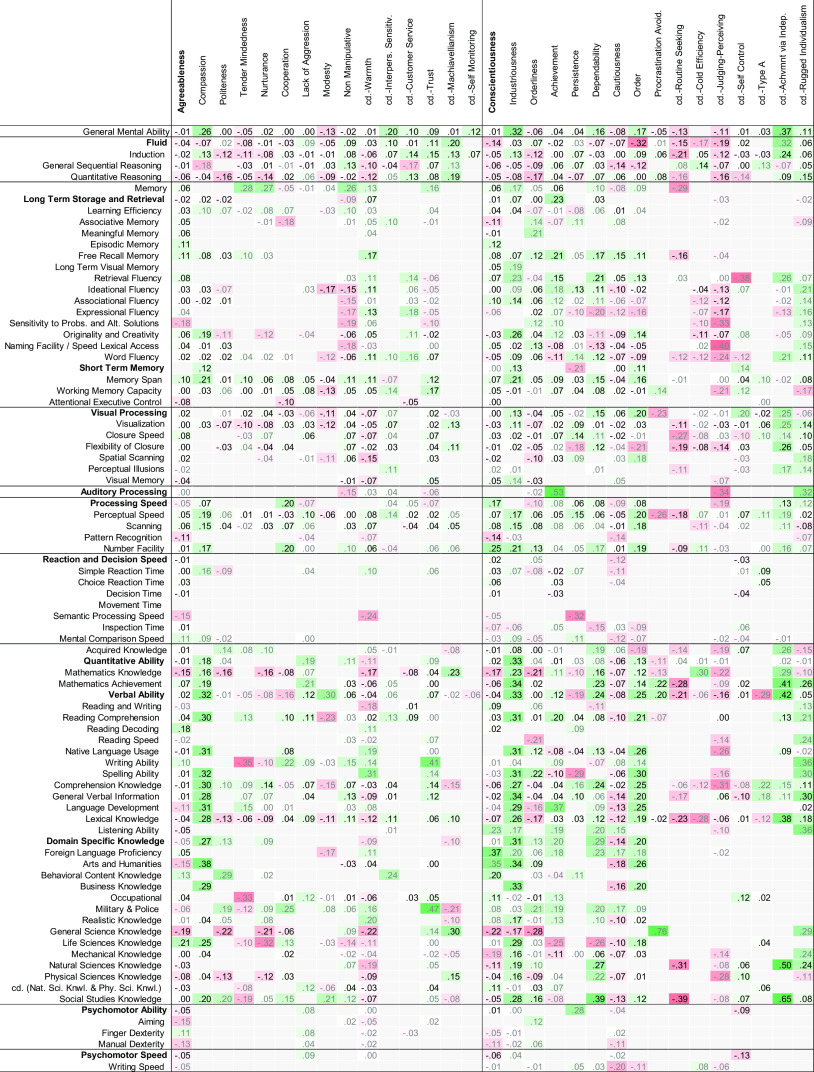
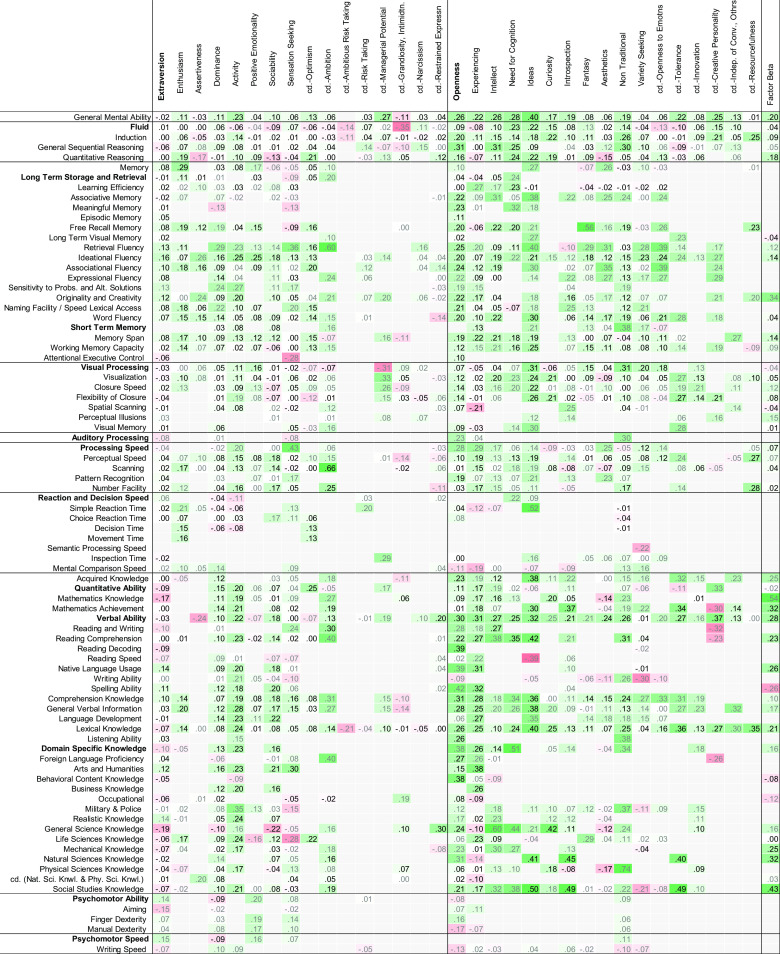
Cognitive ability and personality are fundamental domains of human psychology. Despite a century of vast research, most ability–personality relations remain unestablished. Using contemporary hierarchical personality and cognitive abilities frameworks, we meta-analyze unexamined links between personality traits and cognitive abilities and offer large-scale evidence of their relations. This research quantitatively summarizes 60,690 relations between 79 personality and 97 cognitive ability constructs in 3,543 meta-analyses based on data from millions of individuals. Sets of novel relations are illuminated by distinguishing hierarchical personality and ability constructs (e.g., factors, aspects, facets). The links between personality traits and cognitive abilities are not limited to openness and its components. Some aspects and facets of neuroticism, extraversion, and conscientiousness are also considerably related to primary as well as specific abilities. Overall, the results provide an encyclopedic quantification of what is currently known about personality–ability relations, identify previously unrecognized trait pairings, and reveal knowledge gaps. The meta-analytic findings are visualized in an interactive webtool. The database of coded studies and relations is offered to the scientific community to further advance research, understanding, and applications.
Overview
CoChat Summary
TL;DR
This meta-analysis synthesized 1,325 studies and 2,010,980 people to quantify 3,543 personality–cognitive ability relations, finding many sizable links beyond openness. Relations varied by hierarchical level, with neuroticism facets generally negative and specific facets/aspects of extraversion, conscientiousness, and agreeableness showing notable positive ties to abilities.
Key findings
- Of 3,543 meta-analytic relations, 5% were large or very large (≥.30), 13% medium (.20–.30), 29% small (.10–.20), 25% very small (.05–.10), and 28% negligible (.00–.05); 347 relations involving traits with no openness element had medium-to-large correlations (.20 or greater).
- Neuroticism traits generally correlated negatively with cognitive abilities: global neuroticism was modest (mean ρ = −.07, 95% CI [−.11, −.02]); depression correlated −.18 with general mental ability, and uneven tempered averaged −.29 with acquired knowledge primary abilities.
- Extraversion’s activity facet correlated .23 with general mental ability, mean ρ = .15 with retrieval fluency, .14 with processing speed, and .21 with acquired knowledge; conscientiousness’ industriousness correlated .32 with general mental ability; agreeableness’ compassion correlated .26 with general mental ability and mean .24 with acquired knowledge.
- Openness and general mental ability correlated .26 (95% CI [.25, .27]); intellect-related traits averaged .21 across abilities and .28 with general mental ability, while openness’ experiencing aspect was negligibly related to most non-invested abilities (mean ρ = .05).
Methods
- Psychometric meta-analysis of published and unpublished research identified through nine systematic search procedures: 1,325 studies, 1,976 independent samples, 60,690 personality–ability correlations, 2,010,980 people, and samples from over 50 countries; exclusions included children younger than 12, psychiatric patients, ipsative measures, and certain experimental manipulations.
- The authors estimated relations for 79 personality constructs tied to the Big Five framework and 97 cognitive abilities, yielding 3,543 ability–personality trait pairs; correlations were corrected for sampling error and unreliability in both ability and personality measures using the psychmeta package in R.
- Results were interpreted for meta-analyses with at least 10 independent effect sizes or 1,000 participants; trends across related meta-analyses were synthesized using unit-weighted second-order meta-analytic techniques.
Limitations
- The paper states that for some cognitive ability–personality pairs data were scant, limiting inferences; it also states that reliance on cross-sectional correlations precludes developmental or causal inferences, and that the database is unlikely to be exhaustive despite more than 5 y of searching.
- The text makes evident that many analyses are based on small numbers of samples or individuals, with the authors not interpreting findings based on K < 10 or N < 1,000.
- The paper notes that only 233 of the 3,543 relations were directly comparable to previously published meta-analyses, and nearly half of those comparable effect sizes shifted by .10 or more, indicating that many conclusions rest on newly estimated, less directly replicated relations.
Model-written summary. Check it against the paper before relying on it.
Integrity signals
Registry
Cites
Statistics
Figures
Verification
Claims the paper makes
11 Valid · 5 Not valid · 30 Not checked · 182 Own results and interpretations
The cited sources support only part of this claim — read each source’s verdict below.
In the paper
“In line with previous research (21, 34), acquired knowledge (i.e., invested) abilities tended to be more strongly correlated with personality traits than non-invested abilities were.”
§ Meta-analytic relations between personality and cognitive ability > Results > Overview of Relations and Gaps.
What the sources say
- Not checked yetcites [21] J. Anglim, Personality and intelligence: A meta-analysis. Psychol. Bull. 148, 301 (2022). source
Checked before — its earlier verdict is held back until a new check runs.
- Partly supportedcites [34] L. Borghans, B. H. Golsteyn, J. J. Heckman, J. E. Humphries, What grades and achievement tests measure. Proc. Natl. Acad. Sci. U.S.A. 113, 13354– 13359 (2016). 27830648 PMC5127298 sourceExperimental — accuracy not yet measured
The introduction distinguishes achievement tests designed to measure acquired knowledge from fluid-intelligence tests designed to measure aptitude. The “Grades, Achievement Tests, and Personality” section says personality is positively correlated with achievement-test scores, but it does not establish that these correlations are generally stronger than those for non-invested abilities. The paper also cautions that acquired and innate traits have no clear boundary. (LLM, conf=0.78)
plainstates an association- Asserted: passes — The authors put it forward as true.
- Checkable: passes — It can be checked against evidence.
- Load-bearing: unclear — It is unclear whether the paper’s conclusions depend on it.
- Based: passes — The paper gives a reason why it holds.
- Not checked yet
Every source the paper cites for this claim was checked and supports it.
In the paper
“A key finding was the distinctive patterns of results for the intellect versus experiencing aspects, supporting previous research (50).”
§ Meta-analytic relations between personality and cognitive ability > Results > Openness Traits.
What the sources say
- Supportedcites [50] S. B. Kaufman, Openness to experience and intellect differentially predict creative achievement in the arts and sciences. J. Pers. 84, 248– 258 (2016). 25487993 PMC4459939 source
The Discussion reports distinct patterns: Openness to Experience predicted creative achievement in the arts, while Intellect predicted achievement in the sciences. It also says the results are consistent with a previous finding of different associations for the two aspects. (LLM, conf=0.88)
plainstates an association- Asserted: passes — The authors put it forward as true.
- Checkable: passes — It can be checked against evidence.
- Load-bearing: passes — The paper’s conclusions depend on it.
- Based: passes — The paper gives a reason why it holds.
- Supported
A result the paper reports from its own data — it cites no other source for it, so there is none to check. The quote shows it is in the paper.
In the paper
“Neuroticism facets (e.g., suspiciousness, depression) were negatively related to most cognitive abilities including non-invested (e.g., fluid reasoning) and invested abilities (e.g., knowledge).”
§ Meta-analytic relations between personality and cognitive ability > Abstract
plainstates an association- Asserted: passes — The authors put it forward as true.
- Checkable: passes — It can be checked against evidence.
- Load-bearing: passes — The paper’s conclusions depend on it.
- Based: passes — The paper gives a reason why it holds.
A result the paper reports from its own data — it cites no other source for it, so there is none to check. The quote shows it is in the paper.
In the paper
“Extraversion’s activity facet had sizable, positive relations with several non-invested (e.g., retrieval fluency and processing abilities) and invested abilities.”
§ Meta-analytic relations between personality and cognitive ability > Abstract
plainstates an association- Asserted: passes — The authors put it forward as true.
- Checkable: passes — It can be checked against evidence.
- Load-bearing: passes — The paper’s conclusions depend on it.
- Based: passes — The paper gives a reason why it holds.
A result the paper reports from its own data — it cites no other source for it, so there is none to check. The quote shows it is in the paper.
In the paper
“and −.07 with general mental ability (95% CI [−.11, −.04])”
§ Meta-analytic relations between personality and cognitive ability > Results > Neuroticism Traits.
plainstates an association- Asserted: passes — The authors put it forward as true.
- Checkable: passes — It can be checked against evidence.
- Load-bearing: passes — The paper’s conclusions depend on it.
- Based: passes — The paper gives a reason why it holds.
140 more claims
Create a free account to see all 228 claims and to verify the 6 references still open.
- It may state two separate claims as one. 41
- Probably not a substantial claim. 50
Claims other papers make about this one
Each is checked against this paper’s own text: does it say what the citing paper says it does?
The source backs part of the claim, not all of it — or backs it for a different population, condition or comparison.
In the citing paper
“Stanek and Ones (2023) found that the correlation with CI was .08, -.02, .26, -.01, and .01 for emotional stability, extraversion, openness, agreeableness, and conscientiousness, respectively.”
From A Meta-analysis of the Relationship between Cognitive Intelligence and the Big Five Assessed by Quasi-Ipsative Forced-choice Personality Inventories: Implications for Predicting Job Performance (2025) · cites this paper as Stanek and Ones, 2023
Experimental — accuracy not yet measured
Self-check
Percentages, sums and reported differences re-computed from the paper’s own numbers.
Each contradiction between two passages listed here was confirmed by an independent check.
Rated minor: it would not touch a result — a value no result rests on, a p-value that stays on the same side of the significance level, or a conflict that is clerical, resolved elsewhere in the paper, or outside its own findings.
In the paper
§ Meta-analytic relations between personality and cognitive ability > Results > Overview of Relations and Gaps.
“We do not interpret or discuss findings based on small K or N (i.e., K < 10 or N < 1,000).”
§ Meta-analytic relations between personality and cognitive ability > Materials and Methods > Statistical Analysis: Meta-Analytic Approach.
“The results described above are based on findings less likely due to chance (i.e., meta-analyses with at least 10 independent contributing effect sizes or 1,000 participants).”
Citations
Cites
Preferred Reporting Items for Systematic Reviews and Meta-Analyses: the PRISMA statement
Moher, D., Liberati, A., Tetzlaff, J., Altman, D. G., & for the PRISMA Group (2009) · BMJ · doi:10.1136/bmj.b2535 · Cited by 83,823
Preferred Reporting Items for Systematic Reviews and Meta-Analyses: The PRISMA Statement
Moher, D., Liberati, A., Tetzlaff, J., Altman, D. G., & The PRISMA Group (2009) · PLoS Medicine · doi:10.1371/journal.pmed.1000097 · Cited by 64,042
Wang, G., Ma, R., Qiao, G., Wada, K., Aizawa, Y., & Satoh, T. (2015) · Integrative Medicine International · doi:10.1159/000368408 · Cited by 18,657
The weirdest people in the world?
Henrich, J., Heine, S. J., & Norenzayan, A. (2010) · Behavioral and Brain Sciences · doi:10.1017/s0140525x0999152x · Cited by 12,641 · cited 1×
“Detailed inclusion/exclusion criteria are provided with justifications in SI Appendix , Supplementary Text , Inclusion and exclusion criteria , p. 7. industrialized, rich, educated, and democratic societies (74).”
Methods of Meta-Analysis: Correcting Error and Bias in Research Findings
Schmidt, F. L., & Hunter, J. E. (2015) · doi:10.4135/9781483398105 · Cited by 5,542
Schmidt, F. L., & Hunter, J. E. (1998) · Psychological Bulletin · doi:10.1037//0033-2909.124.2.262 · Cited by 4,180 · cited 1×
“They encompass potent predictors of important behaviors and outcomes (2, 3), including what activities people prefer (4), what environments they gravitate toward (5), who they are drawn to (6), and how well they perform their work (7).”
BackgroundEvaluating Effect Size in Psychological Research: Sense and Nonsense
Funder, D. C., & Ozer, D. J. (2019) · Advances in Methods and Practices in Psychological Science · doi:10.1177/2515245919847202 · Cited by 3,295 · cited 2×
“We interpreted magnitudes using contemporary behavioral science benchmarks (33, p. 156): an effect of r = .05 is “very small,” r = .10 is “small,” r = .20 is “medium,” and an effect size of r = .30 is “large.””
BackgroundMethodHunter, J., & Schmidt, F. (2004) · doi:10.4135/9781412985031 · Cited by 3,023
Meta-analysis of the heritability of human traits based on fifty years of twin studies
Polderman, T. J. C., Benyamin, B., de Leeuw, C. A., Sullivan, P. F., van Bochoven, A., Visscher, P. M., & Posthuma, D. (2015) · Nature Genetics · doi:10.1038/ng.3285 · Cited by 2,467
PREDICTORS OF OBJECTIVE AND SUBJECTIVE CAREER SUCCESS: A META‐ANALYSIS
NG, T. W. H., EBY, L. T., SORENSEN, K. L., & FELDMAN, D. C. (2005) · Personnel Psychology · doi:10.1111/j.1744-6570.2005.00515.x · Cited by 2,412 · cited 1×
“For instance, both cognitive ability and personality traits have been demonstrated to predict career success metrics, such as job performance (69).”
Background
Research works printed but not linked: 6
- D. M. Buss, Human mate selection: Opposites are sometimes said to attract, but in fact we are likely to marry someone who is similar to us in almost every variable. Am. Sci. 73, 47– 51 (1985).
- P. T. Costa, R. R. McCrae, NEO PI-R Professional Manual (Psychological Assessment Resources, 1992).
- J. A. Gray, The Neuropsychology of Anxiety: An Equiry of the Septo-Hippocampal System (Oxford University Press, 1982).
- D. S. Ones, S. Dilchert, C. Giordano, K. C. Stanek, C. Viswesvaran, Waking up Rip van Winkle: A meta-analytic data based evaluation of the HEXACO personality model and inventory. Eur. J. Personal. 34, 538– 541 (2020).
- A. S. Birkland, D. S. Ones, " The structure of emotional stability: A meta-analytic investigation" in Proceedings of 26th International Congress of Applied Psychology (Athens, Greece, 2006).
- Lab S Scimago Journal & Country Rank for Psychology 1996-2018. SJR - International Science Ranking. https://www.scimagojr.com/countryrank.php?area=3200. Accessed 31 December 2018.
Cited by
Li, Y., Chen, C., & Yuan, Y. (2025) · Acta Psychologica · doi:10.1016/j.actpsy.2025.104710 · Cited by 159
El-Akhras, H. A., El-Wahab, M. A. A., Saghier, E. G., & Selem, K. M. (2024) · Journal of Hospitality and Tourism Insights · doi:10.1108/jhti-04-2024-0292 · Cited by 33
Coors, A., Lee, S., Habeck, C. G., & Stern, Y. (2024) · Neurobiology of Aging · doi:10.1016/j.neurobiolaging.2024.02.009 · Cited by 26
The Evolved Mind and Modern Education: Status of Evolutionary Educational Psychology
Geary, D. C. (2024) · Cambridge University Press eBooks · doi:10.1017/9781009454858 · Cited by 22
How big five personality traits influence information sharing on social media: A meta analysis
Lin, H., Wang, C., & Sun, Y. (2024) · PLoS ONE · doi:10.1371/journal.pone.0303770 · Cited by 43
Boredom and curiosity: the hunger and the appetite for information
Seiler, J. P.-H., & Dan, O. (2024) · Frontiers in Psychology · doi:10.3389/fpsyg.2024.1514348 · Cited by 18
Bardach, L., Lohmann, J. F., Horstmann, K. T., Zitzmann, S., & Hecht, M. (2023) · Journal of Research in Personality · doi:10.1016/j.jrp.2023.104445 · Cited by 15
Liu, W., Guo, J., Dong, Y., Li, J., & Wang, Y. (2025) · Journal of Food Science · doi:10.1111/1750-3841.70037 · Cited by 16
Littrell, S., Fugelsang, J. A., & Risko, E. F. (2024) · Personality and Individual Differences · doi:10.1016/j.paid.2024.112570 · Cited by 12
Bobko, P., Roth, P. L., Le, H., Oh, I., & Salgado, J. F. (2024) · International Journal of Selection and Assessment · doi:10.1111/ijsa.12489 · Cited by 16
Taking another look at intelligence and personality using an eye-tracking approach
Bardach, L., Schumacher, A., Trautwein, U., Kasneci, E., Tibus, M., Wortha, F., Gerjets, P. H., & Appel, T. (2024) · npj Science of Learning · doi:10.1038/s41539-024-00252-8 · Cited by 12
Anglim, J., & Marty, A. (2024) · Social Psychological and Personality Science · doi:10.1177/19485506241281025 · Cited by 24
“Despite extensive research on the personality correlates of intelligence (for meta-analyses, see P. L. Ackerman & Heggestad, 1997; Anglim, Dunlop, et al., 2022; Stanek & Ones, 2023), the relationship between intelligence and personal values remains underexplored.”
Looking on the (B)right Side of Life: Cognitive Ability and Miscalibrated Financial Expectations
Dawson, C. (2023) · Personality and Social Psychology Bulletin · doi:10.1177/01461672231209400 · Cited by 13
“Indeed, evidence points to relations between intelligence and broad personality factors (e.g., Anglim et al., 2022; Stanek & Ones, 2023) and between broad personality factors and dispositional optimism (Sharpe et al., 2011).”
Personality, Intelligence, and Second Language Learning Success: A Systematic Review
Xu, W. (2025) · Behavioral Sciences · doi:10.3390/bs15040428 · Cited by 13
“Consequently, some relevant studies may have been missed, influencing the Consequently, some relevant studies may have been missed, influencing the”
InfluentialKulikowski, K., Cucina, J. M., Hayes, T. L., Oh, I., Öneş, D. S., & Viswesvaran, C. (2025) · Journal of Occupational and Organizational Psychology · doi:10.1111/joop.70048 · Cited by 6
Self-citationSchmerwitz, C., & Kopp, B. (2024) · Frontiers in Psychology · doi:10.3389/fpsyg.2024.1437192 · Cited by 7
Association of personality facets and cognition in the Lifelines population-based cohort study
Marcolini, S., Frentz, I., Terracciano, A., & Deyn, P. P. D. (2023) · Journal of Psychiatric Research · doi:10.1016/j.jpsychires.2023.10.034 · Cited by 6
Tolerance to uncertainty as a factor in the mental health of the population in conditions of war
Trofimov, A. Y., & Zabolotna, V. (2023) · Social & Legal Studios · doi:10.32518/sals3.2023.189 · Cited by 13
Stefanova, V., Scheepers, C., Wilson, P. C., & Papageorgiou, K. Α. (2024) · PLoS ONE · doi:10.1371/journal.pone.0302644 · Cited by 8
Schumacher, A., Kammerer, Y., Scharinger, C., Gottschling, S., Hübner, N., Tibus, M., Kasneci, E., Appel, T., Gerjets, P. H., & Bardach, L. (2025) · European Journal of Personality · doi:10.1177/08902070241309124 · Cited by 15
“…intellectual curiosity has been associated with measures of cognitive performance, such as fl uid and crystallized intelligence and academic achievement (Anglim et al., 2022; Chamorro-Premuzic et al., 2006; DeYoung et al., 2005; Kaufman et al., 2016; Stanek & Ones, 2023; von Stumm & Ackerman, 2013).”
Seitz, M., & Steger, D. (2025) · Journal of Intelligence · doi:10.3390/jintelligence13020013 · Cited by 6
Bad news first—Neuroticism, negative expectations, and preference for negative information
Fischer, A., & Mueller, E. M. (2025) · European Journal of Personality · doi:10.1177/08902070251316614 · Cited by 7
“This aligns well with previous research linking openness/intellect to variety seeking, curiosity and general mental abilities (Connelly et al., 2014; Stanek & Ones, 2023) and, more closely re-lated, to information seeking in trivia tasks (Jach et al., 2022).”
Poirier, J., Brault‐Labbé, A., & Brassard, A. (2025) · Gifted Child Quarterly · doi:10.1177/00169862251347293 · Cited by 9
“These effects also seem to remain over time, as suggested by recent studies on intellectually gifted adults samples (e.g., Mammadov & Ward, 2023; Stanek & Ones, 2023).”
Stamate, A. N., Denis, P. L., & Sauvé, G. (2024) · Journal of Intelligence · doi:10.3390/jintelligence12030034 · Cited by 6
Ibarra-López, J. (2023) · 593 Digital Publisher CEIT · doi:10.33386/593dp.2023.5.1993 · Cited by 4
Seiler, J. P.-H., Elpelt, J., Mashkov, V., Ghobadi, A., Kapoor, A., Turner, D., Kaschube, M., Tuescher, O., & Rumpel, S. (2025) · Communications Psychology · doi:10.1038/s44271-025-00233-6 · Cited by 7
“Interestingly, trait openness has also been linked with creativity 80,81 and enhanced cognitive performance 82 , suggesting that the perception of information is associated withtheabilitytoemployittoforminnovativeassociationsandbehaviors 83 .”
The general factor of personality (GFP) in natural language: A deep learning approach
van der Linden, D., Cutler, A., van der Linden, P. A., & Dunkel, C. S. (2025) · Journal of Research in Personality · doi:10.1016/j.jrp.2025.104635 · Cited by 5
Openness/Intellect: A Unique Trait Requires Unique Considerations
Schwaba, T., & Thalmayer, A. G. (2025) · Personality and Social Psychology Review · doi:10.1177/10888683251377227 · Cited by 18
“…and connection in ways related to this trait, and although openness/intellect is associated with desirable qualities like higher intelligence (Stanek & Ones, 2023), we should be careful when assuming there are concrete and objective benefits to higher openness/intellect and receptive when…”
Beyond algorithms: Artificial intelligence driven talent identification with human insight
França, T. J. F., Mamede, H. S., Barroso, J., & Santos, V. (2025) · Intelligent Systems with Applications · doi:10.1016/j.iswa.2025.200604 · Cited by 9
Intellectual giftedness and early adversity: searching for the hidden factor
Boisselier, N., & Soubelet, A. (2024) · Current Psychology · doi:10.1007/s12144-024-06070-w · Cited by 4
“A recent meta-analysis about personality including over 2 million participants (Stanek & Ones, 2023 ) revealed that cognitive ability was positively associated with compassion and interpersonal sensitivity.”
Cognitive Ability, Personality, and Psychopathology: A Stormy Relationship
Colom, R., & Shih, P. (2024) · Journal of Intelligence · doi:10.3390/jintelligence12100096 · Cited by 4
Tsomokos, D. I. (2025) · Journal of Personality · doi:10.1111/jopy.13011 · Cited by 4
“On the other hand, it is now known that personality traits are associated with cognitive abilities (Dougherty and Guillette 2018; Griffin, Guillette, and Healy 2015; Lounsbury et al. 2005; Rammstedt, Lechner, and Danner 2018; Stanek and Ones 2023).”
Rammstedt, B., Vogel, V., Roth, M., & Lechner, C. M. (2026) · Large-scale Assessments in Education · doi:10.1186/s40536-026-00281-2 · Cited by 2
“By contrast, Conscientiousness sometimes shows negative associations with cognitive ability (e.g., Moutafi et al., 2004) which, however, was not evident in the meta-analyses (see Anglim et al., 2022; Stanek & Ones, 2023).”
InfluentialExploring the role of cognitive job demands in job demands‐resources theory
Kulikowski, K. (2026) · Journal of Occupational and Organizational Psychology · doi:10.1111/joop.70095 · Cited by 4
Social connection and cognitive health: A review of concepts, measures, and research priorities
DeAngelis, R. T., Burnside, L., Donnell, D. O., Hicken, M. T., Umberson, D., & Perry, B. L. (2026) · Alzheimer s & Dementia · doi:10.1002/alz.71517 · Cited by 2
“80 A separate longitudinal cohort study of older adults in Dublin,Ireland,foundthatparticipantswhoscoredhigheronextraver-sion and lower on neuroticism also reported more supportive social ties,onaverage,thantheirlessextraverted/moreneuroticpeers.”
Stróżak, P., Jankowski, T., Wojtasiński, M., & Augustynowicz, P. (2025) · Perception · doi:10.1177/03010066251337355 · Cited by 2
The Combined Effect of Big 5 Personality Traits on Fourth-Graders´ Math PerformancePreprint
Schulz, R. A., & González-Vicente, P. (2023) · Preprints.org · doi:10.20944/preprints202308.1302.v1 · Cited by 2
Schumacher, A., Kammerer, Y., Scharinger, C., Gottschling, S., Hübner, N., Tibus, M., Kasneci, E., Appel, T., Gerjets, P. H., & Bardach, L. (2024) · doi:10.31219/osf.io/6djkr · Cited by 2
Martínez, A., Lado, M., Cuadrado, D., & Salgado, J. F. (2025) · Journal of Work and Organizational Psychology · doi:10.5093/jwop2025a3 · Cited by 4
Aschwanden, D., Allemand, M., Kliegel, M., Sutin, A. R., Luchetti, M., Stéphan, Y., Schilling, O. K., Wahl, H.-W., Olaru, G., & Terracciano, A. (2024) · European Journal of Personality · doi:10.1177/08902070241272247 · Cited by 2
“Meta-analytic work has summarized the link between (a) personality and cognitive abilities (Stanek & Ones, 2023), (b) personality and cognitive complaints (Aschwanden et al., 2020), and (c) cognitive complaints and cognitive abilities (Burmester et al., 2016), but an empirical integration of these…”
Hagsand, A. V., & Compo, N. S. (2024) · Journal of Memory and Language · doi:10.1016/j.jml.2024.104579 · Cited by 2
Elinder, M., & Erixson, O. (2024) · The Economic Journal · doi:10.1093/ej/ueae105 · Cited by 8
Additive and Interactive Relations of Personality and Cognition With Externalizing Behaviors
Phillips, N. L., Carter, N. T., King, K. M., Hyatt, C. S., Owens, M. M., Lynam, D. R., & Miller, J. D. (2025) · Clinical Psychological Science · doi:10.1177/21677026251320289 · Cited by 2
“…personality used in the HCP data set allows for a comprehensive investigation of personality at only the domain level; however, recent meta-analytic investigations have shown that personality and cognitive ability, to some degree, relate differentially at the facet level (Stanek & Ones, 2023).”
Sutin, A. R., Luchetti, M., Stéphan, Y., & Terracciano, A. (2025) · Current Opinion in Psychology · doi:10.1016/j.copsyc.2025.102051 · Cited by 4
Personality and cognitive ability: A critical review and meta-analytic synthesis
Anglim, J. (2025) · Current Opinion in Psychology · doi:10.1016/j.copsyc.2025.102171 · Cited by 5
A genetic common factor underlying self-reported math ability and highest math class taken
Giannelis, A., Willoughby, E. A., Edwards, T., McGue, M. K., & Lee, J. J. (2025) · Molecular Psychiatry · doi:10.1038/s41380-025-03237-0 · Cited by 1
“Supplementary Table S11 gives the complete results.”
The Validity of Single‐Response Situational Judgment Tests: A Nomological Network Meta‐Analysis
Martín‐Raugh, M. P., Gallegos, E., Smith, K. M., Brooks, R. R., & Kell, H. J. (2025) · International Journal of Selection and Assessment · doi:10.1111/ijsa.70025 · Cited by 2
Mirmosayyeb, O., Panah, M. Y., Fekri, M., Shaygannejad, A., Vaheb, S., & Shaygannejad, V. (2026) · Multiple Sclerosis and Related Disorders · doi:10.1016/j.msard.2026.107037 · Cited by 1
PersonalityLLM: A Zero-Shot Detection Method for Big Five Personality Traits From Social Avatars
Lin, H., Li, L., Zhao, Y., & Zhao, Y. (2026) · IEEE Transactions on Computational Social Systems · doi:10.1109/tcss.2026.3694667 · Cited by 1
Neuroticism Genetic Risk, Gender, and Economic Disadvantage
Hazak, A., Liuhanen, J., Kantojärvi, K., Sulkava, S., Jääskeläinen, T., Salomaa, V. V., Koskinen, S. V. P., Perola, M., & Paunio, T. (2026) · European Journal of Personality · doi:10.1177/08902070261473064 · Cited by 2
Bodryzlova, Y., Nasri, B., Razafindratovo, R. M. R., Kestens, Y., Bélanger, E., & Moullec, G. (2025) · Journal of Epidemiology & Community Health · doi:10.1136/jech-2023-220542 · Cited by 1
“31 Within the higher social class, an additional level of education (eg, progressing from the first to the second stage of tertiary education) did not significantly impact the odds of cognitive maintenance.”
Personality/cognitive ability relations with and without the Project Talent Longitudinal Sample
Lee, K., & Ashton, M. C. (2025) · Journal of Research in Personality · doi:10.1016/j.jrp.2025.104624 · Cited by 1
Urruela, C., Herrero, Ó., & Colom, R. (2025) · Journal of Forensic Psychology Research and Practice · doi:10.1080/24732850.2025.2553659 · Cited by 2
Littrell, S., Fugelsang, J. A., & School, C. O. A. (2023) · doi:10.31234/osf.io/7ymau · Cited by 1
A Dataset on Big Five Personality Traits and User Data on Digital Gaming Social PlatformsPreprint
Lin, H., & Li, L. (2024) · SSRN Electronic Journal · doi:10.2139/ssrn.4687656 · Cited by 1
Rammstedt, B., Roth, M., Roemer, L., & Lechner, C. M. (2025) · SSRN Electronic Journal · doi:10.2139/ssrn.5239330 · Cited by 2
Bardach, L., Lohmann, J. F., Horstmann, K. T., Zitzmann, S., & Hecht, M. (2023) · doi:10.31219/osf.io/3t6hd
Models of Personality in Project Talent Andtheir Relationship to General IntelligencePreprint
Dunkel, C. S., van der Linden, D., & Klubinski, W. J. (2023) · SSRN Electronic Journal · doi:10.2139/ssrn.4671275
Wang, Y. (2024) · Emerald Group Publishing Limited eBooks · doi:10.1108/978-1-83797-386-620241016
Beiträge der differentiellen Psychologie für die Einzelfallbeurteilung
Hartung, J. (2024) · Springer eBooks · doi:10.1007/978-3-662-64801-8_69-1
Capability Modeling for Corporate Cognition
Sutton, S. (2024) · doi:10.1145/3666015.3666023
Bobko, P., Roth, P. L., huy, H., et al. (2024) · SSRN Electronic Journal · doi:10.2139/ssrn.4893413
Dunkel, C. S., & van der Linden, D. (2024) · Personality and Individual Differences · doi:10.1016/j.paid.2024.112819
Perspective and Curiosity for Peace
Monzani, L., Bruschetto, S., & Escartín, J. (2024) · Peace psychology book series · doi:10.1007/978-3-031-66928-6_9
Mai, Q., Lv, K., Wang, Q., Lin, Y., Pan, J., & Wang, Y. (2024) · Cogent Psychology · doi:10.1080/23311908.2024.2422212
“It has also been suggested that conscientiousness has a significant positive correlation with the speed of cognitive processing (Stanek & Ones, 2023).”
Beiträge der differentiellen Psychologie für die Einzelfallbeurteilung
Hartung, J. (2025) · Springer eBooks · doi:10.1007/978-3-662-64797-4_69
The Relationship between Personality and Within-Person Within-Semester Performance Variability
Zhou, Y., Sackett, P. R., & Brothen, T. (2024) · Personality and Individual Differences · doi:10.1016/j.paid.2025.113115
Cervantes, J. (2025) · Journal of Investigative Medicine · doi:10.1177/10815589251333743
Rodríguez, R. Q., Aperribai, L., Delgado, T. A., Rodríguez-Naveiras, E., & Borges, Á. (2025) · Children · doi:10.3390/children12040501 · Cited by 1
“Although they have been studied for over a century, the relationship between these two variables remains a mystery, with recent research focusing on understanding how they are interconnected [42,48,55,63].”
InfluentialPersonality and good business judgement: the bright and dark side of business reasoning
Furnham, A. F., & Sherman, R. A. (2025) · Frontiers in Psychology · doi:10.3389/fpsyg.2025.1565485 · Cited by 1
“In many ways, these results align with findings from the extensive and growing literature on the intelligence-personality relationship (Bardach et al., 2024; Stanek and Ones, 2023), confirming the idea that the HBRI is a measure of “applied intelligence.”
Sun, Y., & Wrzus, C. (2025) · BMC Geriatrics · doi:10.1186/s12877-025-06300-1 · Cited by 1
“It is also significantly associated with declines in personality traits that reflect psychological maturity, such as emotional stability and conscientiousness [38, 41].”
Primatology as an integrative framework to study social robots
Llorente, M., Guitton, M. J., & Castelain, T. (2025) · Computers in Human Behavior Artificial Humans · doi:10.1016/j.chbah.2025.100206
Understanding Player Experience: Eye-Tracking Insights into Cognitive Behaviour in Video Games
Viakhireva, V. (2025) · Communications in computer and information science · doi:10.1007/978-3-032-04958-2_16
Hartung, J., & Hülür, G. (2025) · European Journal of Personality · doi:10.1177/08902070251399746
“Moreover, individuals ’ abilities are also partially associated with their personality (Anglim et al., 2022; Stanek & Ones, 2023).”
Fatima, N. (2025) · Journal of Social Sciences Research & Policy · doi:10.71327/jssrp.34.90.110
Examining measurement invariance across gender in the BFAS-40
Samo, A., Stevenor, B. A., & McAbee, S. T. (2026) · Personality and Individual Differences · doi:10.1016/j.paid.2026.113695
Personality and cognitive resilience to accelerated epigenetic aging
Stéphan, Y., Sutin, A. R., Luchetti, M., Karaköse, S., & Terracciano, A. (2026) · Journal of Psychiatric Research · doi:10.1016/j.jpsychires.2026.02.030
Iliescu, D., Corbeanu, A., & Ion, A. (2026) · Journal of Business and Psychology · doi:10.1007/s10869-026-10114-2
Who Thrives in Artistic Labour Markets? Evidence on Skills and Personality TraitsPreprint
Beneito, P., & García‐Vega, M. (2026) · SSRN Electronic Journal · doi:10.2139/ssrn.6531531
Boisselier, N. (2025) · theses.fr (ABES) · doi:10.70675/801d548cz4105z46cfz95fcz749e7eb17f46
Rethinking Behaviors of Free‐Ranging Asian Elephants in the Context of Human‐Altered Landscapes
Pokharel, S. S., & Sharma, N. (2026) · Ethology · doi:10.1111/eth.70076 · Cited by 1
Komasi, S., Sadeghi, M., Lorestani, Z., Ocera, A., & Hopwood, C. J. (2026) · Personality and Mental Health · doi:10.1002/pmh.70075
“…associations between neuroticism and OCD beliefs may reflect a tendency towards complex, context-dependent processes wherein adaptive traits relate to heightened meta-cognitive engagement or appraisal styles that nonetheless reinforce belief content (Kahraman and Gök 2024; Stanek and Ones 2023).”
Openness to Experience: from ecology to culture
Dubourg, E., Jach, H. K., Beuchot, T., Smillie, L. D., & Baumard, N. (2026) · Trends in Cognitive Sciences · doi:10.1016/j.tics.2026.03.006 · Cited by 1
Wang, H., & Zhang, K. (2026) · Twin Research and Human Genetics · doi:10.1017/thg.2026.10069
“This aligns with previous findings of a negative correlation between neuroticism and cognitive function (Stanek & Ones, 2023).”
Li, J., Li, X., Li, R., Luo, J., Xu, Y., & Yao, G. (2026) · Social Cognitive and Affective Neuroscience · doi:10.1093/scan/nsag035
“Individuals with high levels of neuroticism display heightened emotional responses, reduced emotional regulation and coping abilities, leading to increased negative emotions (Stanek and Ones 2023).”
What Childhood Leaves Behind: Cognitive Ability and Trust in Adulthood
Dawson, C. (2026) · Personality and Social Psychology Bulletin · doi:10.1177/01461672261439412
ФОРМИРОВАНИЕ ПРЕДПРИНИМАТЕЛЬСКИХ КОГНИТИВНЫХ КОМПЕТЕНЦИЙ СТУДЕНТОВ ТЕХНИЧЕСКИХ ВУЗОВ
Парусимова, Я. В., & СОТНИКОВ, С. Ю. (2026) · Экономика и предпринимательство · doi:10.34925/eip.2026.187.2.126
Duan, Y., Lin, J., Song, M., Dai, Z., Teng, F., Lv, H., & Jia, H. (2026) · PeerJ · doi:10.7717/peerj.21199
Personality nuances and inflammation: A coordinated analysis of six samples
Stéphan, Y., Sutin, A. R., Mõttus, R., Luchetti, M., & Terracciano, A. (2026) · Psychoneuroendocrinology · doi:10.1016/j.psyneuen.2026.107916
Die Differentielle und Persönlichkeitspsychologie im Jahr 2025: Stand, Entwicklungen und Ausblick
Rauthmann, J. F., Armbruster, D., Asselmann, E., Berkessel, J. B., Bleidorn, W., Buecker, S., Gärtner, A., Leising, D., Luhmann, M., Phan, L. V., et al. (2026) · Psychologische Rundschau · doi:10.1026/0033-3042/a000737
NLP-Based Mapping of Adversity Quotient and Bloom’s Taxonomy in Higher Education
Gavhane, J. M., & Pagare, R. (2026) · International Conference on Information and Education Technology (ICIET) · doi:10.1109/iciet69664.2026.11561621
“AQ describes the ability to cope with adversity, endure failure, and remain motivated during trying times [8]; therefore, it plays an important role in predicting both academic performance and personal growth.”
Fastame, M. C., Martis, C., & Vacca, V. (2026) · Applied Neuropsychology Adult · doi:10.1080/23279095.2026.2694697
Abdekhodaie, E., Hatami, J., & Ehsan, H. B. (2026) · Journal of Cross-Cultural Gerontology · doi:10.1007/s10823-026-09593-w
“A recent meta-analysis by Stanek and Ones (2023 ) indicates that the relationships between global conscientiousness and cognitive functions are weaker and less con - sistent than relationships involving its specific facets.”
Pfeffer, I., Strobach, T., & Niermann, C. Y. N. (2026) · Scientific Reports · doi:10.1038/s41598-026-65768-y
“Conscientiousness It is assumed that personality traits shape how individuals make use of and control their cognitive abilities 63 .”
Understanding evacuation dynamics through personality traits: An MBTI-based cellular automaton model
Zhang, Y., Zhang, W., Nong, T., Zhang, X., Zhu, J., Lee, E. W. M., & Shi, M. (2026) · Physica A Statistical Mechanics and its Applications · doi:10.1016/j.physa.2026.132139
Metadata
- Authors
- Stanek, K. C., & Ones, D. S.
- Affiliations
- University of Minnesota (US)
- Department of Psychology, University of Minnesota, Minneapolis, MN 55455
- Corresponding author
- Stanek, Kevin C.
- Venue
- Proceedings of the National Academy of Sciences
- Publisher
- National Academy of Sciences
- Published
- 2023-05-30
- Volume
- 120
- Issue
- 23
- Pages
- e2212794120-e2212794120
- ISSN
- 0027-8424 (ISSN-L)
- 1091-6490
- PMC
- PMC10266031
- OpenAlex
- W4378782419
- Cited by
- 97
- References
- 80
- Citations by year
- 2026: 26 · 2025: 36 · 2024: 26 · 2023: 9
- FWCI
- 4.92
- Type
- journal article
- Language
- en
- Open access
- hybrid
- doi.org
- Licence
- Locations
- Proceedings of the National Academy of Sciences (publishedVersion, cc-by-nc-nd)
- PubMed Central (publishedVersion, cc-by-nc-nd)
- PubMed (publishedVersion)
- Topics
- Social Sciences › Psychology › Clinical Psychology › Personality Traits and Psychology
- Social Sciences › Psychology › Experimental and Cognitive Psychology › Cognitive Abilities and Testing
- Social Sciences › Psychology › Applied Psychology › Psychological Testing and Assessment
- Keywords
- personality traits, cognitive ability, Big Five personality traits, openness to experience, neuroticism, extraversion, conscientiousness, specific abilities, personality facets
- MeSH terms
- Neuroticism, Cognition, Extraversion, Psychological, Humans, Personality, Personality Inventory
About these checks
Registry, retraction, Cites and statistics results are computed, not judged, with one exception: a printed reference that no index lists is read once by a model before it counts as a citation error. Claims are extracted by a model and kept only when their quote appears verbatim in the text; each cited source is then checked, with a model’s help, for whether it says what the claim relies on. Those verdicts can be wrong — read the claim’s quote and the cited source before relying on one.
The claim verdicts this report counts are experimental: their accuracy is not yet measured.
A language model drew the claims from the paper on 2026-10-04, under version 3 of the claim definition (model deepseek-v4.1-flash, prompt extract-v3).
A second model labelled each claim on 2026-10-04 (model jev-1.13-20260917, definition revision gold-guideline-v0.2).
Cited sources are checked with a language model’s help (gpt-6-sol).
Statistics and arithmetic are recomputed, not judged.
Confidence bands are shown only for fields calibrated on our annotated test set. None is calibrated yet, so no band is shown.
What counts as a claim ›How we measure confidence ›How we check this ›
Are you an author, or do you see a problem with this page? Request a review
Data sources
Bibliographic data: Semantic Scholar, OpenAlex, Crossref.
Contains information from the Semantic Scholar Academic Graph Datasets, made available under the ODC Attribution License (ODC-BY 1.0).
Semantic Scholar’s data is described in: Kinney, R., et al. (2023). The Semantic Scholar Open Data Platform. arXiv:2301.10140.
