

Metastasis from the tumor interior and necrotic core formation are regulated by breast cancer-derived angiopoietin-like 7
Open accessThe DOI matches its Crossref record; 79 of the 79 references it cites were found in a registry or an index.
Abstract
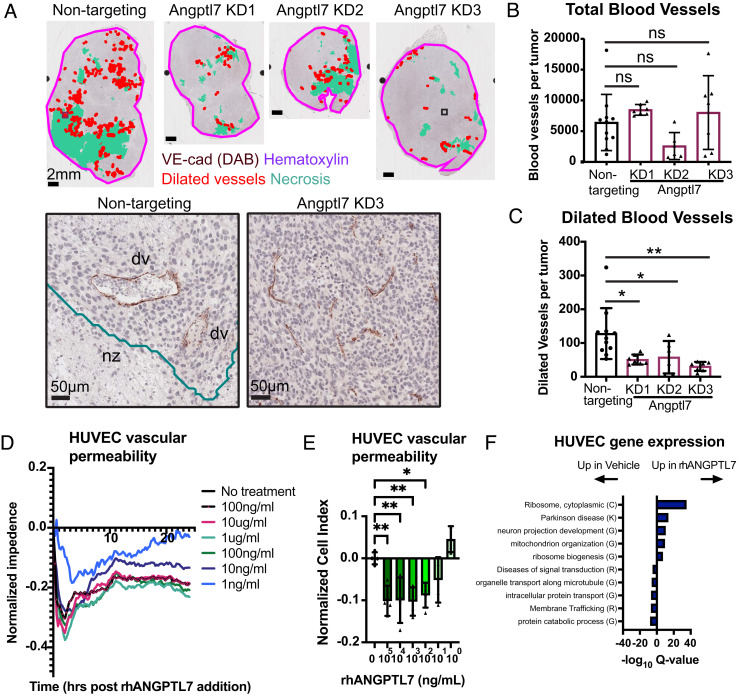
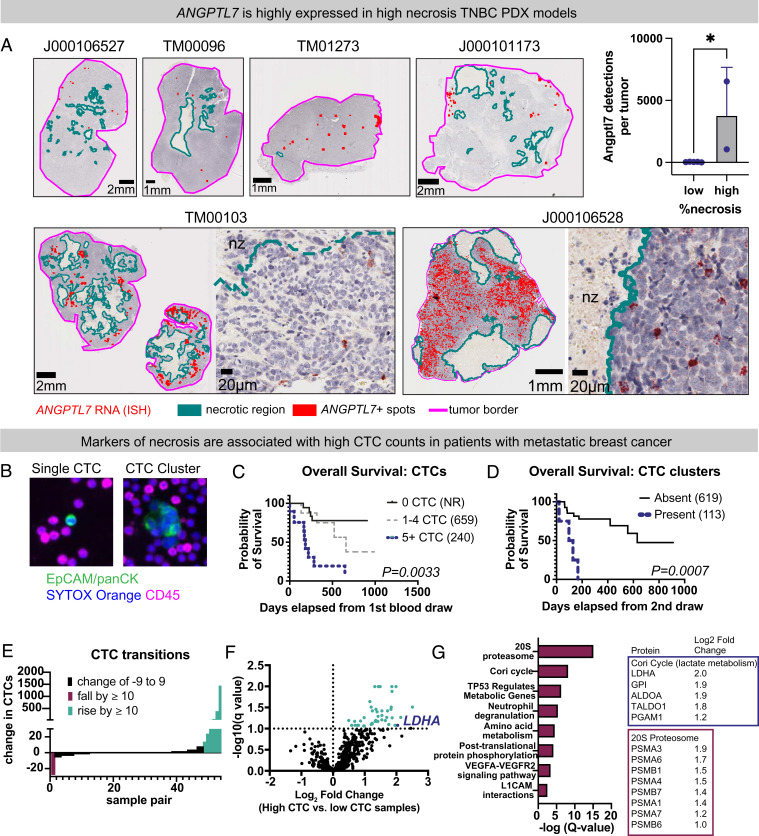
Necrosis in the tumor interior is a common feature of aggressive cancers that is associated with poor clinical prognosis and the development of metastasis. How the necrotic core promotes metastasis remains unclear. Here, we report that emergence of necrosis inside the tumor is correlated temporally with increased tumor dissemination in a rat breast cancer model and in human breast cancer patients. By performing spatially focused transcriptional profiling, we identified angiopoietin-like 7 (Angptl7) as a tumor-specific factor localized to the perinecrotic zone. Functional studies showed that Angptl7 loss normalizes central necrosis, perinecrotic dilated vessels, metastasis, and reduces circulating tumor cell counts to nearly zero. Mechanistically, Angptl7 promotes vascular permeability and supports vascular remodeling in the perinecrotic zone. Taken together, these findings show that breast tumors actively produce factors controlling central necrosis formation and metastatic dissemination from the tumor core.
Overview
The claims and statistics of this paper haven’t been checked yet.
Free: it reads the open-access text and checks the first 5 claims that cite a source we can check. Create a free account to check every claim.
Integrity signals
Registry
Cites
Statistics
Figures
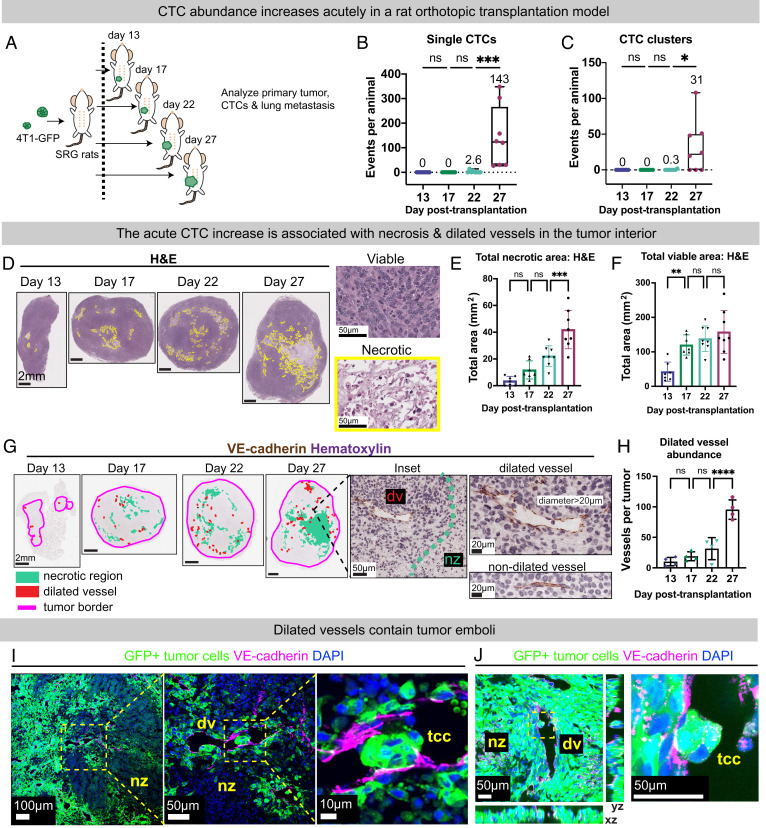
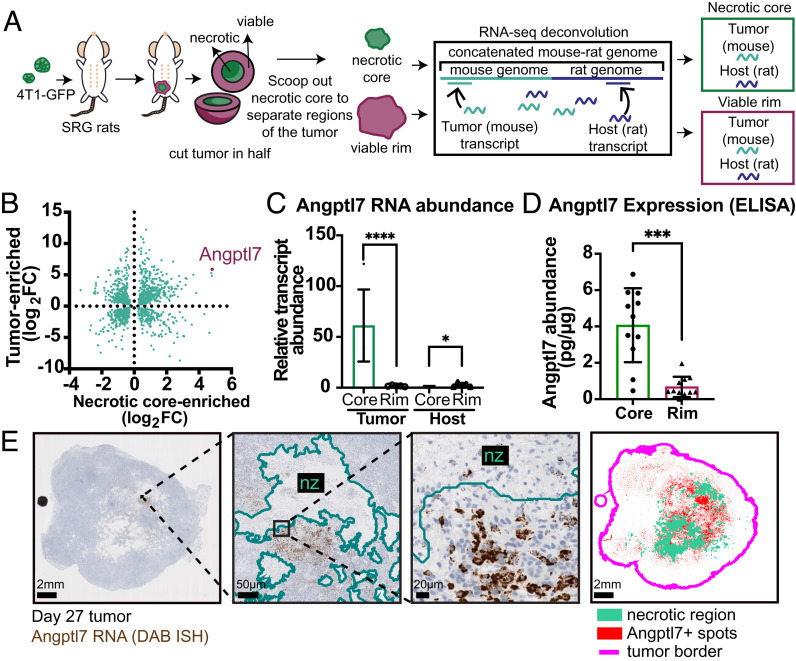
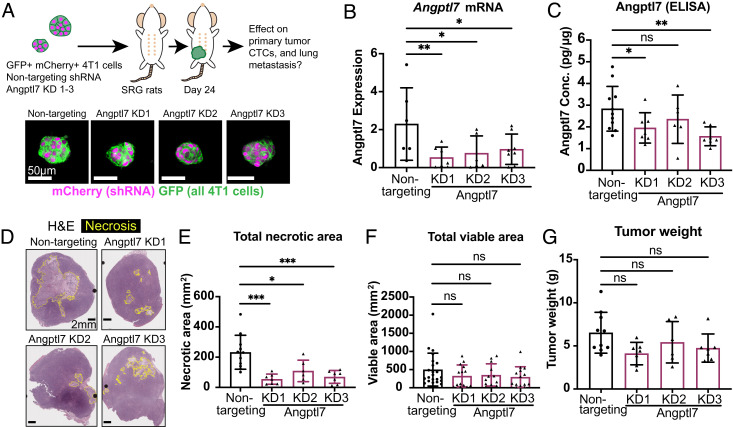
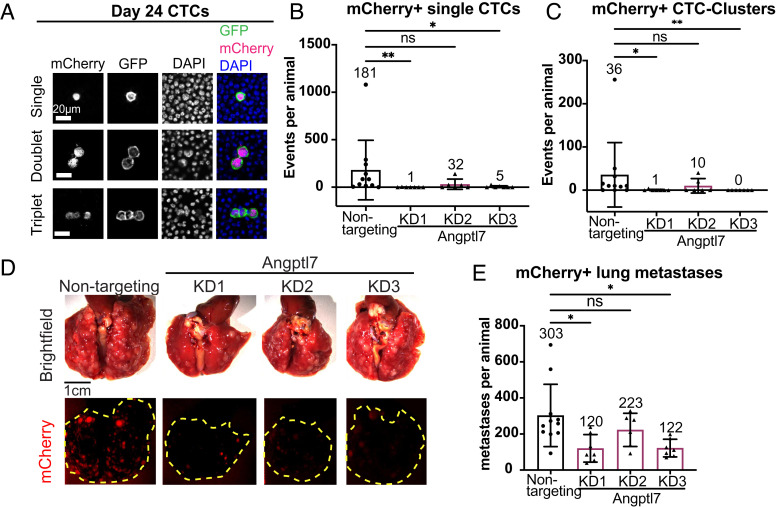
Verification
Claims the paper makes
The claims and statistics of this paper haven’t been checked yet.
Free: it reads the open-access text and checks the first 5 claims that cite a source we can check. Create a free account to check every claim.
Claims other papers make about this one
Each is checked against this paper’s own text: does it say what the citing paper says it does?
The cited source says what the claim attributes to it.
In the citing paper
“Necrosis is a common feature of many tumors and is associated with poor prognosis and increased risk of metastasis [28].”
From The HIF Axes in Cancer - Angiogenesis, Metabolism and Immune-Modulation (2025) · cites this paper as [28]
The cited source says what the claim attributes to it.
In the citing paper
“Indeed, recent studies suggest that metastatic tumor subclones preferentially originate from the tumor interior due in part to changes in vascular permeability associated with necrosis that promotes tumor cell dissemination [28, 29].”
From The HIF Axes in Cancer - Angiogenesis, Metabolism and Immune-Modulation (2025) · cites this paper as [28]
Self-check
Percentages, sums and reported differences re-computed from the paper’s own numbers.
The self-check needs the paper’s full text.
Citations
Cites
Angiogenesis in cancer and other diseases
Carmeliet, P., & Jain, R. K. (2000) · Nature · doi:10.1038/35025220 · Cited by 9,070
QuPath: Open source software for digital pathology image analysis
Bankhead, P., Loughrey, M. B., Fernández, J. A., Dombrowski, Y., McArt, D. G., Dunne, P. D., McQuaid, S., Gray, R. T., Murray, L. J., Coleman, H. G., et al. (2017) · Scientific Reports · doi:10.1038/s41598-017-17204-5 · Cited by 8,908 · cited 3×
“QuPath quantification of RNA ISH.”
InfluentialMolecular Mechanisms of Stress-Responsive Changes in Collagen and Elastin Networks in Skin
Aziz, J., Shezali, H., Radzi, Z., Yahya, N. A., Abu Kassim, N. H., Czernuszka, J., & Rahman, M. T. (2016) · Skin Pharmacology and Physiology · doi:10.1159/000447017 · Cited by 7,323
Foulkes, W. D., Smith, I. E., & Reis-Filho, J. S. (2010) · New England Journal of Medicine · doi:10.1056/nejmra1001389 · Cited by 4,157
Tumour-cell invasion and migration: diversity and escape mechanisms
Friedl, P., & Wolf, K. (2003) · Nature Reviews Cancer · doi:10.1038/nrc1075 · Cited by 3,222
Emerging Biological Principles of Metastasis
Lambert, A. W., Pattabiraman, D. R., & Weinberg, R. A. (2017) · Cell · doi:10.1016/j.cell.2016.11.037 · Cited by 3,067 · cited 1×
“A major focal point of investigation is the tumor-stromal border where cancer cells are directly observed to invade singly or collectively into surrounding tissues and disseminate into local blood vessels (4–7).”
Vascular Channel Formation by Human Melanoma Cells in Vivo and in Vitro: Vasculogenic Mimicry
Maniotis, A. J., Folberg, R., Hess, A., Seftor, E. A., Gardner, L. M. G., Pe'er, J., Trent, J. M., Meltzer, P. S., & Hendrix, M. J. C. (1999) · The American Journal of Pathology · doi:10.1016/s0002-9440(10)65173-5 · Cited by 2,043
Gaggioli, C., Hooper, S., Hidalgo-Carcedo, C., Grosse, R., Marshall, J. F., Harrington, K., & Sahai, E. (2007) · Nature Cell Biology · doi:10.1038/ncb1658 · Cited by 1,589 · cited 1×
“In addition, organotypic culture models have proven useful in modeling invasion in vitro that have morphologic correlates in vivo (61, 62, 67, 68).”
Rankin, E. B., & Giaccia, A. J. (2016) · Science · doi:10.1126/science.aaf4405 · Cited by 1,340
Phenotypic evaluation of the basal-like subtype of invasive breast carcinoma
Livasy, C. A., Karaca, G., Nanda, R., Tretiakova, M. S., Olopade, O. I., Moore, D. T., & Perou, C. M. (2006) · Modern Pathology · doi:10.1038/modpathol.3800528 · Cited by 1,063 · cited 1×
“A challenge of between-tumor/between-patient association studies is that it is not possible to disentangle if necrosis is a regulator of metastasis or a by-product of other more aggressive features such as tumor grade or tumor subtype (23, 24).”
Research works printed but not linked: 4
- 10.1002/1097-0142(19840201)53:3 · doi:10.1002/1097-0142(19840201)53:3
- 77. B. Krajina, RNA sequencing of necrotic core and non-necrotic rim of tumors from 4T1 cell xenografts into rat. National Center for Biotechnology Information Sequence Read Archive. https://www.ncbi.nlm.nih.gov/bioproject/PRJNA925873. Deposited 27 January 2023.
- 78. B. Krajina, Angptl-7 knockdown RNA sequencing of 4T1 orthotopic transplants into rat mammary fat pads. National Center for Biotechnology Information Sequence Read Archive. https://www.ncbi.nlm.nih.gov/bioproject/PRJNA925929. Deposited 27 January 2023.
- 79. B. Krajina, RNA-sequencing of HUVEC cells treated with Angiopoietin-like 7. National Center for Biotechnology Information Sequence Read Archive. https://www.ncbi.nlm.nih.gov/bioproject/PRJNA928719. Deposited 27 January 2023.
Cited by
Neutrophils drive vascular occlusion, tumour necrosis and metastasis
Adrover, J. M., Han, X., Sun, L., Fujii, T., Sivetz, N., Daßler‐Plenker, J., Evans, C., Peters, J., He, X., Cannon, C. D., et al. (2025) · Nature · doi:10.1038/s41586-025-09278-3 · Cited by 111
The HIF Axes in Cancer - Angiogenesis, Metabolism and Immune-Modulation
Acuña-Pilarte, K., & Koh, M. Y. (2025) · Trends in Biochemical Sciences · doi:10.1016/j.tibs.2025.06.005 · Cited by 64
Collective cell migration modes in development, tissue repair and cancer
Cheung, K. J., & Horne‐Badovinac, S. (2025) · Nature Reviews Molecular Cell Biology · doi:10.1038/s41580-025-00858-9 · Cited by 54
Self-citationDeng, Z., Mei, S., Ouyang, Z., Wang, R., Wang, L., Zou, B., Dai, J., Mao, K., Li, Q., Guo, Q., et al. (2025) · Gut Microbes · doi:10.1080/19490976.2025.2476561 · Cited by 47
“20 Our findings confirmed that excessive stimulation of NETs promotes high expression of the vascular growth factors, CD31, VEGF, and MMP9.”
Rodrigues, J., Amin, A., Chandra, S., Mulla, N. J., Nayak, S. G., Rai, S., Ray, S., & Mahato, K. K. (2024) · ACS Sensors · doi:10.1021/acssensors.3c01085 · Cited by 36
Rat Models of Hormone Receptor-Positive Breast Cancer
Nicotra, R., Lutz, C., Messal, H. A., & Jonkers, J. (2024) · Journal of Mammary Gland Biology and Neoplasia · doi:10.1007/s10911-024-09566-0 · Cited by 35
“In addition to its human cell line and patient-derived xenografting potential, the SRG rat strain can be applied for the establishment of mouse-to-rat cell xenografts, highlighting the model’s versatility and promising role in the in vivo study of BC development [178].”
BackgroundMoles, E., Chang, D. W.-W., Mansfeld, F. M., Duly, A. M. P., Kimpton, K., Logan, A., Howard, C. B., Thurecht, K. J., & Kavallaris, M. (2024) · International Journal of Nanomedicine · doi:10.2147/ijn.s450534 · Cited by 22
Dong, Z., Zhang, M., Qu, L., Zou, J., Yang, Y.-H., Ma, Y., Yang, C.-C., Cao, X.-L., Wang, L., Zhang, X., et al. (2024) · Biomarker Research · doi:10.1186/s40364-024-00648-z · Cited by 20
Kern, C. C., Bonventre, J. V., Justin, A. W., KASHANI, K. B., Reynolds, E., Siew, K., Davis, B., Karakoy, H., Grzesiak, N., & Bailey, D. M. (2025) · Oncogene · doi:10.1038/s41388-025-03431-y · Cited by 19
“…as seen in breast carcinomas in particular, tumor dissemination and metastasis strongly correlate temporally with necrosis in animal models [45] and in human cancer patients from recent clinical trial observations [46, 47], which is typically localized to dilated peri-necrotic vessels…”
Zhou, Z., Zhong, H., Wang, H., Wang, S., Kridis, W. B., Wang, R., Shen, K., Wang, Z., & Huang, R. (2025) · Discover Oncology · doi:10.1007/s12672-025-03797-1 · Cited by 19
“BC-derived BC-derived angiopoietin-like 7 (ANG-PTL7), which is structurally related to the angiopoietins, enhances angiogenesis around cancer cells, particularly surrounding necrosis area [45] (Fig.”
Zhang, K., Ha, Y., Gan, Y., Liu, Y., Liu, J., Chen, L., & Li, H. (2025) · Chemical Engineering Journal · doi:10.1016/j.cej.2025.165815 · Cited by 16
Chen, Y., He, A.-C., Huang, T., Lai, D.-H., Wang, Y., Liu, W., Kuo, W., Hou, H., Cheng, S.-J., Lee, C.-Y., et al. (2024) · International Journal of Nanomedicine · doi:10.2147/ijn.s475742 · Cited by 15
“58 Although the degree of necrosis in the control group was the same as that in the passive and CCCP (1 mA) groups, the necrosis area in the control group was larger than that in the other groups, indicating a higher degree of tumor cell infiltration.”
BackgroundKim, H., Kim, B., Kim, S. J., Choi, Y., Kim, I. H., Han, J., Park, Y.-G., Han, Y., & Park, J. (2024) · Advanced Healthcare Materials · doi:10.1002/adhm.202400501 · Cited by 14
Peptide-Conjugated MRI Probe Targeted to Netrin-1, a Novel Metastatic Breast Cancer Biomarker
Moreau, C., Lukačević, T., Pallier, A., Sobilo, J., Aci‐Sèche, S., Garnier, N., Même, S., Tóth, É., & Lacerda, S. (2024) · Bioconjugate Chemistry · doi:10.1021/acs.bioconjchem.3c00558 · Cited by 14
Tumor Organoids: The Era of Personalized Medicine
Rassomakhina, N. V., Ryazanova, A. Y., Likhov, A. R., Bruskin, S. A., Maloshenok, L. G., & Zherdeva, V. V. (2024) · Biochemistry (Moscow) · doi:10.1134/s0006297924140086 · Cited by 14
Three Dimensional Models of Endocrine Organs and Target Tissues Regulated by the Endocrine System
Luca, E., Zitzmann, K., Bornstein, S. R., Kugelmeier, P., Beuschlein, F., Nölting, S., & Hantel, C. (2023) · Cancers · doi:10.3390/cancers15184601 · Cited by 12
“Interestingly, recent data suggest that these conditions might be relevant drivers of metastasis [25], and it is yet to be determined if resulting metastasis maintain the same necrotic properties after dissemination.”
Ai, L., Yi, N., Qiu, C., Huang, W., Zhang, K., Hou, Q., Jia, L., Li, H., & Liu, L. (2024) · International Journal of Oncology · doi:10.3892/ijo.2024.5634 · Cited by 11
“Mechanistically, Angptl7 promotes vascular permeability and supports perineal posi‑ tioning vascular remodeling (145).”
Žárská, M., Novák, O., Jakubcova, T., Novotný, F., Urbancokova, A., Havel, F., Novak, J., Raabová, H., Musílek, K., Filimonenko, V., et al. (2024) · Colloids and Surfaces B Biointerfaces · doi:10.1016/j.colsurfb.2024.114128 · Cited by 9
Jeon, H. J., Chun, H. J., Choi, H. S., Keum, B., Kim, H. B., & Kim, J. H. (2024) · Cancers · doi:10.3390/cancers16071389 · Cited by 9
“This strategy is supported by the fact that apoptosis induces minimal inflammation and damage to surrounding tissues, while necrosis is associated with increased inflammation and release of harmful cellular contents, promoting tumor growth and metastasis [18,19].”
BackgroundThe Impact of Oxygen Distribution on the Tumor Necrotic Region: A Two-phase Model
Sadhu, G., Yadav, K. S., Ghosh, S. S., & Dalal, D. C. (2026) · Acta Biotheoretica · doi:10.1007/s10441-026-09516-9 · Cited by 9
“In order to explore the dynamics of tumor growth, researchers mostly rely on experimental approaches (Adam and Maggelakis 1989; Karsch-Bluman et al. 2019; Yamamoto et al. 2023).”
Godel-Pastre, S., Porcel, E., Pinna, G., Vandamme, M., Denis, C., Leterrier, C., Doris, E., Truillet, C., & Gravel, E. (2024) · ACS Applied Materials & Interfaces · doi:10.1021/acsami.4c00910 · Cited by 9
Liu, Q., Zhang, H., Zhang, Q., Wang, F., Zhu, Y., Feng, S.-G., Jiang, Q. L., & Yan, B. (2024) · Journal of Proteome Research · doi:10.1021/acs.jproteome.4c00195 · Cited by 6
Tiwari, S. K., Chandrasekharan, A., Lupitha, S. S., Mathew, K. A., Jancy, S. V., Halikar, A. M., Sanjeev, V. S., Sivakumar, K. C., Prasad, T., Anurup, K. G., et al. (2025) · Free Radical Biology and Medicine · doi:10.1016/j.freeradbiomed.2025.02.007 · Cited by 6
Radioresistance Mechanisms in Head and Neck Cancer
Nguyen, Q., & Koo, B. S. (2025) · Clinical and Experimental Otorhinolaryngology · doi:10.21053/ceo.2025-00029 · Cited by 6
“Moreover, tumor necrotic cores can harbor metastatic cell populations [43].”
Dehghani, M., Zare‐Zardini, H., Eslami, H., Ansari, M., & Fesahat, F. (2025) · Scientific Reports · doi:10.1038/s41598-025-19075-7 · Cited by 7
“Therefore, high necrosis in cancer cells is not only a sign of cancer progression but also an important factor for malignancy progression and metastasis 96 .”
Steiner, D., Sultan, L., Sullivan, T., Liu, H., Xiao, X., LeClerc, A. L., Melvin, S., Alekseyev, Y. O., Liu, G., Mazzilli, S. A., et al. (2026) · Nature Communications · doi:10.1038/s41467-026-70600-2 · Cited by 6
“An in vivo model of breast cancer demonstrated that ANGPTL7 is a tumor-secreted factor that synchronously triggers the formation of a necrotic core, increases vascular permeability, induces the formation of VI foci, and leads to circulating tumor cells and metastasis 67 .”
Mirzaei, N. M., Kevrekidis, P. G., & Shahriyari, L. (2024) · Royal Society Open Science · doi:10.1098/rsos.240718 · Cited by 6
“This is a crude approximation based on observations from the literature about the percentage of viable space in the TME occupied by necrotic cells [137].”
Zhang, F., Cheng, J., Xu, P., Zhang, C., Qu, L., Zhang, S., Zhang, J., & Zhu, S. (2025) · Theranostics · doi:10.7150/thno.105500 · Cited by 5
“However, we do not anticipate that the lack of signal enhancement in necrotic region within tumor interior will not adversely affect the performance of TSD-HE in intraoperative tissue diagnosis since the boundaries of tumors are most relevant for clinical assessments and surgical resections [61].”
Effect of inosine on recurrence of tumor after radiation therapy: A mathematical investigation
Yadav, K. S., & Sadhu, G. (2025) · Journal of Theoretical Biology · doi:10.1016/j.jtbi.2025.112138 · Cited by 5
Go-or-grow-or-die as a framework for the mathematical modeling of glioblastoma dynamics
Tursynkozha, A., Harris, D. C., Kuang, Y., & Kashkynbayev, A. (2025) · Mathematical Biosciences · doi:10.1016/j.mbs.2025.109520 · Cited by 4
Chen, X., Liu, G., Zheng, Z., Fu, R., Song, Y., & Dou, K. (2025) · iScience · doi:10.1016/j.isci.2025.113692 · Cited by 4
“For example, in breast cancer, it creates a metastatic portal for tumor cells by increasing vascular permeability 54 ; in acute myeloid leukemia, as a key paracrine factor secreted by the bone marrow microenvironment, it is upregulated through a complex signaling cascade involving BMP6-ID1-SP1,…”
Ghaemi, B., Rosu, A., Kuddannaya, S., Laurent, G., Bazzi, R., Roux, S., Shakeri‐Zadeh, A., & Bulte, J. W. M. (2026) · Advanced Functional Materials · doi:10.1002/adfm.202521864 · Cited by 4
Johnson, S. L., Krueger, T. D., Solaris, J., Cheng Ann, C. H. E. N., & Fang, C. (2025) · Chemistry - A European Journal · doi:10.1002/chem.202500639 · Cited by 4
Cytoskeleton imaging of colorectal and lung cancer spheroids using light sheet microscopy
Prado‐Lòpez, S., Foroughipour, M., Becker, K., Foroughipour, S. M., Weber, L., Wanzenboeck, H. D., Sarem, N., & Saghafi, S. (2025) · BJC Reports · doi:10.1038/s44276-025-00144-3 · Cited by 4
“Recently tumor necrosis at the tumoral masses core was associated with cancer dissemination [14].”
A Mathematical Model of Stroma-Supported Allometric Tumor Growth
Leander, R. N., Owanga, G., Nelson, D. E., & Liu, Y. (2024) · Bulletin of Mathematical Biology · doi:10.1007/s11538-024-01265-5 · Cited by 4
The Good, the Bad, or Both? Unveiling the Molecular Functions of LINC01133 in Tumors
Júnior, L. T., & Sogayar, M. C. (2025) · Non-Coding RNA · doi:10.3390/ncrna11040058 · Cited by 3
“Divergences can be exemplified by the contrasting influence of energy metabolism on the tumor surface versus its necrotic core [2], the heterogeneity of the tumor microenvironment [3], and the intricate intracellular signaling network [4], which together pose significant challenges for oncology in…”
Bao, H., Wang, N., Zhu, X., Chen, S., Wang, Y., Han, X., & Zhong, H. (2025) · Journal of Pharmaceutical Analysis · doi:10.1016/j.jpha.2025.101488 · Cited by 3
“A tumor-bearing model of SRG rats was constructed according to previous methods [28].”
Gupta, D. K., Suryavanshi, P., Singh, G. N., Kumar, V., Pawar, S. S., & Jain, V. K. (2023) · Cureus · doi:10.7759/cureus.43673 · Cited by 3
“Angptl-7 is known to increase vascular permeability and dissemination [17].”
BackgroundTahmasvand, R., Dehghani, S., Kooshafar, Z., Najafi, S. A. E., Almasirad, A., & Salimi, M. (2024) · Naunyn-Schmiedeberg s Archives of Pharmacology · doi:10.1007/s00210-023-02931-6 · Cited by 3
“…in vivo, but it critically influences all steps of metastasis (Mrouj et al. 2021) and knowing that angiogenesis contributes to metastasis (Yamamoto et al. 2023; Rashidi et al. 2018; Wang et al. 2023; Iranmanesh et al. 2018), we measured Ki67 and CD31 expressions in the lungs of both…”
Craft, K., Amanor, A., Barnett, I., Donaldson, C., Anegón, I., Madduri, S., Tang, Q., & Bility, M. T. (2025) · International Journal of Molecular Sciences · doi:10.3390/ijms26073082 · Cited by 3
Computational model of the cancer necrotic core formation in a tumor-on-a-chip device
Bonifácio, E., ARAÚJO, C., Guimarães, M. V., de Souza, M. P., Lima, T. P., Freitas, B. A. D. A., & Torres, L. A. G. (2024) · Journal of Theoretical Biology · doi:10.1016/j.jtbi.2024.111893 · Cited by 3
Murad, M., Chen, Y., Iaria, J., Teixeira, A. F., & Zhu, H. (2024) · Cells · doi:10.3390/cells13141166 · Cited by 3
“Proper modelling of cancer cell re-seeding and colonization of metastatic niches in pre-clinical cancer models have been mostly restricted by poor sensitivity and time-consuming methods [55,56].”
BackgroundSu, H., Abdulla, A., Yan, H., Xu, J., Shi, Y., Ding, X., & Tao, B. (2026) · Microsystems & Nanoengineering · doi:10.1038/s41378-025-01129-5 · Cited by 2
“Previous studies have shown that tumors with high levels of necrosis are typically more invasive 25 , and tumor cells were more likely to break through the basement membrane and vascular walls and enter the blood circulation.”
Rosenthal, K. J., Felix-Sanchez, P., Forbush, K. A., Rhoads, N. M., Kang, M., Vicente, J. J., Smith, F. D., Wordeman, L. G., Ong, S., Cheung, K. J., et al. (2026) · Journal of Biological Chemistry · doi:10.1016/j.jbc.2026.111329 · Cited by 2
Self-citationAdhesion forces between macrophages and cancer cells promote early tumor development
Nikolić, J., Ackermann, J., Marín, I., Taheraly, S., Mabire, M., Gobert, F.-X., Maurin, M., de Folmont, A. D. T., Aït-Mohamed, O., Gerena, E., et al. (2026) · Proceedings of the National Academy of Sciences · doi:10.1073/pnas.2514484123 · Cited by 2
“Consequently, edge cells proliferate, while central cells form an apoptotic core, a scenario also observed in vivo in nascent, nonvascularized tumors (8–10).”
Roles of circulating proteins in osteoporosis pathogenesis: Insights from Mendelian randomization
Zhang, Z., He, J., Lin, X., Zhu, Y., & He, W. (2026) · Bone · doi:10.1016/j.bone.2026.118005 · Cited by 2
Necrosis area, Tumor Size, and Lymph Node of Breast Cancer
Laili, K., Pratiwi, S. E., Ilmiawan, M. I., Trianto, H. F., & Fitrianingrum, I. (2024) · Indonesian Journal of Cancer · doi:10.33371/ijoc.v18i3.1121 · Cited by 2
Roy, S. F., Baig, J., DeCoste, R. C., Finch, S., Sennik, S., Kakadekar, A., Sade, S., Micevic, G., Chergui, M., Rahimi, K., et al. (2024) · Pathology · doi:10.1016/j.pathol.2024.03.008 · Cited by 2
Zhang, H., Chen, W., Li, X., Song, Z., Liu, Y., Liu, S., Su, Z., Wu, W., Chen, H., Qin, C., et al. (2025) · JHEP Reports · doi:10.1016/j.jhepr.2025.101514 · Cited by 2
Regunath, K., Fomin, V., Liu, Z., Wang, P., Hoque, M., Tian, B., Rabadán, R., & Prives, C. L. (2024) · Molecular Cancer Research · doi:10.1158/1541-7786.mcr-23-0295 · Cited by 2
Birkemeier, M., Swindle, A., Bowman, J. D., & Lynch, V. J. (2024) · bioRxiv (Cold Spring Harbor Laboratory) · doi:10.1101/2024.04.04.588129 · Cited by 2
Targeting Neutrophil Extracellular Traps to inhibit Colon Cancer Tumor Necrosis and MetastasisPreprint
Gazzara, E., Adrover, J. M., Lui, A., Han, S., Aminzada, Z., Bhandari, N., Sivetz, N., Shirue, V. S., Shergill, B. S., Curtis, M. B., et al. (2025) · bioRxiv (Cold Spring Harbor Laboratory) · doi:10.1101/2025.05.30.657122 · Cited by 2
Kirla, H. (2024) · Murdoch University Research Portal · Cited by 2
Dinda, A., & Nath, S. (2025) · Journal of Thermal Biology · doi:10.1016/j.jtherbio.2025.104235 · Cited by 1
Kulkarni, P., Khare, S., Bramhachari, S., Das, S., Kapoor, N., Goel, S. K., Kumar, P., Kumar, A., & Arya, N. (2025) · Cureus · doi:10.7759/cureus.93920 · Cited by 1
“An important trait of solid tumors is the development of a necrotic core [16].”
Zeng, Y., Hu, J., Chen, R., Chen, H., Chen, C., Xu, J., Xu, Q., & Fan, R. (2026) · Small · doi:10.1002/smll.75095 · Cited by 1
Research Progress on the Correlation between ANGPTL7 and Obstructive Sleep Apnea Hypopnea Syndrome
瞿, 道. (2023) · Advances in Clinical Medicine · doi:10.12677/acm.2023.13102320 · Cited by 1
Eibl, R. H., & Schneemann, M. (2024) · Interdisciplinary cancer research · doi:10.1007/16833_2024_288 · Cited by 1
Steiner, D., Sultan, L., Sullivan, T., Liu, H., Zhang, S., LeClerc, A. L., Alekseyev, Y. O., Liu, G., Mazzilli, S. A., Zhang, J., et al. (2024) · bioRxiv (Cold Spring Harbor Laboratory) · doi:10.1101/2024.06.07.597993
“Although necrosis can occur without VI, an in vivo model of breast cancer demonstrated that VI foci, necrosis, and circulating tumor cells are all temporally correlated and controlled by the tumor specific factor Angptl7 , which promotes vascular permeability and remodeling 57 .”
BackgroundVarga-Zsíros, V. (2024) · SZTE Repository of Dissertations (University of Szeged) · doi:10.14232/phd.12120
O’Connor, C. M., Zawacki, K. P., Durrant, J., Barrie, K., Walton, R. G., King, D., Onishi, G. H., Noto, F. K., Hinderman, M., Begemann, D. E., et al. (2025) · bioRxiv (Cold Spring Harbor Laboratory) · doi:10.1101/2025.03.27.645250
Dong, Z., Zhang, M.-Y., Qu, L.-X., Zou, J., Yang, Y.-H., Ma, Y.-L., Yang, C.-C., Cao, X.-L., Wang, L.-Y., Zhang, X.-L., et al. (2024) · Figshare · doi:10.6084/m9.figshare.26981819
Dong, Z., Zhang, M.-Y., Qu, L.-X., Zou, J., Yang, Y.-H., Ma, Y.-L., Yang, C.-C., Cao, X.-L., Wang, L.-Y., Zhang, X.-L., et al. (2024) · Figshare · doi:10.6084/m9.figshare.26981822
Wang, M. (2024) · MacSphere (McMaster University) · doi:10.71548/19662
Zhang, Y., Qiang, R., Ding, M., & Wang, L. (2026) · Frontiers in Immunology · doi:10.3389/fimmu.2025.1723844
“This protein exerts a pro-angiogenetic effect on human differentiated endothelial cells by stimulating their proliferation, motility, invasiveness, and capability to form capillary-like networks (23, 24).”
Mechanisms of angiopoietin-like protein 7 regulation and therapeutic potential in tumors
Fan, X., Zheng, W., Tian, X., & Wu, X. (2026) · Molecular Biology Reports · doi:10.1007/s11033-025-11404-3
“Yamamoto et al. [49] investigated cellular and molecular changes linked to tumor dissemination using a rat breast cancer xenograft model.”
InfluentialTargeting ubiquitin-specific peptidase 22 in solid tumours: from ubiquitination to immunotherapy
Li, Z., Wang, L., Liu, J., & Tang, Y. (2026) · Frontiers in Cell and Developmental Biology · doi:10.3389/fcell.2026.1792632
“Moreover, tumours are often accompanied by many necrotic areas, leading to persistent inflammation and oxidation product accumulation (Jain et al., 2013; Korbecki et al., 2020; Yamamoto et al., 2023).”
Fotinós, J., Condat, C. A., & Barberis, L. (2026) · bioRxiv (Cold Spring Harbor Laboratory) · doi:10.64898/2026.05.08.723756
Doroudian, M., Rahimian, S., Abbasgholinejad, E., & Najafi, H. (2026) · Elsevier eBooks · doi:10.1016/b978-0-443-33639-3.00003-9
Wang, X., Hua, R., Riquelme, M. A., Zhang, J., Zhang, L., Gu, S., Sun, L., Acosta, F. M., & Jiang, J. X. (2026) · Cancer Letters · doi:10.1016/j.canlet.2026.218722
Shape, shrink, spheroid: a DIY high-throughput spheroid generation device
Mogha, P., Mukherjee, S., Gangwar, T., Roy, D., Vichare, A., Kulkarni, S., Sharma, V., & Majumder, A. (2026) · Biofabrication · doi:10.1088/1758-5090/ae8bdd
A New Contrast-Enhanced Ultrasound (CEUS) Reporting and Data System for Breast Lesions
Qiu, J., Zhang, H., Liu, H., Li, X., Xia, H.-S., Guo, L., 孙丽萍, Xu, H., & Zhang, Y.-F. (2026) · Ultrasound in Medicine & Biology · doi:10.1016/j.ultrasmedbio.2026.08.017
A battery-free wireless implantable biosensor for postoperative breast cancer recurrence monitoring
Weng, Y., Tang, J., Long, Z., Mi, Y., Han, Q., Fang, Z., Xing, L., Shen, H., Xue, X., & Chen, M. (2026) · Sensors and Actuators B Chemical · doi:10.1016/j.snb.2026.141045
Cancer progression as the chronic stabilization of invasive growth
Altintas, D. M., & Comoglio, P. M. (2026) · Trends Open · doi:10.1016/j.treopn.2026.09.014
Spatial geometry and tumor topology: why empty space matters in the fight against cancer
Jafari, A., Alinia, Z., Bahramimoghadam, H., & Ahmadi, S. (2026) · Genome Instability & Disease · doi:10.1007/s42764-026-00195-x
The Development of a Biocomposite Microtissue Platform for High-Throughput Oncology Assays
Li, N. T. (2024) · TSpace (University of Toronto)
Metadata
- Authors
- Yamamoto, A., Huang, Y., Krajina, B. A., McBirney, M., Doak, A. E., Qu, S., Wang, C. L., Haffner, M. C., & Cheung, K. J.
- Affiliations
- University of Washington (US)
- Fred Hutch Cancer Center (US)
- Corresponding author
- Cheung, Kevin J.
- Venue
- Proceedings of the National Academy of Sciences
- Publisher
- National Academy of Sciences
- Published
- 2023-02-28
- Volume
- 120
- Issue
- 10
- Pages
- e2214888120-e2214888120
- ISSN
- 0027-8424 (ISSN-L)
- 1091-6490
- PMC
- PMC10013750
- OpenAlex
- W4322618161
- Cited by
- 69
- References
- 77
- Citations by year
- 2026: 17 · 2025: 24 · 2024: 25 · 2023: 3
- FWCI
- 6.13
- Type
- journal article
- Language
- en
- Open access
- hybrid
- doi.org
- Licence
- Locations
- Proceedings of the National Academy of Sciences (publishedVersion, cc-by)
- PubMed Central (publishedVersion, cc-by)
- PubMed (publishedVersion)
- Funders
- U.S. Department of Defense (BCRP; W81XWH-18-1-0098)
- Susan G. Komen (CCR18548236)
- HHS | NIH | National Cancer Institute (R37CA234488, 1F31CA260932-01A1, T32CA080416)
- Burroughs Wellcome (Burroughs Wellcome Fund Career Award for Medical Scientists)
- V Foundation for Cancer Research (V Foundation Scholar Award)
- Seattle Translational Tumor Research (N/A)
- Doris Duke Charitable Foundation (N/A)
- GE | GE Healthcare (N/A)
- HHS | NIH | National Institute of General Medical Sciences (T32GM007270)
- Topics
- Life Sciences › Biochemistry, Genetics and Molecular Biology › Molecular Biology › Angiogenesis and VEGF in Cancer
- Health Sciences › Medicine › Oncology › Cancer Cells and Metastasis
- Life Sciences › Biochemistry, Genetics and Molecular Biology › Cancer Research › Cancer, Hypoxia, and Metabolism
- Keywords
- ANGPTL7, breast cancer, tumor necrosis, necrotic core, metastasis, vascular permeability, vascular remodeling, circulating tumor cells, tumor microenvironment
- MeSH terms
- Angiopoietin-like Proteins, Angiopoietin-Like Protein 7, Animals, Breast Neoplasms, Female, Humans, Necrosis, Neoplastic Cells, Circulating, Mammary Neoplasms, Animal, Angiopoietins, Rats
About these checks
Registry, retraction, Cites and statistics results are computed, not judged, with one exception: a printed reference that no index lists is read once by a model before it counts as a citation error. Claims are extracted by a model and kept only when their quote appears verbatim in the text; each cited source is then checked, with a model’s help, for whether it says what the claim relies on. Those verdicts can be wrong — read the claim’s quote and the cited source before relying on one.
Statistics and arithmetic are recomputed, not judged.
Confidence bands are shown only for fields calibrated on our annotated test set. None is calibrated yet, so no band is shown.
What counts as a claim ›How we measure confidence ›How we check this ›
Are you an author, or do you see a problem with this page? Request a review
Data sources
Bibliographic data: Semantic Scholar, OpenAlex, Crossref.
Contains information from the Semantic Scholar Academic Graph Datasets, made available under the ODC Attribution License (ODC-BY 1.0).
Semantic Scholar’s data is described in: Kinney, R., et al. (2023). The Semantic Scholar Open Data Platform. arXiv:2301.10140.
