

Large language models show human-like content biases in transmission chain experiments
Open accessThe DOI matches its Crossref record; 28 of the 31 references it cites were found in a registry or an index.
Abstract
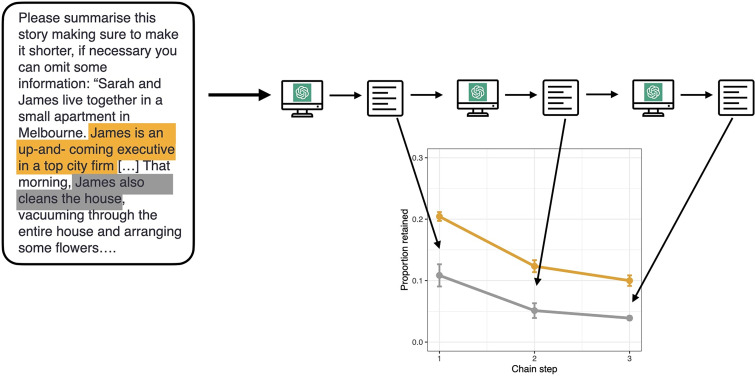
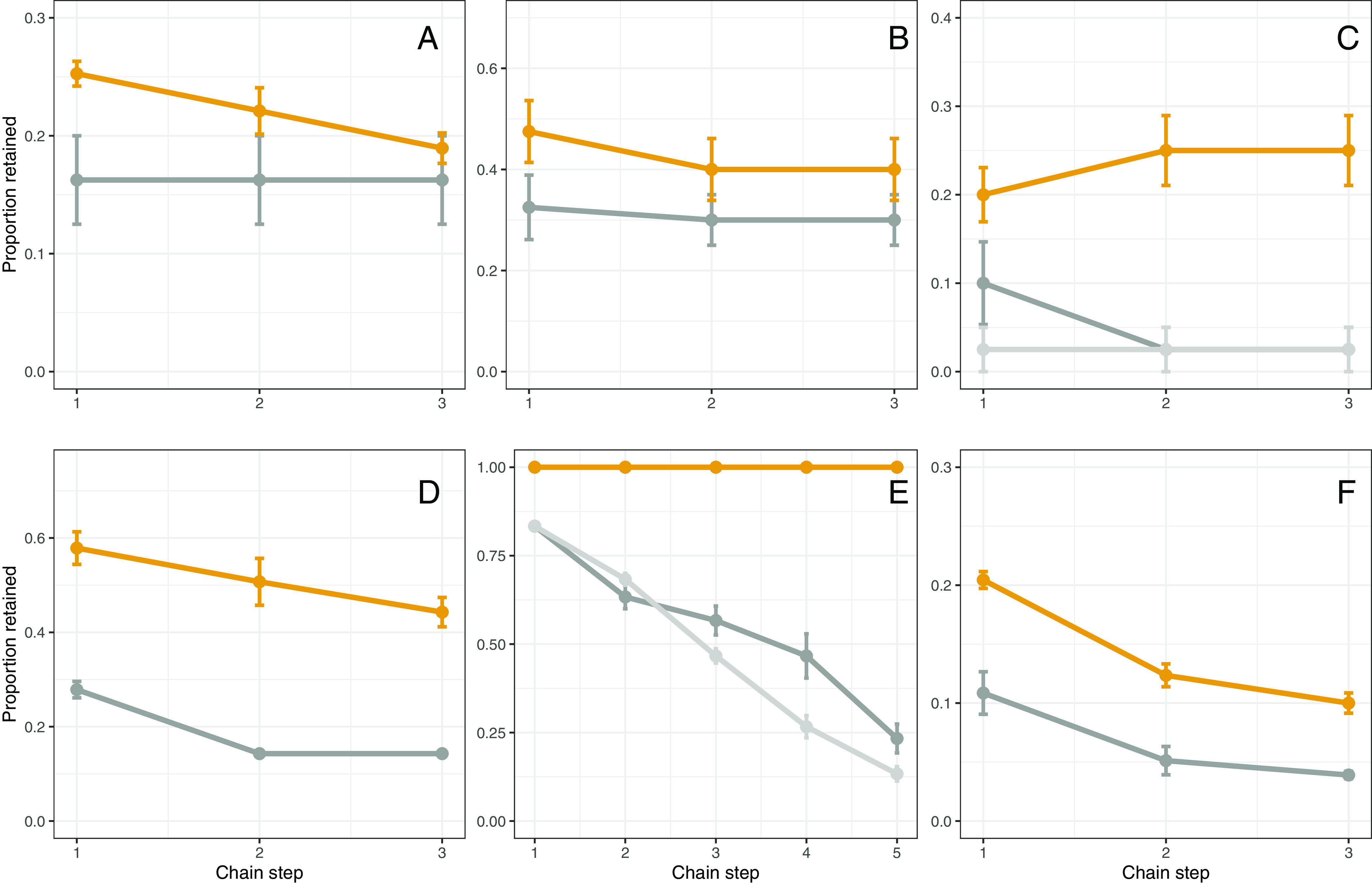
As the use of large language models (LLMs) grows, it is important to examine whether they exhibit biases in their output. Research in cultural evolution, using transmission chain experiments, demonstrates that humans have biases to attend to, remember, and transmit some types of content over others. Here, in five preregistered experiments using material from previous studies with human participants, we use the same, transmission chain-like methodology, and find that the LLM ChatGPT-3 shows biases analogous to humans for content that is gender-stereotype-consistent, social, negative, threat-related, and biologically counterintuitive, over other content. The presence of these biases in LLM output suggests that such content is widespread in its training data and could have consequential downstream effects, by magnifying preexisting human tendencies for cognitively appealing and not necessarily informative, or valuable, content.
Overview
The claims and statistics of this paper haven’t been checked yet.
Free: it reads the open-access text and checks the first 5 claims that cite a source we can check. Create a free account to check every claim.
Integrity signals
Registry
Cites
Statistics
Figures
Verification
Claims the paper makes
The claims and statistics of this paper haven’t been checked yet.
Free: it reads the open-access text and checks the first 5 claims that cite a source we can check. Create a free account to check every claim.
Claims other papers make about this one
Each is checked against this paper’s own text: does it say what the citing paper says it does?
The source backs part of the claim, not all of it — or backs it for a different population, condition or comparison.
In the citing paper
“In the end, LLMs are trained on large datasets that inevitably contain biases—such as gender, racial, or cultural biases—embedded in the text140.”
From Current applications and challenges in large language models for patient care: a systematic review (2025) · cites this paper as [140]
Experimental — accuracy not yet measured
Self-check
Percentages, sums and reported differences re-computed from the paper’s own numbers.
The self-check needs the paper’s full text.
Citations
Cites
Fitting Linear Mixed-Effects Models Using lme4
Bates, D., Mächler, M., Bolker, B., & Walker, S. (2015) · Journal of Statistical Software · doi:10.18637/jss.v067.i01 · Cited by 86,835
Language Models are Few-Shot Learners
Brown, T. B., Mann, B., Ryder, N., Subbiah, M., Kaplan, J., Dhariwal, P., Neelakantan, A., Shyam, P., Sastry, G., Askell, A., et al. (2020) · arXiv · doi:10.48550/arxiv.2005.14165 · Cited by 23,372
Advances in Neural Information Processing Systems 14: Proceedings of the 2001 Conference
(2002) · The MIT Press eBooks · doi:10.7551/mitpress/1120.001.0001 · Cited by 8,890
Culture and the Evolutionary Process
Griesemer, J. R., Boyd, R., & Richerson, P. J. (1986) · The Condor · doi:10.2307/1367778 · Cited by 7,034
Semantics derived automatically from language corpora contain human-like biases
Caliskan, A., Bryson, J. J., & Narayanan, A. (2017) · Science · doi:10.1126/science.aal4230 · Cited by 2,887
Sparks of Artificial General Intelligence: Early experiments with GPT-4
Bubeck, S., Chandrasekaran, V., Eldan, R., Gehrke, J., Horvitz, E., Kamar, E., Lee, P., Lee, Y. T., Li, Y., Lundberg, S., et al. (2023) · arXiv · doi:10.48550/arxiv.2303.12712 · Cited by 1,526
Algorithmic Bias in Autonomous Systems
Danks, D., & London, A. J. (2017) · Proceedings of the Twenty-Sixth International Joint Conference on Artificial Intelligence · doi:10.24963/ijcai.2017/654 · Cited by 472
Dale, R. (2021) · Natural Language Engineering · doi:10.1017/s1351324920000601 · Cited by 432
The multiple roles of cultural transmission experiments in understanding human cultural evolution
Mesoudi, A., & Whiten, A. (2008) · Philosophical Transactions of the Royal Society B: Biological Sciences · doi:10.1098/rstb.2008.0129 · Cited by 394
A bias for social information in human cultural transmission
Mesoudi, A., Whiten, A., & Dunbar, R. (2006) · British Journal of Psychology · doi:10.1348/000712605x85871 · Cited by 349
Research works printed but not linked: 1
- F. C. Bartlett, Remembering (Cambridge University Press, 1932).
Cited by
Items 101–141 of 141
Chrono-Sampling: Generative AI Enabled Time Machine for Public Opinion Data CollectionPreprint
Tamaki, E. R., & Littvay, L. (2024) · PsyArXiv (OSF Preprints) · doi:10.31234/osf.io/49ags · Cited by 2
The Negotiation Trap An Experiment on a Large Language ModelPreprint
Engel, C. (2024) · SSRN Electronic Journal · doi:10.2139/ssrn.5076291
Transitive Inference in Large Language Models and Prompting Intervention
Wu, W., & Deng, W. (2025) · IEEE International Conference on Acoustics Speech and Signal Processing · doi:10.1109/icassp49660.2025.10889585 · Cited by 3
“Ideally, abstract inference is independent of context, whereas there were some recent studies indicating that both human and LLMs tend to be affected by semantic context in which simple reasoning happens [11], [12].”
Value of Improving Result Interpretation in Direct-to-Definitive Urine Drug Panels
Yang, Y. K., & Snozek, C. L. H. (2025) · Clinics in Laboratory Medicine · doi:10.1016/j.cll.2025.01.007
Niu, Y., Fu, S., Xuan, Z., Kang, R., Ren, Z., Jin, S., Wang, Y., & Xiao, Q. (2025) · Digital Health · doi:10.1177/20552076251349616
“29 Because of different programming and constraints imposed by different creators, LLMs carries kind of cultural perspective, both in the evaluative and value sense.”
A Symmetric Bayesian Framework for Swarm Information Interaction and Collective Behavior Prediction
Shen, H., Yu, P., Yang, Y., Li, C., & Chen, X. (2025) · Symmetry · doi:10.3390/sym17122091
Exploring the future of coaching team flow dynamics through the use of new technologies
van den Hout, J. J. J., Shala, A., Krispin, A., Pluymaekers, M., & Buseyne, S. (2025) · Discover Psychology · doi:10.1007/s44202-025-00531-4
“Moreover, recent research by Acerbi and Stub-bersfield [137] highlights that large language models exhibit biases similar to human tendencies, particularly favoring content that is social, negative, gender-stereotype-consistent, threat-related, and biologically counterintuitive, which introduces…”
Retrieval Augmented Generation-based Large Language Model Chatbot
Yau, L. H., Xian, E. T. Y., Yu, Y. P., & Lim, T. M. (2025) · IEEE International Conference on Computation, Big-Data and Engineering (ICCBE) · doi:10.1109/iccbe65177.2025.11255894
“LLMs even exhibit emergent human-like attributes, such as emotional quotient scores [14], though they can also perpetuate human-like biases [15].”
Keturakis, S. (2026) · Communication & Society · doi:10.15581/003.39.1.002
Bausch, T. (2026) · Zeitschrift für Tourismuswissenschaft · doi:10.1515/tw-2025-0028 · Cited by 1
“Acerbi and Stubbersfield (2023) described an additional risk of bias arising from the prese-lection of training sources and the cultural background of the training personnel, which can lead to human-like content biases, especially in sociological or behavioral contexts.”
Thakur, A., Murray, T., Rodriguez, P., & Hilbert, M. (2026) · SSRN Electronic Journal · doi:10.2139/ssrn.6083909 · Cited by 2
Fang, Y., & Zhou, T. (2026) · Information & Management · doi:10.1016/j.im.2026.104322
Sarial‐Abi, G., & Giannetti, V. (2026) · British Journal of Management · doi:10.1111/1467-8551.70045
Human writing and machine patterns: analyzing a decade of convergence
Chang, E. (2026) · Scientometrics · doi:10.1007/s11192-026-05589-y
Experiencing linguistic prejudice and discrimination in Saudi Arabia: a path towards inequality
Al-Hakami, A. Y. M. (2026) · Humanities and Social Sciences Communications · doi:10.1057/s41599-026-06969-8
Koenig, P. D., & Rone, J. (2026) · Information Communication & Society · doi:10.1080/1369118x.2026.2645876 · Cited by 2
Engel, C., Grossmann, M. R. P., & Ockenfels, A. (2025) · Experimental Economics · doi:10.1017/eec.2025.10038 · Cited by 6
Ku, W. L., Liu, Y., Zhang, W., & An, P. (2026) · Design for Augmented Humanity · doi:10.1177/29776481261438705
“…introduces unique challenges: because LLMs are often trained on engagement-oriented datasets, they may inherently prioritize sensationalism or bias (Acerbi, 2023), potentially defaulting to negative narratives without the ethical oversight typical of human newsrooms (Devinney et al., 2024).”
From Expectation to Evaluation: Expectation Cues Systematically Bias LLM and Human Judgment
Sun, Y., Dillion, D., Gray, K. J., Lyu, M., Zhang, Z., & Li, F. (2026) · CHI Conference on Human Factors in Computing Systems · doi:10.1145/3772318.3790492 · Cited by 2
Generative AI and the Future of Musical Diversity
Shilton, D. (2026) · Topics in Cognitive Science · doi:10.1111/tops.70048
What does it mean to have an experience? Two kinds of narrative world models
Breithaupt, F. A. (2026) · Philosophical Transactions of the Royal Society A Mathematical Physical and Engineering Sciences · doi:10.1098/rsta.2025.0009
Detecting Persona-Generated AI Text with Interpretable Linguistic Features
Slavova, E., Parfenova, A., & Pfeffer, J. (2026) · ACM Web Science Conference (WebSci) · doi:10.1145/3795513.3810453
“…while still showing deeper statistical and structural regularities: constrained readability ranges, characteristic syntactic patterns, homogenized clause sequencing, and predictable token behavior that contrast with the more diverse and contextually adaptive patterns of human writers [1, 24, 28].”
Measuring human likeness of artificial intelligence to natural intelligence
Xia, Y., Zhu, B., Geng, M., Zhu, S., Sun, S., Chen, H., Chen, X. M., Na, X., Ye, J., & Tang, C. S. (2026) · The Innovation Informatics · doi:10.59717/j.xinn-inform.2026.100047
Xu, S., Zhang, L., Jamison, A., Saiyed, S., Hou, A. B., Du, H., & Gardner, L. (2026) · npj Digital Public Health · doi:10.1038/s44482-026-00026-6 · Cited by 2
“…most critically, together these fi ndings reveal that an LLM ’ s knowledge base is not a neutral mirror of society, but instead an artifact of a human-curated dataset and training 39 , and in this speci fi c case, LLM reasoning disproportionately aligns with established consensus towards science 40 .”
Synthetic Data in Opinion Studies: A Review of Shortcomings
Bodrunova, S. S. (2026) · Lecture notes in computer science · doi:10.1007/978-3-032-31407-9_17
Hong, C.-H., Liu, Y.-Z., & Chen, C. (2026) · Computers in Human Behavior Artificial Humans · doi:10.1016/j.chbah.2026.100350
Age and generational differences in anthropomorphism and trust in large language models
Cohn, M., Pushkarna, M., Díaz, M., Cooper, J., Olanubi, G. O., Moran, J. M., Mengesha, Z., & Heldreth, C. M. (2026) · Frontiers in Cognition · doi:10.3389/fcogn.2026.1824836
Halimeh, H., Kaltenpoth, S., Bösch, K., & Müller, O. (2026) · SSRN Electronic Journal · doi:10.2139/ssrn.6582539 · Cited by 1
Advancements in the Implementation of Artificial Intelligence for Imaging and Image Analysis
Niz, M. D., Kirchenbüechler, D., Dluhy, P., Piguel, N. H., & Arvanitis, C. (2026) · Microscopy and Microanalysis · doi:10.1093/mam/ozag051
Refahi, M. S., Yoo, H., Hearne, G., Allegra, C., Brown, J. R., Sokhansanj, B. A., Woloszynek, S., Ramjattun, K., Allipilli, S. R., Polikar, R., et al. (2026) · Springer eBooks · doi:10.1007/978-3-032-18509-9_3
Chen, Z.-S., Jiao, W.-C., Tsang, Y.-P., Wu, C.-H., & Wang, X.-J. (2026) · Group Decision and Negotiation · doi:10.1007/s10726-026-10017-w · Cited by 1
“Parallel studies indicate that LLMs replicate a spectrum of human cognitive biases within behavioral economic experiments, notably manifesting heightened loss aversion in Pros - pect Theory tasks compared to human baselines (Hagendorff et al. 2023 ; Acerbi and Stubbersfield 2023).”
Who Gets Hired and Paid: An Experimental Analysis of Gender Bias in the Construction Workforce
Namian, M., Olatunbosun, S., Wen, J., & Nnaji, C. A. (2026) · Journal of Construction Engineering and Management · doi:10.1061/jcemd4.coeng-18034
Human realignment: An empirical study of LLMs as legal decision-aids in moral dilemmas
Engel, C., Hermstrüwer, Y., & Kim, A. (2026) · Artificial Intelligence and Law · doi:10.1007/s10506-026-09517-6 · Cited by 6
Sentiment distribution bias in AI-generated review summaries
Wang, F., Liu, Z., Wang, F., Zhu, Z., & Wang, S. (2026) · Internet Research · doi:10.1108/intr-10-2025-1756 · Cited by 1
Mitchell, J. (2026) · Critical Policy Studies · doi:10.1080/19460171.2026.2727379
Designed to Bullshit, Trained to Bullshit: A Reply to Humphries, Hicks, and Slater
Licon, J. A. (2026) · Philosophy & Technology · doi:10.1007/s13347-026-01192-4
“…its place, and the corpus inherits this asymmetry wholesale, a pattern consistent with evidence that LLMs reproduce human content biases pres-ent in what they were trained on (Acerbi & Stubbersfield, 2023; Simler & Hanson, 2018 ), even if the specific biases they tested were not reputational ones.”
Sensing and Interventions for Social Anxiety: A Review
Poprcova, V., Lefter, I., Warnier, M., & Brazier, F. M. T. (2026) · ACM Transactions on Computing for Healthcare · doi:10.1145/3850152
“In these contexts, misleading outputs from LLMs can unintentionally influence behaviour, potentially amplifying unfairness and human bias [3], and creating ethical, psychological, and safety concerns.”
Ng, J. Y., Al-Khafaji, W. A.-Z., & Moher, D. (2026) · Research Integrity and Peer Review · doi:10.1186/s41073-026-00250-x · Cited by 1
“…inaccuracies typically arise not from deliberate intent to deceive, but from the probabilistic nature of large language model (LLM) outputs: a phenomenon known as hallucination, in which generated text appears coherent and plausible but is factually incorrect or unsupported by evidence [23, 28–30].”
Large language models for computational social science
Xu, F., Shao, C., Chen, L., Zeng, Q., Chen, Z., Sukiennik, N., Wang, J., Gao, C., Wang, H., Lian, J., et al. (2026) · Nature Human Behaviour · doi:10.1038/s41562-026-02539-9 · Cited by 2
Piao, J., Yan, Y., Zhang, J., Li, N., Yan, J., Lan, X., Lu, Z., Zheng, Z., Wang, J. Y., Zhou, D., et al. (2025) · arXiv · doi:10.48550/arxiv.2502.08691 · Cited by 43
“Acerbi et al. [2] simulate the information propagation and find human-like bias in the results of large language model agents.”
Metadata
- Authors
- Acerbi, A., & Stubbersfield, J. M.
- Affiliations
- University of Trento (IT)
- University of Winchester (GB)
- Corresponding author
- Acerbi, Alberto
- Venue
- Proceedings of the National Academy of Sciences
- Publisher
- National Academy of Sciences
- Published
- 2023-10-26
- Volume
- 120
- Issue
- 44
- Pages
- e2313790120-e2313790120
- ISSN
- 0027-8424 (ISSN-L)
- 1091-6490
- PMC
- PMC10622889
- OpenAlex
- W4387952963
- Cited by
- 137
- References
- 31
- Citations by year
- 2026: 45 · 2025: 49 · 2024: 38 · 2023: 5
- FWCI
- 34.28
- Type
- journal article
- Language
- en
- Open access
- hybrid
- doi.org
- Licence
- Locations
- Proceedings of the National Academy of Sciences (publishedVersion, cc-by-nc-nd)
- PubMed Central (publishedVersion, cc-by-nc-nd)
- PubMed (publishedVersion)
- Iris (University of Trento) (submittedVersion, cc-by-nc-nd)
- OSF Preprints (OSF Preprints) (submittedVersion)
- OSF Preprints (OSF Preprints) (submittedVersion, cc-by)
- Funders
- University of Winchester
- Topics
- Physical Sciences › Computer Science › Artificial Intelligence › Ethics and Social Impacts of AI
- Social Sciences › Cultural Studies › Language and cultural evolution
- Physical Sciences › Computer Science › Artificial Intelligence › Topic Modeling
- Keywords
- large language models, ChatGPT-3, content bias, cultural evolution, gender stereotypes, training data bias, social content
- MeSH terms
- Cultural Evolution, Humans, Language, Mental Recall, Bias, Ethical Theory
About these checks
Registry, retraction, Cites and statistics results are computed, not judged, with one exception: a printed reference that no index lists is read once by a model before it counts as a citation error. Claims are extracted by a model and kept only when their quote appears verbatim in the text; each cited source is then checked, with a model’s help, for whether it says what the claim relies on. Those verdicts can be wrong — read the claim’s quote and the cited source before relying on one.
Statistics and arithmetic are recomputed, not judged.
Confidence bands are shown only for fields calibrated on our annotated test set. None is calibrated yet, so no band is shown.
What counts as a claim ›How we measure confidence ›How we check this ›
Are you an author, or do you see a problem with this page? Request a review
Data sources
Bibliographic data: Semantic Scholar, OpenAlex, Crossref.
Contains information from the Semantic Scholar Academic Graph Datasets, made available under the ODC Attribution License (ODC-BY 1.0).
Semantic Scholar’s data is described in: Kinney, R., et al. (2023). The Semantic Scholar Open Data Platform. arXiv:2301.10140.
