

The DOI matches its Crossref record; 48 of the 48 references it cites were found in a registry or an index.
Transfer learning to leverage larger datasets for improved prediction of protein stability changes
Open accessPublished version of a preprint
Abstract
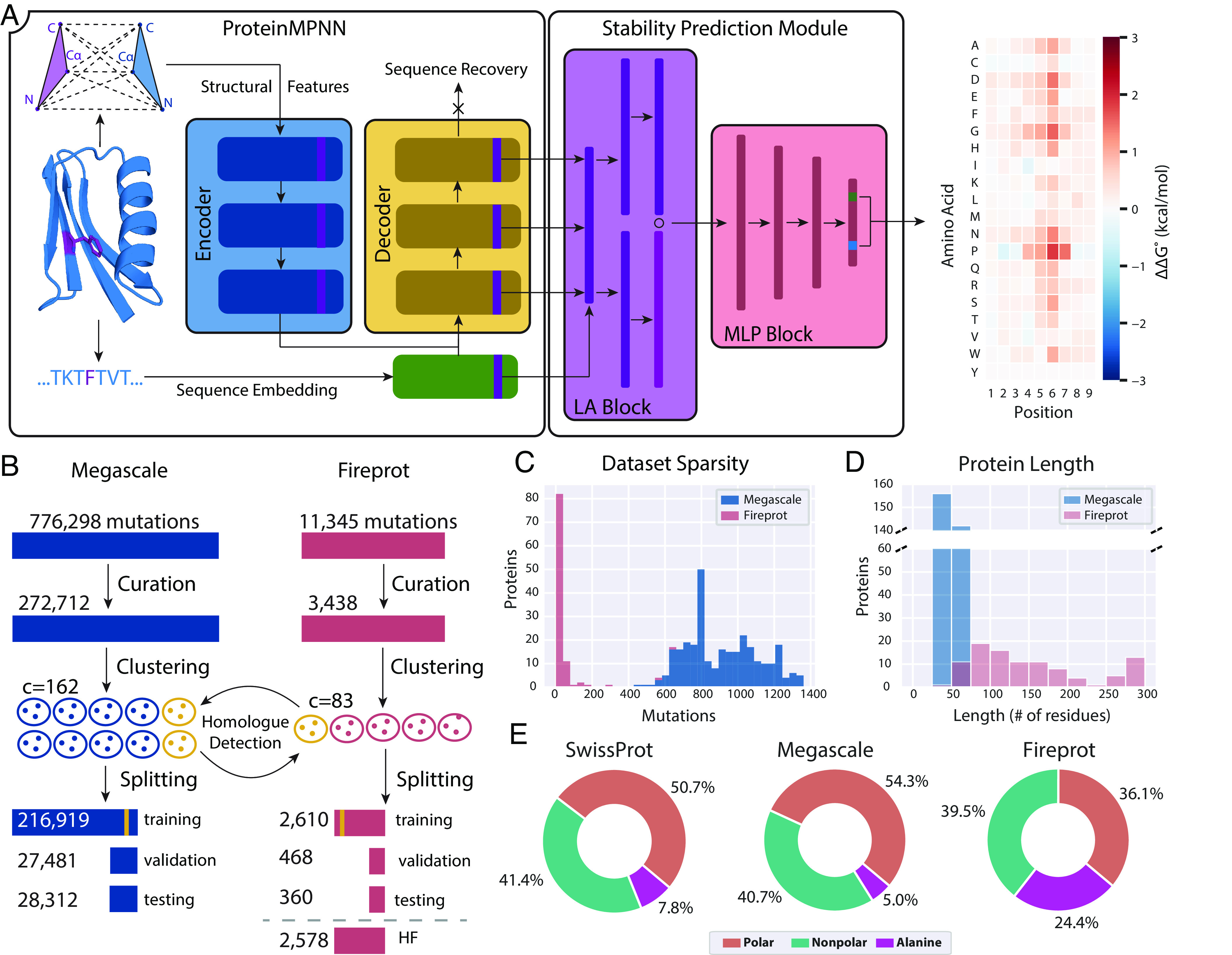
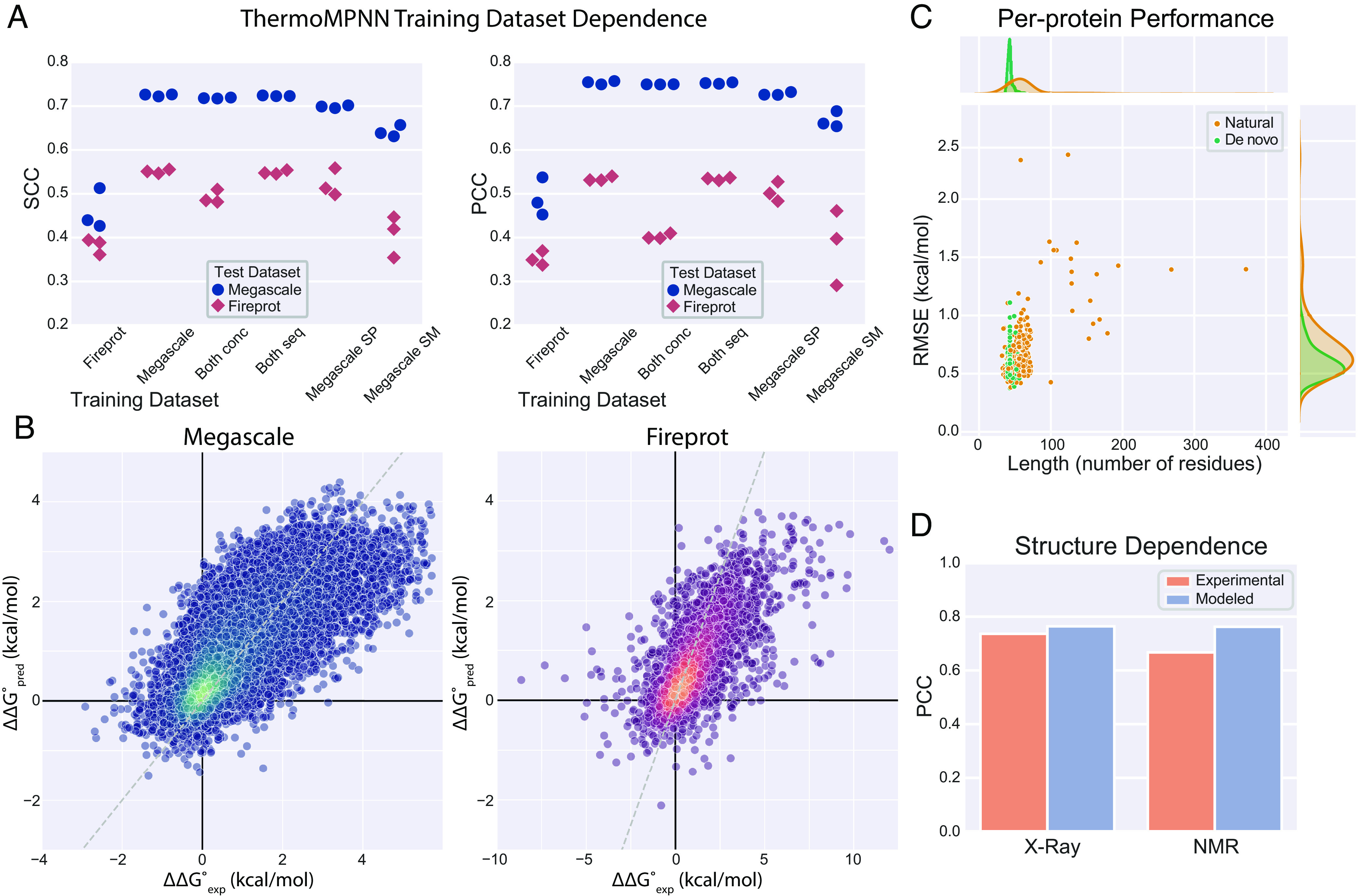
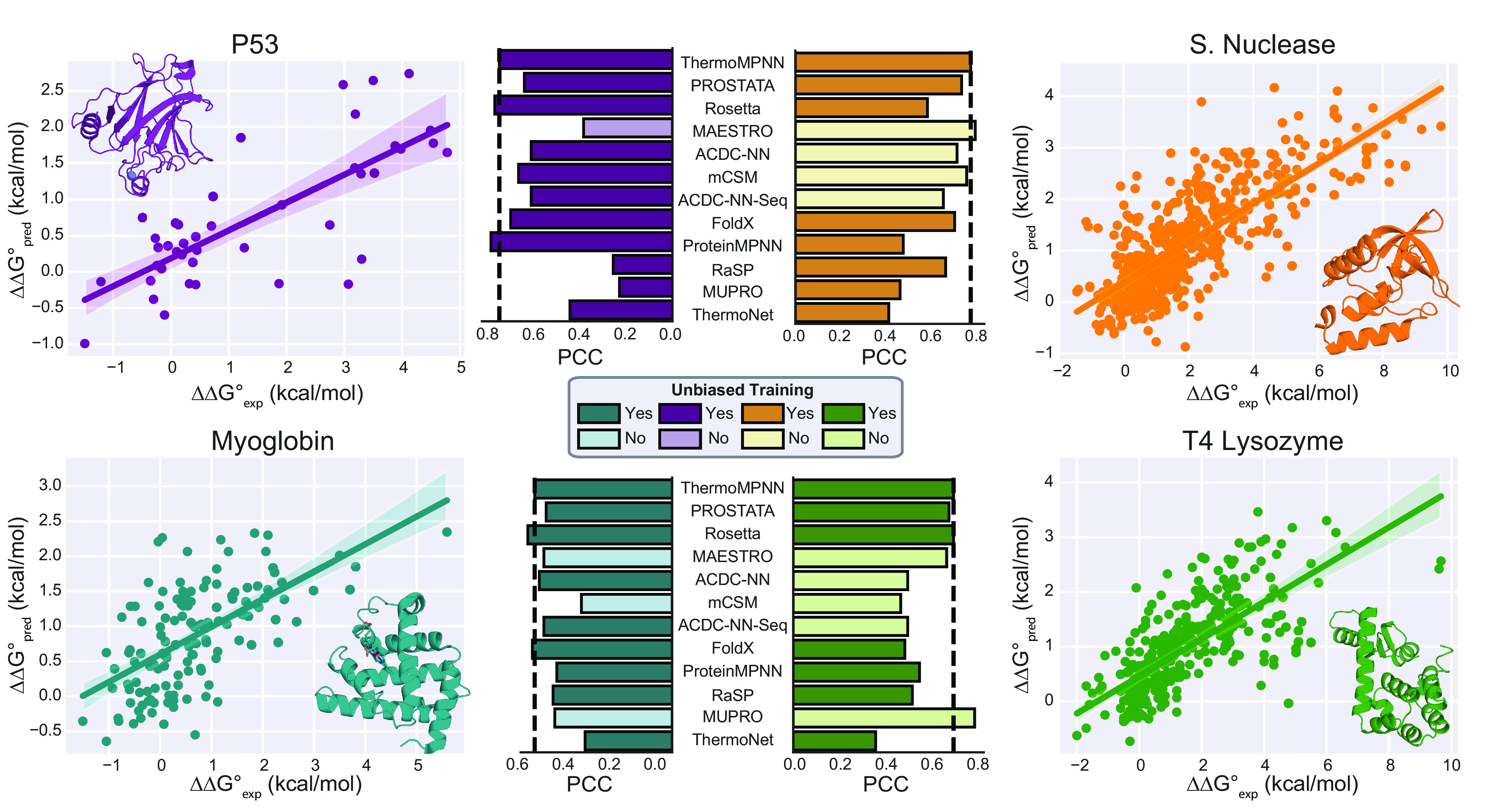
Amino acid mutations that lower a protein’s thermodynamic stability are implicated in numerous diseases, and engineered proteins with enhanced stability can be important in research and medicine. Computational methods for predicting how mutations perturb protein stability are, therefore, of great interest. Despite recent advancements in protein design using deep learning, in silico prediction of stability changes has remained challenging, in part due to a lack of large, high-quality training datasets for model development. Here, we describe ThermoMPNN, a deep neural network trained to predict stability changes for protein point mutations given an initial structure. In doing so, we demonstrate the utility of a recently released megascale stability dataset for training a robust stability model. We also employ transfer learning to leverage a second, larger dataset by using learned features extracted from ProteinMPNN, a deep neural network trained to predict a protein’s amino acid sequence given its three-dimensional structure. We show that our method achieves state-of-the-art performance on established benchmark datasets using a lightweight model architecture that allows for rapid, scalable predictions. Finally, we make ThermoMPNN readily available as a tool for stability prediction and design.
Overview
The claims and statistics of this paper haven’t been checked yet.
Run the check — free, no account needed. It reads the open-access text and checks the sources it cites.
Integrity signals
Registry
Cites
Statistics
Figures
Verification
Claims the paper makes
The claims and statistics of this paper haven’t been checked yet.
Run the check — free, no account needed. It reads the open-access text and checks the sources it cites.
Self-check
Percentages, sums and reported differences re-computed from the paper’s own numbers.
The self-check needs the paper’s full text.
Citations
Cites
Highly accurate protein structure prediction with AlphaFold
Jumper, J., Evans, R., Pritzel, A., Green, T., Figurnov, M., Ronneberger, O., Tunyasuvunakool, K., Bates, R., Žídek, A., Potapenko, A., et al. (2021) · Nature · doi:10.1038/s41586-021-03819-2 · Cited by 43,764
Berman, H. M. (2000) · Nucleic Acids Research · doi:10.1093/nar/28.1.235 · Cited by 40,196
Kabsch, W., & Sander, C. (1983) · Biopolymers · doi:10.1002/bip.360221211 · Cited by 15,320
MMseqs2 enables sensitive protein sequence searching for the analysis of massive data sets
Steinegger, M., & Söding, J. (2017) · Nature Biotechnology · doi:10.1038/nbt.3988 · Cited by 4,840
The FoldX web server: an online force field
Schymkowitz, J., Borg, J., Stricher, F., Nys, R., Rousseau, F., & Serrano, L. (2005) · Nucleic Acids Research · doi:10.1093/nar/gki387 · Cited by 2,759
A Review on Biosensors and Recent Development of Nanostructured Materials-Enabled Biosensors
Naresh, V., & Lee, N. (2021) · Sensors · doi:10.3390/s21041109 · Cited by 2,213
Robust deep learning–based protein sequence design using ProteinMPNN
Dauparas, J., Anishchenko, I., Bennett, N., Bai, H., Ragotte, R. J., Milles, L. F., Wicky, B. I. M., Courbet, A., de Haas, R. J., Bethel, N., et al. (2022) · Science · doi:10.1126/science.add2187 · Cited by 2,210
Robust deep learning based protein sequence design using ProteinMPNN
Dauparas, J., Anishchenko, I., Bennett, N., Bai, H., Ragotte, R. J., Milles, L. F., Wicky, B. I. M., Courbet, A., de Haas, R. J., Bethel, N., et al. (2022) · doi:10.1101/2022.06.03.494563 · Cited by 2,107
Guerois, R., Nielsen, J. E., & Serrano, L. (2002) · Journal of Molecular Biology · doi:10.1016/s0022-2836(02)00442-4 · Cited by 1,728
The Rosetta All-Atom Energy Function for Macromolecular Modeling and Design
Alford, R. F., Leaver-Fay, A., Jeliazkov, J. R., O’Meara, M. J., DiMaio, F. P., Park, H., Shapovalov, M. V., Renfrew, P. D., Mulligan, V. K., Kappel, K., et al. (2017) · Journal of Chemical Theory and Computation · doi:10.1021/acs.jctc.7b00125 · Cited by 1,532
Self-citationPrediction of protein stability changes for single‐site mutations using support vector machines
Cheng, J., Randall, A. Z., & Baldi, P. (2005) · Proteins Structure Function and Bioinformatics · doi:10.1002/prot.20810 · Cited by 1,170
mCSM: Predicting the effects of mutations in proteins using graph-based signatures
Pires, D. E. V., Ascher, D. B., & Blundell, T. L. (2014) · Bioinformatics · doi:10.1093/bioinformatics/btt691 · Cited by 1,066
Directed Evolution: Methodologies and Applications
Wang, Y., Xue, P., Cao, M., Yu, T., Lane, S., & Zhao, H. (2021) · Chemical Reviews · doi:10.1021/acs.chemrev.1c00260 · Cited by 745
Goldenzweig, A., Goldsmith, M., Hill, S. E., Gertman, O., Laurino, P., Ashani, Y., Dym, O., Unger, T., Albeck, S., Prilusky, J., et al. (2016) · Molecular Cell · doi:10.1016/j.molcel.2016.06.012 · Cited by 593
Eris: an automated estimator of protein stability
Yin, S., Ding, F., & Dokholyan, N. V. (2007) · Nature Methods · doi:10.1038/nmeth0607-466 · Cited by 405
Engineering protein-based therapeutics through structural and chemical design
Ebrahimi, S. B., & Samanta, D. (2023) · Nature Communications · doi:10.1038/s41467-023-38039-x · Cited by 405
Power of Biocatalysis for Organic Synthesis
Winkler, C. K., Schrittwieser, J. H., & Kroutil, W. (2021) · ACS Central Science · doi:10.1021/acscentsci.0c01496 · Cited by 396
Mega-scale experimental analysis of protein folding stability in biology and design
Tsuboyama, K., Dauparas, J., Chen, J., Laine, E., Mohseni Behbahani, Y., Weinstein, J. J., Mangan, N. M., Ovchinnikov, S., & Rocklin, G. J. (2023) · Nature · doi:10.1038/s41586-023-06328-6 · Cited by 350
Performance of protein stability predictors
Khan, S., & Vihinen, M. (2010) · Human Mutation · doi:10.1002/humu.21242 · Cited by 324
Using AlphaFold to predict the impact of single mutations on protein stability and function
Pak, M. A., Markhieva, K. A., Novikova, M. S., Petrov, D. S., Vorobyev, I. S., Maksimova, E. S., Kondrashov, F. A., & Ivankov, D. N. (2023) · PLOS One · doi:10.1371/journal.pone.0282689 · Cited by 322
MAESTRO - multi agent stability prediction upon point mutations
Laimer, J., Hofer, H., Fritz, M., Wegenkittl, S., & Lackner, P. (2015) · BMC Bioinformatics · doi:10.1186/s12859-015-0548-6 · Cited by 310
FoldX as Protein Engineering Tool: Better Than Random Based Approaches?
Buß, O., Rudat, J., & Ochsenreither, K. (2018) · Computational and Structural Biotechnology Journal · doi:10.1016/j.csbj.2018.01.002 · Cited by 294
Principles of Protein Stability and Their Application in Computational Design
Goldenzweig, A., & Fleishman, S. J. (2018) · Annual Review of Biochemistry · doi:10.1146/annurev-biochem-062917-012102 · Cited by 291
FireProt: Energy- and Evolution-Based Computational Design of Thermostable Multiple-Point Mutants
Bednář, D., Beerens, K., Šebestová, E., Bendl, J. M., Khare, S. D., Chaloupková, R., Prokop, Z., Brezovský, J., Baker, D. A., & Damborský, J. (2015) · PLoS Computational Biology · doi:10.1371/journal.pcbi.1004556 · Cited by 201
Rapid protein stability prediction using deep learning representations
Blaabjerg, L. M., Kassem, M. M., Good, L. L., Jonsson, N., Cagiada, M., Johansson, K. E., Boomsma, W., Stein, A., & Lindorff-Larsen, K. (2023) · eLife · doi:10.7554/elife.82593 · Cited by 177
Quantification of biases in predictions of protein stability changes upon mutations
Pucci, F., Bernaerts, K. V., Kwasigroch, J. M., & Rooman, M. (2018) · Bioinformatics · doi:10.1093/bioinformatics/bty348 · Cited by 169
Protein stability engineering insights revealed by domain-wide comprehensive mutagenesis
Nisthal, A., Wang, C. Y., Ary, M. L., & Mayo, S. L. (2019) · Proceedings of the National Academy of Sciences · doi:10.1073/pnas.1903888116 · Cited by 162
Pancotti, C., Benevenuta, S., Birolo, G., Alberini, V., Repetto, V., Sanavia, T., Capriotti, E., & Fariselli, P. (2021) · Briefings in Bioinformatics · doi:10.1093/bib/bbab555 · Cited by 147
Li, B., Yang, Y., Capra, J. A., & Gerstein, M. (2020) · PLoS Computational Biology · doi:10.1371/journal.pcbi.1008291 · Cited by 142
Light attention predicts protein location from the language of life
Stärk, H., Dallago, C., Heinzinger, M., & Rost, B. (2021) · Bioinformatics Advances · doi:10.1093/bioadv/vbab035 · Cited by 130
FireProtDB: database of manually curated protein stability data
Štourač, J., Dubrava, J., Musil, M., Horackova, J., Damborský, J., Mazurenko, S., & Bednář, D. (2020) · Nucleic Acids Research · doi:10.1093/nar/gkaa981 · Cited by 129
Diaz, D. J., Gong, C., Ouyang-Zhang, J., Loy, J. M., Wells, J., Yang, D. K., Ellington, A. D., Dimakis, A. G., & Klivans, A. R. (2024) · Nature Communications · doi:10.1038/s41467-024-49780-2 · Cited by 69
An antisymmetric neural network to predict free energy changes in protein variants
Benevenuta, S., Pancotti, C., Fariselli, P., Birolo, G., & Sanavia, T. (2021) · Journal of Physics D Applied Physics · doi:10.1088/1361-6463/abedfb · Cited by 66
Kepp, K. P. (2015) · Biochimica et Biophysica Acta (BBA) - Proteins and Proteomics · doi:10.1016/j.bbapap.2015.06.002 · Cited by 57
A Deep-Learning Sequence-Based Method to Predict Protein Stability Changes Upon Genetic Variations
Pancotti, C., Benevenuta, S., Repetto, V., Birolo, G., Capriotti, E., Sanavia, T., & Fariselli, P. (2021) · Genes · doi:10.3390/genes12060911 · Cited by 45
BayeStab : Predicting effects of mutations on protein stability with uncertainty quantification
Wang, S., Tang, H., Zhao, Y., & Zuo, L. (2022) · Protein Science · doi:10.1002/pro.4467 · Cited by 43
ProS-GNN: Predicting effects of mutations on protein stability using graph neural networks
Wang, S., Tang, H., Shan, P., Wu, Z., & Zuo, L. (2023) · Computational Biology and Chemistry · doi:10.1016/j.compbiolchem.2023.107952 · Cited by 41
PROSTATA: a framework for protein stability assessment using transformers
Umerenkov, D., Nikolaev, F., Shashkova, T., Страшнов, П. В., Sindeeva, M., Shevtsov, A., Ivanisenko, N. V., & Kardymon, O. L. (2023) · Bioinformatics · doi:10.1093/bioinformatics/btad671 · Cited by 40
Predicting protein stability and solubility changes upon mutations: data perspective
Mazurenko, S. (2020) · ChemCatChem · doi:10.1002/cctc.202000933 · Cited by 34
Stabilizing proteins, simplified: A Rosetta‐based webtool for predicting favorable mutations
Thieker, D. F., Maguire, J. B., Kudlacek, S. T., Leaver‐Fay, A., Lyskov, S., & Kuhlman, B. A. (2022) · Protein Science · doi:10.1002/pro.4428 · Cited by 32
Self-citationBoosting protein stability with the computational design of β‐sheet surfaces
Kim, D. N., Jacobs, T., & Kuhlman, B. (2016) · Protein Science · doi:10.1002/pro.2869 · Cited by 29
Self-citationProbabilistic analysis of the frequencies of amino acid pairs within characterized protein sequences
Shen, S., Kai, B., Ruan, J., Huzil, J. T., Carpenter, E. J., & Tuszyński, J. A. (2006) · Physica A Statistical Mechanics and its Applications · doi:10.1016/j.physa.2006.03.004 · Cited by 24
Pak, M. A., Dovidchenko, N. V., Sharma, S. M., & Ivankov, D. N. (2023) · bioRxiv (Cold Spring Harbor Laboratory) · doi:10.1101/2022.12.31.522396 · Cited by 12
Mega-scale experimental analysis of protein folding stability in biology and design
Tsuboyama, K., Dauparas, J., Chen, J., Laine, É., Behbahani, Y. M., Weinstein, J. J., Mangan, N. M., Ovchinnikov, S., & Rocklin, G. J. (2023) · RePEc: Research Papers in Economics · doi:10.5281/zenodo.7992926 · Cited by 10
Stability Oracle: A Structure-Based Graph-Transformer for Identifying Stabilizing MutationsPreprint
Diaz, D. J., Gong, C., Ouyang-Zhang, J., Loy, J. M., Wells, J., Yang, D. K., Ellington, A. D., Dimakis, A. G., & Klivans, A. R. (2023) · bioRxiv (Cold Spring Harbor Laboratory) · doi:10.1101/2023.05.15.540857 · Cited by 9
PROSTATA: Protein Stability Assessment using TransformersPreprint
Umerenkov, D., Shashkova, T., Страшнов, П. В., Nikolaev, F., Sindeeva, M., Ivanisenko, N. V., & Kardymon, O. L. (2022) · bioRxiv (Cold Spring Harbor Laboratory) · doi:10.1101/2022.12.25.521875 · Cited by 7
Mega-scale experimental analysis of protein folding stability in biology and design
Tsuboyama, K., Dauparas, J., Chen, J., Laine, É., Behbahani, Y. M., Weinstein, J. J., Mangan, N. M., Ovchinnikov, S., & Rocklin, G. J. (2022) · Zenodo (CERN European Organization for Nuclear Research) · doi:10.5281/zenodo.7401274 · Cited by 3
FireProtDB + PDB Structural Protein Stability Dataset
Dieckhaus, H., Brocidiacono, M., Randolph, N. Z., & Kuhlman, B. A. (2023) · Zenodo (CERN European Organization for Nuclear Research) · doi:10.5281/zenodo.8169288 · Cited by 1
Self-citation
Cited by
Sorted by citations
De novo protein design—From new structures to programmable functions
Kortemme, T. (2024) · Cell · doi:10.1016/j.cell.2023.12.028 · Cited by 383
Machine learning for functional protein design
Notin, P., Rollins, N. J., Gal, Y., Sander, C., & Marks, D. S. (2024) · Nature Biotechnology · doi:10.1038/s41587-024-02127-0 · Cited by 304
Site-saturation mutagenesis of 500 human protein domains
Beltran, A., Jiang, X., Shen, Y., & Lehner, B. (2025) · Nature · doi:10.1038/s41586-024-08370-4 · Cited by 126
Engineering thermostability of industrial enzymes for enhanced application performance
Xu, K., Fu, H., Chen, Q., Sun, R., Li, R., Zhao, X., Zhou, J., & Wang, X. (2024) · International Journal of Biological Macromolecules · doi:10.1016/j.ijbiomac.2024.139067 · Cited by 92
Proteins with alternative folds reveal blind spots in AlphaFold-based protein structure prediction
Chakravarty, D., Lee, M., & Porter, L. L. (2025) · Current Opinion in Structural Biology · doi:10.1016/j.sbi.2024.102973 · Cited by 76
Metadata
- Authors
- Dieckhaus, H., Brocidiacono, M., Randolph, N. Z., & Kuhlman, B.
- Affiliations
- University of North Carolina at Chapel Hill (US)
- Corresponding author
- Kuhlman, Brian
- Venue
- Proceedings of the National Academy of Sciences
- Publisher
- National Academy of Sciences
- Published
- 2024-01-29
- Volume
- 121
- Issue
- 6
- Pages
- e2314853121-e2314853121
- ISSN
- 0027-8424 (ISSN-L)
- 1091-6490
- PMC
- PMC10861915
- OpenAlex
- W4391308485
- Cited by
- 205
- References
- 47
- Citations by year
- 2026: 104 · 2025: 74 · 2024: 25
- FWCI
- 27.63
- Type
- journal article
- Language
- en
- Open access
- hybrid
- doi.org
- Licence
- Locations
- Proceedings of the National Academy of Sciences (publishedVersion, cc-by-nc-nd)
- bioRxiv (Cold Spring Harbor Laboratory) (acceptedVersion, cc-by-nd)
- PubMed Central (publishedVersion, cc-by-nc-nd)
- PubMed (publishedVersion)
- PubMed Central (submittedVersion, cc-by-nd)
- Funders
- HHS | NIH | National Institute of General Medical Sciences (R35GM131923)
- NSF | EDU | Division of Graduate Education (DGE-2040435)
- Topics
- Life Sciences › Biochemistry, Genetics and Molecular Biology › Molecular Biology › Protein Structure and Dynamics
- Life Sciences › Biochemistry, Genetics and Molecular Biology › Molecular Biology › Machine Learning in Bioinformatics
- Life Sciences › Biochemistry, Genetics and Molecular Biology › Molecular Biology › RNA and protein synthesis mechanisms
- Keywords
- protein stability prediction, transfer learning, ProteinMPNN, point mutations, protein thermodynamic stability, deep neural network, protein design, learned features, engineered proteins
About these checks
Registry, retraction, Cites and statistics results are computed, not judged, with one exception: a printed reference that no index lists is read once by a model before it counts as a citation error. Claims are extracted by a model and kept only when their quote appears verbatim in the text; each cited source is then checked, with a model’s help, for whether it says what the claim relies on. Those verdicts can be wrong — read the claim’s quote and the cited source before relying on one.
Statistics and arithmetic are recomputed, not judged.
Confidence bands are shown only for fields calibrated on our annotated test set. None is calibrated yet, so no band is shown.
What counts as a claim ›How we measure confidence ›How we check this ›
Are you an author, or do you see a problem with this page? Request a review
