

The DOI matches its Crossref record; 48 of the 48 references it cites were found in a registry or an index.
Transfer learning to leverage larger datasets for improved prediction of protein stability changes
Open accessPublished version of a preprint
Abstract
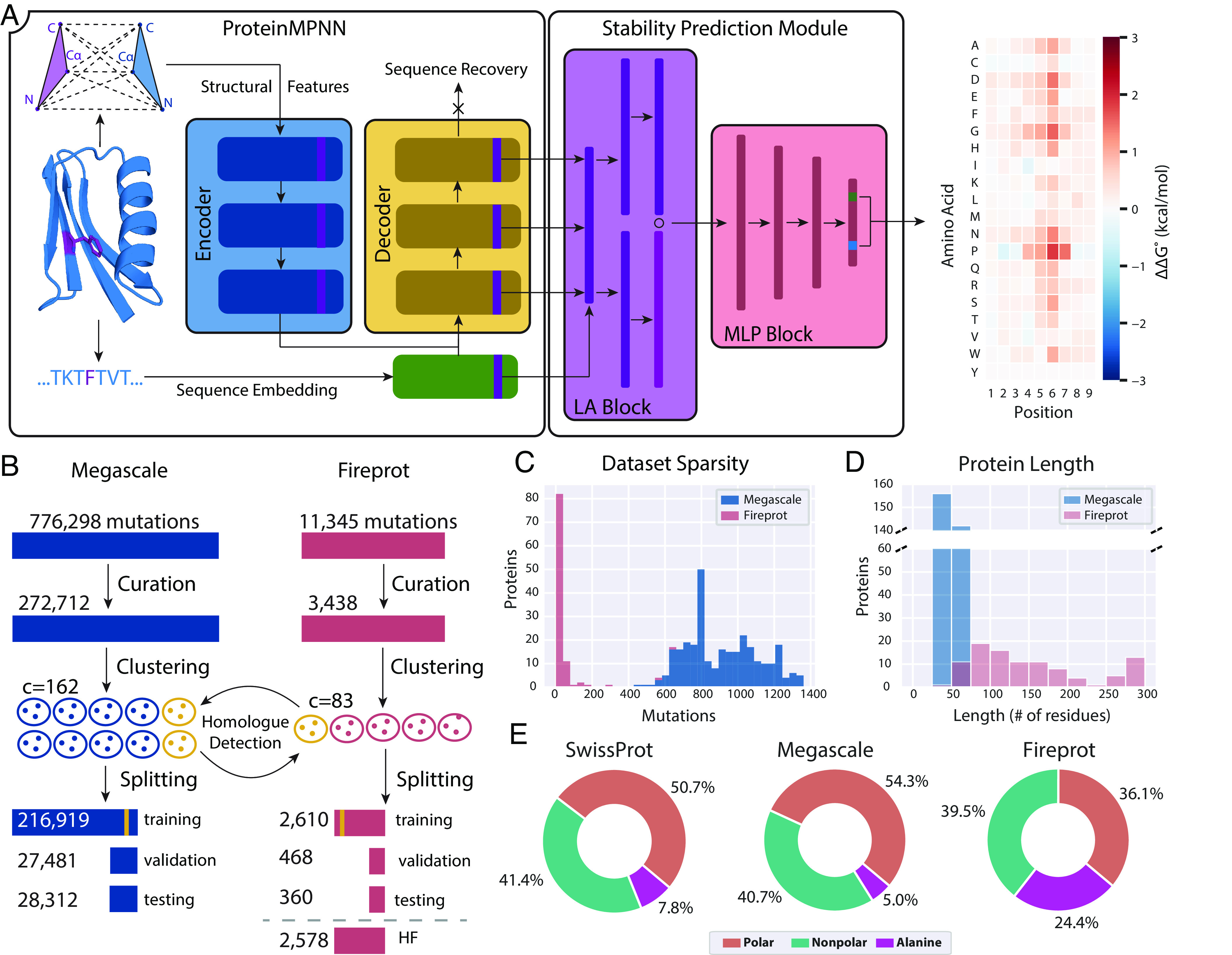
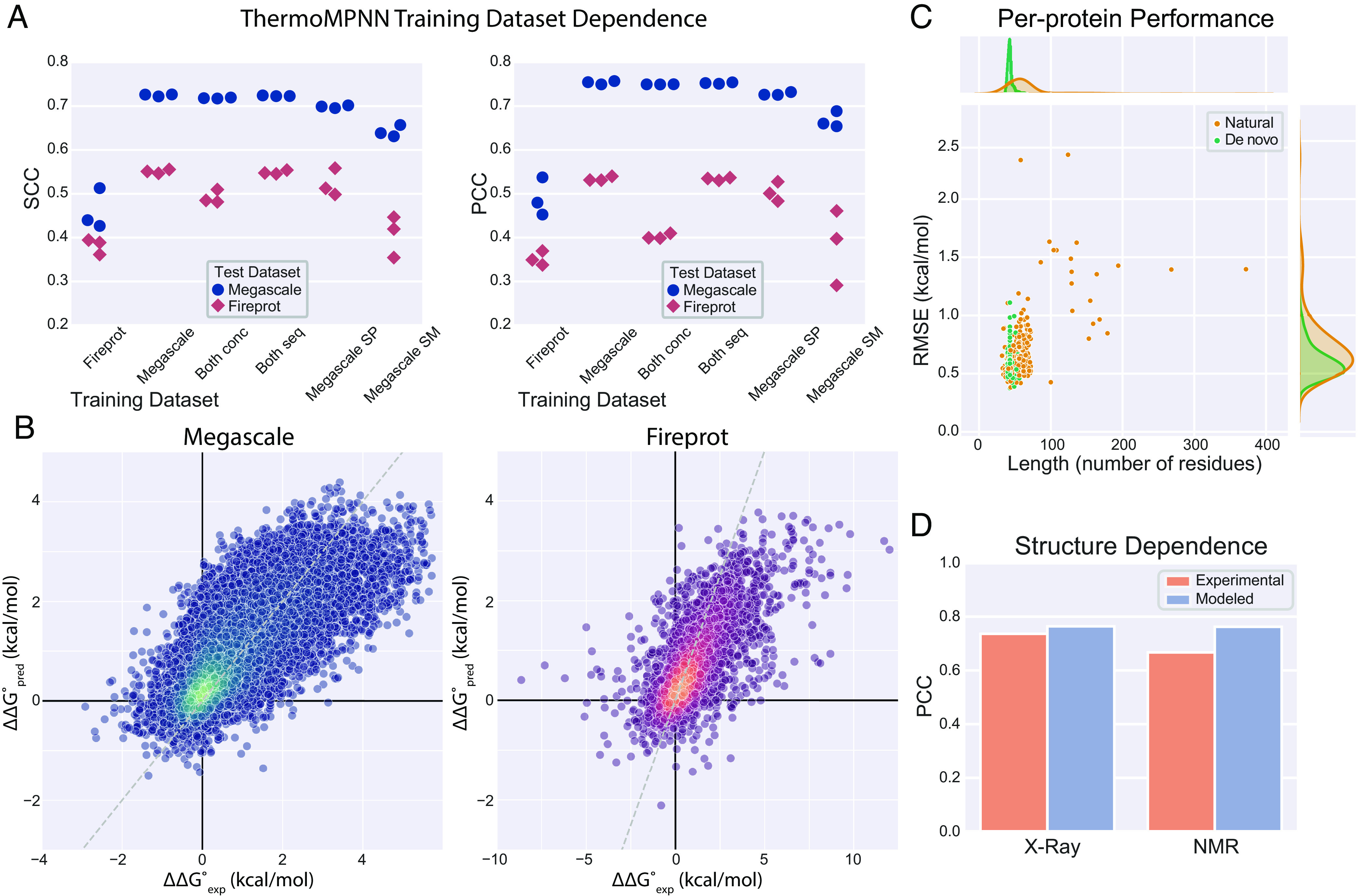
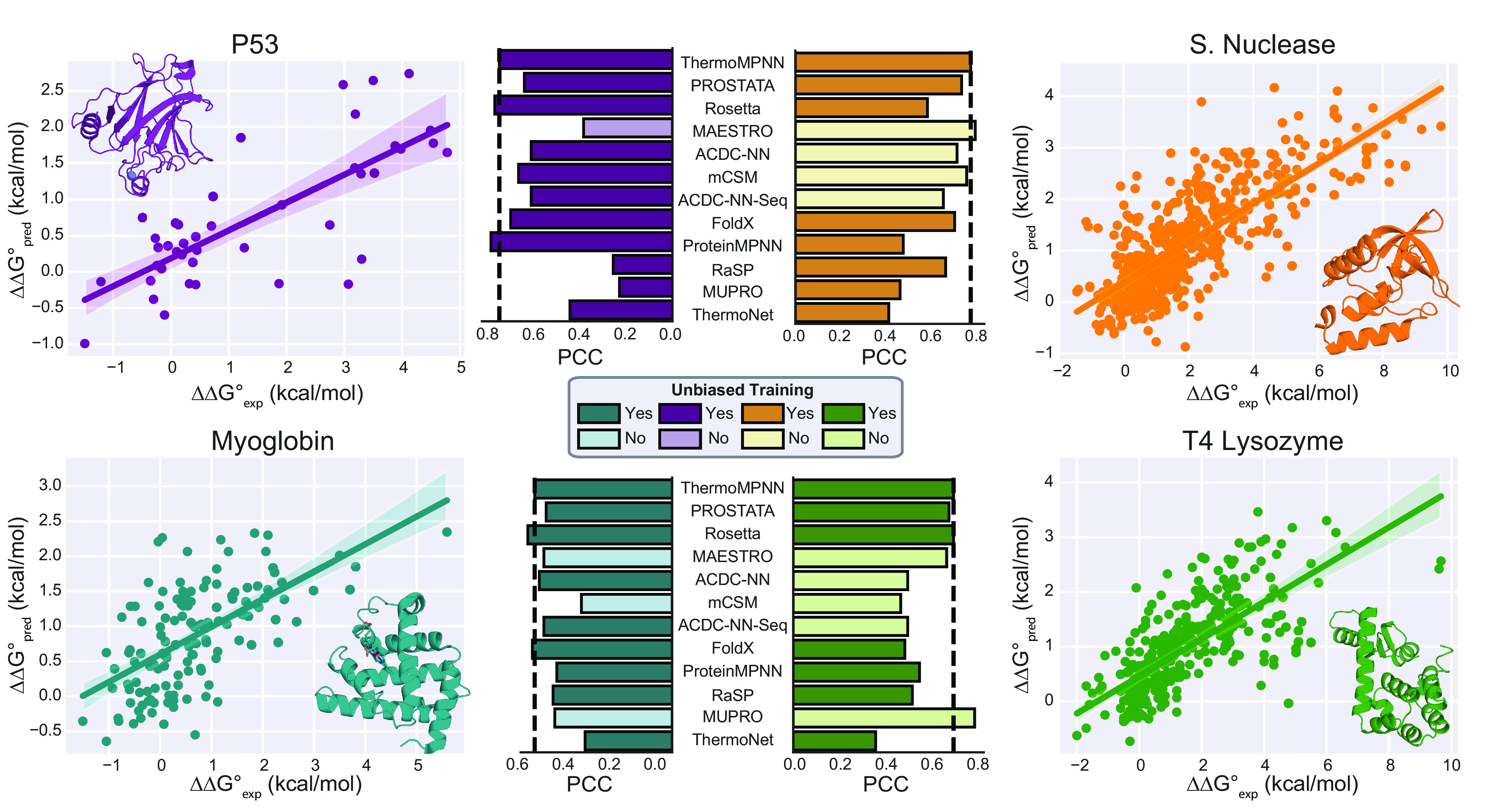
Amino acid mutations that lower a protein’s thermodynamic stability are implicated in numerous diseases, and engineered proteins with enhanced stability can be important in research and medicine. Computational methods for predicting how mutations perturb protein stability are, therefore, of great interest. Despite recent advancements in protein design using deep learning, in silico prediction of stability changes has remained challenging, in part due to a lack of large, high-quality training datasets for model development. Here, we describe ThermoMPNN, a deep neural network trained to predict stability changes for protein point mutations given an initial structure. In doing so, we demonstrate the utility of a recently released megascale stability dataset for training a robust stability model. We also employ transfer learning to leverage a second, larger dataset by using learned features extracted from ProteinMPNN, a deep neural network trained to predict a protein’s amino acid sequence given its three-dimensional structure. We show that our method achieves state-of-the-art performance on established benchmark datasets using a lightweight model architecture that allows for rapid, scalable predictions. Finally, we make ThermoMPNN readily available as a tool for stability prediction and design.
Overview
The claims and statistics of this paper haven’t been checked yet.
Run the check — free, no account needed. It reads the open-access text and checks the sources it cites.
Integrity signals
Registry
Cites
Statistics
Figures
Verification
Claims the paper makes
The claims and statistics of this paper haven’t been checked yet.
Run the check — free, no account needed. It reads the open-access text and checks the sources it cites.
Self-check
Percentages, sums and reported differences re-computed from the paper’s own numbers.
The self-check needs the paper’s full text.
Citations
Cites
Highly accurate protein structure prediction with AlphaFold
Jumper, J., Evans, R., Pritzel, A., Green, T., Figurnov, M., Ronneberger, O., Tunyasuvunakool, K., Bates, R., Žídek, A., Potapenko, A., et al. (2021) · Nature · doi:10.1038/s41586-021-03819-2 · Cited by 43,764
Berman, H. M. (2000) · Nucleic Acids Research · doi:10.1093/nar/28.1.235 · Cited by 40,196
Kabsch, W., & Sander, C. (1983) · Biopolymers · doi:10.1002/bip.360221211 · Cited by 15,320
MMseqs2 enables sensitive protein sequence searching for the analysis of massive data sets
Steinegger, M., & Söding, J. (2017) · Nature Biotechnology · doi:10.1038/nbt.3988 · Cited by 4,840
The FoldX web server: an online force field
Schymkowitz, J., Borg, J., Stricher, F., Nys, R., Rousseau, F., & Serrano, L. (2005) · Nucleic Acids Research · doi:10.1093/nar/gki387 · Cited by 2,759
A Review on Biosensors and Recent Development of Nanostructured Materials-Enabled Biosensors
Naresh, V., & Lee, N. (2021) · Sensors · doi:10.3390/s21041109 · Cited by 2,213
Robust deep learning–based protein sequence design using ProteinMPNN
Dauparas, J., Anishchenko, I., Bennett, N., Bai, H., Ragotte, R. J., Milles, L. F., Wicky, B. I. M., Courbet, A., de Haas, R. J., Bethel, N., et al. (2022) · Science · doi:10.1126/science.add2187 · Cited by 2,210
Robust deep learning based protein sequence design using ProteinMPNN
Dauparas, J., Anishchenko, I., Bennett, N., Bai, H., Ragotte, R. J., Milles, L. F., Wicky, B. I. M., Courbet, A., de Haas, R. J., Bethel, N., et al. (2022) · doi:10.1101/2022.06.03.494563 · Cited by 2,107
Guerois, R., Nielsen, J. E., & Serrano, L. (2002) · Journal of Molecular Biology · doi:10.1016/s0022-2836(02)00442-4 · Cited by 1,728
The Rosetta All-Atom Energy Function for Macromolecular Modeling and Design
Alford, R. F., Leaver-Fay, A., Jeliazkov, J. R., O’Meara, M. J., DiMaio, F. P., Park, H., Shapovalov, M. V., Renfrew, P. D., Mulligan, V. K., Kappel, K., et al. (2017) · Journal of Chemical Theory and Computation · doi:10.1021/acs.jctc.7b00125 · Cited by 1,532
Self-citation
Cited by
Sorted by citations
De novo protein design—From new structures to programmable functions
Kortemme, T. (2024) · Cell · doi:10.1016/j.cell.2023.12.028 · Cited by 383
Machine learning for functional protein design
Notin, P., Rollins, N. J., Gal, Y., Sander, C., & Marks, D. S. (2024) · Nature Biotechnology · doi:10.1038/s41587-024-02127-0 · Cited by 304
Site-saturation mutagenesis of 500 human protein domains
Beltran, A., Jiang, X., Shen, Y., & Lehner, B. (2025) · Nature · doi:10.1038/s41586-024-08370-4 · Cited by 126
Engineering thermostability of industrial enzymes for enhanced application performance
Xu, K., Fu, H., Chen, Q., Sun, R., Li, R., Zhao, X., Zhou, J., & Wang, X. (2024) · International Journal of Biological Macromolecules · doi:10.1016/j.ijbiomac.2024.139067 · Cited by 92
Proteins with alternative folds reveal blind spots in AlphaFold-based protein structure prediction
Chakravarty, D., Lee, M., & Porter, L. L. (2025) · Current Opinion in Structural Biology · doi:10.1016/j.sbi.2024.102973 · Cited by 76
Biophysics-based protein language models for protein engineering
Gelman, S., Johnson, B., Freschlin, C. R., Sharma, A., D’Costa, S., Peters, J., Gitter, A., & Romero, P. A. (2025) · Nature Methods · doi:10.1038/s41592-025-02776-2 · Cited by 77
Machine Learning‐Enhanced Nanoparticle Design for Precision Cancer Drug Delivery
Wang, Q., Liu, Y., Li, C., Xu, S., Xu, S., & Liu, B. (2025) · Advanced Science · doi:10.1002/advs.202503138 · Cited by 81
Sun, C., Li, H., Liu, Y., Li, Y., Gao, R. C., Shi, X., Fei, H., Liu, J., Liang, R., & Gao, C. (2025) · Cell · doi:10.1016/j.cell.2025.07.011 · Cited by 63
An end-to-end framework for the prediction of protein structure and fitness from single sequence
Chen, Y., Xu, Y., Liu, D., Xing, Y., & Gong, H. (2024) · Nature Communications · doi:10.1038/s41467-024-51776-x · Cited by 45
AI-driven de novo enzyme design: Strategies, applications, and future prospects
Cui, X.-C., Zheng, Y., Liu, Y., Yuchi, Z., & Yuan, Y. (2025) · Biotechnology Advances · doi:10.1016/j.biotechadv.2025.108603 · Cited by 44
Multiplexed assays of variant effect for clinical variant interpretation
McEwen, A. E., Tejura, M., Fayer, S., Starita, L. M., & Fowler, D. M. (2025) · Nature Reviews Genetics · doi:10.1038/s41576-025-00870-x · Cited by 52
Autonomous biomedical research with an artificial intelligence agent
Huang, K., Zhang, S., Wang, H., Qu, Y., Lu, Y., Li, R., Roohani, Y., Qiu, L., Cao, S., Li, G. L., et al. (2026) · Science · doi:10.1126/science.adz4351 · Cited by 289
Predicting absolute protein folding stability using generative models
Cagiada, M., Ovchinnikov, S., & Lindorff‐Larsen, K. (2024) · Protein Science · doi:10.1002/pro.5233 · Cited by 38
Grigorakis, K., Ferousi, C., & Topakas, E. (2025) · Catalysts · doi:10.3390/catal15020147 · Cited by 39
Aligning protein generative models with experimental fitness via Direct Preference OptimizationPreprint
Widatalla, T., Rafailov, R., & Hie, B. (2024) · bioRxiv (Cold Spring Harbor Laboratory) · doi:10.1101/2024.05.20.595026 · Cited by 35
Language Modeling Materializes a World Model of Protein BiologyPreprint
Candido, S., Hayes, T., Derry, A., Rao, R., Lin, Z., Verkuil, R., Wu, B. Z., Lee, J. S., Bruguera, E. S., Keval, J. A., et al. (2026) · bioRxiv (Cold Spring Harbor Laboratory) · doi:10.64898/2026.06.03.729735 · Cited by 85
Zhu, C., Mu, J., & Liang, L. (2024) · Journal of Nanobiotechnology · doi:10.1186/s12951-024-02969-5 · Cited by 36
Sun, J., Zhu, T., Cui, Y., & Wu, B. (2025) · The Innovation · doi:10.1016/j.xinn.2024.100750 · Cited by 45
Computational design of conformation-biasing mutations to alter protein functions
Cavanagh, P. E., Xue, A. G., Dai, S. A., Qiang, A., Matsui, T., & Ting, A. Y. (2026) · Science · doi:10.1126/science.adv7953 · Cited by 34
Sepsis subphenotypes: bridging the gaps in sepsis treatment strategies
Zhang, X., Zhang, W., Zhang, H., & Liao, X. (2025) · Frontiers in Immunology · doi:10.3389/fimmu.2025.1546474 · Cited by 30
Protein stability models fail to capture epistatic interactions of double point mutations
Dieckhaus, H., & Kuhlman, B. A. (2024) · Protein Science · doi:10.1002/pro.70003 · Cited by 27
Self-citationFrom traditional to AI-driven: The evolution of intelligent enzyme engineering for biocatalysis
Lv, F., Zhang, J., You, S., & Qi, W. (2025) · Biotechnology Advances · doi:10.1016/j.biotechadv.2025.108788 · Cited by 31
SSEmb: A joint embedding of protein sequence and structure enables robust variant effect predictions
Blaabjerg, L. M., Jonsson, N., Boomsma, W., Stein, A., & Lindorff‐Larsen, K. (2024) · Nature Communications · doi:10.1038/s41467-024-53982-z · Cited by 31
Large-scale discovery, analysis and design of protein energy landscapes
Ferrari, Á. J. R., Dixit, S. M., Thibeault, J., Garcia, M., Houliston, S., Ludwig, R. W., Notin, P., Phoumyvong, C. M., Martell, C. M., Jung, M. D., et al. (2026) · Nature · doi:10.1038/s41586-026-10465-z · Cited by 22
Generalizable and scalable protein stability prediction with rewired protein generative models
Li, Z., & Luo, Y. (2025) · Nature Communications · doi:10.1038/s41467-025-67609-4 · Cited by 24
Zheng, F., Liu, Y., Yang, Y. J., Wen, Y., & Li, M. (2023) · Protein Science · doi:10.1002/pro.4861 · Cited by 23
Savojardo, C., Manfredi, M., Martelli, P. L., & Casadio, R. (2024) · Bioinformatics · doi:10.1093/bioinformatics/btaf019 · Cited by 22
Protein Language Models: Applications and Perspectives
Leclercq, M., & Droit, A. (2025) · Journal of Proteome Research · doi:10.1021/acs.jproteome.5c00506 · Cited by 29
ESM ‐scan—A tool to guide amino acid substitutions
Totaro, M. G., Vide, U., Zausinger, R., Winkler, A., & Oberdorfer, G. (2024) · Protein Science · doi:10.1002/pro.5221 · Cited by 19
Can protein expression be ‘solved’?
Baranowski, C., Martín, H. G., Oyarzún, D. A., Spinner, A., Desai, B. J., Petzold, C. J., Nikolados, E.-M., Kraatz, S. H. W., Gaber, A., Chalkley, R. J., et al. (2025) · Trends in biotechnology · doi:10.1016/j.tibtech.2025.04.021 · Cited by 21
How artificial intelligence is reengineering protein engineering
Listgarten, J., & Jiang, H. (2026) · Science · doi:10.1126/science.aec8444 · Cited by 20
Estevam, G. O., Linossi, E., Rao, J., Macdonald, C. B., Ravikumar, A., Chrispens, K. M., Capra, J. A., Coyote-Maestas, W., Pimentel, H., Collisson, E. A., et al. (2025) · eLife · doi:10.7554/elife.101882 · Cited by 17
Gurusinghe, S. N. S., Wu, Y., DeGrado, W. F., & Shifman, J. M. (2025) · Bioinformatics · doi:10.1093/bioinformatics/btaf270 · Cited by 15
Liang, T., Sun, Z., Ishima, R., Xie, X., Xue, Y., Li, W., & Feng, Z. (2025) · Research · doi:10.34133/research.0674 · Cited by 14
Garcia, M., Dixit, S. M., & Rocklin, G. J. (2026) · Protein Science · doi:10.1002/pro.70453 · Cited by 26
Chungyoun, M., & Gray, J. R. (2026) · Patterns · doi:10.64898/2025.12.27.696706 · Cited by 17
Xu, S., Chen, Y.-M., Meng, X., Pan, R., Yan, A.-X., Li, Z., & Li, Z. (2025) · Bioresource Technology · doi:10.1016/j.biortech.2025.133081 · Cited by 13
Cuturello, F., Celoria, M., Ansuini, A., & Cazzaniga, A. (2024) · Bioinformatics · doi:10.1093/bioinformatics/btae447 · Cited by 11
Küng, C., Protsenko, O., Vanella, R., & Nash, M. A. (2025) · Protein Science · doi:10.1002/pro.70112 · Cited by 14
A small molecule stabilizer rescues the surface expression of nearly all missense variants in a GPCR
Mighell, T. L., & Lehner, B. (2025) · Nature Structural & Molecular Biology · doi:10.1038/s41594-025-01659-6 · Cited by 19
HyperMPNN – A general strategy to design thermostable proteins learned from hyperthermophilesPreprint
Ertelt, M., Schlegel, P., Beining, M., Kaysser, L., Meiler, J., & Schoeder, C. T. (2024) · bioRxiv (Cold Spring Harbor Laboratory) · doi:10.1101/2024.11.26.625397 · Cited by 13
Structure and immunogenicity of an engineered soluble prefusion-stabilized EBV gB antigen
McCool, R. S., Acreman, C. M., Powell, A. E., Picucci, S. I., Stieh, D. J., Chou, C., Huynh, J., Caruso, H., Park, S., O’Rear, J., et al. (2026) · Nature Communications · doi:10.1038/s41467-025-67969-x · Cited by 11
Reaching New Heights in Genetic Code Manipulation with High Throughput Screening
Lino, B. R., Williams, S. J., Castor, M. E., & Deventer, J. A. V. (2024) · Chemical Reviews · doi:10.1021/acs.chemrev.4c00329 · Cited by 11
Deep learning methods for protein representation and function prediction: A comprehensive overview
Wang, M., Nie, Z., He, Y., Vasilakos, A. V., Cheng, Q. S., & Ren, Z. (2025) · Engineering Applications of Artificial Intelligence · doi:10.1016/j.engappai.2025.110977 · Cited by 11
Beltran, A., Jiang, X., Shen, Y., & Lehner, B. (2024) · bioRxiv (Cold Spring Harbor Laboratory) · doi:10.1101/2024.04.26.591310 · Cited by 11
Reliable prediction of protein–protein binding affinity changes upon mutations with Pythia-PPI
Tao, F., Sun, J., Gao, P., Gao, G. F., & Wu, B. (2025) · National Science Review · doi:10.1093/nsr/nwaf231 · Cited by 10
Computation of Protein Thermostability and Epistasis
Peccati, F., Segovia, C. M., Núñez‐Franco, R., & Jiménez‐Osés, G. (2025) · Wiley Interdisciplinary Reviews Computational Molecular Science · doi:10.1002/wcms.70045 · Cited by 11
The genetic architecture of an allosteric hormone receptor
Stammnitz, M. R., & Lehner, B. (2026) · Nature Communications · doi:10.1038/s41467-026-70341-2 · Cited by 8
Allostery is a widespread cause of loss-of-function variant pathogenicity
Liao, X., & Lehner, B. (2026) · Nature Communications · doi:10.1038/s41467-026-74517-8 · Cited by 13
Protein folding stability estimation with explicit consideration of unfolded states
Lee, H. C., Cho, Y., Yun, J., Steinegger, M., Kim, H. M., & Park, H. (2026) · Nature Communications · doi:10.1038/s41467-026-68637-4 · Cited by 11
Lin, J., Wu, W., Nie, G., Li, J., Fang, X., Sheng, Y.-G., Wang, M., Zheng, Q.-Y., Guo, X., Huang, J., et al. (2025) · Nature Communications · doi:10.1038/s41467-025-64323-z · Cited by 9
Engineering complexity into protein-based biomaterials for biomedical applications
Gregorio, N. E., Haas, C. M., King, N. P., & DeForest, C. A. (2025) · Nature Reviews Materials · doi:10.1038/s41578-025-00861-8 · Cited by 11
Evaluating zero-shot prediction of protein design success by AlphaFold, ESMFold, and ProteinMPNNPreprint
Garcia, M., Dixit, S. M., & Rocklin, G. J. (2025) · bioRxiv (Cold Spring Harbor Laboratory) · doi:10.1101/2025.07.29.667290 · Cited by 8
Nie, Z., Ma, Y., Liu, Y., Huang, X., Liu, Z., Peng, Y., Xu, F., Yin, F., Li, Z., Fu, J., et al. (2025) · Briefings in Bioinformatics · doi:10.1093/bib/bbaf319 · Cited by 7
Feldman, J., Brogi, M., & Skolnick, J. (2026) · Computational and Structural Biotechnology Journal · doi:10.34133/csbj.0142 · Cited by 11
When “loss-of-function” means proteostasis burden: Thinking again about coding DNA variants
Shovlin, C. L., & Aldred, M. A. (2025) · The American Journal of Human Genetics · doi:10.1016/j.ajhg.2024.12.002 · Cited by 6
Decoding the effects of mutation on protein interactions using machine learning
Wang, X., Li, A., Zhao, Y., & Peng, Y. (2025) · Biophysics Reviews · doi:10.1063/5.0249920 · Cited by 7
Estevam, G. O., Linossi, E., Rao, J., Macdonald, C. B., Ravikumar, A., Chrispens, K. M., Capra, J. A., Coyote-Maestas, W., Pimentel, H., Collisson, E. A., et al. (2025) · eLife · doi:10.7554/elife.101882.3 · Cited by 6
Sidechain conditioning and modeling for full-atom protein sequence design with FAMPNNPreprint
Shuai, R. W., Widatalla, T., Huang, P., & Hie, B. (2025) · bioRxiv (Cold Spring Harbor Laboratory) · doi:10.1101/2025.02.13.637498 · Cited by 10
Intrinsic dataset features drive mutational effect prediction by protein language modelsPreprint
Vieira, L. C., Lin, S., & Wilke, C. O. (2026) · bioRxiv (Cold Spring Harbor Laboratory) · doi:10.64898/2026.03.08.710389 · Cited by 12
Tang, J., Gong, D., Li, H., & Li, S. (2026) · Acta Pharmaceutica Sinica B · doi:10.1016/j.apsb.2026.01.039 · Cited by 6
Čondić‐Jurkić, K., Alibay, I., Sherman, W., Tollefson, M. R., Walters, W. P., Baker, Z., Chong, L. T., Wei, J. N., Gray, J. J., Weitzner, B. D., et al. (2026) · Journal of Chemical Information and Modeling · doi:10.1021/acs.jcim.5c03137 · Cited by 6
Birnbaum, F., & Keating, A. E. (2026) · Proceedings of the National Academy of Sciences · doi:10.1073/pnas.2535494123 · Cited by 7
Ganesan, S., Mittal, N., Bhat, A., Adiga, R. S., Ganesan, A., Nagarajan, D., & Varadarajan, R. (2024) · Proteins Structure Function and Bioinformatics · doi:10.1002/prot.26738 · Cited by 5
Gupta, A. K., Esih, H., Gradišar, H., & Jerala, R. (2025) · Materials Advances · doi:10.1039/d5ma00792e · Cited by 4
CyclicMPNN: stable cyclic peptide sequence generation
Powers, A. C., Janthana, Y., & Hosseinzadeh, P. (2026) · Digital Discovery · doi:10.1039/d6dd00083e · Cited by 5
Predicting the structure-altering mechanisms of disease variants
Arnaudi, M., Utichi, M., Tiberti, M., & Papaleo, E. (2025) · Current Opinion in Structural Biology · doi:10.1016/j.sbi.2025.102994 · Cited by 4
Energetic and structural control of polyspecificity in a multidrug transporter
Miller, S. T., Henzler‐Wildman, K. A., & Raman, S. (2025) · Proceedings of the National Academy of Sciences · doi:10.1073/pnas.2511892122 · Cited by 3
Supervised learning of protein variant effects across large‐scale mutagenesis datasets
Schulze, T. K., Blaabjerg, L. M., Cagiada, M., & Lindorff‐Larsen, K. (2026) · Protein Science · doi:10.1002/pro.70526 · Cited by 11
Zhang, J., Wang, S., Gao, L., & Li, Q. (2026) · Journal of Biotechnology · doi:10.1016/j.jbiotec.2026.03.012 · Cited by 4
Phosphate-binding proteins and peptides: from molecular mechanisms to potential applications
Mayer, B. K., Hutchison, J. M., McLamore, E. S., Torres, M. J., & Venkiteshwaran, K. (2024) · Current Opinion in Biotechnology · doi:10.1016/j.copbio.2024.103199 · Cited by 4
Studies of Isonitrile Synthases Help Elucidate the Mechanism of Isonitrile Installation
Chen, T., Kim, W., Guo, M., Yao, A., Zhang, Y., & Chang, W. (2025) · ACS Catalysis · doi:10.1021/acscatal.5c03282 · Cited by 4
Ou, W., Jing, D., Guo, X., Liu, Q., & Tan, L. (2025) · ACS Synthetic Biology · doi:10.1021/acssynbio.5c00112 · Cited by 4
Qin, W., Deng, Y., Ren, H., Liu, Y., Liu, L., Liu, W., Zhao, Y., Li, C., & Yang, Z. (2024) · Cancer Medicine · doi:10.1002/cam4.70252 · Cited by 3
BindingGYM: A Large-Scale Mutational Dataset Toward Deciphering Protein-Protein InteractionsPreprint
Lu, W., Zhang, J., Gu, M., & Zheng, S. (2024) · bioRxiv (Cold Spring Harbor Laboratory) · doi:10.1101/2024.12.03.626712 · Cited by 4
Tan, H., Wei, X., Lin, S., Mao, X., Chen, J., Sun, H., Zhang, Y., Zhou, Z., Wei, D., Lin, S., et al. (2025) · bioRxiv (Cold Spring Harbor Laboratory) · doi:10.1101/2025.08.11.669595 · Cited by 4
Woodard, J., Liu, Z., Chegini, A. M., Tian, J., Bhowmick, R., Pennathur, S., Mashaghi, A., Brender, J. R., & Chandrasekaran, S. (2025) · Cell Reports Methods · doi:10.1016/j.crmeth.2025.101169 · Cited by 3
Combined computational, rational, and empirical design of boiling-resistant keratinase
Yang, Y., Luo, Y., Ding, Y., Yao, Y., Liu, J., Xu, Z., Li, Y., Li, H., Gan, F., Tang, X., et al. (2025) · Applied and Environmental Microbiology · doi:10.1128/aem.01860-25 · Cited by 3
Barducci, G., Rossi, I., Codicè, F., Rollo, C., Repetto, V., Pancotti, C., Iannibelli, V., Sanavia, T., & Fariselli, P. (2026) · Communications Biology · doi:10.1038/s42003-026-09632-9 · Cited by 5
Using experimental results of protein design to guide biomolecular energy-function development
Haddox, H. K., Rocklin, G. J., Motta, F. C., Strickland, D., Halabiya, S. F., Cordray, C., Park, H., Klavins, E., Baker, D. A., & DiMaio, F. (2026) · PLoS Computational Biology · doi:10.1371/journal.pcbi.1014215 · Cited by 4
Mechanisms of inflammatory bowel diseases: Insights from human genetics and chemical biology
Graham, D. B., & Xavier, R. J. (2026) · Immunity · doi:10.1016/j.immuni.2026.04.002 · Cited by 3
The mutational landscape of STING-induced immunity
Zhang, B., Xu, P., Meng, Y., Gallay, L., Lestelle, F., Morel, H., Frémond, M., Correia, B. E., & Ablasser, A. (2026) · Nature · doi:10.1038/s41586-026-10685-3 · Cited by 3
Sweeps in Space: Leveraging Geographic Data to Identify Beneficial Alleles in Anopheles gambiae
Rehmann, C. T., Small, S. T., Ralph, P. L., & Kern, A. D. (2025) · Molecular Biology and Evolution · doi:10.1093/molbev/msaf141 · Cited by 3
Zhang, Y., Deng, J., Dong, M., Wu, J., Zhao, Q., Gao, X., & Xiong, D. (2025) · Neural Networks · doi:10.1016/j.neunet.2025.107476 · Cited by 3
AlphaMut: A Deep Reinforcement Learning Model to Suggest Helix-Disrupting Mutations
Bhargav, P., & Mukherjee, A. (2025) · Journal of Chemical Theory and Computation · doi:10.1021/acs.jctc.4c01387 · Cited by 2
Bao, Y., Liu, Z., Jin, H. Z., Wang, H., Wang, W., & Lin, G. N. (2025) · Journal of Chemical Information and Modeling · doi:10.1021/acs.jcim.5c01774 · Cited by 2
Learnable protein representations in computational biology for predicting drug-target affinity
Kumar, R., Romano, J. D., & Ritchie, M. D. (2026) · Journal of Cheminformatics · doi:10.1186/s13321-025-01145-7 · Cited by 2
Hsu, W.-L., Jiao, Y., Hvasta, M. G., Tran, K. N., Troyer, B. T., Huang, W., Kuhlman, B. A., Obregón‐Henao, A., & Lovell, J. F. (2026) · Vaccine · doi:10.1016/j.vaccine.2026.128281 · Cited by 2
Self-citationComprehensive mutagenesis defines the functional landscape of human α-tubulin
Xu, K., Guo, Z., Chen, Z., Li, M., Chen, Z., Zhang, D., Wang, Y., Chai, Y., Zhang, J., Wang, H., et al. (2026) · Proceedings of the National Academy of Sciences · doi:10.1073/pnas.2600822123 · Cited by 3
Xiao, B., Zhang, S., Ainiwaer, M., Liu, H., Ning, L., Hong, Y., Sun, Y., & Ji, Y. (2025) · BMJ Open Ophthalmology · doi:10.1136/bmjophth-2024-001906 · Cited by 2
Aminoacyl-tRNA synthetase urzymes optimized by deep learning behave as a quasispecies
Patra, S. K., Randolph, N. Z., Kuhlman, B. A., Dieckhaus, H., Betts, L., Douglas, J., Wills, P. R., & Carter, C. W. (2025) · Structural Dynamics · doi:10.1063/4.0000294 · Cited by 2
Self-citationNumabe, R., Rainish, A., Niv, M. Y., & Imai, H. (2025) · Chemical Senses · doi:10.1093/chemse/bjaf027 · Cited by 2
Modular Engineering of Thermo-Responsive Allosteric ProteinsPreprint
Hoffmann, K. H., Kroell, A.-S. H., Motzkus, N. A., Lemmen, N., Happ, N., Wolf, B., Bachmann, A., Southern, N. T., Vogd, F., Aschenbrenner, S., et al. (2025) · bioRxiv (Cold Spring Harbor Laboratory) · doi:10.1101/2025.05.02.651844 · Cited by 2
Design, Structure, and Immunogenicity of a Soluble Prefusion-stabilized EBV gB AntigenPreprint
McCool, R. S., Acreman, C. M., Powell, A. E., Picucci, S. I., Stieh, D. J., Huynh, J., Caruso, H., Park, S., O’Rear, J., Chen, J., et al. (2025) · bioRxiv (Cold Spring Harbor Laboratory) · doi:10.1101/2025.05.19.654955 · Cited by 2
Learning Dynamic Protein Representations at Scale with DistogramsPreprint
Portal, N., Karroucha, W., Mallet, V., & Bonomi, M. (2026) · bioRxiv (Cold Spring Harbor Laboratory) · doi:10.64898/2026.01.29.702509 · Cited by 3
Effects of protein interface mutations on protein quality and affinityPreprint
de Kanter, J. K., Smorodina, E., Minnegalieva, A. R., Arts, M., Blaabjerg, L. M., Frolenkova, M., Rawat, P., Wolfram, L., Britze, H., Wilke, Y., et al. (2026) · bioRxiv (Cold Spring Harbor Laboratory) · doi:10.64898/2026.03.24.713863 · Cited by 2
Determinants of metal import and specificity in a bacterial transporterPreprint
Berry, S. P., Freedman, C. B., Marks, D. S., & Gaudet, R. (2026) · bioRxiv (Cold Spring Harbor Laboratory) · doi:10.64898/2026.03.30.714904 · Cited by 2
Li, G., Yao, S., & Fan, L. (2025) · Briefings in Bioinformatics · doi:10.1093/bib/bbaf190 · Cited by 1
Yu, Y., Jiang, F., Ma, X., Zhang, L., Zhong, B., Ouyang, W., Fan, G., Yu, H., Hong, L., & Li, M. (2025) · neural information processing systems · doi:10.52202/085713-4581 · Cited by 1
Metadata
- Authors
- Dieckhaus, H., Brocidiacono, M., Randolph, N. Z., & Kuhlman, B.
- Affiliations
- University of North Carolina at Chapel Hill (US)
- Corresponding author
- Kuhlman, Brian
- Venue
- Proceedings of the National Academy of Sciences
- Publisher
- National Academy of Sciences
- Published
- 2024-01-29
- Volume
- 121
- Issue
- 6
- Pages
- e2314853121-e2314853121
- ISSN
- 0027-8424 (ISSN-L)
- 1091-6490
- PMC
- PMC10861915
- OpenAlex
- W4391308485
- Cited by
- 205
- References
- 47
- Citations by year
- 2026: 104 · 2025: 74 · 2024: 25
- FWCI
- 27.63
- Type
- journal article
- Language
- en
- Open access
- hybrid
- doi.org
- Licence
- Locations
- Proceedings of the National Academy of Sciences (publishedVersion, cc-by-nc-nd)
- bioRxiv (Cold Spring Harbor Laboratory) (acceptedVersion, cc-by-nd)
- PubMed Central (publishedVersion, cc-by-nc-nd)
- PubMed (publishedVersion)
- PubMed Central (submittedVersion, cc-by-nd)
- Funders
- HHS | NIH | National Institute of General Medical Sciences (R35GM131923)
- NSF | EDU | Division of Graduate Education (DGE-2040435)
- Topics
- Life Sciences › Biochemistry, Genetics and Molecular Biology › Molecular Biology › Protein Structure and Dynamics
- Life Sciences › Biochemistry, Genetics and Molecular Biology › Molecular Biology › Machine Learning in Bioinformatics
- Life Sciences › Biochemistry, Genetics and Molecular Biology › Molecular Biology › RNA and protein synthesis mechanisms
- Keywords
- protein stability prediction, transfer learning, ProteinMPNN, point mutations, protein thermodynamic stability, deep neural network, protein design, learned features, engineered proteins
About these checks
Registry, retraction, Cites and statistics results are computed, not judged, with one exception: a printed reference that no index lists is read once by a model before it counts as a citation error. Claims are extracted by a model and kept only when their quote appears verbatim in the text; each cited source is then checked, with a model’s help, for whether it says what the claim relies on. Those verdicts can be wrong — read the claim’s quote and the cited source before relying on one.
Statistics and arithmetic are recomputed, not judged.
Confidence bands are shown only for fields calibrated on our annotated test set. None is calibrated yet, so no band is shown.
What counts as a claim ›How we measure confidence ›How we check this ›
Are you an author, or do you see a problem with this page? Request a review
