

The DOI matches its Crossref record; 8 of the 8 references it cites were found in a registry or an index.
A general genome editing strategy using CRISPR lipid nanoparticle spherical nucleic acids
Open accessAbstract
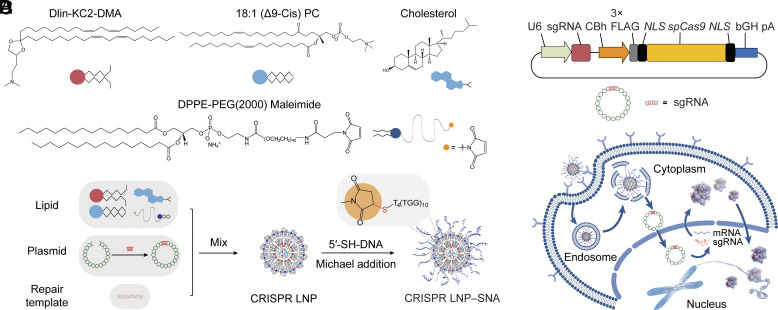
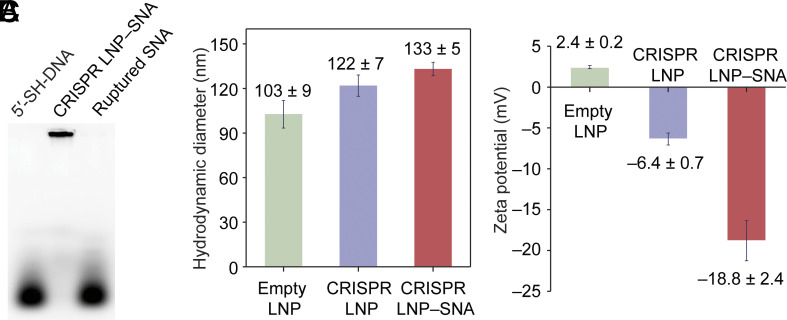
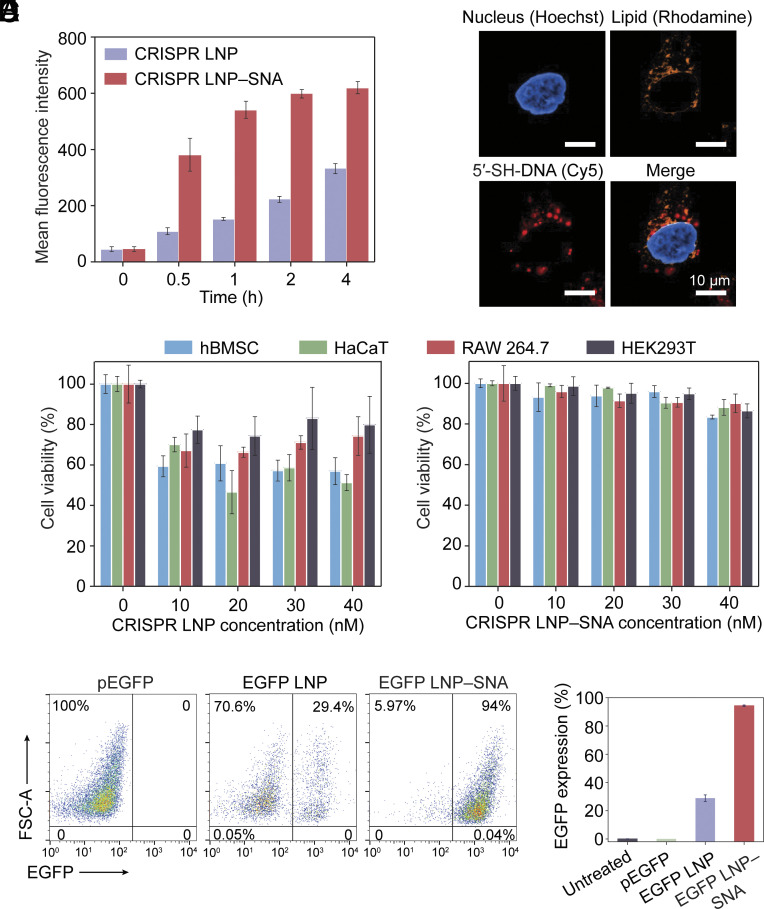
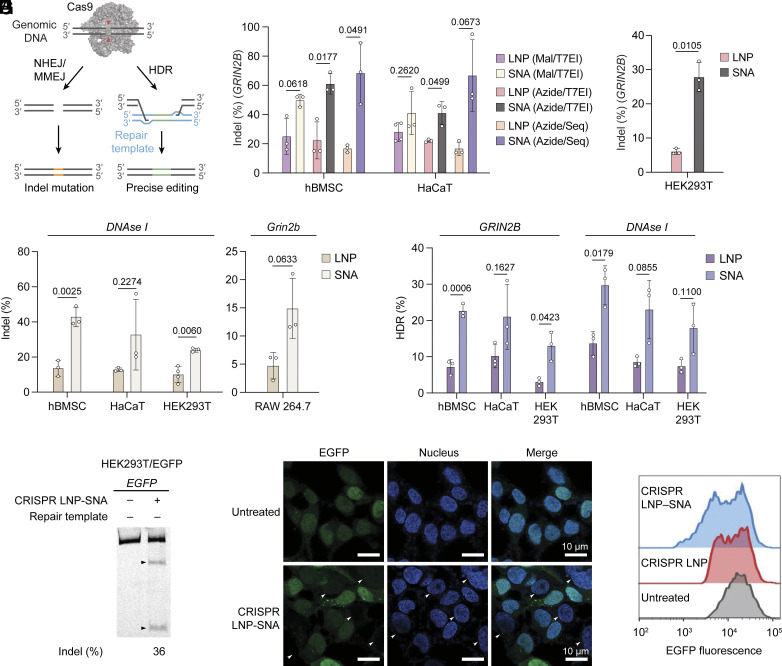
Genome editing with CRISPR–Cas systems hold promise for treating a wide range of genetic disorders and cancers. However, efficient delivery of genome editors remains challenging due to the requirement for the simultaneous delivery or intracellular generation of Cas proteins, guide RNAs, and, in some applications, donor DNAs. Furthermore, the immunogenicity and toxicity of delivery vehicles can limit the safety and efficacy of genetic medicines. Here, we combine two nucleic acid delivery approaches to create CRISPR lipid nanoparticle–spherical nucleic acids (LNP–SNAs) that are both efficient and biocompatible. Compared to lipid nanoparticles (LNPs) lacking a surface-bound DNA shell, CRISPR LNP–SNAs exhibit two- to three-fold higher cellular uptake, reduced cytotoxicity, and improved gene transfection efficiency. Across multiple cell lines and genomic loci, CRISPR LNP–SNAs induce insertion–deletion mutations at average frequencies two- to three-fold higher than those observed with LNPs. When codelivered with donor templates, CRISPR LNP–SNAs enable homology-directed repair at an average efficiency of 21 ± 7%, a 2.5-fold improvement over LNPs (8 ± 4%). The ease of synthesis and biocompatibility of CRISPR LNP–SNAs highlight their potential as a versatile delivery platform for CRISPR–Cas and other gene therapies.
Overview
The claims and statistics of this paper haven’t been checked yet.
Run the check — free, no account needed. It reads the open-access text and checks the sources it cites.
Integrity signals
Registry
Cites
Statistics
Figures
Verification
Claims the paper makes
The claims and statistics of this paper haven’t been checked yet.
Run the check — free, no account needed. It reads the open-access text and checks the sources it cites.
Self-check
Percentages, sums and reported differences re-computed from the paper’s own numbers.
The self-check needs the paper’s full text.
Citations
Cites
CRISPR-Cas9 In Vivo Gene Editing for Transthyretin Amyloidosis
Gillmore, J. D., Gane, E., Taubel, J., Kao, J., Fontana, M., Maitland, M. L., Seitzer, J., O’Connell, D., Walsh, K. R., Wood, K., et al. (2021) · New England Journal of Medicine · doi:10.1056/nejmoa2107454 · Cited by 1,801 · cited 1×
“Lipid nanoparticles (LNPs) are promising nonviral alternatives ( 21 – 27 ) and have been employed in clinical trials ( 28 , 29 ), but their use for multiplexed cargo delivery is underexplored ( 30 ).”
Enhanced proofreading governs CRISPR-Cas9 targeting accuracy
Chen, J. S., Dagdas, Y. S., Kleinstiver, B. P., Welch, M. M., Sousa, A. A., Harrington, L. B., Sternberg, S. H., Joung, J. K., Yildiz, A., & Doudna, J. A. (2017) · Nature · doi:10.1038/nature24268 · Cited by 1,168
The promise and challenge of therapeutic genome editing
Doudna, J. A. (2020) · Nature · doi:10.1038/s41586-020-1978-5 · Cited by 1,126
Finn, J. D., Smith, A. R., Patel, M. C., Shaw, L., Youniss, M. R., van Heteren, J., Dirstine, T., Ciullo, C., Lescarbeau, R., Seitzer, J., et al. (2018) · Cell Reports · doi:10.1016/j.celrep.2018.02.014 · Cited by 878
CRISPR-Cas9 genome editing using targeted lipid nanoparticles for cancer therapy
Rosenblum, D., Gutkin, A., Kedmi, R., Ramishetti, S., Veiga, N., Jacobi, A. M., Schubert, M. S., Friedmann-Morvinski, D., Cohen, Z. R., Behlke, M. A., et al. (2020) · Science Advances · doi:10.1126/sciadv.abc9450 · Cited by 614
IL-1 and IL-1ra are key regulators of the inflammatory response to RNA vaccines
Tahtinen, S., Tong, A.-J., Himmels, P., Oh, J., Paler-Martinez, A., Kim, L., Wichner, S., Oei, Y., McCarron, M. J., Freund, E. C., et al. (2022) · Nature Immunology · doi:10.1038/s41590-022-01160-y · Cited by 535
Segel, M., Lash, B., Song, J., Ladha, A., Liu, C. C., Jin, X., Mekhedov, S. L., Macrae, R. K., Koonin, E. V., & Zhang, F. (2021) · Science · doi:10.1126/science.abg6155 · Cited by 423
Index and biological spectrum of human DNase I hypersensitive sites
Meuleman, W., Muratov, A., Rynes, E., Halow, J., Lee, K., Bates, D., Diegel, M., Dunn, D., Neri, F., Teodosiadis, A., et al. (2020) · Nature · doi:10.1038/s41586-020-2559-3 · Cited by 331
Research works printed but not linked: 47
- 10.1126/science.1225829 · DOI · Paper page
- 10.1126/science.1231143 · DOI · Paper page
- 10.1038/s41556-019-0425-z · DOI
- 10.1038/nprot.2013.143 · DOI · Paper page
- 10.1038/nature17946 · DOI · Paper page
- 10.1038/s41586-019-1711-4 · DOI · Paper page
- 10.1038/s41551-017-0137-2 · DOI · Paper page
- 10.1038/s41563-019-0385-5 · DOI
- 10.1038/ncomms10548 · DOI
- 10.7554/eLife.04766 · DOI · Paper page
- 10.1038/s41592-023-01949-1 · DOI
- 10.1038/nbt.3081 · DOI · Paper page
- 10.1038/s41573-023-00762-x · DOI
- 10.1186/s12951-021-00806-7 · DOI
- 10.1016/j.cell.2021.12.021 · DOI · Paper page
- 10.1038/gt.2016.27 · DOI
- 10.1038/s41467-020-14957-y · DOI
- 10.1038/s41587-023-02078-y · DOI
- 10.1126/science.adk9428 · DOI
- 10.1073/pnas.1520244113 · DOI · Paper page
- 10.1038/s41467-020-17029-3 · DOI
- 10.1073/pnas.2020401118 · DOI
- 10.1126/sciadv.abj6901 · DOI
- 10.1056/NEJMoa2309149 · DOI
- 10.1021/acs.molpharmaceut.1c00916 · DOI
- 10.3390/vaccines12101148 · DOI
- 10.1021/ja209351u · DOI
- 10.1038/382607a0 · DOI
- 10.1126/sciadv.adv6906 · DOI
- 10.1021/acsnano.3c06564 · DOI
- 10.1126/science.1125559 · DOI
- 10.1126/scitranslmed.abb3945 · DOI
- 10.3389/fimmu.2022.1073777 · DOI
- 10.1021/jacs.2c07913 · DOI
- 10.1021/acs.nanolett.1c01973 · DOI
- 10.1016/j.addr.2022.114416 · DOI
- 10.1002/smll.201500027 · DOI
- 10.1073/pnas.1305804110 · DOI
- 10.1042/BSR20160616 · DOI
- 10.1039/D2BM00168C · DOI
- 10.1016/j.isci.2021.103479 · DOI · Paper page
- 10.1073/pnas.2311276120 · DOI
- 10.1016/j.jphs.2016.10.002 · DOI
- 10.1093/nar/gku936 · DOI · Paper page
- 10.1038/nbt.2612 · DOI · Paper page
- K. Chen Lung and liver editing by lipid nanoparticle delivery of a stable CRISPR–Cas9 ribonucleoprotein. Nat. Biotechnol. 10.1038/s41587-024-02437-3 (2024). · DOI
- 10.1073/pnas.2235688100 · DOI
Metadata
- Authors
- Han, Z., Huang, C., Luo, T., & Mirkin, C. A.
- Affiliations
- Northwestern University (US)
- Corresponding author
- Han, Zhenyu
- Huang, Chi
- Mirkin, Chad A.
- Venue
- Proceedings of the National Academy of Sciences
- Publisher
- National Academy of Sciences
- Published
- 2025-09-04
- Volume
- 122
- Issue
- 36
- Pages
- e2426094122-e2426094122
- ISSN
- 0027-8424 (ISSN-L)
- 1091-6490
- PMC
- PMC12435252
- OpenAlex
- W4413980850
- Cited by
- 17
- References
- 8
- Citations by year
- 2026: 13 · 2025: 4
- FWCI
- 5.11
- Type
- journal article
- Language
- en
- Open access
- hybrid
- doi.org
- Licence
- Locations
- Proceedings of the National Academy of Sciences (publishedVersion, cc-by-nc-nd)
- PubMed Central (publishedVersion, cc-by-nc-nd)
- PubMed (publishedVersion)
- Funders
- DOD | AF | AMC | AFRL | Air Force Office of Scientific Research (FA9550-22-1-0300)
- National Science Foundation (DMR-2428112, DMR-2308691, NSF ECCS-2025633)
- Topics
- Life Sciences › Biochemistry, Genetics and Molecular Biology › Molecular Biology › RNA Interference and Gene Delivery
- Life Sciences › Biochemistry, Genetics and Molecular Biology › Molecular Biology › CRISPR and Genetic Engineering
- Physical Sciences › Materials Science › Biomaterials › Nanoparticle-Based Drug Delivery
- Keywords
- CRISPR/Cas genome editing, lipid nanoparticles, spherical nucleic acids, nucleic acid delivery, gene therapy, homology-directed repair, insertion-deletion mutations, cellular uptake, biocompatibility
- MeSH terms
- Gene Editing, RNA, Guide, CRISPR-Cas Systems, Humans, Lipids, Liposomes, Nucleic Acids, Transfection, Nanoparticles, HEK293 Cells, Clustered Regularly Interspaced Short Palindromic Repeats, CRISPR-Cas Systems
About these checks
Registry, retraction, Cites and statistics results are computed, not judged, with one exception: a printed reference that no index lists is read once by a model before it counts as a citation error. Claims are extracted by a model and kept only when their quote appears verbatim in the text; each cited source is then checked, with a model’s help, for whether it says what the claim relies on. Those verdicts can be wrong — read the claim’s quote and the cited source before relying on one.
Statistics and arithmetic are recomputed, not judged.
Confidence bands are shown only for fields calibrated on our annotated test set. None is calibrated yet, so no band is shown.
What counts as a claim ›How we measure confidence ›How we check this ›
Are you an author, or do you see a problem with this page? Request a review
