

The socioeconomic returns to citizenship: A randomized controlled trial
Open accessThe DOI matches its Crossref record; 77 of the 77 references it cites were found in a registry or an index; none of the 45 sources its claims cite is checked for support yet.
Abstract
Based on observational studies, conventional wisdom suggests that citizenship carries economic benefits. We leverage a randomized experiment from New York where low-income registrants with permanent residency who wanted to become citizens entered a lottery to receive fee vouchers to naturalize. Voucher recipients were about 36 p.p. more likely to naturalize. Yet, we find no discernible effects of access to citizenship on multiple economic outcomes, including income, credit scores, access to credit, financial distress, and employment. Leveraging a multidimensional immigrant integration index, we similarly find no measurable effects on noneconomic integration. However, we do find that citizenship reduces fears of deportation. Explaining divergence from past studies, our results also reveal evidence of positive selection into citizenship, suggesting that observational studies are susceptible to selection bias.
Overview
CoChat Summary
TL;DR
In a randomized naturalization campaign in New York City, low-income immigrants offered fee vouchers naturalized at much higher rates, but the vouchers produced no measurable short- to medium-term improvements in economic outcomes, financial well-being, or broader integration. The only clear benefit was reduced fear of deportation, challenging the presumed economic citizenship premium over permanent residency.
Key findings
- Voucher assignment increased citizenship application/naturalization uptake by about 35–37 percentage points (Table 1: 0.346–0.369; first-stage partial F > 200), but this did not translate into discernible financial gains.
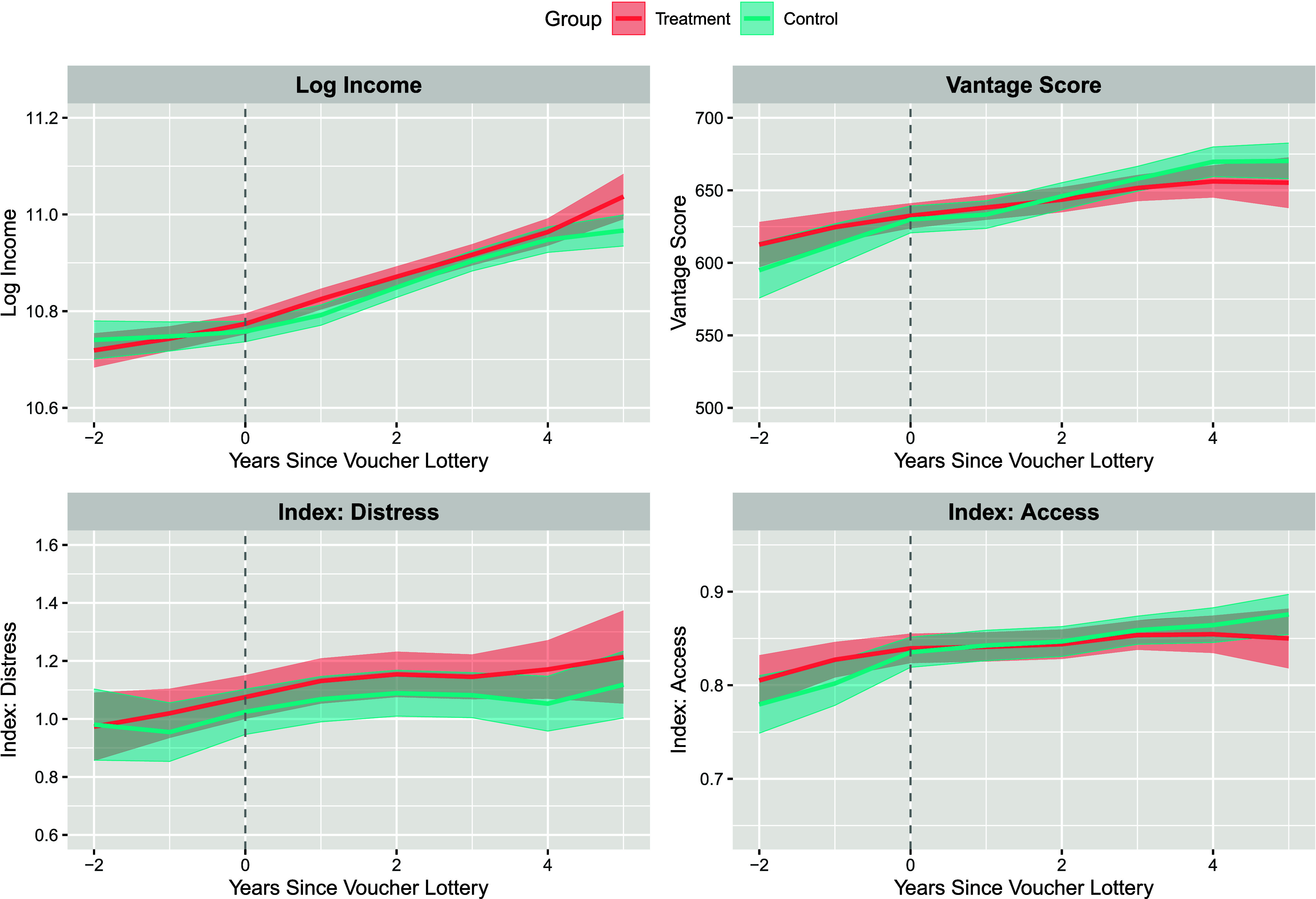
- Credit bureau data showed no measurable effects on income, credit scores, financial distress, or credit access. The panel ITT income effect was 0.2% (95% CI −1.5% to 2.0%); the LATE was 1.8% (95% CI −1.8% to 5.3%). Three-year ITT income was 0.0% (95% CI ±2.4%). A small negative VantageScore estimate was not robust across specifications.
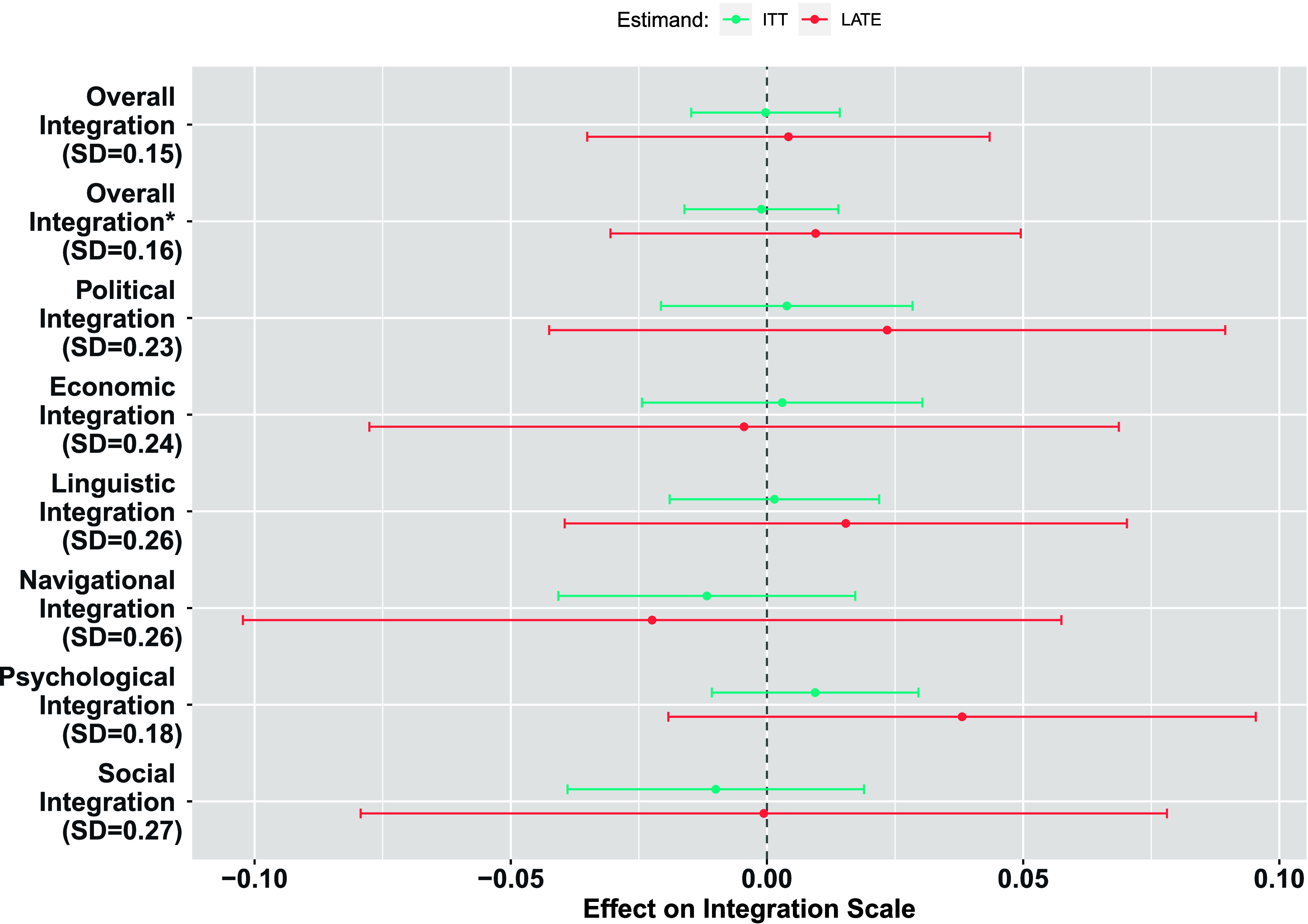
- No support appeared for mechanisms: no discernible effects on student loan activity, self-reported employment, labor force participation, or occupational upgrading. No discernible effects appeared on the IPL-12 overall integration index or its political, social, psychological, navigational, or linguistic dimensions.
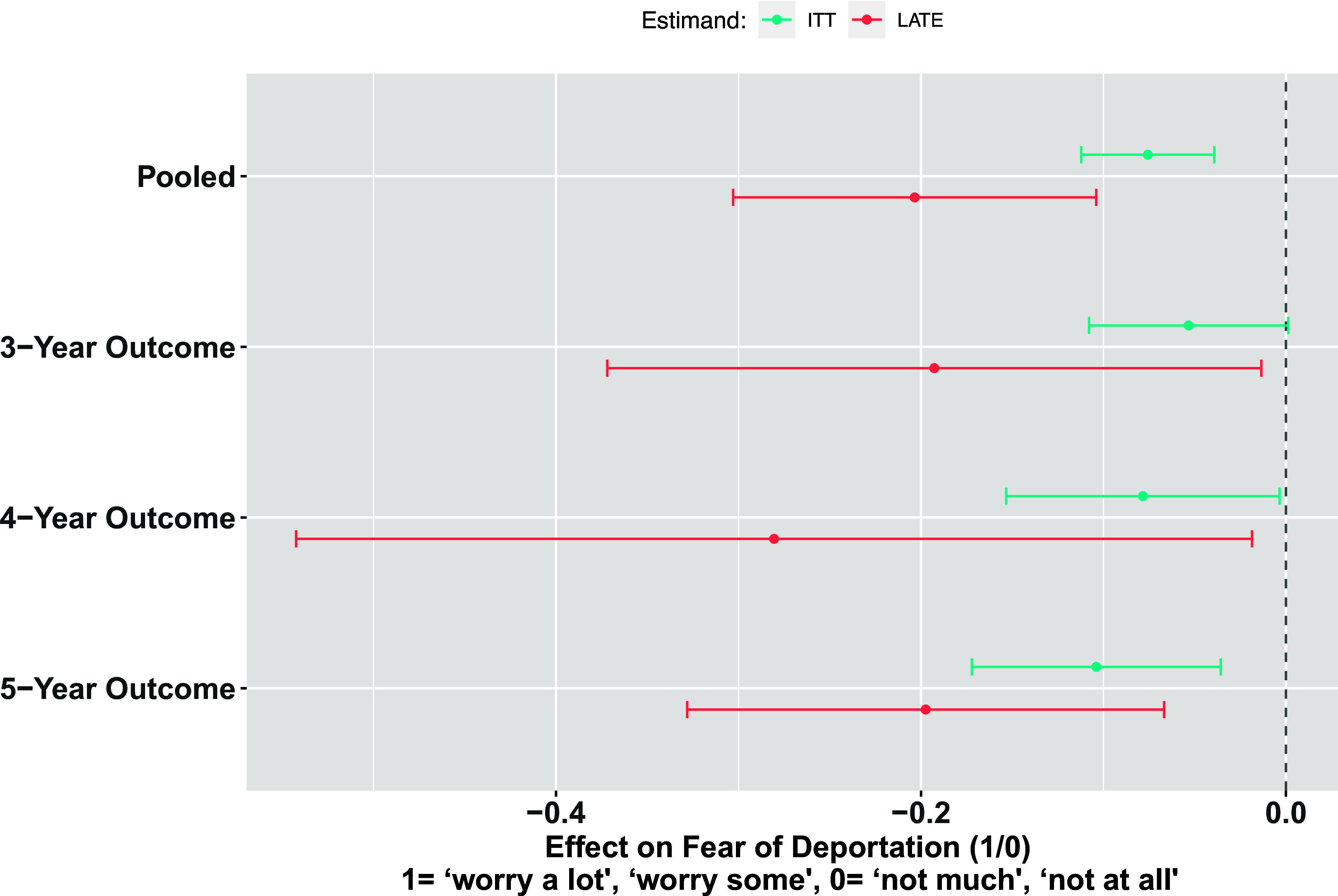
- The only clear benefit was reduced deportation fear: ITT 0.15-point reduction on a four-point scale (95% CI −0.24 to −0.06) and 7.4 percentage-point drop in high fear (95% CI −0.11 to −0.04); LATE 0.42 points (95% CI −0.66 to −0.18) and 20.1 percentage points (95% CI −0.30 to −0.10). Nonexperimental comparisons showed positive selection: naturalizers had higher VantageScore (+26.2 points, P = 0.01), more open credit lines (+5.6%, P = 0.004), more thick files (+9.5%, P = 0.004), fewer delinquencies (−0.31, P = 0.032), fewer collections (−0.16, P = 0.008), and lower distress index (0.24 units, P = 0.011).
Methods
- Randomized controlled trial embedded in a New York State naturalization program operating 2016–2018. Eligible lawful permanent residents had household income ≤300% of Federal Poverty Guidelines; those at 150–300% FPG not receiving means-tested benefits entered a lottery for a voucher covering the full naturalization fee ($680–$725). Overall, 2,802 registrants were randomized: 1,442 treatment and 1,360 control; cohort sizes were 836 in 2016 (309 treated), 746 in 2017 (490 treated), and 1,220 in 2018 (643 treated). Lotteries were stratified by geographic blocks, and analysis was limited to parts of New York City and Long Island.
- Data sources: program registration records; annual follow-up surveys (three-year outcomes for all cohorts, four- and five-year data for 2017 and 2016 cohorts); and matched anonymized credit bureau records (93.3% match rate) providing annual financial outcomes from 2016 to 2021.
- Analysis: preregistered intention-to-treat (ITT) models and local average treatment effects (LATE) via two-stage least squares instrumenting self-reported citizenship with lottery assignment; three-year outcome models, six-year panel models with individual and year fixed effects, and dynamic effects models. Robust SEs and block-level inverse probability weights were used, with balance, match-rate, attrition, and external-validity checks.
Limitations
- The paper states results are limited to short- to medium-term outcomes and that longer-term follow-up is needed. It also states the findings do not rule out an economic citizenship premium in other contexts, countries, or time periods, with potential moderators including labor market flexibility, discrimination based on citizenship status, and difficulty of obtaining citizenship.
- The paper states results concern access to citizenship among immigrants who already have permanent residency and do not speak to returns to other statuses such as permanent residency or deferred action. It also notes the exclusion restriction may not strictly hold: the voucher could have a psychological effect or act as a one-time cash substitute for always-takers, which if present might introduce a small upward bias in LATE estimates.
- The paper reports a three-year survey response rate of about 47% but no significant treatment-by-baseline interaction predicting response; credit bureau match rates were high and balanced. Evident from the design: the intervention removes only the application-fee barrier among motivated low-income registrants in New York City/Long Island, so findings may not generalize to less motivated, higher-income, or other geographic populations.
Model-written summary. Check it against the paper before relying on it.
Integrity signals
Registry
Cites
Statistics
Figures
Verification
Claims the paper makes
0 Valid · 1 Not valid · 17 Not checked · 93 Own results and interpretations
A result the paper reports from its own data — it cites no other source for it, so there is none to check. The quote shows it is in the paper.
In the paper
“for income, the immediate effect (θ1) is again close to zero with a point estimate of 0.3% (95% CI =−1.8%, 2.5%)”
§ The socioeconomic returns to citizenship: A randomized controlled trial > Materials and Methods > Results.
plain- Asserted: passes — The authors put it forward as true.
- Checkable: passes — It can be checked against evidence.
- Load-bearing: passes — The paper’s conclusions depend on it.
- Based: passes — The paper gives a reason why it holds.
A result the paper reports from its own data — it cites no other source for it, so there is none to check. The quote shows it is in the paper.
In the paper
“The null findings are similar for the other financial outcomes including the measures of financial distress and access to credit.”
§ The socioeconomic returns to citizenship: A randomized controlled trial > Materials and Methods > Results.
plain- Asserted: passes — The authors put it forward as true.
- Checkable: passes — It can be checked against evidence.
- Load-bearing: passes — The paper’s conclusions depend on it.
- Based: passes — The paper gives a reason why it holds.
A result the paper reports from its own data — it cites no other source for it, so there is none to check. The quote shows it is in the paper.
In the paper
“We similarly find no discernible effects when we replicate the models using survey-based measures of income and financial distress.”
§ The socioeconomic returns to citizenship: A randomized controlled trial > Abstract
plain- Asserted: passes — The authors put it forward as true.
- Checkable: passes — It can be checked against evidence.
- Load-bearing: unclear — It is unclear whether the paper’s conclusions depend on it.
- Based: passes — The paper gives a reason why it holds.
A result the paper reports from its own data — it cites no other source for it, so there is none to check. The quote shows it is in the paper.
In the paper
“The only clear benefit was a reduction in deportation fears.”
- Also stated in: § Abstract · plain
“However, we do find that citizenship reduced fears of deportation.”
§ The socioeconomic returns to citizenship: A randomized controlled trial > Abstract
boostedstates a cause- Asserted: passes — The authors put it forward as true.
- Checkable: passes — It can be checked against evidence.
- Load-bearing: passes — The paper’s conclusions depend on it.
- Based: passes — The paper gives a reason why it holds.
- Also stated in: § Abstract · plain
A result the paper reports from its own data — it cites no other source for it, so there is none to check. The quote shows it is in the paper.
In the paper
“Again, we find no discernible evidence that citizenship improved the financial outcomes of immigrants.”
§ The socioeconomic returns to citizenship: A randomized controlled trial > Materials and Methods > Results.
plain- Asserted: passes — The authors put it forward as true.
- Checkable: passes — It can be checked against evidence.
- Load-bearing: passes — The paper’s conclusions depend on it.
- Based: passes — The paper gives a reason why it holds.
64 more claims
Create a free account to see all 111 claims and to verify the 42 references still open.
- It may state two separate claims as one. 26
- The quote only partly states this claim. 3
- Probably not a substantial claim. 17
Self-check
Percentages, sums and reported differences re-computed from the paper’s own numbers.
Each contradiction between two passages listed here was confirmed by an independent check.
Rated minor: it would not touch a result — a value no result rests on, a p-value that stays on the same side of the significance level, or a conflict that is clerical, resolved elsewhere in the paper, or outside its own findings.
In the paper
§ The socioeconomic returns to citizenship: A randomized controlled trial > Materials and Methods > Results.
“Overall Integration shows the results for the overall IPL-12 integration index that aggregates all six dimensions (economic, political, social, psychological, navigational, and linguistic) into a single metric.”
§ The socioeconomic returns to citizenship: A randomized controlled trial > Materials and Methods > Results.
“Overall Integration shows the results when we omit the economic dimension and aggregate the remaining five dimensions.”
Citations
Cites
Controlling the False Discovery Rate: A Practical and Powerful Approach to Multiple Testing
Benjamini, Y., & Hochberg, Y. (1995) · Journal of the Royal Statistical Society Series B: Statistical Methodology · doi:10.1111/j.2517-6161.1995.tb02031.x · Cited by 109,482
Estimating dynamic treatment effects in event studies with heterogeneous treatment effects
Sun, L., & Abraham, S. (2021) · Journal of Econometrics · doi:10.1016/j.jeconom.2020.09.006 · Cited by 7,462
Identification and estimation of local average treatment effects
Imbens, G. W., & Angrist, J. D. (1994) · Econometrica · doi:10.2307/2951620 · Cited by 4,101
The Effect of Americanization on the Earnings of Foreign-born Men
Chiswick, B. R. (1978) · Journal of Political Economy · doi:10.1086/260717 · Cited by 2,775
The Oregon Health Insurance Experiment: Evidence from the First Year*
Finkelstein, A., Taubman, S., Wright, B., Bernstein, M., Gruber, J., Newhouse, J. P., Allen, H., Baicker, K., & Oregon Health Study Group (2012) · The Quarterly Journal of Economics · doi:10.1093/qje/qjs020 · Cited by 1,657
When Should You Adjust Standard Errors for Clustering?
Abadie, A., Athey, S., Imbens, G. W., & Wooldridge, J. M. (2022) · The Quarterly Journal of Economics · doi:10.1093/qje/qjac038 · Cited by 1,460
When Should You Adjust Standard Errors for Clustering?
Abadie, A., Athey, S., Imbens, G., & Wooldridge, J. (2017) · National Bureau of Economic Research · doi:10.3386/w24003 · Cited by 1,360
Field Experiments of Discrimination in the Market Place
Riach, P. A., & Rich, J. (2002) · The Economic Journal · doi:10.1111/1468-0297.00080 · Cited by 911
Semiparametric instrumental variable estimation of treatment response models
Abadie, A. (2003) · Journal of Econometrics · doi:10.1016/s0304-4076(02)00201-4 · Cited by 901
You Can't Take It with You? Immigrant Assimilation and the Portability of Human Capital
Friedberg, R. M. (2000) · Journal of Labor Economics · doi:10.1086/209957 · Cited by 810
Research works printed but not linked: 6
- B. Bratsberg, J. F. Ragan Jr., Z. M. Nasir, The effect of naturalization on wage growth: A panel study of young male immigrants. J. Law Econ. 20, 568– 597 (1992).
- C. Gathmann, O. Monscheuer, Naturalization and citizenship: Who benefits? IZA World Labor 125, e223607 (2020).
- J. E. Hayfron, “The economics of Norwegian citizenship” in The Economics of Citizenship, P. Bevelander, D. DeVoretz, Eds. (Malmo University, 2008), pp. 89–104.
- OECD, Naturalisation: A Passport for the Better Integration of Immigrants? (OECD, 2011).
- S. Ruggles, Integrated public use microdata series: Version 9.0 [dataset]. Minneap. Univ. Minn. 23, 56 (2019).
- E. Hartman, R. Grieve, R. Ramsahai, J. S. Sekhon, From sate to patt: Combining experimental with observational studies to estimate population treatment effects. JR Stat. Soc. Ser. A Stat. Soc. 10, 1111 (2015).
Cited by
Rescaling citizenship: revisiting debates on territory, rights, and membership
Falcke, S., & Peters, F. (2025) · Journal of Ethnic and Migration Studies · doi:10.1080/1369183x.2025.2550109 · Cited by 16
The economic returns to citizenship: Evidence from a meta-analysis
Hainmueller, J., & Laitin, D. D. (2026) · Proceedings of the National Academy of Sciences · doi:10.1073/pnas.2617804123
Self-citationA framework for bridging conventional and critical perspectives on immigrant assimilation
Asad, A. L., & Dahir, N. (2026) · Ethnic and Racial Studies · doi:10.1080/01419870.2026.2667901
Intergenerational Mobility Across Origins in France
Sirugue, L. (2024) · theses.fr (ABES) · doi:10.70675/5cd7b827zd475z430fz9138z4f34e4ebd1d2
Catron, P., Hoffmann, N. I., & Li, M. (2026) · American Sociological Review · doi:10.1177/00031224261489725
Metadata
- Authors
- Hainmueller, J., Cascardi, E., Hotard, M., Koslowski, R., Lawrence, D., Yasenov, V., & Laitin, D. D.
- Affiliations
- Stanford University (US)
- University at Albany, State University of New York (US)
- Corresponding author
- Laitin, David D.
- Venue
- Proceedings of the National Academy of Sciences
- Publisher
- National Academy of Sciences
- Published
- 2026-01-30
- Volume
- 123
- Issue
- 5
- Pages
- e2516178123-e2516178123
- ISSN
- 0027-8424 (ISSN-L)
- 1091-6490
- PMC
- PMC12867681
- OpenAlex
- W7126274542
- Semantic Scholar
- 6322dfc194083442533797632e558b7835a8f11d
- Cited by
- 7
- References
- 76
- Citations by year
- 2026: 4
- FWCI
- 15.12
- Type
- journal article
- Language
- en
- Open access
- hybrid
- doi.org
- Licence
- Locations
- Proceedings of the National Academy of Sciences (publishedVersion, cc-by-nc-nd)
- SSRN Electronic Journal (submittedVersion)
- SocArXiv (OSF Preprints) (submittedVersion, cc-by-nd)
- PubMed Central (publishedVersion, cc-by-nc-nd)
- PubMed (publishedVersion)
- RePEc: Research Papers in Economics (submittedVersion)
- Econstor (Econstor) (submittedVersion)
- SocArXiv (OSF Preprints) (submittedVersion)
- Zenodo (CERN European Organization for Nuclear Research) (submittedVersion, cc-by)
- Funders
- Robin Hood Foundation (123714)
- New York Community Trust (P16-00010)
- Topics
- Social Sciences › Sociology and Political Science › Migration, Refugees, and Integration
- Social Sciences › Sociology and Political Science › Migration and Labor Dynamics
- Social Sciences › Sociology and Political Science › Urban, Neighborhood, and Segregation Studies
- Keywords
- citizenship, naturalization, permanent residence, lotteries, low-income immigrants, socioeconomic outcomes, income, credit scores, access to credit, financial distress, employment, immigrant integration, fear of deportation, selection bias, New York
- MeSH terms
- Humans, Income, New York, Poverty, Socioeconomic Factors, Emigrants and Immigrants
About these checks
Registry, retraction, Cites and statistics results are computed, not judged, with one exception: a printed reference that no index lists is read once by a model before it counts as a citation error. Claims are extracted by a model and kept only when their quote appears verbatim in the text; each cited source is then checked, with a model’s help, for whether it says what the claim relies on. Those verdicts can be wrong — read the claim’s quote and the cited source before relying on one.
A language model drew the claims from the paper on 2026-11-27, under version 3 of the claim definition (model deepseek-v4.1-flash, prompt extract-v3).
A second model labelled each claim on 2026-11-27 (model jev-1.13-20260917, definition revision gold-guideline-v0.2).
Statistics and arithmetic are recomputed, not judged.
Confidence bands are shown only for fields calibrated on our annotated test set. None is calibrated yet, so no band is shown.
What counts as a claim ›How we measure confidence ›How we check this ›
Are you an author, or do you see a problem with this page? Request a review
How to cite
Cite CoChat for the checks on this page, and the paper for its own findings.
- This page
- CoChat. (2026). Citation check: The socioeconomic returns to citizenship: A randomized controlled trial. https://app.cochat.ai/papers/10.1073/pnas.2516178123
- The paper
- Hainmueller, J., Cascardi, E., Hotard, M., Koslowski, R., Lawrence, D., Yasenov, V., & Laitin, D. D. (2026). The socioeconomic returns to citizenship: A randomized controlled trial. Proceedings of the National Academy of Sciences. https://doi.org/10.1073/pnas.2516178123
Data sources
Bibliographic data: Semantic Scholar, OpenAlex, Crossref.
Contains information from the Semantic Scholar Academic Graph Datasets, made available under the ODC Attribution License (ODC-BY 1.0).
Semantic Scholar’s data is described in: Kinney, R., et al. (2023). The Semantic Scholar Open Data Platform. arXiv:2301.10140.
