

Motor Dysfunction in Type 5 Adenylyl Cyclase-null Mice
Open accessThe DOI matches its Crossref record; 27 of the 27 references it cites were found in a registry or an index.
Abstract
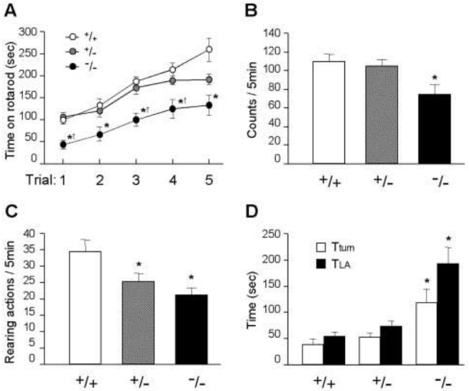
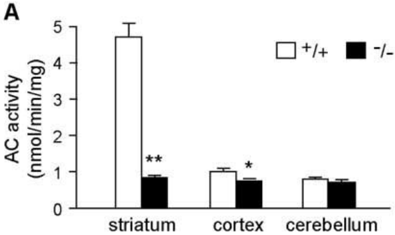
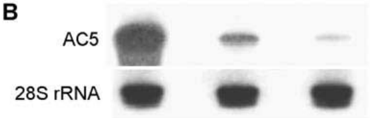
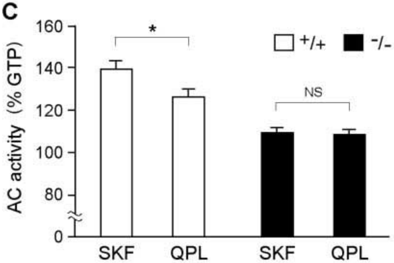
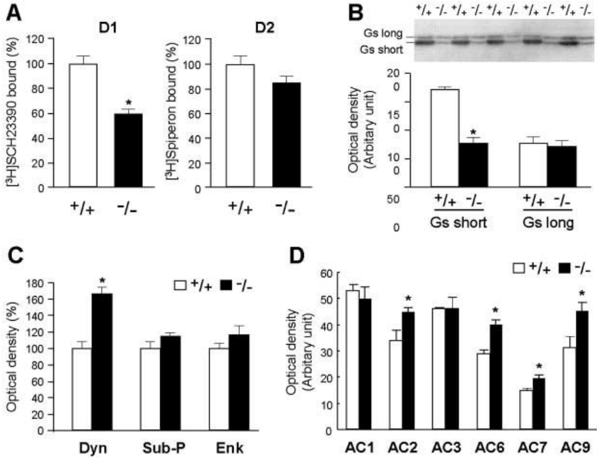
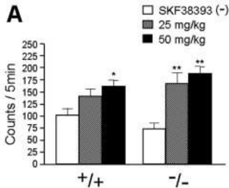
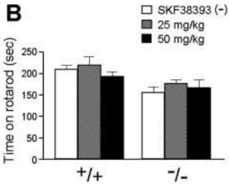
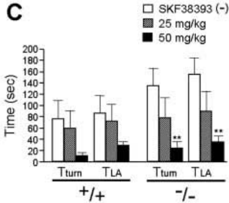
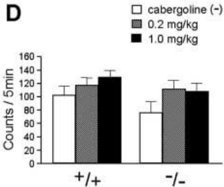
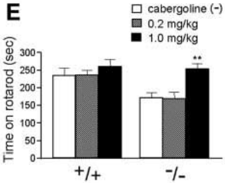
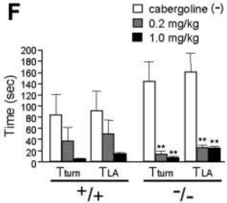
Various neurotransmitters, such as dopamine, stimulate adenylyl cyclase to produce cAMP, which regulates neuronal functions. Genetic disruption of the type 5 adenylyl cyclase isoform led to a major loss of adenylyl cyclase activity in a striatum-specific manner with a small increase in the expression of a few other adenylyl cyclase isoforms. D1 dopaminergic agonist-stimulated adenylyl cyclase activity was attenuated, and this was accompanied by a decrease in the expression of the D1 dopaminergic receptor and G(s)alpha. D2 dopaminergic agonist-mediated inhibition of adenylyl cyclase activity was also blunted. Type 5 adenylyl cyclase-null mice exhibited Parkinsonian-like motor dysfunction, i.e. abnormal coordination and bradykinesia detected by Rotarod and pole test, respectively, and to a lesser extent locomotor impairment was detected by open field tests. Selective D1 or D2 dopaminergic stimulation improved some of these disorders in this mouse model, suggesting the partial compensation of each dopaminergic receptor signal through the stimulation of remnant adenylyl cyclase isoforms. These findings extend our knowledge of the role of an effector enzyme isoform in regulating receptor signaling and neuronal functions and imply that this isoform provides a site of convergence of both D1 and D2 dopaminergic signals and balances various motor functions.
Overview
The claims and statistics of this paper haven’t been checked yet.
Free: it reads the open-access text and checks the first 5 claims that cite a source we can check. Create a free account to check every claim.
Integrity signals
Registry
Cites
Statistics
Figures
Verification
Claims the paper makes
The claims and statistics of this paper haven’t been checked yet.
Free: it reads the open-access text and checks the first 5 claims that cite a source we can check. Create a free account to check every claim.
Claims other papers make about this one
Each is checked against this paper’s own text: does it say what the citing paper says it does?
The source backs part of the claim, not all of it — or backs it for a different population, condition or comparison.
In the citing paper
“In contrast to the cardiovascular system and the metabolic system, in the central nervous system AC5 deletions tend to be detrimental, specifically in the reward circuitry of the brain and motor systems.”
From Physiological roles of mammalian transmembrane adenylyl cyclase isoforms (2022) · cites this paper as [354]
Experimental — accuracy not yet measured
Self-check
Percentages, sums and reported differences re-computed from the paper’s own numbers.
The self-check needs the paper’s full text.
Citations
Cites
Goodman & Gilman's The Pharmacological Basis of Therapeutics
Brunton, L. L. (1985) · Cited by 7,321
Goodman and Gilman's the Pharmacological Basis of Therapeutics
Stigelman, W. H., & Pharm, D. (1986) · Military Medicine · doi:10.1093/milmed/151.1.386 · Cited by 6,782
D 1 and D 2 Dopamine Receptor-regulated Gene Expression of Striatonigral and Striatopallidal Neurons
Gerfen, C. R., Engber, T. M., Mahan, L. C., Susel, Z., Chase, T. N., Monsma, F. J., & Sibley, D. R. (1990) · Science · doi:10.1126/science.2147780 · Cited by 2,967
Reversal of Neuropathology and Motor Dysfunction in a Conditional Model of Huntington's Disease
Yamamoto, A., Lucas, J. J., & Hen, R. (2000) · Cell · doi:10.1016/s0092-8674(00)80623-6 · Cited by 1,067
Regulation and Role of Adenylyl Cyclase Isoforms
Hanoune, J., & Defer, N. (2001) · Annual Review of Pharmacology and Toxicology · doi:10.1146/annurev.pharmtox.41.1.145 · Cited by 691
Parkinsonian-like locomotor impairment in mice lacking dopamine D2 receptors
Baik, J.-H., Picetti, R., Saiardi, A., Thiriet, G., Dierich, A., Depaulis, A., Le Meur, M., & Borrelli, E. (1995) · Nature · doi:10.1038/377424a0 · Cited by 650
Adenylyl cyclases and the interaction between calcium and cAMP signalling
Cooper, D. M. F., Mons, N., & Karpen, J. W. (1995) · Nature · doi:10.1038/374421a0 · Cited by 600
Hersch, S., Ciliax, B., Gutekunst, C., Rees, H., Heilman, C., Yung, K., Bolam, J., Ince, E., Yi, H., & Levey, A. (1995) · The Journal of Neuroscience · doi:10.1523/jneurosci.15-07-05222.1995 · Cited by 483
Matsuura, K., Kabuto, H., Makino, H., & Ogawa, N. (1997) · Journal of Neuroscience Methods · doi:10.1016/s0165-0270(96)02211-x · Cited by 422
Gerfen, C. R., Miyachi, S., Paletzki, R., & Brown, P. (2002) · The Journal of Neuroscience · doi:10.1523/jneurosci.22-12-05042.2002 · Cited by 373
Research works printed but not linked: 1
- Hess, E. J., Battaglia, G., Norman, A. B., and Creese, I. (1987) Mol. Pharmacol. 31, 50 -57
Cited by
Mammalian G Proteins and Their Cell Type Specific Functions
Wettschureck, N., & Offermanns, S. (2005) · Physiological Reviews · doi:10.1152/physrev.00003.2005 · Cited by 1,166
“Mice lacking adenylyl cyclase V show an attenuated D1-receptor/Golf-mediated adenylyl cyclase activation in the striatum (298).”
BackgroundNeve, K. A., Seamans, J. K., & Trantham‐Davidson, H. (2004) · Journal of Receptors and Signal Transduction · doi:10.1081/lrst-200029981 · Cited by 837
“One finding that is difficult to reconcile with a model of D1 receptor signaling that includes a central role for a cyclic AMP/PKA cascade is that a null mutation of adenylate cyclase 5 enhances D1 agonist-stimulated locomoter activity even though D1 receptor stimulation of adenylate cyclase activity is almost abolish…”
BackgroundSadana, R., & Dessauer, C. W. (2009) · Neurosignals · doi:10.1159/000166277 · Cited by 361
Regulation and organization of adenylyl cyclases and cAMP
COOPER, D. M. F. (2003) · Biochemical Journal · doi:10.1042/bj20031061 · Cited by 356
Adenylyl Cyclase–A-kinase Anchoring Protein Complexes: The Next Dimension in cAMP Signaling
Dessauer, C. W. (2009) · Molecular Pharmacology · doi:10.1124/mol.109.059345 · Cited by 254
“AC5 and AKAP150 are highly expressed in striatum, and both exhibit defects in motor coordination when deleted (Iwamoto et al., 2003; Tunquist et al., 2008).”
Background
Metadata
- Authors
- Iwamoto, T., Okumura, S., Iwatsubo, K., Kawabe, J.-I., Ohtsu, K., Sakai, I., Hashimoto, Y., Izumitani, A., Sango, K., Ajiki, K., Toya, Y., Umemura, S., Goshima, Y., Arai, N., Vatner, S. F., & Ishikawa, Y.
- Affiliations
- Yokohama City University (JP)
- Rutgers New Jersey Medical School (US)
- Corresponding author
- Ishikawa, Yoshihiro
- ORCID
- Venue
- Journal of Biological Chemistry
- Publisher
- Elsevier BV
- Published
- 2003-05
- Volume
- 278
- Issue
- 19
- Pages
- 16936-16940
- ISSN
- 0021-9258 (ISSN-L)
- OpenAlex
- W2108964834
- Cited by
- 118
- References
- 27
- Citations by year
- 2026: 2 · 2025: 5 · 2024: 5 · 2022: 5 · 2021: 4 · 2020: 3 · 2019: 3 · 2018: 5 · 2017: 5 · 2016: 6 · 2015: 5 · 2014: 9 · 2012: 16
- FWCI
- 1.73
- Type
- journal article
- Language
- en
- Open access
- hybrid
- doi.org
- Licence
- cc-by
- www.elsevier.com/tdm/userlicense/1.0/ (tdm)
- creativecommons.org/licenses/by/4.0/ (vor, 6378 d)
- Locations
- Journal of Biological Chemistry (publishedVersion, cc-by)
- PubMed (publishedVersion)
- Funders
- National Institutes of Health (7r29hl059729-05)
- National Heart, Lung, and Blood Institute (HL59139, P01HL059139, HL 59729)
- Topics
- Life Sciences › Biochemistry, Genetics and Molecular Biology › Molecular Biology › Receptor Mechanisms and Signaling
- Health Sciences › Medicine › Clinical Neurology › Parkinson's Disease Mechanisms and Treatments
- Life Sciences › Neuroscience › Cellular and Molecular Neuroscience › Neurotransmitter Receptor Influence on Behavior
- Keywords
- motor impairment, bradykinesia, dopamine D1 receptor, dopamine D2 receptor, striatum, Gs protein, cAMP signaling, dopamine receptor signaling, locomotor impairment
- MeSH terms
- Adenylyl Cyclases, Animals, Gene Expression Regulation, Isoenzymes, Motor Activity, Receptors, Dopamine, Signal Transduction, Mice, Knockout, Dopamine Agonists, Parkinsonian Disorders, Mice
About these checks
Registry, retraction, Cites and statistics results are computed, not judged, with one exception: a printed reference that no index lists is read once by a model before it counts as a citation error. Claims are extracted by a model and kept only when their quote appears verbatim in the text; each cited source is then checked, with a model’s help, for whether it says what the claim relies on. Those verdicts can be wrong — read the claim’s quote and the cited source before relying on one.
Statistics and arithmetic are recomputed, not judged.
Confidence bands are shown only for fields calibrated on our annotated test set. None is calibrated yet, so no band is shown.
What counts as a claim ›How we measure confidence ›How we check this ›
Are you an author, or do you see a problem with this page? Request a review
Data sources
Bibliographic data: Semantic Scholar, OpenAlex, Crossref.
Contains information from the Semantic Scholar Academic Graph Datasets, made available under the ODC Attribution License (ODC-BY 1.0).
Semantic Scholar’s data is described in: Kinney, R., et al. (2023). The Semantic Scholar Open Data Platform. arXiv:2301.10140.
