

Polyomavirus Enhancer-binding Protein 2/Core Binding Factor/Acute Myeloid Leukemia Factors Contribute to the Cell Type-specific Activity of the CD11a Integrin Gene Promoter
Open accessThe DOI matches its Crossref record; 42 of the 42 references it cites were found in a registry or an index.
Abstract
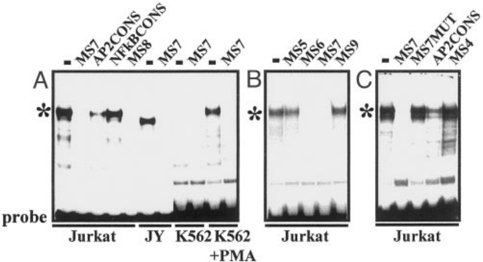
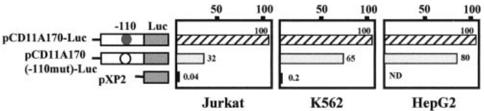
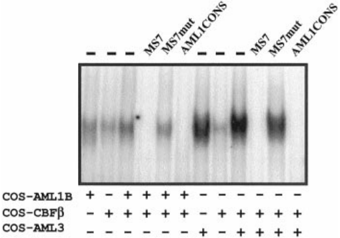
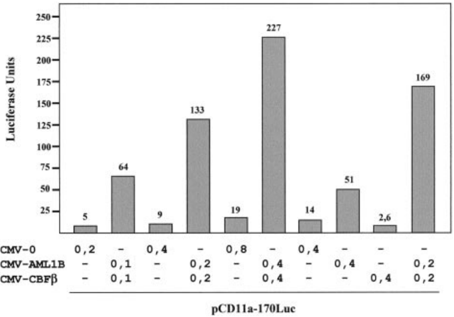
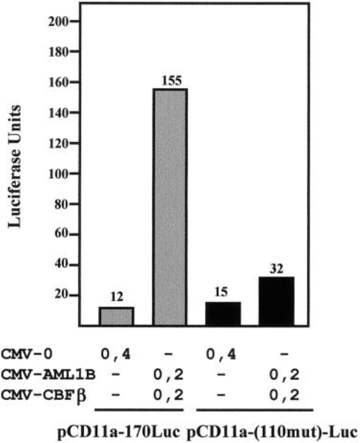
The CD11a/CD18 leukocyte integrin (LFA-1; also known as alphaL/beta2) mediates leukocyte transendothelial migration during immune and inflammatory responses and participates in lymphoma metastasis. CD11a/CD18 leukocyte-restricted expression is controlled by the CD11a gene promoter, which confers tissue-specific expression to reporter genes in vitro and in vivo. DNase I protection analysis of the CD11a proximal gene promoter revealed DNA-protein interactions centered at position -110 (CD11a-110). Disruption of CD11a-110 reduced CD11a promoter activity in a cell type-specific manner, as it reduced its activity by 70% in Jurkat lymphoid cells, whereas the effect was considerably lower in K562 and HepG2 cells. Electrophoretic mobility shift assays showed evidence of cell type-specific differences in CD11a-110 binding and indicated its specific recognition by members of the polyomavirus enhancer-binding protein 2/core binding factor (CBF)/acute myeloid leukemia (AML) family of transcription factors. AML1B/CBFbeta transactivated the CD11a promoter, with AML1B/CBFbeta-mediated transactivation being completely dependent on the integrity of the CD11a-110 element. Therefore, CBF/AML factors play a role in the cell type-restricted transcription of the CD11a integrin gene through recognition of CD11a-110. The involvement of CBF/AML factors in CD11a expression raises the possibility that CD11a/CD18 expression might be deregulated in acute myeloid and B-lineage acute lymphoblastic leukemias, thus contributing to their altered adhesion and metastatic potential.
Overview
The claims and statistics of this paper haven’t been checked yet.
Free: it reads the open-access text and checks the first 5 claims that cite a source we can check. Create a free account to check every claim.
Integrity signals
Registry
Cites
Statistics
Figures


Verification
Claims the paper makes
The claims and statistics of this paper haven’t been checked yet.
Free: it reads the open-access text and checks the first 5 claims that cite a source we can check. Create a free account to check every claim.
Claims other papers make about this one
Each is checked against this paper’s own text: does it say what the citing paper says it does?
The cited source says what the claim attributes to it.
In the citing paper
“its activity in lymphoid cells depends on a functional RUNX1/AML-1-binding site (AML-110) within the MS7 sequence.”
From RUNX/AML and C/EBP factors regulate CD11a integrin expression in myeloid cells through overlapping regulatory elements. (2003) · cites this paper as [11]
In the citing paper
“The MS7 oligonucleotide includes the sequence TTTCACAA, which matches the consensus C/EBP-binding sequence (TTGCGCAA) and overlaps with the previously reported AML-110 element (TGCGGT) 11 (Figure 1A).”
From RUNX/AML and C/EBP factors regulate CD11a integrin expression in myeloid cells through overlapping regulatory elements. (2003) · cites this paper as [11]
Self-check
Percentages, sums and reported differences re-computed from the paper’s own numbers.
The self-check needs the paper’s full text.
Citations
Cites
Traffic signals for lymphocyte recirculation and leukocyte emigration: The multistep paradigm
Springer, T. A. (1994) · Cell · doi:10.1016/0092-8674(94)90337-9 · Cited by 6,929
Schreiber, E., Matthias, P., Müller, M. M., & Schaffner, W. (1989) · Nucleic Acids Research · doi:10.1093/nar/17.15.6419 · Cited by 4,179
IMAGAWA, M. (1987) · Cell · doi:10.1016/0092-8674(87)90152-8 · Cited by 1,339
Specific Acceptance of Cardiac Allograft After Treatment with Antibodies to ICAM-1 and LFA-1
Isobe, M., Yagita, H., Okumura, K., & Ihara, A. (1992) · Science · doi:10.1126/science.1347662 · Cited by 715
Vedder, N. B., Winn, R. K., Rice, C. L., Chi, E. Y., Arfors, K. E., & Harlan, J. M. (1988) · Journal of Clinical Investigation · doi:10.1172/jci113407 · Cited by 425
The t(8;21) Fusion Protein Interferes with AML-1B-Dependent Transcriptional Activation
Meyers, S., Lenny, N., & Hiebert, S. W. (1995) · Molecular and Cellular Biology · doi:10.1128/mcb.15.4.1974 · Cited by 368
Fawcett, J., Holness, C. L. L., Needham, L. A., Turley, H., Gattert, K. C., Mason, D. Y., & Simmons, D. L. (1992) · Nature · doi:10.1038/360481a0 · Cited by 338
Arnaout, M. A. (1990) · Immunological Reviews · doi:10.1111/j.1600-065x.1990.tb00564.x · Cited by 303
Nuchprayoon, I., Meyers, S., Scott, L. M., Suzow, J., Hiebert, S., & Friedman, A. D. (1994) · Molecular and Cellular Biology · doi:10.1128/mcb.14.8.5558 · Cited by 296
Israël, A., Le Bail, O., Hatat, D., Piette, J., Kieran, M., Logeat, F., Wallach, D., Fellous, M., & Kourilsky, P. (1989) · The EMBO Journal · doi:10.1002/j.1460-2075.1989.tb08556.x · Cited by 271
Research works printed but not linked: 5
- 18. Bae, S.-C., and Ito, Y. (1999) Histol. Histopathol. 14, 1213-1221
- 19. Speck, N. A., Stacy, T., Wang, Q., North, T., Gu, T.-L., Miller, J., Binder, M., and Marı ´n-Padilla, M. (1999) Cancer Res. 59, Suppl., 1789s-1793s
- 27. Bottinger, E. P., Shelley, C. S., Farokhzad, O. C., and Arnaout, M. A. (1994) Mol. Cell. Biol. 14, 2604-2615
- 36. Suzow, J., and Friedman, A. D. (1993) Mol. Cell. Biol. 13, 2141-2151 - Cameron, S., Taylor, D. S., TePas, E. C., Speck, N. A., and Mathey-Privot, B.
- 38. Nuchprayoon, I., Meyers, S., Scott, L. M., Suzow, J., Hiebert, S., and Friedman, A. D. (1994) Mol. Cell. Biol. 14, 5558-5568
Cited by
IL-3 expression by myeloma cells increases both osteoclast formation and growth of myeloma cells
Lee, J. W., Chung, H. Y., Ehrlich, L. A., Jelinek, D. F., Callander, N. S., Roodman, G. D., & Choi, S. J. (2004) · Blood · doi:10.1182/blood-2003-06-1992 · Cited by 239
Upstream and downstream targets of RUNX proteins
Otto, F., Lübbert, M., & Stock, M. (2003) · Journal of Cellular Biochemistry · doi:10.1002/jcb.10491 · Cited by 202
AML1 and the AML1-ETO fusion protein in the pathogenesis of t(8;21) AML
Licht, J. D. (2001) · Oncogene · doi:10.1038/sj.onc.1204593 · Cited by 180
de Guzman, C. G., Warren, A. J., Zhang, Z., Gartland, L., Erickson, P., Drabkin, H., Hiebert, S. W., & Klug, C. A. (2002) · Molecular and Cellular Biology · doi:10.1128/mcb.22.15.5506-5517.2002 · Cited by 171
RUNX1 and RUNX1-ETO: roles in hematopoiesis and leukemogenesis
Lam, K. (2012) · Frontiers in Bioscience · doi:10.2741/3977 · Cited by 167
“1125 of T cell receptors and the CD11a promoter (84-86).”
Background
Metadata
- Authors
- Puig-Kröger, A., López-Rodrı́guez, C., Relloso, M., Sánchez-Elsner, T., Nueda, A., Muñoz, E., Bernabéu, C., & Corbı́, A. L.
- Affiliations
- Consejo Superior de Investigaciones Científicas (ES)
- Venue
- Journal of Biological Chemistry
- Publisher
- Elsevier BV
- Published
- 2000-09
- Volume
- 275
- Issue
- 37
- Pages
- 28507-28512
- ISSN
- 0021-9258 (ISSN-L)
- OpenAlex
- W2027972283
- Cited by
- 27
- References
- 41
- Citations by year
- 2025: 1 · 2022: 1 · 2015: 1 · 2014: 1 · 2012: 6
- FWCI
- 1.08
- Type
- journal article
- Language
- en
- Open access
- hybrid
- doi.org
- Licence
- cc-by
- www.elsevier.com/tdm/userlicense/1.0/ (tdm)
- creativecommons.org/licenses/by/4.0/ (vor, 7335 d)
- Locations
- Journal of Biological Chemistry (publishedVersion, cc-by)
- PubMed (publishedVersion)
- DIGITAL.CSIC (Spanish National Research Council (CSIC)) (submittedVersion)
- Topics
- Life Sciences › Biochemistry, Genetics and Molecular Biology › Molecular Biology › Genomics and Chromatin Dynamics
- Health Sciences › Medicine › Immunology and Allergy › Cell Adhesion Molecules Research
- Life Sciences › Immunology and Microbiology › Immunology › T-cell and B-cell Immunology
- Keywords
- CD11a/CD18, LFA-1, beta2 integrins, promoter, transcriptional regulation, cell type-specific gene expression, core binding factor, transcription factor binding, leukocyte transendothelial migration, lymphoma metastasis, acute myeloid leukemia, B-cell acute lymphoblastic leukemia, leukocyte adhesion
- MeSH terms
- Cell Line, DNA-Binding Proteins, Humans, Promoter Regions, Genetic, Proto-Oncogene Proteins, Transcription Factors, Transcriptional Activation, Lymphocyte Function-Associated Antigen-1, CCAAT-Enhancer-Binding Proteins, Transcription Factor AP-2, Core Binding Factor Alpha 2 Subunit
About these checks
Registry, retraction, Cites and statistics results are computed, not judged, with one exception: a printed reference that no index lists is read once by a model before it counts as a citation error. Claims are extracted by a model and kept only when their quote appears verbatim in the text; each cited source is then checked, with a model’s help, for whether it says what the claim relies on. Those verdicts can be wrong — read the claim’s quote and the cited source before relying on one.
Statistics and arithmetic are recomputed, not judged.
Confidence bands are shown only for fields calibrated on our annotated test set. None is calibrated yet, so no band is shown.
What counts as a claim ›How we measure confidence ›How we check this ›
Are you an author, or do you see a problem with this page? Request a review
How to cite
Cite CoChat for the checks on this page, and the paper for its own findings.
- This page
- CoChat. (2026). Citation check: Polyomavirus Enhancer-binding Protein 2/Core Binding Factor/Acute Myeloid Leukemia Factors Contribute to the Cell Type-specific Activity of the CD11a Integrin Gene Promoter. https://app.cochat.ai/papers/10.1074/jbc.m004323200
- The paper
- Puig-Kröger, A., López-Rodrı́guez, C., Relloso, M., Sánchez-Elsner, T., Nueda, A., Muñoz, E., Bernabéu, C., & Corbı́, A. L. (2000). Polyomavirus Enhancer-binding Protein 2/Core Binding Factor/Acute Myeloid Leukemia Factors Contribute to the Cell Type-specific Activity of the CD11a Integrin Gene Promoter. Journal of Biological Chemistry. https://doi.org/10.1074/jbc.m004323200
Data sources
Bibliographic data: Semantic Scholar, OpenAlex, Crossref.
Contains information from the Semantic Scholar Academic Graph Datasets, made available under the ODC Attribution License (ODC-BY 1.0).
Semantic Scholar’s data is described in: Kinney, R., et al. (2023). The Semantic Scholar Open Data Platform. arXiv:2301.10140.
