

Activated pp60c-Src Leads to Elevated Hypoxia-inducible Factor (HIF)-1α Expression under Normoxia
Open accessThe DOI matches its Crossref record; 36 of the 36 references it cites were found in a registry or an index.
Abstract
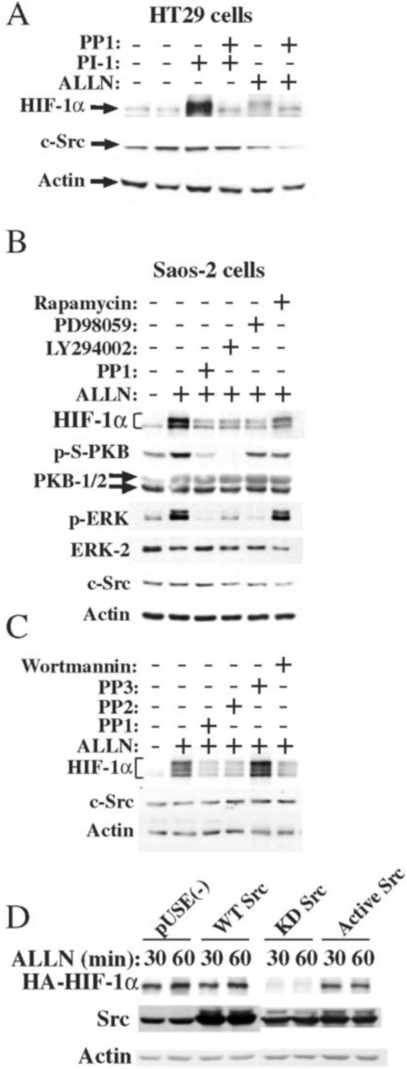
Hypoxia-inducible factor (HIF)-1 is a master transcription factor, which up-regulates glycolysis, erythropoiesis, and angiogenesis under hypoxia. HIF-1alpha accumulates in normoxic tumor cells, leading to glycolysis under aerobic conditions. This phenomenon, known as the "Warburg effect," is caused by a yet unknown mechanism. Here we show that transformed cells that express constitutively active pp60(c-Src) (Src) express HIF-1alpha protein under normoxia, which results in the expression of multiple HIF-1alpha target genes. We show that this occurrence is due to an enhanced rate of HIF-1alpha protein synthesis and not due to reduced HIF-1alpha degradation. Furthermore, we show that the Src-induced increase in protein synthesis is due to the global increase in the rate of cap-dependent translation and does not involve inhibition of HIF-1alpha degradation.
Overview
The claims and statistics of this paper haven’t been checked yet.
Free: it reads the open-access text and checks the first 5 claims that cite a source we can check. Create a free account to check every claim.
Integrity signals
Registry
Cites
Statistics
Figures




Verification
Claims the paper makes
The claims and statistics of this paper haven’t been checked yet.
Free: it reads the open-access text and checks the first 5 claims that cite a source we can check. Create a free account to check every claim.
Claims other papers make about this one
Each is checked against this paper’s own text: does it say what the citing paper says it does?
The cited source says what the claim attributes to it.
In the citing paper
“Notably, HIF-1a is overexpressed in human cancers due to hypoxia-dependent and/or hypoxia-independent pathways (6,18,19)”
From Echinomycin, a small-molecule inhibitor of hypoxia-inducible factor-1 DNA-binding activity. (2005) · cites this paper as [6]
Self-check
Percentages, sums and reported differences re-computed from the paper’s own numbers.
The self-check needs the paper’s full text.
Citations
Cites
The tumour suppressor protein VHL targets hypoxia-inducible factors for oxygen-dependent proteolysis
Maxwell, P. H., Wiesener, M. S., Chang, G.-W., Clifford, S. C., Vaux, E. C., Cockman, M. E., Wykoff, C. C., Pugh, C. W., Maher, E. R., & Ratcliffe, P. J. (1999) · Nature · doi:10.1038/20459 · Cited by 5,180
(1999) · PubMed · Cited by 2,204
eIF4 Initiation Factors: Effectors of mRNA Recruitment to Ribosomes and Regulators of Translation
Gingras, A.-C., Raught, B., & Sonenberg, N. (1999) · Annual Review of Biochemistry · doi:10.1146/annurev.biochem.68.1.913 · Cited by 2,121
Discovery of a Novel, Potent, and Src Family-selective Tyrosine Kinase Inhibitor
Hanke, J. H., Gardner, J. P., Dow, R. L., Changelian, P. S., Brissette, W. H., Weringer, E. J., Pollok, B. A., & Connelly, P. A. (1996) · Journal of Biological Chemistry · doi:10.1074/jbc.271.2.695 · Cited by 1,939
Salceda, S., & Caro, J. (1997) · Journal of Biological Chemistry · doi:10.1074/jbc.272.36.22642 · Cited by 1,674
Regulation of translation initiation by FRAP/mTOR
Gingras, A.-C., Raught, B., & Sonenberg, N. (2001) · Genes & Development · doi:10.1101/gad.887201 · Cited by 1,545
Regulation of 4E-BP1 phosphorylation: a novel two-step mechanism
Gingras, A.-C., Gygi, S. P., Raught, B., Polakiewicz, R. D., Abraham, R. T., Hoekstra, M. F., Aebersold, R., & Sonenberg, N. (1999) · Genes & Development · doi:10.1101/gad.13.11.1422 · Cited by 1,343
Laughner, E., Taghavi, P., Chiles, K., Mahon, P. C., & Semenza, G. L. (2001) · Molecular and Cellular Biology · doi:10.1128/mcb.21.12.3995-4004.2001 · Cited by 1,256
Oncogenic alterations of metabolism
Dang, C. V., & Semenza, G. L. (1999) · Trends in Biochemical Sciences · doi:10.1016/s0968-0004(98)01344-9 · Cited by 1,106
Cockman, M. E., Masson, N., Mole, D. R., Jaakkola, P., Chang, G.-W., Clifford, S. C., Maher, E. R., Pugh, C. W., Ratcliffe, P. J., & Maxwell, P. H. (2000) · Journal of Biological Chemistry · doi:10.1074/jbc.m002740200 · Cited by 1,050
Research works printed but not linked: 5
- 3. Jiang, B. H., Agani, F., Passaniti, A., and Semenza, G. L. (1997) Cancer Res. 57, 5328 -5335
- 6. Krystal, G. W., DeBerry, C. S., Linnekin, D., and Litz, J. (1998) Cancer Res. 58, 4660 -4666
- 15. Li, S., Ke, S., and Budde, R. J. (1996) Cell Biol. Int. 20, 723-729
- 30. Feldser, D., Agani, F., Iyer, N. V., Pak, B., Ferreira, G., and Semenza, G. L. (1999) Cancer Res. 59, 3915-3918
- 33. Zhong, H., De Marzo, A. M., Laughner, E., Lim, M., Hilton, D. A., Zagzag, D., Buechler, P., Isaacs, W. B., Semenza, G. L., and Simons, J. W. (1999) Cancer Res. 59, 5830 -5835
Cited by
HIF-1 as a target for drug development
Giaccia, A., Siim, B. G., & Johnson, R. S. (2003) · Nature Reviews Drug Discovery · doi:10.1038/nrd1199 · Cited by 631
Cancer metabolism: facts, fantasy, and fiction
Zu, X. L., & Guppy, M. (2004) · Biochemical and Biophysical Research Communications · doi:10.1016/j.bbrc.2003.11.136 · Cited by 618
Xu, Q., Briggs, J., Park, S., Niu, G., Kortylewski, M., Zhang, S., Gritsko, T., Turkson, J., Kay, H., Semenza, G. L., et al. (2005) · Oncogene · doi:10.1038/sj.onc.1208719 · Cited by 576
Echinomycin, a small-molecule inhibitor of hypoxia-inducible factor-1 DNA-binding activity.
Kong, D., Park, E. J., Stephen, A. G., Calvani, M., Cardellina, J. H., Monks, A., Fisher, R. J., Shoemaker, R. H., & Melillo, G. (2005) · Cancer Research · doi:10.1158/0008-5472.can-05-1235 · Cited by 508
Regulation of angiogenesis by hypoxia-inducible factor 1
Hirota, K., & Semenza, G. L. (2006) · Critical Reviews in Oncology/Hematology · doi:10.1016/j.critrevonc.2005.12.003 · Cited by 464
Lum, J. J., Bui, T., Gruber, M., Gordan, J. D., DeBerardinis, R. J., Covello, K. L., Simon, M. C., & Thompson, C. B. (2007) · Genes & Development · doi:10.1101/gad.1529107 · Cited by 429
Nitric Oxide Impairs Normoxic Degradation of HIF-1α by Inhibition of Prolyl Hydroxylases
Metzen, E., Zhou, J., Jelkmann, W., Fandrey, J., & Brüne, B. (2003) · Molecular Biology of the Cell · doi:10.1091/mbc.e02-12-0791 · Cited by 414
Gray, M. J., Zhang, J., Ellis, L. M., Semenza, G. L., Evans, D. B., Watowich, S. S., & Gallick, G. E. (2005) · Oncogene · doi:10.1038/sj.onc.1208513 · Cited by 372
(2003) · PubMed · Cited by 350
Regulation of Metabolism by Hypoxia-Inducible Factor 1
Semenza, G. L. (2011) · Cold Spring Harbor Symposia on Quantitative Biology · doi:10.1101/sqb.2011.76.010678 · Cited by 342
Mottet, D., Dumont, V., Deccache, Y., Demazy, C., Ninane, N., Raes, M., & Michiels, C. (2003) · Journal of Biological Chemistry · doi:10.1074/jbc.m300763200 · Cited by 316
Negative and positive regulation of HIF-1: A complex network
Bárdos, J. I., & Ashcroft, M. (2005) · Biochimica et Biophysica Acta (BBA) - Reviews on Cancer · doi:10.1016/j.bbcan.2005.05.001 · Cited by 285
Hypoxia-Inducible Factor-1α and the Glycolytic Phenotype in Tumors
Robey, I. F., Lien, A. D., Welsh, S. J., Baggett, B. K., & Gillies, R. J. (2005) · Neoplasia · doi:10.1593/neo.04430 · Cited by 251
The hypoxia-inducible factors: key transcriptional regulators of hypoxic responses
Bracken, C. P., Whitelaw, M. L., & Peet, D. J. (2003) · Cellular and Molecular Life Sciences (CMLS) · doi:10.1007/s00018-003-2370-y · Cited by 251
Regulation of hypoxia-inducible factor 1 by prolyl and asparaginyl hydroxylases
Hirota, K., & Semenza, G. L. (2005) · Biochemical and Biophysical Research Communications · doi:10.1016/j.bbrc.2005.08.193 · Cited by 229
HIF prolyl and asparaginyl hydroxylases in the biological response to intracellular O2 levels
Masson, N., & Ratcliffe, P. J. (2003) · Journal of Cell Science · doi:10.1242/jcs.00655 · Cited by 215
Targeting the hypoxia-inducible factor (HIF) pathway in cancer
Poon, E., Harris, A. L., & Ashcroft, M. (2009) · Expert Reviews in Molecular Medicine · doi:10.1017/s1462399409001173 · Cited by 213
Hypoxia‐inducible factor‐1 and oncogenic signalling
Bárdos, J. I., & Ashcroft, M. (2004) · BioEssays · doi:10.1002/bies.20002 · Cited by 206
Malakar, P., Stein, I., Saragovi, A., Winkler, R., Stern-Ginossar, N., Berger, M., Pikarsky, E., & Karni, R. (2019) · Cancer Research · doi:10.1158/0008-5472.can-18-1432 · Cited by 188
Self-citationHIFs and tumors—causes and consequences
Höpfl, G., Ogunshola, O., & Gassmann, M. (2004) · American Journal of Physiology-Regulatory, Integrative and Comparative Physiology · doi:10.1152/ajpregu.00538.2003 · Cited by 185
Koh, M. Y., Darnay, B. G., & Powis, G. (2008) · Molecular and Cellular Biology · doi:10.1128/mcb.00773-08 · Cited by 182
Niu, G., Briggs, J., Deng, J., Ma, Y., Lee, H., Kortylewski, M., Kujawski, M., Kay, H., Cress, W. D., Jove, R., et al. (2008) · Molecular Cancer Research · doi:10.1158/1541-7786.mcr-07-2177 · Cited by 177
Cao, Z., Fang, J., Xia, C., Shi, X., & Jiang, B.-H. (2004) · Clinical Cancer Research · doi:10.1158/1078-0432.ccr-03-0588 · Cited by 173
Sun, H.-L., Liu, Y.-N., Huang, Y.-T., Pan, S.-L., Huang, D.-Y., Guh, J.-H., Lee, F.-Y., Kuo, S.-C., & Teng, C.-M. (2007) · Oncogene · doi:10.1038/sj.onc.1210169 · Cited by 171
Zhang, Q., Tang, X., Lu, Q., Zhang, Z., Rao, J., & Le, A. D. (2006) · Molecular Cancer Therapeutics · doi:10.1158/1535-7163.mct-05-0490 · Cited by 168
Signaling by carcinogenic metals and metal-induced reactive oxygen species
Harris, G. K., & Shi, X. (2003) · Mutation research. Fundamental and molecular mechanisms of mutagenesis · doi:10.1016/j.mrfmmm.2003.08.025 · Cited by 168
Wang, S., Liu, S., Sun, H., Huang, T., Chan, C.-H., Yang, C., Yeh, H., Huang, Y., Chou, W., Lin, Y., et al. (2014) · Carcinogenesis · doi:10.1093/carcin/bgu218 · Cited by 156
Zhang, X., Qi, Z., Yin, H., & Yang, G. S. (2019) · Theranostics · doi:10.7150/thno.29673 · Cited by 160
Effects of hypoxia on tumor metabolism
Kim, J., Gao, P., & Dang, C. V. (2007) · Cancer and Metastasis Reviews · doi:10.1007/s10555-007-9060-4 · Cited by 169
Integrins and Cell Metabolism: An Intimate Relationship Impacting Cancer
Ata, R., & Antonescu, C. (2017) · International Journal of Molecular Sciences · doi:10.3390/ijms18010189 · Cited by 136
p300 relieves p53-evoked transcriptional repression of hypoxia-inducible factor-1 (HIF-1)
SCHMID, T., ZHOU, J., KÖHL, R., & BRÜNE, B. (2004) · Biochemical Journal · doi:10.1042/bj20031299 · Cited by 138
Phospholipase D Couples Survival and Migration Signals in Stress Response of Human Cancer Cells
Zheng, Y., Rodrik, V., Toschi, A., Shi, M., Hui, L., Shen, Y., & Foster, D. A. (2006) · Journal of Biological Chemistry · doi:10.1074/jbc.m600660200 · Cited by 136
Src: coordinating metabolism in cancer
Pelaz, S. G., & Tabernero, A. (2022) · Oncogene · doi:10.1038/s41388-022-02487-4 · Cited by 139
S6K1 Alternative Splicing Modulates Its Oncogenic Activity and Regulates mTORC1
Ben-Hur, V., Denichenko, P., Siegfried, Z., Maimon, A., Krainer, A., Davidson, B., & Karni, R. (2013) · Cell Reports · doi:10.1016/j.celrep.2012.11.020 · Cited by 129
Self-citationNasimuzzaman, M., Waris, G., Mikolon, D., Stupack, D. G., & Siddiqui, A. (2007) · Journal of Virology · doi:10.1128/jvi.00763-07 · Cited by 132
RetractedThe splicing-factor oncoprotein SF2/ASF activates mTORC1
Karni, R., Hippo, Y., Lowe, S. W., & Krainer, A. R. (2008) · Proceedings of the National Academy of Sciences · doi:10.1073/pnas.0801376105 · Cited by 124
Self-citationDang, D. T., Chen, F., Gardner, L. B., Cummins, J. M., Rago, C., Bunz, F., Kantsevoy, S. V., & Dang, L. H. (2006) · Cancer Research · doi:10.1158/0008-5472.can-05-2887 · Cited by 122
Glucose metabolism and proliferation in glia: role of astrocytic gap junctions
Tabernero, A., Medina, J. M., & Giaume, C. (2006) · Journal of Neurochemistry · doi:10.1111/j.1471-4159.2006.04088.x · Cited by 114
Schroeder, T., Yuan, H., Viglianti, B. L., Peltz, C., Asopa, S., Vujaskovic, Z., & Dewhirst, M. W. (2005) · Cancer Research · doi:10.1158/0008-5472.can-04-3900 · Cited by 118
Treins, C., Giorgetti-Peraldi, S., Murdaca, J., Monthouël-Kartmann, M.-N., & Van Obberghen, E. (2005) · Molecular Endocrinology · doi:10.1210/me.2004-0239 · Cited by 117
HGF-independent potentiation of EGFR action by c-Met
Dulak, A. M., Gubish, C. T., Stabile, L. P., Henry, C., & Siegfried, J. M. (2011) · Oncogene · doi:10.1038/onc.2011.84 · Cited by 121
Chun, S. Y., Johnson, C., Washburn, J. G., Cruz-Correa, M. R., Dang, D. T., & Dang, L. H. (2010) · Molecular Cancer · doi:10.1186/1476-4598-9-293 · Cited by 109
“This has been well demonstrated under hypoxic conditions; and more recently under normoxic conditions [10,19,20].”
BackgroundMDA-9/Syntenin and IGFBP-2 Promote Angiogenesis in Human Melanoma
Das, S. K., Bhutia, S. K., Azab, B., Kegelman, T. P., Peachy, L., Santhekadur, P. K., Dasgupta, S., Dash, R., Dent, P., Grant, S., et al. (2012) · Cancer Research · doi:10.1158/0008-5472.can-12-1681 · Cited by 98
Wu, H., Liang, X., Fang, Y., Qin, X., Zhang, Y., & Liu, J. (2008) · Biomedicine & Pharmacotherapy · doi:10.1016/j.biopha.2008.06.036 · Cited by 92
Redox Circuitries Driving Src Regulation
Giannoni, E., & Chiarugi, P. (2014) · Antioxidants & Redox Signaling · doi:10.1089/ars.2013.5525 · Cited by 69
Src kinases are important regulators of mitochondrial functions
Hébert-Chatelain, É. (2012) · The International Journal of Biochemistry & Cell Biology · doi:10.1016/j.biocel.2012.08.014 · Cited by 74
Active Src Elevates the Expression of β-Catenin by Enhancement of Cap-Dependent Translation
Karni, R., Gus, Y., Dor, Y., Meyuhas, O., & Levitzki, A. (2005) · Molecular and Cellular Biology · doi:10.1128/mcb.25.12.5031-5039.2005 · Cited by 73
Self-citationHébert-Chatelain, É., José, C., Cortés, N. G., Dupuy, J., Rocher, C., Dachary-Prigent, J., & Letellier, T. (2012) · Biochimica et Biophysica Acta (BBA) - Bioenergetics · doi:10.1016/j.bbabio.2012.01.014 · Cited by 70
Jain, S., Wang, X., Chang, C., Ibarra-Drendall, C., Wang, H., Zhang, Q., Brady, S. W., Li, P., Zhao, H., Dobbs, J. L., et al. (2015) · Cancer Research · doi:10.1158/0008-5472.can-14-2345 · Cited by 69
Burkitt, K., Chun, S. Y., Dang, D. T., & Dang, L. H. (2009) · Molecular Cancer Therapeutics · doi:10.1158/1535-7163.mct-08-0944 · Cited by 61
The role of connexin43–Src interaction in astrocytomas: A molecular puzzle
Tabernero, A., Gangoso, E., Jaraíz-Rodríguez, M., & Medina, J. M. (2015) · Neuroscience · doi:10.1016/j.neuroscience.2015.02.029 · Cited by 59
Src Kinase Inhibition Improves Acute Outcomes After Experimental Intracerebral Hemorrhage
Ardizzone, T. D., Zhan, X., Ander, B. P., & Sharp, F. R. (2007) · Stroke · doi:10.1161/strokeaha.106.478966 · Cited by 56
An, H., Shin, H. J., Jo, S.-G., Kim, Y., Lee, J., Paik, S., & Lee, H. (2011) · Biochimica et Biophysica Acta (BBA) - Molecular Cell Research · doi:10.1016/j.bbamcr.2011.07.017 · Cited by 63
Park, Y.-K., Ahn, D., Oh, M., Tae-Kyoung, L., Yang, E. G., Son, M., & Park, H. (2008) · Molecular Pharmacology · doi:10.1124/mol.108.045278 · Cited by 56
Akt-Mediated Activation of HIF-1 in Pulmonary Vascular Endothelial Cells by S-Nitrosoglutathione
Carver, D. J., Gaston, B., deRonde, K., & Palmer, L. A. (2007) · American Journal of Respiratory Cell and Molecular Biology · doi:10.1165/rcmb.2006-0289sm · Cited by 49
Lee, H., Lee, T., Lee, N., Yang, E. G., Lee, C., Lee, J., Moon, E., Ha, J., & Park, H. (2011) · Carcinogenesis · doi:10.1093/carcin/bgr034 · Cited by 50
Choi, K.-O., Lee, T., Lee, N., Kim, J., Yang, E. G., Yoon, J. M., Kim, J. H., Lee, T. G., & Park, H. (2005) · Molecular Pharmacology · doi:10.1124/mol.105.015271 · Cited by 53
Valle‐Casuso, J. C., González-Sánchez, A., Medina, J. M., & Tabernero, A. (2012) · PLoS ONE · doi:10.1371/journal.pone.0032448 · Cited by 53
Grape seed extract inhibits VEGF expression via reducing HIF-1 protein expression
Lu, J., Zhang, K., Chen, S., & Wen, W. X. (2009) · Carcinogenesis · doi:10.1093/carcin/bgp009 · Cited by 54
Ha, J. H., Ward, J. D., Radhakrishnan, R., Jayaraman, M., Song, Y. S., & Dhanasekaran, D. N. (2016) · Oncotarget · doi:10.18632/oncotarget.9224 · Cited by 51
HIF1α Expression under Normoxia in Prostate Cancer— Which Pathways to Target?
Ranasinghe, W. K. B., Baldwin, G. S., Bolton, D. M., Shulkes, A., Ischia, J. J., & Patel, O. (2014) · The Journal of Urology · doi:10.1016/j.juro.2014.10.085 · Cited by 55
Tomita, M., Semenza, G. L., Michiels, C., Matsuda, T., Uchihara, J.-N., Okudaira, T., Tanaka, Y., Taira, N., Ohshiro, K., & Mori, N. (2007) · Biochemical Journal · doi:10.1042/bj20070286 · Cited by 46
RetractedMYBPC3 deficiency in cardiac fibroblasts drives their activation and contributes to fibrosis
Zou, X., Ouyang, H., Feng, L., Zhang, H., Yang, Y., Pang, D., Han, R., & Tang, X. (2022) · Cell Death and Disease · doi:10.1038/s41419-022-05403-6 · Cited by 50
The Molecular Mechanisms that Promote Edema After Intracerebral Hemorrhage
Bodmer, D., Vaughan, K. A., Zacharia, B. E., Hickman, Z. L., & Connolly, E. S. (2012) · Translational Stroke Research · doi:10.1007/s12975-012-0162-0 · Cited by 49
Endothelial p70 S6 Kinase 1 in Regulating Tumor Angiogenesis
Liu, L.-Z., Zheng, J. Z., Wang, X., & Jiang, B. (2008) · Cancer Research · doi:10.1158/0008-5472.can-08-0819 · Cited by 47
Mizrachy‐Schwartz, S., Cohen, N., Klein, S., Kravchenko‐Balasha, N., & Levitzki, A. (2011) · Journal of Biological Chemistry · doi:10.1074/jbc.m110.211813 · Cited by 47
Self-citationSelvaraju, S., Sathya, S., & Lakshmi, B. S. (2011) · British Journal of Cancer · doi:10.1038/bjc.2011.349 · Cited by 44
Zhang, K., Han, E. S., Dellinger, T. H., Lu, J., Nam, S., Anderson, R. A., Yim, J. H., & Wen, W. X. (2016) · Molecular Carcinogenesis · doi:10.1002/mc.22506 · Cited by 47
Matsunaga, S., Okigaki, M., Takeda, M., Matsui, A., Honsho, S., Katsume, A., Kishita, E., Che, J., Kurihara, T., Adachi, Y., et al. (2009) · Journal of Molecular and Cellular Cardiology · doi:10.1016/j.yjmcc.2009.01.015 · Cited by 45
Xu, M., Cao, F.-L., Liu, L., Zhang, B., Wang, Y., Dong, H., Cui, Y., Dong, M., Xu, D.-Q., Liu, Y., et al. (2011) · American Journal of Respiratory Cell and Molecular Biology · doi:10.1165/rcmb.2011-0113oc · Cited by 45
Pelaz, S. G., Jaraíz-Rodríguez, M., Álvarez-Vázquez, A., Talaverón, R., García-Vicente, L., Flores-Hernández, R., de Cedrón, M. G., Tabernero, M., de Molina, A. R., Lillo, C., et al. (2020) · EBioMedicine · doi:10.1016/j.ebiom.2020.103134 · Cited by 43
Chang, L., Chen, C., Huang, D., Pai, H., Pan, S., & Teng, C. (2010) · Journal of Cellular Physiology · doi:10.1002/jcp.22428 · Cited by 45
Chao, C., Goluszko, E., Lee, Y.-T., Kolokoltsov, A. A., Davey, R. A., Uchida, T., Townsend, C. M., & Hellmich, M. R. (2006) · Oncogene · doi:10.1038/sj.onc.1209862 · Cited by 39
Chou, M. T.-H., Anthony, J., Bjorge, J. D., & Fujita, D. (2010) · Genes & Cancer · doi:10.1177/1947601910366719 · Cited by 37
Sobue, S., Murakami, M., Banno, Y., Ito, H., Kimura, A., Gao, S., Furuhata, A., Takagi, A., Kojima, T., Suzuki, M., et al. (2008) · Oncogene · doi:10.1038/onc.2008.198 · Cited by 42
Xi, Y., Wei, Y., Sennino, B., Ulsamer, A., Kwan, I., Brumwell, A. N., Tan, K., Aghi, M. K., McDonald, D. M., Jablons, D. M., et al. (2013) · Oncogene · doi:10.1038/onc.2012.530 · Cited by 32
Zhang, G., Yang, P., Guo, P.-D., Miele, L., Sarkar, F. H., Wang, Z. P., & Zhou, Q. (2013) · Biochimica et Biophysica Acta (BBA) - Reviews on Cancer · doi:10.1016/j.bbcan.2013.03.001 · Cited by 36
Rao, Z., Shen, D., Chen, J., Jin, L., Wu, X., Chen, M., Li, L., Chu, M., & Lin, J. (2020) · Frontiers in Pharmacology · doi:10.3389/fphar.2020.01193 · Cited by 31
Zhang, L., Yang, Y., Chai, L., Bu, H., Yang, Y., Huang, H., Ran, J., Zhu, Y., Li, L., Chen, F., et al. (2020) · International Journal of Cancer · doi:10.1002/ijc.32530 · Cited by 29
“Hypoxia-inducible factor 1α is a master transcription factor and could be elevated by pp60c-Src activation.(36)Hypoxia-inducible factor 1α is the critical factor bridging the metabolic reprogramming and stemness of tumor cells by inducing aerobic conditions and enhancing pluripotency-related gene expression, such as C…”
BackgroundKalakonda, S., Nallar, S. C., Gong, P., Lindner, D. J., Goldblum, S. E., Reddy, S. P., & Kalvakolanu, D. V. (2007) · American Journal Of Pathology · doi:10.2353/ajpath.2007.070241 · Cited by 30
Hypoxia and HIFs in Ewing sarcoma: new perspectives on a multi-facetted relationship
Ceranski, A. K., Carreño-Gonzalez, M. J., Ehlers, A. C., Colombo, M. V., Cidre‐Aranaz, F., & Grünewald, T. G. P. (2023) · Molecular Cancer · doi:10.1186/s12943-023-01750-w · Cited by 27
Liu, Y., Gao, L., & Gelman, I. H. (2006) · BMC Cancer · doi:10.1186/1471-2407-6-105 · Cited by 27
Beltrán-Povea, A., Caballano‐Infantes, E., Salguero‐Aranda, C., Martín, F., Soria, B., Bedoya, F. J., Tejedo, J. R., & Cahuana, G. M. (2015) · World Journal of Stem Cells · doi:10.4252/wjsc.v7.i3.605 · Cited by 28
Iwasaki, T., Koretomo, Y., Fukuda, T., Paronetto, M. P., Sette, C., Fukami, Y., & Sato, K. (2007) · Development Growth & Differentiation · doi:10.1111/j.1440-169x.2007.00974.x · Cited by 35
Hypoxia-Inducible Factor-1 Alpha in the Heart: A Double Agent?
Hashmi, S., & Al‐Salam, S. (2012) · Cardiology in Review · doi:10.1097/crd.0b013e31826287f6 · Cited by 28
Src Family Kinases in Brain Edema After Acute Brain Injury
Liu, D., Zhang, X., Hu, B., & Ander, B. P. (2016) · Acta neurochirurgica. Supplementum · doi:10.1007/978-3-319-18497-5_33 · Cited by 25
Oncogenic alterations of metabolism and the Warburg effect
Kim, J., Gardner, L. B., & Dang, C. V. (2005) · Drug Discovery Today Disease Mechanisms · doi:10.1016/j.ddmec.2005.04.001 · Cited by 27
Manohar, S. M., Padgaonkar, A., Jalota‐Badhwar, A., Rao, S. V., & Joshi, K. S. (2011) · Prostate Cancer and Prostatic Diseases · doi:10.1038/pcan.2011.51 · Cited by 24
Yuan, C., Liu, J., Liu, L., Jia, H., Gao, Q., Wang, X., & Zhao, J. (2021) · Cell Biology International · doi:10.1002/cbin.11750 · Cited by 20
Novel inhibitors of microtubule organization and phragmoplast formation in diverse plant species
Kimata, Y., Yamada, M., Murata, T., Kuwata, K., Sato, A., Suzuki, T., Kurihara, D., Hasebe, M., Higashiyama, T., & Ueda, M. (2023) · Life Science Alliance · doi:10.26508/lsa.202201657 · Cited by 15
Inhibition of the HIF-1 Survival Pathway as a Strategy to Augment Photodynamic Therapy Efficacy
de Keijzer, M. J., de Klerk, D. J., de Haan, L. R., van Kooten, R. T., Franchi, L. P., Dias, L. M., Kleijn, T. G., van Doorn, D. J., Heger, M., & on behalf of the Photodynamic Therapy Study Group (2022) · Methods in molecular biology · doi:10.1007/978-1-0716-2099-1_19 · Cited by 14
Wang, J., Wang, H., Zhou, W., Luo, X., Wang, H., Meng, Q., Chen, J., Chen, X., Liu, Y., Chan, D. W., et al. (2024) · Journal of Clinical Investigation · doi:10.1172/jci182217 · Cited by 16
Mallawaaratchy, D. M., Mactier, S., Alexander, K. L., Blomfield, K., & Christopherson, R. I. (2011) · Journal of Proteomics · doi:10.1016/j.jprot.2011.11.032 · Cited by 14
Oct-3/4 promotes tumor angiogenesis through VEGF production in glioblastoma
Takahashi, H., Inoue, A., Kawabe, Y., Hosokawa, Y., Iwata, S., Sugimoto, K., Yano, H., Yamashita, D., Harada, H., Kohno, S., et al. (2014) · Brain Tumor Pathology · doi:10.1007/s10014-014-0203-3 · Cited by 12
Src Family Kinases as Regulators of Angiogenesis: Therapeutic Implications
Lesslie, D. P., & Gallick, G. E. (2005) · Current Cancer Therapy Reviews · doi:10.2174/1573394052952500 · Cited by 12
Song, X., Yang, C., Zhang, H., Wang, J., Sun, X., Hu, L., Liu, Z., & Wang, D. (2018) · Annals of Otology Rhinology & Laryngology · doi:10.1177/0003489418765563 · Cited by 11
Galectin-3: a novel protein in cerebellar hemangioblastoma.
Al‐Salam, S., Al-Salam, M., & Ashari, M. A. (2013) · Europe PMC (PubMed Central) · Cited by 12
Involvement of Src in the Adaptation of Cancer Cells under Microenvironmental Stresses
Hasan, A., Ijiri, T. W., & Sato, K. (2012) · Journal of Signal Transduction · doi:10.1155/2012/483796 · Cited by 11
Distinct hypoxic regulation of preadipocyte factor-1 (Pref-1) in preadipocytes and mature adipocytes
Moon, Y., Lee, S., Park, B., & Park, H. (2017) · Biochimica et Biophysica Acta (BBA) - Molecular Cell Research · doi:10.1016/j.bbamcr.2017.11.008 · Cited by 8
Genome editing and cancer therapy: handling the hypoxia-responsive pathway as a promising strategy
Stampone, E., Bencivenga, D., Capellupo, M. C., Roberti, D., Tartaglione, I., Perrotta, S., Ragione, F. D., & Borriello, A. (2023) · Cellular and Molecular Life Sciences · doi:10.1007/s00018-023-04852-2 · Cited by 9
Metadata
- Authors
- Karni, R., Dor, Y., Keshet, E., Meyuhas, O., & Levitzki, A.
- Affiliations
- Hebrew University of Jerusalem (IL)
- Corresponding author
- Levitzki, Alexander
- Venue
- Journal of Biological Chemistry
- Publisher
- Elsevier BV
- Published
- 2002-11
- Volume
- 277
- Issue
- 45
- Pages
- 42919-42925
- ISSN
- 0021-9258 (ISSN-L)
- OpenAlex
- W2142210400
- Cited by
- 116
- References
- 36
- Citations by year
- 2025: 1 · 2024: 1 · 2023: 4 · 2022: 3 · 2021: 3 · 2020: 2 · 2019: 3 · 2018: 1 · 2017: 2 · 2016: 3 · 2015: 3 · 2014: 3 · 2013: 3 · 2012: 11
- FWCI
- 3.39
- Type
- journal article
- Language
- en
- Open access
- hybrid
- doi.org
- Licence
- cc-by
- www.elsevier.com/tdm/userlicense/1.0/ (tdm)
- creativecommons.org/licenses/by/4.0/ (vor, 6559 d)
- Locations
- Journal of Biological Chemistry (publishedVersion, cc-by)
- PubMed (publishedVersion)
- Funders
- James S. McDonnell Foundation
- Topics
- Life Sciences › Biochemistry, Genetics and Molecular Biology › Cancer Research › Cancer, Hypoxia, and Metabolism
- Life Sciences › Biochemistry, Genetics and Molecular Biology › Molecular Biology › Metabolism, Diabetes, and Cancer
- Life Sciences › Biochemistry, Genetics and Molecular Biology › Molecular Biology › PI3K/AKT/mTOR signaling in cancer
- Keywords
- Src kinase, HIF-1α, hypoxia-inducible factor, normoxia, Warburg effect, aerobic glycolysis, protein synthesis, cap-dependent translation, HIF-1α degradation, oncogenic transformation, HIF-1 target genes
- MeSH terms
- Animals, Base Sequence, Cell Line, Gene Expression Regulation, Half-Life, Humans, Kinetics, Recombinant Fusion Proteins, RNA, Messenger, Transcription Factors, Transfection, Protein Biosynthesis, Proto-Oncogene Proteins pp60(c-src), Genes, Reporter, DNA Primers, Hypoxia-Inducible Factor 1, alpha Subunit
About these checks
Registry, retraction, Cites and statistics results are computed, not judged, with one exception: a printed reference that no index lists is read once by a model before it counts as a citation error. Claims are extracted by a model and kept only when their quote appears verbatim in the text; each cited source is then checked, with a model’s help, for whether it says what the claim relies on. Those verdicts can be wrong — read the claim’s quote and the cited source before relying on one.
Statistics and arithmetic are recomputed, not judged.
Confidence bands are shown only for fields calibrated on our annotated test set. None is calibrated yet, so no band is shown.
What counts as a claim ›How we measure confidence ›How we check this ›
Are you an author, or do you see a problem with this page? Request a review
Data sources
Bibliographic data: Semantic Scholar, OpenAlex, Crossref.
Contains information from the Semantic Scholar Academic Graph Datasets, made available under the ODC Attribution License (ODC-BY 1.0).
Semantic Scholar’s data is described in: Kinney, R., et al. (2023). The Semantic Scholar Open Data Platform. arXiv:2301.10140.
