

Covalently dimerized SecA is functional in protein translocation.
Open accessThe DOI matches its Crossref record; 33 of the 33 references it cites were found in a registry or an index.
Abstract
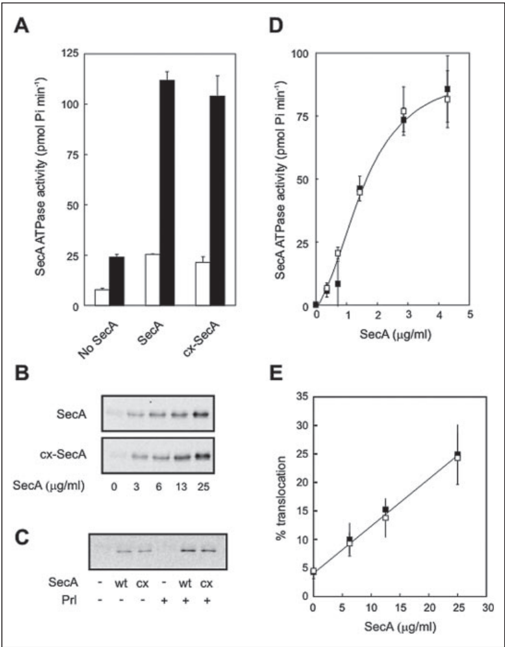
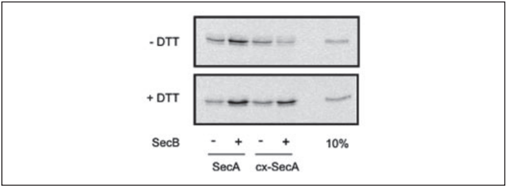
The ATPase SecA provides the driving force for the transport of secretory proteins across the cytoplasmic membrane of Escherichia coli. SecA exists as a dimer in solution, but the exact oligomeric state of SecA during membrane binding and preprotein translocation is a topic of debate. To study the requirements of oligomeric changes in SecA during protein translocation, a non-dissociable SecA dimer was formed by oxidation of the carboxyl-terminal cysteines. The cross-linked SecA dimer interacts with the SecYEG complex with a similar stoichiometry as non-cross-linked SecA. Cross-linking reversibly disrupts the SecB binding site on SecA. However, in the absence of SecB, the activity of the disulfide-bonded SecA dimer is indistinguishable from wild-type SecA. Moreover, SecYEG binding stabilizes a cold sodium dodecylsulfate-resistant dimeric state of SecA. The results demonstrate that dissociation of the SecA dimer is not an essential feature of the protein translocation reaction.
Overview
The claims and statistics of this paper haven’t been checked yet.
Free: it reads the open-access text and checks the first 5 claims that cite a source we can check. Create a free account to check every claim.
Integrity signals
Registry
Cites
Statistics
Figures


Verification
Claims the paper makes
The claims and statistics of this paper haven’t been checked yet.
Free: it reads the open-access text and checks the first 5 claims that cite a source we can check. Create a free account to check every claim.
Claims other papers make about this one
Each is checked against this paper’s own text: does it say what the citing paper says it does?
In the citing paper
“The oligomeric state of membrane-bound SecA is controversially discussed. Liposome studies indicate that only the SecA monomer binds to phospholipids (Roussel and White, 2020), but a SecA dimer is functional in protein translocation (de Keyzer et al., 2005) and can function as receptor for preproteins (Gouridis et al., 2013).”
From The Dynamic SecYEG Translocon (2021) · cites this paper as de Keyzer et al., 2005
Self-check
Percentages, sums and reported differences re-computed from the paper’s own numbers.
The self-check needs the paper’s full text.
Citations
Cites
Hartl, F.-U., Lecker, S., Schiebel, E., Hendrick, J. P., & Wickner, W. (1990) · Cell · doi:10.1016/0092-8674(90)90160-g · Cited by 562
ΔμH+ and ATP function at different steps of the catalytic cycle of preprotein translocase
Schiebel, E., Driessen, A. J. M., Hartl, F.-U., & Wickner, W. (1991) · Cell · doi:10.1016/0092-8674(91)90317-r · Cited by 458
Self-citationLill, R., Cunningham, K., Brundage, L. A., Ito, K., Oliver, D., & Wickner, W. (1989) · The EMBO Journal · doi:10.1002/j.1460-2075.1989.tb03458.x · Cited by 401
Nucleotide Control of Interdomain Interactions in the Conformational Reaction Cycle of SecA
Hunt, J. F., Weinkauf, S., Henry, L., Fak, J. J., McNicholas, P., Oliver, D. B., & Deisenhofer, J. (2002) · Science · doi:10.1126/science.1074424 · Cited by 270
SecA protein is required for secretory protein translocation into E. coli membrane vesicles
Cabelli, R. J., Chen, L., Tai, P. C., & Oliver, D. B. (1988) · Cell · doi:10.1016/0092-8674(88)90227-9 · Cited by 236
Fekkes, P. (1997) · The EMBO Journal · doi:10.1093/emboj/16.20.6105 · Cited by 191
Self-citationDissociation of the dimeric SecA ATPase during protein translocation across the bacterial membrane
Or, E., Navon, A., & Rapoport, T. A. (2002) · The EMBO Journal · doi:10.1093/emboj/cdf471 · Cited by 171
A large conformational change of the translocation ATPase SecA
Osborne, A. R., Clemons, W. M., & Rapoport, T. A. (2004) · Proceedings of the National Academy of Sciences · doi:10.1073/pnas.0401742101 · Cited by 151
The C Terminus of SecA Is Involved in Both Lipid Binding and SecB Binding
Breukink, E., Nouwen, N., van Raalte, A., Mizushima, S., Tommassen, J., & de Kruijff, B. (1995) · Journal of Biological Chemistry · doi:10.1074/jbc.270.14.7902 · Cited by 146
Self-citationBinding, activation and dissociation of the dimeric SecA ATPase at the dimeric SecYEG translocase
Duong, F. (2003) · The EMBO Journal · doi:10.1093/emboj/cdg418 · Cited by 145
Cited by
Protein translocation across the eukaryotic endoplasmic reticulum and bacterial plasma membranes.
Rapoport, T. A. (2007) · Nature · doi:10.1038/nature06384 · Cited by 977
Protein Translocation Across the Bacterial Cytoplasmic Membrane
Driessen, A. J. M., & Nouwen, N. (2008) · Annual Review of Biochemistry · doi:10.1146/annurev.biochem.77.061606.160747 · Cited by 614
Self-citationNatale, P., Brüser, T., & Driessen, A. J. M. (2008) · Biochimica et Biophysica Acta (BBA) - Biomembranes · doi:10.1016/j.bbamem.2007.07.015 · Cited by 542
Self-citationStructure of a complex of the ATPase SecA and the protein-translocation channel.
Zimmer, J., Nam, Y., & Rapoport, T. A. (2008) · Nature · doi:10.1038/nature07335 · Cited by 459
Bacterial protein secretion through the translocase nanomachine
Papanikou, E., Karamanou, S., & Economou, A. (2007) · Nature Reviews Microbiology · doi:10.1038/nrmicro1771 · Cited by 273
du Plessis, D. J. F., Nouwen, N., & Driessen, A. J. M. (2011) · Biochimica et Biophysica Acta (BBA) - Biomembranes · doi:10.1016/j.bbamem.2010.08.016 · Cited by 255
Self-citationThe bacterial Sec-translocase: structure and mechanism
Lycklama a Nijeholt, J. A., & Driessen, A. J. M. (2012) · Philosophical Transactions of the Royal Society B: Biological Sciences · doi:10.1098/rstb.2011.0201 · Cited by 167
Self-citationNanodiscs unravel the interaction between the SecYEG channel and its cytosolic partner SecA
Alami, M., Dalal, K., Lelj‐Garolla, B., Sligar, S. G., & Duong, F. (2007) · The EMBO Journal · doi:10.1038/sj.emboj.7601661 · Cited by 172
“To ascertain the stoichiometry, the SecA dimeric state was stabilized by oxidation with Cu2þ (phenanthroline)3, resulting in the formation of an intra-dimeric SecA disulfide bond (de Keyzer et al, 2005).”
BackgroundMethodSecretion by numbers: protein traffic in prokaryotes
Economou, A., Christie, P. J., Fernandez, R. C., Palmer, T., Plano, G. V., & Pugsley, A. P. (2006) · Molecular Microbiology · doi:10.1111/j.1365-2958.2006.05377.x · Cited by 155
“Tom Rapoport suggested that the SecA ATPase motor functions as a monomer (Or et al., 2002; 2005), a concept refuted by Arnold Driessen (University of Groningen), who reported that cross-linked SecA dimers are functional (de Keyzer et al., 2005), supporting his earlier FRET studies (Driessen, 1993).”
ResultStructure of Dimeric SecA, the Escherichia coli Preprotein Translocase Motor
Papanikolau, Y., Papadovasilaki, M., Ravelli, R. B. G., McCarthy, A. A., Cusack, S., Economou, A., & Petratos, K. (2006) · Journal of Molecular Biology · doi:10.1016/j.jmb.2006.12.049 · Cited by 167
“For simplicity ecSecA[9-861] will be referred hereafter as ecSecA.”
BackgroundMethodInfluentialA new twist on an old pathway – accessory secretion systems
Rigel, N. W., & Braunstein, M. (2008) · Molecular Microbiology · doi:10.1111/j.1365-2958.2008.06294.x · Cited by 126
“E. coli and B. subtilis SecA are known to form dimers (Ding et al., 2003; Jilaveanu et al., 2005), although whether or not the dimer is the translocation-active form of the protein remains controversial (de Keyzer et al., 2005; Jilaveanu et al., 2005; Or et al., 2005).”
BackgroundSurvey of the year 2005 commercial optical biosensor literature
Rich, R. L., & Myszka, D. G. (2006) · Journal of Molecular Recognition · doi:10.1002/jmr.808 · Cited by 142
Different modes of SecY–SecA interactions revealed by site-directed in vivo photo-cross-linking
Mori, H., & Ito, K. (2006) · Proceedings of the National Academy of Sciences · doi:10.1073/pnas.0606390103 · Cited by 113
Vassylyev, D. G., Mori, H., Vassylyeva, M. N., Tsukazaki, T., Kimura, Y., Tahirov, T. H., & Ito, K. (2006) · Journal of Molecular Biology · doi:10.1016/j.jmb.2006.09.061 · Cited by 108
SecA-mediated targeting and translocation of secretory proteins
Chatzi, K. E., Sardis, M. F., Economou, A., & Karamanou, S. (2014) · Biochimica et Biophysica Acta (BBA) - Molecular Cell Research · doi:10.1016/j.bbamcr.2014.02.014 · Cited by 104
Oswald, J., Njenga, R., Natriashvili, A., Sarmah, P., & Koch, H.-G. (2021) · Frontiers in Molecular Biosciences · doi:10.3389/fmolb.2021.664241 · Cited by 88
Interactions That Drive Sec-Dependent Bacterial Protein Transport
Rusch, S. L., & Kendall, D. A. (2007) · Biochemistry · doi:10.1021/bi7010064 · Cited by 75
Sardis, M. F., & Economou, A. (2010) · Molecular Microbiology · doi:10.1111/j.1365-2958.2010.07176.x · Cited by 73
“Tethering the two SecA protomers by the native cysteinyl residues located in the C-tail (de Keyzer et al., 2005) or by engineered cysteinyl residues in the bsSecA 2 dimer interface (Fig.”
BackgroundSecA, a remarkable nanomachine
Küsters, I., & Driessen, A. J. M. (2011) · Cellular and Molecular Life Sciences · doi:10.1007/s00018-011-0681-y · Cited by 87
Self-citationQuaternary Structure of SecA in Solution and Bound to SecYEG Probed at the Single Molecule Level
Küsters, I., van den Bogaart, G., Kedrov, A., Krasnikov, V. V., Fulyani, F., Poolman, B., & Driessen, A. J. M. (2011) · Structure · doi:10.1016/j.str.2010.12.016 · Cited by 73
“In contrast, dimeric SecA was detected to bind inner membrane vesicles (IMVs), as shown by chemical crosslinking (de Keyzer et al., 2005; Jilaveanu et al., 2005) and surface plasmon resonance (SPR) (de Keyzer et al., 2005).”
InfluentialSelf-citationPushing, pulling and trapping – Modes of motor protein supported protein translocation
Tomkiewicz, D., Nouwen, N., & Driessen, A. J. M. (2007) · FEBS Letters · doi:10.1016/j.febslet.2007.04.015 · Cited by 64
Self-citationCompetitive Binding of the SecA ATPase and Ribosomes to the SecYEG Translocon
Wu, Z. C., de Keyzer, J., Kedrov, A., & Driessen, A. J. M. (2012) · Journal of Biological Chemistry · doi:10.1074/jbc.m111.297911 · Cited by 61
“Previously, we observed that the SecA association and dissociation phases do not fit to a simple bimolecular interaction model (26, 35).”
BackgroundSelf-citationBiogenesis of membrane bound respiratory complexes in Escherichia coli
Price, C. E., & Driessen, A. J. M. (2010) · Biochimica et Biophysica Acta (BBA) - Molecular Cell Research · doi:10.1016/j.bbamcr.2010.01.019 · Cited by 67
Self-citationQuaternary dynamics of the SecA motor drive translocase catalysis.
Gouridis, G., Karamanou, S., Sardis, M. F., Schärer, M. A., Capitani, G., & Economou, A. (2013) · Molecular Cell · doi:10.1016/j.molcel.2013.10.036 · Cited by 57
“Covalently bonded SecA dimers, generated using either crosslinking (de Keyzer et al., 2005; Jilaveanu and Oliver, 2006; Or and Rapoport, 2007) or genetic techniques (McFarland et al., 1993; Wang et al., 2008), led to conflicting effects on SecA function.”
BackgroundSecA Dimer Cross-Linked at Its Subunit Interface Is Functional for Protein Translocation
Jilaveanu, L. B., & Oliver, D. (2006) · Journal of Bacteriology · doi:10.1128/jb.188.1.335-338.2006 · Cited by 54
“While we were writing up our work, a study similar to ours was published (6).”
ResultPrimo, C. D., & Lebars, I. (2007) · Analytical Biochemistry · doi:10.1016/j.ab.2007.06.016 · Cited by 50
Segers, K., & Anné, J. (2011) · Chemistry & Biology · doi:10.1016/j.chembiol.2011.04.007 · Cited by 53
Mitra, K., Frank, J., & Driessen, A. J. M. (2006) · Nature Structural & Molecular Biology · doi:10.1038/nsmb1166 · Cited by 63
“Many studies have also demonstrated that it is the dimeric form of SecA that is functional in preprotein translocation through the PC”
BackgroundSelf-citationGold, V. A. M., Robson, A., Clarke, A. R., & Collinson, I. (2007) · Journal of Biological Chemistry · doi:10.1074/jbc.m702066200 · Cited by 43
The Long α-Helix of SecA Is Important for the ATPase Coupling of Translocation
Mori, H., & Ito, K. (2006) · Journal of Biological Chemistry · doi:10.1074/jbc.m606906200 · Cited by 41
Wang, H., Na, B., Yang, H., & Tai, P. C. (2007) · Journal of Bacteriology · doi:10.1128/jb.01633-07 · Cited by 45
“4D) was significantly higher than that of the proposed monomeric SecA mutant (22) and similar to that of the reported conjugated SecA dimer which no longer supports SecB-dependent protein translocation (6).”
BackgroundCryo-electron Microscopic Structure of SecA Protein Bound to the 70S Ribosome
Singh, R., Kraft, C., Jaiswal, R., Sejwal, K., Kasaragod, V. B., Kuper, J., Bürger, J., Mielke, T., Luirink, J., & Bhushan, S. (2014) · Journal of Biological Chemistry · doi:10.1074/jbc.m113.506634 · Cited by 40
“Several in vitro translocation studies have also indicated that SecA functions as a dimer [16,19,24].”
BackgroundDas, S., Stivison, E., Folta‐Stogniew, E. J., & Oliver, D. B. (2008) · Journal of Bacteriology · doi:10.1128/jb.00593-08 · Cited by 38
Protein secretion in Corynebacterium glutamicum
Liu, X., Zhang, W., Zhao, Z., Dai, X., Yang, Y., & Bai, Z. (2016) · Critical Reviews in Biotechnology · doi:10.1080/07388551.2016.1206059 · Cited by 36
“drives the protein translocation,[91,92] which is coupled”
A Large Conformational Change Couples the ATP Binding Site of SecA to the SecY Protein Channel
Robson, A. D., Booth, A. E. G., Gold, V. A. M., Clarke, A. R., & Collinson, I. R. (2007) · Journal of Molecular Biology · doi:10.1016/j.jmb.2007.09.086 · Cited by 36
SecA-Mediated Protein Translocation through the SecYEG Channel
Komarudin, A. G., & Driessen, A. J. M. (2019) · Microbiology Spectrum · doi:10.1128/microbiolspec.psib-0028-2019 · Cited by 35
Self-citationSugai, R., Takemae, K., Tokuda, H., & Nishiyama, K.-I. (2007) · Journal of Biological Chemistry · doi:10.1074/jbc.m704716200 · Cited by 33
SecA: A Potential Antimicrobial Target
Chaudhary, A. S., Chen, W., Jin, J., Tai, P. C., & Wang, B. (2015) · Future Medicinal Chemistry · doi:10.4155/fmc.15.42 · Cited by 35
Cross‐linked SecA dimers are not functional in protein translocation
Or, E., & Rapoport, T. A. (2007) · FEBS Letters · doi:10.1016/j.febslet.2007.04.083 · Cited by 35
“These dimers were generated through disulfide bridge formation of their C-terminal cysteines [26].”
BackgroundOligomeric states of the SecA and SecYEG core components of the bacterial Sec translocon
Rusch, S. L., & Kendall, D. A. (2006) · Biochimica et Biophysica Acta (BBA) - Biomembranes · doi:10.1016/j.bbamem.2006.08.013 · Cited by 40
Design, syntheses and evaluation of 4-oxo-5-cyano thiouracils as SecA inhibitors.
Chaudhary, A. S., Jin, J., Chen, W., Tai, P. C., & Wang, B. (2015) · Bioorganic & Medicinal Chemistry · doi:10.1016/j.bmc.2014.11.017 · Cited by 31
Energetics of SecA Dimerization
Wowor, A. J., Yu, D., Kendall, D. A., & Cole, J. L. (2011) · Journal of Molecular Biology · doi:10.1016/j.jmb.2011.02.006 · Cited by 35
“Several studies have reported that binding of signal peptide induces dissociation of the SecA dimer,32,37 whereas others indicate that the dimer remains intact throughout the preprotein translocation cycle.(29,45,46,60,61) It has also been reported that signal”
Jilaveanu, L. B., & Oliver, D. B. (2006) · Journal of Biological Chemistry · doi:10.1074/jbc.m610828200 · Cited by 28
Cellular dynamics of the SecA ATPase at the single molecule level
Seinen, A., Spakman, D., van Oijen, A. M., & Driessen, A. J. M. (2021) · Scientific Reports · doi:10.1038/s41598-021-81081-2 · Cited by 22
Self-citationAssembly of the translocase motor onto the preprotein‐conducting channel
Karamanou, S., Bariami, V., Papanikou, E., Kalodimos, C. G., & Economou, A. (2008) · Molecular Microbiology · doi:10.1111/j.1365-2958.2008.06402.x · Cited by 27
Auclair, S. M., Oliver, D. B., & Mukerji, I. (2013) · Biochemistry · doi:10.1021/bi301217t · Cited by 22
Topologically Fixed SecG Is Fully Functional
van der Sluis, E. O., van der Vries, E., Berrelkamp, G., Nouwen, N. P., & Driessen, A. J. M. (2006) · Journal of Bacteriology · doi:10.1128/jb.188.3.1188-1190.2006 · Cited by 22
Self-citationPatel, C. N., Smith, V. F., & Randall, L. L. (2006) · Protein Science · doi:10.1110/ps.062141006 · Cited by 24
“Previous studies have come to conflicting conclusions as to whether SecA functions as a monomer (Or et al. 2002, 2005) or as a dimer (de Keyzer et al. 2005; Jilaveanu et al. 2005; Randall et al. 2005; Jilaveanu and Oliver 2006).”
ResultAnalysis of SecA Dimerization in Solution
Wowor, A. J., Yan, Y., Auclair, S. M., Yu, D., Zhang, J., May, E. R., Gross, M. L., Kendall, D. A., & Cole, J. L. (2014) · Biochemistry · doi:10.1021/bi500348p · Cited by 22
Yu, D., Wowor, A. J., Cole, J. L., & Kendall, D. A. (2013) · Journal of Bacteriology · doi:10.1128/jb.02269-12 · Cited by 23
Swanson, S., Ioerger, T. R., Rigel, N. W., Miller, B. K., Braunstein, M., & Sacchettini, J. C. (2015) · Journal of Bacteriology · doi:10.1128/jb.00696-15 · Cited by 21
The Canonical and Accessory Sec System of Gram-positive Bacteria
Prabudiansyah, I., & Driessen, A. J. M. (2016) · Current topics in microbiology and immunology · doi:10.1007/82_2016_9 · Cited by 27
Self-citationPrabudiansyah, I., Küsters, I., & Driessen, A. J. M. (2015) · PLoS ONE · doi:10.1371/journal.pone.0128788 · Cited by 19
Self-citationBhanu, M. K., Zhao, P., & Kendall, D. A. (2013) · Journal of Bacteriology · doi:10.1128/jb.00661-13 · Cited by 16
“ine for 5 min at room temperature (32).”
BackgroundAnalysis of the Isolated SecA DEAD Motor Suggests a Mechanism for Chemical–Mechanical Coupling
Nithianantham, S., & Shilton, B. H. (2008) · Journal of Molecular Biology · doi:10.1016/j.jmb.2008.08.022 · Cited by 16
Single-Molecule Studies of Bacterial Protein Translocation
Kedrov, A., Küsters, I., & Driessen, A. J. M. (2013) · Biochemistry · doi:10.1021/bi400913x · Cited by 13
Self-citationSingle-Molecule Studies on the Protein Translocon
Seinen, A., & Driessen, A. J. M. (2019) · Annual Review of Biophysics · doi:10.1146/annurev-biophys-052118-115352 · Cited by 13
“SecYEG-bound SecA is activated for ATPase activity when it binds a preprotein (22, 50, 52, 63).”
BackgroundSelf-citationLiu, X., Li, Y., & Bai, Z. (2021) · Elsevier eBooks · doi:10.1016/b978-0-12-821477-0.00006-4 · Cited by 14
Winkler, K., Karner, A., Hörner, A., Hannesschlaeger, C., Knyazev, D. G., Siligan, C., Zimmermann, M., Kuttner, R., Pohl, P., & Preiner, J. (2020) · Nanoscale Advances · doi:10.1039/d0na00427h · Cited by 13
Fiedler, S. M., & Graumann, P. L. (2024) · Cells · doi:10.3390/cells13050377 · Cited by 11
Biogenesis of β-barrel integral proteins of bacterial outer membrane
Федоровна, С. Т., Novikova, O. D., & Portnyagina, O. Y. (2012) · Biochemistry (Moscow) · doi:10.1134/s0006297912110016 · Cited by 16
Using a Low Denaturant Model To Explore the Conformational Features of Translocation-Active SecA
Maki, J. L., Krishnan, B., & Gierasch, L. M. (2012) · Biochemistry · doi:10.1021/bi201793e · Cited by 9
Binding of SecA ATPase monomers and dimers to lipid vesicles
Roussel, G., & White, S. H. (2019) · Biochimica et Biophysica Acta (BBA) - Biomembranes · doi:10.1016/j.bbamem.2019.183112 · Cited by 9
“4 suggests that SecA is monomeric (31,32) while other data suggest that dimers can interact as well (33,34).”
BackgroundSecA – a multidomain and multitask bacterial export protein
Ambroziak, P., Rzepka, I., & Skórko‐Glonek, J. (2021) · Acta Biochimica Polonica · doi:10.18388/abp.2020_5761 · Cited by 15
“Generally, SecA is mainly purified from cells in a dimeric form and many studies indicate that this protein functions as a dimer (Akita et al., 1991; Driessen, 1993; de Keyzer et al., 2005; Jilaveanu, et al., 2005; Wang et al., 2008; Kusters et al., 2011; Gouridis et al., 2013).”
BackgroundTang, Y. C., Pan, X., Tai, P. C., & Sui, S. (2010) · Science China Life Sciences · doi:10.1007/s11427-010-4061-x · Cited by 6
Jensen, R. K., Xue, L., Marotta, F., Somody, J. C., Selkrig, J., Lenz, S., Rappsilber, J., Savitski, M. M., Kosiński, J., Typas, A., et al. (2026) · Cell · doi:10.1016/j.cell.2026.08.055 · Cited by 8
SecAAA trimer is fully functional as SecAA dimer in the membrane: Existence of higher oligomers?
Wang, H., Ma, Y., Hsieh, Y., Yang, H., Li, M., Wang, B., & Tai, P. C. (2014) · Biochemical and Biophysical Research Communications · doi:10.1016/j.bbrc.2014.03.116 · Cited by 5
Gubbens, J., Slijper, M., KRUIJFF, B. D., & de Kroon, A. I. P. M. (2008) · Biochimica et Biophysica Acta (BBA) - Proteins and Proteomics · doi:10.1016/j.bbapap.2008.08.020 · Cited by 5
“mechanosensitive channel MscS, the oligomeric state and, in the latter case, its dissociation by TFE was confirmed in one dimensional SDS-PAGE gels using immunodetection [8, 14 ].”
Driessen, A. J. M. (2005) · Nature · doi:10.1038/438299a · Cited by 5
Self-citationAn alternate mode of oligomerization for E. coli SecA
Yazdi, A. K., Vezina, G. C., & Shilton, B. H. (2017) · Scientific Reports · doi:10.1038/s41598-017-11648-5 · Cited by 3
Meining, W., Scheuring, J., Fischer, M. J., & Weinkauf, S. (2006) · Acta Crystallographica Section F Structural Biology and Crystallization Communications · doi:10.1107/s1744309106017544 · Cited by 2
“It has been described as being translocation-active in a dimeric state (Driessen, 1993; de Keyzer et al., 2005), while other studies have proposed the dissociation of the dimer during translocation (Duong, 2003; Or et al., 2005).”
BackgroundLindič, N., Loboda, J., Usenik, A., Vidmar, R., & Türk, V. (2020) · International Journal of Molecular Sciences · doi:10.3390/ijms21176153 · Cited by 1
SecA-Mediated Protein Translocation through the SecYEG Channel
Komarudin, A. G., & Driessen, A. J. M. (2019) · ASM Press eBooks · doi:10.1128/9781683670285.ch2 · Cited by 1
Self-citationSec Protein-Conducting Channel and SecA
van der Sluis, E. O., Nouwen, N. P., & Driessen, A. J. M. (2007) · The Enzymes · doi:10.1016/s1874-6047(07)25002-4 · Cited by 1
Self-citationCo-and Posttranslational Protein Targeting to the SecYEG Translocon in Escherichia coli
Bibi, E. (2014) · ASM Press eBooks · doi:10.1128/9781555815806.ch1 · Cited by 1
Thermodynamics of the Protein Translocation
Kedrov, A., den Blaauwen, T., & Driessen, A. J. M. (2009) · Methods in enzymology on CD-ROM/Methods in enzymology · doi:10.1016/s0076-6879(09)66012-2 · Cited by 1
Self-citationKolayarattil, M. B. (2013) · OpenCommons - UConn (University of Connecticut)
Maki, J. L. (2009) · ScholarWorks@UMassAmherst (University of Massachusetts Amherst) · doi:10.7275/6fq6-ge11
Winkler, K., Karner, A., Hörner, A., Hannesschlaeger, C., Knyazev, D. G., Siligan, C., Zimmermann, M., Kuttner, R., Pohl, P., & Preiner, J. (2019) · bioRxiv (Cold Spring Harbor Laboratory) · doi:10.1101/799247
Characterization of Structure and Function of SECA Domains
Huang, Y. (2011) · Digital Archive @ GSU · doi:10.57709/2384955
D’Lima, N. G. (2014) · OpenCommons - UConn (University of Connecticut)
Yan, Y. (2015) · Open Scholarship Institutional Repository (Washington University in St. Louis) · doi:10.7936/k7fj2dz2
Metadata
- Authors
- de Keyzer, J., van der Sluis, E. O., Spelbrink, R. E. J., Nijstad, N., de Kruijff, B., Nouwen, N., van der Does, C., & Driessen, A. J. M.
- Affiliations
- University of Groningen (NL)
- Corresponding author
- Driessen, Arnold J.M.
- Venue
- Journal of Biological Chemistry
- Publisher
- Elsevier BV
- Published
- 2005-10
- Volume
- 280
- Issue
- 42
- Pages
- 35255-35260
- ISSN
- 0021-9258 (ISSN-L)
- OpenAlex
- W2119248644
- Cited by
- 82
- References
- 33
- Citations by year
- 2026: 1 · 2024: 1 · 2022: 1 · 2021: 4 · 2020: 2 · 2019: 6 · 2017: 1 · 2016: 2 · 2015: 4 · 2014: 7 · 2013: 6 · 2012: 4
- FWCI
- 6.09
- Type
- journal article
- Language
- en
- Open access
- hybrid
- doi.org
- Licence
- cc-by
- www.elsevier.com/tdm/userlicense/1.0/ (tdm)
- creativecommons.org/licenses/by/4.0/ (vor, 5480 d)
- Locations
- Journal of Biological Chemistry (publishedVersion, cc-by)
- PubMed (publishedVersion)
- University of Groningen research database (University of Groningen / Centre for Information Technology) (publishedVersion, other-oa)
- Publication Server of Goethe University Frankfurt am Main (Goethe University Frankfurt) (submittedVersion, cc-by)
- University of Groningen research database (University of Groningen / Centre for Information Technology) (submittedVersion, other-oa)
- Topics
- Life Sciences › Biochemistry, Genetics and Molecular Biology › Genetics › Bacterial Genetics and Biotechnology
- Life Sciences › Biochemistry, Genetics and Molecular Biology › Molecular Biology › Heat shock proteins research
- Health Sciences › Medicine › Oncology › Drug Transport and Resistance Mechanisms
- Keywords
- SecA, protein translocation, covalent dimerization, disulfide cross-linking, oligomeric state, preprotein translocation, ATPase, Escherichia coli, membrane protein secretion, plasma membrane
- MeSH terms
- SEC Translocation Channels, SecA Proteins, Adenosine Triphosphatases, Bacterial Proteins, Cell Membrane, Cross-Linking Reagents, Cysteine, Cytoplasm, Disulfides, Dose-Response Relationship, Drug, Escherichia coli, Kinetics, Mutation, Oxygen, Protein Binding, Sodium Dodecyl Sulfate, Time Factors, Urea, Protein Structure, Tertiary, Dimerization, Surface Plasmon Resonance, Protein Transport, Membrane Transport Proteins
About these checks
Registry, retraction, Cites and statistics results are computed, not judged, with one exception: a printed reference that no index lists is read once by a model before it counts as a citation error. Claims are extracted by a model and kept only when their quote appears verbatim in the text; each cited source is then checked, with a model’s help, for whether it says what the claim relies on. Those verdicts can be wrong — read the claim’s quote and the cited source before relying on one.
Statistics and arithmetic are recomputed, not judged.
Confidence bands are shown only for fields calibrated on our annotated test set. None is calibrated yet, so no band is shown.
What counts as a claim ›How we measure confidence ›How we check this ›
Are you an author, or do you see a problem with this page? Request a review
Data sources
Bibliographic data: Semantic Scholar, OpenAlex, Crossref.
Contains information from the Semantic Scholar Academic Graph Datasets, made available under the ODC Attribution License (ODC-BY 1.0).
Semantic Scholar’s data is described in: Kinney, R., et al. (2023). The Semantic Scholar Open Data Platform. arXiv:2301.10140.
