

Covalently dimerized SecA is functional in protein translocation.
Open accessThe DOI matches its Crossref record; 33 of the 33 references it cites were found in a registry or an index.
Abstract
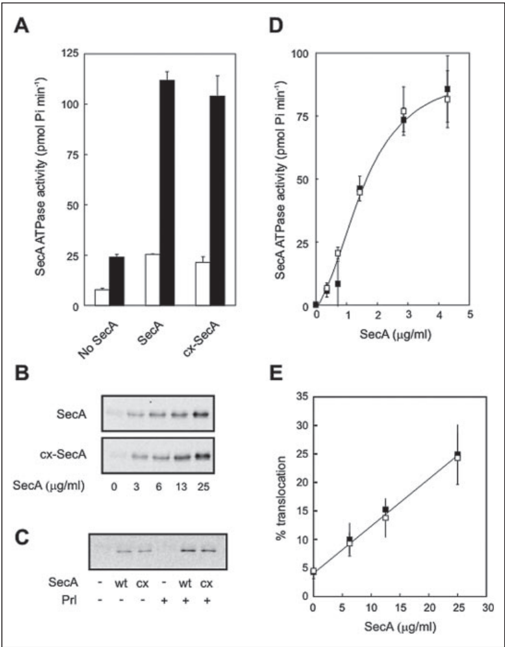
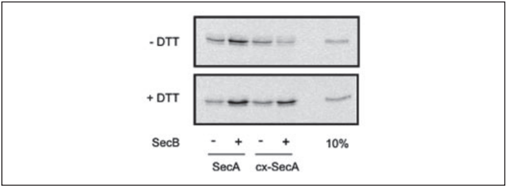
The ATPase SecA provides the driving force for the transport of secretory proteins across the cytoplasmic membrane of Escherichia coli. SecA exists as a dimer in solution, but the exact oligomeric state of SecA during membrane binding and preprotein translocation is a topic of debate. To study the requirements of oligomeric changes in SecA during protein translocation, a non-dissociable SecA dimer was formed by oxidation of the carboxyl-terminal cysteines. The cross-linked SecA dimer interacts with the SecYEG complex with a similar stoichiometry as non-cross-linked SecA. Cross-linking reversibly disrupts the SecB binding site on SecA. However, in the absence of SecB, the activity of the disulfide-bonded SecA dimer is indistinguishable from wild-type SecA. Moreover, SecYEG binding stabilizes a cold sodium dodecylsulfate-resistant dimeric state of SecA. The results demonstrate that dissociation of the SecA dimer is not an essential feature of the protein translocation reaction.
Overview
The claims and statistics of this paper haven’t been checked yet.
Free: it reads the open-access text and checks the first 5 claims that cite a source we can check. Create a free account to check every claim.
Integrity signals
Registry
Cites
Statistics
Figures


Verification
Claims the paper makes
The claims and statistics of this paper haven’t been checked yet.
Free: it reads the open-access text and checks the first 5 claims that cite a source we can check. Create a free account to check every claim.
Claims other papers make about this one
Each is checked against this paper’s own text: does it say what the citing paper says it does?
In the citing paper
“The oligomeric state of membrane-bound SecA is controversially discussed. Liposome studies indicate that only the SecA monomer binds to phospholipids (Roussel and White, 2020), but a SecA dimer is functional in protein translocation (de Keyzer et al., 2005) and can function as receptor for preproteins (Gouridis et al., 2013).”
From The Dynamic SecYEG Translocon (2021) · cites this paper as de Keyzer et al., 2005
Self-check
Percentages, sums and reported differences re-computed from the paper’s own numbers.
The self-check needs the paper’s full text.
Citations
Cites
Hartl, F.-U., Lecker, S., Schiebel, E., Hendrick, J. P., & Wickner, W. (1990) · Cell · doi:10.1016/0092-8674(90)90160-g · Cited by 562
ΔμH+ and ATP function at different steps of the catalytic cycle of preprotein translocase
Schiebel, E., Driessen, A. J. M., Hartl, F.-U., & Wickner, W. (1991) · Cell · doi:10.1016/0092-8674(91)90317-r · Cited by 458
Self-citationLill, R., Cunningham, K., Brundage, L. A., Ito, K., Oliver, D., & Wickner, W. (1989) · The EMBO Journal · doi:10.1002/j.1460-2075.1989.tb03458.x · Cited by 401
Nucleotide Control of Interdomain Interactions in the Conformational Reaction Cycle of SecA
Hunt, J. F., Weinkauf, S., Henry, L., Fak, J. J., McNicholas, P., Oliver, D. B., & Deisenhofer, J. (2002) · Science · doi:10.1126/science.1074424 · Cited by 270
SecA protein is required for secretory protein translocation into E. coli membrane vesicles
Cabelli, R. J., Chen, L., Tai, P. C., & Oliver, D. B. (1988) · Cell · doi:10.1016/0092-8674(88)90227-9 · Cited by 236
Fekkes, P. (1997) · The EMBO Journal · doi:10.1093/emboj/16.20.6105 · Cited by 191
Self-citationDissociation of the dimeric SecA ATPase during protein translocation across the bacterial membrane
Or, E., Navon, A., & Rapoport, T. A. (2002) · The EMBO Journal · doi:10.1093/emboj/cdf471 · Cited by 171
A large conformational change of the translocation ATPase SecA
Osborne, A. R., Clemons, W. M., & Rapoport, T. A. (2004) · Proceedings of the National Academy of Sciences · doi:10.1073/pnas.0401742101 · Cited by 151
The C Terminus of SecA Is Involved in Both Lipid Binding and SecB Binding
Breukink, E., Nouwen, N., van Raalte, A., Mizushima, S., Tommassen, J., & de Kruijff, B. (1995) · Journal of Biological Chemistry · doi:10.1074/jbc.270.14.7902 · Cited by 146
Self-citationBinding, activation and dissociation of the dimeric SecA ATPase at the dimeric SecYEG translocase
Duong, F. (2003) · The EMBO Journal · doi:10.1093/emboj/cdg418 · Cited by 145
Driessen, A. J. M. (1993) · Biochemistry · doi:10.1021/bi00211a030 · Cited by 140
Self-citationComplex behavior in solution of homodimeric SecA.
Woodbury, R. L., Hardy, S. J. S., & Randall, L. L. (2002) · Protein Science · doi:10.1110/ps.4090102 · Cited by 136
The protein-conducting channel SecYEG
Veenendaal, A. K. J., van der Does, C., & Driessen, A. J. M. (2004) · Biochimica et Biophysica Acta (BBA) - Molecular Cell Research · doi:10.1016/j.bbamcr.2004.02.009 · Cited by 133
Self-citationKaufmann, A., Manting, E. H., Veenendaal, A. K. J., Driessen, A. J. M., & van der Does, C. (1999) · Biochemistry · doi:10.1021/bi990539d · Cited by 122
Self-citationMatsuyama, S., Kimura, E., & Mizushima, S.-I. (1990) · Journal of Biological Chemistry · doi:10.1016/s0021-9258(19)38953-7 · Cited by 116
van der Wolk, J. P. W., Fekkes, P., Boorsma, A., Huie, J. L., Silhavy, T. J., & Driessen, A. J. M. (1998) · The EMBO Journal · doi:10.1093/emboj/17.13.3631 · Cited by 113
Self-citationFekkes, P., De Wit, J. G., Van Der Wolk, J. P. W., Kimsey, H. H., Kumamoto, C. A., & Driessen, A. J. M. (1998) · Molecular Microbiology · doi:10.1046/j.1365-2958.1998.00997.x · Cited by 111
Self-citationSecA, an essential component of the secretory machinery of Escherichiacoli, exists as homodimer
Akita, M., Shinkai, A., Matsuyama, S.-I., & Mizushima, S. (1991) · Biochemical and Biophysical Research Communications · doi:10.1016/0006-291x(91)90507-4 · Cited by 110
The Bacterial ATPase SecA Functions as a Monomer in Protein Translocation
Or, E., Boyd, D., Gon, S., Beckwith, J., & Rapoport, T. (2005) · Journal of Biological Chemistry · doi:10.1074/jbc.m413947200 · Cited by 104
Dimeric SecA is essential for protein translocation
Jilaveanu, L. B., Zito, C. R., & Oliver, D. (2005) · Proceedings of the National Academy of Sciences · doi:10.1073/pnas.0502774102 · Cited by 102
Phospholipid-induced Monomerization and Signal-peptide-induced Oligomerization of SecA
Benach, J., Chou, Y.-T., Fak, J. J., Itkin, A., Nicolae, D. D., Smith, P. C., Wittrock, G., Floyd, D. L., Golsaz, C. M., Gierasch, L. M., et al. (2003) · Journal of Biological Chemistry · doi:10.1074/jbc.m205992200 · Cited by 97
Zinc Stabilizes the SecB Binding Site of SecA
Fekkes, P., de Wit, J. G., Boorsma, A., Friesen, R. H. E., & Driessen, A. J. M. (1999) · Biochemistry · doi:10.1021/bi982818r · Cited by 84
Self-citationStructural determinants of SecB recognition by SecA in bacterial protein translocation
Zhou, J., & Xu, Z. (2003) · Nature Structural & Molecular Biology · doi:10.1038/nsb980 · Cited by 83
Asymmetric Binding Between SecA and SecB Two Symmetric Proteins: Implications for Function in Export
Randall, L. L., Crane, J. M., Lilly, A. A., Liu, G., Mao, C., Patel, C. N., & HARDY, S. J. S. (2005) · Journal of Molecular Biology · doi:10.1016/j.jmb.2005.02.036 · Cited by 78
Bu, Z., Wang, L., & Kendall, D. A. (2003) · Journal of Molecular Biology · doi:10.1016/s0022-2836(03)00840-4 · Cited by 66
Reconstitution of Purified Bacterial Preprotein Translocase in Liposomes
van der Does, C., de Keyzer, J., van der Laan, M., & Driessen, A. J. M. (2003) · Methods in enzymology on CD-ROM/Methods in enzymology · doi:10.1016/s0076-6879(03)72005-9 · Cited by 65
Self-citationde Keyzer, J., van der Does, C., & Driessen, A. J. M. (2002) · Journal of Biological Chemistry · doi:10.1074/jbc.m208449200 · Cited by 62
Self-citationThe Bacterial Protein–Translocation Complex: SecYEG Dimers Associate with One or Two SecA Molecules
Tziatzios, C., Schubert, D., Lotz, M., Gundogan, D., Betz, H., Schägger, H., Haase, W., Duong, F., & Collinson, I. R. (2004) · Journal of Molecular Biology · doi:10.1016/j.jmb.2004.04.076 · Cited by 59
Escherichia coli SecA truncated at its termini is functional and dimeric
Karamanou, S., Sianidis, G., Gouridis, G., Pozidis, C., Papanikolau, Y., Papanikou, E., & Economou, A. (2005) · FEBS Letters · doi:10.1016/j.febslet.2005.01.025 · Cited by 40
de Keyzer, J., van der Does, C., Kloosterman, T. G., & Driessen, A. J. M. (2003) · Journal of Biological Chemistry · doi:10.1074/jbc.m303490200 · Cited by 39
Self-citationRajapandi, T., & Oliver, D. B. (1994) · Biochemical and Biophysical Research Communications · doi:10.1006/bbrc.1994.1617 · Cited by 29
Spelbrink, R. E. J., Kolkman, A., Slijper, M., Killian, J. A., & KRUIJFF, B. D. (2005) · Journal of Biological Chemistry · doi:10.1074/jbc.m501617200 · Cited by 27
Self-citationde Keyzer, J., van der Does, C., Swaving, J., & Driessen, A. J. M. (2002) · FEBS Letters · doi:10.1016/s0014-5793(01)03213-6 · Cited by 25
Self-citation
Cited by
Protein translocation across the eukaryotic endoplasmic reticulum and bacterial plasma membranes.
Rapoport, T. A. (2007) · Nature · doi:10.1038/nature06384 · Cited by 977
Protein Translocation Across the Bacterial Cytoplasmic Membrane
Driessen, A. J. M., & Nouwen, N. (2008) · Annual Review of Biochemistry · doi:10.1146/annurev.biochem.77.061606.160747 · Cited by 614
Self-citationNatale, P., Brüser, T., & Driessen, A. J. M. (2008) · Biochimica et Biophysica Acta (BBA) - Biomembranes · doi:10.1016/j.bbamem.2007.07.015 · Cited by 542
Self-citationStructure of a complex of the ATPase SecA and the protein-translocation channel.
Zimmer, J., Nam, Y., & Rapoport, T. A. (2008) · Nature · doi:10.1038/nature07335 · Cited by 459
Bacterial protein secretion through the translocase nanomachine
Papanikou, E., Karamanou, S., & Economou, A. (2007) · Nature Reviews Microbiology · doi:10.1038/nrmicro1771 · Cited by 273
Metadata
- Authors
- de Keyzer, J., van der Sluis, E. O., Spelbrink, R. E. J., Nijstad, N., de Kruijff, B., Nouwen, N., van der Does, C., & Driessen, A. J. M.
- Affiliations
- University of Groningen (NL)
- Corresponding author
- Driessen, Arnold J.M.
- Venue
- Journal of Biological Chemistry
- Publisher
- Elsevier BV
- Published
- 2005-10
- Volume
- 280
- Issue
- 42
- Pages
- 35255-35260
- ISSN
- 0021-9258 (ISSN-L)
- OpenAlex
- W2119248644
- Cited by
- 82
- References
- 33
- Citations by year
- 2026: 1 · 2024: 1 · 2022: 1 · 2021: 4 · 2020: 2 · 2019: 6 · 2017: 1 · 2016: 2 · 2015: 4 · 2014: 7 · 2013: 6 · 2012: 4
- FWCI
- 6.09
- Type
- journal article
- Language
- en
- Open access
- hybrid
- doi.org
- Licence
- cc-by
- www.elsevier.com/tdm/userlicense/1.0/ (tdm)
- creativecommons.org/licenses/by/4.0/ (vor, 5480 d)
- Locations
- Journal of Biological Chemistry (publishedVersion, cc-by)
- PubMed (publishedVersion)
- University of Groningen research database (University of Groningen / Centre for Information Technology) (publishedVersion, other-oa)
- Publication Server of Goethe University Frankfurt am Main (Goethe University Frankfurt) (submittedVersion, cc-by)
- University of Groningen research database (University of Groningen / Centre for Information Technology) (submittedVersion, other-oa)
- Topics
- Life Sciences › Biochemistry, Genetics and Molecular Biology › Genetics › Bacterial Genetics and Biotechnology
- Life Sciences › Biochemistry, Genetics and Molecular Biology › Molecular Biology › Heat shock proteins research
- Health Sciences › Medicine › Oncology › Drug Transport and Resistance Mechanisms
- Keywords
- SecA, protein translocation, covalent dimerization, disulfide cross-linking, oligomeric state, preprotein translocation, ATPase, Escherichia coli, membrane protein secretion, plasma membrane
- MeSH terms
- SEC Translocation Channels, SecA Proteins, Adenosine Triphosphatases, Bacterial Proteins, Cell Membrane, Cross-Linking Reagents, Cysteine, Cytoplasm, Disulfides, Dose-Response Relationship, Drug, Escherichia coli, Kinetics, Mutation, Oxygen, Protein Binding, Sodium Dodecyl Sulfate, Time Factors, Urea, Protein Structure, Tertiary, Dimerization, Surface Plasmon Resonance, Protein Transport, Membrane Transport Proteins
About these checks
Registry, retraction, Cites and statistics results are computed, not judged, with one exception: a printed reference that no index lists is read once by a model before it counts as a citation error. Claims are extracted by a model and kept only when their quote appears verbatim in the text; each cited source is then checked, with a model’s help, for whether it says what the claim relies on. Those verdicts can be wrong — read the claim’s quote and the cited source before relying on one.
Statistics and arithmetic are recomputed, not judged.
Confidence bands are shown only for fields calibrated on our annotated test set. None is calibrated yet, so no band is shown.
What counts as a claim ›How we measure confidence ›How we check this ›
Are you an author, or do you see a problem with this page? Request a review
Data sources
Bibliographic data: Semantic Scholar, OpenAlex, Crossref.
Contains information from the Semantic Scholar Academic Graph Datasets, made available under the ODC Attribution License (ODC-BY 1.0).
Semantic Scholar’s data is described in: Kinney, R., et al. (2023). The Semantic Scholar Open Data Platform. arXiv:2301.10140.
