

Perceptions of performance and satisfaction after relocation to an activity-based office
Open accessThe DOI matches its Crossref record; 47 of the 47 references it cites were found in a registry or an index; 2 of the 65 sources its claims cite were checked for support.
Abstract
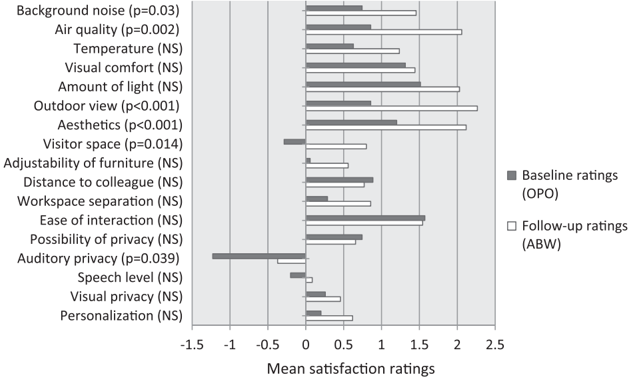
Many companies move from open-plan offices (OPO) to activity-based workplaces (ABWs). However, few studies examine the benefits and drawbacks following such a change. The aim of this study was to explore how physical conditions, office use, communication, privacy, territoriality, satisfaction and perceived performance change following a company's relocation from an OPO to an ABW. A mixed methods approach included pre- and post-relocation questionnaires and post-relocation focus groups, individual interviews and observations. The questionnaires enabled comparisons over time (n = 34) and broader analyses based on retrospective ratings of perceived change (n = 66). Results showed that satisfaction with auditory privacy, background noise, air quality, outdoor view and aesthetics increased significantly after relocation. Negative outcomes, such as lack of communication within teams, were perceived as being due to the high people-to-workstation ratio and lack of rules. Overall satisfaction with the physical work environment increased in the ABW compared to the OPO. Perceived performance did not change significantly. Practitioner Summary: Activity-based workplaces (ABWs) are commonly implemented although their effects on performance and well-being are unclear. This case study gives advice to stakeholders involved in office planning. Despite shortcomings with the people-to-workstation ratio and rules, employees showed improved satisfaction with auditory privacy and aesthetics in the ABW compared with the previous open-plan office.
Overview
CoChat Summary
TL;DR
This mixed-methods case study followed a Swedish insurance company’s relocation from an open-plan office to an activity-based workplace (ABW). Satisfaction with several physical conditions and overall physical work environment improved, but perceived performance did not change significantly, and employees reported problems with workstation availability, team communication, and rules.
Key findings
- Satisfaction improved significantly after relocation for background noise, aesthetics, visitor space, outdoor view, and air quality; auditory privacy also improved significantly, though acoustic privacy and speech level remained the lowest-rated physical conditions.
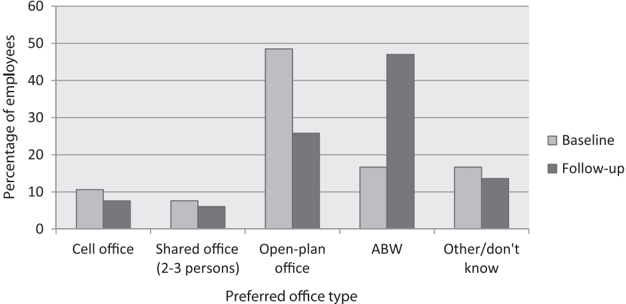
- Overall satisfaction with the physical work environment was significantly more positive than neutral in the ABW (p = 0.013); 47% preferred the ABW after relocation versus 16% before, while preference for the open-plan office dropped from 49% to 26%.
- Perceived performance did not change significantly: retrospective ratings showed no significant change in individual or group efficiency, and 86% reported often or always being productive at their workstation in the ABW.
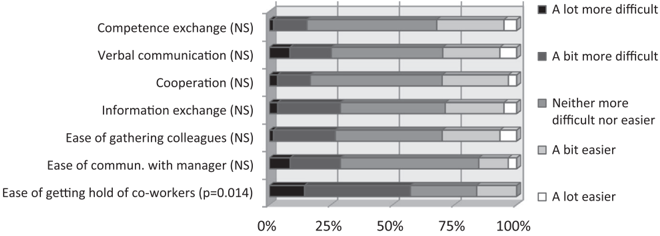
- Negative outcomes included significantly lower satisfaction with getting hold of co-workers (p = 0.014), nesting (28% often or always occupied the same workstation on consecutive days), and an average 7.84 min/person/day spent finding an appropriate workplace (range 0–45 min).
Methods
- Explorative case study at a large Swedish insurance company that relocated two departments from an open-plan office to an ABW in December 2014; the ABW had 64 equipped workstations for 100 relocated workers.
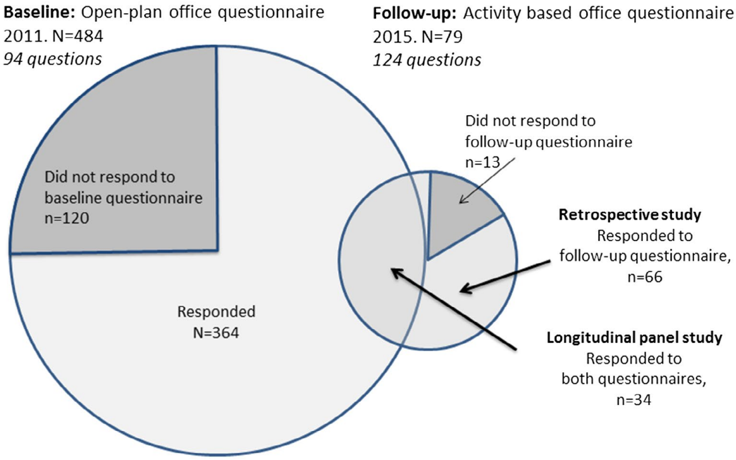
- Mixed methods: pre-relocation baseline questionnaire in 2011 and post-relocation follow-up questionnaire in spring 2015; longitudinal panel n = 34 answered both, retrospective follow-up sample n = 66; plus 3 focus groups (n = 20), 26 individual interviews, and observations.
- Analyses included General Linear Model repeated measures, Wilcoxon signed rank tests, frequency analysis, and qualitative categorisation in QSR Nvivo.
Limitations
- The paper states that the three-year gap between questionnaires led to personnel turnover, limiting response rate and suggesting possible selection bias; only 41 relocated employees had worked at the company at baseline.
- The paper states there were no baseline interviews or observations, so those methods could not be compared over time; the follow-up was only 3 months after relocation, so employees may not have been fully acclimatised.
- The paper states retrospective ratings rely on memory and should be interpreted with caution, and that productivity/performance are difficult to measure, though self-assessed measures are considered reasonable indicators. Evident from the text: this is a single case study in one Swedish insurance company, so generalisability is analytical rather than statistical.
Model-written summary. Check it against the paper before relying on it.
Integrity signals
Registry
Cites
Statistics
Figures



Verification
Claims the paper makes
2 Valid · 0 Not valid · 32 Not checked · 105 Own results and interpretations
The sources with a verdict support this claim; the rest weren’t checked yet, have no full text we could read, or their verdicts aren’t rated yet.
In the paper
“These inconclusive results are consistent with other studies (Meijer, Frings-Dresen, and Sluiter 2009;Wolfeld 2010)”
§ Perceptions of performance and satisfaction after relocation to an activity-based office > 4.3. Perceived performance
What the sources say
- Not checked — no full text of the sourcecites Meijer, Frings-Dresen, and Sluiter 2009 matched to “Effects of office innovation on office workers' health and performance” (2009) source
- Supportedcites Wolfeld 2010
Our copy of Wolfeld (2010) is a study whose central predictions came out null: the RESULTS section states that 'frequency of impromptu interactions does not significantly correlate with productivity, job satisfaction or organizational commitment. Therefore, Hypothesis 1 is not supported,' Hypothesis 3 (visibility) likewise lacked support, and Hypothesis 4 was only 'partially supported.' The limitations paragraph in the DISCUSSION stresses the small sample and notes that 'some of the nonsignificant but higher correlations could be statistically significant,' i.e. the findings are inconclusive rather than settled — so citing it as one of the 'other studies' with inconclusive results is fair. Mild caveat: the paper does report two significant relations (accessibility–interaction frequency r = .631, accessibility–productivity r = .408), but these concern office-layout accessibility, not the interaction–outcome links the citing sentence is about. (LLM, conf=0.80)
plain- Asserted: passes — The authors put it forward as true.
- Checkable: passes — It can be checked against evidence.
- Load-bearing: unclear — It is unclear whether the paper’s conclusions depend on it.
- Based: passes — The paper gives a reason why it holds.
A result the paper reports from its own data — it cites no other source for it, so there is none to check. The quote shows it is in the paper.
In the paper
“Satisfaction with visual privacy (F (1, 34) = 0.48, MSE = 1.47, p = 0.49, 2 p = 0.014) and with the possibility to withdraw to private areas for conversations, phone calls and quiet concentrated work (F (1, 34) = 0.049, MSE = 2.6, p = 0.825, 2 p = 0.001) did not change significantly from”
§ Perceptions of performance and satisfaction after relocation to an activity-based office > 3.3.2. Visual and informative privacy
plain- Asserted: passes — The authors put it forward as true.
- Checkable: passes — It can be checked against evidence.
- Load-bearing: unclear — It is unclear whether the paper’s conclusions depend on it.
- Based: passes — The paper gives a reason why it holds.
A result the paper reports from its own data — it cites no other source for it, so there is none to check. The quote shows it is in the paper.
In the paper
“Results showed that satisfaction with auditory privacy, background noise, air quality, outdoor view and aesthetics increased significantly after relocation.”
- Also stated in: § 3.3.1. Auditory privacy · plain
“and the background noise F (1, 34) = 8.82, MSE = 2.59, p < 0.05, 2 p = 0.21 after the employees relocated to the ABW.”
§ Perceptions of performance and satisfaction after relocation to an activity-based office > Abstract
plainstates a causen = 34 ·- Asserted: passes — The authors put it forward as true.
- Checkable: passes — It can be checked against evidence.
- Load-bearing: passes — The paper’s conclusions depend on it.
- Based: passes — The paper gives a reason why it holds.
- Also stated in: § 3.3.1. Auditory privacy · plain
A result the paper reports from its own data — it cites no other source for it, so there is none to check. The quote shows it is in the paper.
In the paper
“Improvements in aesthetics, freshness and brightness were mentioned most frequently: 'It's always fun with a new and fresh environment' (I-10).”
§ Perceptions of performance and satisfaction after relocation to an activity-based office > 3.1. Change in physical work conditions and office use
plain- Asserted: passes — The authors put it forward as true.
- Checkable: passes — It can be checked against evidence.
- Load-bearing: unclear — It is unclear whether the paper’s conclusions depend on it.
- Based: passes — The paper gives a reason why it holds.
A result the paper reports from its own data — it cites no other source for it, so there is none to check. The quote shows it is in the paper.
In the paper
“The interviewees reported no complaints about the possibility of having confidential conversations.”
§ Perceptions of performance and satisfaction after relocation to an activity-based office > 3.3.2. Visual and informative privacy
plain- Asserted: passes — The authors put it forward as true.
- Checkable: passes — It can be checked against evidence.
- Load-bearing: unclear — It is unclear whether the paper’s conclusions depend on it.
- Based: passes — The paper gives a reason why it holds.
82 more claims
Create a free account to see all 139 claims and to verify the 5 references still open.
- Probably not a substantial claim. 30
- It may state two separate claims as one. 30
Self-check
Percentages, sums and reported differences re-computed from the paper’s own numbers.
Each contradiction between two passages listed here was confirmed by an independent check.
Rated major: it would touch a result — a value a result rests on, reported and recomputed p-values on opposite sides of the significance level, two passages that conflict with no sign which is right, or a cited work retracted before this paper was published.
In the paper
§ Perceptions of performance and satisfaction after relocation to an activity-based office > 3.3.1. Auditory privacy
“the background noise F (1, 34) = 8.82, MSE = 2.59, p < 0.05, 2 p = 0.21”
§ Perceptions of performance and satisfaction after relocation to an activity-based office > 5. Conclusion
“| Background noise | F (1, 34) = 4.63 | 1.93 | 0.03 | 0.12 |”
Citations
Cites
Case Study Research: Design and Methods
Chaiklin, H. (1991) · The Journal of Nervous and Mental Disease · doi:10.1097/00005053-199102000-00025 · Cited by 39,535
(2009) · Cited by 21,330
Męcfal, S. (2012) · University of Lodz Repository (University of Łódź) · Cited by 6,617
Workspace satisfaction: The privacy-communication trade-off in open-plan offices
Kim, J., & de Dear, R. (2013) · Journal of Environmental Psychology · doi:10.1016/j.jenvp.2013.06.007 · Cited by 673
Vischer, J. C. (2007) · Stress and Health · doi:10.1002/smi.1134 · Cited by 488
De Croon, E., Sluiter, J., Kuijer, P. P., & Frings-Dresen, M. (2005) · Ergonomics · doi:10.1080/00140130512331319409 · Cited by 450 · cited 3×
“…are not only affected by physical office features such as temperature, lighting, air quality, office layout and furniture (Brill, Weidemann, and Associates 2001; Sundstrom and Sundstrom 1986), but also by the provision of communication, privacy and territoriality (de Croon et al. 2005).”
BackgroundOpening the black box: Presenting a model for evaluating organizational-level interventions
Nielsen, K., & Randall, R. (2013) · European Journal of Work and Organizational Psychology · doi:10.1080/1359432x.2012.690556 · Cited by 431 · cited 1×
“User involvement decreases misuse of the workplace (cf. Appel-Meulenbroek, Groenen, and Janssen 2011) and supports shared understanding of why it is necessary to implement a change (Nielsen and Randall 2013).”
Background(1986) · Medical Entomology and Zoology · Cited by 406
Traditional versus Open Office Design: A Longitudinal Field Study
Brennan, A., Chugh, J. S., & Kline, T. (2002) · Environment and Behavior · doi:10.1177/0013916502034003001 · Cited by 402
Office Type in Relation to Health, Well-Being, and Job Satisfaction Among Employees
Danielsson, C. B., & Bodin, L. (2008) · Environment and Behavior · doi:10.1177/0013916507307459 · Cited by 363
Research works printed but not linked: 4
- Alker, J., M. Malanca, C. Pottage, R. O'Brien, D. Akhras, B. Ambrose, and J. Wong. 2015. "Health, Wellbeing and Productivity in Offices. " In World Green Building Council. http://www. worldgbc.org/activities/health-wellbeing-productivity- offices/research. Ways of Working in an Academic Setting. " Facilities 28 (3/4): 206-224.
- de Been, Iris, Marion Beijer, and Dorieke den Hollander. 2015. "How to Cope with Dilemmas in Activity Based Work Environments: Results from User-centred research. " In conference paper 14th Euro FM Research Symposium. Euro FM research papers.
- 10.1111/ina.2005.15.issue-6 · DOI
- Rolfö, Linda, and Jörgen Eklund. 2015. "Examining Office Type Preference. " Paper presented at the Nordic Ergonomics Society 47th Annual Conference, Lillehammer, Norway.
Cited by
The COVID-19 office in transition: cost, efficiency and the social responsibility business case
Parker, L. D. (2020) · Accounting, Auditing & Accountability Journal · doi:10.1108/aaaj-06-2020-4609 · Cited by 190
Designing activity-based workspaces: satisfaction, productivity and physical activity
Cândido, C., Thomas, L., Haddad, S., Zhang, F., Mackey, M., & Ye, W. (2018) · Building Research & Information · doi:10.1080/09613218.2018.1476372 · Cited by 150
“When workers’ satisfaction after relocation to an activity-based office from an open-plan working environment were examined, Rolfö, Eklund, and Jahncke (2018) found a higher rate of satisfaction with auditory privacy, background noise, air quality, outdoor view and aesthetics.”
BackgroundHaapakangas, A., Hallman, D., Mathiassen, S. E., & Jahncke, H. (2018) · Building and Environment · doi:10.1016/j.buildenv.2018.09.017 · Cited by 160
Self-citationRelocation to an activity-based flexible office – Design processes and outcomes
Rolfö, L. (2018) · Applied Ergonomics · doi:10.1016/j.apergo.2018.05.017 · Cited by 112
Self-citationLongitudinal Effects of Activity-Based Flexible Office Design on Teamwork
Wohlers, C., & Hertel, G. (2018) · Frontiers in Psychology · doi:10.3389/fpsyg.2018.02016 · Cited by 73
Chafi, M. B., & Rolfö, L. (2019) · Ergonomics · doi:10.1080/00140139.2018.1516805 · Cited by 74
Self-citationMasoudinejad, S., & Veitch, J. A. (2022) · Journal of Environmental Psychology · doi:10.1016/j.jenvp.2022.101920 · Cited by 69
Jahncke, H., & Hallman, D. (2020) · Journal of Environmental Psychology · doi:10.1016/j.jenvp.2020.101503 · Cited by 63
Self-citationRoskams, M., & Haynes, B. (2019) · Journal of Corporate Real Estate · doi:10.1108/jcre-01-2019-0001 · Cited by 72
Jo, H. I., & Jeon, J. Y. (2021) · Building and Environment · doi:10.1016/j.buildenv.2021.108598 · Cited by 52
Conceptualizing social well-being in activity-based offices
Colenberg, S., Appel‐Meulenbroek, R., Romero, N. A., & Keyson, D. V. (2020) · Journal of Managerial Psychology · doi:10.1108/jmp-09-2019-0529 · Cited by 69
Knowledge workers’ stated preferences for important characteristics of activity-based workspaces
van den Berg, J., Appel‐Meulenbroek, R., Kemperman, A. D. A. M., & Sotthewes, M. (2020) · Building Research & Information · doi:10.1080/09613218.2020.1726169 · Cited by 57
The dialectics of spatial performances: The interplay of tensions in activity-based organizing
Sivunen, A. E., & Putnam, L. L. (2019) · Human Relations · doi:10.1177/0018726719857117 · Cited by 58
“Even though employees have difficulty locating colleagues (Rolfö et al., 2018) and often claim spaces (Brunia et al.”
BackgroundMarzban, S., Cândido, C., Mackey, M., Engelen, L., Zhang, F., & Tjondronegoro, D. (2022) · Journal of Facilities Management · doi:10.1108/jfm-08-2021-0081 · Cited by 63
Bergefurt, L., Weijs-Perrée, M., Appel‐Meulenbroek, R., Arentze, T., & de Kort, Y. A. W. (2022) · Journal of Environmental Psychology · doi:10.1016/j.jenvp.2022.101826 · Cited by 48
Metwally, A. B. M., Diab, A., & Mohamed, M. K. A. (2021) · International journal of organizational analysis · doi:10.1108/ijoa-11-2020-2500 · Cited by 45
Office employee satisfaction: the influence of design factors on psychological user satisfaction
Kwon, M., & Remøy, H. (2019) · Facilities · doi:10.1108/f-03-2019-0041 · Cited by 59
Magnier‐Watanabe, R., Benton, C. F., Orsini, P., Uchida, T., & Magnier-Watanabe, K. (2022) · International journal of organizational analysis · doi:10.1108/ijoa-08-2021-2907 · Cited by 46
A framework for disability in the new ways of working
Klinksiek, I. D., Jammaers, E., & Taskin, L. (2023) · Human Resource Management Review · doi:10.1016/j.hrmr.2023.100954 · Cited by 51
Öhrn, M., Wahlström, V., Harder, M. S., Nordin, M., Pettersson, A., Danielsson, C. B., Olsson, D., Andersson, M., & Järvholm, L. S. (2021) · International Journal of Environmental Research and Public Health · doi:10.3390/ijerph18147640 · Cited by 45
“Improved satisfaction with aspects of the physical work environment after relocation to an activity-based office environment have been shown in some studies, whereas other have reported negative outcomes such as increased noise distraction and lack of privacy [9,13,14].”
BackgroundResultBergsten, E. L., Haapakangas, A., Larsson, J., Jahncke, H., & Hallman, D. (2021) · Applied Ergonomics · doi:10.1016/j.apergo.2020.103348 · Cited by 43
“…et al., 2018a, 2018b; Engelen et al., 2018; Rolf ¨ o et al., 2018; Bernstein et al., 1998), and productivity (Candido et al., 2018; van der Voordt, 2004; Haapakangas et al., 2018b; Rolf ¨ o et al., 2018; Seddigh et al., 2015; Kim et al., 2016; Arundell et al., 2018; Meijer et al., 2009).”
BackgroundSelf-citationActivity-based flexible offices: effects on work-related outcomes in a longitudinal study
Hodžić, S., Kubicek, B., Uhlig, L., & Korunka, C. (2020) · Ergonomics · doi:10.1080/00140139.2020.1850882 · Cited by 46
Cha, S. H., Seo, J., Baek, S. H., & Koo, C. (2018) · Building and Environment · doi:10.1016/j.buildenv.2018.07.051 · Cited by 34
Gerlitz, A., & Hülsbeck, M. (2023) · Management Review Quarterly · doi:10.1007/s11301-022-00316-2 · Cited by 47
“Candido et al. (2019); Blok et al. (2009); Divett (2020) show that productivity increases when occupants move from OPO to ABW, but Rolfö et al. (2018) conclude that there is no change in productivity.”
InfluentialSelf-rated health implications of noise for open-plan office workers: An overview of the literature
de Oliveira, S. F. C., Aletta, F., & Kang, J. (2023) · Building Acoustics · doi:10.1177/1351010x231152841 · Cited by 27
“…of separated and isolated zones in order to enhance workers’ privacy and/or social interaction, as well as creating alternative workspaces, 17,22,24 given that different desks in the same office can represent different experiences and, therefore, different comfort rates when assessing the…”
InfluentialOffice types and workers' cognitive vs affective evaluations from a noise perspective
Otterbring, T., Danielsson, C. B., & Pareigis, J. (2020) · Journal of Managerial Psychology · doi:10.1108/jmp-09-2019-0534 · Cited by 35
Wijk, K., Bergsten, E. L., & Hallman, D. (2020) · International Journal of Environmental Research and Public Health · doi:10.3390/ijerph17145250 · Cited by 43
“Studies indicate that perceived performance and employee satisfaction with the physical environment might increase after relocation to an ABW [18].”
BackgroundArgus, M., & Pääsuke, M. (2021) · International Journal of Occupational Safety and Ergonomics · doi:10.1080/10803548.2021.1999616 · Cited by 54
“[18,24,27,28], we feel that our finding of no difference indicates an ABW not being a relevant factor.”
BackgroundIII. Personenbezogene Tätigkeiten im digitalen Wandel
Schlicht, L., Melzer, M., & Rösler, U. (2022) · Nomos Verlagsgesellschaft mbH & Co. KG eBooks · doi:10.5771/9783748927372-59 · Cited by 27
Manca, C. (2021) · International Journal of Management Reviews · doi:10.1111/ijmr.12280 · Cited by 35
Chafi, M. B. (2019) · Applied Ergonomics · doi:10.1016/j.apergo.2019.102877 · Cited by 32
Office Design’s Impact on Psychosocial Work Environment and Emotional Health
Danielsson, C. B., & Theorell, T. (2024) · International Journal of Environmental Research and Public Health · doi:10.3390/ijerph21040438 · Cited by 33
Understanding user behaviour in activity-based offices
Haapakangas, A., Sirola, P., & Ruohomäki, V. (2022) · Ergonomics · doi:10.1080/00140139.2022.2092654 · Cited by 33
Halldórsson, F., Kristinsson, K., Guðmundsdóttir, S., & Hardardottir, L. (2021) · Journal of Environmental Psychology · doi:10.1016/j.jenvp.2021.101707 · Cited by 28
Baek, S. H., & Cha, S. H. (2018) · Building and Environment · doi:10.1016/j.buildenv.2018.12.030 · Cited by 20
Forooraghi, M., Cordero, A. C., & Chafi, M. B. (2021) · Building Research & Information · doi:10.1080/09613218.2021.1983753 · Cited by 28
Nappi, I., Ribeiro, G. D. C., & Cochard, N. (2020) · Journal of Corporate Real Estate · doi:10.1108/jcre-05-2019-0026 · Cited by 29
Workplace change process and satisfaction with activity-based office
Sirola, P., Haapakangas, A., Lahtinen, M., & Ruohomäki, V. (2021) · Facilities · doi:10.1108/f-12-2020-0127 · Cited by 36
Aidla, A., Kindsiko, E., Poltimäe, H., & Hääl, L. (2022) · Journal of Facilities Management · doi:10.1108/jfm-07-2021-0070 · Cited by 23
(2022) · Nomos Verlagsgesellschaft mbH & Co. KG eBooks · doi:10.5771/9783748927372 · Cited by 18
Forooraghi, M., Miedema, E., Ryd, N., & Wallbaum, H. (2021) · International Journal of Environmental Research and Public Health · doi:10.3390/ijerph182312779 · Cited by 25
Neue Arbeitswelten: Wahrnehmung und Wirkung von Open-Space-Büros
Becker, C., Kratzer, N., & Lanfer, S. S. L. (2019) · Arbeit · doi:10.1515/arbeit-2019-0017 · Cited by 15
Zamani, Z., & Gum, D. (2019) · Journal of Corporate Real Estate · doi:10.1108/jcre-08-2018-0028 · Cited by 48
Exploring Soundscape Assessment Methods in Office Environments: A Systematic Review
Rachman, Z. A., Aletta, F., & Kang, J. (2024) · Buildings · doi:10.3390/buildings14113408 · Cited by 20
“Additionally, questions related to finding suitable workspaces were integrated into the study by Rolfö et al. (2017) [64].”
InfluentialA human data-driven interaction estimation using IoT sensors for workplace design
Hoon, J., & Cha, S. H. (2020) · Automation in Construction · doi:10.1016/j.autcon.2020.103352 · Cited by 16
Nooij, B., van Teunenbroek, C., Teelken, C., & Veenswijk, M. B. (2023) · Facilities · doi:10.1108/f-03-2022-0049 · Cited by 15
Larsson, J., Vinberg, S., & Jahncke, H. (2022) · International Journal of Environmental Research and Public Health · doi:10.3390/ijerph192013557 · Cited by 16
Self-citationGöçer, Ö., Cândido, C., Göçer, K., Brambilla, A., Thomas, L., Biloria, N. M., Mackey, M., Alizadeh, T., & Sarkar, S. (2022) · Building and Environment · doi:10.1016/j.buildenv.2022.109273 · Cited by 11
Puyalto, A. R., García-Navalón, E., Santiso-Hernandez, J., Delgado-Rodríguez, E., & García-Santos, A. (2021) · Buildings · doi:10.3390/buildings11110513 · Cited by 16
“Several factors have driven the transformation in workspaces: the sharing economy [5], the need for flexibility [6,7], the increase in self-employed workers, and the use of mobile technology, making it possible to work anywhere at any time [6,8].”
BackgroundCordero, A. C., Chafi, M. B., & Karlsson, M. (2020) · International Journal of Human Factors and Ergonomics · doi:10.1504/ijhfe.2020.107286 · Cited by 15
Location choices of face-to-face interactions in academic buildings: an experience sampling approach
Weijs-Perrée, M., Buck, L., Appel‐Meulenbroek, R., & Arentze, T. (2019) · Ergonomics · doi:10.1080/00140139.2019.1660419 · Cited by 15
Working in the office or working from home: Where are employees most creative?
Rücker, M., Pakos, O., Windschiegl, S., & Voigt, K. (2024) · Creativity and Innovation Management · doi:10.1111/caim.12601 · Cited by 16
Zhang, Y., Ou, D., Chen, C., Qu, G., Kang, S., & Zhan, M. (2023) · Building and Environment · doi:10.1016/j.buildenv.2023.110734 · Cited by 12
Development and Validation of a Multi-Dimensional Measure of Activity-Based Working Behaviors
Bäcklander, G., Fältén, R., Danielsson, C. B., Toivanen, S., & Richter, A. (2021) · Frontiers in Psychology · doi:10.3389/fpsyg.2021.655881 · Cited by 13
“…change-capable, modern, and innovative to be attractive to skilled talent; and organizational change—specifically so that employees will change their behavior to new ways of working (van der Voordt, 2004; Davis et al., 2012; Kim et al., 2016; Gerards et al., 2018; Rolfö et al., 2018).”
BackgroundPan, J., Cho, T. Y., Sun, M., Steemers, K., & Bardhan, R. (2025) · Building and Environment · doi:10.1016/j.buildenv.2025.112544 · Cited by 12
Co‐working office spaces in Sydney: Spatiotemporal dynamics and industry patterns
Hsu, Y., Han, H., & Lee, J. B. (2024) · Geographical Research · doi:10.1111/1745-5871.12650 · Cited by 11
Halldórsson, F., Kristinsson, K., & Valgeirsson, H. (2024) · Ergonomics · doi:10.1080/00140139.2024.2337065 · Cited by 8
“…work environment have been mixed with studies reporting both positive and negative effects (e.g. De croon et al. 2005; engelen et al. 2019; Kim et al. 2016; Rolfö, eklund, and Jahncke 2018). the same applies to autonomy and job satisfaction (e.g. Danielsson and Bodin 2008; lansdale et al. 2011).”
Gharaei, B., & Ghomeishi, M. (2023) · Current Psychology · doi:10.1007/s12144-023-04949-8 · Cited by 10
Becker, C., Souček, R., & Göritz, A. S. (2022) · Work · doi:10.3233/wor-210767 · Cited by 12
“Furthermore, Rolf¨o et al. [14] reported an increase in overall satisfaction with the physical work environment in activity-based working compared to open-plan offices.”
Predictors of Preference for the Activity-based Flexible Office
Rolfö, L., Jahncke, H., Järvholm, L. S., Öhrn, M., & Chafi, M. B. (2018) · Advances in intelligent systems and computing · doi:10.1007/978-3-030-02053-8_83 · Cited by 10
Self-citationAdvancing soundscape assessment in open-plan offices: Insights from expert focus groups
Rachman, Z. A., Aletta, F., & Kang, J. (2025) · Building Acoustics · doi:10.1177/1351010x251340905 · Cited by 7
“54,55 Additionally, dedicated spaces for specific activities, such as online meetings or phone calls, were examined for their contribution to privacy and functionality in office environments.”
InfluentialInfluence of aromatization on the perception of work environment and job satisfaction
Čarnogurský, K., Madzík, P., Diačiková, A., & Berčík, J. (2022) · The TQM Journal · doi:10.1108/tqm-11-2021-0324 · Cited by 7
A user-specific activity pattern generation framework for evidence-based ABW planning
Hoon, J., & Cha, S. H. (2020) · Building and Environment · doi:10.1016/j.buildenv.2020.107519 · Cited by 8
Hansson, J., Vinberg, S., Wall, E., & Löfstrand, P. (2025) · PLoS ONE · doi:10.1371/journal.pone.0320324 · Cited by 7
“The majority of research on ABWs has focused on the employees’ experiences [3,9,13] rather than on leaders [1,14], and only a limited number of studies have integrated perspectives from both groups [15].”
The role of personality type in overcoming workplace distractions
Zulfiqar, S., Khawar, M. R., Sarwar, B., & Huo, C. (2023) · Journal of Innovation & Knowledge · doi:10.1016/j.jik.2023.100381 · Cited by 8
Gaudiino, M., den Broeck, A. V., & Verbruggen, M. (2023) · Journal of Environmental Psychology · doi:10.1016/j.jenvp.2023.102039 · Cited by 7
Balancing privacy and communication in activity-based workspaces: a longitudinal study
Rücker, M., Eismann, T., Meinel, M., Söllner, A., & Voigt, K. (2022) · Journal of Corporate Real Estate · doi:10.1108/jcre-11-2021-0038 · Cited by 11
Nooij, B., Kingma, S. F., & Veenswijk, M. B. (2022) · Facilities · doi:10.1108/f-06-2020-0067 · Cited by 7
Meyer, S.-C., Hartwig, M., Tisch, A., & Wischniewski, S. (2022) · Nomos Verlagsgesellschaft mbH & Co. KG eBooks · doi:10.5771/9783748927372-313 · Cited by 6
Bergsten, E. L., Wijk, K., & Hallman, D. (2022) · International Journal of Environmental Research and Public Health · doi:10.3390/ijerph192114338 · Cited by 9
Longitudinal data on implementing an activity-based work environment
Halldórsson, F., Kristinsson, K., Guðmundsdóttir, S., et al. (2022) · Data in Brief · doi:10.1016/j.dib.2022.107920 · Cited by 4
IV. Informationsbezogene Tätigkeiten
Tegtmeier, P., Certa, M., & Wischniewski, S. (2022) · Nomos Verlagsgesellschaft mbH & Co. KG eBooks · doi:10.5771/9783748927372-133 · Cited by 4
Relocation to Activity-Based Workplaces (ABW)—Importance of the Implementation Process
Bergsten, E. L., Wijk, K., & Hallman, D. (2021) · International Journal of Environmental Research and Public Health · doi:10.3390/ijerph182111456 · Cited by 6
“Satisfaction with spatial factors, such as office layout [8,10,13,15], desk sharing, and privacy [5,12,13,16] has also been studied.”
BackgroundHalldórsson, F., Valgeirsson, H., & Kristinsson, K. (2024) · Journal of Corporate Real Estate · doi:10.1108/jcre-09-2023-0038 · Cited by 6
Forooraghi, M., Hultberg, A., Jónsdóttir, I. H., & Chafi, M. B. (2025) · Ergonomics · doi:10.1080/00140139.2025.2475350 · Cited by 7
“…a secure online service and contained anonymous data only. the questions were based on a survey developed by Rolfö and colleagues (Rolfö 2018b; Rolfö, eklund, and Jahncke 2018), which aims to evaluate office designs. the questions were selected based on previous research on activity-based…”
Borge, R. H., Johannessen, H. A., Fostervold, K. I., & Nielsen, M. B. (2024) · Scandinavian Journal of Work Environment & Health · doi:10.5271/sjweh.4167 · Cited by 2
“This interpretation echoes previous studies that suggest non-territoriality seem to limit, rather than enhance, employees’ control over workspace and the facilitation of work task completion (26, 39).”
ResultUzakbayev, T., Самойлов, К., Kuspangaliyev, B., Sadvokasova, G., & Nurkusheva, L. T. (2022) · Designs · doi:10.3390/designs6060127 · Cited by 3
Wütschert, M. S., Pereira, D., & Elfering, A. (2022) · Escritos de Psicología / Psychological Writings · doi:10.24310/espsiescpsi.v15i1.12876 · Cited by 6
“A-FOs are designed to offer a variety of work zones employees can choose from in accordance with their work activities and individual needs (Appel-Meulenbroek et al., 2020; Bergsten et al., 2021; Rolfö et al., 2018).”
BackgroundFranssila, H., & Kirjonen, A. (2022) · Journal of Corporate Real Estate · doi:10.1108/jcre-01-2021-0001 · Cited by 9
VII. Technischer und organisatorischer Arbeitsschutz in der digitalisierten Arbeitswelt
Robelski, Vock, Richter, Kittelmann, Westhoven, Gabriel, Voß, & Sommer (2022) · Nomos Verlagsgesellschaft mbH & Co. KG eBooks · doi:10.5771/9783748927372-273 · Cited by 3
Katily, A. R., Ilmi, Z., & Amalia, S. (2021) · Journal of Scientific Papers Social development & Security · doi:10.33445/sds.2021.11.1.5 · Cited by 2
“Rolfö et al. (2018) and Arifin (2015) consider that job satisfaction has no significant effect on employee performance.”
Workplace Privacy: How Job Types Matter
Kupritz, V. W. (2019) · Performance Improvement Quarterly · doi:10.1002/piq.21316 · Cited by 2
Suarlin, S., Elpisah, E., & Chairuddin, A. (2026) · Cogent Business & Management · doi:10.1080/23311975.2026.2677224 · Cited by 2
Perceptions of activity-based flexible offices among onsite, hybrid and remote workers
Forooraghi, M., Jónsdóttir, I. H., & Chafi, M. B. (2026) · Applied Ergonomics · doi:10.1016/j.apergo.2026.104760 · Cited by 2
Afamefuna, K., Schweiker, M., & Harmsen, J. (2026) · European Review of Applied Psychology · doi:10.1016/j.erap.2025.101140 · Cited by 4
The office as a site of management control: an historical film elicitation study
Parker, L. D. (2025) · Accounting Auditing & Accountability Journal · doi:10.1108/aaaj-01-2025-7673 · Cited by 1
Tokumura, T., Takahashi, H., Wada, K., TAKAHASHI, M., & Tanabe, S. (2024) · Japan Architectural Review · doi:10.1002/2475-8876.70010 · Cited by 2
Yaacob, A., Goh, S. K., Gu, M. L., & Tsen, M. K. (2024) · Springer eBooks · doi:10.1007/978-981-99-9371-0_10 · Cited by 1
Tegtmeier, P., Terhoeven, J., & Wischniewski, S. (2023) · Lecture notes in computer science · doi:10.1007/978-3-031-35741-1_34 · Cited by 1
Heidling, E., & Kratzer, N. (2022) · Lecture notes in management and industrial engineering · doi:10.1007/978-3-030-86248-0_5 · Cited by 1
Impact of design factors on user satisfaction
Kwon, M. (2020) · DOAJ (DOAJ: Directory of Open Access Journals) · doi:10.7480/abe.2020.15.4451 · Cited by 1
Impact of design factors on user satisfaction
Kwon, M. (2020) · Architecture and the Built Environment · doi:10.59490/abe.2020.15.4451 · Cited by 5
Sachs, S., Lanfer, S. S. L., & Lahmann, C. (2026) · Frontiers in Psychology · doi:10.3389/fpsyg.2026.1964644
Güler, G. Y., Koch, D., & Danielsson, C. B. (2026) · Ergonomics · doi:10.1080/00140139.2026.2727005
Hansson, J., Wall, E., Löfstrand, P., & Vinberg, S. (2026) · International Journal of Qualitative Studies on Health and Well-Being · doi:10.1080/17482631.2026.2728848
“However, research has also pointed out that communication within teams can be inhibited when team members are scattered in the office, and that locating colleagues may be challenging (Rolfö et al., 2018).”
The developments of office ergonomics and human factors—A critical scoping review
Ghareeb, N., Nirmal, U., Zughaer, H., & Alshuraiaan, B. (2026) · Intelligent Systems with Applications · doi:10.1016/j.iswa.2026.200713
Golshany, N., & Ghamari, H. (2026) · Buildings · doi:10.3390/buildings16091766
Hosseinpour, A., Tavakkoli-Moghaddam, R. R., Mazloum, M., et al. (2025) · INFOR Information Systems and Operational Research · doi:10.1080/03155986.2025.2598109
Perspective of Office Workers on Impact of Standardized Workplace Design on Performance
Harithasan, D., & Wen, T. J. (2025) · Malaysian Journal of Medicine and Health Sciences · doi:10.47836/mjmhs.v21.i6.1362
“By reviewing the existing literature (15,16) and engaging in interactive discussion within the research team, a semi-structured interview guide, which comprised 14 semi-structured questions, was developed.”
Metadata
- Authors
- Rolfö, L., Eklund, J., & Jahncke, H.
- Affiliations
- KTH Royal Institute of Technology (SE)
- Unit of Ergonomics, School of Technology and Health, KTH, Stockholm, Sweden
- University of Gävle (SE)
- Corresponding author
- Rolfö, Linda
- Venue
- Ergonomics
- Publisher
- Informa UK Limited
- Published
- 2017-11-16
- Volume
- 61
- Issue
- 5
- Pages
- 644-657
- ISSN
- 0014-0139 (ISSN-L)
- 1366-5847
- OpenAlex
- W2770933381
- Semantic Scholar
- 841e8378525993be7be2854ac5157cb8a9ee3964
- Cited by
- 121
- References
- 45
- Citations by year
- 2026: 8 · 2025: 11 · 2024: 13 · 2023: 13 · 2022: 29 · 2021: 16 · 2020: 14 · 2019: 8 · 2018: 9
- FWCI
- 12.14
- Type
- journal article
- Language
- en
- Open access
- hybrid
- doi.org
- Licence
- Locations
- Ergonomics (publishedVersion, cc-by-nc-nd)
- PubMed (publishedVersion)
- Diva portal (Dalarna University Library) (submittedVersion, other-oa)
- KTH Publication Database DiVA (KTH Royal Institute of Technology) (submittedVersion, other-oa)
- Funders
- AFA Försäkring (130200)
- Topics
- Physical Sciences › Engineering › Architecture › Facilities and Workplace Management
- Social Sciences › Education › Educational Environments and Student Outcomes
- Physical Sciences › Engineering › Building and Construction › Building Energy and Comfort Optimization
- Keywords
- open-plan offices, office relocation, job satisfaction, perceived performance, background noise, air quality, outdoor views, workplace communication, territoriality, office space planning, work environment
- MeSH terms
- Work Performance, Adult, Environment, Female, Humans, Interprofessional Relations, Job Satisfaction, Male, Middle Aged, Noise, Occupational, Organizational Innovation, Surveys and Questionnaires, Sweden, Organizational Culture, Linear Models, Workplace, Privacy, Organizational Case Studies
About these checks
Registry, retraction, Cites and statistics results are computed, not judged, with one exception: a printed reference that no index lists is read once by a model before it counts as a citation error. Claims are extracted by a model and kept only when their quote appears verbatim in the text; each cited source is then checked, with a model’s help, for whether it says what the claim relies on. Those verdicts can be wrong — read the claim’s quote and the cited source before relying on one.
A language model drew the claims from the paper on 2026-10-10, under version 3 of the claim definition (model deepseek-v4.1-flash, prompt extract-v3).
A second model labelled each claim on 2026-10-10 (model jev-1.13-20260917, definition revision gold-guideline-v0.2).
Cited sources are checked with a language model’s help (qwen3.8-omni-flash).
Statistics and arithmetic are recomputed, not judged.
Confidence bands are shown only for fields calibrated on our annotated test set. None is calibrated yet, so no band is shown.
What counts as a claim ›How we measure confidence ›How we check this ›
Are you an author, or do you see a problem with this page? Request a review
Data sources
Bibliographic data: Semantic Scholar, OpenAlex, Crossref.
Contains information from the Semantic Scholar Academic Graph Datasets, made available under the ODC Attribution License (ODC-BY 1.0).
Semantic Scholar’s data is described in: Kinney, R., et al. (2023). The Semantic Scholar Open Data Platform. arXiv:2301.10140.
