

Perceptions of performance and satisfaction after relocation to an activity-based office
Open accessThe DOI matches its Crossref record; 47 of the 47 references it cites were found in a registry or an index; 2 of the 65 sources its claims cite were checked for support.
Abstract
Many companies move from open-plan offices (OPO) to activity-based workplaces (ABWs). However, few studies examine the benefits and drawbacks following such a change. The aim of this study was to explore how physical conditions, office use, communication, privacy, territoriality, satisfaction and perceived performance change following a company's relocation from an OPO to an ABW. A mixed methods approach included pre- and post-relocation questionnaires and post-relocation focus groups, individual interviews and observations. The questionnaires enabled comparisons over time (n = 34) and broader analyses based on retrospective ratings of perceived change (n = 66). Results showed that satisfaction with auditory privacy, background noise, air quality, outdoor view and aesthetics increased significantly after relocation. Negative outcomes, such as lack of communication within teams, were perceived as being due to the high people-to-workstation ratio and lack of rules. Overall satisfaction with the physical work environment increased in the ABW compared to the OPO. Perceived performance did not change significantly. Practitioner Summary: Activity-based workplaces (ABWs) are commonly implemented although their effects on performance and well-being are unclear. This case study gives advice to stakeholders involved in office planning. Despite shortcomings with the people-to-workstation ratio and rules, employees showed improved satisfaction with auditory privacy and aesthetics in the ABW compared with the previous open-plan office.
Overview
CoChat Summary
TL;DR
This mixed-methods case study followed a Swedish insurance company’s relocation from an open-plan office to an activity-based workplace (ABW). Satisfaction with several physical conditions and overall physical work environment improved, but perceived performance did not change significantly, and employees reported problems with workstation availability, team communication, and rules.
Key findings
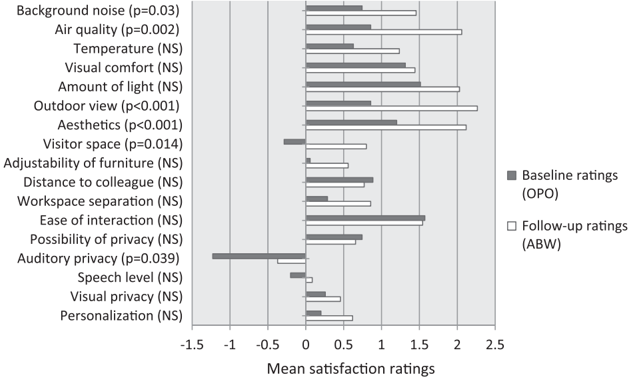
- Satisfaction improved significantly after relocation for background noise, aesthetics, visitor space, outdoor view, and air quality; auditory privacy also improved significantly, though acoustic privacy and speech level remained the lowest-rated physical conditions.
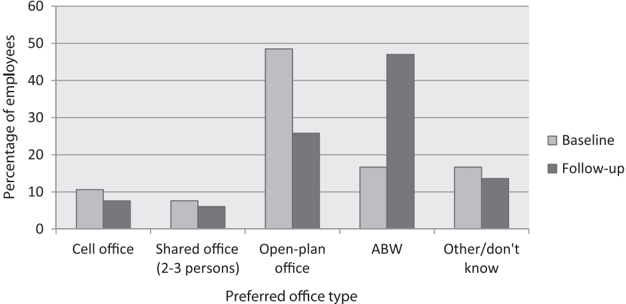
- Overall satisfaction with the physical work environment was significantly more positive than neutral in the ABW (p = 0.013); 47% preferred the ABW after relocation versus 16% before, while preference for the open-plan office dropped from 49% to 26%.
- Perceived performance did not change significantly: retrospective ratings showed no significant change in individual or group efficiency, and 86% reported often or always being productive at their workstation in the ABW.
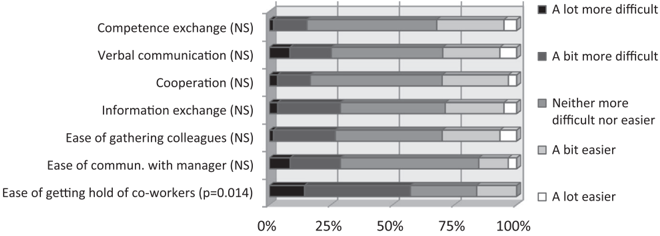
- Negative outcomes included significantly lower satisfaction with getting hold of co-workers (p = 0.014), nesting (28% often or always occupied the same workstation on consecutive days), and an average 7.84 min/person/day spent finding an appropriate workplace (range 0–45 min).
Methods
- Explorative case study at a large Swedish insurance company that relocated two departments from an open-plan office to an ABW in December 2014; the ABW had 64 equipped workstations for 100 relocated workers.
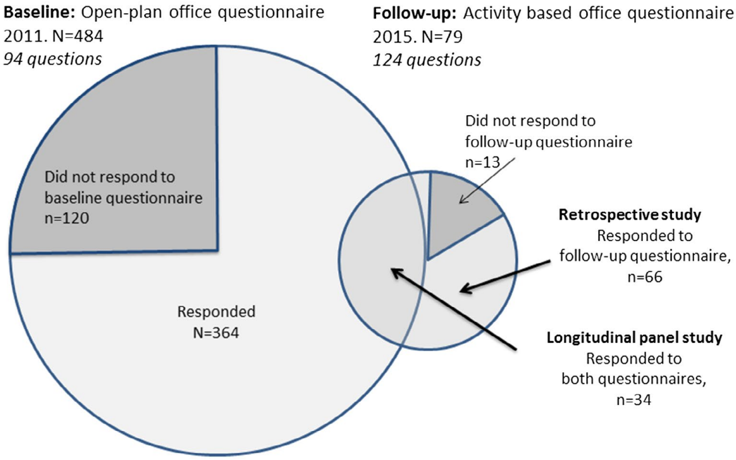
- Mixed methods: pre-relocation baseline questionnaire in 2011 and post-relocation follow-up questionnaire in spring 2015; longitudinal panel n = 34 answered both, retrospective follow-up sample n = 66; plus 3 focus groups (n = 20), 26 individual interviews, and observations.
- Analyses included General Linear Model repeated measures, Wilcoxon signed rank tests, frequency analysis, and qualitative categorisation in QSR Nvivo.
Limitations
- The paper states that the three-year gap between questionnaires led to personnel turnover, limiting response rate and suggesting possible selection bias; only 41 relocated employees had worked at the company at baseline.
- The paper states there were no baseline interviews or observations, so those methods could not be compared over time; the follow-up was only 3 months after relocation, so employees may not have been fully acclimatised.
- The paper states retrospective ratings rely on memory and should be interpreted with caution, and that productivity/performance are difficult to measure, though self-assessed measures are considered reasonable indicators. Evident from the text: this is a single case study in one Swedish insurance company, so generalisability is analytical rather than statistical.
Model-written summary. Check it against the paper before relying on it.
Integrity signals
Registry
Cites
Statistics
Figures



Verification
Claims the paper makes
2 Valid · 0 Not valid · 32 Not checked · 105 Own results and interpretations
The sources with a verdict support this claim; the rest weren’t checked yet, have no full text we could read, or their verdicts aren’t rated yet.
In the paper
“These inconclusive results are consistent with other studies (Meijer, Frings-Dresen, and Sluiter 2009;Wolfeld 2010)”
§ Perceptions of performance and satisfaction after relocation to an activity-based office > 4.3. Perceived performance
What the sources say
- Not checked — no full text of the sourcecites Meijer, Frings-Dresen, and Sluiter 2009 matched to “Effects of office innovation on office workers' health and performance” (2009) source
- Supportedcites Wolfeld 2010
Our copy of Wolfeld (2010) is a study whose central predictions came out null: the RESULTS section states that 'frequency of impromptu interactions does not significantly correlate with productivity, job satisfaction or organizational commitment. Therefore, Hypothesis 1 is not supported,' Hypothesis 3 (visibility) likewise lacked support, and Hypothesis 4 was only 'partially supported.' The limitations paragraph in the DISCUSSION stresses the small sample and notes that 'some of the nonsignificant but higher correlations could be statistically significant,' i.e. the findings are inconclusive rather than settled — so citing it as one of the 'other studies' with inconclusive results is fair. Mild caveat: the paper does report two significant relations (accessibility–interaction frequency r = .631, accessibility–productivity r = .408), but these concern office-layout accessibility, not the interaction–outcome links the citing sentence is about. (LLM, conf=0.80)
plain- Asserted: passes — The authors put it forward as true.
- Checkable: passes — It can be checked against evidence.
- Load-bearing: unclear — It is unclear whether the paper’s conclusions depend on it.
- Based: passes — The paper gives a reason why it holds.
A result the paper reports from its own data — it cites no other source for it, so there is none to check. The quote shows it is in the paper.
In the paper
“Satisfaction with visual privacy (F (1, 34) = 0.48, MSE = 1.47, p = 0.49, 2 p = 0.014) and with the possibility to withdraw to private areas for conversations, phone calls and quiet concentrated work (F (1, 34) = 0.049, MSE = 2.6, p = 0.825, 2 p = 0.001) did not change significantly from”
§ Perceptions of performance and satisfaction after relocation to an activity-based office > 3.3.2. Visual and informative privacy
plain- Asserted: passes — The authors put it forward as true.
- Checkable: passes — It can be checked against evidence.
- Load-bearing: unclear — It is unclear whether the paper’s conclusions depend on it.
- Based: passes — The paper gives a reason why it holds.
A result the paper reports from its own data — it cites no other source for it, so there is none to check. The quote shows it is in the paper.
In the paper
“Results showed that satisfaction with auditory privacy, background noise, air quality, outdoor view and aesthetics increased significantly after relocation.”
- Also stated in: § 3.3.1. Auditory privacy · plain
“and the background noise F (1, 34) = 8.82, MSE = 2.59, p < 0.05, 2 p = 0.21 after the employees relocated to the ABW.”
§ Perceptions of performance and satisfaction after relocation to an activity-based office > Abstract
plainstates a causen = 34 ·- Asserted: passes — The authors put it forward as true.
- Checkable: passes — It can be checked against evidence.
- Load-bearing: passes — The paper’s conclusions depend on it.
- Based: passes — The paper gives a reason why it holds.
- Also stated in: § 3.3.1. Auditory privacy · plain
A result the paper reports from its own data — it cites no other source for it, so there is none to check. The quote shows it is in the paper.
In the paper
“Improvements in aesthetics, freshness and brightness were mentioned most frequently: 'It's always fun with a new and fresh environment' (I-10).”
§ Perceptions of performance and satisfaction after relocation to an activity-based office > 3.1. Change in physical work conditions and office use
plain- Asserted: passes — The authors put it forward as true.
- Checkable: passes — It can be checked against evidence.
- Load-bearing: unclear — It is unclear whether the paper’s conclusions depend on it.
- Based: passes — The paper gives a reason why it holds.
A result the paper reports from its own data — it cites no other source for it, so there is none to check. The quote shows it is in the paper.
In the paper
“The interviewees reported no complaints about the possibility of having confidential conversations.”
§ Perceptions of performance and satisfaction after relocation to an activity-based office > 3.3.2. Visual and informative privacy
plain- Asserted: passes — The authors put it forward as true.
- Checkable: passes — It can be checked against evidence.
- Load-bearing: unclear — It is unclear whether the paper’s conclusions depend on it.
- Based: passes — The paper gives a reason why it holds.
82 more claims
Create a free account to see all 139 claims and to verify the 7 references still open.
- Probably not a substantial claim. 30
- It may state two separate claims as one. 30
Self-check
Percentages, sums and reported differences re-computed from the paper’s own numbers.
Each contradiction between two passages listed here was confirmed by an independent check.
Rated major: it would touch a result — a value a result rests on, reported and recomputed p-values on opposite sides of the significance level, two passages that conflict with no sign which is right, or a cited work retracted before this paper was published.
In the paper
§ Perceptions of performance and satisfaction after relocation to an activity-based office > 3.3.1. Auditory privacy
“the background noise F (1, 34) = 8.82, MSE = 2.59, p < 0.05, 2 p = 0.21”
§ Perceptions of performance and satisfaction after relocation to an activity-based office > 5. Conclusion
“| Background noise | F (1, 34) = 4.63 | 1.93 | 0.03 | 0.12 |”
Citations
Cites
Case Study Research: Design and Methods
Chaiklin, H. (1991) · The Journal of Nervous and Mental Disease · doi:10.1097/00005053-199102000-00025 · Cited by 39,535
(2009) · Cited by 21,330
Męcfal, S. (2012) · University of Lodz Repository (University of Łódź) · Cited by 6,617
Workspace satisfaction: The privacy-communication trade-off in open-plan offices
Kim, J., & de Dear, R. (2013) · Journal of Environmental Psychology · doi:10.1016/j.jenvp.2013.06.007 · Cited by 673
Vischer, J. C. (2007) · Stress and Health · doi:10.1002/smi.1134 · Cited by 488
De Croon, E., Sluiter, J., Kuijer, P. P., & Frings-Dresen, M. (2005) · Ergonomics · doi:10.1080/00140130512331319409 · Cited by 450 · cited 3×
“…are not only affected by physical office features such as temperature, lighting, air quality, office layout and furniture (Brill, Weidemann, and Associates 2001; Sundstrom and Sundstrom 1986), but also by the provision of communication, privacy and territoriality (de Croon et al. 2005).”
BackgroundOpening the black box: Presenting a model for evaluating organizational-level interventions
Nielsen, K., & Randall, R. (2013) · European Journal of Work and Organizational Psychology · doi:10.1080/1359432x.2012.690556 · Cited by 431 · cited 1×
“User involvement decreases misuse of the workplace (cf. Appel-Meulenbroek, Groenen, and Janssen 2011) and supports shared understanding of why it is necessary to implement a change (Nielsen and Randall 2013).”
Background(1986) · Medical Entomology and Zoology · Cited by 406
Traditional versus Open Office Design: A Longitudinal Field Study
Brennan, A., Chugh, J. S., & Kline, T. (2002) · Environment and Behavior · doi:10.1177/0013916502034003001 · Cited by 402
Office Type in Relation to Health, Well-Being, and Job Satisfaction Among Employees
Danielsson, C. B., & Bodin, L. (2008) · Environment and Behavior · doi:10.1177/0013916507307459 · Cited by 363
Office Noise, Satisfaction, and Performance
Sundstrom, E., Town, J. P., Rice, R. W., Osborn, D. P., & Brill, M. (1994) · Environment and Behavior · doi:10.1177/001391659402600204 · Cited by 361 · cited 2×
“…auditory privacy (de Croon et al. 2005; Jahncke and Halin 2012; Jahncke, Hongisto, and Virjonen 2013; Kaarlela-Tuomaala et al. 2009; Kim and de Dear 2013; Sundstrom, Burt, and Kamp 1980; Sundstrom et al. 1994), and reduced confidentiality during communication (Brennan, Chugh, and Kline 2002).”
BackgroundPrivacy at Work: Architectural Correlates of Job Satisfaction and Job Performance.
Sundstrom, E., Burt, R. E., & Kamp, D. (1980) · Academy of Management Journal · doi:10.2307/255498 · Cited by 350 · cited 2×
“…auditory privacy (de Croon et al. 2005; Jahncke and Halin 2012; Jahncke, Hongisto, and Virjonen 2013; Kaarlela-Tuomaala et al. 2009; Kim and de Dear 2013; Sundstrom, Burt, and Kamp 1980; Sundstrom et al. 1994), and reduced confidentiality during communication (Brennan, Chugh, and Kline 2002).”
BackgroundProductivity and employee satisfaction in flexible workplaces
van der Voordt, T. J. M. (2004) · Journal of Corporate Real Estate · doi:10.1108/14630010410812306 · Cited by 309 · cited 5×
“…caused unnecessary movement and searches of colleagues, which decreased the communication benefits, perceived performance and satisfaction. van der Voordt (2004) has emphasised the importance of allocating workstations properly to avoid a mix of colleagues with jobs that have little in common.”
BackgroundMethodInfluentialKaarlela-Tuomaala, A., Helenius, R., Keskinen, E., & Hongisto, V. (2009) · Ergonomics · doi:10.1080/00140130903154579 · Cited by 302 · cited 2×
“The reasons included reduced auditory privacy (de Croon et al. 2005; Jahncke and Halin 2012; Jahncke, Hongisto, and Virjonen 2013; Kaarlela-Tuomaala et al. 2009; Kim and de Dear 2013; Sundstrom, Burt, and Kamp 1980; Sundstrom et al. 1994), and reduced confidentiality during communication (Brennan,…”
Background寺口, 季. (2017) · Institutional Repositories DataBase (IRDB) · doi:10.18910/60462 · Cited by 281
Disruption of office‐related tasks by speech and office noise
Banbury, S., & Berry, D. C. (1998) · British Journal of Psychology · doi:10.1111/j.2044-8295.1998.tb02699.x · Cited by 270 · cited 4×
“The presence of background noise can result in 2–12% drops in performance (Jahncke, Hongisto, and Virjonen 2013), and up to 66% decrease in productivity (Banbury and Berry 1998).”
BackgroundResultInfluentialAn end‐user's perspective on activity‐based office concepts
Appel‐Meulenbroek, R., Groenen, P., & Janssen, I. (2011) · Journal of Corporate Real Estate · doi:10.1108/14630011111136830 · Cited by 268 · cited 15×
“Practitioner Summary: Activity-based workplaces (ABWs) are commonly implemented although their effects on performance and well-being are unclear.”
BackgroundResultInfluentialThe influence of office type on satisfaction and perceived productivity support
De Been, I., & Beijer, M. (2014) · Journal of Facilities Management · doi:10.1108/jfm-02-2013-0011 · Cited by 250
Team member proximity and teamwork in innovative projects
Hoegl, M., & Proserpio, L. (2004) · Research Policy · doi:10.1016/j.respol.2004.06.005 · Cited by 225
Wohlers, C., & Hertel, G. (2017) · Ergonomics · doi:10.1080/00140139.2016.1188220 · Cited by 223 · cited 5×
“Time loss due to additional activities related to hot-desking was found to decrease employees’ perceived performance and is in line with findings from de Been, Beijer, and den Hollander (2015) and Wohlers and Hertel (2016).”
BackgroundResultInfluentialAccommodating new ways of working: lessons from best practices and worst cases
Brunia, S., De Been, I., & van der Voordt, T. J. M. (2016) · Journal of Corporate Real Estate · doi:10.1108/jcre-10-2015-0028 · Cited by 192
The Physical Environment of the Office: Contemporary and Emerging Issues
Davis, M. C., Leach, D. J., & Clegg, C. W. (2011) · International Review of Industrial and Organizational Psychology 2011 · doi:10.1002/9781119992592.ch6 · Cited by 185 · cited 1×
“The organisation’s motivation for changing office type as well as planning process was similar to other organisations (Davis, Leach, and Clegg 2011; Toivanen 2015; Van Meel, Martens, and van Ree 2010).”
ResultTEAM MEMBER PROXIMITY AND TEAMWORK IN INNOVATIVE PROJECTS.
HOEGL, M., & PROSERPIO, L. (2004) · Academy of Management Proceedings · doi:10.5465/ambpp.2004.13857778 · Cited by 174
A model predicting the effect of speech of varying intelligibility on work performance
Hongisto, V. (2005) · Indoor Air · doi:10.1111/j.1600-0668.2005.00391.x · Cited by 171
Disproving Widespread Myths about Workplace Design
Inalhan, G. (2003) · Facilities · doi:10.1108/f.2003.06921aae.003 · Cited by 158
The impact of office layout on productivity
Haynes, B. P. (2008) · Journal of Facilities Management · doi:10.1108/14725960810885961 · Cited by 143
The Physical Environment of the Office: Contemporary and Emerging Issues
Davis, M. C., Leach, D. J., & Clegg, C. W. (2012) · Wiley eBooks · doi:10.1002/9781118311141.ch6 · Cited by 137
Concentration requirements modify the effect of office type on indicators of health and performance
Seddigh, A., Berntson, E., Bodin Danielson, C., & Westerlund, H. (2014) · Journal of Environmental Psychology · doi:10.1016/j.jenvp.2014.01.009 · Cited by 130 · cited 3×
“performance by Seddigh et al. (2014) found that there are”
BackgroundResultEffects of new ways of working on work hours and work location, health and job-related outcomes
Nijp, H. H., Beckers, D. G. J., van de Voorde, K., Geurts, S. A. E., & Kompier, M. A. J. (2016) · Chronobiology International · doi:10.3109/07420528.2016.1167731 · Cited by 121 · cited 1×
“However, few studies have examined whether this concept actually promotes these positive work condition consequences (van der Voordt 2004) and the results are inconsistent (de Been and Beijer 2014; Gorgievski et al. 2010; Nijp et al. 2016).”
BackgroundCase studies and generalizability: grounded theory and research in science education
Taber, K. S. (2000) · International Journal of Science Education · doi:10.1080/095006900289732 · Cited by 121 · cited 1×
“The strength of a case study is that it provides insights of wider value (Taber, 2010).”
BackgroundTomorrow’s offices through today’s eyes: Effects of innovation in the working environment
Vos, P., & van der Voordt, T. (2002) · Journal of Corporate Real Estate · doi:10.1108/14630010210811778 · Cited by 99
After the fire: New ways of working in an academic setting
Gorgievski, M. J., van der Voordt, T. J. M., van Herpen, S. G. A., & van Akkeren, S. (2010) · Facilities · doi:10.1108/02632771011023159 · Cited by 98 · cited 3×
“This study, in accordance with several other studies (Danielsson and Bodin 2008; Gorgievski et al. 2010; Lansdale et al. 2011; Vos and van der Voordt 2002) showed that overall satisfaction increased in the ABW.”
BackgroundResultJahncke, H., Hongisto, V., & Virjonen, P. (2013) · Applied Acoustics · doi:10.1016/j.apacoust.2012.08.007 · Cited by 95
Self-citationPersonalization in non‐territorial offices: a study of a human need
Brunia, S., & Hartjes‐Gosselink, A. (2009) · Journal of Corporate Real Estate · doi:10.1108/14630010910985922 · Cited by 93 · cited 1×
“Nesting tendencies have also been found by Brunia and Hartjes-Gosselink (2009).”
BackgroundEffects of office innovation on office workers' health and performance
Meijer, E. M., Frings-Dresen, M. H. W., & Sluiter, J. K. (2009) · Ergonomics · doi:10.1080/00140130902842752 · Cited by 88
Jahncke, H., & Halin, N. (2012) · Noise and Health · doi:10.4103/1463-1741.102966 · Cited by 83
Self-citationDesigning for interaction in research environments: A case study
Lansdale, M., Parkin, J., Austin, S., & Baguley, T. (2011) · Journal of Environmental Psychology · doi:10.1016/j.jenvp.2011.05.006 · Cited by 49 · cited 2×
“This study, in accordance with several other studies (Danielsson and Bodin 2008; Gorgievski et al. 2010; Lansdale et al. 2011; Vos and van der Voordt 2002) showed that overall satisfaction increased in the ABW.”
BackgroundResult(2010) · Cited by 41
How flexible workplace strategies can be made successful at the operational level
Van Koetsveld, R., & Kamperman, L. (2011) · Corporate Real Estate Journal · doi:10.69554/lhxi3919 · Cited by 36
To use or not to use: which type of property should you choose?
Appel‐Meulenbroek, R., Kemperman, A. D. A. M., Kleijn, M., & Hendriks, E. H. E. (2015) · Journal of Property Investment and Finance · doi:10.1108/jpif-09-2014-0059 · Cited by 35 · cited 1×
“The fact that a high people-to-workstation ratio lowers support for work processes and reduces satisfaction and performance is in line with the findings of Wohlers and Hertel (2016) and Appel-Meulenbroek et al. (2015).”
Result(2010) · W&M Publish (College of William & Mary) · Cited by 16
Evaluation of Flexible Offices
Brunnberg, H. (2000) · Proceedings of the Human Factors and Ergonomics Society Annual Meeting · doi:10.1177/154193120004400634 · Cited by 13 · cited 3×
“The reasons for implementing new office concepts include reducing overhead costs, saving space and increasing flexibility in office use (Appel-Meulenbroek, Groenen, and Janssen 2011; de Been and Beijer 2014; Brunnberg 2000).”
Background(2015) · Cited by 4
Qualitative Research: Designing, Implementing, and Publishing a Study
Merriam, S. B. (2018) · Advances in Library and Information Science · doi:10.4018/978-1-5225-7730-0.ch001 · Cited by 3
Levine, J. A. (2015) · Clark Digital Commons (Clark University) · Cited by 1
To use or not to use: which type of property should you choose?
Appel-Meulenbroek, R., Kemperman, A., Kleijn, M., & Hendriks, E. (2015) · RePEc: Research Papers in Economics · doi:10.1108/jpif-09-2014-0059/full/html?utm_source=repec&utm_medium=feed&utm_campaign=repec
Case Studies and Generalizability: Grounded Theory and Research in Science Education
Taber, K., & Taber, K. S. (n.d.) · Case Studies · doi:10.4135/9781473915480.n20
Research works printed but not linked: 4
- Alker, J., M. Malanca, C. Pottage, R. O'Brien, D. Akhras, B. Ambrose, and J. Wong. 2015. "Health, Wellbeing and Productivity in Offices. " In World Green Building Council. http://www. worldgbc.org/activities/health-wellbeing-productivity- offices/research. Ways of Working in an Academic Setting. " Facilities 28 (3/4): 206-224.
- de Been, Iris, Marion Beijer, and Dorieke den Hollander. 2015. "How to Cope with Dilemmas in Activity Based Work Environments: Results from User-centred research. " In conference paper 14th Euro FM Research Symposium. Euro FM research papers.
- 10.1111/ina.2005.15.issue-6 · DOI
- Rolfö, Linda, and Jörgen Eklund. 2015. "Examining Office Type Preference. " Paper presented at the Nordic Ergonomics Society 47th Annual Conference, Lillehammer, Norway.
Cited by
The COVID-19 office in transition: cost, efficiency and the social responsibility business case
Parker, L. D. (2020) · Accounting, Auditing & Accountability Journal · doi:10.1108/aaaj-06-2020-4609 · Cited by 190
Designing activity-based workspaces: satisfaction, productivity and physical activity
Cândido, C., Thomas, L., Haddad, S., Zhang, F., Mackey, M., & Ye, W. (2018) · Building Research & Information · doi:10.1080/09613218.2018.1476372 · Cited by 150
“When workers’ satisfaction after relocation to an activity-based office from an open-plan working environment were examined, Rolfö, Eklund, and Jahncke (2018) found a higher rate of satisfaction with auditory privacy, background noise, air quality, outdoor view and aesthetics.”
BackgroundHaapakangas, A., Hallman, D., Mathiassen, S. E., & Jahncke, H. (2018) · Building and Environment · doi:10.1016/j.buildenv.2018.09.017 · Cited by 160
Self-citationRelocation to an activity-based flexible office – Design processes and outcomes
Rolfö, L. (2018) · Applied Ergonomics · doi:10.1016/j.apergo.2018.05.017 · Cited by 112
Self-citationLongitudinal Effects of Activity-Based Flexible Office Design on Teamwork
Wohlers, C., & Hertel, G. (2018) · Frontiers in Psychology · doi:10.3389/fpsyg.2018.02016 · Cited by 73
Metadata
- Authors
- Rolfö, L., Eklund, J., & Jahncke, H.
- Affiliations
- KTH Royal Institute of Technology (SE)
- Unit of Ergonomics, School of Technology and Health, KTH, Stockholm, Sweden
- University of Gävle (SE)
- Corresponding author
- Rolfö, Linda
- Venue
- Ergonomics
- Publisher
- Informa UK Limited
- Published
- 2017-11-16
- Volume
- 61
- Issue
- 5
- Pages
- 644-657
- ISSN
- 0014-0139 (ISSN-L)
- 1366-5847
- OpenAlex
- W2770933381
- Semantic Scholar
- 841e8378525993be7be2854ac5157cb8a9ee3964
- Cited by
- 121
- References
- 45
- Citations by year
- 2026: 8 · 2025: 11 · 2024: 13 · 2023: 13 · 2022: 29 · 2021: 16 · 2020: 14 · 2019: 8 · 2018: 9
- FWCI
- 12.14
- Type
- journal article
- Language
- en
- Open access
- hybrid
- doi.org
- Licence
- Locations
- Ergonomics (publishedVersion, cc-by-nc-nd)
- PubMed (publishedVersion)
- Diva portal (Dalarna University Library) (submittedVersion, other-oa)
- KTH Publication Database DiVA (KTH Royal Institute of Technology) (submittedVersion, other-oa)
- Funders
- AFA Försäkring (130200)
- Topics
- Physical Sciences › Engineering › Architecture › Facilities and Workplace Management
- Social Sciences › Education › Educational Environments and Student Outcomes
- Physical Sciences › Engineering › Building and Construction › Building Energy and Comfort Optimization
- Keywords
- open-plan offices, office relocation, job satisfaction, perceived performance, background noise, air quality, outdoor views, workplace communication, territoriality, office space planning, work environment
- MeSH terms
- Work Performance, Adult, Environment, Female, Humans, Interprofessional Relations, Job Satisfaction, Male, Middle Aged, Noise, Occupational, Organizational Innovation, Surveys and Questionnaires, Sweden, Organizational Culture, Linear Models, Workplace, Privacy, Organizational Case Studies
About these checks
Registry, retraction, Cites and statistics results are computed, not judged, with one exception: a printed reference that no index lists is read once by a model before it counts as a citation error. Claims are extracted by a model and kept only when their quote appears verbatim in the text; each cited source is then checked, with a model’s help, for whether it says what the claim relies on. Those verdicts can be wrong — read the claim’s quote and the cited source before relying on one.
A language model drew the claims from the paper on 2026-10-10, under version 3 of the claim definition (model deepseek-v4.1-flash, prompt extract-v3).
A second model labelled each claim on 2026-10-10 (model jev-1.13-20260917, definition revision gold-guideline-v0.2).
Cited sources are checked with a language model’s help (qwen3.8-omni-flash).
Statistics and arithmetic are recomputed, not judged.
Confidence bands are shown only for fields calibrated on our annotated test set. None is calibrated yet, so no band is shown.
What counts as a claim ›How we measure confidence ›How we check this ›
Are you an author, or do you see a problem with this page? Request a review
Data sources
Bibliographic data: Semantic Scholar, OpenAlex, Crossref.
Contains information from the Semantic Scholar Academic Graph Datasets, made available under the ODC Attribution License (ODC-BY 1.0).
Semantic Scholar’s data is described in: Kinney, R., et al. (2023). The Semantic Scholar Open Data Platform. arXiv:2301.10140.
