

The DOI matches its Crossref record; 81 of the 81 references it cites were found in a registry or an index.
Virtues of mentors and mentees in the Finnish model of teachers' peer-group mentoring
Open accessAbstract
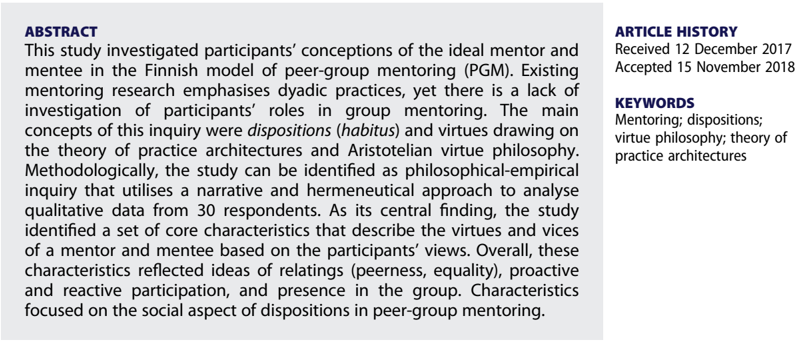
This study investigated participants’ conceptions of the ideal mentor and mentee in the Finnish model of peer-group mentoring (PGM). Existing mentoring research emphasises dyadic practices, yet there is a lack of investigation of participants’ roles in group mentoring. The main concepts of this inquiry were dispositions (habitus) and virtues drawing on the theory of practice architectures and Aristotelian virtue philosophy. Methodologically, the study can be identified as philosophical-empirical inquiry that utilises a narrative and hermeneutical approach to analyse qualitative data from 30 respondents. As its central finding, the study identified a set of core characteristics that describe the virtues and vices of a mentor and mentee based on the participants’ views. Overall, these characteristics reflected ideas of relatings (peerness, equality), proactive and reactive participation, and presence in the group. Characteristics focused on the social aspect of dispositions in peer-group mentoring.
Overview
The claims and statistics of this paper haven’t been checked yet.
Run the check — free, no account needed. It reads the open-access text and checks the sources it cites.
Integrity signals
Registry
Cites
Statistics
Figures



Verification
Claims the paper makes
The claims and statistics of this paper haven’t been checked yet.
Run the check — free, no account needed. It reads the open-access text and checks the sources it cites.
Claims other papers make about this one
Each is checked against this paper’s own text: does it say what the citing paper says it does?
The cited source says what the claim attributes to it.
In the citing paper
“Mentoring, according to Pennanen et al. (2020), is a global and widely applied method of professional development.”
From The Impact of Mentoring in the Development of Pre-Service Teachers from a University in South Africa (2021) · cites this paper as Pennanen et al. (2020)
Self-check
Percentages, sums and reported differences re-computed from the paper’s own numbers.
The self-check needs the paper’s full text.
Citations
Cites
Bourdieu, P. (1990) · doi:10.1515/9781503621749 · Cited by 17,271
After Virtue: A Study in Moral Theory
Burrell, D. B., & MacIntyre, A. (1984) · Journal of Law and Religion · doi:10.2307/1051043 · Cited by 3,572
Becoming Critical: Education, Knowledge, and Action Research
Newsome, G. L., Carr, W., & Kemmis, S. (1988) · Canadian Journal of Education / Revue canadienne de l éducation · doi:10.2307/1495177 · Cited by 3,449
38. After Virtue: A Study in Moral Theory
MacIntyre, A. (2015) · Princeton University Press eBooks · doi:10.1515/9781400848393-039 · Cited by 3,338
Practical Reason: On the Theory of Action
Bowen, J. R. (1999) · American Anthropologist · doi:10.1525/aa.1999.101.4.876 · Cited by 2,840
Practical Reason: On the Theory of Action
Bourdıeu, P. (1998) · Cited by 2,291
Phases of the Mentor Relationship
Kram, K. E. (1983) · Academy of Management Journal · doi:10.2307/255910 · Cited by 2,199
MENTORING ALTERNATIVES: THE ROLE OF PEER RELATIONSHIPS IN CAREER DEVELOPMENT.
Kram, K. E., & Isabella, L. A. (1985) · Academy of Management Journal · doi:10.2307/256064 · Cited by 1,739
Becoming Critical: Education. Knowledge and Action Research
Benson, G. (2018) · Journal of educational thought. · doi:10.55016/ojs/jet.v23i3.52878 · Cited by 1,550
Outline of a Theory of Practice
Bourdıeu, P. (2020) · Routledge eBooks · doi:10.4324/9781003060963-11 · Cited by 1,249
Research works printed but not linked: 8
- Aspfors J., 2012, Peer-group mentoring for teacher development, 144
- Hiltula A., 2012, Peer-group mentoring for teacher development, 60
- Kemmis S., 2008, Enabling praxis, 10.1163/9789087903275 · DOI
- Lane S., 2003, Teacher Education Quarterly, 30, 55
- Lejonberg E., 2015, International Journal of Evidence Based Coaching and Mentoring, 13, 45
- Levinson D., 1978, The seasons of a man’s life
- Moilanen P., 2002, Narrative research: Voices of teachers and philosophers, 91
- 10.1080/13611267.2011.622081 · DOI
Cited by
Nascimento, L., Correia, M. F., & Califf, C. B. (2023) · Technology in Society · doi:10.1016/j.techsoc.2023.102428 · Cited by 107
Finnish model of peer‐group mentoring: review of research
Tynjälä, P., Pennanen, M., Markkanen, I., & Heikkinen, H. L. T. (2019) · Annals of the New York Academy of Sciences · doi:10.1111/nyas.14296 · Cited by 75
Self-citationInternational perspectives on teacher induction: A systematic review
Courtney, S. A., Austin, C. K., & Zolfaghari, M. (2023) · Teaching and Teacher Education · doi:10.1016/j.tate.2023.104047 · Cited by 43
Kaplan, H. (2022) · Frontiers in Psychology · doi:10.3389/fpsyg.2022.859364 · Cited by 41
Research Integrity Supervision Practices and Institutional Support: A Qualitative Study
Pizzolato, D., & Dierickx, K. (2022) · Journal of Academic Ethics · doi:10.1007/s10805-022-09468-y · Cited by 40
Metadata
- Authors
- Pennanen, M., Heikkinen, H. L. T., & Tynjälä, P.
- Affiliations
- University of Jyväskylä (FI)
- Corresponding author
- Pennanen, Matti
- Venue
- Scandinavian Journal of Educational Research
- Publisher
- Informa UK Limited
- Published
- 2018-12-20
- Volume
- 64
- Issue
- 3
- Pages
- 355-371
- ISSN
- 0031-3831 (ISSN-L)
- 1470-1170
- OpenAlex
- W2906189831
- Cited by
- 48
- References
- 81
- Citations by year
- 2026: 6 · 2025: 6 · 2024: 5 · 2023: 9 · 2022: 8 · 2021: 8 · 2020: 4 · 2019: 1 · 2018: 1
- FWCI
- 11.35
- Type
- journal article
- Language
- en
- Open access
- hybrid
- doi.org
- Licence
- Locations
- Scandinavian Journal of Educational Research (publishedVersion, cc-by-nc-nd)
- Jyväskylä University Digital Archive (University of Jyväskylä) (submittedVersion, cc-by-nc-nd)
- Griffith Research Online (submittedVersion, cc-by-nc-nd)
- Funders
- Charles Sturt University
- Topics
- Social Sciences › Education › Teacher Education and Leadership Studies
- Social Sciences › Education › Mentoring and Academic Development
- Social Sciences › Arts and Humanities › Philosophy › Education, Philosophy, and Society
- Keywords
- peer group mentoring, teacher mentoring, virtue, dispositions, habitus, Aristotelian virtue ethics, practice architectures, peer relationships
About these checks
Registry, retraction, Cites and statistics results are computed, not judged, with one exception: a printed reference that no index lists is read once by a model before it counts as a citation error. Claims are extracted by a model and kept only when their quote appears verbatim in the text; each cited source is then checked, with a model’s help, for whether it says what the claim relies on. Those verdicts can be wrong — read the claim’s quote and the cited source before relying on one.
Statistics and arithmetic are recomputed, not judged.
Confidence bands are shown only for fields calibrated on our annotated test set. None is calibrated yet, so no band is shown.
What counts as a claim ›How we measure confidence ›How we check this ›
Are you an author, or do you see a problem with this page? Request a review
How to cite
Cite CoChat for the checks on this page, and the paper for its own findings.
- This page
- CoChat. (2026). Citation check: Virtues of mentors and mentees in the Finnish model of teachers' peer-group mentoring. https://app.cochat.ai/papers/10.1080/00313831.2018.1554601
- The paper
- Pennanen, M., Heikkinen, H. L. T., & Tynjälä, P. (2020). Virtues of mentors and mentees in the Finnish model of teachers' peer-group mentoring. Scandinavian Journal of Educational Research. https://doi.org/10.1080/00313831.2018.1554601
