

Demographic models of the reproductive process: Past, interlude, and future
Open accessThe DOI matches its Crossref record; 53 of the 53 references it cites were found in a registry or an index.
Abstract
After 30 years of active development, mechanistic models of the reproductive process nearly stopped attracting scholarly interest in the early 1980s. In the following decades, fertility research continued to thrive, relying on solid descriptive work and detailed analysis of micro-level data. The absence of systematic modelling efforts, however, has also made the field more fragmented, with empirical research, theory building, and forecasting advancing along largely disconnected channels. In this paper we outline some of the drivers of this process, from the popularization of user-friendly statistical software to the limitations of early family building models. We then describe a series of developments in computational modelling and statistical computing that can contribute to the emergence of a new generation of mechanistic models. Finally, we introduce a concrete example of this new kind of model, and show how they can be used to formulate and test theories coherently and make informed projections.
Overview
The claims and statistics of this paper haven’t been checked yet.
Free: it reads the open-access text and checks the first 5 claims that cite a source we can check. Create a free account to check every claim.
Integrity signals
Registry
Cites
Statistics
Figures



Verification
Claims the paper makes
The claims and statistics of this paper haven’t been checked yet.
Free: it reads the open-access text and checks the first 5 claims that cite a source we can check. Create a free account to check every claim.
Self-check
Percentages, sums and reported differences re-computed from the paper’s own numbers.
The self-check needs the paper’s full text.
Citations
Cites
Regression Models and Life-Tables
Cox, D. R. (1972) · Journal of the Royal Statistical Society Series B: Statistical Methodology · doi:10.1111/j.2517-6161.1972.tb00899.x · Cited by 39,793
Dynamic models of segregation†
Schelling, T. C. (1971) · The Journal of Mathematical Sociology · doi:10.1080/0022250x.1971.9989794 · Cited by 4,915
Theory of Modeling and Simulation
(2019) · Elsevier eBooks · doi:10.1016/c2016-0-03987-6 · Cited by 2,914
Europe's second demographic transition.
van de Kaa, D. J. (1987) · PubMed · Cited by 1,935
Approximate Bayesian Computation in Evolution and Ecology
Beaumont, M. A. (2010) · Annual Review of Ecology, Evolution, and Systematics · doi:10.1146/annurev-ecolsys-102209-144621 · Cited by 1,114 · cited 1×
“The first ABC algorithm was introduced in population genetics two decades ago (see Beaumont 2010, 2019).”
MethodFertility, Biology, and Behavior: An Analysis of the Proximate Determinants
Bongaarts, J., & Potter, R. G. (1984) · Studies in Family Planning · doi:10.2307/1965489 · Cited by 585
Changes with age in the level and duration of fertility in the menstrual cycle
Dunson, D. B. (2002) · Human Reproduction · doi:10.1093/humrep/17.5.1399 · Cited by 574
Leridon, H. (2004) · Human Reproduction · doi:10.1093/humrep/deh304 · Cited by 507 · cited 1×
“This corresponds to a monthly fecundability of 0.20 ( = 1−e−ϕ), a value consistent with those reported in the literature for non-contracepting young couples (Bongaarts and Potter 1983; Leridon 2004).”
ResultInfluentialModel Fertility Schedules: Variations in The Age Structure of Childbearing in Human Populations
Coale, A. J., & Trussell, T. J. (1974) · Population Index · doi:10.2307/2733910 · Cited by 428
(1987) · Population · doi:10.3917/popu.p1987.42n1.0005 · Cited by 386
Statistical inference for stochastic simulation models - theory and application
Hartig, F., Calabrese, J. M., Reineking, B., Wiegand, T., & Huth, A. (2011) · Ecology Letters · doi:10.1111/j.1461-0248.2011.01640.x · Cited by 384 · cited 1×
“By providing a framework for parameter estimation, model selection, and uncertainty estimation in complex simulation models, they have allowed researchers to tackle a number of problems that previously remained out of reach (Hartig et al. 2011).”
MethodTwo Is Best? The Persistence of a Two‐Child Family Ideal in Europe
Sobotka, T., & Beaujouan, É. (2014) · Population and Development Review · doi:10.1111/j.1728-4457.2014.00691.x · Cited by 348 · cited 2×
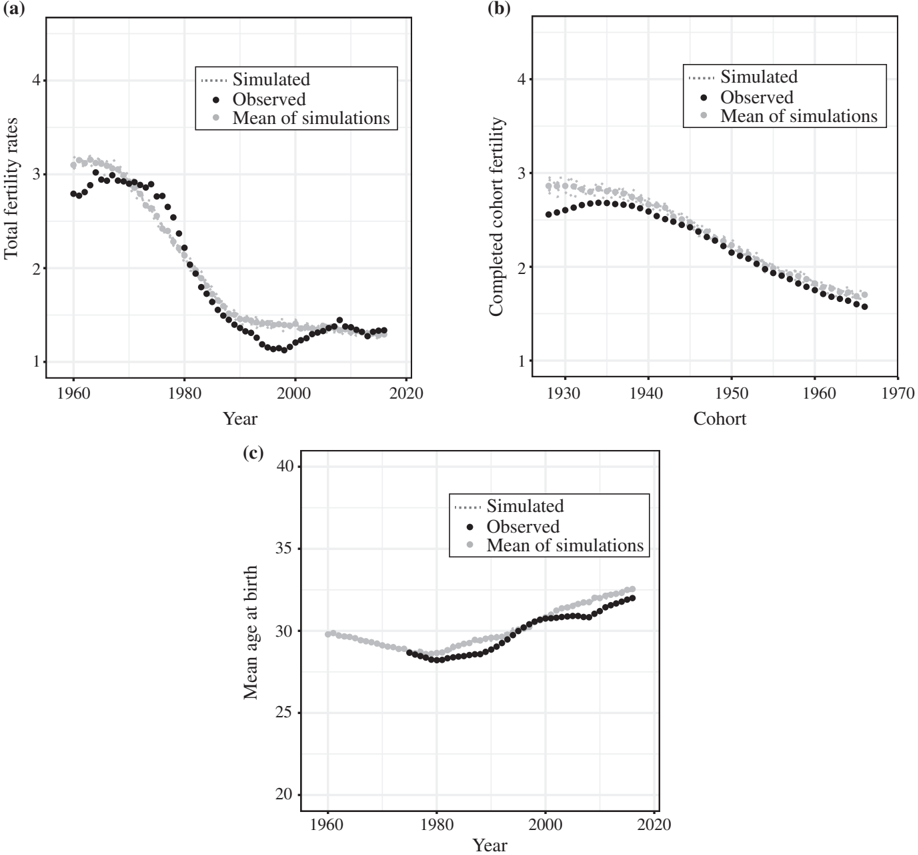
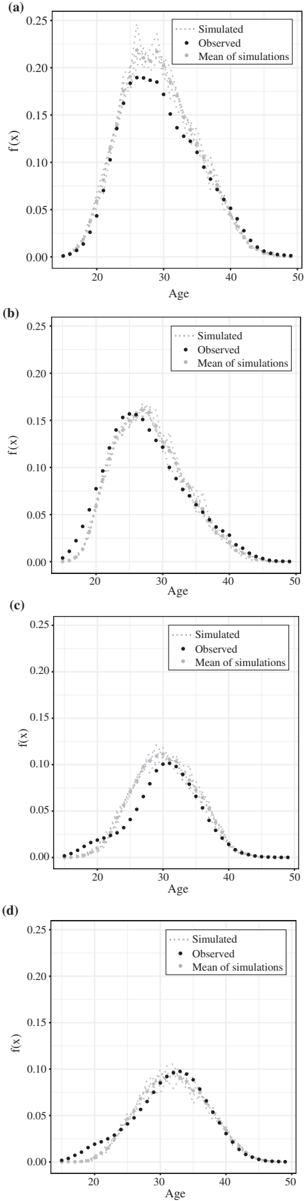
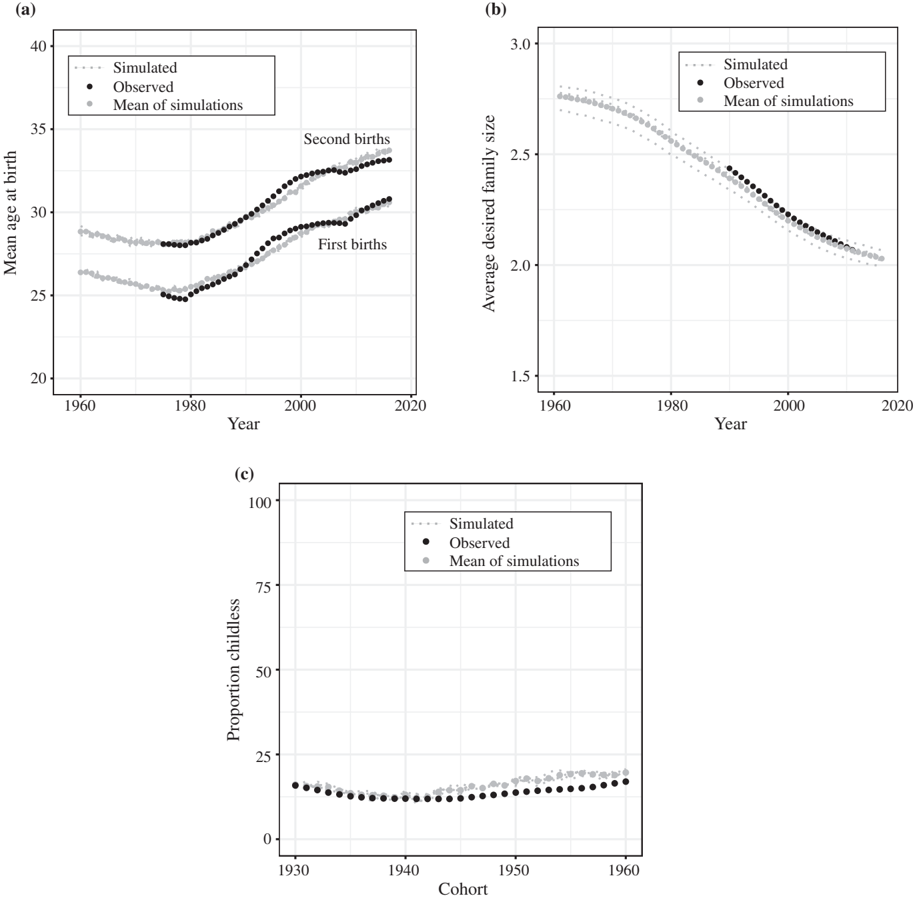
“Source: Simulated data by authors; observed data from: (a) Human Fertility Database; (b) Sobotka and Beaujouan (2014); (c) Esteve et al. (2016).”
BackgroundMethodA New Type of Socio-Economic System
Orcutt, G. H. (1957) · The Review of Economics and Statistics · doi:10.2307/1928528 · Cited by 320
The checkerboard model of social interaction
Sakoda, J. M. (1971) · The Journal of Mathematical Sociology · doi:10.1080/0022250x.1971.9989791 · Cited by 253 · cited 1×
“By allowing the cells/agents to move within the grid/city, the models published first by Sakoda (1971) and shortly after by Schelling (1971) gave rise to the emergence of a newmodelling tradition (see Hegselmann et al. 2017 for a historical perspective on the development and fortunes of these two…”
BackgroundBayesian Optimization for Likelihood-Free Inference of Simulator-Based Statistical Models
Gutmann, M. U., & Corander, J. (2015) · arXiv (Cornell University) · doi:10.48550/arxiv.1501.03291 · Cited by 208
Approximate Bayesian Computation
Beaumont, M. A. (2019) · Annual Review of Statistics and Its Application · doi:10.1146/annurev-statistics-030718-105212 · Cited by 183 · cited 1×
“The first ABC algorithm was introduced in population genetics two decades ago (see Beaumont 2010, 2019).”
MethodOld and New Methods in Historical Demography.
McNicoll, G., Reher, D. S., & Schofield, R. (1994) · Population and Development Review · doi:10.2307/2137622 · Cited by 164
Process, Mechanism, and Modeling in Macroecology
Connolly, S. R., Keith, S. A., Colwell, R. K., & Rahbek, C. (2017) · Trends in Ecology & Evolution · doi:10.1016/j.tree.2017.08.011 · Cited by 164
Daily Fecundability: First Results from a New Data Base
Colombo, B., & Masarotto, G. (2000) · Demographic Research · doi:10.4054/demres.2000.3.5 · Cited by 162
Billari, F. C., & Prskawetz, A. (2003) · Contributions to economics · doi:10.1007/978-3-7908-2715-6 · Cited by 146
Human Reproduction: A Stochastic Process
Perrin, E. B., & Sheps, M. C. (1964) · Biometrics · doi:10.2307/2527616 · Cited by 134
Mathematical Models of Conception and Birth.
Cohen, J. E., Sheps, M. C., & MENKEN, J. A. (1974) · Journal of the American Statistical Association · doi:10.2307/2286189 · Cited by 124 · cited 3×
“This line of research was developed in the 1950s and 1960s by a community of researchers who drew from an array of mathematical techniques, notably stochastic process theory (Brass 1958; Singh 1963; Perrin and Sheps 1964; Potter and Sakoda 1966; Henry 1972; Sheps et al. 1973; Singh et al. 1974).”
BackgroundThomas C. Schelling and James M. Sakoda: The Intellectual, Technical, and Social History of a Model
Hegselmann, R. (2017) · Journal of Artificial Societies and Social Simulation · doi:10.18564/jasss.3511 · Cited by 104
Stochastic Processes in Demography and Their Computer Implementation
Mode, C. J. (1985) · Biomathematics · doi:10.1007/978-3-642-82322-0 · Cited by 86 · cited 1×
“We follow previous studies that have successfully approached the empirical distribution in age at marriage using the log-normal distribution (Mode 1985), where: ln (Mi) N(mi, s2) (7) with µi= yi + ξ, where yi is the number of years of education of woman i, and parameter ξ is the average waiting…”
MethodThe Development and Use of Demographic Models
Coale, A. J., & Trussell, J. (1996) · Population Studies · doi:10.1080/0032472031000149576 · Cited by 82 · cited 1×
“…to have been the increasing availability of survey and census microdata, which, combined with new statistical methods and the spread of user-friendly software implementing these methods, radically changed the structure of incentives in academic research (Coale and Trussell 1996; Burch 2018).”
MethodNew Frontiers in Microsimulation Modelling
Zaidi, M. A., Harding, A., & Williamson, P. R. (2009) · Cited by 79
Fondements théoriques des mesures de la fécondité naturelle
Henry, L. (1953) · Revue de l Institut International de Statistique / Review of the International Statistical Institute · doi:10.2307/1401425 · Cited by 78 · cited 1×
“Henry defined this notion as the ‘fertility of a human population that makes no deliberate effort to limit births’ (Henry 1953, p. 135).”
BackgroundThe Distribution of Births in Human Populations
Brass, W. (1958) · Population Studies · doi:10.2307/2172212 · Cited by 73
Transition to Parenthood: The Role of Social Interaction and Endogenous Networks
Diaz, B. A., Fent, T., Prskawetz, A., & Bernardi, L. (2011) · Demography · doi:10.1007/s13524-011-0023-6 · Cited by 71
Demography: Past, Present, and Future
Xie, Y. (2000) · Journal of the American Statistical Association · doi:10.1080/01621459.2000.10474248 · Cited by 66 · cited 1×
“Xie (2000) described the influence of the groundbreaking work of Cox (1972) in demography as representing ‘a shift in methodological orientation toward statistical demography […] with attention paid primarily to group differences or the effects of covariates’ (Xie 2000, p. 671).”
BackgroundAn analytic simulation model of human reproduction with demographic and biological components
Ridley, J. C., & Sheps, M. C. (1966) · Population Studies · doi:10.1080/00324728.1966.10406018 · Cited by 64
Multistate Analysis of Life Histories with R
Willekens, F. (2014) · Use R! · doi:10.1007/978-3-319-08383-4 · Cited by 60 · cited 1×
“In demography, this usually took the form of transition probabilities obtained from survival or multistate models, which were later used as inputs in microsimulation models representing a given sequence of events (Willekens 2009, 2014).”
MethodBillari, F. C., Prskawetz, A., & Fent, T. (2006) · Digital Access to Libraries (Université catholique de Louvain (UCL), l'Université de Namur (UNamur) and the Université Saint-Louis (USL-B)) · doi:10.1007/3-7908-1721-x · Cited by 56
Multistate modelling extended by behavioural rules: An application to migration
Klabunde, A., Zinn, S., Willekens, F., & Leuchter, M. (2017) · Population Studies · doi:10.1080/00324728.2017.1350281 · Cited by 52 · cited 1×
“For example, Klabunde et al. (2017) successfully extended a classic multistate model with behavioural rules to explain migration patterns.”
BackgroundFamily policies in the context of low fertility and social structure
Fent, T., Aparicio Diaz, B., & Prskawetz, A. (2013) · Demographic Research · doi:10.4054/demres.2013.29.37 · Cited by 49
mlegp: statistical analysis for computer models of biological systems using R
Dancik, G. M., & Dorman, K. S. (2008) · Bioinformatics · doi:10.1093/bioinformatics/btn329 · Cited by 48 · cited 1×
“Specifically, we fit a Gaussian process regression using the R package mlegp (Dancik and Dorman 2008).”
MethodGardner, M. R. (1970) · Scientific American · doi:10.1038/scientificamerican0670-132 · Cited by 43
Use of a fertility simulation model to refine measurement techniques
Barrett, J. C. (1971) · Demography · doi:10.2307/2060684 · Cited by 41 · cited 1×
“Microsimulation models instead used Monte Carlo techniques in order to draw realizations of individual reproductive trajectories (e.g. Ridley and Sheps 1966; Barrett 1969, 1971; Venkatacharya 1971).”
MethodIntroduction: Agent-Based Computational Demography
Billari, F. C., Ongaro, F., & Prskawetz, A. (2003) · Contributions to economics · doi:10.1007/978-3-7908-2715-6_1 · Cited by 36
Probability Models for the Variation in the Number of Births per Couple
Singh, S. N. (1963) · Journal of the American Statistical Association · doi:10.1080/01621459.1963.10500882 · Cited by 35 · cited 1×
“This line of research was developed in the 1950s and 1960s by a community of researchers who drew from an array of mathematical techniques, notably stochastic process theory (Brass 1958; Singh 1963; Perrin and Sheps 1964; Potter and Sakoda 1966; Henry 1972; Sheps et al. 1973; Singh et al. 1974).”
BackgroundHeterogeneity in fecundability studies: issues and modelling
Écochard, R. (2006) · Statistical Methods in Medical Research · doi:10.1191/0962280206sm436oa · Cited by 35 · cited 1×
“…demographic one, is now most extensively studied in the field of reproductive epidemiology, where major insights have been gained into the individual-level determinants of the waiting time to conception for couples attempting to have a child (Colombo et al. 2000; Dunson et al. 2002; Ecochard 2006).”
BackgroundAdditional Births Averted When Abortion is Added to Contraception
Potter, R. G. (1972) · Studies in Family Planning · doi:10.2307/1965360 · Cited by 30
A dynamic model of the reproductive process
Bongaarts, J. (1977) · Population Studies · doi:10.1080/00324728.1977.10412747 · Cited by 27 · cited 1×
“The system of equations was then solved using numerical methods (Potter 1972; Bongaarts 1977).”
MethodAgent-Based Modelling in Population Studies
Grow, A., Bavel, J. V., & Courgeau, D. (2016) · The Springer series on demographic methods and population analysis · doi:10.1007/978-3-319-32283-4 · Cited by 27
Evolution of the shape of the fertility curve: Why might some countries develop a bimodal curve?
Burkimsher, M. (2017) · Demographic Research · doi:10.4054/demres.2017.37.11 · Cited by 27
To move research from quantity to quality, go beyond good intentions
Finkel, A. (2019) · Nature · doi:10.1038/d41586-019-00613-z · Cited by 27 · cited 1×
“The incentives faced by researchers are also likely to change in the near future, as indicated by the growing number of scholars advocating for a less quantity-based evaluation of academic work (Finkel 2019).”
BackgroundA computer model of family building based on expected values
Potter, R. G., & Sakoda, J. M. (1966) · Demography · doi:10.2307/2060170 · Cited by 26 · cited 1×
“This line of research was developed in the 1950s and 1960s by a community of researchers who drew from an array of mathematical techniques, notably stochastic process theory (Brass 1958; Singh 1963; Perrin and Sheps 1964; Potter and Sakoda 1966; Henry 1972; Sheps et al. 1973; Singh et al. 1974).”
BackgroundOn the measurement of human fertility : selected writings of Louis Henry
Henry, L. (1972) · Elsevier eBooks · Cited by 19
Design and Analysis of Demographic Simulations
Hilton, J., & Bijak, J. (2016) · The Springer series on demographic methods and population analysis · doi:10.1007/978-3-319-32283-4_8 · Cited by 14
Childlessness in Spain: Tick Tock, Tick Tock, Tick Tock!
Esteve, A., Devolder, D., & Valls, A. D. I. (2016) · Perspectives Demogràfiques · doi:10.46710/ced.pd.eng.1 · Cited by 14
A Monte Carlo model for the study of human fertility under varying fecundability
Venkatacharya, K. (1971) · Social Biology · doi:10.1080/19485565.1971.9987949 · Cited by 6 · cited 1×
“Microsimulation models instead used Monte Carlo techniques in order to draw realizations of individual reproductive trajectories (e.g. Ridley and Sheps 1966; Barrett 1969, 1971; Venkatacharya 1971).”
MethodDoes Demography Need Differential Equations?
Burch, T. K. (2017) · Demographic research monographs · doi:10.1007/978-3-319-65433-1_5 · Cited by 5
The distribution of births in human populations in rural Taiwan
Brass, W. (1958) · Population Studies · doi:10.1080/00324728.1958.10404370
Research works printed but not linked: 7
- Barrett, J. C. 1969. A Monte Carlo simulation of human reproduction, Genus 25(1/4): 1-22. https://www.jstor. org/stable/29787859
- Ciganda, D. and F. Villavicencio. 2016. Feedback mechan- isms in the postponement of fertility in Spain, in André Grow and Jan Van Bavel (eds), Agent-Based Modelling in Population Studies. Dordrecht: Springer, pp. 405-435
- Dandekar, V. 1955. Certain modified forms of binomial and Poisson distributions, Sankhya ̄: The Indian Journal of Statistics (1933-1960) 15(3): 237-250. https://www.jstor.org/stable/i25048241
- Gini, C. 1924. Premières recherches sur la fécondabilité de la femme [Initial Research on the Fecundability of Women], in North-Holland: (ed), Proceedings of the International Mathematical Congress. (Vol. 2.). Toronto.
- Hilton, J. and J. Bijak. 2017. Design and analysis of demo- graphic simulations, in André Grow and Jan Van Bavel Demographic models of the reproductive process 509 (eds) Agent-based Modelling in Population Studies. Dordrecht: Springer, pp. 211-235. Human Fertility Database. 2011. Human Fertility Database.
- Inglehart, R., C. Haerpfer, A. Moreno, C. Welzel, K. Kizilova, J. Diez-Medrano, M. Lagos, P. Norris, E. Ponarin, and B. Puranen et al. (eds). 2018. World Values Survey: All Rounds -Country-Pooled Datafile. Madrid: JD Systems Institute. Available: https://www. worldvaluessurvey.org/WVSDocumentationWVL.jsp
- Singh, S., B. Bhattacharya, and R. Yadava. 1974. A parity dependent model for number of births and its appli- cations, Sankhya ̄: The Indian Journal of Statistics, Series B 36(1): 93-102. https://www.jstor.org/stable/25051886
Cited by
Delayed first births and completed fertility across the 1940–1969 birth cohorts
Beaujouan, E., Zeman, K., & Nathan, M. (2023) · Demographic Research · doi:10.4054/demres.2023.48.15 · Cited by 29
Delayed Fertility as a Driver of Fertility Decline?
Beaujouan, E. (2023) · The Springer Series on Demographic Methods and Population Analysis · doi:10.1007/978-3-031-29666-6_4 · Cited by 21
Future fertility scenarios in Finland: a computational forecasting approach
Ciganda, D., Hellstrand, J., & Myrskylä, M. (2023) · doi:10.4054/mpidr-wp-2023-010 · Cited by 3
Self-citationGranholm, R. L., Gauthier, A. H., & Stulp, G. (2025) · Demographic Research · doi:10.4054/demres.2025.52.24 · Cited by 5
Assessment of Demographic Profile of European Union Countries
Ginevičius, R., Neverauskienė, L. O., Trishch, R., Andriušaitienė, D., & Stasytytė, V. (2025) · Amfiteatru Economic · doi:10.24818/ea/2025/70/1109 · Cited by 5
Metadata
- Authors
- Ciganda, D., & Todd, N.
- Affiliations
- Max Planck Institute for Demographic Research (DE)
- Venue
- Population Studies
- Publisher
- Informa UK Limited
- Published
- 2021-09-06
- Volume
- 76
- Issue
- 3
- Pages
- 495-513
- ISSN
- 0032-4728 (ISSN-L)
- 1477-4747
- OpenAlex
- W3196594289
- Cited by
- 6
- References
- 52
- Citations by year
- 2025: 2 · 2024: 2 · 2023: 2
- FWCI
- 1.58
- Type
- journal article
- Language
- en
- Open access
- hybrid
- doi.org
- Licence
- Locations
- Population Studies (publishedVersion, cc-by)
- PubMed (publishedVersion)
- HAL (submittedVersion, other-oa)
- RePEc: Research Papers in Economics (submittedVersion)
- Topics
- Social Sciences › Demography › Family Dynamics and Relationships
- Social Sciences › Demography › Insurance, Mortality, Demography, Risk Management
- Social Sciences › Geography, Planning and Development › demographic modeling and climate adaptation
- Keywords
- fertility models, demographic modeling, computational modelling, statistical computing, fertility prediction, theory testing
- MeSH terms
- Computer Simulation, Demography, Fertility, Forecasting, Humans
About these checks
Registry, retraction, Cites and statistics results are computed, not judged, with one exception: a printed reference that no index lists is read once by a model before it counts as a citation error. Claims are extracted by a model and kept only when their quote appears verbatim in the text; each cited source is then checked, with a model’s help, for whether it says what the claim relies on. Those verdicts can be wrong — read the claim’s quote and the cited source before relying on one.
Statistics and arithmetic are recomputed, not judged.
Confidence bands are shown only for fields calibrated on our annotated test set. None is calibrated yet, so no band is shown.
What counts as a claim ›How we measure confidence ›How we check this ›
Are you an author, or do you see a problem with this page? Request a review
Data sources
Bibliographic data: Semantic Scholar, OpenAlex, Crossref.
Contains information from the Semantic Scholar Academic Graph Datasets, made available under the ODC Attribution License (ODC-BY 1.0).
Semantic Scholar’s data is described in: Kinney, R., et al. (2023). The Semantic Scholar Open Data Platform. arXiv:2301.10140.
