

Determination of estrone sulfate, testosterone, androstenedione, DHEAS, cortisol, cortisone, and 17α-hydroxyprogesterone by LC-MS/MS in children and adolescents
Open accessThe DOI matches its Crossref record; 43 of the 43 references it cites were found in a registry or an index; none of the 55 sources its claims cite is checked for support yet.
Abstract
Quantitation of endogenous steroids and their precursors is essential for diagnosis of a wide range of endocrine disorders. Usually, these analyses have been carried out using immunoassays. However, immunoassays often overestimate concentrations due to assay interference by other endogenous steroids, especially for low concentrations. Mass spectrometry based methods offer superior specificity, accuracy, and sensitivity. We therefore present a liquid chromatography-tandem mass spectrometry (LC-MS/MS) method with automated sample preparation for determination of 17α-hydroxyprogesterone (17OHP), cortisol, cortisone, dehydroepiandrosterone sulfate (DHEAS), androstenedione (A4), testosterone (T), and estrone sulfate (E1S). Samples were prepared using protein precipitation and 96-well filter plates, fully automated in a pipetting robot and analyzed by LC-MS/MS. Serum samples from 187 healthy children and adolescents aged 5-18 years were used to study hormone changes in relation to sex and pubertal stage. Lower limit of quantification for 17OHP was 0.7 nmol/L, for cortisol 11 nmol/L, for cortisone 2 nmol/L, for DHEAS 0.1 µmol/L, and for A4, T, and E1S, 0.2 nmol/L. This study showed a general increase in 17OHP, DHEAS, A4, T and E1S in both genders during puberty. In boys, A4 and T increased significantly throughout pubertal development. Girls had significantly higher A4 and E1S concentrations, while boys had higher T concentrations. No sex- or puberty-specific differences were seen in cortisol or cortisone concentrations. To the best of our knowledge, this is the first presentation of changes in serum E1S concentrations during pubertal development in healthy children.
Overview
CoChat Summary
TL;DR
The paper describes an automated LC-MS/MS method for simultaneous serum measurement of 17OHP, cortisol, cortisone, DHEAS, androstenedione, testosterone, and estrone sulfate, and applies it to 187 healthy children and adolescents aged 5–18 years. It reports sex- and puberty-related steroid changes, including the first presentation of serum estrone sulfate changes during pubertal development in healthy children.
Key findings
- The LC-MS/MS method had lower limits of quantification of 0.7 nmol/L for 17OHP, 11 nmol/L for cortisol, 2 nmol/L for cortisone, 0.1 mmol/L for DHEAS, and 0.2 nmol/L for androstenedione, testosterone, and estrone sulfate.
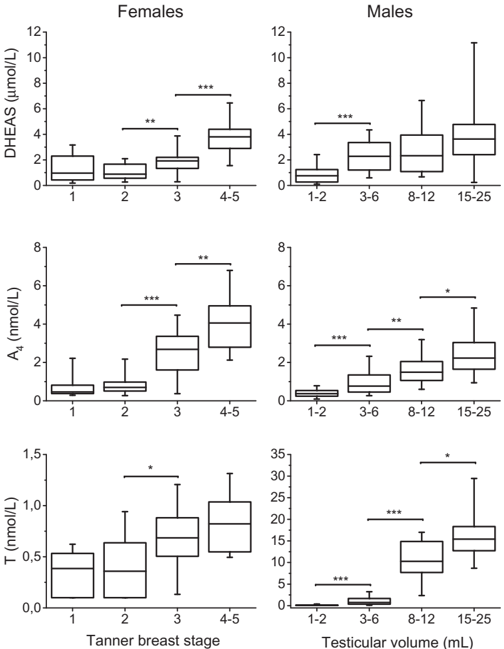
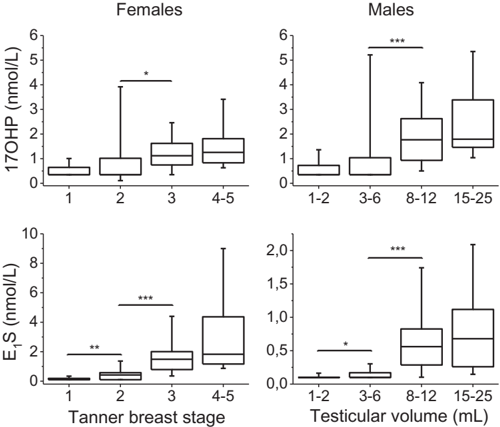
- In 187 children and adolescents (85 females, 102 males), 17OHP, DHEAS, androstenedione, testosterone, and estrone sulfate generally increased during puberty in both genders; boys showed significant increases in androstenedione and testosterone throughout pubertal development, while girls had significantly higher androstenedione and estrone sulfate and boys had higher testosterone.
- No sex- or puberty-specific differences were seen in cortisol or cortisone concentrations; cortisol/cortisone ratio was calculated on the whole group.
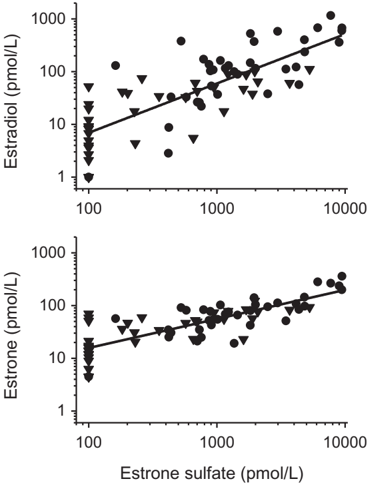
- Estrone sulfate was very low in prepubertal children, with 70% of girls’ and 90% of boys’ samples below LOQ; by the end of puberty, adolescent girls had three to four times higher estrone sulfate than adolescent boys, and estrone sulfate correlated with estrone (r = 0.80, p < 0.001) and estradiol (r = 0.79, p < 0.001) in 73 children.
Methods
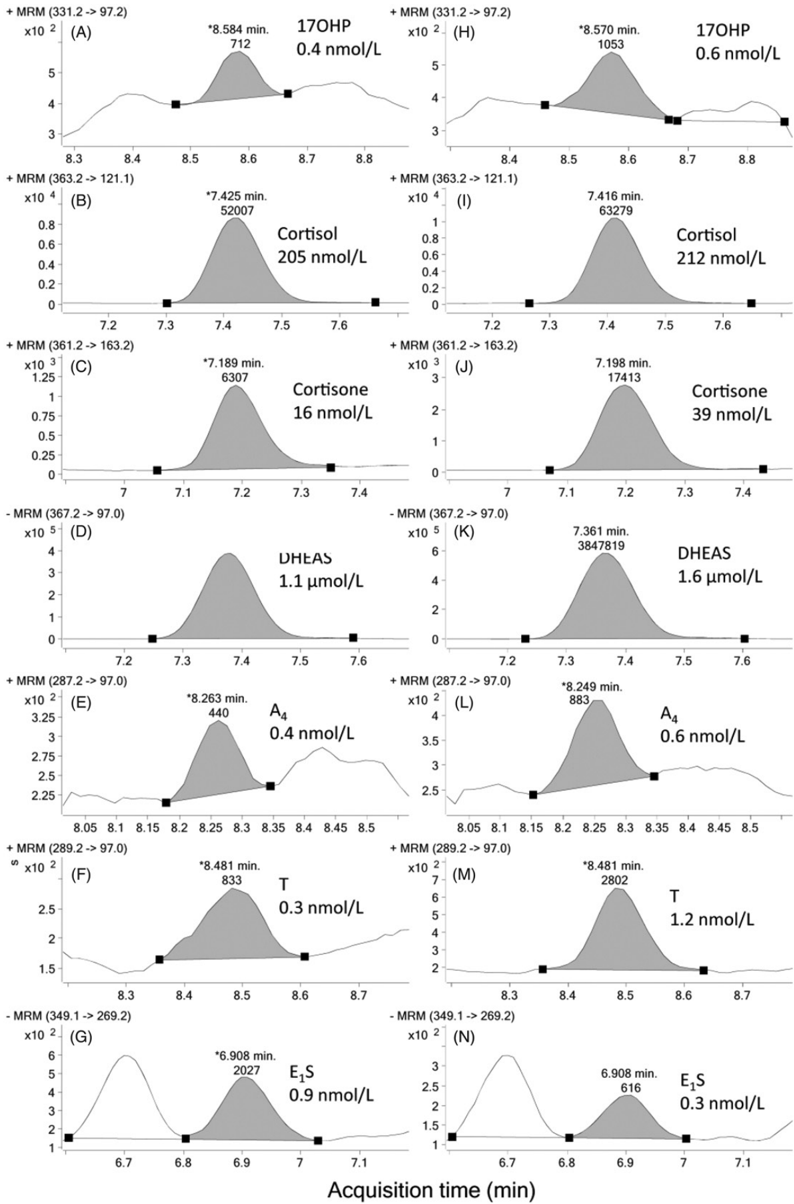
- Sample preparation was fully automated using protein precipitation in acetonitrile, 96-well filter plates, and a pipetting robot; analysis used LC-MS/MS on an Agilent 1260 LC system coupled to an Agilent 6460 triple quadrupole mass spectrometer with polarity-switching MRM.
- Assay validation included calibration curves, LOD/LOQ, intra- and inter-assay precision, accuracy by spiking pooled child sera, interference testing with structurally related steroids, stability tests, and participation in an external quality assessment scheme.
- The study used leftover serum samples from children and adolescents aged 5–18 years submitted for routine clinical testing in 2015–2018, drawn between 8 and 12 a.m.; 187 seemingly healthy, non-obese individuals (85 females, 102 males) had puberty stages registered, and steroid concentrations were compared by sex and pubertal stage using Mann-Whitney U tests with p < 0.05 considered significant.
Limitations
- The paper states that the limited number of individuals may influence interpretation of results, and that sensitivity for testosterone and estrone sulfate seems suboptimal, although it was possible to distinguish prepubertal stage from start of puberty.
- The paper also notes that LOQ and assay precision were performed on pure pooled patient samples from children with true low concentrations.
- Text-evident limitations include the use of leftover clinical samples rather than a population-based sample, non-fasting samples, and the possibility that Tanner breast stage 1 girls included both true prepubertal girls and early pubertal girls, which the authors suggest likely explains higher testosterone in prepubertal girls; no external quality assessment program was available for cortisone or estrone sulfate.
Model-written summary. Check it against the paper before relying on it.
Integrity signals
Registry
Cites
Statistics
Figures


Verification
Claims the paper makes
0 Valid · 0 Not valid · 32 Not checked · 59 Own results and interpretations
A result the paper reports from its own data — it cites no other source for it, so there is none to check. The quote shows it is in the paper.
In the paper
“No sex-or puberty-specific differences were seen in cortisol or cortisone concentrations.”
§ Determination of estrone sulfate, testosterone, androstenedione, DHEAS, cortisol, cortisone, and 17a-hydroxyprogesterone by LC-MS/MS in children and adolescents > Abstract
plain- Asserted: passes — The authors put it forward as true.
- Checkable: passes — It can be checked against evidence.
- Load-bearing: passes — The paper’s conclusions depend on it.
- Based: passes — The paper gives a reason why it holds.
A result the paper reports from its own data — it cites no other source for it, so there is none to check. The quote shows it is in the paper.
In the paper
“In boys, A 4 and T increased significantly throughout pubertal development.”
§ Determination of estrone sulfate, testosterone, androstenedione, DHEAS, cortisol, cortisone, and 17a-hydroxyprogesterone by LC-MS/MS in children and adolescents > Abstract
plainstates a causen = 187- Asserted: passes — The authors put it forward as true.
- Checkable: passes — It can be checked against evidence.
- Load-bearing: passes — The paper’s conclusions depend on it.
- Based: passes — The paper gives a reason why it holds.
A result the paper reports from its own data — it cites no other source for it, so there is none to check. The quote shows it is in the paper.
In the paper
“Girls had significantly higher A 4 and E 1 S concentrations, while boys had higher T concentrations.”
§ Determination of estrone sulfate, testosterone, androstenedione, DHEAS, cortisol, cortisone, and 17a-hydroxyprogesterone by LC-MS/MS in children and adolescents > Abstract
plainstates an associationn = 187- Asserted: passes — The authors put it forward as true.
- Checkable: passes — It can be checked against evidence.
- Load-bearing: passes — The paper’s conclusions depend on it.
- Based: passes — The paper gives a reason why it holds.
A result the paper reports from its own data — it cites no other source for it, so there is none to check. The quote shows it is in the paper.
In the paper
“This study showed a general increase in 17OHP, DHEAS, A 4 , T and E 1 S in both genders during puberty.”
§ Determination of estrone sulfate, testosterone, androstenedione, DHEAS, cortisol, cortisone, and 17a-hydroxyprogesterone by LC-MS/MS in children and adolescents > Abstract
plainstates a causen = 187- Asserted: passes — The authors put it forward as true.
- Checkable: passes — It can be checked against evidence.
- Load-bearing: passes — The paper’s conclusions depend on it.
- Based: passes — The paper gives a reason why it holds.
A result the paper reports from its own data — it cites no other source for it, so there is none to check. The quote shows it is in the paper.
In the paper
“At the end of puberty, there was no sex-specific difference in DHEAS concentrations, but adolescent boys had significantly higher T (p < 0.001) and 17OHP (p < 0.05) concentrations, while adolescent girls had significantly higher A 4 (p < 0.01) and E 1 S concentrations (p < 0.001).”
§ Determination of estrone sulfate, testosterone, androstenedione, DHEAS, cortisol, cortisone, and 17a-hydroxyprogesterone by LC-MS/MS in children and adolescents > Serum concentrations of 17OHP, DHEAS, A 4 , T, and E 1 S determined by LC-MS/MS in relation to sex and
plain- Asserted: passes — The authors put it forward as true.
- Checkable: passes — It can be checked against evidence.
- Load-bearing: unclear — It is unclear whether the paper’s conclusions depend on it.
- Based: passes — The paper gives a reason why it holds.
51 more claims
Create a free account to see all 91 claims and to verify the 54 references still open.
- The quote only partly states this claim. 2
- It may state two separate claims as one. 19
- Probably not a substantial claim. 20
Citations
Cites
Tanner, J. M., & Whitehouse, R. H. (1976) · Archives of Disease in Childhood · doi:10.1136/adc.51.3.170 · Cited by 3,137
Park, H., Harris, S. M., Boldenow, E., Aronoff, D. M., Rea, M., Xi, C., & Loch‐Caruso, R. (2024) · American Journal of Reproductive Immunology · doi:10.1111/aji.13807 · Cited by 2,087
Kushnir, M. M., Blamires, T., Rockwood, A. L., Roberts, W. L., Yue, B., Erdogan, E., Bunker, A. M., & Meikle, A. W. (2010) · Clinical Chemistry · doi:10.1373/clinchem.2010.143222 · Cited by 283
Estrone Sulfate: Production Rate and Metabolism in Man
Ruder, H. J., Loriaux, L., & Lipsett, M. B. (1972) · Journal of Clinical Investigation · doi:10.1172/jci106862 · Cited by 257
Knutsson, U., Dahlgren, J., Marcus, C., Rosberg, S., Brönnegård, M., Stierna, P., & Albertsson-Wikland, K. (1997) · The Journal of Clinical Endocrinology & Metabolism · doi:10.1210/jcem.82.2.3769 · Cited by 198
Self-citationStandardized LC–MS/MS based steroid hormone profile-analysis
Koal, T., Schmiederer, D., Pham-Tuan, H., Röhring, C., & Rauh, M. (2012) · The Journal of Steroid Biochemistry and Molecular Biology · doi:10.1016/j.jsbmb.2011.12.001 · Cited by 196
Kulle, A. E., Riepe, F. G., Melchior, D., Hiort, O., & Holterhus, P. M. (2010) · The Journal of Clinical Endocrinology & Metabolism · doi:10.1210/jc.2009-1670 · Cited by 182
24-Hour Secretory Pattern of Dehydroisoandrosterone and Dehydroisoandrosterone Sulfate
ROSENFELD, R. S., ROSENBERG, B. J., FUKUSHIMA, D. K., & HELLMAN, L. (1975) · The Journal of Clinical Endocrinology & Metabolism · doi:10.1210/jcem-40-5-850 · Cited by 171
Rauh, M., Gröschl, M., Rascher, W., & Dörr, H. G. (2006) · Steroids · doi:10.1016/j.steroids.2006.01.015 · Cited by 170
Cortisol metabolism and the role of 11β-hydroxysteroid dehydrogenase
Tomlinson, J. W., & Stewart, P. M. (2001) · Best Practice & Research Clinical Endocrinology & Metabolism · doi:10.1053/beem.2000.0119 · Cited by 167
Research works printed but not linked: 1
- Ankarberg C, Norjavaara E. Diurnal rhythm of testosterone secretion before and throughout puberty in healthy girls: correl- ation with 17beta-estradiol and dehydroepiandrosterone sulfate. J Clin Endocrinol Metab. 1999;84(3):975-984.
Cited by
Orçun, A., Yıldız, Z., & Dağdelen, L. K. (2022) · Steroids · doi:10.1016/j.steroids.2022.109078 · Cited by 6
Li, Y., Zhang, D., Mo, Y., Zeng, T., Wu, T., Liu, L., Zhang, H., & Chen, C. (2022) · Journal of Pharmaceutical and Biomedical Analysis · doi:10.1016/j.jpba.2022.115139 · Cited by 5
Positive Cortisol–Testosterone Hormonal Coupling Among Adolescents in Argentina and Jordan
Glass, D. J., Godwin, J., Koehn, J., Bez, E., Corley, M. K., Dajani, R. B., Hadfield, K., Panter‐Brick, C., Valeggia, C. R., & Martin, M. A. (2025) · American Journal of Biological Anthropology · doi:10.1002/ajpa.70134 · Cited by 4
Çağatay, N. U., Maviş, M. E., Erarpat, S., & Bakırdere, S. (2023) · Bioanalysis · doi:10.4155/bio-2023-0025 · Cited by 4
Escobar‐Olivos, D., Gómez, M., Triviño, J. J., Arancibia, V., & Rojas−Romo, C. (2025) · ChemistrySelect · doi:10.1002/slct.202404805 · Cited by 2
Metadata
- Authors
- Ankarberg-Lindgren, C., Andersson, M. X., & Dahlgren, J.
- Affiliations
- Göteborg Pediatric Growth Research Center, Department of Pediatrics, Institute of Clinical Sciences, The Sahlgrenska Academy, University of Gothenburg, Gothenburg, Sweden
- University of Gothenburg (SE)
- Sahlgrenska University Hospital (SE)
- Venue
- Scandinavian Journal of Clinical and Laboratory Investigation
- Publisher
- Informa UK Limited
- Published
- 2020-10-14
- Volume
- 80
- Issue
- 8
- Pages
- 672-680
- ISSN
- 0036-5513 (ISSN-L)
- 1502-7686
- OpenAlex
- W3103171090
- Cited by
- 12
- References
- 42
- Citations by year
- 2026: 4 · 2025: 3 · 2023: 2 · 2022: 2 · 2021: 1
- FWCI
- 0.75
- Type
- journal article
- Language
- en
- Open access
- hybrid
- doi.org
- Licence
- Locations
- Scandinavian Journal of Clinical and Laboratory Investigation (publishedVersion, cc-by)
- PubMed (publishedVersion)
- Funders
- Swedish government and the county councils, the ALF-agreement (427731)
- Swedish Research Council (521-2013-3013)
- IngaBritt and Arne Lundberg Research Foundation (2015-103)
- Topics
- Health Sciences › Medicine › Endocrinology, Diabetes and Metabolism › Adrenal Hormones and Disorders
- Health Sciences › Medicine › Endocrinology, Diabetes and Metabolism › Hormonal and reproductive studies
- Health Sciences › Medicine › Endocrinology, Diabetes and Metabolism › Sexual Differentiation and Disorders
- Keywords
- estrone sulfate, testosterone, androstenedione, dehydroepiandrosterone sulfate, cortisol, cortisone, 17-hydroxyprogesterone, endogenous steroids, puberty, sex differences, children and adolescents, automated sample preparation
- MeSH terms
- Adolescent, Androstenedione, Child, Child, Preschool, Chromatography, Liquid, Cortisone, Estrone, Female, Humans, Hydrocortisone, Hydroxyprogesterones, Male, Puberty, Robotics, Sex Factors, Testosterone, Dehydroepiandrosterone Sulfate, Tandem Mass Spectrometry, Limit of Detection
About these checks
Registry, retraction, Cites and statistics results are computed, not judged, with one exception: a printed reference that no index lists is read once by a model before it counts as a citation error. Claims are extracted by a model and kept only when their quote appears verbatim in the text; each cited source is then checked, with a model’s help, for whether it says what the claim relies on. Those verdicts can be wrong — read the claim’s quote and the cited source before relying on one.
A language model drew the claims from the paper on 2026-11-27, under version 3 of the claim definition (model deepseek-v4.1-flash, prompt extract-v3).
A second model labelled each claim on 2026-11-27 (model jev-1.13-20260917, definition revision gold-guideline-v0.2).
Statistics and arithmetic are recomputed, not judged.
Confidence bands are shown only for fields calibrated on our annotated test set. None is calibrated yet, so no band is shown.
What counts as a claim ›How we measure confidence ›How we check this ›
Are you an author, or do you see a problem with this page? Request a review
How to cite
Cite CoChat for the checks on this page, and the paper for its own findings.
- This page
- CoChat. (2026). Citation check: Determination of estrone sulfate, testosterone, androstenedione, DHEAS, cortisol, cortisone, and 17α-hydroxyprogesterone by LC-MS/MS in children and adolescents. https://app.cochat.ai/papers/10.1080/00365513.2020.1829699
- The paper
- Ankarberg-Lindgren, C., Andersson, M. X., & Dahlgren, J. (2020). Determination of estrone sulfate, testosterone, androstenedione, DHEAS, cortisol, cortisone, and 17α-hydroxyprogesterone by LC-MS/MS in children and adolescents. Scandinavian Journal of Clinical and Laboratory Investigation. https://doi.org/10.1080/00365513.2020.1829699
Data sources
Bibliographic data: Semantic Scholar, OpenAlex, Crossref.
Contains information from the Semantic Scholar Academic Graph Datasets, made available under the ODC Attribution License (ODC-BY 1.0).
Semantic Scholar’s data is described in: Kinney, R., et al. (2023). The Semantic Scholar Open Data Platform. arXiv:2301.10140.
