

Utilizing Generative AI Responsibly and Ethically for Research Purposes in Higher Education: A Policy Analysis
Open accessThe DOI matches its Crossref record; 30 of the 30 references it cites were found in a registry or an index; 10 of the 63 sources its claims cite were checked for support.
Abstract
As generative artificial intelligence (GenAI) technologies, such as large language models, become deeply integrated into academic research, questions surrounding their ethical and responsible use have become central to higher education policy. This study provides a thorough analysis of guidelines and regulations governing GenAI in higher education research, mapping and comparing policy responses across four key domains: governmental authorities, higher education institutions (HEIs), academic publishers, and publication manuals. Using an inductive qualitative approach, we systematically analyzed a purposive sample of 74 policy documents from around the world, encompassing diverse institutional and regulatory perspectives. The analysis began by quantifying the frequency of major policy themes, revealing both convergence and divergence in institutional approaches to GenAI. For governmental policies, 10 recurring themes were identified, focusing on ethical use, AI quality assurance, regulatory compliance, and the need for transparency and accountability. HEI policies highlighted 14 themes, emphasizing disclosure requirements, safeguarding academic integrity, addressing concerns about AI misuse, and promoting AI literacy and training among researchers and students. Publishers’ guidelines featured 10 themes, including clear positions on AI authorship, accountability of human authors, and requirements for disclosure and transparency in scholarly communication. Publication manuals identified 11 key themes, reflecting evolving citation practices, mandatory acknowledgment of AI tool use, and the integration of new standards for referencing AI-generated content. Five core domains emerged as central to effective policy: transparency and disclosure, authorship and accountability, quality assurance and safety measures, data security and privacy, and AI literacy and training. Across all document types, transparency and disclosure were consistently emphasized as foundational to ethical research conduct, while approaches to authorship, quality assurance, and data security exhibited variation in specificity and enforcement. The analysis revealed a widespread consensus that AI cannot be listed as an author, yet the mechanisms for ensuring human accountability and for documenting AI’s contribution varied across domains. Quality assurance protocols and privacy safeguards were present but differed in their rigor and implementation, often reflecting regional or institutional priorities. Notably, the need for robust AI literacy and training was frequently cited as essential for mitigating risks associated with GenAI misuse and for fostering responsible academic practice. The comparative synthesis underscores the importance of multi-stakeholder collaboration in developing comprehensive, adaptable policies that address the dynamic challenges posed by GenAI. While there are significant areas of thematic overlap, such as a shared commitment to transparency and ethical standards, notable gaps persist—particularly in guidance around equity, inclusivity, and the practical enforcement of AI-related policies. The study concludes that harmonizing regulatory frameworks and fostering AI literacy will be essential to safeguard academic integrity and support innovation in research practice. These findings offer actionable insights for policymakers, university leaders, publishers, and academic communities seeking to responsibly integrate GenAI into higher education research.
Overview
CoChat Summary
TL;DR
This policy analysis inductively examines 74 documents from governments, universities, publishers, and publication manuals to map how generative AI is governed in higher education research. It finds broad convergence on transparency and the principle that AI cannot be an author, but variation and gaps in enforcement, equity, inclusivity, and practical implementation.
Key findings
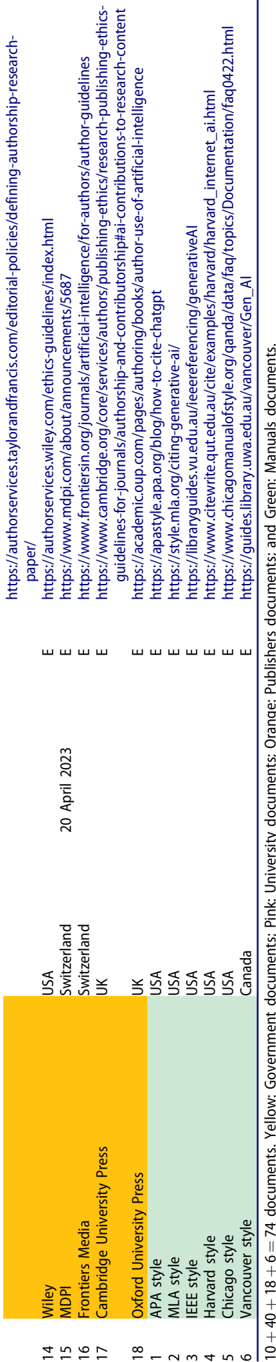
- Across 74 policy documents—10 from authorities, 40 from universities, 18 from publishers, and 6 from publication manuals—transparency/disclosure emerged as the most recurrent theme, especially in university and publisher documents.
- The analysis identified five core domains: transparency and disclosure, authorship and accountability, quality assurance and safety measures, data security and privacy, and AI literacy and training.
- There was widespread consensus that AI cannot be listed as an author, but mechanisms for ensuring human accountability and documenting AI contributions varied across domains.
- The paper reports 10 recurring themes in governmental policies, 14 in HEI policies, 10 in publishers’ guidelines, and 11 in publication manuals; gaps persisted around equity, inclusivity, accessibility, and enforcement.
Methods
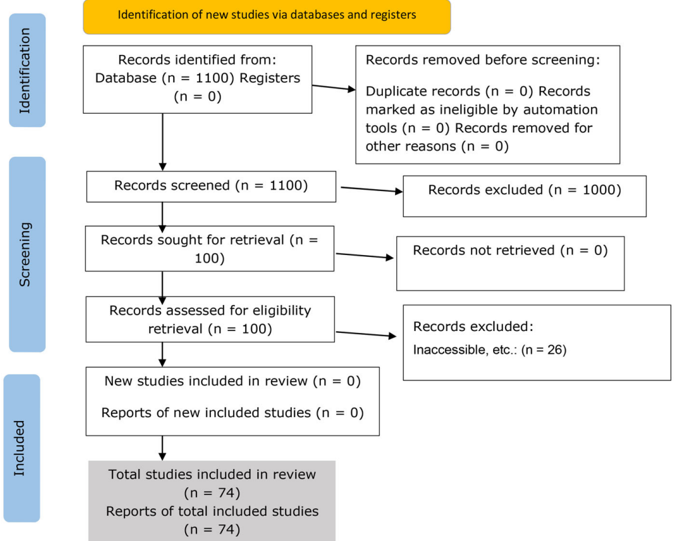
- Inductive qualitative policy analysis using a positivist paradigm, reported according to the Standards for Reporting Qualitative Research (SRQR).
- Purposive sampling of publicly accessible policy documents from four sources: authorities, universities, publishers, and publication manuals; searches were mainly conducted on Google, with snowball sampling and university selection informed by the Shanghai Jiao Tong University top 1000 ranking, 2024 version.
- Data collection ran from early March 2024 to September 1, 2024; analysis began September 1, 2024, using inductive thematic coding assisted by MYRA, a generative AI tool, with member checking and triangulation across the four document sources.
Limitations
- The paper states that purposive sampling may have introduced selection bias by prioritizing publicly accessible online documents, potentially excluding internal policies and guidelines.
- It states that reliance on the Shanghai Jiao Tong University ranking may have overrepresented highly ranked institutions, and that the analysis reflects policies as of September 1, 2024, amid rapid AI change.
- It states that reliance on publicly available documents may exclude internal or unpublished guidelines, and that the focus on policy documents provides limited insight into practical implementation and effectiveness; the text also makes evident that no human participants or stakeholder perspectives were included.
Model-written summary. Check it against the paper before relying on it.
Integrity signals
Registry
Cites
Statistics
Figures



Verification
Claims the paper makes
6 Valid · 5 Not valid · 42 Not checked · 56 Own results and interpretations
The cited sources support only part of this claim — read each source’s verdict below.
In the paper
“The misuse of GenAI in research within higher education can lead to biased or inaccurate conclusions due to several factors.”
What the sources say
- Partly supportedcites Noroozi et al., 2024 matched to “Generative AI in Education: Pedagogical, Theoretical, and Methodological Perspectives” (2024) sourceExperimental — accuracy not yet measured
The Contributors to This Special Issue section (p. 4) reports concerns about bias, accuracy and reliability when ChatGPT is used in academic research, along with limitations such as inability to verify information. The Conclusions and Future Studies section (p. 10) also warns that GenAI may perpetuate inaccuracies. Neither passage specifically says that misuse in higher-education research leads to biased or inaccurate research conclusions. (LLM, conf=0.80)
- Not checked — no full text of the sourcecites Al-Zahrani, 2024 matched to “The impact of generative AI tools on researchers and research: Implications for academia in higher education” (2024) source
- Supportedcites Kurtz et al., 2024 matched to “Strategies for Integrating Generative AI into Higher Education: Navigating Challenges and Leveraging Opportunities” (2024) source
Section 3 (GenAI in HE) states that 'a major concern associated with GenAI is inaccuracy and bias because AI inherently reflects imperfections in its training data,' listing several contributing factors (fabricating information, plagiarizing sources, prejudiced associations) and the consequent need for extensive oversight 'to validate quality and identify errors' — which is the substance of the claim's biased/inaccurate outcomes in higher education. The same section frames misuse in academia (cheating, academic dishonesty, misuse of information, use without proper attribution undermining 'research abilities'), and Section 4 repeats bias, inequality, non-transparency and lack of reliability as GenAI challenges in HE, with the Discussion noting the potential to 'perpetuate existing biases.' The only shift is that our copy ties inaccuracy/bias to inherent training-data imperfections rather than to misuse alone, and speaks of academic work generally rather than research conclusions specifically; as a hedged background paraphrase this remains supported. (LLM, conf=0.80)
plainstates a cause- Asserted: passes — The authors put it forward as true.
- Checkable: passes — It can be checked against evidence.
- Load-bearing: passes — The paper’s conclusions depend on it.
- Based: passes — The paper gives a reason why it holds.
- Partly supported
In the paper
“Harvard University (Citation2024), for example, mandates that students and faculty transparently acknowledge AI-generated content, emphasizing the importance of academic integrity.”
§ 3. Results > 3.1. Transparency and disclosure
What the sources say
- Not matchedcites Citation2024
This doesn’t read as a citation we can look up.
plain- Asserted: passes — The authors put it forward as true.
- Checkable: passes — It can be checked against evidence.
- Load-bearing: unclear — It is unclear whether the paper’s conclusions depend on it.
- Based: passes — The paper gives a reason why it holds.
- Not matched
A result the paper reports from its own data — it cites no other source for it, so there is none to check. The quote shows it is in the paper.
In the paper
“Notably, the need for robust AI literacy and training was frequently cited as essential for mitigating risks associated with GenAI misuse and for fostering responsible academic practice.”
plainstates a cause- Asserted: passes — The authors put it forward as true.
- Checkable: passes — It can be checked against evidence.
- Load-bearing: passes — The paper’s conclusions depend on it.
- Based: passes — The paper gives a reason why it holds.
In the paper
“The US National Science Foundation (Citation2023), for instance, requires researchers to disclose AI use in project proposals, outlining its role in developing their research.”
§ 3. Results > 3.1. Transparency and disclosure
What the sources say
- Not matchedcites Citation2023
This doesn’t read as a citation we can look up.
plain- Asserted: passes — The authors put it forward as true.
- Checkable: passes — It can be checked against evidence.
- Load-bearing: unclear — It is unclear whether the paper’s conclusions depend on it.
- Based: passes — The paper gives a reason why it holds.
- Not matched
A result the paper reports from its own data — it cites no other source for it, so there is none to check. The quote shows it is in the paper.
In the paper
“Similarly, themes such as Security, Privacy, and Data Protection, Policy/Regulation/Development/Implementation, and Ethical Use/Guidelines/Responsibilities are highly represented in university policies, underscoring a growing institutional focus on safeguarding data and promoting responsible AI integration.”
plain- Asserted: passes — The authors put it forward as true.
- Checkable: passes — It can be checked against evidence.
- Load-bearing: passes — The paper’s conclusions depend on it.
- Based: passes — The paper gives a reason why it holds.
33 more claims
Create a free account to see all 109 claims and to verify the 3 references still open.
- Probably not a substantial claim. 47
- It may state two separate claims as one. 38
Self-check
Percentages, sums and reported differences re-computed from the paper’s own numbers.
Each contradiction between two passages listed here was confirmed by an independent check.
Rated major: it would touch a result — a value a result rests on, reported and recomputed p-values on opposite sides of the significance level, two passages that conflict with no sign which is right, or a cited work retracted before this paper was published.
In the paper
§ 3. Results > 3.1. Transparency and disclosure
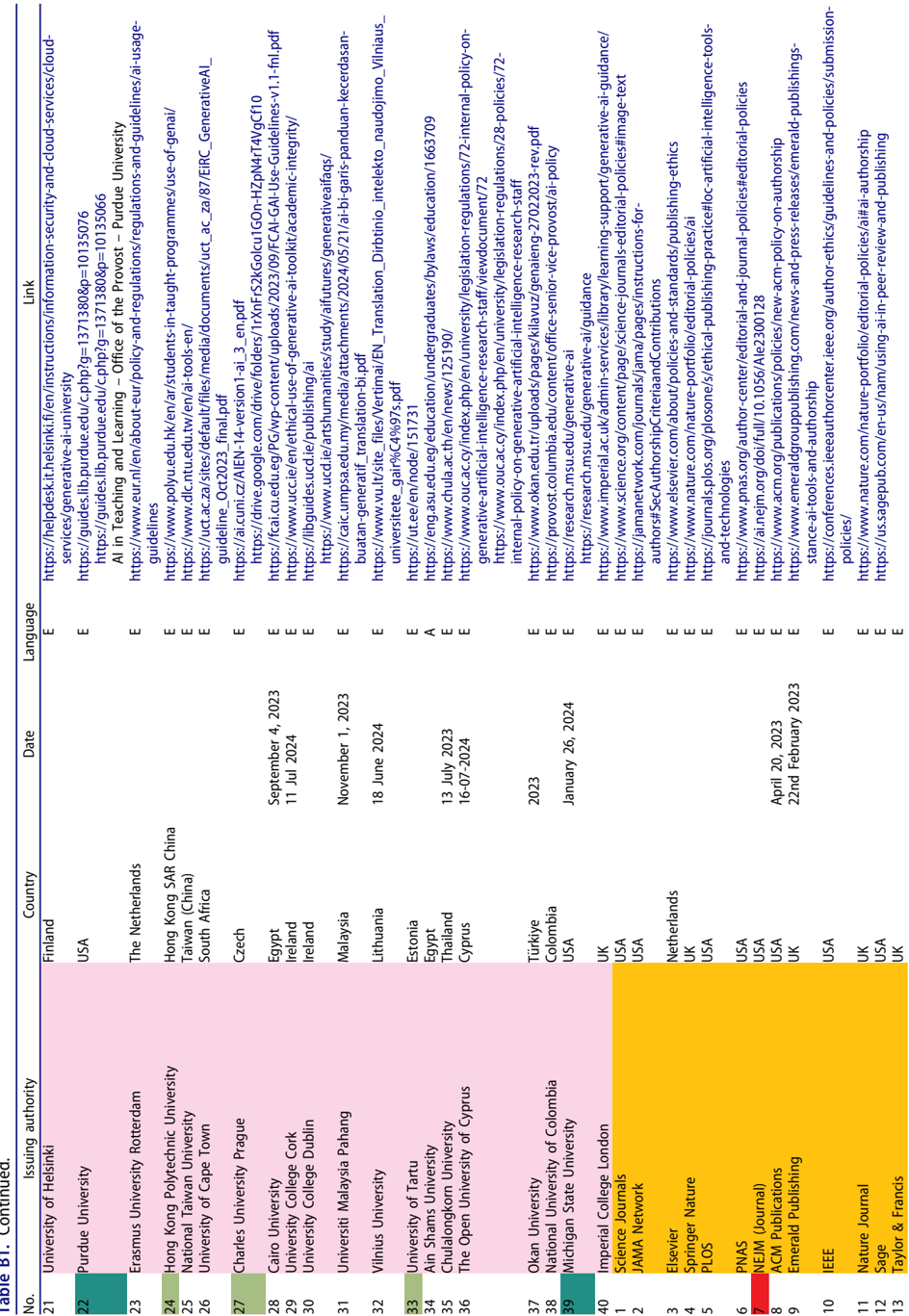
“The US National Science Foundation (Citation2023), for instance, requires researchers to disclose AI use in project proposals, outlining its role in developing their research.”
§ Appendix B
““Proposers are encouraged to indicate in the project description the extent to which, if any, generative AI technology was used and how it was used to develop their proposal.””
Rated minor: it would not touch a result — a value no result rests on, a p-value that stays on the same side of the significance level, or a conflict that is clerical, resolved elsewhere in the paper, or outside its own findings.
In the paper
§ Appendix B
“Transcript: 38 NATIONAL UNIVERSITY OF COLOMBIA”
§ Appendix B
““Columbia community members must not input any Confidential Information into Generative AI tools, except when permitted by validated contract language and security controls.””
Citations
Cites
The PRISMA 2020 statement: An updated guideline for reporting systematic reviews
Page, M. J., McKenzie, J. E., Bossuyt, P. M., Boutron, I., Hoffmann, T. C., Mulrow, C. D., Shamseer, L., Tetzlaff, J. M., Akl, E. A., Brennan, S. E., et al. (2021) · BMJ · doi:10.1136/bmj.n71 · Cited by 108,283
Standards for Reporting Qualitative Research: A Synthesis of Recommendations
O’Brien, B. C., Harris, I. B., Beckman, T. J., Reed, D. A., & Cook, D. A. (2014) · Academic Medicine · doi:10.1097/acm.0000000000000388 · Cited by 12,211
The SAGE Encyclopedia of Social Science Research Methods
Lewis-Beck, M., Bryman, A., & Futing Liao, T. (2004) · Sage eBooks · doi:10.4135/9781412950589 · Cited by 1,439
Inductive content analysis: A guide for beginning qualitative researchers
Vears, D. F., & Gillam, L. (2022) · Focus on Health Professional Education: A Multi-Professional Journal · doi:10.11157/fohpe.v23i1.544 · Cited by 741
Kyngäs, H. (2020) · The Application of Content Analysis in Nursing Science Research · doi:10.1007/978-3-030-30199-6_2 · Cited by 393
Dabis, A., & Csáki, C. (2024) · Humanities and Social Sciences Communications · doi:10.1057/s41599-024-03526-z · Cited by 318
Ning, Y., Teixayavong, S., Shang, Y., Savulescu, J., Nagaraj, V., Miao, D., Mertens, M., Ting, D. S. W., Ong, J. C. L., Liu, M., et al. (2024) · The Lancet Digital Health · doi:10.1016/s2589-7500(24)00143-2 · Cited by 212
Why and how to embrace AI such as ChatGPT in your academic life
Lin, Z. (2023) · Royal Society Open Science · doi:10.1098/rsos.230658 · Cited by 202
Why and how to embrace AI such as ChatGPT in your academic life
Lin, Z. (2023) · doi:10.31234/osf.io/sdx3j · Cited by 202
Kurtz, G., Amzalag, M., Shaked, N., Zaguri, Y., Kohen-Vacs, D., Gal, E., Zailer, G., & Barak-Medina, E. (2024) · Education Sciences · doi:10.3390/educsci14050503 · Cited by 181
Generative AI in Education: Pedagogical, Theoretical, and Methodological Perspectives
Noroozi, O., Soleimani, S., Farrokhnia, M., & Banihashem, S. K. (2024) · International Journal of Technology in Education · doi:10.46328/ijte.845 · Cited by 165
Zohny, H., McMillan, J., & King, M. (2023) · Journal of Medical Ethics · doi:10.1136/jme-2023-108909 · Cited by 130
Al-Zahrani, A. M. (2024) · Innovations in Education and Teaching International · doi:10.1080/14703297.2023.2271445 · Cited by 120
Higher education crisis: Academic misconduct with generative AI
Song, N. (2024) · Journal of Contingencies and Crisis Management · doi:10.1111/1468-5973.12532 · Cited by 107
Qadhi, S. M., Alduais, A., Chaaban, Y., & Khraisheh, M. (2024) · Information · doi:10.3390/info15060325 · Cited by 106
Self-citationChen, K., Tallant, A. C., & Selig, I. (2025) · Information and Learning Sciences · doi:10.1108/ils-10-2023-0160 · Cited by 104
‘ChatGPT et al.’: The ethics of using (generative) artificial intelligence in research and science
Schlagwein, D., & Willcocks, L. (2023) · Journal of Information Technology · doi:10.1177/02683962231200411 · Cited by 97
Fadlelmula, F. K., & Qadhi, S. M. (2024) · Journal of University Teaching and Learning Practice · doi:10.53761/pswgbw82 · Cited by 75
Self-citationThe use of Generative AI in qualitative analysis: Inductive thematic analysis with ChatGPT
(2024) · Journal of Applied Learning & Teaching · doi:10.37074/jalt.2024.7.1.22 · Cited by 70
Park, S. H. (2023) · Korean Journal of Radiology · doi:10.3348/kjr.2023.0643 · Cited by 51
Unveiling Generative AI in Higher Education: Insights from Engineering Students and Professors
Guillén-Yparrea, N., & Hernández-Rodríguez, F. (2024) · 2024 IEEE Global Engineering Education Conference (EDUCON) · doi:10.1109/educon60312.2024.10578876 · Cited by 43
Legal regulation of generative AI: a multidimensional construction
Li, J., Cai, X., & Cheng, L. (2023) · International Journal of Legal Discourse · doi:10.1515/ijld-2023-2017 · Cited by 34
Communicating Clear Guidance: Advice for Generative AI Policy Development in Higher Education
Moore, S., & Lookadoo, K. (2024) · Business and Professional Communication Quarterly · doi:10.1177/23294906241254786 · Cited by 31
Chaaban, Y. (2025) · Teaching in Higher Education · doi:10.1080/13562517.2025.2465995 · Cited by 30
Self-citationUnderstanding Researchers’ AI Readiness in a Higher Education Context: Q Methodology Research
Chaaban, Y., Qadhi, S., Chen, J., & Du, X. (2024) · Education Sciences · doi:10.3390/educsci14070709 · Cited by 19
Self-citationGenerative-AI-Generated Challenges for Health Data Research
Spector-Bagdady, K. (2023) · The American Journal of Bioethics · doi:10.1080/15265161.2023.2252311 · Cited by 18
Generative Artificial Intelligence
Bank, W. (2023) · World Bank, Washington, DC eBooks · doi:10.1596/39959 · Cited by 10
Generative Artificial Intelligence in Healthcare: Ethical Considerations and Assessment Checklist
Ning, Y., Teixayavong, S., Shang, Y., Savulescu, J., Nagaraj, V., Miao, D., Mertens, M., Ting, D. S. W., Ong, J. C. L., Liu, M., et al. (2023) · arXiv · doi:10.48550/arxiv.2311.02107 · Cited by 9
AI for learning unleashed: Pioneering generative AI in education at the University of Miami
Gregory, R. W., & Narang, S. (2024) · Journal of Information Technology Teaching Cases · doi:10.1177/20438869241266258 · Cited by 5
Regulating the use of generative AI in academic research and publications
Kunda, I. (2023) · PUBMET · doi:10.15291/pubmet.4274 · Cited by 5
Research works printed but not linked: 5
- Creswell, J. W., & Creswell, J. D. (2018). Research design: Qualitative, quantitative, and mixed methods approaches (5th ed.). SAGE Publications Ltd.
- Elsevier. (2024). Publishing ethics. https://www.elsevier.com/about/policies-and-standards/publishing-ethics(open in a new window).
- Frankfort-Nachmias, C., & Nachmias, D. (2008). Research methods in the social sciences (7th ed.) Worth Publishers.
- Nature Portfolio. (2024). Artificial Intelligence (AI). Springer Nature. https://www.nature.com/nature-portfolio/editorial-policies/ai#ai-authorship(open in a new window).
- Wiley. (2024). Best practice guidelines on research integrity and publishing ethics. https://authorservices.wiley.com/ethics-guidelines/index.html(open in a new window).
Cited by
Slimi, Z. (2026) · Frontiers in Education · doi:10.3389/feduc.2026.1769680 · Cited by 38
Institutional approaches to generative AI management in higher education: a systematic review
Bacalso, F. D., Villamor, F. E., Paclipan, C. P., Orquia, C. J. B., Rendon, I. P., Albiso, A. T., & Himang, C. M. (2026) · Frontiers in Education · doi:10.3389/feduc.2026.1814426 · Cited by 23
The ETHICAL Protocol for Responsible Use of Generative AI for Research Purposes in Higher Education
Alduais, A. M. S., Qadhi, S., Chaaban, Y., & Khraisheh, M. A. M. (2025) · AI Magazine · doi:10.1002/aaai.70047 · Cited by 12
Self-citationChigwada, J., & Ngulube, P. (2026) · Frontiers in Research Metrics and Analytics · doi:10.3389/frma.2026.1740510 · Cited by 5
Qadhi, S. M., Alduais, A. M. S., Chaaban, Y., & Khraisheh, M. A. M. (2026) · The International Information & Library Review · doi:10.1080/10572317.2026.2626122 · Cited by 8
“Recent works have focused on analyzing institutional policies and proposing structured frameworks for the responsible use of generative AI in higher education research, rather than examining the lived ethical experiences of end users (Alduais et al., 2025a; Alduais et al., 2025b).”
Self-citation
Metadata
- Authors
- Alduais, A., Qadhi, S., Chaaban, Y., & Khraisheh, M.
- Affiliations
- Norwegian University of Science and Technology (NO)
- Qatar University (QA)
- Corresponding author
- Alduais, Ahmed
- Venue
- Serials Review
- Publisher
- Informa UK Limited
- Published
- 2025-10-02
- Volume
- 51
- Issue
- 3-4
- Pages
- 120-170
- ISSN
- 0098-7913 (ISSN-L)
- 1879-095X
- OpenAlex
- W4416589843
- Semantic Scholar
- 904017e0748150fb9142abcff24173c1d4f758ac
- Cited by
- 37
- References
- 28
- Citations by year
- 2026: 36 · 2025: 1
- FWCI
- 38.68
- Type
- journal article
- Language
- en
- Open access
- hybrid
- doi.org
- Licence
- public-domain
- creativecommons.org/licenses/by/4.0/ (vor)
- Locations
- Serials Review (publishedVersion, public-domain)
- Funders
- Qatar National Research Fund (ARG01-0516-230177)
- Qatar National Library
- Topics
- Social Sciences › Education › Academic integrity and plagiarism
- Physical Sciences › Computer Science › Artificial Intelligence › Ethics and Social Impacts of AI
- Social Sciences › Education › Artificial Intelligence in Education
- Keywords
- generative AI, responsible AI use, AI ethics, higher education policy, AI authorship, academic integrity, AI literacy, quality assurance, data security and privacy, publication guidelines, AI regulation, multi-stakeholder collaboration, policy harmonization, AI misuse, artificial intelligence in education, equity and inclusion
About these checks
Registry, retraction, Cites and statistics results are computed, not judged, with one exception: a printed reference that no index lists is read once by a model before it counts as a citation error. Claims are extracted by a model and kept only when their quote appears verbatim in the text; each cited source is then checked, with a model’s help, for whether it says what the claim relies on. Those verdicts can be wrong — read the claim’s quote and the cited source before relying on one.
The claim verdicts this report counts are experimental: their accuracy is not yet measured.
A language model drew the claims from the paper on 2026-09-30, under version 3 of the claim definition (model deepseek-v4.1-flash, prompt extract-v3).
A second model labelled each claim on 2026-09-30 (model jev-1.13-20260917, definition revision gold-guideline-v0.2).
Cited sources are checked with a language model’s help (gpt-6-sol and qwen3.8-omni-flash).
Statistics and arithmetic are recomputed, not judged.
Confidence bands are shown only for fields calibrated on our annotated test set. None is calibrated yet, so no band is shown.
What counts as a claim ›How we measure confidence ›How we check this ›
Are you an author, or do you see a problem with this page? Request a review
Data sources
Bibliographic data: Semantic Scholar, OpenAlex, Crossref.
Contains information from the Semantic Scholar Academic Graph Datasets, made available under the ODC Attribution License (ODC-BY 1.0).
Semantic Scholar’s data is described in: Kinney, R., et al. (2023). The Semantic Scholar Open Data Platform. arXiv:2301.10140.
