

The DOI matches its Crossref record, with a small difference in title or year; 3 of the 3 references it cites were found in a registry or an index.
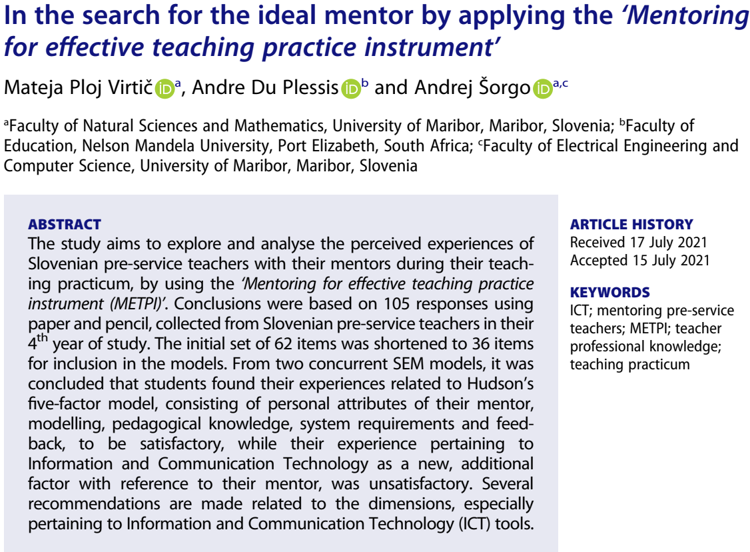
In the search for the ideal mentor by applying the ‘Mentoring for effective teaching practice instrument’
Open accessAbstract
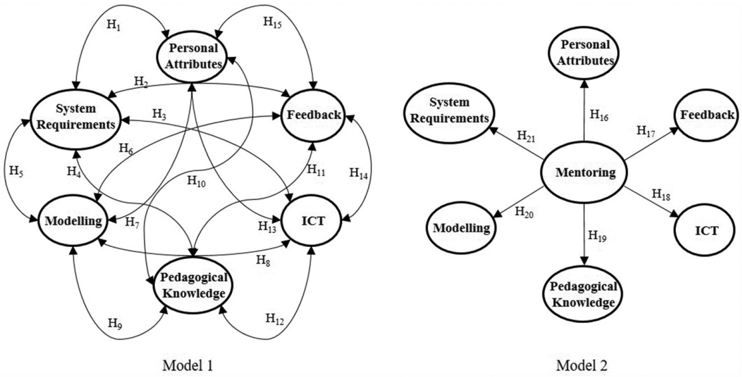
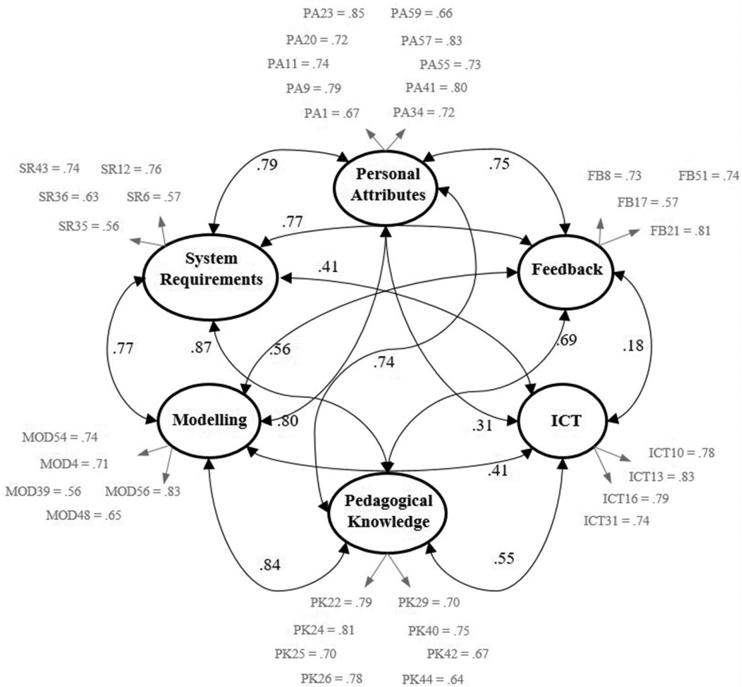
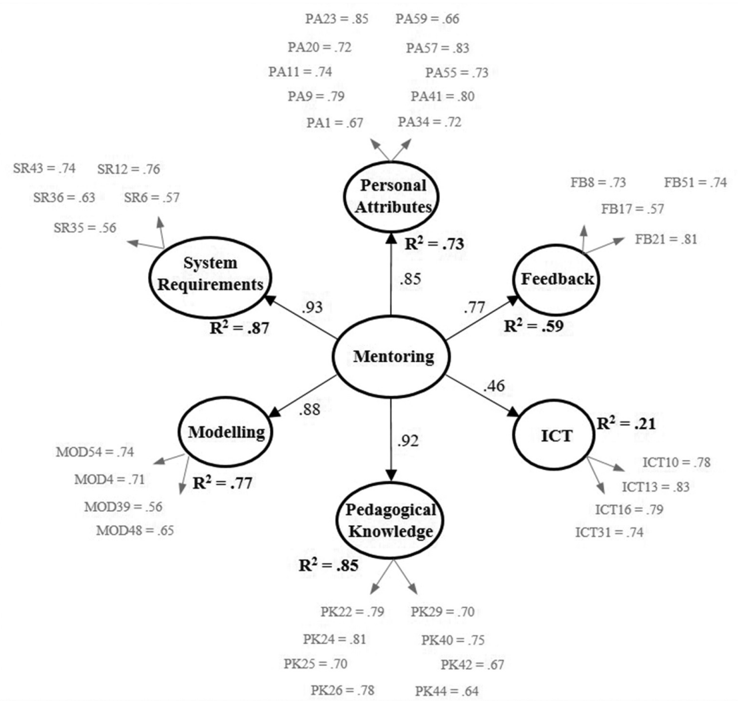
The study aims to explore and analyse the perceived experiences of Slovenian pre-service teachers with their mentors during their teaching practicum, by using the ‘Mentoring for effective teaching practice instrument (METPI)’. Conclusions were based on 105 responses using paper and pencil, collected from Slovenian pre-service teachers in their 4th year of study. The initial set of 62 items was shortened to 36 items for inclusion in the models. From two concurrent SEM models, it was concluded that students found their experiences related to Hudson’s five-factor model, consisting of personal attributes of their mentor, modelling, pedagogical knowledge, system requirements and feedback, to be satisfactory, while their experience pertaining to Information and Communication Technology as a new, additional factor with reference to their mentor, was unsatisfactory. Several recommendations are made related to the dimensions, especially pertaining to Information and Communication Technology (ICT) tools.
Overview
The claims and statistics of this paper haven’t been checked yet.
Run the check — free, no account needed. It reads the open-access text and checks the sources it cites.
Integrity signals
Registry
Cites
Statistics
Figures



Verification
Claims the paper makes
The claims and statistics of this paper haven’t been checked yet.
Run the check — free, no account needed. It reads the open-access text and checks the sources it cites.
Claims other papers make about this one
Each is checked against this paper’s own text: does it say what the citing paper says it does?
The source backs part of the claim, not all of it — or backs it for a different population, condition or comparison.
In the citing paper
“Nevertheless, it appears that in developed countries such as Slovenia where there is a massive drive to promote ICT usage for teaching and learning, mentoring ICT modelling by mentor teachers remains very low (Ploj Virtič, Du Plessis and Šorgo, 2021), similar to this South African situation.”
From Postgraduate Certificate in Education (PGCE) Students’ Experience of Mentoring (2022) · cites this paper as Ploj Virtič, Du Plessis and Šorgo, 2021
Experimental — accuracy not yet measured
Self-check
Percentages, sums and reported differences re-computed from the paper’s own numbers.
The self-check needs the paper’s full text.
Citations
Cites
Structural Equation Modeling With AMOS: Basic Concepts, Applications, and Programming, Third Edition
Byrne, B. M. (2016) · doi:10.4324/9781315757421 · Cited by 4,653
The adequacy of response rates to online and paper surveys: what can be done?
Nulty, D. D. (2008) · Assessment & Evaluation in Higher Education · doi:10.1080/02602930701293231 · Cited by 2,581
Forming the mentor-mentee relationship
Hudson, P. (2016) · Mentoring & Tutoring: Partnership in Learning · doi:10.1080/13611267.2016.1163637 · Cited by 173
Research works printed but not linked: 44
- 10.14221/ajte.2010v35n6.3 · DOI · Paper page
- 10.1080/13611267.2017.1308093 · DOI · Paper page
- Çakmak, M. 2013. “Learning from Teaching Experiences: Novice Teachers’ Thoughts.” HU Journal of Education 1: 55–67.
- 10.5334/aogh.1537 · DOI
- Creswell, J. W. 2015. 30 Essential Skills for the Qualitative Researcher. California, Thousand Oaks: SAGE.
- Creswell, J. W., and C. N. Poth. 2018. Qualitative Inquiry & Research Design: Choosing Among Five Approaches. 4th ed. California, Thousand Oaks: SAGE.
- 10.33225/jbse/16.15.140 · DOI
- 10.33225/jbse/18.17.184 · DOI
- 10.29086/978-0-9869936-1-9/2020/AASBS02 · DOI
- 10.17344/acsi.2016.2821 · DOI
- Field, A. 2013. Discovering Statistics Using IBM SPSS Statistics. 4th ed. Los Angeles: SAGE.
- 10.1080/02619768.2020.1748595 · DOI · Paper page
- 10.14221/ajte.2018v44n3.1 · DOI
- Hill, G., and K. L. Brodin. 2004. “Physical Education Teachers’ Perceptions of the Adequacy of University Coursework in Preparation for Teaching.” Physical Educator 61 (2): 75–87.
- 10.1080/0261976042000223015 · DOI · Paper page
- 10.12973/eu-jer.2.3.107 · DOI
- 10.1080/13632434.2012.724673 · DOI
- Hudson, P. B. 2009. “Mentoring Preservice Teachers in Primary Mathematics.” The International Journal of Learning 16 (4): 119–132.
- Hudson, P. B., and T. M. H. Nguyen. 2008. “What Do Preservice EFL Teachers Expect from Their Mentors?” Australian Association of Research in Education (AARE) 30: 1–10.
- 10.1002/sce.20025 · DOI
- 10.1080/02619760802509115 · DOI
- 10.1080/09500690500206457 · DOI
- 10.2307/255910 · DOI
- Kram, K. E. 1985. Mentoring at Work: Developmental Relationships in Organizational Life. Glenview, IL: Scott Foresman.
- Maynard, T., and J. Furlong. 1993. “Learning to Teach and Models of Mentoring.” In Mentoring: Perspective on School-based Teacher Education, edited by D. McIntyre, H. Hagger, and M. Wilkins, 69–85. London: Kogan Page.
- 10.1111/j.1467-9620.2006.00684.x · DOI · Paper page
- 10.1016/j.tate.2005.09.001 · DOI
- 10.33225/pec/18.76.364 · DOI
- 10.14712/23363177.2015.21 · DOI
- 10.12973/eu-jer.10.1.393 · DOI
- Pšunder, M., and M. Ploj Virtič. 2010. “The Influence of the Study on the Use of Modern Information and Communication Technologies among Students and Teachers.” Informatologia 43 (4): 269–279.
- Ragins, B. R., and K. E. Kram. 2007. “The Roots and Meaning of Mentoring.” In The Handbook of Mentoring at Work: Theory, Research, and Practice, edited by B. R. Ragins and K. E. Kram, 3–15. Thousand Oaks, CA: Sage.
- Retelj, A., and B. Kosevski Puljić. 2016. “We Need More Practice! How Future Teachers Evaluate Their Experiences with Micro-teaching?” The Journal of Elementary Education 9 (4): 139–154.
- 10.17763/haer.57.1.j463w79r56455411 · DOI · Paper page
- 10.12973/ejmste/75225 · DOI
- 10.1016/j.chb.2016.09.006 · DOI
- Van’t Hooft, M., and K. Swan. 2007. Ubiquitous Computing in Education: Invisible Technology, Visible Impact. London: Lawrence Erlbaum Associates.
- 10.15516/cje.v17i0.1557 · DOI
- 10.1177/183693910503000106 · DOI
- Wissiak Grm, K. S., and V. Ferk Savec. 2014. “The Self-evaluation of Slovenian Prospective Chemistry Teachers’ Progress during Their Practical Pedagogical Training in Primary Schools.” Acta Chimica Slovenica 61 (4): 729–739.
- 10.1177/0013164413495237 · DOI · Paper page
- 10.1016/j.system.2014.02.002 · DOI
- 10.1177/002248718003100620 · DOI · Paper page
- 10.1111/ejed.12080 · DOI
Cited by
Sorted by citations
Postgraduate Certificate in Education (PGCE) Students’ Experience of Mentoring
du Plessis, A., & Ismail, B. (2022) · Revija za Elementarno Izobraževanje · doi:10.18690/rei.15.4.447-473.2022 · Cited by 1
Self-citation
Metadata
- Authors
- Ploj Virtič, M., Du Plessis, A., & Šorgo, A.
- Affiliations
- Faculty of Natural Sciences and Mathematics, University of Maribor, Maribor, Slovenia
- Faculty of Education, Nelson Mandela University, Port Elizabeth, South Africa
- University of Maribor (SI)
- Venue
- European Journal of Teacher Education
- Publisher
- Informa UK Limited
- Published
- 2021-07-26
- Volume
- 46
- Issue
- 4
- Pages
- 688-706
- ISSN
- 0261-9768 (ISSN-L)
- 1469-5928
- OpenAlex
- W3186956384
- Cited by
- 22
- References
- 3
- Citations by year
- 2026: 1 · 2025: 8 · 2024: 4 · 2023: 5 · 2022: 4
- FWCI
- 5.71
- Type
- journal article
- Language
- en
- Open access
- hybrid
- doi.org
- Licence
- Locations
- European Journal of Teacher Education (publishedVersion, cc-by-nc-nd)
- University of Maribor digital library (University of Maribor) (submittedVersion, cc-by-nc-nd)
- Nelson Mandela University Research Repository (submittedVersion)
- Funders
- Slovenian Research Agency
- Topics
- Social Sciences › Education › Teacher Education and Leadership Studies
- Social Sciences › Education › Teacher Education and Assessments
- Social Sciences › Education › Reflective Practices in Education
- Keywords
- mentoring, pre-service teachers, teaching practicum, mentor characteristics, feedback, pedagogical knowledge, modeling, information and communication technologies, teacher professional development
About these checks
Registry, retraction, Cites and statistics results are computed, not judged, with one exception: a printed reference that no index lists is read once by a model before it counts as a citation error. Claims are extracted by a model and kept only when their quote appears verbatim in the text; each cited source is then checked, with a model’s help, for whether it says what the claim relies on. Those verdicts can be wrong — read the claim’s quote and the cited source before relying on one.
Statistics and arithmetic are recomputed, not judged.
Confidence bands are shown only for fields calibrated on our annotated test set. None is calibrated yet, so no band is shown.
What counts as a claim ›How we measure confidence ›How we check this ›
Are you an author, or do you see a problem with this page? Request a review
How to cite
Cite CoChat for the checks on this page, and the paper for its own findings.
- This page
- CoChat. (2026). Citation check: In the search for the ideal mentor by applying the ‘Mentoring for effective teaching practice instrument’. https://app.cochat.ai/papers/10.1080/02619768.2021.1957828
- The paper
- Ploj Virtič, M., Du Plessis, A., & Šorgo, A. (2023). In the search for the ideal mentor by applying the ‘Mentoring for effective teaching practice instrument’. European Journal of Teacher Education. https://doi.org/10.1080/02619768.2021.1957828
