

The DOI matches its Crossref record; the references it cites are not checked yet.
SAR thresholds for electromagnetic exposure using functional thermal dose limits
Open accessAbstract
Background and purpose: To protect against any potential adverse effects to human health from localised exposure to radio frequency (100 kHz–3 GHz) electromagnetic fields (RF EMF), international health organisations have defined basic restrictions on specific absorption rate (SAR) in tissues. These exposure restrictions incorporate safety factors which are generally conservative so that exposures that exceed the basic restrictions are not necessarily harmful. The magnitude of safety margin for various exposure scenarios is unknown. This shortcoming becomes more critical for medical applications where the safety guidelines are required to be relaxed. The purpose of this study was to quantify the magnitude of the safety factor included in the current basic restrictions for various exposure scenarios under localised exposure to RF EMF.Materials and methods: For each exposure scenario, we used the lowest thermal dose (TD) required to induce acute local tissue damage reported in literature, calculated the corresponding TD-functional SAR limits (SARTDFL) and related these limits to the existing basic restrictions, thereby estimating the respective safety factor.Results: The margin of safety factor in the current basic restrictions on 10 g peak spatial average SAR (psSAR10g) for muscle is large and can reach up to 31.2.Conclusions: Our analysis provides clear instructions for calculation of SARTDFL and consequently quantification of the incorporated safety factor in the current basic restrictions. This research can form the basis for further discussion on establishing the guidelines dedicated to a specific exposure scenario, i.e. exposure-specific SAR limits, rather than the current generic guidelines.
Overview
The claims and statistics of this paper haven’t been checked yet.
Run the check — free, no account needed. It reads the open-access text and checks the sources it cites.
Integrity signals
Registry
Cites
Statistics
Figures


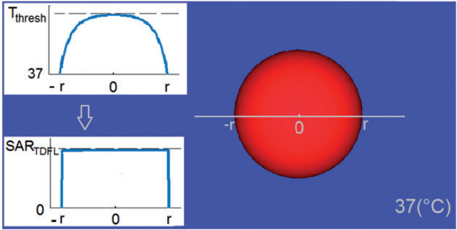
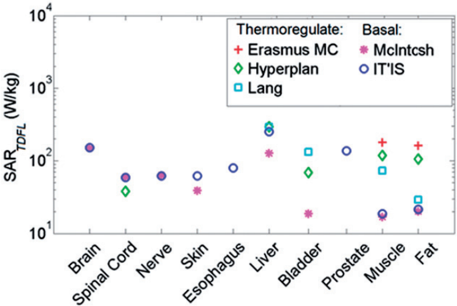
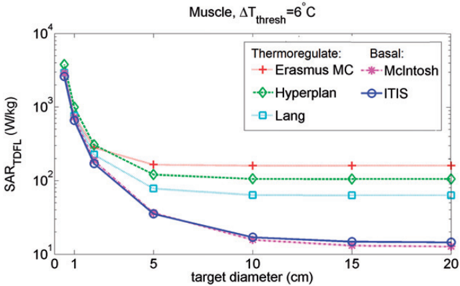
Verification
Claims the paper makes
The claims and statistics of this paper haven’t been checked yet.
Run the check — free, no account needed. It reads the open-access text and checks the sources it cites.
Claims other papers make about this one
Each is checked against this paper’s own text: does it say what the citing paper says it does?
In the citing paper
“Regulatory agencies like the FDA also mandate standards for electromagnetic disturbances, impacting device biocompatibility requirements (Adibzadeh et al., 2018; Review of published literature between 2008 and 2018 of relevance to radiofrequency radiation and cancer, 2020).”
From Comparative analysis of energy transfer mechanisms for neural implants (2024) · cites this paper as Adibzadeh et al., 2018
Self-check
Percentages, sums and reported differences re-computed from the paper’s own numbers.
The self-check needs the paper’s full text.
Citations
The citation lists haven’t been fetched yet
References 38 · Cited by 23
Research works printed but not linked: 39
- ICNIRP, 1998, Health Phys, 74, 494
- IEEE (2005). Standard for safety levels with respect to human exposure to radio frequency electromagnetic fields, 3 kHz to 300 GHz, Std C95.1.
- 10.3109/02656736.2015.1110757 · DOI
- 10.3109/02656736.2015.1108462 · DOI
- 10.3109/02656736.2015.1129440 · DOI
- 10.1088/0031-9155/60/3/995 · DOI
- 10.1088/0031-9155/61/2/488 · DOI
- International Electrotechnical Commission. IEC., 2010, International standard, Medical equipment IEC 60601-2-33: particular requirements for the safety of Magnetic resonance equipment
- 10.1007/s00330-013-2825-y · DOI
- 10.1002/mrm.24671 · DOI
- 10.1142/S1793048010001184 · DOI
- 10.1016/S0360-3016(02)04144-5 · DOI
- 10.1109/10.784145 · DOI
- 10.1016/j.ijrobp.2007.01.035 · DOI
- 10.1016/0360-3016(84)90379-1 · DOI
- 10.1080/02656730500271668 · DOI
- 10.3109/02656736.2015.1114153 · DOI
- 10.1152/jappl.1948.1.2.93 · DOI
- 10.1088/0031-9155/41/11/002 · DOI
- 10.1088/0031-9155/41/11/003 · DOI · Paper page
- 10.1111/j.1749-6632.1980.tb50739.x · DOI
- 10.1088/0031-9155/56/23/008 · DOI
- Chou CK, 1983, Electromagnetic heating for therapy
- 10.1088/0031-9155/43/10/012 · DOI
- 10.3109/02656739509022453 · DOI
- 10.3109/02656739609023525 · DOI
- 10.1109/TBME.1984.325364 · DOI
- 10.1016/0360-3016(85)90343-8 · DOI
- 10.1016/0360-3016(91)90236-W · DOI
- 10.1080/0265673031000119006 · DOI
- Yarmolenko PS, 2011, Int J Hyperthermia, 26, 1
- Drizdal T, 2010, Radioengineering, 19, 281
- 10.1002/mrm.24690 · DOI
- 10.1186/s13014-015-0510-9 · DOI
- 10.1016/j.ultrasmedbio.2006.04.010 · DOI
- 10.1007/s00421-006-0331-5 · DOI
- 10.1186/s13014-016-0588-8 · DOI
- 10.1002/bem.21885 · DOI
- 10.3109/02656736.2013.822993 · DOI
Metadata
- Authors
- Adibzadeh, F., Paulides, M. M., & van Rhoon, G. C.
- Affiliations
- Erasmus MC Cancer Institute (NL)
- Corresponding author
- Adibzadeh, Fatemeh
- Venue
- International Journal of Hyperthermia
- Publisher
- Informa UK Limited
- Published
- 2018-01-18
- Volume
- 34
- Issue
- 8
- Pages
- 1248-1254
- ISSN
- 0265-6736 (ISSN-L)
- 1464-5157
- OpenAlex
- W2791851543
- Cited by
- 23
- References
- 38
- Citations by year
- 2025: 3 · 2024: 5 · 2023: 2 · 2022: 2 · 2021: 5 · 2020: 1 · 2019: 5
- FWCI
- 1.44
- Type
- journal article
- Language
- en
- Open access
- hybrid
- doi.org
- Licence
- cc-by-nc-nd
- Locations
- International Journal of Hyperthermia (publishedVersion, cc-by-nc-nd)
- PubMed (publishedVersion)
- TU/e Research Portal (publishedVersion, other-oa)
- EUR Research Repository (Erasmus University Rotterdam) (submittedVersion, other-oa)
- TU/e Research Portal (submittedVersion)
- RePub (Erasmus University Rotterdam) (submittedVersion, other-oa)
- TU/e Research Portal (submittedVersion, other-oa)
- Topics
- Life Sciences › Biochemistry, Genetics and Molecular Biology › Biophysics › Electromagnetic Fields and Biological Effects
- Health Sciences › Medicine › Ophthalmology › Ocular and Laser Science Research
- Physical Sciences › Engineering › Biomedical Engineering › Ultrasound and Hyperthermia Applications
- Keywords
- specific absorption rate, radiofrequency electromagnetic fields, thermal dose, safety factor, basic restrictions, tissue heating, muscle tissue
- MeSH terms
- Animals, Body Temperature, Cats, Dogs, Electromagnetic Fields, Humans, Swine, Magnetic Field Therapy
About these checks
Registry, retraction, Cites and statistics results are computed, not judged, with one exception: a printed reference that no index lists is read once by a model before it counts as a citation error. Claims are extracted by a model and kept only when their quote appears verbatim in the text; each cited source is then checked, with a model’s help, for whether it says what the claim relies on. Those verdicts can be wrong — read the claim’s quote and the cited source before relying on one.
Statistics and arithmetic are recomputed, not judged.
Confidence bands are shown only for fields calibrated on our annotated test set. None is calibrated yet, so no band is shown.
What counts as a claim ›How we measure confidence ›How we check this ›
Are you an author, or do you see a problem with this page? Request a review
How to cite
Cite CoChat for the checks on this page, and the paper for its own findings.
- This page
- CoChat. (2026). Citation check: SAR thresholds for electromagnetic exposure using functional thermal dose limits. https://app.cochat.ai/papers/10.1080/02656736.2018.1424945
- The paper
- Adibzadeh, F., Paulides, M. M., & van Rhoon, G. C. (2018). SAR thresholds for electromagnetic exposure using functional thermal dose limits. International Journal of Hyperthermia. https://doi.org/10.1080/02656736.2018.1424945
