

Cognitive reactivity as outcome and working mechanism of mindfulness-based cognitive therapy for recurrently depressed patients in remission
Open accessThe DOI matches its Crossref record; 27 of the 27 references it cites were found in a registry or an index.
Abstract
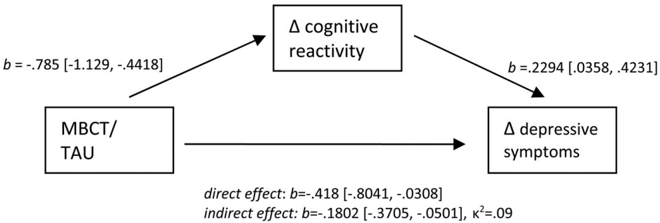
Major depressive disorder is a prevalent condition with high relapse rates. There is evidence that cognitive reactivity is an important vulnerability factor for the recurrence of depression. Mindfulness-based interventions are designed to reduce relapse rates, with cognitive reactivity as one of the proposed working mechanisms. In a randomised controlled trial we compared the effect of mindfulness-based cognitive therapy (MBCT) with treatment-as-usual (TAU) on cognitive reactivity in recurrently depressed patients (N = 115). Depressive symptoms, cognitive reactivity, and mindfulness skills were assessed pre and post treatment. Patients in the MBCT group reported a significantly greater reduction in cognitive reactivity than those in the TAU group (d = .51). The reduction of cognitive reactivity appeared to mediate the association between MBCT/TAU and decrease of depressive symptoms, using pre and post scores. The current study provides evidence that MBCT reduces cognitive reactivity and preliminary evidence that cognitive reactivity is a working mechanism of MBCT.
Overview
The claims and statistics of this paper haven’t been checked yet.
Free: it reads the open-access text and checks the first 5 claims that cite a source we can check. Create a free account to check every claim.
Integrity signals
Registry
Cites
Statistics
Figures



Verification
Claims the paper makes
The claims and statistics of this paper haven’t been checked yet.
Free: it reads the open-access text and checks the first 5 claims that cite a source we can check. Create a free account to check every claim.
Claims other papers make about this one
Each is checked against this paper’s own text: does it say what the citing paper says it does?
The cited source says what the claim attributes to it.
In the citing paper
“In specific populations (i.e. recurrent depression), mechanisms of decentering, rumination, and cognitive reactivity seem to be integral to the process of change (Bieling et al., 2012; Cladder-Micus et al., 2018; Fissler et al., 2016; Segal et al., 2019; van Aalderen et al., 2012).”
From The State- and Trait-Level Effects and Candidate Mechanisms of Four Mindfulness-Based Cognitive Therapy (MBCT) Practices: Two Exploratory Studies (2023) · cites this paper as Cladder-Micus et al., 2018
Self-check
Percentages, sums and reported differences re-computed from the paper’s own numbers.
The self-check needs the paper’s full text.
Citations
Cites
(2013) · Cited by 44,563
Hamilton, M. (1960) · Journal of Neurology, Neurosurgery & Psychiatry · doi:10.1136/jnnp.23.1.56 · Cited by 32,817
Psychometric properties of the Beck Depression Inventory: Twenty-five years of evaluation
Beck, A. T., Steer, R. A., & Carbin, M. G. (1988) · Clinical Psychology Review · doi:10.1016/0272-7358(88)90050-5 · Cited by 11,696
Preacher, K. J., & Kelley, K. (2011) · Psychological Methods · doi:10.1037/a0022658 · Cited by 3,060 · cited 1×
“To estimate the effect size of the indirect effect, κ2 was computed which represents a “ratio to the maximum possible indirect effect” (Preacher & Kelley, 2011).”
Mediators and Mechanisms of Change in Psychotherapy Research
Kazdin, A. E. (2007) · Annual Review of Clinical Psychology · doi:10.1146/annurev.clinpsy.3.022806.091432 · Cited by 2,504 · cited 1×
“Finding a variable statistically mediating an effect does not prove that it is a working mechanism, however, it is an important step in narrowing down the possible variables of influence (Kazdin, 2007).”
BackgroundGu, J., Strauss, C., Bond, R., & Cavanagh, K. (2015) · Clinical Psychology Review · doi:10.1016/j.cpr.2015.01.006 · Cited by 1,712 · cited 3×
“This is in line with the theoretical rationale of MBCT (Segal et al., 2002) and previous findings (Gu et al., 2015).”
BackgroundResultThe Evolution of the Cognitive Model of Depression and Its Neurobiological Correlates
Beck, A. T. (2008) · American Journal of Psychiatry · doi:10.1176/appi.ajp.2008.08050721 · Cited by 1,537
Kuyken, W., Warren, F. C., Taylor, R. S., Whalley, B., Crane, C., Bondolfi, G., Hayes, R., Huijbers, M., Ma, H., Schweizer, S., et al. (2016) · JAMA Psychiatry · doi:10.1001/jamapsychiatry.2016.0076 · Cited by 821
Self-citationHow does mindfulness-based cognitive therapy work?
Kuyken, W., Watkins, E., Holden, E., White, K., Taylor, R. S., Byford, S., Evans, A., Radford, S., Teasdale, J. D., & Dalgleish, T. (2010) · Behaviour Research and Therapy · doi:10.1016/j.brat.2010.08.003 · Cited by 809
Scher, C. D., Ingram, R. E., & Segal, Z. V. (2005) · Clinical Psychology Review · doi:10.1016/j.cpr.2005.01.005 · Cited by 495
Research works printed but not linked: 1
- Segal, Z. V., Williams, J., & Teasdale, J. (2002). Mindfulness-based cognitive therapy for depression: A new approach to relapse pre- vention. New York, NY: Guilford.
Cited by
Johannsen, M., Nissen, E. R., Lundorff, M., & O'Toole, M. S. (2022) · Clinical Psychology Review · doi:10.1016/j.cpr.2022.102156 · Cited by 116
Effects of mindfulness interventions on depressive symptoms in adolescents: A meta-analysis
Reangsing, C., Punsuwun, S., & Schneider, J. K. (2021) · International Journal of Nursing Studies · doi:10.1016/j.ijnurstu.2020.103848 · Cited by 98
Maddock, A., & Blair, C. (2023) · Current Psychology · doi:10.1007/s12144-021-02082-y · Cited by 68
Per, M., Schmelefske, E., Brophy, K., Austin, S. B., & Khoury, B. (2022) · Mindfulness · doi:10.1007/s12671-021-01815-1 · Cited by 61
Geurts, D. E. M., Haegens, N. M., Van Beek, M. H. C. T., Schroevers, M. J., Compen, F. R., & Speckens, A. E. M. (2021) · Journal of Psychiatric Research · doi:10.1016/j.jpsychires.2021.07.043 · Cited by 26
Self-citation
Metadata
- Authors
- Cladder-Micus, M. B., van Aalderen, J., Donders, A. R. T., Spijker, J., Vrijsen, J. N., & Speckens, A. E. M.
- Affiliations
- Radboud University Nijmegen (NL)
- Department of Psychiatry, Radboud University Medical Centre, Nijmegen, The Netherlands
- Radboud University Medical Center (NL)
- Corresponding author
- Cladder-Micus, M. B.
- Venue
- Cognition and Emotion
- Publisher
- Informa UK Limited
- Published
- 2017-02-07
- Volume
- 32
- Issue
- 2
- Pages
- 371-378
- ISSN
- 0269-9931 (ISSN-L)
- 1464-0600
- OpenAlex
- W2587191193
- Cited by
- 26
- References
- 27
- Citations by year
- 2026: 2 · 2025: 4 · 2024: 3 · 2023: 2 · 2022: 3 · 2021: 5 · 2020: 4 · 2019: 1 · 2018: 2
- FWCI
- 2.37
- Type
- journal article
- Language
- en
- Open access
- hybrid
- doi.org
- Licence
- Locations
- Cognition & Emotion (publishedVersion, cc-by-nc-nd)
- PubMed (publishedVersion)
- Radboud Repository (Radboud University) (submittedVersion)
- Radboud Repository (Radboud University) (submittedVersion, other-oa)
- Funders
- Fonds Psychische Gezondheid (2005 6028)
- Topics
- Social Sciences › Psychology › Clinical Psychology › Mindfulness and Compassion Interventions
- Social Sciences › Psychology › Experimental and Cognitive Psychology › Anxiety, Depression, Psychometrics, Treatment, Cognitive Processes
- Health Sciences › Medicine › Pharmacology (medical) › Treatment of Major Depression
- Keywords
- cognitive reactivity, mindfulness-based cognitive therapy, recurrent depression, major depressive disorder, depression relapse, remitted depression, therapeutic mechanisms, depressive symptoms, mindfulness skills
- MeSH terms
- Cognition, Major Depressive Disorder, Female, Humans, Male, Middle Aged, Psychotherapy, Group, Recurrence, Cognitive Behavioral Therapy, Treatment Outcome, Mindfulness
About these checks
Registry, retraction, Cites and statistics results are computed, not judged, with one exception: a printed reference that no index lists is read once by a model before it counts as a citation error. Claims are extracted by a model and kept only when their quote appears verbatim in the text; each cited source is then checked, with a model’s help, for whether it says what the claim relies on. Those verdicts can be wrong — read the claim’s quote and the cited source before relying on one.
Statistics and arithmetic are recomputed, not judged.
Confidence bands are shown only for fields calibrated on our annotated test set. None is calibrated yet, so no band is shown.
What counts as a claim ›How we measure confidence ›How we check this ›
Are you an author, or do you see a problem with this page? Request a review
How to cite
Cite CoChat for the checks on this page, and the paper for its own findings.
- This page
- CoChat. (2026). Citation check: Cognitive reactivity as outcome and working mechanism of mindfulness-based cognitive therapy for recurrently depressed patients in remission. https://app.cochat.ai/papers/10.1080/02699931.2017.1285753
- The paper
- Cladder-Micus, M. B., van Aalderen, J., Donders, A. R. T., Spijker, J., Vrijsen, J. N., & Speckens, A. E. M. (2018). Cognitive reactivity as outcome and working mechanism of mindfulness-based cognitive therapy for recurrently depressed patients in remission. Cognition and Emotion. https://doi.org/10.1080/02699931.2017.1285753
Data sources
Bibliographic data: Semantic Scholar, OpenAlex, Crossref.
Contains information from the Semantic Scholar Academic Graph Datasets, made available under the ODC Attribution License (ODC-BY 1.0).
Semantic Scholar’s data is described in: Kinney, R., et al. (2023). The Semantic Scholar Open Data Platform. arXiv:2301.10140.
