

Proposing a farm assessment toolkit: evaluating a South African land reform case study
Open accessThe DOI matches its Crossref record; 25 of the 25 references it cites were found in a registry or an index; 4 of the 20 sources its claims cite were checked for support.
Abstract
The paper presents a robust, scientific evaluation method to determine the potential viability of a farm, compared to its current performance. The comparison informs recommendations for sustainable farm development. The process entails a stepwise analysis of land suitability, enterprise potential, infrastructure status, operator capacity, inherent limitations and external risks of the farm. An expert panel considers quantitative and qualitative data to establish suitable development measures. Applied to a land reform initiative, ±2000 farms entailing 1.86 million hectares were evaluated, detailing corrective measures for each farm. Roughly 59% of the evaluated farms were potentially commercial, but only 7% performed accordingly. Correlations between farmer capability and farm performance, as well as between infrastructure and performance, were evident, indicating that post-settlement support is vital. As risk and limitation scores increased, farm viability tended to decrease. The tool accurately determined viability based on available resources (natural and physical), resulting in evidence-based policy advice. The evaluation informed land reform policy recommendations, proposing more coordinated support to improve access to services. The tool would also be useful for farmers to reflect on enterprise performance. The visual, sequential nature of the evaluation facilitates sound decision-making. The tool has potential as a valid agricultural development evaluation instrument.
Overview
CoChat Summary
TL;DR
This paper proposes and tests a stepwise, expert-panel farm assessment toolkit for South African land reform farms, combining survey data, geospatial resource data, and qualitative scoring to compare potential with actual performance. Applied to about 2,000 PLAS farms, it found a large gap between potential and realized outcomes, with only 7% performing at commercial benchmark levels despite 59% being potentially commercial.
Key findings
- About ±2000 PLAS farms covering 1.86 million hectares were evaluated; the authors estimate potential annual income of ±R3 billion collectively, while actual performance was less than a quarter of this.
- In the portfolio, 59% of farms were judged potentially commercial, but only 7% achieved the commercial benchmark in actual performance; 24% had potential net income of R350,000–R699,000, and 67% of farms had actual net income below R150,000 per year.
- The paper reports a correlation between farmer capability and farm performance, and between infrastructure and performance; as risk and limitation scores increased, farm viability decreased.
- The authors estimate that 7045 full-time workers and 12,000 temporary workers were employed on PLAS farms at evaluation time, versus 60,050 workers that could have been employed if farms were optimally productive.
Methods
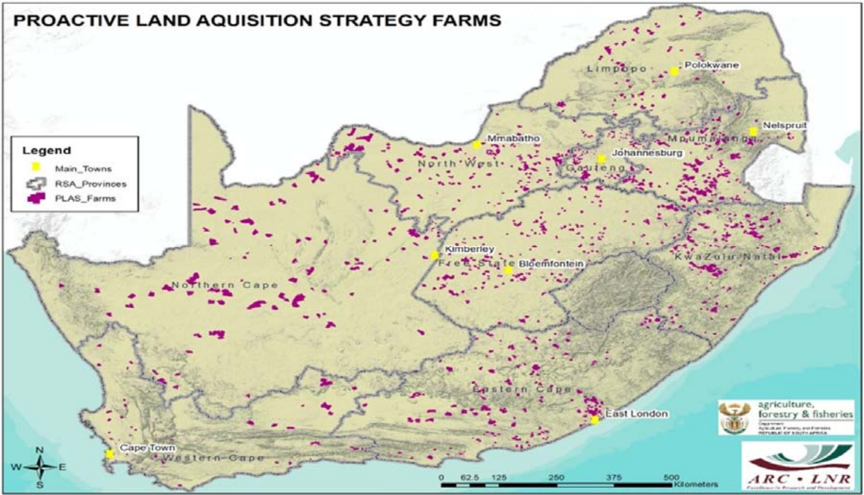
- The study combines primary and secondary sources, including a comprehensive farm survey of about ±2000 PLAS farms dispersed across South Africa, plus geo-spatial natural resource data and satellite imagery.
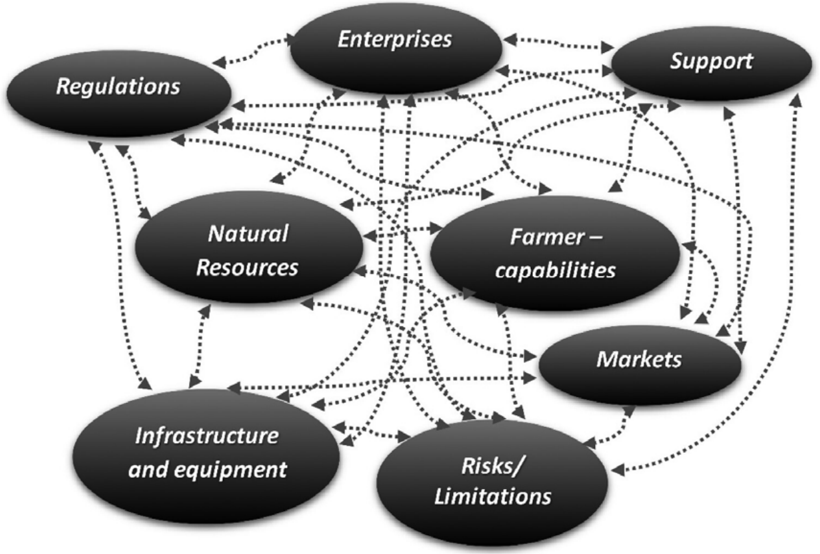
- An expert panel using a trans-disciplinary, Delphi-style consensus process assessed farms across seven survey dimensions and multiple scoring components: natural resources, commodity mix, actual vs potential performance, ROI, infrastructure, farmer capability, and risks/limitations.
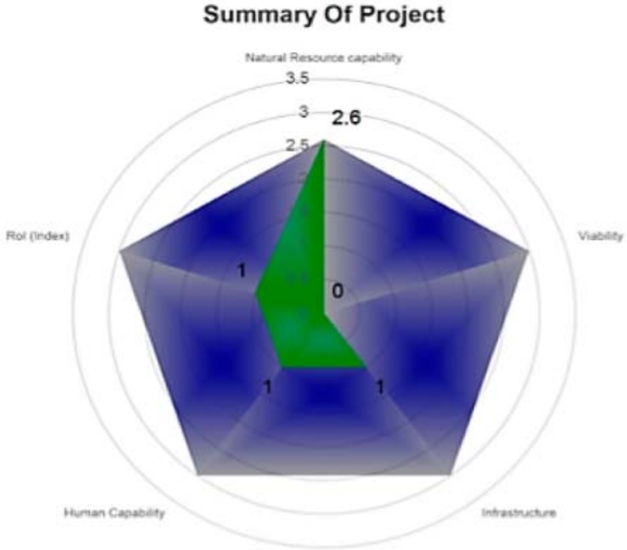
- The analysis compared potential vs actual farm performance, used three-tier scoring (good/satisfactory/poor), and summarized results with farm-level reports and a visual pentagon/penta-graph.
Limitations
- The paper explicitly says the methodology requires extensive data and an expert panel, implying substantial investment in data collection and human capacity.
- It notes that the geospatial database is primarily suitable at 1:50,000 scale, so variance due to scale is possible.
- Evident from the text: the toolkit relies on panel consensus and qualitative scoring, which may be sensitive to expert judgment, although the paper says it tries to reduce bias through a participatory expert system.
Model-written summary. Check it against the paper before relying on it.
Integrity signals
Registry
Cites
Statistics
Figures
Verification
Claims the paper makes
2 Valid · 2 Not valid · 12 Not checked · 72 Own results and interpretations
The cited sources support only part of this claim — read each source’s verdict below.
In the paper
“This indicated that the programme had been unsuccessful in establishing commercial farmers and corroborates the work of other authors (Kirsten et al. 2016; Maka and Aliber 2019; Zantsi and Greyling 2021).”
What the sources say
- Partly supportedcites Kirsten et al. 2016 matched to “Performance of land reform projects in the North West province of South Africa: Changes over time and possible causes” (2016) sourceExperimental — accuracy not yet measured
The Introduction says many land reform projects failed to achieve commercial viability, which supports the broader point. But Table 2 and §5.2 identify the projects studied as SLAG and LRAD projects, not PLAS projects. The paper therefore does not establish that PLAS was unsuccessful in establishing commercial farmers; no page numbers were available in our copy. (LLM, conf=0.87)
- Partly supportedcites Maka and Aliber 2019 matched to “The Role Of Mentors In Land Reform Projects Supported Through The Recapitalisation And Development Programme: Findings From Buffalo City Metropolitan Municipality, South Africa” (2019) sourceExperimental — accuracy not yet measured
Maka and Aliber (2019) never assess PLAS: in our copy PLAS appears only as a programme-type label in Table 1 (Section 3 Methodology, project summary — Beacon Hill, BN Zuma/Sea View, Siyavuselela, Sixoweni), and the paper's own findings concern mentor effectiveness under the RADP, with several beneficiaries reporting improved operations (Section 4.1). The closest content is in Section 1 Introduction, where the failure to establish commercial farming is stated at the level of land reform generally — the Minister's 2009 announcement that 90% of land reform projects had failed and DRDLR (2013) on projects in distress or failed — and the aspiration that RADP 'graduate emerging farmers to become commercial farmers' (Sections 1 and 2). So the general point is in the source, but the PLAS-specific attribution is not, and the failure statistic is credited there to the Minister/DRDLR rather than being this paper's finding. (LLM, conf=0.66)
- Partly supportedcites Zantsi and Greyling 2021 matched to “Land redistribution in South Africa’s land reform policy: a better way to select beneficiaries” (2021) sourceExperimental — accuracy not yet measured
Our copy comes close but never states that PLAS was unsuccessful at establishing commercial farmers. Section 2 (p. 4) says land redistribution progress has been slow, only ~10% of agricultural land redistributed, and 'Productivity on the redistributed farms has been low (Kirsten et al. 2016; Mtero, Gumede, and Ramantsima 2019)', with poor beneficiary selection blamed — a general land-redistribution statement, not a PLAS verdict. The only PLAS-specific outcome evidence is reported from another source: Section 3.3 (p. 7) cites a DRDLR (2015) study of 113 PLAS beneficiaries where 'more than half said they could not manage their farms without the help of their mentors', and Section 3.2 (p. 5) notes the selection system 'typically benefits black elites who are already farming commercially' and a 'disjuncture between beneficiary aspirations, beneficiary capabilities and the realities of commercial farming'. So the paper supports difficulty/low productivity and dependency on mentors, but the flat claim of programme failure to establish commercial farmers is stronger than, and partly credited elsewhere in, our copy. (LLM, conf=0.70)
hedged- Asserted: passes — The authors put it forward as true.
- Checkable: passes — It can be checked against evidence.
- Load-bearing: passes — The paper’s conclusions depend on it.
- Based: passes — The paper gives a reason why it holds.
- Partly supported
The cited sources support only part of this claim — read each source’s verdict below.
In the paper
“Widespread institutional and post-settlement support bottlenecks were found (Binswanger-Mkhize 2014; Drimie 2016; LRAAP 2019; Sihlobo and Kirsten 2019; Vink and Kirsten 2019).”
What the sources say
- Not checked — no full text of the sourcecites Binswanger-Mkhize 2014 doi:10.1080/03031853.2014.929007
- Partly supportedcites Drimie 2016Experimental — accuracy not yet measured
Our copy of Drimie (2016) supports the 'institutional bottleneck' half of the attribution in general terms: Section 5 (Implications for policy and policymaking) says policy has been left 'largely to a government department that is poorly equipped—administratively and conceptually' and requires 'structural and institutional change', and Section 3 (Emerging discord) records that 'moving towards actual alignment has been challenging for DRDLR, since they have no mandate to compel other departments to comply', while noting that 'land reform policy has more or less abandoned any coherent focus on pro-poor land redistribution' (there credited to du Toit 2015). What our copy does not contain is any finding on post-settlement support in land reform: searches for 'post-settlement support', 'after land transfer / beneficiaries / failed projects' and support to land reform beneficiaries returned no passage addressing that specific bottleneck. The paper is also a policy-coherence review rather than an empirical study that 'found' widespread bottlenecks, so the claim's land-reform-specific, post-settlement element rests on other works in the citation string. (LLM, conf=0.68)
- Not matchedcites LRAAP 2019
An author–year citation the paper’s reference list doesn’t settle. We don’t search these by name.
plain- Asserted: passes — The authors put it forward as true.
- Checkable: passes — It can be checked against evidence.
- Load-bearing: passes — The paper’s conclusions depend on it.
- Based: passes — The paper gives a reason why it holds.
A result the paper states — it cites no source for it, so there is none to check. The quote shows it is in the paper.
In the paper
“As risk and limitation scores increased, farm viability tended to decrease.”
hedgedstates an association- Asserted: passes — The authors put it forward as true.
- Checkable: passes — It can be checked against evidence.
- Load-bearing: passes — The paper’s conclusions depend on it.
- Based: passes — The paper gives a reason why it holds.
A result the paper reports from its own data — it cites no other source for it, so there is none to check. The quote shows it is in the paper.
In the paper
“Roughly 59% of the evaluated farms were potentially commercial, but only 7% performed accordingly.”
hedged- Asserted: passes — The authors put it forward as true.
- Checkable: passes — It can be checked against evidence.
- Load-bearing: passes — The paper’s conclusions depend on it.
- Based: passes — The paper gives a reason why it holds.
A result the paper reports from its own data — it cites no other source for it, so there is none to check. The quote shows it is in the paper.
In the paper
“Correlations between farmer capability and farm performance, as well as between infrastructure and performance, were evident, indicating that post-settlement support is vital.”
plainstates an association- Asserted: passes — The authors put it forward as true.
- Checkable: passes — It can be checked against evidence.
- Load-bearing: passes — The paper’s conclusions depend on it.
- Based: passes — The paper gives a reason why it holds.
36 more claims
Create a free account to see all 88 claims and to verify the 4 references still open.
- It may state two separate claims as one. 28
- The quote only partly states this claim. 4
- Probably not a substantial claim. 26
Self-check
Percentages, sums and reported differences re-computed from the paper’s own numbers.
Rated major: it would touch a result — a value a result rests on, reported and recomputed p-values on opposite sides of the significance level, two passages that conflict with no sign which is right, or a cited work retracted before this paper was published.
In the paper
“| Actual production | R527.00 | % Actual annual Return on Investment | 18.3 |”
Reported 18.3 · recomputed 0.000182
Citations
Cites
The number, size, and distribution of farms, smallholder farms, and family farms worldwide
Lowder, S. K., Skoet, J., & Raney, T. (2016) · World Development · doi:10.1016/j.worlddev.2015.10.041 · Cited by 2,012
Current Progress and Future Prospects of Agriculture Technology: Gateway to Sustainable Agriculture
Khan, N., Ray, R. L., Sargani, G. R., Ihtisham, M., Khayyam, M., & Ismail, S. (2021) · Sustainability · doi:10.3390/su13094883 · Cited by 510
Place, F. (2009) · World Development · doi:10.1016/j.worlddev.2008.08.020 · Cited by 357
An environmental evaluation system for water resource planning
Dee, N., Baker, J., Drobny, N., Duke, K., Whitman, I., & Fahringer, D. (1973) · Water Resources Research · doi:10.1029/wr009i003p00523 · Cited by 302 · cited 1×
“The panel evaluation approach was broadly based on an environmental evaluation system that identi fi es key components and applies indicators to evaluate each component (Dee et al. 1973).”
MethodLand Reform in Developing Countries: Property Rights and Property Wrongs
Lipton, M. (2009) · doi:10.4324/9780203876251 · Cited by 244
The Recent Growth Boom in Developing Economies: A Structural-Change Perspective
Diao, X., McMillan, M., & Rodrik, D. (2019) · The Palgrave Handbook of Development Economics · doi:10.1007/978-3-030-14000-7_9 · Cited by 190
Chopin, P., Mubaya, C. P., Descheemaeker, K., Öborn, I., & Bergkvist, G. (2021) · Agronomy for Sustainable Development · doi:10.1007/s13593-021-00674-3 · Cited by 129
Understanding Farm Diversity to Promote Agroecological Transitions
Teixeira, H. M., Van den Berg, L., Cardoso, I. M., Vermue, A. J., Bianchi, F. J. J. A., Peña-Claros, M., & Tittonell, P. (2018) · Sustainability · doi:10.3390/su10124337 · Cited by 114
Methods to assess farming sustainability in developing countries. A review
Schindler, J., Graef, F., & König, H. J. (2015) · Agronomy for Sustainable Development · doi:10.1007/s13593-015-0305-2 · Cited by 113
Farmers’ Adaptation Strategies to Climate Change in Southeast Asia: A Systematic Literature Review
Idris, N. D. M., Zulkepli, N. A., Siwar, C., & Zainol, M. R. (2022) · Sustainability · doi:10.3390/su14063639 · Cited by 108
Research works printed but not linked: 5
- Hall, R. 2009. Dynamics in the commercial farming sector. In Another countryside, edited by Ruth Hall, 120–131. Cape Town: Institute for Poverty, Land and Agrarian Studies.
- Lraap (Land Reform and agriculture Advisory Panel). 2019. Final report of the presidential advisory panel on land reform and agriculture. Pretoria: The Presidency.
- 10.46743/2160-371502018.3232 · doi:10.46743/2160-371502018.3232
- Muller-Praefcke D. K. Lai and W. Sorrenson. 2010. The use of monitoring and evaluation in agriculture and rural development projects. Findings from a review of implementation completion reports. FAO. https://www.fao.org/3/am292e/am292e.pdf
- Sihlobo, W., and J. Kirsten. 2019. A compendium of essays on land reform in South Africa. Co-published by AgBIZ and Stellenbosch University. agbiz.co.za/uploads/AgbizNews18/181207_Land%20Reform%20Essays%20Final.pdf
Cited by
Zantsi, S., Mack, G., Möhring, A., Cloete, K., Greyling, J. C., & Mann, S. (2025) · Agrekon · doi:10.1080/03031853.2025.2509488 · Cited by 4
“As a result, some farms remain vacant for extended periods, sometimes up to five years (Verschoor et al. 2023).”
Verschoor, A. J., Zantsi, S., Mdiya, L., & Gandidzanwa, C. (2025) · Suid-Afrikaanse tydskrif vir landbouvoorligting/South African journal of agricultural extension · doi:10.17159/2413-3221/2025/v53n5a21387 · Cited by 1
Self-citationZantsi, S., Sotsha, K., Shiba, W. T., & Verschoor, A.-J. (2025) · Frontiers in Sustainable Food Systems · doi:10.3389/fsufs.2025.1682797 · Cited by 1
Self-citationZantsi, S., Phali, L., Verschoor, A.-J., & Gandidzanwa, C. (2026) · African Journal of Range and Forage Science · doi:10.2989/10220119.2025.2596675 · Cited by 1
“While this, in theory, is supposed to happen immediately, evidence suggests that it can be delayed for months and years (Verschoor et al. 2023).”
Self-citationWhat happens on land reform farms in South Africa? A field-based reality check
Hall, R., & Kepe, T. (2026) · Agrekon · doi:10.1080/03031853.2026.2663772 · Cited by 1
“And finally, the point we take issue with, is the view that a central problem has been beneficiary selection – poor results arise from the wrong people getting the land (Verschoor et al. 2023, 216).”
Influential
Metadata
- Authors
- Verschoor, A.-J., Gandidzanwa, C., Newby, T., Collett, A., & Venter, S.
- Affiliations
- Agricultural Research Council of South Africa (ZA)
- University of Pretoria (ZA)
- Geoterra Image (South Africa) (ZA)
- Department of Agriculture, Land Reform and Rural Development (ZA)
- Corresponding author
- Verschoor, Aart-Jan
- Venue
- Agrekon
- Publisher
- Informa UK Limited
- Published
- 2023-10-02
- Volume
- 62
- Issue
- 3-4
- Pages
- 215-227
- ISSN
- 0303-1853 (ISSN-L)
- 2078-0400
- OpenAlex
- W4389568922
- Cited by
- 10
- References
- 25
- Citations by year
- 2026: 4 · 2025: 6
- FWCI
- 3.06
- Type
- journal article
- Language
- en
- Open access
- green
- hdl.handle.net
- Locations
- Agrekon (publishedVersion)
- RePEc: Research Papers in Economics (submittedVersion)
- UpSpace Institutional Repository (University of Pretoria) (submittedVersion)
- AgEcon Search (University of Minnesota, USA) (submittedVersion)
- AgEcon Search (University of Minnesota, USA)
- Topics
- Life Sciences › Agricultural and Biological Sciences › General Agricultural and Biological Sciences › Agricultural Development and Management
- Social Sciences › Economics, Econometrics and Finance › Economics and Econometrics › Agricultural economics and policies
- Life Sciences › Agricultural and Biological Sciences › Soil Science › Land Rights and Reforms
- Keywords
- land reform, land suitability, agricultural infrastructure, farmer capacity, firm performance, expert panel review, South Africa
About these checks
Registry, retraction, Cites and statistics results are computed, not judged, with one exception: a printed reference that no index lists is read once by a model before it counts as a citation error. Claims are extracted by a model and kept only when their quote appears verbatim in the text; each cited source is then checked, with a model’s help, for whether it says what the claim relies on. Those verdicts can be wrong — read the claim’s quote and the cited source before relying on one.
The claim verdicts this report counts are experimental: their accuracy is not yet measured.
A language model drew the claims from the paper on 2026-10-10, under version 3 of the claim definition (model deepseek-v4.1-flash, prompt extract-v3).
A second model labelled each claim on 2026-10-10 (model jev-1.13-20260917, definition revision gold-guideline-v0.2).
Cited sources are checked with a language model’s help (gpt-6-sol and qwen3.8-omni-flash).
Statistics and arithmetic are recomputed, not judged.
Confidence bands are shown only for fields calibrated on our annotated test set. None is calibrated yet, so no band is shown.
What counts as a claim ›How we measure confidence ›How we check this ›
Are you an author, or do you see a problem with this page? Request a review
How to cite
Cite CoChat for the checks on this page, and the paper for its own findings.
- This page
- CoChat. (2026). Citation check: Proposing a farm assessment toolkit: evaluating a South African land reform case study. https://app.cochat.ai/papers/10.1080/03031853.2023.2279159
- The paper
- Verschoor, A.-J., Gandidzanwa, C., Newby, T., Collett, A., & Venter, S. (2023). Proposing a farm assessment toolkit: evaluating a South African land reform case study. Agrekon. https://doi.org/10.1080/03031853.2023.2279159
Data sources
Bibliographic data: Semantic Scholar, OpenAlex, Crossref.
Contains information from the Semantic Scholar Academic Graph Datasets, made available under the ODC Attribution License (ODC-BY 1.0).
Semantic Scholar’s data is described in: Kinney, R., et al. (2023). The Semantic Scholar Open Data Platform. arXiv:2301.10140.
