

Patriarchal capitalism with Chinese characteristics: gendered discourse of 'Double Eleven' shopping festival
Open accessThe DOI matches its Crossref record; 61 of the 62 references it cites were found in a registry or an index; 1 of the 72 sources its claims cite were checked for support.
Abstract
In this article we consider the Double Eleven shopping festival as a major discursive site where the hegemony of what we call patriarchal capitalism with Chinese characteristics is articulated. The state, the market, the corporations and the media, both mainstream and social media, all played an important role in building up a national spending spree that is deeply embedded in the current class and gender structure of China. The phenomenon of Double Eleven emerged at a time when state capitalism has been overwriting socialist institutions, while patriarchal ideology being further intensified through consumerism. As a consequence, the intersectionality of class and gender becomes increasingly manifest in the Chinese society. We start with a brief overview of the trajectory of gender politics in China since 1949, with specific focus on how the socialist project of seeking gender equality was gradually replaced by the quest for ‘womanhood’ and ‘femininity’. We then discuss, using both secondary sources and our own analysis of news coverage of Double Eleven, why maintaining a high level of consumer demand is of crucial importance for the Chinese state and what the state’s role has been in configuring the hegemonic gender order. A brief section on ideology and discourse lays out the conceptual framework of our analysis. It is at the intersection of a dissipating socialist ethos, emerging economic stagnation and ascending consumerism that the sexist discourse in relation to Double Eleven proliferates, and this is the analytical focus of our empirical section. We elaborate on the theoretical implications of the empirical analysis before concluding.
Overview
CoChat Summary
TL;DR
The paper argues that Alibaba’s “Double Eleven” shopping festival is a major discursive site where the hegemony of “patriarchal capitalism with Chinese characteristics” is articulated through state, market, corporate, and media discourses. It shows how women are hailed as “spendthrift chicks” and consumer-in-chief, while socialist gender-equality legacies are appropriated or undone by consumerist, middle-class, and patriarchal norms.
Key findings
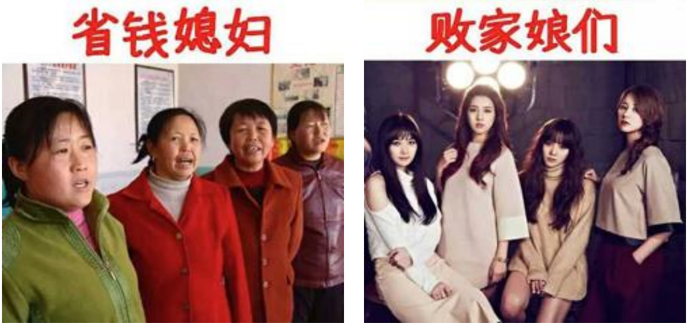
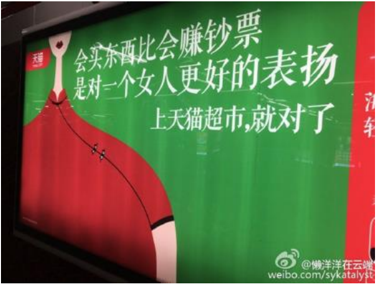
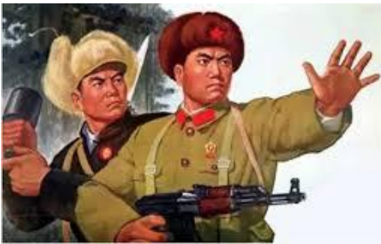
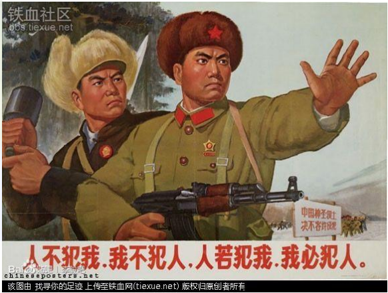
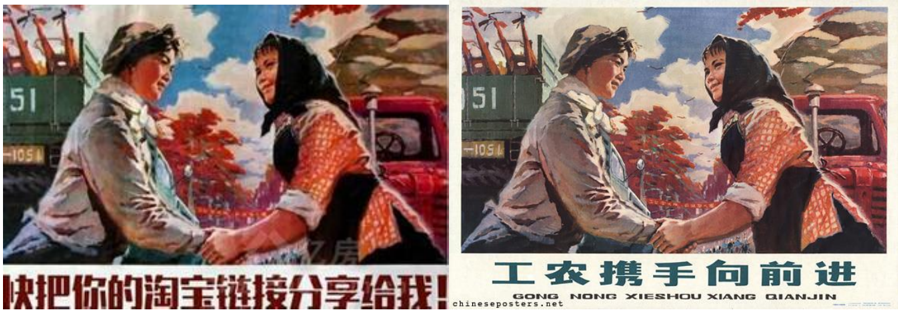
- Double Eleven discourse constructs a national, gendered spending spree that reduces women’s multiple social roles to that of consumer, exemplified by the term “spendthrift chicks” (败家娘们) and by online spoofs of socialist posters, such as changing a Korean War-era slogan to “Double Eleven, stay vigilant against fire, theft and spendthrifts” and changing “workers and peasants marching forward hand in hand” to “share your Taobao 3 link with me now!”
- The paper reports that in the 2015 Double Eleven, cosmetics and baby/maternity products were among the top five product types with highest sales and specifically target women; a 2007 Ernst & Young China report claimed 78% of married women were in charge of everyday expenditure and apparel purchasing for the family; Jack Ma observed women accounted for 70% of buyers on Alibaba.
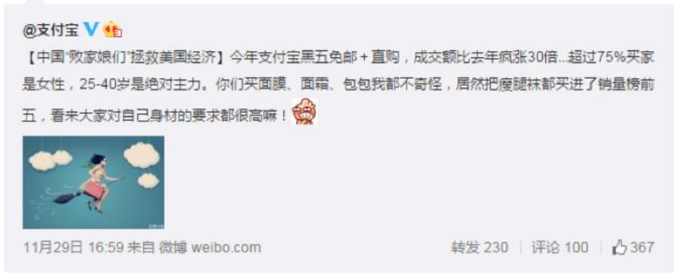
- It also cites Alipay’s claim that Black Friday 2015 sales volume increased 30 times over the previous year, with more than 75% of online shoppers reported to be Chinese women aged 25–40, and notes that the share of SOEs and urban collectives in the urban labour market declined from 75.7% in 1995 to 33.4% in 2002.
- The analysis concludes that consumption-based femininity conceals class and gender inequality, projects middle-class normativity, and designates rural women and female migrant workers as an “abject” lacking femininity and purchasing power; it calls for combining redistribution with recognition rather than celebrating “spendthrift chicks.”
Methods
- Critical discourse analysis (Fairclough) using purposive sampling of “illustrative” rather than “definitive” texts from the 2014 and 2015 Double Eleven festivals, including a text by a neoclassical economist, Alibaba advertisements, online song lyrics, online parodies, and news coverage.
- The corpus includes both institutional discourse (news coverage, advertisements) and popular discourse (online spoofs, digital memes), analyzed through a conceptual framework of ideology, hegemony, and discursive practice.
- The paper also draws on secondary sources and the authors’ own analysis of news coverage to connect Double Eleven discourse to China’s political economy, gender order, and consumer capitalism.
Limitations
- The authors state that their selected texts were “illustrative” rather than “definitive” and that purposive sampling was used, so the corpus is not exhaustive.
- The paper states that the transformation of class structure from the Maoist to Post-Mao era is “not discussed in detail here,” and it calls for future research on disjuncture, disarticulation, and counter-hegemonic practices by Chinese feminists.
- The text makes evident that this is an accepted manuscript version, which may differ from the published version, and the analysis is qualitative and discursive rather than based on audience reception or causal sales data.
Model-written summary. Check it against the paper before relying on it.
Integrity signals
Registry
Cites
Statistics
Figures
Verification
Claims the paper makes
1 Valid · 8 Not valid · 56 Not checked · 76 Own results and interpretations
None of the sources cited for this claim have been checked yet.
In the paper
“Purchasing decision in the other three categories, namely home appliance, smart phones and apparel, also rests predominantly with women.”
plain- Asserted: passes — The authors put it forward as true.
- Checkable: passes — It can be checked against evidence.
- Load-bearing: passes — The paper’s conclusions depend on it.
- Based: passes — The paper gives a reason why it holds.
In the paper
“Further, as the pressure for profit intensified, many urban enterprises stopped providing subsidized child care service, creating new obstacles to women's participation in paid labour (Ding et al. 2009, pp. 167-168).”
What the sources say
- Not matchedcites Ding et al. 2009, pp. 167-168
An author–year citation the paper’s reference list doesn’t settle. We don’t search these by name.
plainstates a cause- Asserted: passes — The authors put it forward as true.
- Checkable: passes — It can be checked against evidence.
- Load-bearing: unclear — It is unclear whether the paper’s conclusions depend on it.
- Based: passes — The paper gives a reason why it holds.
- Not matched
A result the paper states — it cites no source for it, so there is none to check. The quote shows it is in the paper.
In the paper
“The call for women to 'hold up half the sky' by joining the collective project of building socialism was hardly accompanied by a call for men to share household work or child rearing responsibility.”
plain- Asserted: passes — The authors put it forward as true.
- Checkable: passes — It can be checked against evidence.
- Load-bearing: passes — The paper’s conclusions depend on it.
- Based: passes — The paper gives a reason why it holds.
A result the paper states — it cites no source for it, so there is none to check. The quote shows it is in the paper.
In the paper
“Yet for many Chinese women, rediscovering their femininity is now perceived as the crucial step in reasserting their individuality and towards redefining their gendered subjectivity.”
plain- Asserted: passes — The authors put it forward as true.
- Checkable: passes — It can be checked against evidence.
- Load-bearing: passes — The paper’s conclusions depend on it.
- Based: passes — The paper gives a reason why it holds.
A result the paper reports from its own data — it cites no other source for it, so there is none to check. The quote shows it is in the paper.
In the paper
“A Google search for images and texts in Mandarin depicting 'spendthrift chicks' yields a kaleidoscope of online parodies that appropriate socialist propaganda posters to celebrate and mobilize online consumption, many of which are heavily gendered.”
plainstates an association- Asserted: passes — The authors put it forward as true.
- Checkable: passes — It can be checked against evidence.
- Load-bearing: passes — The paper’s conclusions depend on it.
- Based: passes — The paper gives a reason why it holds.
47 more claims
Create a free account to see all 141 claims and to verify the 12 references still open.
- Probably not a substantial claim. 54
- It may state two separate claims as one. 54
Claims other papers make about this one
Each is checked against this paper’s own text: does it say what the citing paper says it does?
The source backs part of the claim, not all of it — or backs it for a different population, condition or comparison.
In the citing paper
“The state adopts gender-essentialist discourses, advocating for women's irreducible difference from, and inferiority (in both physical and intellectual terms) to men, and disciplining those who fails to align.”
From #girls help girls#: feminist discussions and affective heterotopia in patriarchal China (2024) · cites this paper as Bingchun Meng and Yanning Huang 2017
Experimental — accuracy not yet measuredThe cited source says what the claim attributes to it.
In the citing paper
“Indeed, scholars point out that the post-socialist era has witnessed a resurgence of patriarchy.”
From #girls help girls#: feminist discussions and affective heterotopia in patriarchal China (2024) · cites this paper as Bingchun Meng and Yanning Huang 2017
Citations
Cites
Visual Pleasure and Narrative Cinema
Mulvey, L. (1975) · Screen · doi:10.1093/screen/16.3.6 · Cited by 8,680
Qualitative Communication Research Methods
Lindlof, T. R., & Taylor, B. C. (1994) · Cited by 5,768
Undoing the Demos: Neoliberalism’s Stealth Revolution
Brown, W. (2015) · Zone Books · doi:10.2307/j.ctt17kk9p8 · Cited by 4,453
Neoliberalism as Exception: Mutations in Citizenship and Sovereignty
Ong, A. (2006) · doi:10.1215/9780822387879 · Cited by 3,906
The Aftermath of Feminism: Gender, Culture and Social Change
McRobbie, Á. (2008) · Goldsmiths (University of London) · Cited by 2,871
Postfeminist media culture: Elements of a sensibility
Gill, R. (2007) · European Journal of Cultural Studies · doi:10.1177/1367549407075898 · Cited by 2,302
Desiring China: Experiments in Neoliberalism, Sexuality, and Public Culture
Rofel, L. (2007) · doi:10.1215/9780822389903 · Cited by 1,561
Visual Pleasure and Narrative Cinema
Mulvey, L. (1975) · Feminisms · doi:10.1007/978-1-349-14428-0_27 · Cited by 1,138
From Redistribution to Recognition? Dilemmas of Justice in a “Postsocialist” Age
(2014) · Justice Interruptus · doi:10.4324/9781315822174-8 · Cited by 1,121
The Problem of Ideology-Marxism without Guarantees
Hall, S. (1986) · Journal of Communication Inquiry · doi:10.1177/019685998601000203 · Cited by 1,105 · cited 1×
“Ideology is hence the kind of ‘discursive terrain’ that people take for granted when mapping their life and making sense of social relations (Hall 1986).”
Background
Research works printed but not linked: 14
- Althusser, L., 1971. Lenin and Philosophy . New York: Monthly Review Press.
- Althusser, L., 2008. On Ideology . London: Verso.
- Banet-Weiser, S., 2012. Authentic TM: The Politics of Ambivalence in a Brand Culture (Critical Cultural Communication) . New York; London: New York University Press.
- Billig, M., 1995. Banal Nationalism . London: Sage.
- Butler, J., 1990. Gender Trouble . New York: Routledge.
- Chow, R., 1991. Women and Chinese modernity: The politics of reading between West and East . Minneapolis: University of Minnesota Press.
- Deacon, D., Pickering, M., and Murdock, G., 2010. Researching Communication: A Practical Guide to Methods in Media and Cultural Analysis . London: Bloomsbury.
- Evans, H., 1997. Women and Sexuality in China . New York: The Continuum.
- Fraser, N., 1997. Justice Interrupts . London: Routledge.
- Fraser, N., 2013. Fortunes of feminism: From state-managed feminism to neoliberal crisis . London: Verso.
- Mies, M., 1986. Patriarchy and accumulation on a world scale . London: Zed Books.
- Mitchell, J., 1971. Women's Estate . Harmondsworth: Penguin.
- Riordan, E., 2002. Intersections and new directions: On feminism and political economy. In : E. R. Meehan & E. Riordan Eds . Sex & money: Feminism and political economy in the media . Thousand Oaks, CA: Sage, 3-15.
- Zhong, X., Wang, Z., and Di, B., 2001. Era . New Brunswick, NJ; London: Rutgers University Press.
Cited by
(2020) · doi:10.1080/14680777.2020.1837908 · Cited by 159
Yang, S., Li, L., & Zhang, J. (2018) · Sustainability · doi:10.3390/su10061801 · Cited by 124
Guo, J. (2022) · Global Media and China · doi:10.1177/20594364221095896 · Cited by 127
Wang Hong Fashion Culture and the Postfeminist Time in China
Liao, S. X. (2019) · Fashion Theory · doi:10.1080/1362704x.2019.1638158 · Cited by 103
Yin, S. (2021) · Cultural Studies · doi:10.1080/09502386.2021.1944242 · Cited by 91
Liu, T., & Lai, Z. (2020) · Information Communication & Society · doi:10.1080/1369118x.2020.1791217 · Cited by 82
Tracing Weibo (2009–2019): The commercial dissolution of public communication and changing politics
Jia, L., & Han, X. (2020) · Internet Histories · doi:10.1080/24701475.2020.1769894 · Cited by 51
When Anxious Mothers Meet Social Media: Wechat, Motherhood and the Imaginary of the Good Life
Meng, B. (2020) · Javnost - The Public · doi:10.1080/13183222.2020.1727276 · Cited by 56
Self-citationShifting the struggle inward: Mainstream debate on digital grassroots feminism in China
Yang, C. S., & Zhou, Y. (2023) · Asian Journal of Women s Studies · doi:10.1080/12259276.2023.2183453 · Cited by 51
A techno-feminist analysis of beauty app development in China’s high-tech industry
Peng, A. Y. (2021) · Journal of Gender Studies · doi:10.1080/09589236.2021.1929091 · Cited by 47
Platform as new “daddy”: China’s gendered wanghong economy and patriarchal platforms behind
Han, X. (2022) · Internet Policy Review · doi:10.14763/2022.1.1631 · Cited by 48
Femvertising and Postfeminist Discourse: Advertising to Break Menstrual Taboos in China
Guo, J., Zhang, Z., Song, J., Lu, J., Yu, D., & Liao, S. X. (2022) · Women s Studies in Communication · doi:10.1080/07491409.2022.2053624 · Cited by 46
Counter-discourse production in social media: A feminist CDA of a Weibo post
Wang, Q., & Ouyang, H. (2023) · Discourse & Communication · doi:10.1177/17504813221150187 · Cited by 43
Wang, Y., & Chang, J. (2023) · Asian Journal of Women s Studies · doi:10.1080/12259276.2023.2205672 · Cited by 41
Digital nationalism versus gender politics in post-reform China: Gender-issue debates on Zhihu
Peng, A. Y. (2022) · Global Media and Communication · doi:10.1177/17427665221125537 · Cited by 39
Chen, Z. T., & Cheung, M. (2020) · Social Semiotics · doi:10.1080/10350330.2020.1720992 · Cited by 44
#girls help girls#: feminist discussions and affective heterotopia in patriarchal China
Yang, X., & Hu, N. (2024) · Feminist Media Studies · doi:10.1080/14680777.2023.2229967 · Cited by 29
“Introduction; Alicia Leung 2003; Bingchun Meng and Yanning Huang 2017; Alex Zhao 2014).”
When feminists became ‘extremists’: A corpus-based study of representations of feminism on Weibo
Bao, K. (2023) · Discourse & Communication · doi:10.1177/17504813231171654 · Cited by 30
Sun, Q., & Ding, R. (2024) · Social Media + Society · doi:10.1177/20563051241283301 · Cited by 38
The womb as battleground: negotiating motherhood and feminism on Chinese social media
Tian, W., & Ge, J. (2024) · Feminist Media Studies · doi:10.1080/14680777.2024.2323653 · Cited by 32
Post-reform gender politics: how do Chinese Internet users portray Theresa May on Zhihu
Peng, A. Y., Cummings, J., & Li, Y. (2020) · Feminist Media Studies · doi:10.1080/14680777.2020.1788110 · Cited by 25
Guo, J., & Fang, K. (2022) · Journalism · doi:10.1177/14648849221108768 · Cited by 23
Peng, A. Y. (2020) · Feminist Media Studies · doi:10.1080/14680777.2020.1750779 · Cited by 21
Ge, J., & Tian, W. (2024) · Social Semiotics · doi:10.1080/10350330.2024.2405512 · Cited by 24
Postfeminist heroes and heroines in contemporary Chinese advertising
Liu, R. (2022) · Feminist Media Studies · doi:10.1080/14680777.2022.2149601 · Cited by 18
Going Public and Going Global: Chinese Internet Companies and Global Finance Networks
Jia, L.-R. (2018) · Westminster Papers in Communication and Culture · doi:10.16997/wpcc.280 · Cited by 15
Chang, A. H. (2025) · Humanities and Social Sciences Communications · doi:10.1057/s41599-025-04802-2 · Cited by 33
Chen, Z. T., & Chen, L. (2021) · Asian Journal of Women s Studies · doi:10.1080/12259276.2021.1913850 · Cited by 14
Online feminist stand-up comedy: an emerging affective-discursive intervention on gender in China
Li, D., & Guo, J. (2024) · Continuum · doi:10.1080/10304312.2024.2354247 · Cited by 19
Guo, J. (2024) · Global Media and China · doi:10.1177/20594364241278101 · Cited by 16
A Socialist Superwoman for the New Era
Wang, Y., & Mihelj, S. (2019) · Feminist Media Histories · doi:10.1525/fmh.2019.5.3.36 · Cited by 11
Pseudo-Feminism and Chinese Digital Influencers
Peng, A. Y. (2020) · Springer eBooks · doi:10.1007/978-3-030-59969-0_4 · Cited by 15
Huang, Y., Yang, Z., & Chang, K. (2024) · The Journal of Chinese Sociology · doi:10.1186/s40711-023-00204-6 · Cited by 22
Self-citationPun, N., & Chen, P. (2022) · Cultural Studies · doi:10.1080/09502386.2022.2056219 · Cited by 13
A wen-wu Approach to Male Teenage Chinese Sports Fans’ Heteronormative Interpretation of Masculinity
Peng, A. Y., Chen, Z. T., & Chen, S. (2023) · Feminist Review · doi:10.1177/01417789231155896 · Cited by 12
Wu, H., & Zhang, Y. (2025) · International Journal of Cultural Studies · doi:10.1177/13678779251323923 · Cited by 11
Wang, C. Y., & Chen, Z. (2023) · Nations and Nationalism · doi:10.1111/nana.12916 · Cited by 13
China's Livestreaming Local Officials: An Experiment in Popular Digital Communications
Sullivan, J., Zhao, Y., & Wang, W. (2023) · The China Quarterly · doi:10.1017/s030574102300070x · Cited by 15
Xu, J. (2025) · Journal of Gender Studies · doi:10.1080/09589236.2025.2475206 · Cited by 12
Sun, Q. (2024) · Gender Place & Culture · doi:10.1080/0966369x.2024.2392125 · Cited by 9
Min, X., & Zheng, S. (2025) · Journal of Gender Studies · doi:10.1080/09589236.2025.2506767 · Cited by 7
More than perfect: Cosmetic surgery and ageing single women in contemporary China
Chow, Y. F. (2022) · European Journal of Cultural Studies · doi:10.1177/13675494221086308 · Cited by 6
Tian, W., & Ge, J. (2024) · Humanities and Social Sciences Communications · doi:10.1057/s41599-024-03819-3 · Cited by 18
Decoding the gendered design and (dis)affordances of face-editing technologies in China
Luo, X., & Zhang, R. (2023) · International Journal of Human-Computer Studies · doi:10.1016/j.ijhcs.2023.103149 · Cited by 7
Wang, Y., & Chang, J. (2024) · Asian Journal of Women s Studies · doi:10.1080/12259276.2024.2418672 · Cited by 6
Sexism and Male Self-Cognitive Crisis: Sentiment and Discourse Analysis of an Internet Event
Hu, B., Luo, F.-L., Peng, Z.-W., & Lin, S. (2021) · Journal of Broadcasting & Electronic Media · doi:10.1080/08838151.2021.2019741 · Cited by 7
Women on China’s Internet: Consumption, contestation, and challenges for empowerment
Song, Y., Li, J., & Zou, S. (2024) · Communication and the Public · doi:10.1177/20570473241280322 · Cited by 6
Foregrounding intersectionality in rural youth’s schooling experiences in China: a queer re-reading
Wang, W. (2019) · International Journal of Qualitative Studies in Education · doi:10.1080/09518398.2019.1609126 · Cited by 7
From media events to my events: Chinese mediated festivals in the digital era 1
Feng, X., & Lu, I. F. (2022) · Convergence The International Journal of Research into New Media Technologies · doi:10.1177/13548565221110071 · Cited by 5
Li, R., & Abidin, C. (2025) · Social Media + Society · doi:10.1177/20563051251349742 · Cited by 5
Representing Single Women: The Transformation of “Leftover Women” on Chinese TV Series
Peng, A. (2022) · Journal of Communication Inquiry · doi:10.1177/01968599221130750 · Cited by 5
Chen, A., Moradi, S., & Hort, J. (2023) · Journal of Dairy Science · doi:10.3168/jds.2023-23502 · Cited by 4
Xu, D., & Liu, T. (2024) · Journal of Cultural Economy · doi:10.1080/17530350.2024.2346208 · Cited by 4
Postfeminist branding: masculinity and nationalist sentiment in Li Jiaqi’s beauty livestreaming
Chen, G. (2025) · Feminist Media Studies · doi:10.1080/14680777.2025.2544349 · Cited by 3
Liu, X. (2025) · Social Media + Society · doi:10.1177/20563051251358524 · Cited by 7
Zhang, Y. S., & Ling, T. (2026) · Feminist Media Studies · doi:10.1080/14680777.2026.2622442 · Cited by 4
Chen, J., Liu, C., & Bian, F. (2024) · Gender Place & Culture · doi:10.1080/0966369x.2024.2319053 · Cited by 3
Lu, M. (2024) · Continuum · doi:10.1080/10304312.2024.2419592 · Cited by 3
Liu, M. (2024) · Feminist Media Studies · doi:10.1080/14680777.2024.2345204 · Cited by 7
Zhang, Z., Zhu, H., & Lu, M. (2025) · Mass Communication & Society · doi:10.1080/15205436.2025.2489509 · Cited by 4
Wang, Y., Feng, D. W., & Wang, H. (2024) · SAGE Open · doi:10.1177/21582440241268713 · Cited by 4
Wang, J., & Zhao, Y. (2024) · Pragmatics and Society · doi:10.1075/ps.23059.wan · Cited by 6
Lai, Z., & Ho, M. H. S. (2024) · East Asian Journal of Popular Culture · doi:10.1386/eapc_00141_1 · Cited by 2
Cao, H., & Zhong, Y. (2024) · Journal of Computer-Mediated Communication · doi:10.1093/jcmc/zmae005 · Cited by 4
The Gendered Nature of China’s Digital Public Sphere
Peng, A. Y. (2020) · Springer eBooks · doi:10.1007/978-3-030-59969-0_3 · Cited by 2
Hu, X., He, W., & Wang, L. (2024) · Australian Feminist Studies · doi:10.1080/08164649.2025.2497777 · Cited by 1
Zou, W., Huang, L., & Li, X. (2025) · Communication Monographs · doi:10.1080/03637751.2025.2561970 · Cited by 4
The Surname War: Chinese Women’s Discursive Resistance Against Patronymy Online
Wang, Y., & Chang, J. (2024) · SAGE Open · doi:10.1177/21582440241305631 · Cited by 1
Hung, A. H.-C. (2021) · Asian Journal of Law and Society · doi:10.1017/als.2020.56 · Cited by 1
Reshaping female consumer subjectivity: Beauty consumption practices in Li Jiaqi’s livestream room
Chen, G., & Adnan, H. M. (2025) · Journal of Consumer Culture · doi:10.1177/14695405251356543 · Cited by 2
Qing, S., & Prado, E. (2020) · Observatorio (OBS*) · doi:10.15847/obsobs14220201602 · Cited by 3
Seeing (post)feminism through visual style: The case of pro-woman advertising in China
Chan, J., & Aiello, G. (2026) · Feminist Media Studies · doi:10.1080/14680777.2026.2696828
Gender Representation in Chinese Political News Coverage of Corruption
Li, Y. (2020) · HARVEST (University of Saskatchewan)
Cruel attachments to post-socialist urban masculinity: Chinese men’s backlash towards Ding Zhen
Lu, M. (2026) · Journal of Urban Cultural Studies · doi:10.1386/jucs_00118_1
“Do not approach men. You will be miserable.”
Zhang, Y., & Zhang, L. (2025) · Internet Pragmatics · doi:10.1075/ip.00120.zha
Chen, Z., & Yan, J. (2026) · Discourse & Society · doi:10.1177/09579265261465904
Jia, X. (2026) · Springer eBooks · doi:10.1007/978-3-032-18396-5_3 · Cited by 2
Consuming Places and Communicating Mobility Through Purchasing
Xie, Z. (2024) · Springer eBooks · doi:10.1007/978-981-97-7348-0_5
Frauen in China: Konservative Wende der Frauenpolitik unter Xi Jinping
Spakowski, N. (2022) · FEMINA POLITICA – Zeitschrift für feministische Politikwissenschaft · doi:10.3224/feminapolitica.v31i1.09
Book Review: A Feminist Reading of China’s Digital Public Sphere
Chen, Z. T. (2023) · Global Media and China · doi:10.1177/20594364231160106
Xia, Y., & Sun, M. (2026) · Asian Women · doi:10.64446/aw.2026.9.42.3.503
Peng, A. Y. (2020) · Springer eBooks · doi:10.1007/978-3-030-59969-0_7
(Un)Doing gender norms in postfeminist China: the case of male beauty influencer Li Jiaqi
Huang, H., Graeve, K. D., & Praet, E. V. (2025) · Consumption Markets & Culture · doi:10.1080/10253866.2025.2513448 · Cited by 1
Лю, Т., & Xu, W. (2025) · Feminist Media Studies · doi:10.1080/14680777.2025.2598650
Living on My Own, Creatively, Precariously
Chow, Y. F. (2018) · Springer eBooks · doi:10.1007/978-3-319-76898-4_1
Han, C., & Ge, J. (2026) · Chinese Journal of Communication · doi:10.1080/17544750.2026.2677587
Gender and (Post)feminism in China
Jia, X. (2026) · Springer eBooks · doi:10.1007/978-3-032-18396-5_2
Researching the Mediated Structure of Feeling
Wu, H. (2025) · Palgrave studies in mediating kinship, representation, and difference. · doi:10.1007/978-3-031-83742-5_2
Wu, H. (2025) · Palgrave studies in mediating kinship, representation, and difference. · doi:10.1007/978-3-031-83742-5_1
Metadata
- Authors
- Meng, B., & Huang, Y.
- Affiliations
- London School of Economics and Political Science (GB)
- Corresponding author
- Meng, Bingchun
- Venue
- Cultural Studies
- Publisher
- Informa UK Limited
- Published
- 2017-07-19
- Volume
- 31
- Issue
- 5
- Pages
- 659-684
- ISSN
- 0950-2386 (ISSN-L)
- 1466-4348
- OpenAlex
- W2729981829
- Cited by
- 92
- References
- 56
- Citations by year
- 2026: 9 · 2025: 15 · 2024: 23 · 2023: 11 · 2022: 11 · 2021: 5 · 2020: 12 · 2019: 3 · 2018: 3
- FWCI
- 10.26
- Type
- journal article
- Language
- en
- Open access
- green
- eprints.lse.ac.uk
- Licence
- cc-by
- Locations
- Cultural Studies (publishedVersion)
- London School of Economics and Political Science Research Online (London School of Economics and Political Science) (acceptedVersion)
- RePEc: Research Papers in Economics (submittedVersion, cc-by)
- London School of Economics and Political Science Theses Online (London School of Economics and Political Science) (submittedVersion)
- LSE Research Online Documents on Economics (submittedVersion)
- RePEc: Research Papers in Economics (submittedVersion)
- Topics
- Social Sciences › Gender Studies › Gender and Feminist Studies
- Social Sciences › Gender Studies › Gender, Feminism, and Media
- Social Sciences › Gender Studies › Media, Gender, and Advertising
- Keywords
- patriarchal capitalism, gender discourse, consumerism, state capitalism, sexist discourse, media coverage, social media, economic stagnation, Chinese consumer culture
About these checks
Registry, retraction, Cites and statistics results are computed, not judged, with one exception: a printed reference that no index lists is read once by a model before it counts as a citation error. Claims are extracted by a model and kept only when their quote appears verbatim in the text; each cited source is then checked, with a model’s help, for whether it says what the claim relies on. Those verdicts can be wrong — read the claim’s quote and the cited source before relying on one.
A language model drew the claims from the paper on 2026-10-10, under version 3 of the claim definition (model deepseek-v4.1-flash, prompt extract-v3).
A second model labelled each claim on 2026-10-10 (model jev-1.13-20260917, definition revision gold-guideline-v0.2).
Statistics and arithmetic are recomputed, not judged.
Confidence bands are shown only for fields calibrated on our annotated test set. None is calibrated yet, so no band is shown.
What counts as a claim ›How we measure confidence ›How we check this ›
Are you an author, or do you see a problem with this page? Request a review
Data sources
Bibliographic data: Semantic Scholar, OpenAlex, Crossref.
Contains information from the Semantic Scholar Academic Graph Datasets, made available under the ODC Attribution License (ODC-BY 1.0).
Semantic Scholar’s data is described in: Kinney, R., et al. (2023). The Semantic Scholar Open Data Platform. arXiv:2301.10140.
