

Preventing drift of oxygen isotopes of CO2-in-air stored in glass sample flasks: new insights and recommendations
Open accessThe DOI matches its Crossref record; 25 of the 26 references it cites were found in a registry or an index.
Abstract
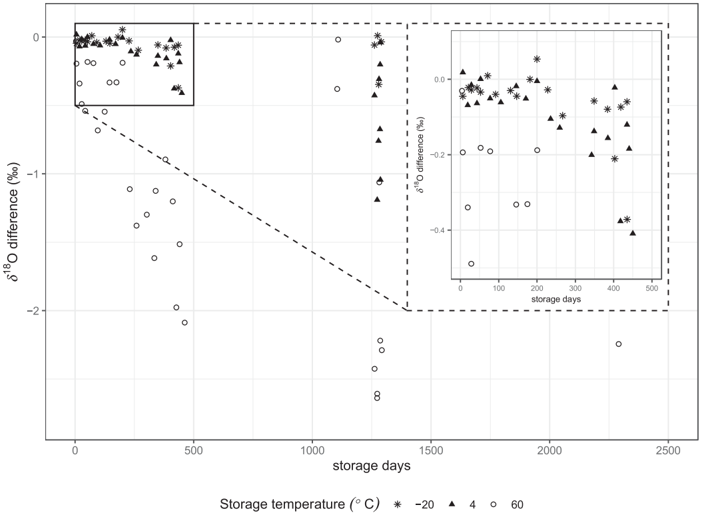
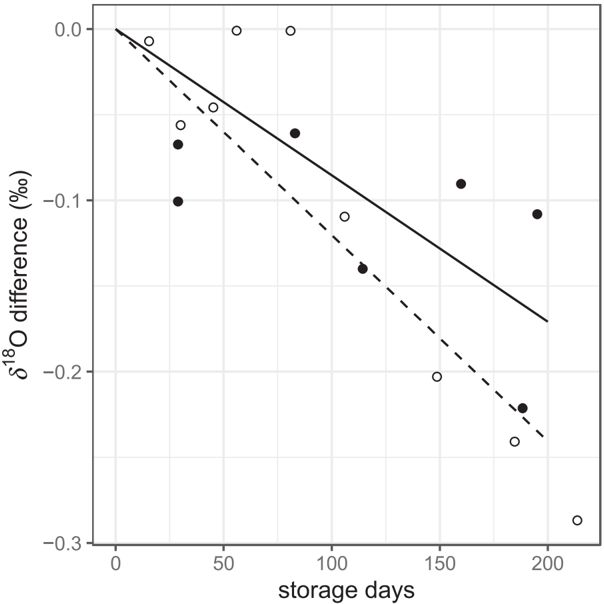
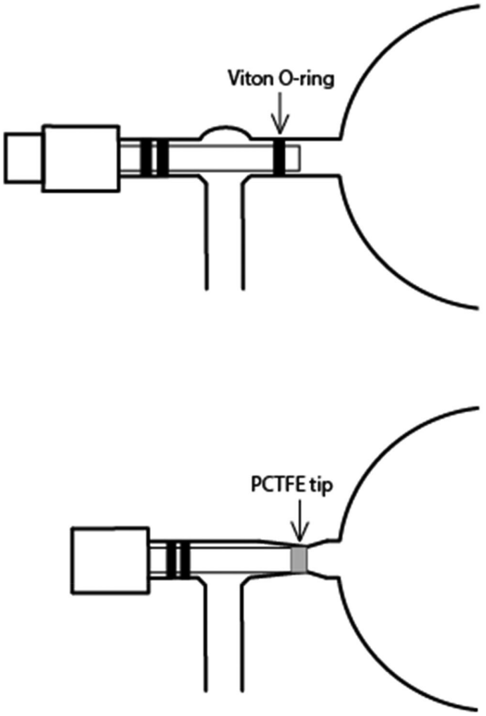
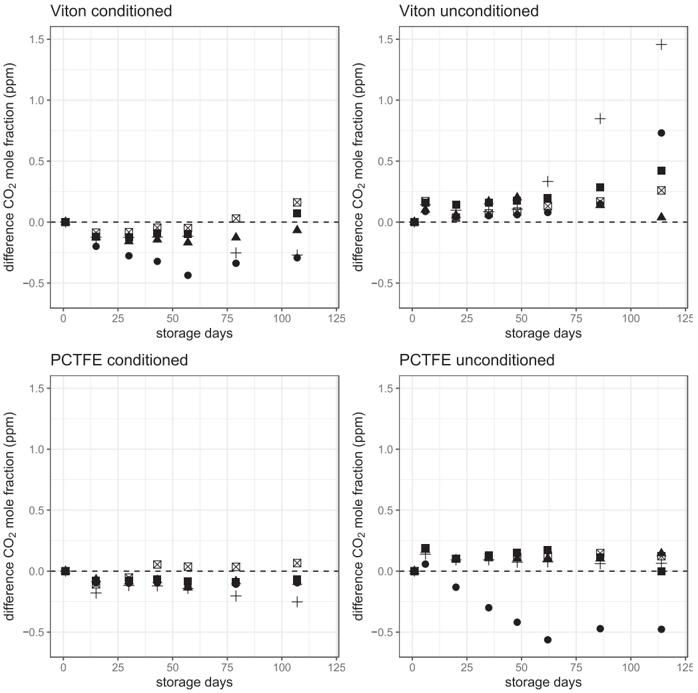
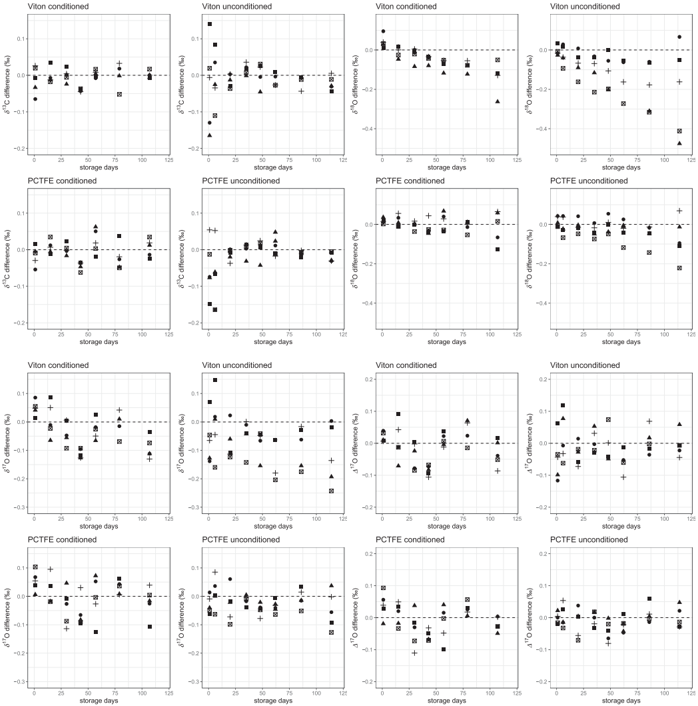
It is known that the oxygen isotope composition of CO2-in-air, when stored over longer time periods in glass sample flasks, tends to drift to more negative values while the carbon isotope composition remains stable. The exact mechanisms behind this drift were still unclear. New experimental results reveal that water already inside the flasks during sampling plays a major role in the drift of the oxygen isotopes. A drying method to remove any water sticking to the inner walls by evacuating the flasks for more than 72 h while heating to 60 °C significantly decreases drift of the oxygen isotopes. Moreover, flasks not dried with this method showed higher differences among drift rates of individual flasks. This is explained through the buildup of H2O molecules sticking to the inner walls. Humidity of the air samples in the flasks as well as surface characteristics will lead to differences among flasks. Results also show that permeability of water is higher through Viton O-ring flask seals than through polychlorotrifluoroethylene (PCTFE) shaft seals, and that the stability of flasks sealed with the latter is significantly better over time.
Overview
The claims and statistics of this paper haven’t been checked yet.
Free: it reads the open-access text and checks the first 5 claims that cite a source we can check. Create a free account to check every claim.
Integrity signals
Registry
Cites
Statistics
Figures



Verification
Claims the paper makes
The claims and statistics of this paper haven’t been checked yet.
Free: it reads the open-access text and checks the first 5 claims that cite a source we can check. Create a free account to check every claim.
Claims other papers make about this one
Each is checked against this paper’s own text: does it say what the citing paper says it does?
The source backs part of the claim, not all of it — or backs it for a different population, condition or comparison.
In the citing paper
“In addition, there is a possibility that (1) moisture (H2O) might also be introduced from the laboratory air and absorbed onto the inner glass wall of Labco vials during the storage and use of Labco vials (e.g., [38]) and that (2) the routine flush and fill procedure with He–CO2 or He gas may not entirely remove tightly bound water (H2O) on the glass wall of Labco vials.”
From Guidelines for Accurate and Precise Stable Isotope Analysis of Calcite, Dolomite, and Magnesite Using a Carbonate Device for Continuous Flow‐Isotope Ratio Mass Spectrometry (CF‐IRMS) (2025) · cites this paper as [38]
Experimental — accuracy not yet measured
Self-check
Percentages, sums and reported differences re-computed from the paper’s own numbers.
The self-check needs the paper’s full text.
Citations
Cites
Ciais, P., Tans, P. P., Trolier, M., White, J. W. C., & Francey, R. J. (1995) · Science · doi:10.1126/science.269.5227.1098 · Cited by 757
Changes in oceanic and terrestrial carbon uptake since 1982
Francey, R. J., Tans, P. P., Allison, C. E., Enting, I. G., White, J. W. C., & Trolier, M. (1995) · Nature · doi:10.1038/373326a0 · Cited by 477
Interannual variability in the oxygen isotopes of atmospheric CO2 driven by El Niño
Welp, L. R., Keeling, R. F., Meijer, H. A. J., Bollenbacher, A. F., Piper, S. C., Yoshimura, K., Francey, R. J., Allison, C. E., & Wahlen, M. (2011) · Nature · doi:10.1038/nature10421 · Cited by 248
Self-citationHigh‐precision measurements of 17 O/ 16 O and 18 O/ 16 O ratios in CO 2
Barkan, E., & Luz, B. (2012) · Rapid Communications in Mass Spectrometry · doi:10.1002/rcm.6400 · Cited by 247
Trolier, M., White, J. W. C., Tans, P. P., Masarie, K. A., & Gemery, P. A. (1996) · Journal of Geophysical Research: Atmospheres · doi:10.1029/96jd02363 · Cited by 222
A Fourier transform infrared trace gas and isotope analyser for atmospheric applications
Griffith, D. W. T., Deutscher, N. M., Caldow, C., Kettlewell, G., Riggenbach, M., & Hammer, S. (2012) · Atmospheric Measurement Techniques · doi:10.5194/amt-5-2481-2012 · Cited by 215
Latitudinal variation in oxygen-18 of atmospheric CO2
Francey, R. J., & Tans, P. P. (1987) · Nature · doi:10.1038/327495a0 · Cited by 189
Jacob, H., & Sonntag, C. (1991) · Tellus B: Chemical and Physical Meteorology · doi:10.3402/tellusb.v43i3.15276 · Cited by 166
Keeling, C. D., Carter, A. F., & Mook, W. G. (1984) · Journal of Geophysical Research Atmospheres · doi:10.1029/jd089id03p04615 · Cited by 146
Water on Salt: An Infrared Study of Adsorbed H2O on NaCl(100) under Ambient Conditions
Peters, S. J., & Ewing, G. E. (1997) · The Journal of Physical Chemistry B · doi:10.1021/jp972810b · Cited by 132
Permeation of atmospheric gases through polymer O‐rings used in flasks for air sampling
Sturm, P., Leuenberger, M., Sirignano, C., Neubert, R. E. M., Meijer, H. A. J., Langenfelds, R. L., Brand, W. A., & Tohjima, Y. (2004) · Journal of Geophysical Research Atmospheres · doi:10.1029/2003jd004073 · Cited by 103
Self-citationGhosh, P., Patecki, M., Rothe, M., & Brand, W. A. (2005) · Rapid Communications in Mass Spectrometry · doi:10.1002/rcm.1886 · Cited by 77
Self-citationThe N2O correction in the carbon and oxygen isotopic analysis of atmospheric CO2
Mook, W. G., & der Hoek, S. V. (1983) · Chemical Geology · doi:10.1016/s0009-2541(83)80021-7 · Cited by 70
Gemery-Hill, P. A., Trolier, M., & White, J. W. C. (1996) · Journal of Geophysical Research Atmospheres · doi:10.1029/96jd00053 · Cited by 68
Werner, R. A., Rothe, M., & Brand, W. A. (2001) · Rapid Communications in Mass Spectrometry · doi:10.1002/rcm.487 · Cited by 57
Self-citationJena Reference Air Set (JRAS): a multi-point scale anchor for isotope measurements of CO 2 in air
Wendeberg, M., Richter, J. M., Rothe, M., & Brand, W. A. (2013) · Atmospheric measurement techniques · doi:10.5194/amt-6-817-2013 · Cited by 54
Self-citationBaier, B. C., Sweeney, C., Choi, Y., Davis, K. J., DiGangi, J. P., Feng, S., Fried, A., Halliday, H. S., Higgs, J., Lauvaux, T., et al. (2020) · Journal of Geophysical Research Atmospheres · doi:10.1029/2019jd031339 · Cited by 50
A Mass Spectrometric Study of the Outgassing of Some Elastomers and Plastics
Barton, R., & Govier, R. P. (1965) · Journal of Vacuum Science and Technology · doi:10.1116/1.1492413 · Cited by 37
Outgassing rate measurements of stainless steel and polymers using the difference method
Battes, K., Day, C., & Hauer, V. (2015) · Journal of Vacuum Science & Technology A Vacuum Surfaces and Films · doi:10.1116/1.4905099 · Cited by 36
Nelson, S. T. (2000) · Rapid Communications in Mass Spectrometry · doi:10.1002/(sici)1097-0231(20000229)14:4<293::aid-rcm869>3.0.co;2-l · Cited by 33
Steur, P. M., Scheeren, B., Nelson, D. D., McManus, J. B., & Meijer, H. A. J. (2021) · Atmospheric measurement techniques · doi:10.5194/amt-14-4279-2021 · Cited by 33
Self-citationValidation of routine continuous airborne CO 2 observations near the Bialystok Tall Tower
Chen, H., Winderlich, J., Gerbig, C., Katrynski, K., Jordan, A., & Heimann, M. (2012) · Atmospheric measurement techniques · doi:10.5194/amt-5-873-2012 · Cited by 12
The Stability of 100 ppb Hydrogen Sulfide Standards
Benesch, R., Haouchine, M., & Jacksier, T. (2004) · Analytical Chemistry · doi:10.1021/ac049016o · Cited by 12
Caution on the use of Viton® or FETFE® O-rings in carbon dioxide sample containers for δ180 analysis
Revesz, K. M., & Coplen, T. B. (1991) · Chemical Geology Isotope Geoscience section · doi:10.1016/0168-9622(91)90054-z · Cited by 7
PCTFE as a solution to birefringence in atom trap viewports
Warner, C., Behr, J. A., & Gorelov, A. (2014) · Review of Scientific Instruments · doi:10.1063/1.4900957 · Cited by 4
Research works printed but not linked: 1
- Rothe M, Jordan A, Brand WA. Trace gases, δ 13 C and δ 18 O of CO 2 -in-air samples: storage in glass flasks using PCTFE seals and other effects. In: Proceedings of the 12th IAEA/WMO meeting of CO 2 experts; 2005. p. 64-70.
Cited by
Chanca, I. S., Levin, I., Trumbore, S. E., Macário, K., Lavrič, J. V., Quesada, C. A., de Araújo, A. C., Dias‐Júnior, C. Q., van Asperen, H., Hammer, S., et al. (2025) · Biogeosciences · doi:10.5194/bg-22-455-2025 · Cited by 12
International Atomic Energy Agency (2024) · International Atomic Energy Agency eBooks · doi:10.61092/iaea.logm-wiux · Cited by 9
Steur, P. M., Scheeren, B., Koren, G., Adnew, G. A., Peters, W., & Meijer, H. A. J. (2024) · Atmospheric chemistry and physics · doi:10.5194/acp-24-11005-2024 · Cited by 6
Self-citationDasgupta, B., Menoud, M., van der Veen, C., Levin, I., Veidt, C., Moossen, H., Michel, S. E., Sperlich, P., Morimoto, S., Fujita, R., et al. (2025) · Atmospheric measurement techniques · doi:10.5194/amt-18-6591-2025 · Cited by 5
Self-citationKim, S., Kim, S., & Knyf, M. (2025) · Rapid Communications in Mass Spectrometry · doi:10.1002/rcm.9958 · Cited by 2
Metadata
- Authors
- Steur, P. M., Botter, D., Scheeren, H. A., Moossen, H., Rothe, M., & Meijer, H. A. J.
- Affiliations
- University of Groningen (NL)
- Centre for Isotope Research (CIO), Energy and Sustainability Institute Groningen (ESRIG), University of Groningen, Groningen, Netherlands
- Max Planck Institute for Biogeochemistry (DE)
- Corresponding author
- Steur, Pharahilda M.
- Venue
- Isotopes in Environmental and Health Studies
- Publisher
- Informa UK Limited
- Published
- 2023-05-04
- Volume
- 59
- Issue
- 3
- Pages
- 309-326
- ISSN
- 1025-6016 (ISSN-L)
- 1477-2639
- OpenAlex
- W4384819723
- Cited by
- 13
- References
- 26
- Citations by year
- 2026: 2 · 2025: 3 · 2024: 8
- FWCI
- 1.46
- Type
- journal article
- Language
- en
- Open access
- hybrid
- doi.org
- Licence
- Locations
- Isotopes in Environmental and Health Studies (publishedVersion, cc-by)
- PubMed (publishedVersion)
- University of Groningen research database (University of Groningen / Centre for Information Technology) (submittedVersion, cc-by)
- Funders
- European Union’s Horizon 2020 research and innovation programme
- Topics
- Physical Sciences › Environmental Science › Global and Planetary Change › Atmospheric and Environmental Gas Dynamics
- Physical Sciences › Earth and Planetary Sciences › Geochemistry and Petrology › Groundwater and Isotope Geochemistry
- Physical Sciences › Environmental Science › Ecology › Isotope Analysis in Ecology
- Keywords
- sample storage, vacuum drying, water permeability, isotope fractionation
- MeSH terms
- Carbon Dioxide, Carbon Isotopes, Humidity, Oxygen, Oxygen Isotopes, Water
About these checks
Registry, retraction, Cites and statistics results are computed, not judged, with one exception: a printed reference that no index lists is read once by a model before it counts as a citation error. Claims are extracted by a model and kept only when their quote appears verbatim in the text; each cited source is then checked, with a model’s help, for whether it says what the claim relies on. Those verdicts can be wrong — read the claim’s quote and the cited source before relying on one.
Statistics and arithmetic are recomputed, not judged.
Confidence bands are shown only for fields calibrated on our annotated test set. None is calibrated yet, so no band is shown.
What counts as a claim ›How we measure confidence ›How we check this ›
Are you an author, or do you see a problem with this page? Request a review
Data sources
Bibliographic data: Semantic Scholar, OpenAlex, Crossref.
Contains information from the Semantic Scholar Academic Graph Datasets, made available under the ODC Attribution License (ODC-BY 1.0).
Semantic Scholar’s data is described in: Kinney, R., et al. (2023). The Semantic Scholar Open Data Platform. arXiv:2301.10140.
