

Calibrating Reliance on Automated Advice: Transparency and Trust Calibration Feedback
Open accessThe DOI matches its Crossref record; 62 of the 62 references it cites were found in a registry or an index.
Abstract
Inappropriate reliance on automated advice can result in humans accepting incorrect or rejecting correct advice. Increased automation transparency and trust calibration feedback are principles purported to promote accurate automation use. We examined the effects of automation transparency, trust calibration feedback, and their potential interacting effect on automation use accuracy and other outcomes. Participants completed uninhabited vehicle management missions by agreeing/disagreeing with automated advice. Transparency was manipulated within-subjects (low, high) and trust calibration feedback between-subjects (absent, present). If trust was inappropriate, trust calibration feedback instructed participants to take their time and carefully check display information. Higher transparency benefited automation use accuracy, decision time, perceived workload, trust, and usability. Trust calibration feedback had no benefit on automation use accuracy and subsequently did not amplify the benefits of increased transparency. These findings have potential implications to inform the design of automated decision aids to support human understanding of, and calibration to, automation capabilities.
Overview
The claims and statistics of this paper haven’t been checked yet.
Free: it reads the open-access text and checks the first 5 claims that cite a source we can check. Create a free account to check every claim.
Integrity signals
Registry
Cites
Statistics
Figures


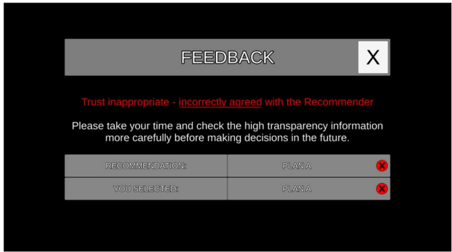
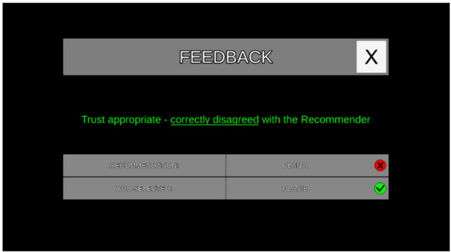
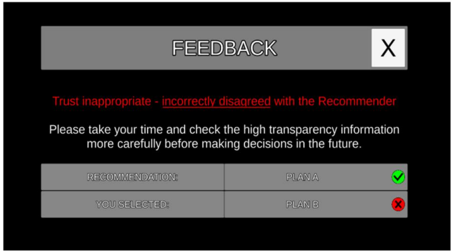
Verification
Claims the paper makes
The claims and statistics of this paper haven’t been checked yet.
Free: it reads the open-access text and checks the first 5 claims that cite a source we can check. Create a free account to check every claim.
Claims other papers make about this one
Each is checked against this paper’s own text: does it say what the citing paper says it does?
The source backs part of the claim, not all of it — or backs it for a different population, condition or comparison.
In the citing paper
“Multiple explanation types (Naiseh etal. 2023) and trust calibration feedback (Tatasciore and Loft 2025) are proven not to help users recognize incorrect AI recommendations as well.”
From Exploring automation bias in human–AI collaboration: a review and implications for explainable AI (2026) · cites this paper as Tatasciore and Loft 2025
Experimental — accuracy not yet measuredThe cited source says what the claim attributes to it.
In the citing paper
“Offering trust calibration feedback did not help either (Tatasciore and Loft 2025).”
From Exploring automation bias in human–AI collaboration: a review and implications for explainable AI (2026) · cites this paper as Tatasciore and Loft 2025
Self-check
Percentages, sums and reported differences re-computed from the paper’s own numbers.
The self-check needs the paper’s full text.
Citations
Cites
SUS: A 'Quick and Dirty' Usability Scale
(1996) · Usability Evaluation In Industry · doi:10.1201/9781498710411-35 · Cited by 8,989
Trust in Automation: Designing for Appropriate Reliance
Lee, J. D., & See, K. A. (2004) · Human Factors: The Journal of the Human Factors and Ergonomics Society · doi:10.1518/hfes.46.1.50_30392 · Cited by 6,605 · cited 2×
“The provision of increased transparency may amplify automation bias if participants ascribe greater analysis capability and power/ authority to automation that provides an increased rationale (local explanation) for its recommendations (Dwivedi et al., 2023; Lee & See, 2004).”
Cohen, J. (1992) · Current Directions in Psychological Science · doi:10.1111/1467-8721.ep10768783 · Cited by 5,870
Engineering Psychology and Human Performance
Wickens, C. D., Hollands, J. G., Banbury, S., & Parasuraman, R. (2015) · Psychology Press eBooks · doi:10.4324/9781315665177 · Cited by 4,982
Humans and automation: Use, misuse, disuse, abuse
Parasuraman, R., & Riley, V. (1997) · Human Factors: The Journal of the Human Factors and Ergonomics Society · doi:10.1518/001872097778543886 · Cited by 4,554 · cited 1×
“…under-trust increases the probability of under-relying on automation and disusing automated advice (rejecting correct advice), whereas excessive trust increases the probability of over-reliance and misusing automated advice (accepting incorrect advice; Lee & See, 2004; Parasuraman & Riley, 1997).”
A Meta-Analysis of Factors Affecting Trust in Human-Robot Interaction
Hancock, P. A., Billings, D. R., Schaefer, K. E., Chen, J. Y. C., de Visser, E. J., & Parasuraman, R. (2011) · Human Factors: The Journal of the Human Factors and Ergonomics Society · doi:10.1177/0018720811417254 · Cited by 2,051 · cited 1×
“Numerous factors such as human characteristics (e.g., personality), situational elements (e.g., task difficulty), and automation design (e.g., predictability) have been shown to impact trust in and reliance on automation (Hancock et al., 2011).”
(2011) · Cited by 2,025
Proceedings of the Human Factors and Ergonomics Society 2019 Annual Meeting
(2019) · Proceedings of the Human Factors and Ergonomics Society Annual Meeting · doi:10.1177/1071181319631171 · Cited by 1,432
Explainable AI (XAI): Core Ideas, Techniques, and Solutions
Dwivedi, R., Dave, D., Naik, H., Singhal, S., Omer, R., Patel, P., Qian, B., Wen, Z., Shah, T., Morgan, G., et al. (2023) · ACM Computing Surveys · doi:10.1145/3561048 · Cited by 1,386
Pashler, H., & Wagenmakers, E. (2012) · Perspectives on Psychological Science · doi:10.1177/1745691612465253 · Cited by 1,321 · cited 1×
“The importance of establishing the robustness and generality of psychological effects is well-recognized by scholars (e.g., Pashler & Wagenmakers, 2012; Yong, 2012), and synthesizing findings across multiple studies can be used to derive more precise effect size estimates and in doing so facilitate…”
Research works printed but not linked: 2
- 47. Stein, E. S. (1985). Air traffic controller workload: An examination of workload probe (No. DOT/FAA/CT-TN84/24). Department of Transportation, Federal Aviation Administration, William J. Hughes Technical Center.
- 54. Van de Merwe, K., Mallam, S., Nazir, S., & Engelhardtsen, Ø. (2024). The influence of agent transparency and complexity on situation awareness, mental workload, and task performance. Journal of Cognitive Engineering and Decision Making, 18(2), 156-184. https:// doi.org/10.1177/1555343424124055 · doi:10.1177/1555343424124055
Cited by
Exploring automation bias in human–AI collaboration: a review and implications for explainable AI
Romeo, G., & Conti, D. (2026) · AI & SOCIETY · doi:10.1007/s00146-025-02422-7 · Cited by 209
“Multiple explanation types (Naiseh et al. 2023) and trust calibration feedback (Tatasciore and Loft 2025) are proven not to help users recognize incorrect AI recommendations as well.”
Shahin, M., Maghanaki, M., & Chen, F. F. (2026) · Expert Systems with Applications · doi:10.1016/j.eswa.2026.131606 · Cited by 12
Zheng, J., Guo, Y., Rong, W., Zhou, W., Wang, X., & Qi, X. (2025) · Ocean Engineering · doi:10.1016/j.oceaneng.2025.122913 · Cited by 5
Tatasciore, M., Bennett, L., Bowden, V. K., Bell, J., Visser, T. A. W., McAnally, K. I., McCarley, J. S., Thompson, M. B., Shanahan, C., Morris, R. A., et al. (2025) · Human Factors The Journal of the Human Factors and Ergonomics Society · doi:10.1177/00187208251349269 · Cited by 6
“…with our prior work using the same (or very similar) UV management tasks, which demonstrated that fi xed high compared to fi xed low transparency leads to more accurate automation use (e.g. Tatasciore et al., 2023; Tatasciore et al., 2024; Tatasciore & Loft, 2024; Tatasciore & Loft, 2025).”
InfluentialSelf-citationThe benefits of automation transparency are dependent on human attention control capacity
Gegoff, I., Tatasciore, M., Bowden, V. K., & Loft, S. D. (2025) · Applied Ergonomics · doi:10.1016/j.apergo.2025.104619 · Cited by 3
Self-citationBrunyé, T. T., Petrimoulx, M. V., & Cantelon, J. A. (2026) · Sensors · doi:10.3390/s26072034 · Cited by 3
“Evaluation should therefore test whether confidence estimates align with true reliability, whether the system appropriately produces “no recommendation” states when evidence is weak, and whether uncertainty information actually improves downstream human decision quality [74,94].”
Avramović, N., Markovic, A. P., Comic, T., Čavoški, S., Zornić, N., & Vujović, V. (2026) · Applied Sciences · doi:10.3390/app16104825 · Cited by 1
Ayasrah, M. N., Al‐Rousan, A. H., Almulla, M. O., & Almulla, A. A. (2026) · Education and Information Technologies · doi:10.1007/s10639-026-13941-1 · Cited by 1
“Accordingly, MAA is theoretically posited as the psy - chological mechanism that mediates algorithmic/AI understanding and appropriate reliance behaviors under uncertainty and contextual constraints (Lucas et al., 2024; Tatasciore & Loft, 2025).”
How Trust Evolves in Human–AI Interaction: A Dynamic Pathway from Calibration to Failure and RepairPreprint
Zhu, Y., Tan, B., He, Y., Wang, C., & Zhang, T. (2026) · SSRN Electronic Journal · doi:10.2139/ssrn.6612500 · Cited by 1
Tian, F., Chen, Z., Qiu, W., & Li, H. (2026) · International Journal of Human-Computer Interaction · doi:10.1080/10447318.2026.2676763
Black Box Warfare: Human Judgment and Military Decision-Making in the Age of AI
Shandler, R., Gross, M. L., & Shereshevsky, Y. (2026) · Journal of Conflict Resolution · doi:10.1177/00220027261463443 · Cited by 4
The Sovereign Loop: A Novel Model for Trust-Calibrated Human-Centered AI in Data-Scarce Environments
Berisha, F., Silva, L. D., Mooney, P., Pourzolfaghar, Z., & Helfert, M. (2026) · Springer proceedings in complexity · doi:10.1007/978-3-032-21524-6_2
Human–AI Interaction and Cultural Dimensions of Learner Trust and Agency
Subrahmanyam, S. (2026) · Advances in computational intelligence and robotics book series · doi:10.4018/979-8-3373-9898-3.ch003
A Decade in Review: Situation-Awareness-Based Agent Transparency and Human-Machine Teaming
Chen, J. Y. C., & Wright, J. L. (2026) · International Journal of Human-Computer Interaction · doi:10.1080/10447318.2026.2724199
Evolving Human Trust Dynamics with Automated Systems: A Scoping Review
Schulze, K. J., Sheaves, A., Cole, K., Wilson, R., Holland, C. W., & Neyedli, H. F. (2026) · Proceedings of the Human Factors and Ergonomics Society Annual Meeting · doi:10.1177/10711813261485838
Distributive Effects of AI Support: A Framework for Analyzing Performance Shifts Within Groups
Campagner, A., Natali, C., Fregosi, C., & Cabitza, F. (2026) · Lecture notes in computer science · doi:10.1007/978-3-032-37976-4_16
Explanation Transparency and Trust Perception After Generative AI Failure: A Dual-Path Model
Yang, Q., & Dong, H. (2026) · International Journal of Human-Computer Interaction · doi:10.1080/10447318.2026.2734323
Ohmoto, Y., Terada, K., Iwanaga, R., & Kumazaki, H. (2026) · JMIR Formative Research · doi:10.2196/98367
“To achieve well-calibrated trust, professionals must understand their own capacities as well as the capabilities and limitations of AI systems and recognize potential biases in their trust [7].”
Li, M., Shu, J., Chang, F., Peng, T., Chen, X., Wu, Y., & Tao, T. (2026) · International Journal of Human-Computer Interaction · doi:10.1080/10447318.2026.2739769
Metadata
- Authors
- Tatasciore, M., & Loft, S.
- Affiliations
- School of Psychological Science, The University of Western
- Corresponding author
- Tatasciore, Monica
- Loft, Shayne
- Venue
- International Journal of Human–Computer Interaction
- Publisher
- Informa UK Limited
- Published
- 2025-04-16
- Volume
- 41
- Issue
- 23
- Pages
- 14723-14733
- ISSN
- 1044-7318 (ISSN-L)
- 1532-7590
- OpenAlex
- W4409511947
- Cited by
- 20
- References
- 59
- Citations by year
- 2026: 16 · 2025: 4
- FWCI
- 22.16
- Type
- journal article
- Language
- en
- Open access
- hybrid
- doi.org
- Licence
- Locations
- International Journal of Human-Computer Interaction (publishedVersion, cc-by-nc-nd)
- UWA Profiles and Research Repository (UWA) (publishedVersion, cc-by-nc-nd)
- Funders
- Australian Research Council Future Fellowship (2)
- Topics
- Social Sciences › Human Factors and Ergonomics › Human-Automation Interaction and Safety
- Social Sciences › Psychology › Social Psychology › Social Robot Interaction and HRI
- Physical Sciences › Computer Science › Human-Computer Interaction › Usability and User Interface Design
- Keywords
- automation transparency, automated decision aids, trust in automation, decision time, perceived workload, usability, human-automation interaction
About these checks
Registry, retraction, Cites and statistics results are computed, not judged, with one exception: a printed reference that no index lists is read once by a model before it counts as a citation error. Claims are extracted by a model and kept only when their quote appears verbatim in the text; each cited source is then checked, with a model’s help, for whether it says what the claim relies on. Those verdicts can be wrong — read the claim’s quote and the cited source before relying on one.
Statistics and arithmetic are recomputed, not judged.
Confidence bands are shown only for fields calibrated on our annotated test set. None is calibrated yet, so no band is shown.
What counts as a claim ›How we measure confidence ›How we check this ›
Are you an author, or do you see a problem with this page? Request a review
Data sources
Bibliographic data: Semantic Scholar, OpenAlex, Crossref.
Contains information from the Semantic Scholar Academic Graph Datasets, made available under the ODC Attribution License (ODC-BY 1.0).
Semantic Scholar’s data is described in: Kinney, R., et al. (2023). The Semantic Scholar Open Data Platform. arXiv:2301.10140.
