

Calibrating Reliance on Automated Advice: Transparency and Trust Calibration Feedback
Open accessThe DOI matches its Crossref record; 62 of the 62 references it cites were found in a registry or an index.
Abstract
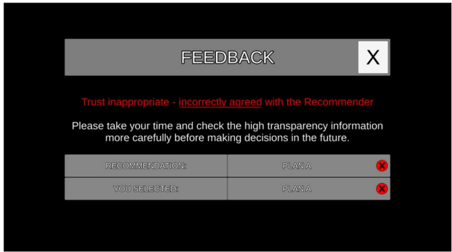
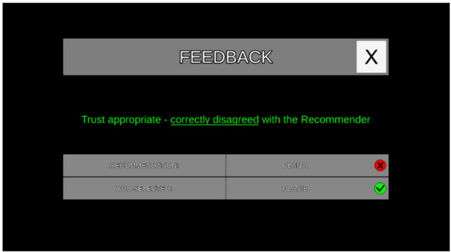
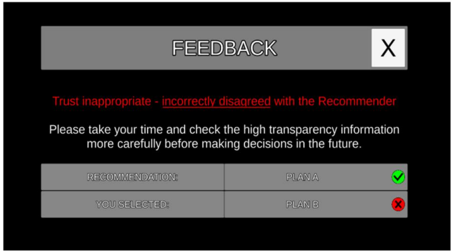
Inappropriate reliance on automated advice can result in humans accepting incorrect or rejecting correct advice. Increased automation transparency and trust calibration feedback are principles purported to promote accurate automation use. We examined the effects of automation transparency, trust calibration feedback, and their potential interacting effect on automation use accuracy and other outcomes. Participants completed uninhabited vehicle management missions by agreeing/disagreeing with automated advice. Transparency was manipulated within-subjects (low, high) and trust calibration feedback between-subjects (absent, present). If trust was inappropriate, trust calibration feedback instructed participants to take their time and carefully check display information. Higher transparency benefited automation use accuracy, decision time, perceived workload, trust, and usability. Trust calibration feedback had no benefit on automation use accuracy and subsequently did not amplify the benefits of increased transparency. These findings have potential implications to inform the design of automated decision aids to support human understanding of, and calibration to, automation capabilities.
Overview
The claims and statistics of this paper haven’t been checked yet.
Free: it reads the open-access text and checks the first 5 claims that cite a source we can check. Create a free account to check every claim.
Integrity signals
Registry
Cites
Statistics
Figures


Verification
Claims the paper makes
The claims and statistics of this paper haven’t been checked yet.
Free: it reads the open-access text and checks the first 5 claims that cite a source we can check. Create a free account to check every claim.
Claims other papers make about this one
Each is checked against this paper’s own text: does it say what the citing paper says it does?
The source backs part of the claim, not all of it — or backs it for a different population, condition or comparison.
In the citing paper
“Multiple explanation types (Naiseh etal. 2023) and trust calibration feedback (Tatasciore and Loft 2025) are proven not to help users recognize incorrect AI recommendations as well.”
From Exploring automation bias in human–AI collaboration: a review and implications for explainable AI (2026) · cites this paper as Tatasciore and Loft 2025
Experimental — accuracy not yet measuredThe cited source says what the claim attributes to it.
In the citing paper
“Offering trust calibration feedback did not help either (Tatasciore and Loft 2025).”
From Exploring automation bias in human–AI collaboration: a review and implications for explainable AI (2026) · cites this paper as Tatasciore and Loft 2025
Self-check
Percentages, sums and reported differences re-computed from the paper’s own numbers.
The self-check needs the paper’s full text.
Citations
Cites
SUS: A 'Quick and Dirty' Usability Scale
(1996) · Usability Evaluation In Industry · doi:10.1201/9781498710411-35 · Cited by 8,989
Trust in Automation: Designing for Appropriate Reliance
Lee, J. D., & See, K. A. (2004) · Human Factors: The Journal of the Human Factors and Ergonomics Society · doi:10.1518/hfes.46.1.50_30392 · Cited by 6,605 · cited 2×
“The provision of increased transparency may amplify automation bias if participants ascribe greater analysis capability and power/ authority to automation that provides an increased rationale (local explanation) for its recommendations (Dwivedi et al., 2023; Lee & See, 2004).”
Cohen, J. (1992) · Current Directions in Psychological Science · doi:10.1111/1467-8721.ep10768783 · Cited by 5,870
Engineering Psychology and Human Performance
Wickens, C. D., Hollands, J. G., Banbury, S., & Parasuraman, R. (2015) · Psychology Press eBooks · doi:10.4324/9781315665177 · Cited by 4,982
Humans and automation: Use, misuse, disuse, abuse
Parasuraman, R., & Riley, V. (1997) · Human Factors: The Journal of the Human Factors and Ergonomics Society · doi:10.1518/001872097778543886 · Cited by 4,554 · cited 1×
“…under-trust increases the probability of under-relying on automation and disusing automated advice (rejecting correct advice), whereas excessive trust increases the probability of over-reliance and misusing automated advice (accepting incorrect advice; Lee & See, 2004; Parasuraman & Riley, 1997).”
A Meta-Analysis of Factors Affecting Trust in Human-Robot Interaction
Hancock, P. A., Billings, D. R., Schaefer, K. E., Chen, J. Y. C., de Visser, E. J., & Parasuraman, R. (2011) · Human Factors: The Journal of the Human Factors and Ergonomics Society · doi:10.1177/0018720811417254 · Cited by 2,051 · cited 1×
“Numerous factors such as human characteristics (e.g., personality), situational elements (e.g., task difficulty), and automation design (e.g., predictability) have been shown to impact trust in and reliance on automation (Hancock et al., 2011).”
(2011) · Cited by 2,025
Proceedings of the Human Factors and Ergonomics Society 2019 Annual Meeting
(2019) · Proceedings of the Human Factors and Ergonomics Society Annual Meeting · doi:10.1177/1071181319631171 · Cited by 1,432
Explainable AI (XAI): Core Ideas, Techniques, and Solutions
Dwivedi, R., Dave, D., Naik, H., Singhal, S., Omer, R., Patel, P., Qian, B., Wen, Z., Shah, T., Morgan, G., et al. (2023) · ACM Computing Surveys · doi:10.1145/3561048 · Cited by 1,386
Pashler, H., & Wagenmakers, E. (2012) · Perspectives on Psychological Science · doi:10.1177/1745691612465253 · Cited by 1,321 · cited 1×
“The importance of establishing the robustness and generality of psychological effects is well-recognized by scholars (e.g., Pashler & Wagenmakers, 2012; Yong, 2012), and synthesizing findings across multiple studies can be used to derive more precise effect size estimates and in doing so facilitate…”
Automation bias: a systematic review of frequency, effect mediators, and mitigators
Goddard, K., Roudsari, A., & Wyatt, J. C. (2012) · Journal of the American Medical Informatics Association · doi:10.1136/amiajnl-2011-000089 · Cited by 1,162 · cited 1×
“…bias can occur in both novices and experts (Mosier et al., 1992; Skitka et al., 1999), novices tend to exhibit greater reliance (potential automation bias) than experts who typically would have greater familiarity with baseline automation reliability and context (e.g., Goddard et al., 2012).”
Does automation bias decision-making?
SKITKA, L. J., MOSIER, K. L., & BURDICK, M. (1999) · International Journal of Human-Computer Studies · doi:10.1006/ijhc.1999.0252 · Cited by 1,139 · cited 2×
“Although automation bias can occur in both novices and experts (Mosier et al., 1992; Skitka et al., 1999), novices tend to exhibit greater reliance (potential automation bias) than experts who typically would have greater familiarity with baseline automation reliability and context (e.g., Goddard…”
The Hawthorne effect: A reconsideration of the methodological artifact.
Adair, J. G. (1984) · Journal of Applied Psychology · doi:10.1037/0021-9010.69.2.334 · Cited by 1,095 · cited 1×
“Albeit we cannot rule out the presence of demand characteristics (Hawthorne effect; Adair, 1984) on the self-reports made by participants post-task completion.”
Zhang, Y., Liao, Q. V., & Bellamy, R. K. E. (2020) · Proceedings of the 2020 Conference on Fairness, Accountability, and Transparency · doi:10.1145/3351095.3372852 · Cited by 895
Designing for Situation Awareness
Endsley, M. R., Bolte, B., & Jones, D. G. (2003) · doi:10.1201/9780203485088 · Cited by 675
Macmillan, N. A., & Kaplan, H. L. (1985) · Psychological Bulletin · doi:10.1037//0033-2909.98.1.185 · Cited by 565
Shen, W., Plotkin, J. L., Francardo, V., Ko, W. K. D., Xie, Z., Li, Q., Fieblinger, T., Wess, J., Neubig, R. R., Lindsley, C. W., et al. (2015) · HAL (Le Centre pour la Communication Scientifique Directe) · doi:10.1016/j.neuron · Cited by 452
The Role of Explanations on Trust and Reliance in Clinical Decision Support Systems
Bussone, A., Stumpf, S., & O'Sullivan, D. (2015) · 2015 International Conference on Healthcare Informatics · doi:10.1109/ichi.2015.26 · Cited by 441 · cited 1×
“…towards agreeing with automated advice, which can result in no improvements to rejecting incorrect advice (Tatasciore et al., 2023, 2024; Tatasciore & Loft, 2024), or even poorer correct rejection rates and poorer overall accuracy of automation use (Bhaskara et al., 2021; Bussone et al., 2015).”
Yong, E. (2012) · Nature · doi:10.1038/485298a · Cited by 405
Intelligent agent transparency in human–agent teaming for multi-UxV management
Mercado, J. E., Rupp, M. A., Chen, J. Y. C., Barnes, M. J., Barber, D., & Procci, K. (2016) · Human Factors: The Journal of the Human Factors and Ergonomics Society · doi:10.1177/0018720815621206 · Cited by 403 · cited 3×
“Furthermore, unlike prior UV studies (Bhaskara et al., 2021; Gegoff et al., 2024, 2025; Mercado et al., 2016; Stowers et al., 2020; Tatasciore et al., 2023; Tatasciore & Loft, 2024; but see Tatasciore et al., 2024), as well as prior studies testing automation transparency designs in other task…”
Monitoring an Automated System for a Single Failure: Vigilance and Task Complexity Effects
MOLLOY, R., & PARASURAMAN, R. (1996) · Human Factors: The Journal of the Human Factors and Ergonomics Society · doi:10.1177/001872089606380211 · Cited by 321
Situation Awareness-Based Agent Transparency
Chen, J. Y., Procci, K., Boyce, M., Wright, J., Garcia, A., & Barnes, M. (2014) · doi:10.21236/ada600351 · Cited by 293
Affective Processes in Human–Automation Interactions
Merritt, S. M. (2011) · Human Factors: The Journal of the Human Factors and Ergonomics Society · doi:10.1177/0018720811411912 · Cited by 260 · cited 1×
“Perceived trust was measured using a six-item questionnaire adapted from Merritt (2011).”
Adaptive trust calibration for human-AI collaboration
Okamura, K., & Yamada, S. (2020) · PLOS ONE · doi:10.1371/journal.pone.0229132 · Cited by 239 · cited 6×
“Overall, these findings are inconsistent with those by Okamura and Yamada (2020) who found that presenting trust calibration cues when inappropriate trust was detected (as opposed to only presenting real-time cumulative automation reliability information) increased trust calibration, as indicated…”
InfluentialMcGuirl, J. M., & Sarter, N. B. (2006) · Human Factors: The Journal of the Human Factors and Ergonomics Society · doi:10.1518/001872006779166334 · Cited by 212 · cited 2×
“Providing trust calibration feedback (e.g., human/automation performance-oriented feedback) has also been suggested as a work design principle to promote trust calibration and accurate automation use (e.g., McGuirl & Sarter, 2006; Okamura & Yamada, 2020).”
Human Decision Makers and Automated Decision Aids: Made for Each Other?
Mosier, K. L., & Skitka, L. J. (2018) · doi:10.1201/9781315137957-10 · Cited by 188
Naiseh, M., Al-Thani, D., Jiang, N., & Ali, R. (2023) · International Journal of Human-Computer Studies · doi:10.1016/j.ijhcs.2022.102941 · Cited by 170 · cited 3×
“This could also involve the presentation of other forms of local explanations (e.g., counterfactual cases) or reiteration of global explanations (Naiseh et al., 2023).”
van de Merwe, K., Mallam, S., & Nazir, S. (2024) · Human Factors: The Journal of the Human Factors and Ergonomics Society · doi:10.1177/00187208221077804 · Cited by 161
Design of a Cooperative Problem-Solving System for En-Route Flight Planning: An Empirical Evaluation
Layton, C., Smith, P. J., & McCoy, C. E. (1994) · Human Factors: The Journal of the Human Factors and Ergonomics Society · doi:10.1177/001872089403600106 · Cited by 158
Wischnewski, M., Krämer, N., & Müller, E. (2023) · Proceedings of the 2023 CHI Conference on Human Factors in Computing Systems · doi:10.1145/3544548.3581197 · Cited by 146 · cited 2×
“Therefore, a key challenge concerns fostering calibrated trust in the automation, that is, ensuring humans align their trust with the automation’s true capabilities/reliability (Carter et al., 2024; Strickland et al., 2024; Wischnewski et al., 2023), such that disuse and misuse can be minimized.”
Agent Transparency: A Review of Current Theory and Evidence
Bhaskara, A., Skinner, M., & Loft, S. D. (2020) · IEEE Transactions on Human-Machine Systems · doi:10.1109/thms.2020.2965529 · Cited by 146
Self-citationBoard on Human-Systems Integration, Education, D. O. B. A. S. S. A., & National Academies of Sciences, E. (2021) · National Academies Press eBooks · doi:10.17226/26355 · Cited by 133
The impact of cognitive feedback on judgment performance and trust with decision aids
Seong, Y., & Bisantz, A. M. (2008) · International Journal of Industrial Ergonomics · doi:10.1016/j.ergon.2008.01.007 · Cited by 129
Fu, Z., Wu, D.-A. J., Ross, I., Chung, J. M., Mamelak, A. N., Adolphs, R., & Rutishauser, U. (2019) · Neuron · doi:10.1016/j.neuron.2018.11.016 · Cited by 126
The handbook of operator fatigue
Turner, R. (2013) · Ergonomics · doi:10.1080/00140139.2013.819674 · Cited by 120
(2018) · doi:10.1201/9781315137957-2 · Cited by 108
Human Performance Benefits of The Automation Transparency Design Principle: Validation and Variation
Skraaning, G., & Jamieson, G. A. (2021) · Human Factors: The Journal of the Human Factors and Ergonomics Society · doi:10.1177/0018720819887252 · Cited by 66
The IMPACT of Agent Transparency on Human Performance
Stowers, K., Kasdaglis, N., Rupp, M. A., Newton, O. B., Chen, J. Y. C., & Barnes, M. J. (2020) · IEEE Transactions on Human-Machine Systems · doi:10.1109/thms.2020.2978041 · Cited by 65
Effect of automation transparency in the management of multiple unmanned vehicles
Bhaskara, A., Duong, L., Brooks, J., Li, R., McInerney, R., Skinner, M., Pongracic, H., & Loft, S. D. (2020) · Applied Ergonomics · doi:10.1016/j.apergo.2020.103243 · Cited by 65
Self-citationElectronic Checklists: Implications for Decision Making
Mosier, K. L., Palmer, E. A., & Degani, A. (1992) · Proceedings of the Human Factors Society Annual Meeting · doi:10.1177/154193129203600104 · Cited by 61
Robot transparency and team orientation effects on human–robot teaming
Guznov, S., Lyons, J., Pfahler, M., Heironimus, A., Woolley, M., Friedman, J., & Neimeier, A. (2020) · International Journal of Human–Computer Interaction · doi:10.1080/10447318.2019.1676519 · Cited by 54
Wohleber, R. W., Matthews, G., Lin, J., Szalma, J. L., Calhoun, G. L., Funke, G. J., Chiu, C.-Y. P., & Ruff, H. A. (2018) · Human Factors The Journal of the Human Factors and Ergonomics Society · doi:10.1177/0018720818799468 · Cited by 52
Chen, J., Mishler, S., Hu, B., Li, N., & Proctor, R. W. (2018) · International Journal of Human-Computer Studies · doi:10.1016/j.ijhcs.2018.05.010 · Cited by 50 · cited 1×
“However, Chen et al. (2021) found that human performance-oriented feedback (i.e., human decision accuracy) improved automation use (decision sensitivity), led to faster decision times, and alleviated the bias toward agreeing with automated advice (also see Chen et al., 2018).”
Carter, O. B. J., Loft, S. D., & Visser, T. A. W. (2023) · Human Factors The Journal of the Human Factors and Ergonomics Society · doi:10.1177/00187208231218156 · Cited by 49
Self-citationThe relationship of trust and dependence
Patton, C. E., & Wickens, C. D. (2024) · Ergonomics · doi:10.1080/00140139.2024.2342436 · Cited by 44 · cited 1×
“Although evidence suggests there is not an one-to-one mapping between trust in automation and reliance on automation (Patton & Wickens, 2024), under-trust increases the probability of under-relying on automation and disusing automated advice (rejecting correct advice), whereas excessive trust…”
An Investigation of the Prevalence of Replication Research in Human Factors
Jones, K. S., Derby, P. L., & Schmidlin, E. A. (2010) · Human Factors: The Journal of the Human Factors and Ergonomics Society · doi:10.1177/0018720810384394 · Cited by 41
Chen, J., Mishler, S., & Hu, B. (2021) · IEEE Transactions on Human-Machine Systems · doi:10.1109/thms.2021.3051137 · Cited by 40 · cited 2×
“In contrast to most prior studies (e.g., Chen et al., 2021; Lu & Sarter, 2019), trust calibration feedback in the current study provided information about both human and automation performance (Okamura & Yamada, 2020).”
Sargent, R., Walters, B. A., & Wickens, C. D. (2023) · Lecture notes in computer science · doi:10.1007/978-3-031-35596-7_16 · Cited by 36
Transparent Automated Advice to Mitigate the Impact of Variation in Automation Reliability
Gegoff, I., Tatasciore, M., Bowden, V. K., McCarley, J. S., & Loft, S. D. (2023) · Human Factors The Journal of the Human Factors and Ergonomics Society · doi:10.1177/00187208231196738 · Cited by 35
Self-citationEffects of transparency on pilot trust and agreement in the autonomous constrained flight planner
Sadler, G., Battiste, H., Ho, N., Hoffmann, L., Johnson, W., Shively, R., Lyons, J., & Smith, D. (2016) · 2016 IEEE/AIAA 35th Digital Avionics Systems Conference (DASC) · doi:10.1109/dasc.2016.7777998 · Cited by 34
Can increased automation transparency mitigate the effects of time pressure on automation use?
Tatasciore, M., & Loft, S. D. (2023) · Applied Ergonomics · doi:10.1016/j.apergo.2023.104142 · Cited by 34
Self-citationThe Perception of Automation Reliability and Acceptance of Automated Advice
Hutchinson, J., Strickland, L., Farrell, S., & Loft, S. (2023) · Human Factors: The Journal of the Human Factors and Ergonomics Society · doi:10.1177/00187208211062985 · Cited by 32 · cited 1×
“Strickland et al. (2024; also see Hutchinson et al., 2023) found that human estimates of future automation reliability are disproportionality weighted by recent automation reliability.”
Self-citationTransparency improves the accuracy of automation use, but automation confidence information does not
Tatasciore, M., Strickland, L. J. G., & Loft, S. D. (2024) · Cognitive Research Principles and Implications · doi:10.1186/s41235-024-00599-x · Cited by 29
Self-citationDo concurrent task demands impact the benefit of automation transparency?
Tatasciore, M., Bowden, V. K., & Loft, S. D. (2023) · Applied Ergonomics · doi:10.1016/j.apergo.2023.104022 · Cited by 25
Self-citationFievez, F., Derosière, G., Verbruggen, F., & Duqué, J. (2022) · Frontiers in Human Neuroscience · doi:10.3389/fnhum.2022.864590 · Cited by 22
Effects of transparency on the acceptance of automated resolution advisories
Goritzlehner, R., Borst, C., Ellerbroek, J., Westin, C., van Paassen, M. M., & Mulder, M. (2014) · Conference proceedings/Conference proceedings - IEEE International Conference on Systems, Man, and Cybernetics · doi:10.1109/smc.2014.6974381 · Cited by 21
How do humans learn about the reliability of automation?
Strickland, L. J. G., Farrell, S., Wilson, M. K., Hutchinson, J., & Loft, S. D. (2024) · Cognitive Research Principles and Implications · doi:10.1186/s41235-024-00533-1 · Cited by 20
Self-citationGegoff, I., Tatasciore, M., Bowden, V. K., & Loft, S. D. (2025) · Human Factors The Journal of the Human Factors and Ergonomics Society · doi:10.1177/00187208251318465 · Cited by 14
Self-citationZhou, Y., Cui, X., Qu, W., et al. (2022) · Institutional Repository of Institute of Psychology, Chinese Academy of Sciences (Institute of Psychology, Chinese Academy of Sciences) · doi:10.1016/j.apergo · Cited by 9
Challenges in Fatigue and Performance Research
Hockey, B. (2017) · CRC Press eBooks · doi:10.1201/9781315557366-3 · Cited by 7
Lu, Y., & Sarter, N. (2019) · Proceedings of the Human Factors and Ergonomics Society Annual Meeting · doi:10.1177/1071181319631345 · Cited by 5 · cited 2×
“In contrast to most prior studies (e.g., Chen et al., 2021; Lu & Sarter, 2019), trust calibration feedback in the current study provided information about both human and automation performance (Okamura & Yamada, 2020).”
Barbero (2014) · doi:10.1016/j · Cited by 1
Research works printed but not linked: 2
- 47. Stein, E. S. (1985). Air traffic controller workload: An examination of workload probe (No. DOT/FAA/CT-TN84/24). Department of Transportation, Federal Aviation Administration, William J. Hughes Technical Center.
- 54. Van de Merwe, K., Mallam, S., Nazir, S., & Engelhardtsen, Ø. (2024). The influence of agent transparency and complexity on situation awareness, mental workload, and task performance. Journal of Cognitive Engineering and Decision Making, 18(2), 156-184. https:// doi.org/10.1177/1555343424124055 · doi:10.1177/1555343424124055
Cited by
Exploring automation bias in human–AI collaboration: a review and implications for explainable AI
Romeo, G., & Conti, D. (2026) · AI & SOCIETY · doi:10.1007/s00146-025-02422-7 · Cited by 209
“Multiple explanation types (Naiseh et al. 2023) and trust calibration feedback (Tatasciore and Loft 2025) are proven not to help users recognize incorrect AI recommendations as well.”
Shahin, M., Maghanaki, M., & Chen, F. F. (2026) · Expert Systems with Applications · doi:10.1016/j.eswa.2026.131606 · Cited by 12
Zheng, J., Guo, Y., Rong, W., Zhou, W., Wang, X., & Qi, X. (2025) · Ocean Engineering · doi:10.1016/j.oceaneng.2025.122913 · Cited by 5
Tatasciore, M., Bennett, L., Bowden, V. K., Bell, J., Visser, T. A. W., McAnally, K. I., McCarley, J. S., Thompson, M. B., Shanahan, C., Morris, R. A., et al. (2025) · Human Factors The Journal of the Human Factors and Ergonomics Society · doi:10.1177/00187208251349269 · Cited by 6
“…with our prior work using the same (or very similar) UV management tasks, which demonstrated that fi xed high compared to fi xed low transparency leads to more accurate automation use (e.g. Tatasciore et al., 2023; Tatasciore et al., 2024; Tatasciore & Loft, 2024; Tatasciore & Loft, 2025).”
InfluentialSelf-citationThe benefits of automation transparency are dependent on human attention control capacity
Gegoff, I., Tatasciore, M., Bowden, V. K., & Loft, S. D. (2025) · Applied Ergonomics · doi:10.1016/j.apergo.2025.104619 · Cited by 3
Self-citation
Metadata
- Authors
- Tatasciore, M., & Loft, S.
- Affiliations
- School of Psychological Science, The University of Western
- Corresponding author
- Tatasciore, Monica
- Loft, Shayne
- Venue
- International Journal of Human–Computer Interaction
- Publisher
- Informa UK Limited
- Published
- 2025-04-16
- Volume
- 41
- Issue
- 23
- Pages
- 14723-14733
- ISSN
- 1044-7318 (ISSN-L)
- 1532-7590
- OpenAlex
- W4409511947
- Cited by
- 20
- References
- 59
- Citations by year
- 2026: 16 · 2025: 4
- FWCI
- 22.16
- Type
- journal article
- Language
- en
- Open access
- hybrid
- doi.org
- Licence
- Locations
- International Journal of Human-Computer Interaction (publishedVersion, cc-by-nc-nd)
- UWA Profiles and Research Repository (UWA) (publishedVersion, cc-by-nc-nd)
- Funders
- Australian Research Council Future Fellowship (2)
- Topics
- Social Sciences › Human Factors and Ergonomics › Human-Automation Interaction and Safety
- Social Sciences › Psychology › Social Psychology › Social Robot Interaction and HRI
- Physical Sciences › Computer Science › Human-Computer Interaction › Usability and User Interface Design
- Keywords
- automation transparency, automated decision aids, trust in automation, decision time, perceived workload, usability, human-automation interaction
About these checks
Registry, retraction, Cites and statistics results are computed, not judged, with one exception: a printed reference that no index lists is read once by a model before it counts as a citation error. Claims are extracted by a model and kept only when their quote appears verbatim in the text; each cited source is then checked, with a model’s help, for whether it says what the claim relies on. Those verdicts can be wrong — read the claim’s quote and the cited source before relying on one.
Statistics and arithmetic are recomputed, not judged.
Confidence bands are shown only for fields calibrated on our annotated test set. None is calibrated yet, so no band is shown.
What counts as a claim ›How we measure confidence ›How we check this ›
Are you an author, or do you see a problem with this page? Request a review
Data sources
Bibliographic data: Semantic Scholar, OpenAlex, Crossref.
Contains information from the Semantic Scholar Academic Graph Datasets, made available under the ODC Attribution License (ODC-BY 1.0).
Semantic Scholar’s data is described in: Kinney, R., et al. (2023). The Semantic Scholar Open Data Platform. arXiv:2301.10140.
