

The DOI matches its Crossref record; 37 of the 38 references it cites were found in a registry or an index.
Chatbots for future docs: exploring medical students’ attitudes and knowledge towards artificial intelligence and medical chatbots
Open accessAbstract
Artificial intelligence (AI) in medicine and digital assistance systems such as chatbots will play an increasingly important role in future doctor – patient communication. To benefit from the potential of this technical innovation and ensure optimal patient care, future physicians should be equipped with the appropriate skills. Accordingly, a suitable place for the management and adaptation of digital assistance systems must be found in the medical education curriculum. To determine the existing levels of knowledge of medical students about AI chatbots in particular in the healthcare setting, this study surveyed medical students of the University of Luebeck and the University Hospital of Tuebingen. Using standardized quantitative questionnaires and qualitative analysis of group discussions, the attitudes of medical students toward AI and chatbots in medicine were investigated. From this, relevant requirements for the future integration of AI into the medical curriculum could be identified. The aim was to establish a basic understanding of the opportunities, limitations, and risks, as well as potential areas of application of the technology. The participants (N = 12) were able to develop an understanding of how AI and chatbots will affect their future daily work. Although basic attitudes toward the use of AI were positive, the students also expressed concerns. There were high levels of agreement regarding the use of AI in administrative settings (83.3%) and research with health-related data (91.7%). However, participants expressed concerns that data protection may be insufficiently guaranteed (33.3%) and that they might be increasingly monitored at work in the future (58.3%). The evaluations indicated that future physicians want to engage more intensively with AI in medicine. In view of future developments, AI and data competencies should be taught in a structured way during the medical curriculum and integrated into curricular teaching.
Overview
The claims and statistics of this paper haven’t been checked yet.
Free: it reads the open-access text and checks the first 5 claims that cite a source we can check. Create a free account to check every claim.
Integrity signals
Registry
Cites
Statistics
Figures
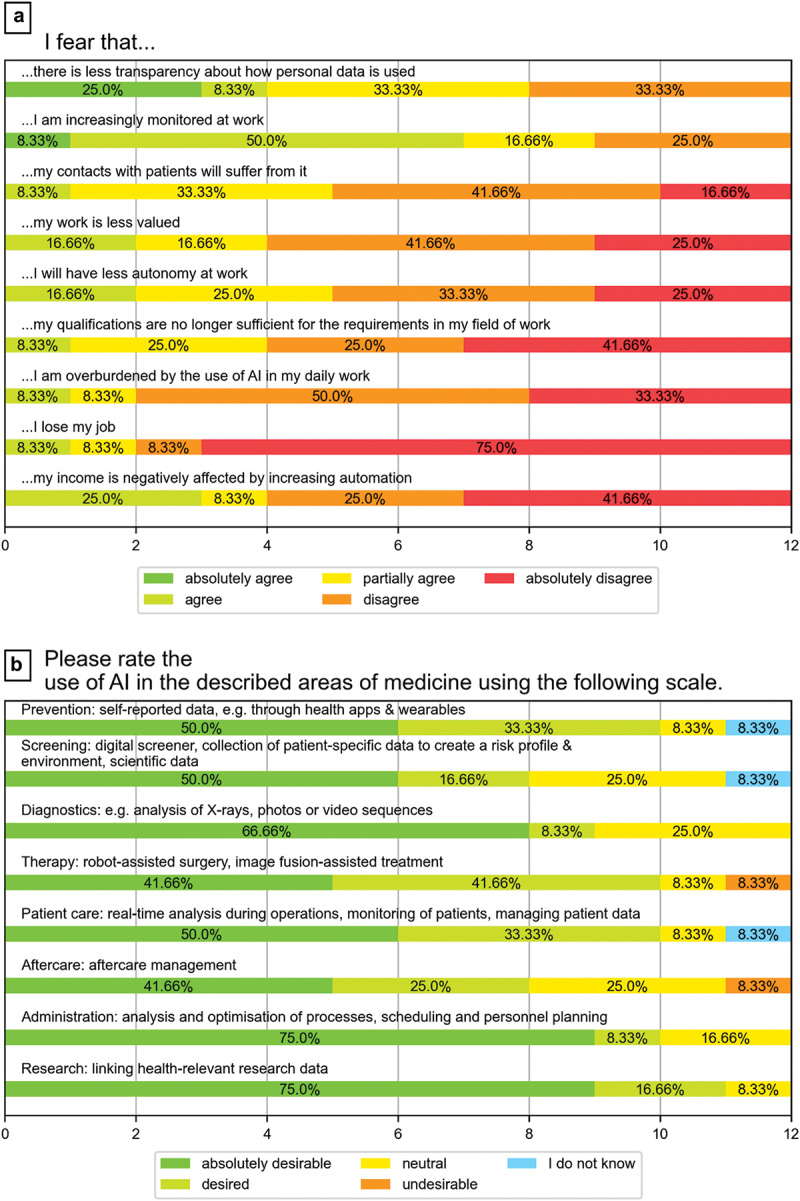
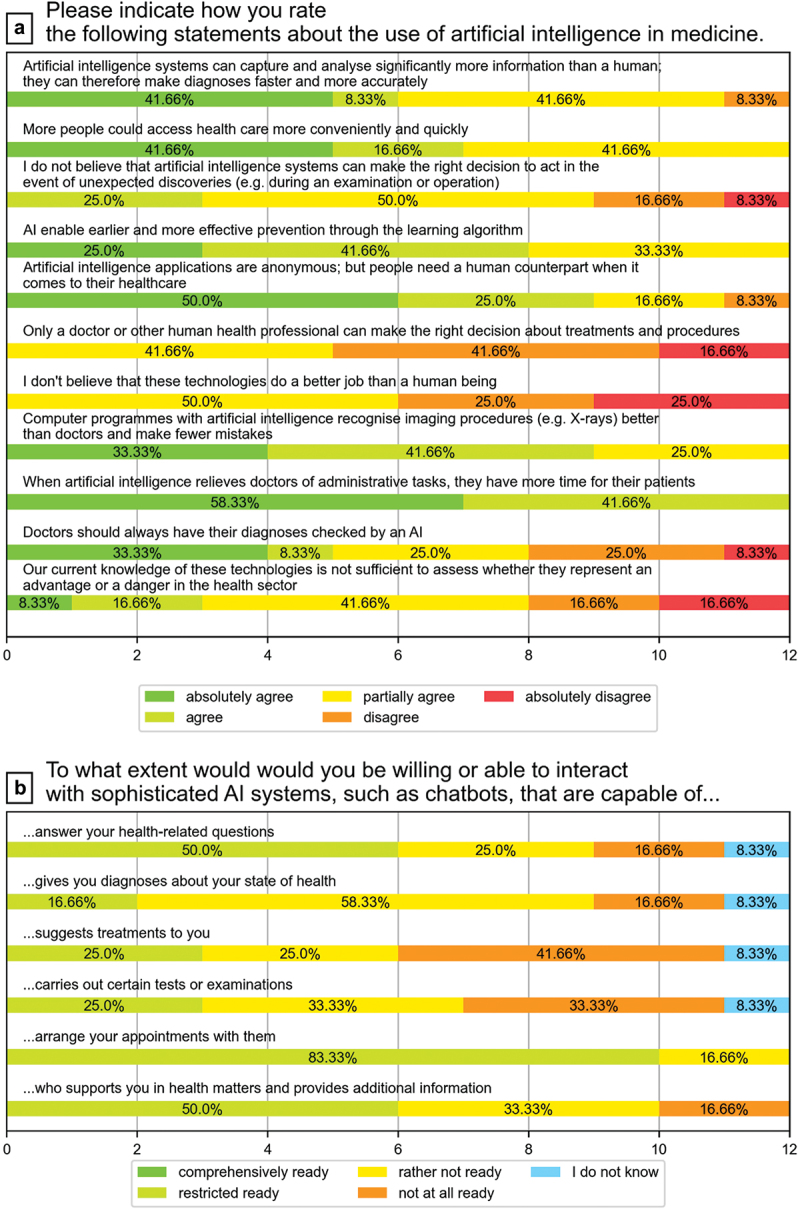
Verification
Claims the paper makes
The claims and statistics of this paper haven’t been checked yet.
Free: it reads the open-access text and checks the first 5 claims that cite a source we can check. Create a free account to check every claim.
Claims other papers make about this one
Each is checked against this paper’s own text: does it say what the citing paper says it does?
The source backs part of the claim, not all of it — or backs it for a different population, condition or comparison.
In the citing paper
“This was also showed in previous studies that most of healthcare students have a positive attitude towards AI [19, 44–47].”
From Medical, dental, and nursing students’ attitudes and knowledge towards artificial intelligence: a systematic review and meta-analysis (2024) · cites this paper as [19]
Experimental — accuracy not yet measuredThe source backs part of the claim, not all of it — or backs it for a different population, condition or comparison.
In the citing paper
“Overall, in addition to positive attitudes toward AI, students generally expressed enthusiasm for integrating it into their future medical practice [70, 71]. Many believed AI had the potential to enhance and transform medicine by optimizing physicians’ workloads and reducing healthcare costs [42, 72, 73]. Additionally, students viewed AI as a supportive tool that can assist physicians, help”
From Artificial intelligence in undergraduate medical education: an updated scoping review (2025) · cites this paper as [42]
Experimental — accuracy not yet measuredThe source backs part of the claim, not all of it — or backs it for a different population, condition or comparison.
In the citing paper
“Similarly, we identified only 1 study examining learner attitudes toward generative AI in medical education [29]. The authors noted generally positive opinions albeit limited by unfamiliarity with these tools.”
From Opportunities, Challenges, and Future Directions of Generative Artificial Intelligence in Medical Education: Scoping Review (2023) · cites this paper as [29]
Experimental — accuracy not yet measuredThe cited source says what the claim attributes to it.
In the citing paper
“In contrast, a few of them employed either qualitative methods [38–40] or a mixed-methods approach [41–45].”
From Artificial intelligence in undergraduate medical education: an updated scoping review (2025) · cites this paper as [42]
Self-check
Percentages, sums and reported differences re-computed from the paper’s own numbers.
The self-check needs the paper’s full text.
Citations
Cites
Standards for Reporting Qualitative Research: A Synthesis of Recommendations
O’Brien, B. C., Harris, I. B., Beckman, T. J., Reed, D. A., & Cook, D. A. (2014) · Academic Medicine · doi:10.1097/acm.0000000000000388 · Cited by 12,211 · cited 2×
“This study followed the Standards for Reporting Qualitative Research [21] and presents a mixed-method study as part of a project supported by the Federal Ministry of Education and Research, Germany (BMBF The attitudes of participants regarding the topic of AI in medicine were quantitatively assessed by means of a stan…”
MethodQualitative Inhaltsanalyse : Grundlagen und Techniken
Mayring, P. (2003) · Cited by 6,519
Rajpurkar, P., Chen, E., Banerjee, O., & Topol, E. J. (2022) · Nature Medicine · doi:10.1038/s41591-021-01614-0 · Cited by 3,212 · cited 1×
“Furthermore, the digital networking of patients, hospitals, physicians and other healthcare services is enabling a shift from a physician-centric approach to more patient-centered treatment [5].”
BackgroundCombining Qualitative and Quantitative Methods in Information Systems Research: A Case Study1
Kaplan, B., & Duchon, D. (1988) · MIS Quarterly · doi:10.2307/249133 · Cited by 1,074 · cited 1×
“We combined quantitative and qualitative research methods in this study to achieve an in-depth analysis of the collected data [22].”
MethodChan, K. S., & Zary, N. (2019) · JMIR Medical Education · doi:10.2196/13930 · Cited by 877 · cited 2×
“According to current literature, although AI competencies are essential for medical practice, they are not comprehensively taught in medical education [7,11,12].”
BackgroundNadarzynski, T., Miles, O., Cowie, A., & Ridge, D. (2019) · DIGITAL HEALTH · doi:10.1177/2055207619871808 · Cited by 810 · cited 1×
“However, there are also raising concerns about chatbots potentially eroding diagnostic practice, being driven by business logic, and having limitations and incompleteness that may harm patients in emergency situations [18,19].”
BackgroundMedical students' attitude towards artificial intelligence: a multicentre survey
Pinto dos Santos, D., Giese, D., Brodehl, S., Chon, S. H., Staab, W., Kleinert, R., Maintz, D., & Baeßler, B. (2019) · European Radiology · doi:10.1007/s00330-018-5601-1 · Cited by 754 · cited 1×
“The majority were certain that they would not be replaced by AI in their jobs or that they would be less valued in their roles as future doctors, as other authors have stated in similar studies [27].”
ResultSit, C., Srinivasan, R., Amlani, A., Muthuswamy, K., Azam, A., Monzon, L., & Poon, D. S. (2020) · Insights into Imaging · doi:10.1186/s13244-019-0830-7 · Cited by 507 · cited 1×
“…great deal of uncertainty and skepticism regarding chatbots due to the lack of integration of AI topics into the medical curriculum (as yet), as well as a lack of knowledge about the basic conditions and legal and ethical requirements of AI use [33], reflecting findings from other studies [34–36].”
ResultHandbuch Methoden der empirischen Sozialforschung
(2014) · Springer eBooks · doi:10.1007/978-3-531-18939-0 · Cited by 441 · cited 1×
“As one student did not complete the course, we used the mean imputation procedure for the missing values after testing for normal distribution using the Kolmogorov-Smirnov test procedure [24,25].”
MethodHan, E.-R., Yeo, S., Kim, M.-J., Lee, Y.-H., Park, K.-H., & Roh, H. (2019) · BMC Medical Education · doi:10.1186/s12909-019-1891-5 · Cited by 393 · cited 2×
“Future physicians will not only need to be flexible in responding to different healthcare contexts but will also require the competence to adequately deal with procedures and applications involving AI and the accompanying big data [7].”
Background
Research works printed but not linked: 4
- Plange N, Feltgen N, Arbeitsgemeinschaft L. The “Nationaler Kompetenzbasierter Lernzielkatalog Medizin NKLM 2.0”-Implications for medical education in ophthalmology. Ophthalmologie. 2022 Nov 21. PubMed PMID: 36409352.
- Kuhn S. Transformation durch Bildung. Deutsches Ärzteblatt. 2018;2018:115.
- Neyer F, Felber J, Gebhardt C. Kurzskala zur Erfassung von Technikbereitschaft [Short scale for recording technology willingness]. In: GESIS - Leibniz Institute for Social Sciences. Zusammenstellung sozialwissenschaftlicher Items und Skalen (ZIS); 2016.
- Kirschner PA, De Bruyckere P. The myths of the digital native and the multitasker. In Teaching and Teacher EducationVol. 67 p. 135–142; 2017 Oct. PubMed PMID: WOS:000411543800013; English.
Cited by
A scoping review of artificial intelligence in medical education: BEME Guide No. 84
Gordon, M., Daniel, M., Ajiboye, A., Uraiby, H., Xu, N. Y., Bartlett, R., Hanson, J., Haas, M., Spadafore, M., Grafton-Clarke, C., et al. (2024) · Medical Teacher · doi:10.1080/0142159x.2024.2314198 · Cited by 679
Preiksaitis, C., & Rose, C. (2023) · JMIR Medical Education · doi:10.2196/48785 · Cited by 552
“[29] Need for further training in limitations Theme 6: Potential detriments to learning “Lastly, there is a need to delve deeper into the possible consequences of overdependence on LLMs in medical education.””
BackgroundInfluentialEffects of Generative Chatbots in Higher Education
Ilieva, G., Yankova, T., Klisarova-Belcheva, S., Dimitrov, A., Bratkov, M., & Angelov, D. (2023) · Information · doi:10.3390/info14090492 · Cited by 194
Holderried, F., Stegemann–Philipps, C., Herschbach, L., Moldt, J.-A., Nevins, A., Griewatz, J., Holderried, M., Herrmann-Werner, A., Festl-Wietek, T., & Mahling, M. (2024) · JMIR Medical Education · doi:10.2196/53961 · Cited by 156
“In particular, chatbots are of interest tool-wise in the area of virtual patients [21,22].”
BackgroundSelf-citationZahlan, A., Ranjan, R. P., & Hayes, D. (2023) · Technology in Society · doi:10.1016/j.techsoc.2023.102321 · Cited by 195
Metadata
- Authors
- Moldt, J.-A., Festl-Wietek, T., Madany Mamlouk, A., Nieselt, K., Fuhl, W., & Herrmann-Werner, A.
- Affiliations
- University of Tübingen (DE)
- University of Tuebingen, Tuebingen, Germany
- Institute for Neuro- and Bioinformatics, University of Luebeck, Luebeck, Germany
- Corresponding author
- Moldt, Julia-Astrid
- ORCID
- Venue
- Medical Education Online
- Publisher
- Informa UK Limited
- Published
- 2023-02-28
- Volume
- 28
- Issue
- 1
- Pages
- 2182659-2182659
- ISSN
- 1087-2981 (ISSN-L)
- PMC
- PMC9979998
- OpenAlex
- W4322718967
- Cited by
- 186
- References
- 38
- Citations by year
- 2026: 40 · 2025: 55 · 2024: 64 · 2023: 27
- FWCI
- 7.41
- Type
- journal article
- Language
- en
- Open access
- gold
- doi.org
- Locations
- Medical Education Online (publishedVersion, cc-by)
- PubMed Central (publishedVersion, cc-by)
- PubMed (publishedVersion)
- DOAJ (DOAJ: Directory of Open Access Journals) (submittedVersion, cc-by-sa)
- Funders
- Deutsche Forschungsgemeinschaft
- Ministry of Education
- Topics
- Health Sciences › Medicine › Health Informatics › Artificial Intelligence in Healthcare and Education
- Social Sciences › Education › Innovations in Medical Education
- Social Sciences › Education › Artificial Intelligence in Education
- Keywords
- healthcare chatbots, artificial intelligence in healthcare, medical students, attitudes toward AI, AI knowledge, medical curriculum, data protection, workplace monitoring, data competencies, physician-patient communication
- MeSH terms
- Artificial Intelligence, Communication, Curriculum, Humans, Students, Medical, Knowledge
About these checks
Registry, retraction, Cites and statistics results are computed, not judged, with one exception: a printed reference that no index lists is read once by a model before it counts as a citation error. Claims are extracted by a model and kept only when their quote appears verbatim in the text; each cited source is then checked, with a model’s help, for whether it says what the claim relies on. Those verdicts can be wrong — read the claim’s quote and the cited source before relying on one.
Statistics and arithmetic are recomputed, not judged.
Confidence bands are shown only for fields calibrated on our annotated test set. None is calibrated yet, so no band is shown.
What counts as a claim ›How we measure confidence ›How we check this ›
Are you an author, or do you see a problem with this page? Request a review
How to cite
Cite CoChat for the checks on this page, and the paper for its own findings.
- This page
- CoChat. (2026). Citation check: Chatbots for future docs: exploring medical students’ attitudes and knowledge towards artificial intelligence and medical chatbots. https://app.cochat.ai/papers/10.1080/10872981.2023.2182659
- The paper
- Moldt, J.-A., Festl-Wietek, T., Madany Mamlouk, A., Nieselt, K., Fuhl, W., & Herrmann-Werner, A. (2023). Chatbots for future docs: exploring medical students’ attitudes and knowledge towards artificial intelligence and medical chatbots. Medical Education Online. https://doi.org/10.1080/10872981.2023.2182659
Data sources
Bibliographic data: Semantic Scholar, OpenAlex, Crossref.
Contains information from the Semantic Scholar Academic Graph Datasets, made available under the ODC Attribution License (ODC-BY 1.0).
Semantic Scholar’s data is described in: Kinney, R., et al. (2023). The Semantic Scholar Open Data Platform. arXiv:2301.10140.
