

Integrating internet CBT into clinical practice: a practical guide for clinicians
Open accessThe DOI matches its Crossref record; 48 of the 48 references it cites were found in a registry or an index.
Abstract
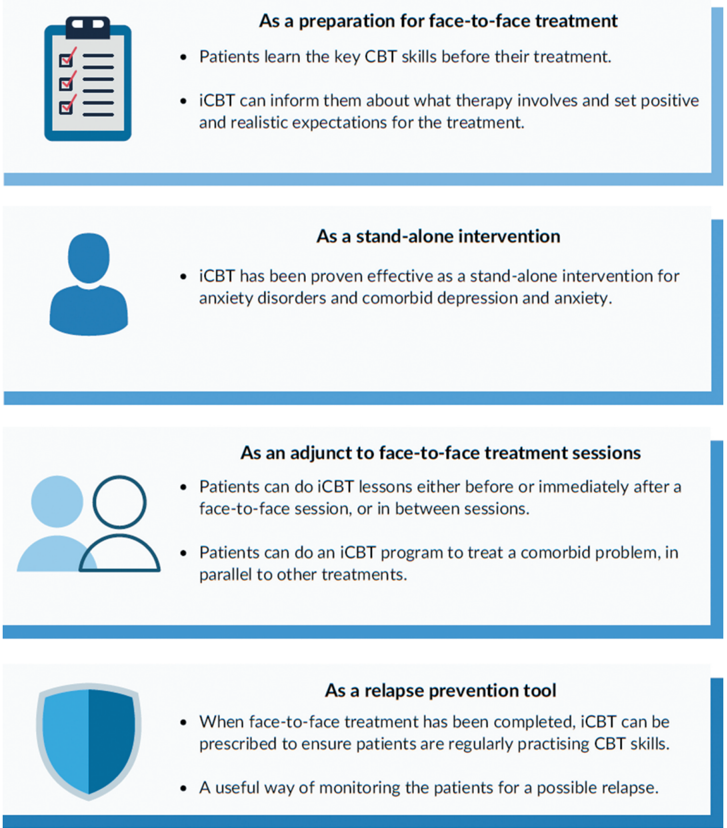
Objective: This paper offers clinical insights and practical guidelines for clinicians about how internet-delivered cognitive behaviour therapy (iCBT) can be safely and effectively integrated into routine psychological therapy practice, in a 'blended' care model.Method: For over a decade, the Clinical Research Unit for Anxiety and Depression (CRUfAD) has developed, tested, and disseminated iCBT programs for anxiety and depression, into routine care settings. This paper outlines examples of the available iCBT options for clinicians and details the advantages of integrating iCBT for anxiety and/or depression into psychological practice. We address common barriers to using iCBT, offer practical solutions based on our research and clinical experience, and present the lived experiences of ‘real-world’ clinicians using iCBT in their private practises and specialist clinics. Considerations associated with risk management, funding arrangements, and flexible models of care (e.g., stepped, blended and adjunct care) are discussed.Results: Flexible and judicious use of iCBT in our outpatient routine care clinic has reduced treatment waitlists and enabled clinicians to dedicate more time to sophisticated therapeutic interventions (e.g., experiential work) and to support clients with complex needs.Conclusion: iCBT can be safely and effectively integrated into routine psychological practice, and enhance client care.KEY POINTSWhat is already known about this topic:(1) Internet cognitive behavioural therapy (iCBT) is effective for treating anxiety and depression.(2) iCBT includes psychoeducation and core CBT components (e.g., thought challenging) delivered over the internet.(3) To date, most iCBT programs have been used as stand-alone interventions, either as self-help or under guidance from a clinician.What this paper adds:(1) Outlines examples of iCBT options, their advantages and disadvantages, indications and contraindications.(2) Outlines a variety of ways to integrate iCBT into routine clinical practice settings, including prequel to therapy, as an adjunct, and relapse prevention tool.(3) Offers practical solutions to address common barriers and concerns to using iCBT in routine practice.
Overview
The claims and statistics of this paper haven’t been checked yet.
Free: it reads the open-access text and checks the first 5 claims that cite a source we can check. Create a free account to check every claim.
Integrity signals
Registry
Cites
Statistics
Figures



Verification
Claims the paper makes
The claims and statistics of this paper haven’t been checked yet.
Free: it reads the open-access text and checks the first 5 claims that cite a source we can check. Create a free account to check every claim.
Claims other papers make about this one
Each is checked against this paper’s own text: does it say what the citing paper says it does?
The source backs part of the claim, not all of it — or backs it for a different population, condition or comparison.
In the citing paper
“literature on internet-based CBT (e.g., Newby et al., 2021) has pointed out the need for digital CBT interventions to include a variety of CBT techniques and strategies to promote symptomatic reduction and relapse prevention”
From Therapeutic games to reduce anxiety and depression in young people: A systematic review and exploratory meta‐analysis of their use and effectiveness. (2024) · cites this paper as Newby et al., 2021
Experimental — accuracy not yet measuredThe cited source says what the claim attributes to it.
In the citing paper
“DMHIs allow people to access psychotherapy skills and content in their own time and empower them to self-manage their symptoms [7-11].”
Self-check
Percentages, sums and reported differences re-computed from the paper’s own numbers.
The self-check needs the paper’s full text.
Citations
Cites
Statistical Power Analysis for the Behavioral Sciences
Muller, K. (1989) · Technometrics · doi:10.1080/00401706.1989.10488618 · Cited by 99,167
The PHQ-9: Validity of a brief depression severity measure
Kroenke, K., Spitzer, R. L., & Williams, J. B. W. (2001) · Journal of General Internal Medicine · doi:10.1046/j.1525-1497.2001.016009606.x · Cited by 44,910
Vos, T., Barber, R. M., Bell, B., Bertozzi-Villa, A., Biryukov, S., Bolliger, I., Charlson, F., Davis, A., Degenhardt, L., Dicker, D., et al. (2015) · The Lancet · doi:10.1016/s0140-6736(15)60692-4 · Cited by 6,414
Cochrane Database of Systematic Reviews
(2008) · Encyclopedia of Public Health · doi:10.1007/978-1-4020-5614-7_436 · Cited by 4,527
Andrews, G., Cuijpers, P., Craske, M. G., McEvoy, P., & Titov, N. (2010) · PLoS ONE · doi:10.1371/journal.pone.0013196 · Cited by 1,311
Andersson, G., Cuijpers, P., Carlbring, P., Riper, H., & Hedman, E. (2014) · World Psychiatry · doi:10.1002/wps.20151 · Cited by 1,077
Andrews, G., Henderson, S., & Hall, W. (2001) · British Journal of Psychiatry · doi:10.1192/bjp.178.2.145 · Cited by 933
Andrews, G., Basu, A., Cuijpers, P., Craske, M. G., McEvoy, P., English, C. L., & Newby, J. M. (2018) · Journal of Anxiety Disorders · doi:10.1016/j.janxdis.2018.01.001 · Cited by 922
Self-citationHedman, E., Ljótsson, B., & Lindefors, N. (2012) · Expert Review of Pharmacoeconomics & Outcomes Research · doi:10.1586/erp.12.67 · Cited by 672
Mind the gap: improving the dissemination of CBT
Shafran, R., Clark, D. M., Fairburn, C. G., Arntz, A., Barlow, D. H., Ehlers, A., Freeston, M., Garety, P. A., Hollon, S. D., Ost, L. G., et al. (2009) · Behaviour Research and Therapy · doi:10.1016/j.brat.2009.07.003 · Cited by 569
Cited by
Mahoney, A. E. J., Elders, A., Li, I., David, C., Haskelberg, H., Guiney, H., & Millard, M. (2021) · Internet Interventions · doi:10.1016/j.invent.2021.100439 · Cited by 51
Self-citationJackson, H. M., Calear, A. L., Batterham, P. J., Ohan, J. L., Farmer, G. M., & Farrer, L. M. (2023) · Journal of Medical Internet Research · doi:10.2196/44673 · Cited by 25
“However, we subsequently limited the scope of the review to digital CBT programs to facilitate comparisons across studies and because of the established evidence base for CBT in the treatment of depression and anxiety [16,47].”
Atik, E., Stricker, J., Schückes, M., & Pittig, A. (2022) · doi:10.2196/preprints.44742 · Cited by 23
Atik, E., Stricker, J., Schückes, M., & Pittig, A. (2023) · JMIR Mental Health · doi:10.2196/44742 · Cited by 29
“Thus, blended CBT (bCBT) programs, combining face-to-face CBT with digital tools, have been increasingly advocated [41,42].”
BackgroundJoubert, A. E., Grierson, A. B., Li, I., Sharrock, M. J., Moulds, M. L., Werner‐Seidler, A., Stech, E. P., Mahoney, A., & Newby, J. M. (2023) · Behaviour Research and Therapy · doi:10.1016/j.brat.2023.104378 · Cited by 26
Self-citationBraun, P., Atik, E., Guthardt, L., Apolinário-Hagen, J., & Schückes, M. (2023) · JMIR Formative Research · doi:10.2196/45970 · Cited by 17
“An evolution of iCBT is a blended CBT (bCBT) program that integrates regular face-to-face CBT sessions with digital therapeutics (DTx) such as evidence-based mental health apps to mitigate the disadvantages of iCBT while benefiting from several advantages [25,26].”
Background(2023) · doi:10.2196/preprints.45970 · Cited by 17
Integrating digital interventions with clinical practice in youth mental health services
Cross, S. P., Nicholas, J., Bell, I. H., Mangelsdorf, S., Valentine, L., Thompson, A., Gleeson, J. F., & Alvarez-Jimenez, M. (2023) · Australasian Psychiatry · doi:10.1177/10398562231169365 · Cited by 16
Abdelaziz, E. M., Alshammari, A. M., Elsharkawy, N. B., Oraby, F. A., & Ramadan, O. M. E. (2025) · BMC Pregnancy and Childbirth · doi:10.1186/s12884-025-07341-5 · Cited by 26
“The advent of digital technology has facilitated the delivery of CBT through online platforms, known as Internet-based Cognitive Behavioral Therapy (ICBT) [34, 35], enhancing accessibility and flexibility for users [36].”
Eve, Z., Turner, M., Di Basilio, D., Harkin, B., Yates, A., Persson, S., Henry, J., Williams, A., Walton, G., Jones, M. V., et al. (2024) · Clinical Psychology & Psychotherapy · doi:10.1002/cpp.2938 · Cited by 14
A scoping review of therapist behaviors in guided digital mental health interventions
González-Robles, A., Miguel, C., Richards, D., Duffy, D., & Enrique, Á. (2024) · Internet Interventions · doi:10.1016/j.invent.2024.100751 · Cited by 12
“These practices could then be included in training manuals for future supporters (Newby et al., 2021; Terpstra et al., 2018).”
BackgroundThe evolving landscape of digital mental health: implications for research and practice
Seabrook, E., & Nedeljkovic, M. (2021) · Clinical Psychologist · doi:10.1080/13284207.2021.1977157 · Cited by 12
Technology-based cognitive behavioral therapy interventions
Newby, J. M., Upton, E., Mason, E., & Black, M. (2024) · Psychiatric Clinics of North America · doi:10.1016/j.psc.2024.02.004 · Cited by 11
Self-citationCross, S. P. M., Mangelsdorf, S. N., Valentine, L., O’Sullivan, S., McEnery, C., Scott, I., Gilbertson, T., Louis, S., Myer, J., Liu, P., et al. (2025) · Internet Interventions · doi:10.1016/j.invent.2025.100849 · Cited by 18
“For clinicians, this enables the reallocation of limited therapeutic time toward more complex, in-session therapeutic tasks requiring nuanced interpersonal interaction, while more structured or repetitive components (e.g., psychoeducation or homework) can be managed digitally (Newby et al., 2021).”
Coo, S., García, M. I., Pérez, J. C., Aldoney, D., Olhaberry, M., Fernández, O., Álamo, N., Franco, P., Pérez, F., Fernández, S., et al. (2023) · Journal of Pediatric Psychology · doi:10.1093/jpepsy/jsad086 · Cited by 11
Waks, S., Moses, K., & Wootton, B. M. (2024) · British Journal of Clinical Psychology · doi:10.1111/bjc.12462 · Cited by 11
Le, J. T., Mahoney, A., Court, J. L., & Shiner, C. T. (2025) · Australian Journal of Rural Health · doi:10.1111/ajr.70011 · Cited by 9
“Similar considerations have been reported previously [28, 37], and as for all clinical treatments, it is acknowledged that DMHIs will be better suited to some (but not all) consumers.”
Self-citationBjarke, J., Gjestad, R., & Nordgreen, T. (2025) · JMIR Mental Health · doi:10.2196/68165 · Cited by 7
“Additionally, the internet-delivered treatment format is less time-consuming for the therapist, thus it is scalable and affordable without compromising the quality of care [16].”
Drozd, F., Sandtrø, H. P., Leksbø, T. S., Haga, S. M., Jacobsen, H., & Størksen, H. T. (2024) · BMC Health Services Research · doi:10.1186/s12913-024-10632-w · Cited by 6
“Practical guidelines may provide important insights and key points to consider (e.g., privacy, funding schemes, policy, and regulatory context) [22, 23]; however, the development of IMIs still requires careful consideration of the context in which they are to be used [24].”
BackgroundWang, D., Lin, B., Du, J., Liu, W., Sun, T., Li, Q., & Xiao, L. (2025) · International Journal of Clinical and Health Psychology · doi:10.1016/j.ijchp.2025.100543 · Cited by 11
“Internet-delivered interventions offer flexibility and have proven effective in improving sleep and well-being among shift workers (Newby et al., 2021; Peter et al., 2019).”
Shiner, C. T., Li, I., Millard, M., & Mahoney, A. (2024) · Disability and Rehabilitation Assistive Technology · doi:10.1080/17483107.2024.2389208 · Cited by 4
“…there remains strong interest to use digital mental health services adjunct to, or in conjunction with, traditional therapy or support services [61,90]; and provides evidence that digital services are being integrated within established health care settings. the accessibility of digital…”
Self-citationLiving with Loss: Evaluating an Internet-Based Program for Parents Following Perinatal Death
Loughnan, S. A., Lancaster, A., Crocker, S., Astell, C., Griffin, A., Wojcieszek, A. M., Boyle, F. M., Ellwood, D. A., Dean, J., Horey, D., et al. (2024) · Journal of Loss and Trauma · doi:10.1080/15325024.2024.2415708 · Cited by 8
“…self-directed interventions that require no specialist clinician support or training can potentially be safely and effectively integrated into routine care within a range of blended or stepped care (Newby et al., 2021) models (e.g. as a stand-alone intervention or adjunct to face-to-face therapy).”
Online Therapy for Children: Yay or Nay? Clinicians’ Insights from the COVID-19 Era
Hagyari-Donaldson, P., & Scott, N. (2024) · Child & Youth Care Forum · doi:10.1007/s10566-024-09835-3 · Cited by 4
“Other examples of technology-supported evidence-based approaches for online therapy for children include cognitive behavior therapy (CBT) via videoconferencing (Mei-ninger et al., 2022), Internet-delivered CBT (iCBT; Newby et al., 2021), and mixed reality simulation (Sampson et al., 2021).”
Steele, K. R., Upton, E. L., Holden, M., Regan, A., Coleshill, M. J., Li, S., Joubert, A. E., Mahoney, A., Millard, M., & Newby, J. M. (2025) · Trials · doi:10.1186/s13063-025-08826-6 · Cited by 4
“Future studies should test the gen-eralisability and effectiveness of the program outcomes in a community sample, in routine-care settings, which tend to draw a more diverse and representative sample of participants including those with more severe and complex presentations [e.g. [95, 96]].”
Self-citationBendelin, N., Gerdle, B. U. C., & Andersson, G. (2023) · Scandinavian Journal of Pain · doi:10.1515/sjpain-2022-0139 · Cited by 4
Kikas, K., O'Moore, K., Miller, R. K., Matheson, J.-A. T., Li, S., Varghese, K., Baldwin, P., Cockayne, N., Whitton, A. E., & Newby, J. M. (2025) · JMIR Human Factors · doi:10.2196/69499 · Cited by 3
“DMHIs allow people to access psychotherapy skills and content in their own time and empower them to self-manage their symptoms [7-11].”
Self-citationInternet-Delivered Cognitive Behavioral Therapy for Anxiety
Onyeka, O. “., Riddle, D., Bivins, E. J., Armstrong, G. M., Upshaw, B. M., Rast, C. E., & Silva, T. (2024) · Advances in Psychiatry and Behavioral Health · doi:10.1016/j.ypsc.2024.05.003 · Cited by 9
Lee, J. W. K., Mowat, R. M., Blamires, J., & Foster, M. (2025) · Journal of Advanced Nursing · doi:10.1111/jan.16716 · Cited by 6
“However, access to web-based CBT may be challenging for those with limited technological proficiency, disabilities and language barriers (Newby et al. 2021).”
Martínez‐García, L., Mendizabal, J. B., Santos-Goñi, M. A., Miralles, I., & Osma, J. (2025) · Digital Health · doi:10.1177/20552076251334442 · Cited by 3
Faisal, K., & Masood, A. (2022) · Journal of Professional & Applied Psychology · doi:10.52053/jpap.v3i4.130 · Cited by 4
Nielssen, O. B., Staples, L., Karin, E., Ryan, K., Kayrouz, R., Dear, B. F., Cross, S. P. M., & Titov, N. (2023) · BJPsych Open · doi:10.1192/bjo.2023.60 · Cited by 3
Andrews, B., Klein, B., Corboy, D., McLaren, S., & Watson, S. (2023) · Counselling and Psychotherapy Research · doi:10.1002/capr.12667 · Cited by 7
Franco, P., Olhaberry, M., Muzard, A., Lara, M. A., & Cuijpers, P. J. (2022) · Depression and personality · doi:10.1007/978-3-031-13029-8_8 · Cited by 2
Jabeen, M., Shahzadi, M., Hussain, A., Unbrin, A., & Ehsaan, S. (2024) · Journal of the Pakistan Medical Association · doi:10.47391/jpma.10974 · Cited by 3
Digital Therapies for Insomnia
Jackson, M. L., Meaklim, H., & Mason, E. C. (2023) · Springer eBooks · doi:10.1007/978-3-031-10698-9_6 · Cited by 2
Self-citationMunteanu, T., Kannis‐Dymand, L., Millear, P. M. R., & Jones, M. (2024) · Cyberpsychology Journal of Psychosocial Research on Cyberspace · doi:10.5817/cp2024-4-6 · Cited by 4
“The value of including CBT, self-directed activities in the apps was noted within the current sample; this is important as CBT principles have been shown to empower individuals to understand their challenges and build skills to cope and effect change (Newby et al., 2021; Newman et al., 2020).”
BackgroundLaidsaar‐Powell, R., Giunta, S., Beatty, L., Butow, P. N., Costa, D. S. J., Lam, A. K. F., Juraskova, I., Cook, O., Crawford-Williams, F. M., Rankin, N. M., et al. (2024) · Contemporary Clinical Trials · doi:10.1016/j.cct.2024.107749 · Cited by 1
Bendelin, N. (2023) · Linköping University medical dissertations · doi:10.3384/9789180750288 · Cited by 1
INTERNET-BASED COGNITIVE BEHAVIORAL THERAPY FOR SOMATIC SYMPTOM DISORDER
Ariyanti, N. T. (2024) · Journal of Psychiatry Psychology and Behavioral Research · doi:10.21776/ub.jppbr.2024.005.01.9
Ramm, R., Wiisanen, M., & DeMarco, M. (2025) · Oxford University Press eBooks · doi:10.1093/med/9780197760864.003.0005
Roemer, L., Eustis, E. H., & González-Garzón, A. M. (2025) · CBT: science into practice · doi:10.1007/978-3-031-91439-3_12
Sørensen, N. M., Skaarnes, H., Mathiasen, K., McLellan, L. F., Thastum, M., & Lomholt, J. J. (2025) · Cognitive Behaviour Therapy · doi:10.1080/16506073.2025.2522995 · Cited by 3
“Therapist support includes monitoring treatment and progress and providing general support on both the use of the program and treatment specific components throughout the treatment course (Newby et al., 2021).”
Mobile Mental Health Screening in EmotiZen via the Novel Brain-Inspired MCoG-LDPSNet
Bormpotsis, C., Anagnostouli, M. C., Sedky, M., Jelastopulu, E., & Patel, A. (2025) · Biomimetics · doi:10.3390/biomimetics10090563 · Cited by 1
Drozd, F., Pettersen Sandtrø, H., Leksbø, T. S., Haga, S. M., Jacobsen, H., & Størksen, H. T. (2024) · Figshare · doi:10.6084/m9.figshare.25183272
Rosenberg, B. M., Barnes‐Horowitz, N. M., Ngo, D., Park, J. W., Amran, O. H., West, A., Jiani, L. I., Yang, C., Cai, K. Y., Valles, T. E., et al. (2026) · Journal of Affective Disorders · doi:10.1016/j.jad.2026.121366
“Given their utility and accessibility, digital mental health programs may be especially well-suited for combination with other treatments (Newby et al., 2021) such as rTMS.”
Self-citationSözer, Ö. T. (2026) · Klinik Psikoloji Dergisi · doi:10.57127/kpd.26024438.1798783
Digital Technologies in Social Work with Children and Youth: The Experiences of Social Workers
Sadauskas, J., & Jesa, B. I. (2026) · European social work education and practice · doi:10.1007/978-3-032-18544-0_7 · Cited by 1
Metadata
- Authors
- Newby, J., Mason, E., Kladnistki, N., Murphy, M., Millard, M., Haskelberg, H., Allen, A., & Mahoney, A.
- Affiliations
- UNSW Sydney (AU)
- St Vincent's Hospital Sydney (AU)
- Hyde Park Clinical Psychology, Sydney, Australia
- Corresponding author
- Newby, Jill
- Venue
- Clinical Psychologist
- Publisher
- Informa UK Limited
- Published
- 2021-03-15
- Volume
- 25
- Issue
- 2
- Pages
- 164-178
- ISSN
- 1328-4207 (ISSN-L)
- 1742-9552
- OpenAlex
- W3139106837
- Semantic Scholar
- d528ddc15f7f4889360934f75514f709d06615d5
- Cited by
- 45
- References
- 40
- Citations by year
- 2026: 3 · 2025: 13 · 2024: 13 · 2023: 12 · 2022: 2 · 2021: 2
- FWCI
- 6.51
- Type
- journal article
- Language
- en
- Open access
- hybrid
- doi.org
- Licence
- Locations
- Clinical Psychologist (publishedVersion, cc-by-nc-nd)
- UNSWorks (University of New South Wales, Sydney, Australia) (submittedVersion, cc-by-nc-nd)
- Funders
- Australian Medical Research Future Fund (1145382)
- Topics
- Social Sciences › Psychology › Applied Psychology › Digital Mental Health Interventions
- Social Sciences › Psychology › Experimental and Cognitive Psychology › Anxiety, Depression, Psychometrics, Treatment, Cognitive Processes
- Health Sciences › Medicine › Public Health, Environmental and Occupational Health › Telemedicine and Telehealth Implementation
- Keywords
- internet-based cognitive behavioral therapy, blended care, anxiety, depression, stepped care, relapse prevention, psychoeducation, risk management, funding arrangements
About these checks
Registry, retraction, Cites and statistics results are computed, not judged, with one exception: a printed reference that no index lists is read once by a model before it counts as a citation error. Claims are extracted by a model and kept only when their quote appears verbatim in the text; each cited source is then checked, with a model’s help, for whether it says what the claim relies on. Those verdicts can be wrong — read the claim’s quote and the cited source before relying on one.
Statistics and arithmetic are recomputed, not judged.
Confidence bands are shown only for fields calibrated on our annotated test set. None is calibrated yet, so no band is shown.
What counts as a claim ›How we measure confidence ›How we check this ›
Are you an author, or do you see a problem with this page? Request a review
Data sources
Bibliographic data: Semantic Scholar, OpenAlex, Crossref.
Contains information from the Semantic Scholar Academic Graph Datasets, made available under the ODC Attribution License (ODC-BY 1.0).
Semantic Scholar’s data is described in: Kinney, R., et al. (2023). The Semantic Scholar Open Data Platform. arXiv:2301.10140.
