

The DOI matches its Crossref record; 37 of the 37 references it cites were found in a registry or an index.
Ambivalent citizenship: political cynicism, community engagement and belonging among youth in Brazil
Abstract
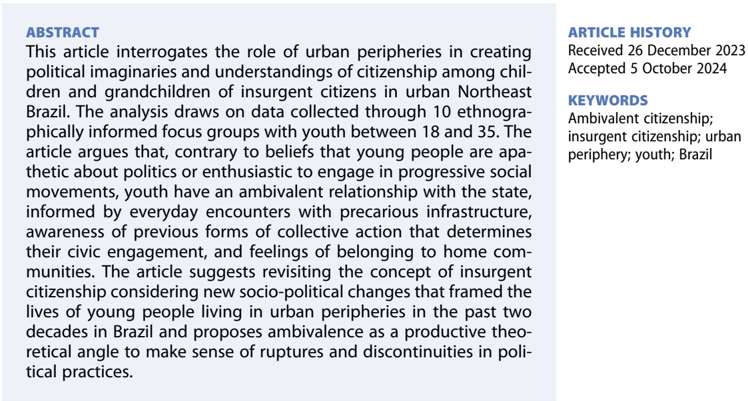
This article interrogates the role of urban peripheries in creating political imaginaries and understandings of citizenship among children and grandchildren of insurgent citizens in urban Northeast Brazil. The analysis draws on data collected through 10 ethnographically informed focus groups with youth between 18 and 35. The article argues that, contrary to beliefs that young people are apathetic about politics or enthusiastic to engage in progressive social movements, youth have an ambivalent relationship with the state, informed by everyday encounters with precarious infrastructure, awareness of previous forms of collective action that determines their civic engagement, and feelings of belonging to home communities. The article suggests revisiting the concept of insurgent citizenship considering new socio-political changes that framed the lives of young people living in urban peripheries in the past two decades in Brazil and proposes ambivalence as a productive theoretical angle to make sense of ruptures and discontinuities in political practices.
Overview
The claims and statistics of this paper haven’t been checked yet.
Run the check — free, no account needed. It reads the open-access text and checks the sources it cites.
Integrity signals
Registry
Cites
Statistics
Figures


Verification
Claims the paper makes
The claims and statistics of this paper haven’t been checked yet.
Run the check — free, no account needed. It reads the open-access text and checks the sources it cites.
Claims other papers make about this one
Each is checked against this paper’s own text: does it say what the citing paper says it does?
In the citing paper
“These divisions weakened Conjunto Palmeiras's capacity to unite around existing problems through their numerous community organizations (Mandache 2024).”
From Political polarization and the liberal bias: A plea for an anthropology of the popular (2026) · cites this paper as Mandache 2024
Self-check
Percentages, sums and reported differences re-computed from the paper’s own numbers.
The self-check needs the paper’s full text.
Citations
Cites
Cultures of politics/politics of cultures: re-visioning Latin American social movements
(1998) · Choice Reviews Online · doi:10.5860/choice.36-1132 · Cited by 1,441
The Making of Social Movements in Latin America: Identity, Strategy, and Democracy.
Zamosc, L., Escobar, A., & Alvarez, S. E. (1994) · Contemporary Sociology · doi:10.2307/2074889 · Cited by 955
Insurgent Citizenship: Disjunctions of Democracy and Modernity in Brazil
Lazar, S. (2009) · Hispanic American Historical Review · doi:10.1215/00182168-2009-076 · Cited by 904
Low, S. M., & Altman, I. (1992) · Place Attachment · doi:10.1007/978-1-4684-8753-4_1 · Cited by 834
Laughter out of place: race, class, violence, and sexuality in a Rio shantytown
(2004) · Choice Reviews Online · doi:10.5860/choice.41-6704 · Cited by 825
Representing Fundamentalism: The Problem of the Repugnant Cultural Other
Harding, S. (1991) · Social research · Cited by 460
Community-Based Participatory Research
Hacker, K. (2013) · Sage eBooks · doi:10.4135/9781452244181 · Cited by 372
State of the world's cities, 2010-2011: bridging the urban divide
(2011) · Choice Reviews Online · doi:10.5860/choice.48-3002 · Cited by 324
Uninterested Youth? Young People's Attitudes towards Party Politics in Britain
Henn, M., Weinstein, M., & Forrest, S. E. (2005) · Political Studies · doi:10.1111/j.1467-9248.2005.00544.x · Cited by 254
Fleischmann, L., & Steinhilper, E. (2017) · Social Inclusion · doi:10.17645/si.v5i3.945 · Cited by 216
Repertórios de interação estado-sociedade em um estado heterogêneo: a experiência na Era Lula
Abers, R. N., Serafim, L., & Tatagiba, L. (2014) · Dados · doi:10.1590/0011-5258201411 · Cited by 203
The Spectacular Favela: Violence in Modern Brazil
Larkins, E. R. (2015) · Cited by 201
Autoconstruction in Working-Class Brazil
Holston, J. (1991) · Cultural Anthropology · doi:10.1525/can.1991.6.4.02a00020 · Cited by 198
Ambivalence and Citizenship: Theorising the Political Claims of Irregular Migrants
McNevin, A. (2013) · Millennium Journal of International Studies · doi:10.1177/0305829812463473 · Cited by 133
‘Politics are Bollocks’: Youth, Politics and Activism in Contemporary Europe
Pilkington, H., & Pollock, G. (2015) · The Sociological Review · doi:10.1111/1467-954x.12260 · Cited by 130
Networks and Marginality: Life in a Mexican Shantytown
Dietz, H., de Lomnitz, L. A., & Lomnitz, C. (1979) · Hispanic American Historical Review · doi:10.1215/00182168-59.1.177 · Cited by 116
Citizenship: a perverse confluence
Dagnino, E. (2007) · Development in Practice · doi:10.1080/09614520701469534 · Cited by 103
Contesting privilege with right: the transformation of differentiated citizenship in Brazil
Holston, J. (2011) · Citizenship Studies · doi:10.1080/13621025.2011.565157 · Cited by 97
Woodman, D., & Wyn, J. (2015) · Journal of Youth Studies · doi:10.1080/13676261.2015.1048206 · Cited by 88
Social Movements and Leftist Governments in Latin America
Prevost, G. (2012) · Zed Books · doi:10.5040/9781350222649 · Cited by 58
Reflexões sobre a hiperperiferia: novas e velhas faces da pobreza no entorno municipal
Torres, H. D. G., & Marques, E. C. L. (2001) · Revista Brasileira de Estudos Urbanos e Regionais · doi:10.22296/2317-1529.2001n4p49 · Cited by 46
“AQUI NÃO TEM GANGUE, TEM FACÇÃO”: AS TRANSFORMAÇÕES SOCIAIS DO CRIME EM FORTALEZA.
Paiva, L. F. S. (2019) · Caderno CRH · doi:10.9771/ccrh.v32i85.26375 · Cited by 38
Situating Fortaleza: Urban space and uneven development in northeastern Brazil
Garmany, J. (2010) · Cities · doi:10.1016/j.cities.2010.08.004 · Cited by 35
Rolezinhos: Marcas, consumo e segregação no Brasil
Pinheiro‐Machado, R., & Scalco, L. M. (2014) · Revista Estudos Culturais · doi:10.11606/issn.2446-7693i1p1-21 · Cited by 33
Magaña, M. R. (2016) · The Journal of Latin American and Caribbean Anthropology · doi:10.1111/jlca.12218 · Cited by 31
The right to shine: Poverty, consumption and (de) politicization in neoliberal Brazil
Pinheiro‐Machado, R., & Scalco, L. M. (2022) · Journal of Consumer Culture · doi:10.1177/14695405221086066 · Cited by 28
JOVENS EM MOVIMENTO: MAPAS PLURAIS, CONEXÕES E TENDÊNCIAS NA CONFIGURAÇÃO DAS PRÁTICAS
Spósito, M. P., de Almeida, E., & Corrochano, M. C. (2020) · Educação & Sociedade · doi:10.1590/es.228732 · Cited by 26
Kratz, C. A. (2010) · American Ethnologist · doi:10.1111/j.1548-1425.2010.01286.x · Cited by 23
Claiming rights in exile: women’s insurgent citizenship practices in the Thai-Myanmar borderlands
Olivius, E. (2019) · Citizenship Studies · doi:10.1080/13621025.2019.1664408 · Cited by 20
“I'm Not a Leader”: Cynicism and Good Citizenship in a Brazilian Favela
Savell, S. (2015) · PoLAR Political and Legal Anthropology Review · doi:10.1111/plar.12112 · Cited by 18
Cynical Citizenship: Gender, Regionalism, and Political Subjectivity in Porto Alegre, Brazil
Junge, B. (2018) · Project Muse (Johns Hopkins University) · Cited by 9
Porous infrastructures and the politics of upward mobility in Brazil's public housing
Kopper, M. (2018) · Economic Anthropology · doi:10.1002/sea2.12132 · Cited by 9
Flipping the City: Space and Subjectivity in the São Paulo Periphery
Klein, C. H. (2019) · City & Society · doi:10.1111/ciso.12207 · Cited by 9
Brazil’s Social Safety Net Under Lula
Ansell, A. (2011) · NACLA Report on the Americas · doi:10.1080/10714839.2011.11725533 · Cited by 7
Confronting Affirmative Action in Brazil
Penha-Lopes, V. (2017) · Lexington Books · doi:10.5771/9781498537797 · Cited by 6
Exploring Ibero-American Youth Cultures in the 21st Century
(2021) · Springer eBooks · doi:10.1007/978-3-030-83541-5 · Cited by 1
Hallett, M. C., & Otero-Asmar, Y. (2022) · Citizenship Studies · doi:10.1080/13621025.2022.2131074 · Cited by 1
Research works printed but not linked: 8
- Davis, D.-A., and C. Craven. 2016. Feminist Ethnography: Thinking Through Methodologies, Challenges and Possibilities. Lanham: Rowman & Littlefield.
- Freire, P. 1973/2017. The Pedagogy of the Oppressed. New York: Bloomsbury.
- Kopper, M. 2024. “The Right to Information: Bottom-Up Bureaucracies and Data Infrastructures at Brazil’s Urban Margins.” Journal of Anthropological Research. (forthcoming).
- Mandache, L.-A. 2023. “NGOs as ‘Necessary Evils’: Challenges of Doing Good in Urban Northeast Brazil.” In Ethnographic Insights on Latin America and the Caribbean, edited by M. Medeiros and J. Guzman, 241–251. Toronto: University of Toronto Press.
- Mandache, L.-A., and M. Kopper. 2024. “Beyond Liberal Insurgency: New Modulations of Citizenship at Brazil’s Urban Margins.” Journal of Anthropological Research. (forthcoming).
- Mühlfried, F. 2021. “The Spectrum of Mistrust.” Zeitschrift für Ethnologie 146: 201–218.
- Muylaert, A. 2015. The Second Mother. Drama.
- Trece, J., and C. Considera. 2023. Breve Retrato Econômico Da Região Nordeste. FGV IBRE. https://portalibre.fgv.br/system/files/2023-04/td8-breve-retrato-economico-da-regiao-nordeste.pdf.
Cited by
Political polarization and the liberal bias: A plea for an anthropology of the popular
Mandache, L.-A. (2026) · Human Organization · doi:10.1080/00187259.2025.2561702 · Cited by 1
Self-citation
Metadata
- Authors
- Mandache, L.-A.
- Affiliations
- Center for Ethics and Poverty Research, University of Salzburg, Salzburg, Austria
- Venue
- Citizenship Studies
- Publisher
- Informa UK Limited
- Published
- 2024-07-03
- Volume
- 28
- Issue
- 4-5
- Pages
- 498-515
- ISSN
- 1362-1025
- 1469-3593
- Cited by
- 6
- References
- 37
- Language
- en
- Funders
- Austrian Science Fund (M3045)
About these checks
Registry, retraction, Cites and statistics results are computed, not judged, with one exception: a printed reference that no index lists is read once by a model before it counts as a citation error. Claims are extracted by a model and kept only when their quote appears verbatim in the text; each cited source is then checked, with a model’s help, for whether it says what the claim relies on. Those verdicts can be wrong — read the claim’s quote and the cited source before relying on one.
Statistics and arithmetic are recomputed, not judged.
Confidence bands are shown only for fields calibrated on our annotated test set. None is calibrated yet, so no band is shown.
What counts as a claim ›How we measure confidence ›How we check this ›
Are you an author, or do you see a problem with this page? Request a review
Data sources
Bibliographic data: Semantic Scholar, OpenAlex, Crossref.
Contains information from the Semantic Scholar Academic Graph Datasets, made available under the ODC Attribution License (ODC-BY 1.0).
Semantic Scholar’s data is described in: Kinney, R., et al. (2023). The Semantic Scholar Open Data Platform. arXiv:2301.10140.
