

The DOI matches its Crossref record; 66 of the 66 references it cites were found in a registry or an index.
Transparent to whom? No algorithmic accountability without a critical audience
Open accessAbstract
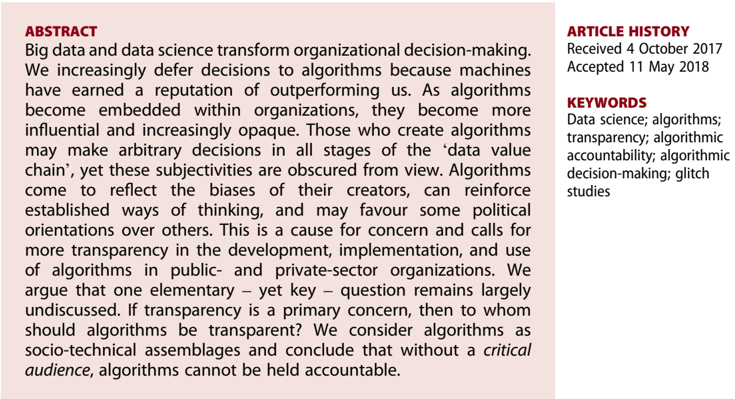
Big data and data science transform organizational decision-making. We increasingly defer decisions to algorithms because machines have earned a reputation of outperforming us. As algorithms become embedded within organizations, they become more influential and increasingly opaque. Those who create algorithms may make arbitrary decisions in all stages of the ‘data value chain’, yet these subjectivities are obscured from view. Algorithms come to reflect the biases of their creators, can reinforce established ways of thinking, and may favour some political orientations over others. This is a cause for concern and calls for more transparency in the development, implementation, and use of algorithms in public- and private-sector organizations. We argue that one elementary – yet key – question remains largely undiscussed. If transparency is a primary concern, then to whom should algorithms be transparent? We consider algorithms as socio-technical assemblages and conclude that without a critical audience, algorithms cannot be held accountable.
Overview
The claims and statistics of this paper haven’t been checked yet.
Run the check — free, no account needed. It reads the open-access text and checks the sources it cites.
Integrity signals
Registry
Cites
Statistics
Figures

Verification
Claims the paper makes
The claims and statistics of this paper haven’t been checked yet.
Run the check — free, no account needed. It reads the open-access text and checks the sources it cites.
Claims other papers make about this one
Each is checked against this paper’s own text: does it say what the citing paper says it does?
The cited source says what the claim attributes to it.
In the citing paper
“Crucially, a meaningful account cannot be given unless the forum can understand and critically engage with the subject matter [37,75].”
From Reviewable Automated Decision-Making: A Framework for Accountable Algorithmic Systems (2021) · cites this paper as [37]
Self-check
Percentages, sums and reported differences re-computed from the paper’s own numbers.
The self-check needs the paper’s full text.
Citations
Cites
Tversky, A., & Kahneman, D. (1974) · Science · doi:10.1126/science.185.4157.1124 · Cited by 28,810 · cited 1×
“In statistics and economics, the cognitive biases of people (e.g. con fi r-mation bias) and analytical pitfals (e.g. selection bias) have been subject of inquiry for many decades and are relatively well understood (see Tversky & Kahneman, 1974).”
null (2016) · Philosophy Study · doi:10.17265/2159-5313/2016.09.003 · Cited by 28,317
Judgment under Uncertainty: Heuristics and Biases
Tversky, A., & Kahneman, D. (1975) · Utility, Probability, and Human Decision Making · doi:10.1007/978-94-010-1834-0_8 · Cited by 22,650
The FAIR Guiding Principles for scientific data management and stewardship
Wilkinson, M. D., Dumontier, M., Aalbersberg, I. J., Appleton, G., Axton, M., Baak, A., Blomberg, N., Boiten, J.-W., da Silva Santos, L. B., Bourne, P. E., et al. (2016) · Scientific Data · doi:10.1038/sdata.2016.18 · Cited by 18,423 · cited 3×
“The FAIR acronym refers to data management that is Findable, Accessible, Interoperable, and Reusable (Wilkinson, 2016, p. 4; Wilkinson et al., 2017, p. 3): Findable ‒ data should be identi fi ed using globally unique, resolvable, and persistent identi fi ers, and should include machine-actionable…”
MethodBusiness intelligence and analytics: from big data to big impact
Chen, H., Chiang, R. H. L., & Storey, V. C. (2012) · MIS Quarterly · doi:10.2307/41703503 · Cited by 6,250
(2023) · doi:10.1126/science · Cited by 6,063
Beyond the hype: Big data concepts, methods, and analytics
Gandomi, A., & Haider, M. (2015) · International Journal of Information Management · doi:10.1016/j.ijinfomgt.2014.10.007 · Cited by 4,226 · cited 1×
“The resulting pervasive collection of data-centric innovations has been subjected to limited academic scrutiny, especially when compared to the dissemination of earlier statistical techniques (Gandomi & Haider, 2015).”
MethodThe Black Box Society: The Secret Algorithms That Control Money and Information
Pasquale, F. (2015) · doi:10.4159/harvard.9780674736061 · Cited by 3,796
Barocas, S., & Selbst, A. D. (2014) · doi:10.2139/ssrn.2477899 · Cited by 3,048 · cited 2×
“Despite the many advantages that these quanti fi cation objects may bring about, concerns have risen about the susceptibility of algorithmic models to human-like bias (Barocas & Selbst, 2016; Caliskan-Islam, Bryson, & Narayanan, 2016; van Doorn, 2017).”
BackgroundSemantics derived automatically from language corpora contain human-like biases
Caliskan, A., Bryson, J. J., & Narayanan, A. (2017) · Science · doi:10.1126/science.aal4230 · Cited by 2,887 · cited 1×
“…can learn to adopt similar discriminatory attitudes based on words associated with a particular gender or social group (Barocas & Selbst, 2016; Caliskan, Bryson, & Narayanan, 2017) ‒ similarly, algorithmic models have been demonstrated to potentially reproduce racialized and sex-ualized…”
Background
Research works printed but not linked: 14
- 10.15779/Z38BG31 · DOI · Paper page
- Bodó B., 2017, Yale Journal of Law & Technology, 19, 133
- 10.1126/science.aal4230 · DOI · Paper page
- Cloninger C., 2013, Slave to the algorithm., 16
- 10.17265/2159-5313/2016.09.003 · DOI · Paper page
- Knoespe K. J., 2008, Théorie, Littérature, Epistémologie, 25, 235
- Lazer D., 2014, Policy Forum, 343, 1203
- Macpherson N., 2013, Review of quality assurance of government models
- Manon H., 2011, World Picture, 6, 1
- Minsky M. L., 1965, Proceedings of International Federation of Information Processing Congress, 1, 45
- Miyazaki S., 2012, Computational Culture, 2
- 10.17265/2159-5313/2016.09.003 · DOI · Paper page
- Sandvig C., 2014, Paper presented to Data and Discrimination: Converting Critical Concerns into Productive Inquiry
- Seaver N., 2013, Media in Transition, 8, 1
Cited by
Sorted by citations
Morley, J., Floridi, L., Kinsey, L., & Elhalal, A. (2020) · Science and Engineering Ethics · doi:10.1007/s11948-019-00165-5 · Cited by 882
(2019) · doi:10.1080/1369118x.2019.1573914 · Cited by 719
Role of fairness, accountability, and transparency in algorithmic affordance
Shin, D., & Park, Y. J. (2019) · Computers in Human Behavior · doi:10.1016/j.chb.2019.04.019 · Cited by 643
Towards transparency by design for artificial intelligence
Felzmann, H., Fosch-Villaronga, E., Lutz, C., & Tamò-Larrieux, A. (2020) · Science and Engineering Ethics · doi:10.1007/s11948-020-00276-4 · Cited by 588
Algorithms as work designers: How algorithmic management influences the design of jobs
Parent-Rocheleau, X., & Parker, S. K. (2022) · Human Resource Management Review · doi:10.1016/j.hrmr.2021.100838 · Cited by 512
Metadata
- Authors
- Kemper, J., & Kolkman, D.
- Affiliations
- University of Amsterdam (NL)
- Eindhoven University of Technology (NL)
- Corresponding author
- Kemper, Jakko
- Venue
- Information, Communication & Society
- Publisher
- Informa UK Limited
- Published
- 2018-06-18
- Volume
- 22
- Issue
- 14
- Pages
- 2081-2096
- ISSN
- 1369-118X (ISSN-L)
- 1468-4462
- OpenAlex
- W2809386502
- Cited by
- 260
- References
- 66
- Citations by year
- 2026: 26 · 2025: 26 · 2024: 30 · 2023: 36 · 2022: 32 · 2021: 51 · 2020: 39 · 2019: 19 · 2018: 1
- FWCI
- 54.68
- Type
- journal article
- Language
- en
- Open access
- hybrid
- doi.org
- Licence
- Locations
- Information Communication & Society (publishedVersion, cc-by-nc-nd)
- UvA-DARE (University of Amsterdam) (publishedVersion, cc-by-nc-nd)
- TU/e Research Portal (submittedVersion, other-oa)
- Data Archiving and Networked Services (DANS) (submittedVersion, other-oa)
- Topics
- Physical Sciences › Computer Science › Artificial Intelligence › Ethics and Social Impacts of AI
- Physical Sciences › Computer Science › Artificial Intelligence › Explainable Artificial Intelligence (XAI)
- Social Sciences › Political Science and International Relations › E-Government and Public Services
- Keywords
- algorithmic accountability, algorithmic transparency, critical audiences, algorithmic decision-making, algorithmic bias, data value chain, sociotechnical assemblages, organizational decision-making, big data, political orientation, public and private institutions
About these checks
Registry, retraction, Cites and statistics results are computed, not judged, with one exception: a printed reference that no index lists is read once by a model before it counts as a citation error. Claims are extracted by a model and kept only when their quote appears verbatim in the text; each cited source is then checked, with a model’s help, for whether it says what the claim relies on. Those verdicts can be wrong — read the claim’s quote and the cited source before relying on one.
Statistics and arithmetic are recomputed, not judged.
Confidence bands are shown only for fields calibrated on our annotated test set. None is calibrated yet, so no band is shown.
What counts as a claim ›How we measure confidence ›How we check this ›
Are you an author, or do you see a problem with this page? Request a review
