

The anti-depressant effects of a novel PDE4 inhibitor derived from resveratrol
Open accessThe DOI matches its Crossref record; 28 of the 28 references it cites were found in a registry or an index.
Abstract
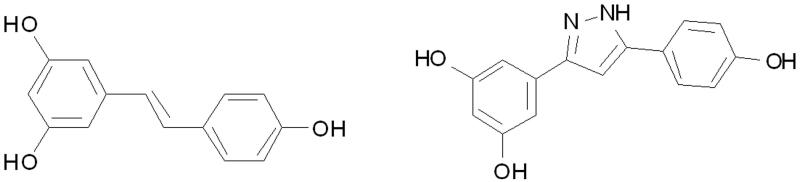
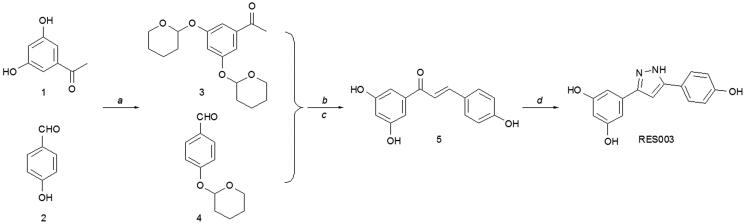
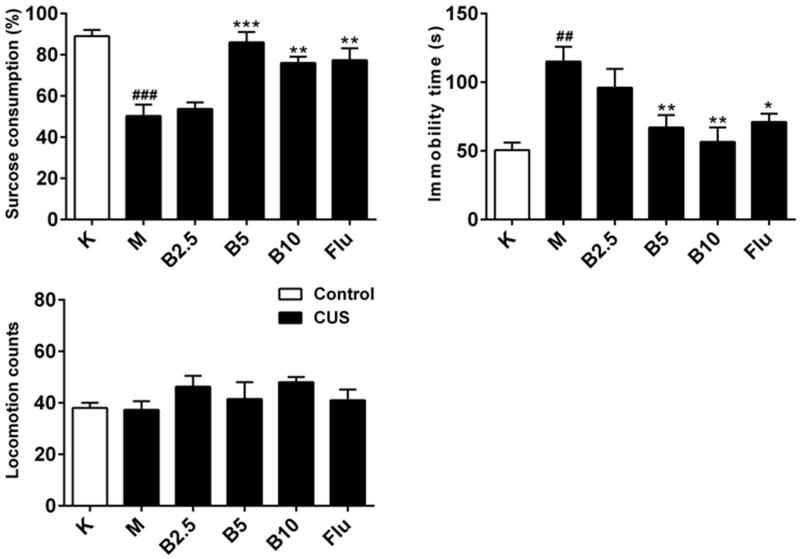
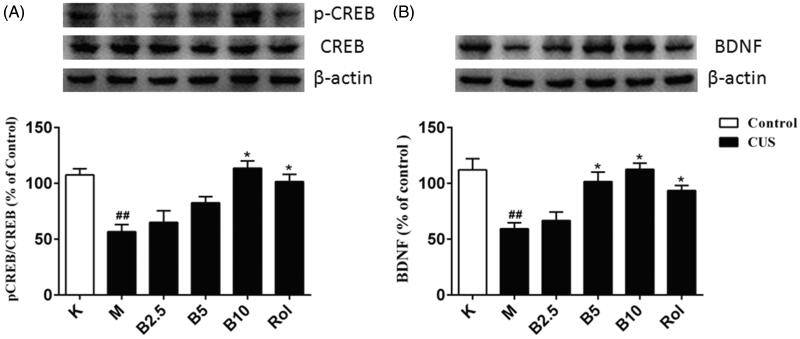
Context Resveratrol has shown anti-stress and anti-depressant-like abilities involved in inhibiting phosphodiesterase-4 (PDE4) enzyme. However, its application is limited due to its low efficacy, bioavailability and selectivity.Objective This study synthesized a new resveratrol derivative RES003 and evaluated its PDE4 inhibitory and anti-depressant-like activities in vitro and in vivo, respectively.Materials and methods PDEs inhibitory activities were evaluated by radioactive tracer method. Anti-depressant-like activities of novel resveratrol analogue (RES003) at doses of 2.5, 5.0 and 10 mg/kg was investigated by sugar water consumption and forced swimming tests using male ICR mice under chronic unpredictable stress procedure for 10 days. A total of 84 mice were randomly distributed into seven groups (n = 12). Drugs and vehicle were administered (intra-gastric or intra-peritoneal) once a day from the first to the last day. The molecular mechanisms were identified by western blot.Results RES003 showed more potent PDE4 inhibitory activity (half maximal inhibitory concentration (IC50), 0.87 μM) and better selectivity than resveratrol (IC50, 18.8 μM). RES003 could significantly increase the consumption of sugar water (p < 0.01) and immobility time (p < 0.01) compared to vehicle-treated stressed groups at doses of 5 and 10 mg/kg. Furthermore, RES003 could significantly increase the levels of cyclic adenosine monophosphate response element binding protein phosphorylation (10 mg/kg, p < 0.05) and brain-derived neurotrophic factor (BDNF) expression (5 and 10 mg/kg, p < 0.05 and 0.01) in mouse brain.Discussion and conclusions RES003 could ameliorate chronic stress induced depression-like behaviours through inhibition of PDE4 and activation of cAMP-triggered phosphorylation of cAMP response element binding protein/BDNF signalling pathway. Consequently, RES003 is a promising lead compound for the treatment of depression.
Overview
The claims and statistics of this paper haven’t been checked yet.
Free: it reads the open-access text and checks the first 5 claims that cite a source we can check. Create a free account to check every claim.
Integrity signals
Registry
Cites
Statistics
Figures
Verification
Claims the paper makes
The claims and statistics of this paper haven’t been checked yet.
Free: it reads the open-access text and checks the first 5 claims that cite a source we can check. Create a free account to check every claim.
Self-check
Percentages, sums and reported differences re-computed from the paper’s own numbers.
The self-check needs the paper’s full text.
Citations
Cites
Therapeutic potential of resveratrol: the in vivo evidence
Baur, J. A., & Sinclair, D. A. (2006) · Nature Reviews Drug Discovery · doi:10.1038/nrd2060 · Cited by 3,958
CREB: A Stimulus-Induced Transcription Factor Activated by A Diverse Array of Extracellular Signals
Shaywitz, A. J., & Greenberg, M. E. (1999) · Annual Review of Biochemistry · doi:10.1146/annurev.biochem.68.1.821 · Cited by 2,134
Resveratrol Ameliorates Aging-Related Metabolic Phenotypes by Inhibiting cAMP Phosphodiesterases
Park, S.-J., Ahmad, F., Philp, A., Baar, K., Williams, T., Luo, H., Ke, H., Rehmann, H., Taussig, R., Brown, A. L., et al. (2012) · Cell · doi:10.1016/j.cell.2012.01.017 · Cited by 1,349
“Behavioural despair” in rats and mice: Strain differences and the effects of imipramine
Porsolt, R. D., Bertin, A., & Jalfre, M. (1978) · European Journal of Pharmacology · doi:10.1016/0014-2999(78)90414-4 · Cited by 636 · cited 2×
“According to the previous description, animals were individually placed in glass cylinders (25 cm height, 10 cm diameter) containing 10 cm depth of water at 24 ± 1 C for 6min, allowing for free swimming (Porsolt et al. 1978).”
MethodBanasr, M., Hery, M., Printemps, R., & Daszuta, A. (2004) · Neuropsychopharmacology · doi:10.1038/sj.npp.1300320 · Cited by 539 · cited 1×
“In the mice hippocampus and other brain regions, BDNF also regulates nerve cell plasticity and development, which may be achieved through promoting cell survival and reducing neuronal damage (Takahashi et al. 1999; Banasr et al. 2004).”
BackgroundTakahashi, J., Palmer, T. D., & Gage, F. H. (1999) · Journal of Neurobiology · doi:10.1002/(sici)1097-4695(199901)38:1<65::aid-neu5>3.0.co;2-q · Cited by 414 · cited 1×
“In the mice hippocampus and other brain regions, BDNF also regulates nerve cell plasticity and development, which may be achieved through promoting cell survival and reducing neuronal damage (Takahashi et al. 1999; Banasr et al. 2004).”
BackgroundPhosphodiesterases in the CNS: targets for drug development
Menniti, F. S., Faraci, W. S., & Schmidt, C. J. (2006) · Nature Reviews Drug Discovery · doi:10.1038/nrd2058 · Cited by 391 · cited 1×
“In the signalling pathways involving PDEs, PKA and PKG regulate the expression of key genes in central nervous system by activating some transcription factors (Menniti et al. 2006; Figure 4.”
BackgroundMitochondrial mechanisms of neural cell apoptosis
Polster, B. M., & Fiskum, G. (2004) · Journal of Neurochemistry · doi:10.1111/j.1471-4159.2004.02572.x · Cited by 327 · cited 1×
“The chronic unpredictable stress procedure was carried out as described previously with minor modification (Polster and Fiskum 2004).”
MethodCoimbra, M., Isacchi, B., van Bloois, L., Torano, J. S., Ket, A., Wu, X., Broere, F., Metselaar, J. M., Rijcken, C. J. F., Storm, G., et al. (2011) · International Journal of Pharmaceutics · doi:10.1016/j.ijpharm.2011.01.056 · Cited by 323 · cited 1×
“The usefulness of resveratrol, however, is limited by its chemical instability and low bioavailability (Baur and Sinclair 2006; Kang et al. 2009; Coimbra et al. 2011).”
BackgroundResveratrol and derivatives for the prevention and treatment of cancer
Fulda, S. (2010) · Drug Discovery Today · doi:10.1016/j.drudis.2010.07.005 · Cited by 256 · cited 1×
“Some of these compounds were reported to exhibit strong neuroprotective, pro-apoptotic and anti-proliferative effects (Belluti et al. 2010; Fulda 2010; Mazue et al. 2010; Biasutto et al. 2014, 2017).”
BackgroundBelluti, F., Fontana, G., Bo, L. D., Carenini, N., Giommarelli, C., & Zunino, F. (2010) · Bioorganic & Medicinal Chemistry · doi:10.1016/j.bmc.2010.03.069 · Cited by 232 · cited 1×
“Some of these compounds were reported to exhibit strong neuroprotective, pro-apoptotic and anti-proliferative effects (Belluti et al. 2010; Fulda 2010; Mazue et al. 2010; Biasutto et al. 2014, 2017).”
BackgroundChen, L.-W., Wang, Y.-Q., Wei, L.-C., Shi, M., & Chan, Y.-S. (2007) · CNS & Neurological Disorders - Drug Targets · doi:10.2174/187152707781387288 · Cited by 159 · cited 1×
“Resveratrol, a natural polyphenol being present in many plantbased foods, has many pharmacological properties including antioxidant and anti-inflammatory activities (Tredici et al. 1999; Chen et al. 2007; Ranney and Petro 2009).”
BackgroundSilove, D., Alonso, J., Bromet, E., Gruber, M., Sampson, N., Scott, K., Andrade, L., Benjet, C., Caldas de Almeida, J. M., De Girolamo, G., et al. (2015) · American Journal of Psychiatry · doi:10.1176/appi.ajp.2015.14091185 · Cited by 143 · cited 1×
“It is characterized by high rates of suicide, anxiety or irritable mood along with cognitive and sleep disorder (Schoepf et al. 2014; Silove et al. 2015).”
BackgroundYu, Y., Wang, R., Chen, C., Du, X., Ruan, L., Sun, J., Li, J., Zhang, L., O’Donnell, J. M., Pan, J., et al. (2012) · Journal of Psychiatric Research · doi:10.1016/j.jpsychires.2012.10.018 · Cited by 114 · cited 2×
“SPT The SPT was performed according to the previous description with minor modification (Yu et al. 2013).”
MethodSelf-citationWang, G., Chen, L., Pan, X., Chen, J., Wang, L., Wang, W., Cheng, R., Wu, F., Feng, X., Yu, Y., et al. (2016) · Oncotarget · doi:10.18632/oncotarget.8041 · Cited by 110
Self-citationYoung, R. A., & Ward, A. (1988) · Drugs · doi:10.2165/00003495-198836020-00003 · Cited by 108
Kang, S., Cuendet, M., Endringer, D. C., Croy, V. L., Pezzuto, J. M., & Lipton, M. A. (2008) · Bioorganic & Medicinal Chemistry · doi:10.1016/j.bmc.2008.04.031 · Cited by 102 · cited 1×
“The usefulness of resveratrol, however, is limited by its chemical instability and low bioavailability (Baur and Sinclair 2006; Kang et al. 2009; Coimbra et al. 2011).”
BackgroundLi, W., Ling, S., Yang, Y., Hu, Z., Davies, H., & Fang, M. (2014) · PubMed · Cited by 95
Phosphodiesterases in the Central Nervous System
Kleppisch, T. (2008) · Handbook of experimental pharmacology · doi:10.1007/978-3-540-68964-5_5 · Cited by 84 · cited 1×
“Kleppisch 2009).”
Zhang, L.-M., Qiu, Z.-K., Zhao, N., Chen, H.-X., Liu, Y.-Q., Xu, J.-P., Zhang, Y.-Z., Yang, R.-F., & Li, Y.-F. (2014) · The International Journal of Neuropsychopharmacology · doi:10.1017/s1461145714000479 · Cited by 82 · cited 1×
“However, only one-third of individuals with depression or anxiety show full remission in response to these medications (Zhang et al. 2014).”
BackgroundResveratrol, map kinases and neuronal cells: might wine be a neuroprotectant?
Tredici, G., Miloso, M., Nicolini, G., Galbiati, S., Cavaletti, G., & Bertelli, A. A. A. (1999) · PubMed · Cited by 80
Mazué, F., Colin, D., Gobbo, J., Wegner, M., Rescifina, A., Spatafora, C., Fasseur, D., Delmas, D., Meunier, P., Tringali, C., et al. (2010) · European Journal of Medicinal Chemistry · doi:10.1016/j.ejmech.2010.03.024 · Cited by 70 · cited 1×
“Some of these compounds were reported to exhibit strong neuroprotective, pro-apoptotic and anti-proliferative effects (Belluti et al. 2010; Fulda 2010; Mazue et al. 2010; Biasutto et al. 2014, 2017).”
BackgroundResveratrol derivatives as a pharmacological tool
Biasutto, L., Mattarei, A., Azzolini, M., Spina, M. L., Nicola Sassi, A., Romio, M., Paradisi, C., & Zoratti, M. (2017) · Annals of the New York Academy of Sciences · doi:10.1111/nyas.13401 · Cited by 69 · cited 1×
“Some of these compounds were reported to exhibit strong neuroprotective, pro-apoptotic and anti-proliferative effects (Belluti et al. 2010; Fulda 2010; Mazue et al. 2010; Biasutto et al. 2014, 2017).”
BackgroundResveratrol protects spatial learning in middle-aged C57BL/6 mice from effects of ethanol
Ranney, A., & Petro, M. S. (2009) · Behavioural Pharmacology · doi:10.1097/fbp.0b013e32832f0193 · Cited by 47
Improving the Efficacy of Plant Polyphenols
Biasutto, L., Mattarei, A., Nicola Sassi, A., Azzolini, M., Romio, M., Paradisi, C., & Zoratti, M. (2014) · Anti-Cancer Agents in Medicinal Chemistry · doi:10.2174/1871520614666140627150054 · Cited by 37 · cited 1×
“Some of these compounds were reported to exhibit strong neuroprotective, pro-apoptotic and anti-proliferative effects (Belluti et al. 2010; Fulda 2010; Mazue et al. 2010; Biasutto et al. 2014, 2017).”
BackgroundSchoepf, D., Uppal, H., Potluri, R., CHANDRAN, S. R., & Heun, R. (2014) · Journal of Psychiatric Research · doi:10.1016/j.jpsychires.2014.01.010 · Cited by 33 · cited 1×
“It is characterized by high rates of suicide, anxiety or irritable mood along with cognitive and sleep disorder (Schoepf et al. 2014; Silove et al. 2015).”
BackgroundZhao, P., Chen, S.-K., Cai, Y.-H., Lu, X., Li, Z., Cheng, Y., Zhang, C., Hu, X., He, X., & Luo, H. (2013) · Biochimica et Biophysica Acta (BBA) - Proteins and Proteomics · doi:10.1016/j.bbapap.2013.07.004 · Cited by 25 · cited 1×
“PDE4 has been implicated in anti-depressant and anxiolytic activities by catalyzing the hydrolysis of cAMP, which plays a critical role in the cellular response to extracellular stimuli (Zhao et al. 2013).”
BackgroundCote, R., Feng, Q., & Valeriani, B. A. (2003) · Investigative Ophthalmology & Visual Science · Cited by 3
Cited by
Hassamal, S. (2023) · Frontiers in Psychiatry · doi:10.3389/fpsyt.2023.1130989 · Cited by 578
“PDE-4 (87) PDE-4 hydrolyzes and inactivates intracellular cAMP, which is a second messenger that”
BackgroundSocała, K., Żmudzka, E., Lustyk, K., Zagaja, M. P., Brighenti, V., Costa, A., Andres‐Mach, M., Pytka, K., Martinelli, I., Mandrioli, J., et al. (2024) · Phytotherapy Research · doi:10.1002/ptr.8101 · Cited by 31
PDE4 Inhibitors for Disease Therapy: Advances and Future Perspective
Du, B., Luo, M., Ren, C., & Zhang, J. (2023) · Future Medicinal Chemistry · doi:10.4155/fmc-2023-0101 · Cited by 21
Bai, Y., Zhang, Y., Li, S., Zhang, W., Wang, X., He, B., & Ju, W. (2021) · Frontiers in Pharmacology · doi:10.3389/fphar.2021.711303 · Cited by 11
Chen, J., Wei, X., Wu, X.-F., Zhang, Q., Xia, G., Xia, H., Shang, H., & Lin, S. H. (2024) · Aging · doi:10.18632/aging.205960 · Cited by 12
“RES003, a resveratrol derivative with an IC50 of 0.87 μM, can improve chronic stress-induced depression-like behaviors and other psychiatric disorders by inhibiting PDE4 and upregulating the p-CREB/BDNF signaling pathway [76].”
BackgroundInfluential
Metadata
- Authors
- Yu, Y., Wang, J., & Huang, X.
- Affiliations
- Wenzhou Medical University (CN)
- Changzhou University (CN)
- Corresponding author
- Huang, Xianfeng
- Venue
- Pharmaceutical Biology
- Publisher
- Informa UK Limited
- Published
- 2021-01
- Volume
- 59
- Issue
- 1
- Pages
- 416-421
- ISSN
- 0925-1618 (ISSN-L)
- 1388-0209
- 1744-5116
- PMC
- PMC8049461
- OpenAlex
- W3153195639
- Cited by
- 14
- References
- 28
- Citations by year
- 2026: 4 · 2025: 1 · 2024: 4 · 2023: 4 · 2021: 1
- FWCI
- 0.71
- Type
- journal article
- Language
- en
- Open access
- gold
- doi.org
- Licence
- Locations
- Pharmaceutical Biology (publishedVersion, cc-by)
- PubMed Central (publishedVersion, cc-by)
- PubMed (publishedVersion)
- DOAJ (DOAJ: Directory of Open Access Journals) (submittedVersion, cc-by-sa)
- Funders
- National Natural Science Foundation (81970475)
- Basic Public Research Program of Zhejiang Province (LBY21H030002)
- Natural Science Foundation of Zhejiang Province (LY18H030005)
- Topics
- Life Sciences › Biochemistry, Genetics and Molecular Biology › Molecular Biology › Phosphodiesterase function and regulation
- Health Sciences › Medicine › Pharmacology (medical) › Treatment of Major Depression
- Health Sciences › Medicine › Geriatrics and Gerontology › Sirtuins and Resveratrol in Medicine
- Keywords
- resveratrol derivatives, phosphodiesterase-4 inhibitors, antidepressant effects, chronic unpredictable mild stress, depression-like behavior, brain-derived neurotrophic factor, cAMP signaling, forced swim test
- MeSH terms
- Resveratrol, Cyclic AMP, Animals, Antidepressive Agents, Depression, Disease Models, Animal, Dose-Response Relationship, Drug, Male, Mice, Inbred ICR, Stress, Psychological, Signal Transduction, Inhibitory Concentration 50, Mice, Phosphodiesterase 4 Inhibitors
About these checks
Registry, retraction, Cites and statistics results are computed, not judged, with one exception: a printed reference that no index lists is read once by a model before it counts as a citation error. Claims are extracted by a model and kept only when their quote appears verbatim in the text; each cited source is then checked, with a model’s help, for whether it says what the claim relies on. Those verdicts can be wrong — read the claim’s quote and the cited source before relying on one.
Statistics and arithmetic are recomputed, not judged.
Confidence bands are shown only for fields calibrated on our annotated test set. None is calibrated yet, so no band is shown.
What counts as a claim ›How we measure confidence ›How we check this ›
Are you an author, or do you see a problem with this page? Request a review
Data sources
Bibliographic data: Semantic Scholar, OpenAlex, Crossref.
Contains information from the Semantic Scholar Academic Graph Datasets, made available under the ODC Attribution License (ODC-BY 1.0).
Semantic Scholar’s data is described in: Kinney, R., et al. (2023). The Semantic Scholar Open Data Platform. arXiv:2301.10140.
