

Is beauty-based inequality gendered? A systematic review of gender differences in socioeconomic outcomes of physical attractiveness in labor markets
Open accessThe DOI matches its Crossref record; 121 of the 121 references it cites were found in a registry or an index; none of the 48 sources its claims cite is checked for support yet.
Abstract
During the past decade, academic interest in physical attractiveness-based social inequalities has spread significantly beyond the United States to Europe. In previous research, however, there has been no consensus on whether the socioeconomic outcomes of physical attractiveness are gendered. Thus, we conducted a systematic review to determine to what extent and how the socioeconomic outcomes of physical appearance in labor markets are gendered. A total of 58 articles were reviewed after searching through five databases and identifying relevant articles. The results show that, in general, more attractive individuals are socioeconomically favored, which is true for both men and women. The number of studies that claim that attractiveness is more beneficial for women is almost equal to the number of studies that claim it is more beneficial for men. Moreover, while the socioeconomic outcomes for men are somewhat consistent, the outcomes for women appear to be more inconsistent; only women appear to be both rewarded and penalized for being attractive. Therefore, we conclude that contextual factors play a greater role in attractiveness-related outcomes, especially for women, than previously assumed.
Overview
CoChat Summary
TL;DR
This systematic review of 58 quantitative studies finds that physical attractiveness is generally socioeconomically beneficial for both men and women in labor markets, but the outcomes are gendered in consistency: attractiveness is more consistently an asset for men, while only women are sometimes penalized for being attractive. The authors conclude that contextual factors, especially for women, play a greater role than previously assumed.
Key findings
- Across 58 reviewed articles, attractiveness was beneficial for both men and women in 39 papers; 19 found it more beneficial for women and 20 more beneficial for men, so there is no clear overall gender advantage in rewards.
- The clearest gender difference is in penalties: 7 studies found the “beauty is beastly” effect for women, and no study detected it for men; Table 4 reports attractiveness as more detrimental for women in 8 papers versus 0 for men.
- For plainness/unattractiveness, most studies found negative outcomes for one or both genders (15 papers); 4 found plainness more detrimental for women, 5 for men, 6 for both, and 2 for neither, while only 3 found plainness beneficial for either gender.
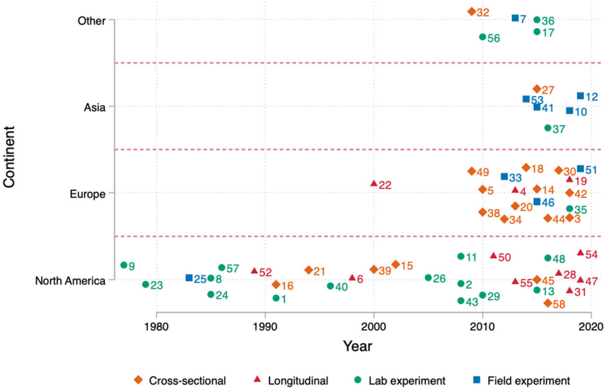
- Publication trends show 64% of included studies were published in 2010 or later; before 2010 almost all were North American, after which Europe and Asia increased, and Africa had no included research. Outcomes were money (21; 36.21%), hiring (20; 34.48%), votes (9; 15.52%), and other (8; 13.79%), with most occupation-specific research on white-collar jobs and near-total absence of blue-collar jobs.
Methods
- Systematic review searching EBSCO, Scopus, ProQuest, Web of Science, and Google Scholar in three waves in 2019; after duplicate removal and title/abstract screening, 504 articles passed the first phase, 101 met criteria, and 58 studies were included.
- Included quantitative studies comparing work-related socioeconomic outcomes of physical attractiveness by gender, including cross-sectional, longitudinal, lab, and field experiments; outcomes included income, salary, hiring, tips, electoral votes, and career success.
- Two researchers independently screened and extracted data using a structured extraction table; disagreements were resolved by discussion or a third reviewer, followed by descriptive synthesis and supplementary tabulation by country, year, study type, occupation, outcome, rating basis, and rater pool.
Limitations
- Stated: not all studies provided all extraction information (e.g., country or year missing); attractiveness was measured in numerous ways and on countless scales with no uniformity, limiting comparability; the literature focuses on positive outcomes and contrasts “attractive” with “others” rather than examining unattractiveness or different levels of attractiveness.
- Stated: blue-collar occupations were barely represented, causing a middle-class bias and potentially distorting gender results; few studies focused on less attractive/plainness; the supplementary analysis found no clear patterns explaining inconsistent gender results, and further research is needed on cultural differences.
- Evident from the text: the Google Scholar search included only the first 1,000 of 1,100,000 results; many included studies used lab experiments and student raters, which may not reflect real labor markets; Africa had no included studies, limiting global generalizability.
Model-written summary. Check it against the paper before relying on it.
Integrity signals
Registry
Cites
Statistics
Figures



Verification
Claims the paper makes
0 Valid · 2 Not valid · 30 Not checked · 86 Own results and interpretations
A result the paper reports from its own data — it cites no other source for it, so there is none to check. The quote shows it is in the paper.
In the paper
“The results show that, in general, more attractive individuals are socioeconomically favored, which is true for both men and women.”
§ Is beauty-based inequality gendered? A systematic review of gender differences in socioeconomic outcomes of physical attractiveness in labor markets > Abstract
plainstates an association- Asserted: passes — The authors put it forward as true.
- Checkable: passes — It can be checked against evidence.
- Load-bearing: passes — The paper’s conclusions depend on it.
- Based: passes — The paper gives a reason why it holds.
A result the paper reports from its own data — it cites no other source for it, so there is none to check. The quote shows it is in the paper.
In the paper
“Moreover, while the socioeconomic outcomes for men are somewhat consistent, the outcomes for women appear to be more inconsistent; only women appear to be both rewarded and penalized for being attractive.”
§ Is beauty-based inequality gendered? A systematic review of gender differences in socioeconomic outcomes of physical attractiveness in labor markets > Abstract
hedged- Asserted: passes — The authors put it forward as true.
- Checkable: passes — It can be checked against evidence.
- Load-bearing: passes — The paper’s conclusions depend on it.
- Based: passes — The paper gives a reason why it holds.
A result the paper reports from its own data — it cites no other source for it, so there is none to check. The quote shows it is in the paper.
In the paper
“The results show that, in general, more attractive individuals are socioeconomically favored, which is true for both men and women.”
§ Is beauty-based inequality gendered? A systematic review of gender differences in socioeconomic outcomes of physical attractiveness in labor markets > Abstract
plainstates an association- Asserted: passes — The authors put it forward as true.
- Checkable: passes — It can be checked against evidence.
- Load-bearing: passes — The paper’s conclusions depend on it.
- Based: passes — The paper gives a reason why it holds.
A result the paper reports from its own data — it cites no other source for it, so there is none to check. The quote shows it is in the paper.
In the paper
“Moreover, while the socioeconomic outcomes for men are somewhat consistent, the outcomes for women appear to be more inconsistent; only women appear to be both rewarded and penalized for being attractive.”
§ Is beauty-based inequality gendered? A systematic review of gender differences in socioeconomic outcomes of physical attractiveness in labor markets > Abstract
hedgedstates an association- Asserted: passes — The authors put it forward as true.
- Checkable: passes — It can be checked against evidence.
- Load-bearing: passes — The paper’s conclusions depend on it.
- Based: passes — The paper gives a reason why it holds.
A result the paper reports from its own data — it cites no other source for it, so there is none to check. The quote shows it is in the paper.
In the paper
“The number of studies that claim that attractiveness is more beneficial for women is almost equal to the number of studies that claim it is more beneficial for men.”
§ Is beauty-based inequality gendered? A systematic review of gender differences in socioeconomic outcomes of physical attractiveness in labor markets > Abstract
plain- Asserted: passes — The authors put it forward as true.
- Checkable: passes — It can be checked against evidence.
- Load-bearing: passes — The paper’s conclusions depend on it.
- Based: passes — The paper gives a reason why it holds.
38 more claims
Create a free account to see all 118 claims and to verify the 48 references still open.
- Probably not a substantial claim. 55
- It may state two separate claims as one. 28
- The quote only partly states this claim. 1
Self-check
Percentages, sums and reported differences re-computed from the paper’s own numbers.
Each contradiction between two passages listed here was confirmed by an independent check.
Rated major: it would touch a result — a value a result rests on, reported and recomputed p-values on opposite sides of the significance level, two passages that conflict with no sign which is right, or a cited work retracted before this paper was published.
In the paper
§ Is beauty-based inequality gendered? A systematic review of gender differences in socioeconomic outcomes of physical attractiveness in labor markets > Discussion
“In other words, both genders generally benefit from attractiveness, but only women get penalized for being attractive.”
§ Is beauty-based inequality gendered? A systematic review of gender differences in socioeconomic outcomes of physical attractiveness in labor markets > Gendered outcome Number of papers
“Attractiveness detrimental for both 2”
Rated minor: it would not touch a result — a value no result rests on, a p-value that stays on the same side of the significance level, or a conflict that is clerical, resolved elsewhere in the paper, or outside its own findings.
In the paper
§ Is beauty-based inequality gendered? A systematic review of gender differences in socioeconomic outcomes of physical attractiveness in labor markets > Search strategy, inclusion criteria, and data extraction
“The second wave was conducted on October 18, 2019 using Web of Science.”
§ Is beauty-based inequality gendered? A systematic review of gender differences in socioeconomic outcomes of physical attractiveness in labor markets > Appendix A: Bibliographic search strategy
“Search date October 2, 2019 October 1, 2019 October 2, 2019 October 9, 2019 December 18, 2019”
Rated minor: it would not touch a result — a value no result rests on, a p-value that stays on the same side of the significance level, or a conflict that is clerical, resolved elsewhere in the paper, or outside its own findings.
In the paper
§ Is beauty-based inequality gendered? A systematic review of gender differences in socioeconomic outcomes of physical attractiveness in labor markets > Gendered outcomes
“Seven studies have found this effect for women, but no study has detected it for men.”
§ Is beauty-based inequality gendered? A systematic review of gender differences in socioeconomic outcomes of physical attractiveness in labor markets > Gendered outcome Number of papers
“Attractiveness more detrimental for women 8”
Citations
Cites
Distinction: A Social Critique of the Judgement of Taste.
Warner, M., Bourdieu, P., & Nice, R. (1985) · MLN · doi:10.2307/2905454 · Cited by 14,091
The Managed Heart: Commercialization of Human Feeling
Tropman, J. E., & Hochschild, A. R. (1984) · Journal of Policy Analysis and Management · doi:10.2307/3324333 · Cited by 8,746
Unbearable Weight: Feminism, Western Culture and the Body.
Nichter, M., & Bordo, S. (1995) · Contemporary Sociology · doi:10.2307/2075082 · Cited by 5,018
Sex differences in human mate preferences: Evolutionary hypotheses tested in 37 cultures
Buss, D. M. (1989) · Behavioral and Brain Sciences · doi:10.1017/s0140525x00023992 · Cited by 4,484 · cited 1×
“According to Buss (1989), attractiveness is more consequential for women, since their fertility and ‘ reproductive value ’ are more important than men ’ s.”
BackgroundMaxims or myths of beauty? A meta-analytic and theoretical review
Langlois, J. H., Kalakanis, L., Rubenstein, A. J., Larson, A., Hallam, M., & Smoot, M. (2000) · Psychological Bulletin · doi:10.1037/0033-2909.126.3.390 · Cited by 2,429 · cited 6×
“(Langlois et al .”
BackgroundInfluentialFemininity and Domination: Studies in the Phenomenology of Oppression
Bartky, S. L. (1990) · Cited by 2,398
Eagly, A. H., Ashmore, R. D., Makhijani, M. G., & Longo, L. C. (1991) · Psychological Bulletin · doi:10.1037/0033-2909.110.1.109 · Cited by 1,875 · cited 3×
“Early psychological research reviews on the physical attractiveness stereo-type have concluded that people tend to attribute more positive characteristics to attractive individuals, both women and men (Eagly et al .”
BackgroundInfluentialGender, Status, and Leadership
Ridgeway, C. L. (2001) · Journal of Social Issues · doi:10.1111/0022-4537.00233 · Cited by 1,270 · cited 1×
“…Ridgeway 2006), which suggests that status characteristics and stereotypes are based on widely shared cultural beliefs that shape people ’ s expectations of themselves and others, and subsequently shape their actions, regardless of whether they personally endorse cultural beliefs (Ridgeway 2001).”
BackgroundThe beauty myth: how images of beauty are used against women
(1992) · Choice Reviews Online · doi:10.5860/choice.29-3031 · Cited by 1,257
Good-looking people are not what we think.
Feingold, A. (1992) · Psychological Bulletin · doi:10.1037//0033-2909.111.2.304 · Cited by 1,189 · cited 2×
“2003; Feingold 1992; Langlois et al .”
Research works printed but not linked: 2
- 63. Kraft, P. (2012) 'The role of beauty in the labor market', Ph.D. thesis, Center for Economic Research and Graduate Education, Charles University Prague.
- 118. Warhurst, C. and Nickson, D. P. (2001) Looking Good, Sounding Right: Style Counselling and the Aesthetics of the new Economy, London: The Industrial Society.
Cited by
Using deepfakes for experiments in the social sciences - A pilot study
Eberl, A., Kühn, J., & Wolbring, T. (2022) · Frontiers in Sociology · doi:10.3389/fsoc.2022.907199 · Cited by 48
Physical appearance and elections: An inequality perspective
Bahamonde, H., & Sarpila, O. (2023) · Political Psychology · doi:10.1111/pops.12940 · Cited by 13
Self-citationSarpila, O., Koivula, A., & Kukkonen, I. (2024) · Sociology · doi:10.1177/00380385241249038 · Cited by 19
“The result that attractiveness is positively associated with occupation-congruent appearance is aligned with the argument in attractiveness-based stratification research that people tend to favour good-looking people (Wolbring and Riordan, 2016; for a review, see Kukkonen et al., 2024).”
InfluentialSelf-citationImpact of inclusive marketing communication on brand love and brand attitude
Srivastava, J., Malik, N., Sethi, D., & Tripathi, S. N. (2025) · Corporate Communications An International Journal · doi:10.1108/ccij-02-2024-0021 · Cited by 18
Kühn, J., & Wolbring, T. (2024) · Research in Social Stratification and Mobility · doi:10.1016/j.rssm.2024.100992 · Cited by 13
Self-objectification is (Still) gendered: A meta-analysis across measures and societal contexts
Guo, Y., Xiao, L., Dang, J., & Li, B. (2025) · Body Image · doi:10.1016/j.bodyim.2025.101972 · Cited by 7
Pretty unequal? Immigrant-native differences in returns to physical attractiveness in Germany
Hellyer, J., Hellriegel, E., Gereke, J., & Schunck, R. (2023) · Journal of Economic Behavior & Organization · doi:10.1016/j.jebo.2023.09.012 · Cited by 9
Beyond the pitch: Exploring the role of beauty in soccer player salaries
Паршаков, П. А., Gasparetto, T. M., Votintseva, N., & Shakina, E. A. (2024) · Journal of Economic Psychology · doi:10.1016/j.joep.2024.102709 · Cited by 9
Agthe, M., Klümper, L., & Schwarz, S. (2023) · Springer eBooks · doi:10.1007/978-3-031-08956-5_483-1 · Cited by 5
Navigating the double bind – gendered attitudes towards appearance-based exercise in Finland
Grahn, A. (2024) · International Review for the Sociology of Sport · doi:10.1177/10126902241307425 · Cited by 5
“…feminist literature, this suggests that appearance-based exercise serves as yet another normative standard for women where beauty works against women, although paradoxically, women are taught at a very young age that good looks are a woman ’ s most important trait (see, e.g. Kukkonen et al., 2024).”
Hot at the top: The influence of self-rated attractiveness on self-perceived status
Tan, L. K. L., Folwarczny, M., Otterbring, T., & Li, N. P. (2024) · Current Research in Ecological and Social Psychology · doi:10.1016/j.cresp.2024.100205 · Cited by 7
Chefor, G. L., & Chefor, E. (2025) · Journal of Service Theory and Practice · doi:10.1108/jstp-05-2024-0128 · Cited by 4
Gordon, R. A. (2023) · Elsevier eBooks · doi:10.1016/b978-0-323-96023-6.00065-8 · Cited by 3
Song, Y., Qiyuan, Z. H. O. U., Wenyi, L. I., & Liu, Y. (2025) · Telematics and Informatics · doi:10.1016/j.tele.2025.102325 · Cited by 7
Klatzka, C. H., Hahn, E., & Spinath, F. M. (2024) · Current Psychology · doi:10.1007/s12144-023-05597-8 · Cited by 2
“A recent systematic review revealed that individual differences in attractiveness can result in unequal treatment in the labor market, while higher attractiveness seems advantageous (Kukkonen et al., 2023).”
Aydin, N., Plewe, M. C., Mahr, L. A. M., & Kleber, J. (2024) · Behavioral Sciences · doi:10.3390/bs14050406 · Cited by 2
“Research has shown that attractiveness is consistently beneficial for men, whereas the evaluation of women seems to be more context-dependent and inconsistent [59].”
BackgroundFernández-Reino, M., & Rovira, M. (2024) · Oxford Review of Economic Policy · doi:10.1093/oxrep/grae032 · Cited by 2
The most likeable soccer players and the least likeable hockey players are in greater demand
Kotrba, V., Strnadová, M., Martinez, L. F., & Brinca, P. (2024) · The Journal of Economic Inequality · doi:10.1007/s10888-024-09650-9 · Cited by 2
“One such factor is the physical appearance of the worker (Hamermesh and Biddle 1994) which has been intensively researched since the 1990s (Kukkonen et al. 2024).”
Schunck, R., Gereke, J., & Hellriegel, E. (2025) · European Sociological Review · doi:10.1093/esr/jcaf008 · Cited by 1
Vonk, L., & Keere, K. D. (2025) · Work and Occupations · doi:10.1177/07308884251362257 · Cited by 2
“This could, for example, offer valuable insights into why candidates deemed attractive in general surveys don ’ t always succeed, either in controlled experiments or real-world job markets (see Kukkonen et al., 2024; Kuwabara & Thébaud, 2017).”
The Neural Correlates of Facial Attractiveness in Resume Screening: Evidence from ERPs
Ling, B., Xia, Y., & Wang, Y. (2025) · Behavioral Sciences · doi:10.3390/bs15081130 · Cited by 1
“Additionally, another research highlights the existence of looks discrimination in the labor market (Kukkonen et al., 2023), with less attractive indi‑ viduals facing biases that limit their earning potential and career advancement.”
Xiao, L., Li, B., & Wang, F. (2026) · Archives of Sexual Behavior · doi:10.1007/s10508-025-03320-1 · Cited by 1
Lee, H. J., Oh, M., & Park, J. (2026) · Current Psychology · doi:10.1007/s12144-025-08537-w · Cited by 1
Schönbach, K. (2025) · Springer eBooks · doi:10.1007/978-3-658-47059-3_2
Inequity in Software Engineering: Looks that Matter
Sánchez‐Gordón, M., Mohanani, R., & Colomo‐Palacios, R. (2025) · International Workshop on Cooperative and Human Aspects of Software Engineering (CHASE) · doi:10.1109/chase66643.2025.00015
“…across a variety of disciplines including management science [4], neuroscience [5], and social psychology [6], and with increasing attention to attractiveness-based inequalities in the labor market [7], this paper discusses some challenges and opportunities associated with attractiveness advantage.”
Sánchez-Gordón, M., Colomo‐Palacios, R., Guevara‐Vega, C., Quiña‐Mera, A., & Hubin, A. (2025) · Empirical Software Engineering · doi:10.1007/s10664-025-10675-5 · Cited by 1
“…physical attractiveness is a popular research topic across a variety of disciplines (Nault et al. 2020) and the growing attention to attractiveness-based inequalities in the labor market (Kukkonen et al. 2024), we would like to explore the role of attractiveness advantage in software development.”
Physically Attractive Women's Experiences of Gender Discrimination in Their Professional Careers
Gök, B. (2025) · 3 SEKTÖR SOSYAL EKONOMİ DERGİSİ · doi:10.63556/tisej.2025.1563
“…of physical appearance and beauty on labor market outcomes has garnered a lot of attention in the social sciences in recent years (Aumeboonsuke, 2018; Johnson & Chan, 2019; Kukkonen et al., 2024; Maheshwari et al., 2024; Paustian-Underdahl & Walker, 2016; Timming et al., 2021; Usmani, 2020).”
Küçükaltan, E. G., Sirin, P. U., & Caner, B. C. (2026) · CORPORATE GOVERNANCE AND RESEARCH & DEVELOPMENT STUDIES · doi:10.3280/cgrds2-2025oa21132
Sarpila, O., & Kukkonen, I. (2026) · Handbooks of sociology and social research · doi:10.1007/978-3-032-08035-6_8 · Cited by 1
Self-citationKuipers, G., Chow, Y. F., Chong, G. P. L., & Zhou, W. (2026) · Handbooks of sociology and social research · doi:10.1007/978-3-032-08035-6_7
Looking Right for the Job: Appearances, Unequal Chances, and Gatekeeping in the Labor Market
Keere, K. D., Sarpila, O., & Vonk, L. (2026) · Handbooks of sociology and social research · doi:10.1007/978-3-032-08035-6_14 · Cited by 3
Self-citationCraig, M. L. (2026) · Handbooks of sociology and social research · doi:10.1007/978-3-032-08035-6_2 · Cited by 1
Kaplan, D. (2026) · Handbooks of sociology and social research · doi:10.1007/978-3-032-08035-6_4 · Cited by 1
Introduction. Beauty and Inequality: New Questions for a Fragmented Field
Kuipers, G., Sarpila, O., & Brans, L. (2026) · Handbooks of sociology and social research · doi:10.1007/978-3-032-08035-6_1
Self-citationRaudenská, P. (2026) · Handbooks of sociology and social research · doi:10.1007/978-3-032-08035-6_11
Beauty and Hiring Discrimination
Kühn, J., & Wolbring, T. (2026) · Handbooks of sociology and social research · doi:10.1007/978-3-032-08035-6_10 · Cited by 1
Sarpila, O., Brans, L., & Kuipers, G. (2026) · Handbooks of sociology and social research · doi:10.1007/978-3-032-08035-6_6 · Cited by 2
Self-citationBeauty, Race/Ethnicity, and Gender Inequalities
Monk, E. P. (2026) · Handbooks of sociology and social research · doi:10.1007/978-3-032-08035-6_16 · Cited by 1
Özlü, N. G. Ö., Vural, F., & CENAN, D. (2026) · Archives of Sexual Behavior · doi:10.1007/s10508-025-03407-9 · Cited by 1
“When women perceive themselves as failing to meet these ideals, they may encounter social stigma, relational difficulties, and diminished sexual quality of life (Kukkonen et al., 2023).”
Zaguri‐Vittenberg, S., Klein, V., & Kahalon, R. (2026) · Psychology of Women Quarterly · doi:10.1177/03616843261442442
Mistresses of Ink: Rewriting the Tattoo Industry
Bertola, L. (2026) · Gender Work and Organization · doi:10.1111/gwao.70204
A neuroimaging meta-analysis on social impression formation of stable characteristics
Koch, E. M. W., Arioli, M., Contò, F., Canessa, N., & Cattaneo, Z. (2026) · Cerebral Cortex · doi:10.1093/cercor/bhag087
“Previous trans-disciplinary research has highlighted the societal relevance of social impressions ( Volk and Quinsey 2002; Todorov et al. 2015; Piva and Rovelli 2023; Han et al. 2024; Kukkonen et al. 2024).”
Occupational Therapy in Appearance-Focused Societies: Why Body Image Matters for Practice
Zaguri‐Vittenberg, S., & Zagmi-Averbuch, S. B. (2026) · Occupational Therapy in Mental Health · doi:10.1080/0164212x.2026.2738081
ПСИХОЛОГІЧНА ОПТИМІЗАЦІЯ СТИЛЬОВИХ ПРОЯВІВ ЖІНОЧОЇ АТРАКТИВНОСТІ У ПРОФЕСІЙНІЙ ВЗАЄМОДІЇ
Myshenina, A. (2026) · Science and Education · doi:10.24195/2414-4665-2026-3-7
Metadata
- Authors
- Kukkonen, I., Pajunen, T., Sarpila, O., & Åberg, E.
- Affiliations
- University of Turku (FI)
- Corresponding author
- Kukkonen, Iida
- Venue
- European Societies
- Publisher
- MIT Press
- Published
- 2023-05-15
- Volume
- 26
- Issue
- 1
- Pages
- 117-148
- ISSN
- 1461-6696 (ISSN-L)
- 1469-8307
- OpenAlex
- W4376956394
- Cited by
- 43
- References
- 121
- Citations by year
- 2026: 19 · 2025: 11 · 2024: 9 · 2023: 4
- FWCI
- 2.16
- Type
- journal article
- Language
- en
- Open access
- hybrid
- doi.org
- Licence
- Locations
- European Societies (publishedVersion, cc-by)
- UTUPub (University of Turku) (submittedVersion)
- Funders
- Academy of Finland (325813)
- Topics
- Social Sciences › Sociology and Political Science › Names, Identity, and Discrimination Research
- Social Sciences › Economics, Econometrics and Finance › Economics and Econometrics › Labor market dynamics and wage inequality
- Social Sciences › Gender Studies › Labour Market and Migration
- Keywords
- physical attractiveness, gender differences, beauty premium, labor market outcomes, socioeconomic disparities, gender inequality, contextual factors
About these checks
Registry, retraction, Cites and statistics results are computed, not judged, with one exception: a printed reference that no index lists is read once by a model before it counts as a citation error. Claims are extracted by a model and kept only when their quote appears verbatim in the text; each cited source is then checked, with a model’s help, for whether it says what the claim relies on. Those verdicts can be wrong — read the claim’s quote and the cited source before relying on one.
A language model drew the claims from the paper on 2026-09-28, under version 3 of the claim definition (model deepseek-v4.1-flash, prompt extract-v3).
A second model labelled each claim on 2026-09-28 (model jev-1.13-20260917, definition revision gold-guideline-v0.2).
Statistics and arithmetic are recomputed, not judged.
Confidence bands are shown only for fields calibrated on our annotated test set. None is calibrated yet, so no band is shown.
What counts as a claim ›How we measure confidence ›How we check this ›
Are you an author, or do you see a problem with this page? Request a review
Data sources
Bibliographic data: Semantic Scholar, OpenAlex, Crossref.
Contains information from the Semantic Scholar Academic Graph Datasets, made available under the ODC Attribution License (ODC-BY 1.0).
Semantic Scholar’s data is described in: Kinney, R., et al. (2023). The Semantic Scholar Open Data Platform. arXiv:2301.10140.
