

Is beauty-based inequality gendered? A systematic review of gender differences in socioeconomic outcomes of physical attractiveness in labor markets
Open accessThe DOI matches its Crossref record; 121 of the 121 references it cites were found in a registry or an index; none of the 48 sources its claims cite is checked for support yet.
Abstract
During the past decade, academic interest in physical attractiveness-based social inequalities has spread significantly beyond the United States to Europe. In previous research, however, there has been no consensus on whether the socioeconomic outcomes of physical attractiveness are gendered. Thus, we conducted a systematic review to determine to what extent and how the socioeconomic outcomes of physical appearance in labor markets are gendered. A total of 58 articles were reviewed after searching through five databases and identifying relevant articles. The results show that, in general, more attractive individuals are socioeconomically favored, which is true for both men and women. The number of studies that claim that attractiveness is more beneficial for women is almost equal to the number of studies that claim it is more beneficial for men. Moreover, while the socioeconomic outcomes for men are somewhat consistent, the outcomes for women appear to be more inconsistent; only women appear to be both rewarded and penalized for being attractive. Therefore, we conclude that contextual factors play a greater role in attractiveness-related outcomes, especially for women, than previously assumed.
Overview
CoChat Summary
TL;DR
This systematic review of 58 quantitative studies finds that physical attractiveness is generally socioeconomically beneficial for both men and women in labor markets, but the outcomes are gendered in consistency: attractiveness is more consistently an asset for men, while only women are sometimes penalized for being attractive. The authors conclude that contextual factors, especially for women, play a greater role than previously assumed.
Key findings
- Across 58 reviewed articles, attractiveness was beneficial for both men and women in 39 papers; 19 found it more beneficial for women and 20 more beneficial for men, so there is no clear overall gender advantage in rewards.
- The clearest gender difference is in penalties: 7 studies found the “beauty is beastly” effect for women, and no study detected it for men; Table 4 reports attractiveness as more detrimental for women in 8 papers versus 0 for men.
- For plainness/unattractiveness, most studies found negative outcomes for one or both genders (15 papers); 4 found plainness more detrimental for women, 5 for men, 6 for both, and 2 for neither, while only 3 found plainness beneficial for either gender.
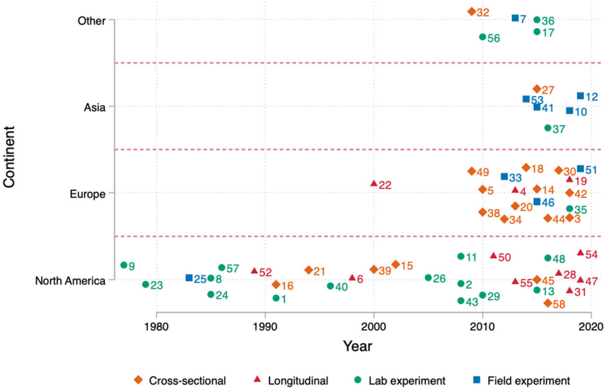
- Publication trends show 64% of included studies were published in 2010 or later; before 2010 almost all were North American, after which Europe and Asia increased, and Africa had no included research. Outcomes were money (21; 36.21%), hiring (20; 34.48%), votes (9; 15.52%), and other (8; 13.79%), with most occupation-specific research on white-collar jobs and near-total absence of blue-collar jobs.
Methods
- Systematic review searching EBSCO, Scopus, ProQuest, Web of Science, and Google Scholar in three waves in 2019; after duplicate removal and title/abstract screening, 504 articles passed the first phase, 101 met criteria, and 58 studies were included.
- Included quantitative studies comparing work-related socioeconomic outcomes of physical attractiveness by gender, including cross-sectional, longitudinal, lab, and field experiments; outcomes included income, salary, hiring, tips, electoral votes, and career success.
- Two researchers independently screened and extracted data using a structured extraction table; disagreements were resolved by discussion or a third reviewer, followed by descriptive synthesis and supplementary tabulation by country, year, study type, occupation, outcome, rating basis, and rater pool.
Limitations
- Stated: not all studies provided all extraction information (e.g., country or year missing); attractiveness was measured in numerous ways and on countless scales with no uniformity, limiting comparability; the literature focuses on positive outcomes and contrasts “attractive” with “others” rather than examining unattractiveness or different levels of attractiveness.
- Stated: blue-collar occupations were barely represented, causing a middle-class bias and potentially distorting gender results; few studies focused on less attractive/plainness; the supplementary analysis found no clear patterns explaining inconsistent gender results, and further research is needed on cultural differences.
- Evident from the text: the Google Scholar search included only the first 1,000 of 1,100,000 results; many included studies used lab experiments and student raters, which may not reflect real labor markets; Africa had no included studies, limiting global generalizability.
Model-written summary. Check it against the paper before relying on it.
Integrity signals
Registry
Cites
Statistics
Figures



Verification
Claims the paper makes
0 Valid · 2 Not valid · 30 Not checked · 86 Own results and interpretations
A result the paper reports from its own data — it cites no other source for it, so there is none to check. The quote shows it is in the paper.
In the paper
“The results show that, in general, more attractive individuals are socioeconomically favored, which is true for both men and women.”
§ Is beauty-based inequality gendered? A systematic review of gender differences in socioeconomic outcomes of physical attractiveness in labor markets > Abstract
plainstates an association- Asserted: passes — The authors put it forward as true.
- Checkable: passes — It can be checked against evidence.
- Load-bearing: passes — The paper’s conclusions depend on it.
- Based: passes — The paper gives a reason why it holds.
A result the paper reports from its own data — it cites no other source for it, so there is none to check. The quote shows it is in the paper.
In the paper
“Moreover, while the socioeconomic outcomes for men are somewhat consistent, the outcomes for women appear to be more inconsistent; only women appear to be both rewarded and penalized for being attractive.”
§ Is beauty-based inequality gendered? A systematic review of gender differences in socioeconomic outcomes of physical attractiveness in labor markets > Abstract
hedged- Asserted: passes — The authors put it forward as true.
- Checkable: passes — It can be checked against evidence.
- Load-bearing: passes — The paper’s conclusions depend on it.
- Based: passes — The paper gives a reason why it holds.
A result the paper reports from its own data — it cites no other source for it, so there is none to check. The quote shows it is in the paper.
In the paper
“The results show that, in general, more attractive individuals are socioeconomically favored, which is true for both men and women.”
§ Is beauty-based inequality gendered? A systematic review of gender differences in socioeconomic outcomes of physical attractiveness in labor markets > Abstract
plainstates an association- Asserted: passes — The authors put it forward as true.
- Checkable: passes — It can be checked against evidence.
- Load-bearing: passes — The paper’s conclusions depend on it.
- Based: passes — The paper gives a reason why it holds.
A result the paper reports from its own data — it cites no other source for it, so there is none to check. The quote shows it is in the paper.
In the paper
“Moreover, while the socioeconomic outcomes for men are somewhat consistent, the outcomes for women appear to be more inconsistent; only women appear to be both rewarded and penalized for being attractive.”
§ Is beauty-based inequality gendered? A systematic review of gender differences in socioeconomic outcomes of physical attractiveness in labor markets > Abstract
hedgedstates an association- Asserted: passes — The authors put it forward as true.
- Checkable: passes — It can be checked against evidence.
- Load-bearing: passes — The paper’s conclusions depend on it.
- Based: passes — The paper gives a reason why it holds.
A result the paper reports from its own data — it cites no other source for it, so there is none to check. The quote shows it is in the paper.
In the paper
“The number of studies that claim that attractiveness is more beneficial for women is almost equal to the number of studies that claim it is more beneficial for men.”
§ Is beauty-based inequality gendered? A systematic review of gender differences in socioeconomic outcomes of physical attractiveness in labor markets > Abstract
plain- Asserted: passes — The authors put it forward as true.
- Checkable: passes — It can be checked against evidence.
- Load-bearing: passes — The paper’s conclusions depend on it.
- Based: passes — The paper gives a reason why it holds.
38 more claims
Create a free account to see all 118 claims and to verify the 48 references still open.
- Probably not a substantial claim. 55
- It may state two separate claims as one. 28
- The quote only partly states this claim. 1
Self-check
Percentages, sums and reported differences re-computed from the paper’s own numbers.
Each contradiction between two passages listed here was confirmed by an independent check.
Rated major: it would touch a result — a value a result rests on, reported and recomputed p-values on opposite sides of the significance level, two passages that conflict with no sign which is right, or a cited work retracted before this paper was published.
In the paper
§ Is beauty-based inequality gendered? A systematic review of gender differences in socioeconomic outcomes of physical attractiveness in labor markets > Discussion
“In other words, both genders generally benefit from attractiveness, but only women get penalized for being attractive.”
§ Is beauty-based inequality gendered? A systematic review of gender differences in socioeconomic outcomes of physical attractiveness in labor markets > Gendered outcome Number of papers
“Attractiveness detrimental for both 2”
Rated minor: it would not touch a result — a value no result rests on, a p-value that stays on the same side of the significance level, or a conflict that is clerical, resolved elsewhere in the paper, or outside its own findings.
In the paper
§ Is beauty-based inequality gendered? A systematic review of gender differences in socioeconomic outcomes of physical attractiveness in labor markets > Search strategy, inclusion criteria, and data extraction
“The second wave was conducted on October 18, 2019 using Web of Science.”
§ Is beauty-based inequality gendered? A systematic review of gender differences in socioeconomic outcomes of physical attractiveness in labor markets > Appendix A: Bibliographic search strategy
“Search date October 2, 2019 October 1, 2019 October 2, 2019 October 9, 2019 December 18, 2019”
Rated minor: it would not touch a result — a value no result rests on, a p-value that stays on the same side of the significance level, or a conflict that is clerical, resolved elsewhere in the paper, or outside its own findings.
In the paper
§ Is beauty-based inequality gendered? A systematic review of gender differences in socioeconomic outcomes of physical attractiveness in labor markets > Gendered outcomes
“Seven studies have found this effect for women, but no study has detected it for men.”
§ Is beauty-based inequality gendered? A systematic review of gender differences in socioeconomic outcomes of physical attractiveness in labor markets > Gendered outcome Number of papers
“Attractiveness more detrimental for women 8”
Citations
Cites
Distinction: A Social Critique of the Judgement of Taste.
Warner, M., Bourdieu, P., & Nice, R. (1985) · MLN · doi:10.2307/2905454 · Cited by 14,091
The Managed Heart: Commercialization of Human Feeling
Tropman, J. E., & Hochschild, A. R. (1984) · Journal of Policy Analysis and Management · doi:10.2307/3324333 · Cited by 8,746
Unbearable Weight: Feminism, Western Culture and the Body.
Nichter, M., & Bordo, S. (1995) · Contemporary Sociology · doi:10.2307/2075082 · Cited by 5,018
Sex differences in human mate preferences: Evolutionary hypotheses tested in 37 cultures
Buss, D. M. (1989) · Behavioral and Brain Sciences · doi:10.1017/s0140525x00023992 · Cited by 4,484 · cited 1×
“According to Buss (1989), attractiveness is more consequential for women, since their fertility and ‘ reproductive value ’ are more important than men ’ s.”
BackgroundMaxims or myths of beauty? A meta-analytic and theoretical review
Langlois, J. H., Kalakanis, L., Rubenstein, A. J., Larson, A., Hallam, M., & Smoot, M. (2000) · Psychological Bulletin · doi:10.1037/0033-2909.126.3.390 · Cited by 2,429 · cited 6×
“(Langlois et al .”
BackgroundInfluentialFemininity and Domination: Studies in the Phenomenology of Oppression
Bartky, S. L. (1990) · Cited by 2,398
Eagly, A. H., Ashmore, R. D., Makhijani, M. G., & Longo, L. C. (1991) · Psychological Bulletin · doi:10.1037/0033-2909.110.1.109 · Cited by 1,875 · cited 3×
“Early psychological research reviews on the physical attractiveness stereo-type have concluded that people tend to attribute more positive characteristics to attractive individuals, both women and men (Eagly et al .”
BackgroundInfluentialGender, Status, and Leadership
Ridgeway, C. L. (2001) · Journal of Social Issues · doi:10.1111/0022-4537.00233 · Cited by 1,270 · cited 1×
“…Ridgeway 2006), which suggests that status characteristics and stereotypes are based on widely shared cultural beliefs that shape people ’ s expectations of themselves and others, and subsequently shape their actions, regardless of whether they personally endorse cultural beliefs (Ridgeway 2001).”
BackgroundThe beauty myth: how images of beauty are used against women
(1992) · Choice Reviews Online · doi:10.5860/choice.29-3031 · Cited by 1,257
Good-looking people are not what we think.
Feingold, A. (1992) · Psychological Bulletin · doi:10.1037//0033-2909.111.2.304 · Cited by 1,189 · cited 2×
“2003; Feingold 1992; Langlois et al .”
Trust and Credit: The Role of Appearance in Peer-to-peer Lending
Duarte, J., Siegel, S., & Young, L. (2012) · Review of Financial Studies · doi:10.1093/rfs/hhs071 · Cited by 1,064 · cited 1×
“Lastly, we discussed the inclusion of several studies (Duarte et al .”
BackgroundSex bias in work settings: The Lack of Fit model.
Heilman, M. E. (1983) · Research in Organizational Behavior · Cited by 1,018
Facial attractiveness: evolutionary based research
Little, A. C., Jones, B. C., & DeBruine, L. M. (2011) · Philosophical Transactions of the Royal Society B: Biological Sciences · doi:10.1098/rstb.2010.0404 · Cited by 1,010 · cited 1×
“(Little et al .”
International Preferences in Selecting Mates: A Study of 37 Cultures
Buss, D. M., Abbott, M., Angleitner, A., Asherian, A., Biaggio, A., Blanco-Villasenor, A., Bruchon-Schweitzer, M., Ch'U, H.-Y., Czapinski, J., Deraad, B., et al. (1990) · Journal of Cross-Cultural Psychology · doi:10.1177/0022022190211001 · Cited by 746 · cited 2×
“Evolutionary approaches claim that the preference for beautiful people is a result of deeply ingrained dispositions stemming from the evolutionary role of attractiveness in selecting mates for successful reproduction (Buss et al .”
BackgroundHamermesh, D., & Biddle, J. (1993) · National Bureau of Economic Research · doi:10.3386/w4518 · Cited by 702
Mobius, M. M., & Rosenblat, T. S. (2006) · American Economic Review · doi:10.1257/000282806776157515 · Cited by 691 · cited 3×
“In economistic explanations, the main mechanism through which beauty is believed to confer bene fi ts is related to preferences; employers, customers, and coworkers alike prefer beautiful people (Hamermesh 2011; Mobius and Rosenblat 2006; Rosenblat 2008).”
BackgroundHOSODA, M., STONE‐ROMERO, E. F., & COATS, G. (2003) · Personnel Psychology · doi:10.1111/j.1744-6570.2003.tb00157.x · Cited by 622 · cited 8×
“(2017) suggested that attractiveness is more advantageous for women than for men, whereas Morrow (1990) concluded that men are more likely to receive the bene fi ts. Previous review articles (e.g. Hosoda et al .”
BackgroundInfluentialHakim, C. (2010) · European Sociological Review · doi:10.1093/esr/jcq014 · Cited by 475
Beauty, Productivity, and Discrimination: Lawyers' Looks and Lucre
Biddle, J. E., & Hamermesh, D. S. (1998) · Journal of Labor Economics · doi:10.1086/209886 · Cited by 464 · cited 1×
“…2011; Kanazawa and Still 2018), better negotiators (Rosenblat 2008), or whether the preferences indeed cause employees to be more productive in certain fi elds of work where, for example, customer preferences are crucial for productivity (Biddle and Hamermesh 1998; Hamer-mesh and Biddle 1994).”
BackgroundCorrell, S. J., & Ridgeway, C. L. (2006) · Handbooks of Sociology and Social Research · doi:10.1007/0-387-36921-x_2 · Cited by 451 · cited 1×
“1985, Correll and Ridgeway 2006), which suggests that status characteristics and stereotypes are based on widely shared cultural beliefs that shape people ’ s expectations of themselves and others, and subsequently shape their actions, regardless of whether they personally endorse cultural beliefs…”
BackgroundGender and attractiveness biases in hiring decisions: Are more experienced managers less biased?
Marlowe, C. M., Schneider, S. L., & Nelson, C. E. (1996) · Journal of Applied Psychology · doi:10.1037/0021-9010.81.1.11 · Cited by 393
Beauty in the classroom: instructors’ pulchritude and putative pedagogical productivity
Hamermesh, D. S., & Parker, A. (2005) · Economics of Education Review · doi:10.1016/j.econedurev.2004.07.013 · Cited by 391
The looks of a winner: Beauty and electoral success
Berggren, N., Jordahl, H., & Poutvaara, P. (2010) · Journal of Public Economics · doi:10.1016/j.jpubeco.2009.11.002 · Cited by 390 · cited 3×
“Previous research on electoral outcomes has also been related to the literature concerning appearance premiums in the labor market (e.g. Berggren et al .”
BackgroundResultHeilman, M. E., & Saruwatari, L. R. (1979) · Organizational Behavior and Human Performance · doi:10.1016/0030-5073(79)90003-5 · Cited by 374 · cited 3×
“This explanation is sometimes referred to as the ‘ beauty is beastly ’ e ff ect (for example, Heilman and Saruwatari 1979).”
BackgroundSexism and beautyism in personnel consultant decision making.
Cash, T. F., Gillen, B., & Burns, D. S. (1977) · Journal of Applied Psychology · doi:10.1037//0021-9010.62.3.301 · Cited by 366
The Influence of Physical Attractiveness and Gender on Ultimatum Game Decisions
Solnick, S. J., & Schweitzer, M. E. (1999) · Organizational Behavior and Human Decision Processes · doi:10.1006/obhd.1999.2843 · Cited by 345
Beauty, gender and stereotypes: Evidence from laboratory experiments
Andreoni, J., & Petrie, R. (2008) · Journal of Economic Psychology · doi:10.1016/j.joep.2007.07.008 · Cited by 337
Beauty, Stature and the Labour Market: A British Cohort Study
Harper, B. (2000) · Oxford Bulletin of Economics and Statistics · doi:10.1111/1468-0084.0620s1771 · Cited by 335 · cited 1×
“2010; Hamermesh and Biddle 1994; Harper 2000; Liu and Sierminska 2014; Mobius and Rosenblat 2006).”
BackgroundJudge, T. A., Hurst, C., & Simon, L. S. (2009) · Journal of Applied Psychology · doi:10.1037/a0015497 · Cited by 325
Webster, & Driskell (1983) · American Journal of Sociology · doi:10.1086/227836 · Cited by 305 · cited 1×
“In sociology, beauty has been considered a di ff use status characteristic, which signals status in a similar manner to other forms of status generalization, such as sex or race (Webster and Driskell, 1983; Frevert and Walker 2014; Wolbring and Riordan 2016).”
BackgroundCraig, M. (2002) · doi:10.1093/acprof:oso/9780195152623.001.0001 · Cited by 270 · cited 1×
“Considering that attractiveness in itself is a classed, gendered, racist, and ageist concept (Craig 2002, Jha 2015, Kuipers 2015, Kwan and Traut-ner 2009), exploring these social categorizations may help us better understand appearance-related inequality.”
BackgroundAttractiveness and Income for Men and Women in Management1
Frieze, I. H., Olson, J. E., & Russell, J. (1991) · Journal of Applied Social Psychology · doi:10.1111/j.1559-1816.1991.tb00458.x · Cited by 269
Stereotype Directionality and Attractiveness Stereotyping: Is Beauty Good or is Ugly Bad?
Griffin, A. M., & Langlois, J. H. (2006) · Social Cognition · doi:10.1521/soco.2006.24.2.187 · Cited by 259 · cited 1×
“This limits our understanding of appearance-based inequality (Gri ffi n and Langlois 2006; Kanazawa and Still 2018).”
BackgroundHeilman, M. E., & Stopeck, M. H. (1985) · Organizational Behavior and Human Decision Processes · doi:10.1016/0749-5978(85)90035-4 · Cited by 232 · cited 1×
“2013), competence (e.g. evaluations of career progress and capability; Heilman and Stopeck 1985), or speed of obtaining a loan in di ff erent sectors of the labor market (Jenq et al .”
BackgroundObesity, Attractiveness, and Differential Treatment in Hiring: A Field Experiment
Rooth, D.-O. (2009) · Journal of Human Resources · doi:10.1353/jhr.2009.0027 · Cited by 219
Are Good-Looking People More Employable?
Ruffle, B. J., & Shtudiner, Z. (2015) · Management Science · doi:10.1287/mnsc.2014.1927 · Cited by 213
Monk, E. P. (2022) · Sociological Theory · doi:10.1177/07352751221076863 · Cited by 209 · cited 2×
“More e ff orts should be made to unpack the ‘ black box ’ of attractiveness (cf. Mears 2014), and focusing on cues of categories, as well as typicality (Monk 2022).”
BackgroundKwan, S., & Trautner, M. N. (2009) · Sociology Compass · doi:10.1111/j.1751-9020.2008.00179.x · Cited by 206 · cited 1×
“Speci fi cally, femininity is achieved through meticulous work on the body (Kwan and Trautner 2009).”
BackgroundAesthetic Labour: Beauty Politics in Neoliberalism
Elias, A., Gill, R., & Scharff, C. (2017) · Aesthetic Labour · doi:10.1057/978-1-137-47765-1_1 · Cited by 204
Aesthetic Labor for the Sociologies of Work, Gender, and Beauty
Mears, A. (2014) · Sociology Compass · doi:10.1111/soc4.12211 · Cited by 189 · cited 5×
“More e ff orts should be made to unpack the ‘ black box ’ of attractiveness (cf. Mears 2014), and focusing on cues of categories, as well as typicality (Monk 2022).”
BackgroundInfluentialHot or Not: Do Professors Perceived as Physically Attractive Receive Higher Student Evaluations?
Riniolo, T. C., Johnson, K. C., Sherman, T. R., & Misso, J. A. (2006) · The Journal of General Psychology · doi:10.3200/genp.133.1.19-35 · Cited by 182 · cited 1×
“One question that emerged was whether to include studies on student ratings of teachers (e.g. Hamermesh and Parker 2005; Riniolo et al .”
BackgroundJohnson, S. K., Podratz, K. E., Dipboye, R. L., & Gibbons, E. (2010) · The Journal of Social Psychology · doi:10.1080/00224540903365414 · Cited by 181
Faces of politicians: Babyfacedness predicts inferred competence but not electoral success
Poutvaara, P., Jordahl, H., & Berggren, N. (2009) · Journal of Experimental Social Psychology · doi:10.1016/j.jesp.2009.06.007 · Cited by 177
Nonverbal Cues and Status: An Expectation States Approach
Ridgeway, C. L., Berger, J., & Smith, L. (1985) · American Journal of Sociology · doi:10.1086/228172 · Cited by 172 · cited 1×
“These approaches have been complemented by expectation states theory (Ridgeway et al .”
MethodBeauty Pays: Why Attractive People Are More Successful
(2011) · Princeton University Press eBooks · doi:10.1515/9781400839445 · Cited by 165 · cited 7×
“The authors suggested (based on Hamermesh 2011) that the disincentives of less-than-average looks on the labor market may lead women who are less attractive to opt out.”
BackgroundInfluentialGonzalez, L., & Loureiro, Y. K. (2014) · Journal of Behavioral and Experimental Finance · doi:10.1016/j.jbef.2014.04.002 · Cited by 163 · cited 1×
“2012; Gonzalez and Loureiro 2014; Jenq et al .”
BackgroundMaestripieri, D., Henry, A., & Nickels, N. (2017) · Behavioral and Brain Sciences · doi:10.1017/s0140525x16000340 · Cited by 162
The labor market return to an attractive face: Evidence from a field experiment
López Bóo, F., Rossi, M. A., & Urzúa, S. S. (2013) · Economics Letters · doi:10.1016/j.econlet.2012.10.016 · Cited by 154
Unexplored dimensions of discrimination in Europe: homosexuality and physical appearance
Patacchini, E., Ragusa, G., & Zénou, Y. (2014) · Journal of Population Economics · doi:10.1007/s00148-014-0533-9 · Cited by 143
King, A., & Leigh, A. (2009) · Kyklos · doi:10.1111/j.1467-6435.2009.00452.x · Cited by 142
The Political Gender Gap: Gender Bias in Facial Inferences that Predict Voting Behavior
Chiao, J. Y., Bowman, N. E., & Gill, H. (2008) · PLoS ONE · doi:10.1371/journal.pone.0003666 · Cited by 135
Cash, T. F., & Kilcullen, R. N. (1985) · Journal of Applied Social Psychology · doi:10.1111/j.1559-1816.1985.tb00903.x · Cited by 134
Intelligence and physical attractiveness☆
Kanazawa, S. (2010) · Intelligence · doi:10.1016/j.intell.2010.11.003 · Cited by 131 · cited 1×
“…dence as a result of being preferred in di ff erent situations throughout life (Mobius and Rosenblat 2006), or attractive people being more intelligent (Kanazawa 2011; Kanazawa and Still 2018), better negotiators (Rosenblat 2008), or whether the preferences indeed cause employees to be more…”
BackgroundThe Beauty Premium: Physical Attractiveness and Gender in Dictator Games
Rosenblat, T. (2008) · Negotiation Journal · doi:10.1111/j.1571-9979.2008.00198.x · Cited by 120 · cited 3×
“…throughout life (Mobius and Rosenblat 2006), or attractive people being more intelligent (Kanazawa 2011; Kanazawa and Still 2018), better negotiators (Rosenblat 2008), or whether the preferences indeed cause employees to be more productive in certain fi elds of work where, for example, customer…”
BackgroundPhysical Attractiveness and Social Status
Frevert, T. K., & Walker, L. S. (2014) · Sociology Compass · doi:10.1111/soc4.12132 · Cited by 119 · cited 1×
“In sociology, beauty has been considered a di ff use status characteristic, which signals status in a similar manner to other forms of status generalization, such as sex or race (Webster and Driskell, 1983; Frevert and Walker 2014; Wolbring and Riordan 2016).”
BackgroundBeauty and distinction? The evaluation of appearance and cultural capital in five European countries
Kuipers, G. (2015) · Poetics · doi:10.1016/j.poetic.2015.10.001 · Cited by 116 · cited 2×
“Importantly, women are more easily evaluated based on strict aesthetic standards than men (Kuipers 2015).”
BackgroundPredictors of Male and Female Servers' Average Tip Earnings1
Lynn, M., & Simons, T. L. (2000) · Journal of Applied Social Psychology · doi:10.1111/j.1559-1816.2000.tb02314.x · Cited by 115
Sexism and Beautyism Effects in Selection as a Function of Self-Monitoring Level of Decision Maker.
Jawahar, I. M. “., & Mattsson, J. (2005) · Journal of Applied Psychology · doi:10.1037/0021-9010.90.3.563 · Cited by 109
Benzeval, M., Green, M. J., & MacIntyre, S. (2013) · PLoS ONE · doi:10.1371/journal.pone.0063975 · Cited by 109
Aesthetic Capital: A Research Review on Beauty Perks and Penalties
Anderson, T. L., Grunert, C., Katz, A., & Lovascio, S. (2010) · Sociology Compass · doi:10.1111/j.1751-9020.2010.00312.x · Cited by 108 · cited 3×
“Hence, it is perhaps not surprising that gender has also been ignored in many previous literature reviews on physical appearance-related inequality (e.g. Anderson et al .”
MethodInfluentialPhysical Attractiveness and Selection Decision Making
Morrow, P. C. (1990) · Journal of Management · doi:10.1177/014920639001600104 · Cited by 108 · cited 1×
“(2017) suggested that attractiveness is more advantageous for women than for men, whereas Morrow (1990) concluded that men are more likely to receive the bene fi ts. Previous review articles (e.g. Hosoda et al .”
Background"A Thing of Beauty is a Joy Forever"? Returns to Physical Attractiveness over the Life Course
Jæger, M. M. (2011) · Social Forces · doi:10.1093/sf/89.3.983 · Cited by 106
Changing looks and changing “discrimination”: The beauty of economists
Hamermesh, D. S. (2006) · Economics Letters · doi:10.1016/j.econlet.2006.06.004 · Cited by 106
Beauty, weight, and skin color in charitable giving
Jenq, C., Pan, J., & Theseira, W. E. (2015) · Journal of Economic Behavior & Organization · doi:10.1016/j.jebo.2015.06.004 · Cited by 105 · cited 2×
“2012; Gonzalez and Loureiro 2014; Jenq et al .”
BackgroundDo Academic Salaries Decline with Seniority?
Moore, W. J., Newman, R. J., & Turnbull, G. K. (1998) · Journal of Labor Economics · doi:10.1086/209892 · Cited by 104 · cited 1×
“Although some studies (Kaun 1984; Moore et al .”
ResultGirls as elite distinction: The appropriation of bodily capital
Mears, A. (2015) · Poetics · doi:10.1016/j.poetic.2015.08.004 · Cited by 100 · cited 1×
“Mears has shown how men use attractive female bodies for their own status projects, whereas women themselves may be stigmatized by the bene fi ts of attractiveness (Mears 2015; 2020).”
BackgroundBeholding Inequality: Race, Gender, and Returns to Physical Attractiveness in the United States
Monk, E. P., Esposito, M. H., & Lee, H. (2021) · American Journal of Sociology · doi:10.1086/715141 · Cited by 97 · cited 4×
“In sociology, it is well understood that attractiveness as a status characteristic intersects with other status characteristics (Monk et al .”
BackgroundMethodResultInfluentialPhysical appearance and earnings: further evidence
French, M. T. (2002) · Applied Economics · doi:10.1080/00036840010027568 · Cited by 96
Sexual Fields: Toward a Sociology of Collective Sexual Life
Paik, A. (2016) · Contemporary Sociology: A Journal of Reviews · doi:10.1177/0094306116629410y · Cited by 86 · cited 1×
“In Bourdieu-sian terms, the structure of the social fi eld matters (Green 2014; Kukko-nen 2021).”
BackgroundFacial appearance affects science communication
Gheorghiu, A. I., Callan, M. J., & Skylark, W. J. (2017) · Proceedings of the National Academy of Sciences · doi:10.1073/pnas.1620542114 · Cited by 84
Fruhen, L. S., Watkins, C. D., & Jones, B. C. (2015) · The Leadership Quarterly · doi:10.1016/j.leaqua.2015.07.001 · Cited by 83
Physical Attractiveness and Income Attainment Among Canadians
Roszell, P., Kennedy, D., & Grabb, E. (1989) · The Journal of Psychology · doi:10.1080/00223980.1989.10543009 · Cited by 82
Beauty and the feast: Examining the effect of beauty on earnings using restaurant tipping data
Parrett, M. (2015) · Journal of Economic Psychology · doi:10.1016/j.joep.2015.04.002 · Cited by 80
Gender, Physical Attractiveness, and Electability: An Experimental Investigation of Voter Biases
Sigelman, C. K., Sigelman, L., Thomas, D. B., & Ribich, F. D. (1986) · Journal of Applied Social Psychology · doi:10.1111/j.1559-1816.1986.tb01137.x · Cited by 77
PHYSICAL ATTRACTIVENESS, AGE, AND SEX AS DETERMINANTS OF REACTIONS TO RESUMES
Quereshi, M. Y., & Kay, J. P. (1986) · Social Behavior and Personality An International Journal · doi:10.2224/sbp.1986.14.1.103 · Cited by 69 · cited 1×
“Additionally, it was necessary to determine whether to include experimental laboratory studies that utilized game theoretical designs, ultimatum games, or bar-gaining tasks (e.g. Deryugina and Shurchkov 2015; Solnick and Schweit-zer 1999; Quereshi and Kay 1986).”
BackgroundPotts, A. (2001) · Journal of Gender Studies · doi:10.1080/09589230120053274 · Cited by 69 · cited 1×
“According to this view, man has two brains: one that thinks rationally, and another carnal, primal ‘ penis brain, ’ which operates in contrast to the man ’ s rational, cerebral thoughts (Potts 2001).”
BackgroundNow you see it, now you don’t: The vanishing beauty premium
Deryugina, T., & Shurchkov, O. (2015) · Journal of Economic Behavior & Organization · doi:10.1016/j.jebo.2015.05.007 · Cited by 68 · cited 1×
“Additionally, it was necessary to determine whether to include experimental laboratory studies that utilized game theoretical designs, ultimatum games, or bar-gaining tasks (e.g. Deryugina and Shurchkov 2015; Solnick and Schweit-zer 1999; Quereshi and Kay 1986).”
BackgroundVery Important People: Status and Beauty in the Global Party Circuit
Mears, A. (2020) · Project Muse (Johns Hopkins University) · doi:10.1515/9780691189895 · Cited by 67
Myth or fact? The beauty premium across the wage distribution in Germany
Doorley, K., & Sierminska, E. M. (2015) · Economics Letters · doi:10.1016/j.econlet.2015.01.033 · Cited by 66
Is There Really a Beauty Premium or an Ugliness Penalty on Earnings?
Kanazawa, S., & Still, M. C. (2017) · Journal of Business and Psychology · doi:10.1007/s10869-017-9489-6 · Cited by 64
Wolbring, T., & Riordan, P. (2016) · Social Science Research · doi:10.1016/j.ssresearch.2015.12.009 · Cited by 63 · cited 3×
“In sociology, beauty has been considered a di ff use status characteristic, which signals status in a similar manner to other forms of status generalization, such as sex or race (Webster and Driskell, 1983; Frevert and Walker 2014; Wolbring and Riordan 2016).”
BackgroundThe Global Beauty Industry: Colorism, Racism, and the National Body
Jha, M. R. (2015) · Routledge eBooks · doi:10.4324/9781315733432 · Cited by 61
Managing the semiotics of skin tone: Race and aesthetic labor in the fashion modeling industry
Wissinger, E. (2012) · Economic and Industrial Democracy · doi:10.1177/0143831x11427591 · Cited by 60 · cited 1×
“…labor, which underscores how appearance-related inequalities are shaped in social interaction in particular labor market contexts, where the power relations tend to be skewed, such as in terms of social class, gender, age, and race (e.g. Boyle and Keere 2019, Wissinger 2012, Walters 2018).”
Backgroundvan den Berg, M., & Arts, J. (2018) · Work Employment and Society · doi:10.1177/0950017018758196 · Cited by 60 · cited 1×
“Moreover, good looks have become a more crucial requirement for work (van den Berg and Arts 2019; Warhurst and Nickson2001), leading to discussions about prohibiting appearance discrimination in the labor market (Hamermesh 2011; Mason and Minerva 2020).”
BackgroundBeauty, body size and wages: Evidence from a unique data set
Oreffice, S., & Quintana‐Domeque, C. (2016) · Economics & Human Biology · doi:10.1016/j.ehb.2016.01.003 · Cited by 54
Gender and the returns to attractiveness
Wong, J. S., & Penner, A. M. (2016) · Research in Social Stratification and Mobility · doi:10.1016/j.rssm.2016.04.002 · Cited by 51
The Electoral Success of Beauties and Beasts
Lütz, G. (2010) · Swiss Political Science Review · doi:10.1002/j.1662-6370.2010.tb00437.x · Cited by 50
Beauty and job accessibility: new evidence from a field experiment
Deng, W., Li, D., & Zhou, D. (2019) · Journal of Population Economics · doi:10.1007/s00148-019-00744-7 · Cited by 49
Jäckle, S., & Metz, T. (2017) · Politics & Policy · doi:10.1111/polp.12209 · Cited by 48 · cited 1×
“2018; Jäckle and Metz 2017).”
Double standards in the accumulation and utilisation of ‘aesthetic capital’
Sarpila, O., Koivula, A., Kukkonen, I., Åberg, E., & Pajunen, T. (2020) · Poetics · doi:10.1016/j.poetic.2020.101447 · Cited by 48 · cited 2×
“However, even though women are expected to work more on their appearances than men (Sarpila et al .”
BackgroundSelf-citationMaurer-Fazio, M., & Lei, L. (2015) · International Journal of Manpower · doi:10.1108/ijm-12-2014-0258 · Cited by 47
“They’ll Go with the Lighter”: Tri-racial Aesthetic Labor in Clothing Retail
Walters, K. (2017) · Sociology of Race and Ethnicity · doi:10.1177/2332649217710662 · Cited by 47 · cited 1×
“…labor, which underscores how appearance-related inequalities are shaped in social interaction in particular labor market contexts, where the power relations tend to be skewed, such as in terms of social class, gender, age, and race (e.g. Boyle and Keere 2019, Wissinger 2012, Walters 2018).”
BackgroundWhen Beauty Doesn't Pay: Gender and Beauty Biases in a Peer-to-Peer Loan Market
Kuwabara, K., & Thébaud, S. (2017) · Social Forces · doi:10.1093/sf/sox020 · Cited by 45 · cited 1×
“It is possible that these types of lab experiments, based on fi rst impression and stimulus-reaction schemes, reinforce gender stereotypes related to attractive women in particular (Kuwabara and Thébaud 2017).”
BackgroundBeauty still matters: The role of attractiveness in labour market outcomes
Anýžová, P., & Matějů, P. (2018) · International Sociology · doi:10.1177/0268580918760431 · Cited by 45 · cited 1×
“These studies measured, for example, occupational status or standing (Aný ž ová and Mat ě j ů 2018; Sala et al .”
BackgroundLee, S., Pitesa, M., Pillutla, M., & Thau, S. (2015) · Organizational Behavior and Human Decision Processes · doi:10.1016/j.obhdp.2015.02.003 · Cited by 43 · cited 1×
“In contrast, Lee et al .”
Should the Equality Act 2010 Be Extended to Prohibit Appearance Discrimination?
Mason, A. S., & Minerva, F. (2020) · Political Studies · doi:10.1177/0032321720966480 · Cited by 43 · cited 1×
“Moreover, good looks have become a more crucial requirement for work (van den Berg and Arts 2019; Warhurst and Nickson2001), leading to discussions about prohibiting appearance discrimination in the labor market (Hamermesh 2011; Mason and Minerva 2020).”
BackgroundPaustian-Underdahl, S. C., & Walker, L. S. (2016) · The International Journal of Human Resource Management · doi:10.1080/09585192.2015.1053963 · Cited by 42
Exploring the impact of male and female facial attractiveness on occupational prestige
Sala, E., Terraneo, M., Lucchini, M., & Knies, G. (2012) · Research in Social Stratification and Mobility · doi:10.1016/j.rssm.2012.10.003 · Cited by 41 · cited 2×
“These studies measured, for example, occupational status or standing (Aný ž ová and Mat ě j ů 2018; Sala et al .”
BackgroundPhysical Appearance as a Form of Capital: Key Problems and Tensions
Kukkonen, I. (2021) · Emerald Group Publishing Limited eBooks · doi:10.1108/978-1-80043-708-120210002 · Cited by 38 · cited 1×
“From this perspective, many aesthetic standards are a result of culturally embedded processes of evaluation, and the value of attractiveness is negotiated within social fi elds with particular power constellations (Kukkonen 2021; Mears 2014).”
BackgroundSelf-citationBiases Influencing Recommendation Letter Contents: Physical Attractiveness and Gender 1
Nicklin, J. M., & Roch, S. G. (2008) · Journal of Applied Social Psychology · doi:10.1111/j.1559-1816.2008.00425.x · Cited by 35
Ryabov, I. (2018) · Race and Social Problems · doi:10.1007/s12552-018-9245-1 · Cited by 34
Boyle, B., & Keere, K. D. (2019) · The Sociological Review · doi:10.1177/0038026119827753 · Cited by 34 · cited 1×
“…labor, which underscores how appearance-related inequalities are shaped in social interaction in particular labor market contexts, where the power relations tend to be skewed, such as in terms of social class, gender, age, and race (e.g. Boyle and Keere 2019, Wissinger 2012, Walters 2018).”
BackgroundBeauty and the Labor Market: Accounting for the Additional Effects of Personality and Grooming
Robins, P. K., Homer, J. F., & French, M. T. (2011) · LABOUR · doi:10.1111/j.1467-9914.2010.00511.x · Cited by 33
Jackson, L. A. (1983) · Journal of Applied Social Psychology · doi:10.1111/j.1559-1816.1983.tb01751.x · Cited by 33
Lee, M., Pitesa, M., Pillutla, M. M., & Thau, S. (2018) · Journal of Personality and Social Psychology · doi:10.1037/pspi0000114 · Cited by 30
Looks and Labor: Do Attractive People Work More?
Gehrsitz, M. (2014) · Labour · doi:10.1111/labr.12035 · Cited by 28
Looks That Matter: The Effect of Physical Attractiveness in Low- and High-Information Elections
Lev‐On, A., & Waismel-Manor, I. (2016) · American Behavioral Scientist · doi:10.1177/0002764216676249 · Cited by 28
Evaluating the Effect of Beauty on Labor Market Outcomes: A Review of the Literature.Preprint
Liu, X., & Sierminska, E. M. (2014) · SSRN Electronic Journal · doi:10.2139/ssrn.2613431 · Cited by 25 · cited 1×
“2010; Hamermesh and Biddle 1994; Harper 2000; Liu and Sierminska 2014; Mobius and Rosenblat 2006).”
BackgroundImpact of Gender, Physical Attractiveness, and Intelligence on the Perception of Peer Counselors
Abramowitz, I. A., & O’Grady, K. E. (1991) · The Journal of Psychology · doi:10.1080/00223980.1991.10543295 · Cited by 23
Do good looks matter when applying for jobs in the hospitality industry?
Chiang, C. I., & Saw, Y. L. (2017) · International Journal of Hospitality Management · doi:10.1016/j.ijhm.2017.12.001 · Cited by 23
Beauty and appearance in corporate director elections
Geiler, P., Renneboog, L. D. R., & Zhao, Y. (2018) · Journal of International Financial Markets Institutions and Money · doi:10.1016/j.intfin.2018.03.004 · Cited by 23
What is beautiful is bad: Physical attractiveness as stigma
Tseëlon, E., & Tseëlon, E. (1992) · Journal for the Theory of Social Behaviour · doi:10.1111/j.1468-5914.1992.tb00221.x · Cited by 22 · cited 1×
“2017), yet attractiveness entails risks of not only stigma (Tseëlon 1992), but also socioeconomic penalties on labor markets.”
Background“Men Wanted”: Heterosexual Aesthetic Labor in the Masculinization of the Hair Salon
Barber, K. (2016) · Gender & Society · doi:10.1177/0891243216637827 · Cited by 22 · cited 1×
“In their professional lives, aesthetic laborers are expected to present particular femininities and masculinities (Barber 2016; van den Berg 2019).”
BackgroundIn the eye of the beholder? The returns to beauty and IQ for the self‐employed
Patel, P. C., & Wolfe, M. T. (2019) · Strategic Entrepreneurship Journal · doi:10.1002/sej.1323 · Cited by 21
Faculty Advancement in a Nontraditional University Environment
Kaun, D. E. (1984) · Industrial and Labor Relations Review · doi:10.1177/001979398403700409 · Cited by 17 · cited 1×
“Although some studies (Kaun 1984; Moore et al .”
ResultSierminska, E. M., & Liu, X. (2015) · Elsevier eBooks · doi:10.1016/b978-0-08-097086-8.94015-7 · Cited by 16 · cited 2×
“However, this would have excluded some of the most-cited studies on the subject (e.g. Hamermesh and Biddle 1994), which, among many others, employed data from a longitudinal study in the United States called Add Health.”
BackgroundDo employers reward physical attractiveness in transition countries?
Mavisakalyan, A. (2017) · Economics & Human Biology · doi:10.1016/j.ehb.2017.10.002 · Cited by 16
Exploitation of aesthetic capital – disapproved by whom?
Kukkonen, I., Åberg, E., Sarpila, O., & Pajunen, T. (2018) · International Journal of Sociology and Social Policy · doi:10.1108/ijssp-09-2017-0116 · Cited by 15 · cited 1×
“Indeed, strict social norms regulate the use of one ’ s physical appearance in order to gain socioeconomic advantage, particularly for women (Kukkonen et al .”
BackgroundSelf-citationEffect of Physical Attractiveness on Selection Decisions in India and the United States
Shahani‐Denning, C., Dudhat, P., Tevet, R., & Andreoli, N. A. (2010) · Cited by 12
Looks Good, You’re Hired? Evidence from Extra-Parliamentary Activities of German Parliamentarians
Geys, B. (2015) · German Economic Review · doi:10.1111/geer.12041 · Cited by 10
van den Berg, M. (2019) · Gender Place & Culture · doi:10.1080/0966369x.2018.1551782 · Cited by 7 · cited 1×
“In their professional lives, aesthetic laborers are expected to present particular femininities and masculinities (Barber 2016; van den Berg 2019).”
Background
Research works printed but not linked: 2
- 63. Kraft, P. (2012) 'The role of beauty in the labor market', Ph.D. thesis, Center for Economic Research and Graduate Education, Charles University Prague.
- 118. Warhurst, C. and Nickson, D. P. (2001) Looking Good, Sounding Right: Style Counselling and the Aesthetics of the new Economy, London: The Industrial Society.
Cited by
Using deepfakes for experiments in the social sciences - A pilot study
Eberl, A., Kühn, J., & Wolbring, T. (2022) · Frontiers in Sociology · doi:10.3389/fsoc.2022.907199 · Cited by 48
Physical appearance and elections: An inequality perspective
Bahamonde, H., & Sarpila, O. (2023) · Political Psychology · doi:10.1111/pops.12940 · Cited by 13
Self-citationSarpila, O., Koivula, A., & Kukkonen, I. (2024) · Sociology · doi:10.1177/00380385241249038 · Cited by 19
“The result that attractiveness is positively associated with occupation-congruent appearance is aligned with the argument in attractiveness-based stratification research that people tend to favour good-looking people (Wolbring and Riordan, 2016; for a review, see Kukkonen et al., 2024).”
InfluentialSelf-citationImpact of inclusive marketing communication on brand love and brand attitude
Srivastava, J., Malik, N., Sethi, D., & Tripathi, S. N. (2025) · Corporate Communications An International Journal · doi:10.1108/ccij-02-2024-0021 · Cited by 17
Kühn, J., & Wolbring, T. (2024) · Research in Social Stratification and Mobility · doi:10.1016/j.rssm.2024.100992 · Cited by 13
Metadata
- Authors
- Kukkonen, I., Pajunen, T., Sarpila, O., & Åberg, E.
- Affiliations
- University of Turku (FI)
- Corresponding author
- Kukkonen, Iida
- Venue
- European Societies
- Publisher
- MIT Press
- Published
- 2023-05-15
- Volume
- 26
- Issue
- 1
- Pages
- 117-148
- ISSN
- 1461-6696 (ISSN-L)
- 1469-8307
- OpenAlex
- W4376956394
- Cited by
- 43
- References
- 121
- Citations by year
- 2026: 19 · 2025: 11 · 2024: 9 · 2023: 4
- FWCI
- 2.16
- Type
- journal article
- Language
- en
- Open access
- hybrid
- doi.org
- Licence
- Locations
- European Societies (publishedVersion, cc-by)
- UTUPub (University of Turku) (submittedVersion)
- Funders
- Academy of Finland (325813)
- Topics
- Social Sciences › Sociology and Political Science › Names, Identity, and Discrimination Research
- Social Sciences › Economics, Econometrics and Finance › Economics and Econometrics › Labor market dynamics and wage inequality
- Social Sciences › Gender Studies › Labour Market and Migration
- Keywords
- physical attractiveness, gender differences, beauty premium, labor market outcomes, socioeconomic disparities, gender inequality, contextual factors
About these checks
Registry, retraction, Cites and statistics results are computed, not judged, with one exception: a printed reference that no index lists is read once by a model before it counts as a citation error. Claims are extracted by a model and kept only when their quote appears verbatim in the text; each cited source is then checked, with a model’s help, for whether it says what the claim relies on. Those verdicts can be wrong — read the claim’s quote and the cited source before relying on one.
A language model drew the claims from the paper on 2026-09-28, under version 3 of the claim definition (model deepseek-v4.1-flash, prompt extract-v3).
A second model labelled each claim on 2026-09-28 (model jev-1.13-20260917, definition revision gold-guideline-v0.2).
Statistics and arithmetic are recomputed, not judged.
Confidence bands are shown only for fields calibrated on our annotated test set. None is calibrated yet, so no band is shown.
What counts as a claim ›How we measure confidence ›How we check this ›
Are you an author, or do you see a problem with this page? Request a review
Data sources
Bibliographic data: Semantic Scholar, OpenAlex, Crossref.
Contains information from the Semantic Scholar Academic Graph Datasets, made available under the ODC Attribution License (ODC-BY 1.0).
Semantic Scholar’s data is described in: Kinney, R., et al. (2023). The Semantic Scholar Open Data Platform. arXiv:2301.10140.
