

The EU Energy Transition in a Geopoliticizing World
Open accessThe DOI matches its Crossref record; 53 of the 55 references it cites were found in a registry or an index, and 1 are not checked yet; 2 of the 80 sources its claims cite were checked for support.
Abstract
Amidst heightened global power rivalries, the geopolitical aspects of the energy transition are taking centre stage, with even liberal-minded countries growing wary about foreign investment in the energy sector and the dependencies created by global value chains of green technologies. Building on current debates on the 'geopoliticization' of foreign economic policies, this paper sets out a conceptual framework to assess the extent to which the energy transition is becoming geopoliticized in the European Union (EU) and its impact on international energy relations. Theoretically, the paper makes the case for considering geopoliticization as a missing link in the study of politicization and securitization in International Relations, allowing for a more fine-grained diagnosis of current trends and their likely evolution. Empirically, the analysis identifies structural geopoliticizing dynamics in the EU's framing of the energy transition, although to different degrees depending on the concrete issue at hand. While demands for factoring in the geopolitical consequences of the energy transition are ever louder, normatively, the paper raises a note of caution against the adverse consequences geopoliticization may have for the global transition to low-carbon energy systems.
Verified 2026-11-25 · 1 reference not checked yet
Overview
CoChat Summary
TL;DR
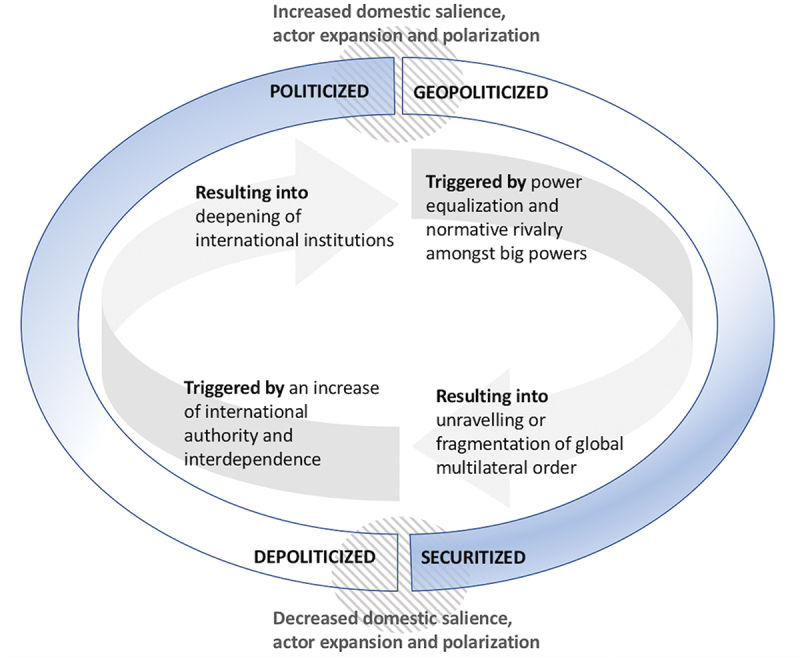
The paper conceptualizes geopoliticization as a missing link between politicization and securitization and applies it to the EU energy transition. It finds EU external energy policy increasingly geopoliticized, with foreign investment dominated by a geopoliticizing frame while renewable energy production remains a mix of politicizing, geopoliticizing, and securitizing frames.
Key findings
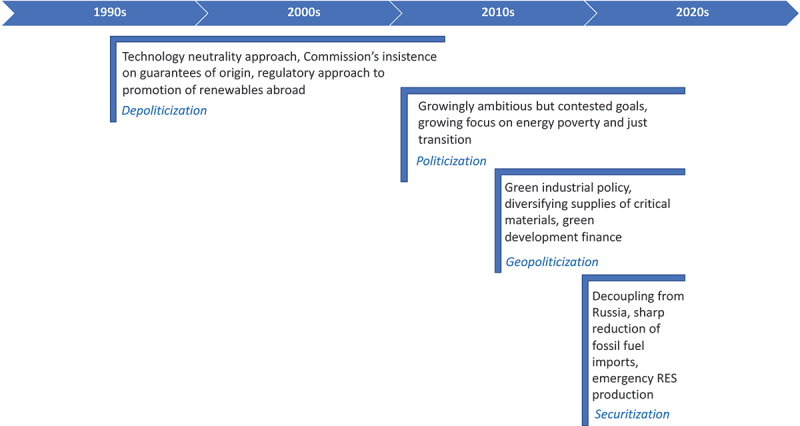
- Geopoliticization is defined as framing a social phenomenon as a matter of international power competition, distinct from but bridging politicization and securitization; it can co-occur with politicization and intensify into securitization.
- The EU’s energy transition framing is mostly geopoliticizing, leading to geoeconomic instruments such as FDI screening, green industrial policy, and strategic partnerships. By 2023, 22 EU Member States had FDI screening mechanisms, up from 17 when Regulation (EU) 2019/452 came into force; in at least 9 of the 22, energy is explicitly a sensitive domain, while 20 Member States already had other controls on foreign acquisitions in energy.
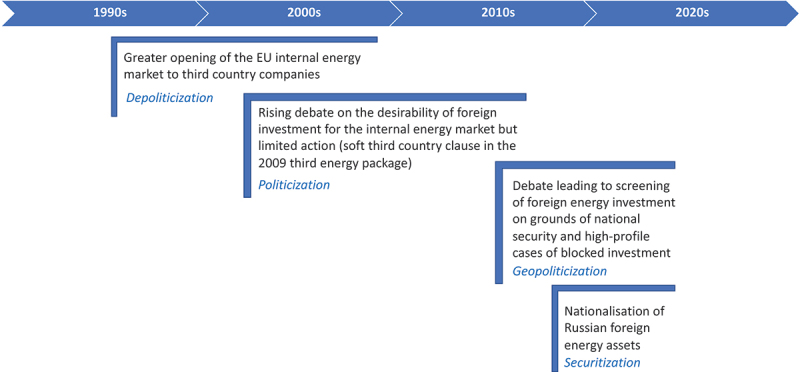
- In foreign investment in energy infrastructure and green technology, a geopoliticizing frame has dominated since the mid-2010s, with a securitizing turn after Russia’s 2022 invasion of Ukraine: Nord Stream 2 certification was halted, Gazprom Germania was placed under German fiduciary control, and Chinese overall FDI in Europe fell to its lowest level since 2013 in 2022, with only one large energy acquisition.
- In renewable energy production and technology, frames co-occur: REPowerEU proposed raising the 2030 renewable target to 45%, more than doubling the 20% goal reached in 2020, and replacing 40% (150 billion cubic metres) of EU gas imports, but contestation remains over hydrogen and nuclear. Of Global Gateway 2023 flagship projects, 20 out of 28 in Latin America and 15 out of 17 in Asia relate to the energy transition.
Methods
- Conceptual framework treating geopoliticization as a policy frame with four dimensions: problematization, institutional/policy-making structures, policy instruments, and expected international cooperation outcomes; operationalized for the energy transition in Table 1.
- Case study of EU external energy policy in two domains: foreign investment in energy infrastructure and green technology, and renewable energy development and production; analysis focuses on developments since 2010.
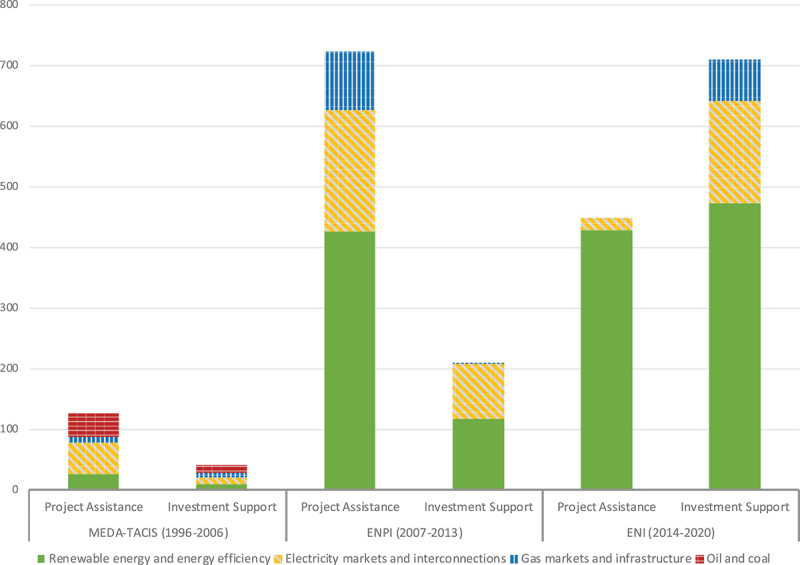
- Data include documentary analysis of primary sources such as European Commission communications, European parliamentary debates, and member states’ positions; own-gathered data on EU inward foreign investment and EU energy assistance between 2010 and 2020; complemented by reports from international institutions, think-tank analyses, and specialised media. The analysis is interpretive and qualitative.
Limitations
- Stated in the paper: detailed examinations of how the energy transition is actually approached in different jurisdictions are less common, and this study addresses the EU as a single case; the two empirical domains serve as an illustration of slightly different geopoliticization dynamics.
- Stated in the paper: it is still early to provide aggregate data on development assistance for the 2021–2027 period, so the Global Gateway discussion relies on flagship project counts; the analysis is interpretive rather than based on word frequencies.
- Evident from the text: the single-case EU design and two-domain focus limit generalizability, and the paper does not causally identify the effects of geopoliticization on international cooperation or conflict; the normative caution against geopoliticization is the author’s assessment.
Model-written summary. Check it against the paper before relying on it.
Integrity signals
Registry
Cites
Statistics
Figures
Verification
Claims the paper makes
2 Valid · 4 Not valid · 70 Not checked · 91 Own results and interpretations
Every source the paper cites for this claim was checked and supports it.
In the paper
“Therefore, external energy policy seems increasingly difficult to isolate from the emerging ‘geoeconomic order’ characterised by ‘heightened concern over the security risks posed by economic interdependence and digital connectivity, strong competition over technological development, and increased invocations of security exceptions’ (Roberts, Moraes, and Ferguson 2019, 657).”
§ The EU Energy Transition in a Geopoliticizing World > Introduction
What the sources say
- Supportedcites Roberts, Moraes, and Ferguson 2019 matched to “Toward a Geoeconomic Order in International Trade and Investment” (2019) source
The citation is attached to the quoted characterisation of the emerging order, and our copy states that almost verbatim in Section I (p. 657 area): 'The new order is marked by ... heightened concern over the security risks posed by economic interdependence and digital connectivity, strong competition over technological development, and increased invocations of security exceptions'. The paper's 'Logic of the Emerging Geoeconomic Order' section (pp. 657-660) further supports the difficulty of isolating policy from this order, noting that expanding invocations of national security 'to sectors that previously were not considered to be strategic ... makes it hard to draw a clear line between protection and protectionism'. The energy-policy framing ('Therefore, external energy policy...') is the citing authors' own inference and is not attributed to this source; the paper does not discuss energy policy as such, but the content it is credited with — the definition of the geoeconomic order — is fully present. (LLM, conf=0.88)
hedgedstates an association- Asserted: passes — The authors put it forward as true.
- Checkable: passes — It can be checked against evidence.
- Load-bearing: passes — The paper’s conclusions depend on it.
- Based: passes — The paper gives a reason why it holds.
- Supported
Every source the paper cites for this claim was checked and supports it.
In the paper
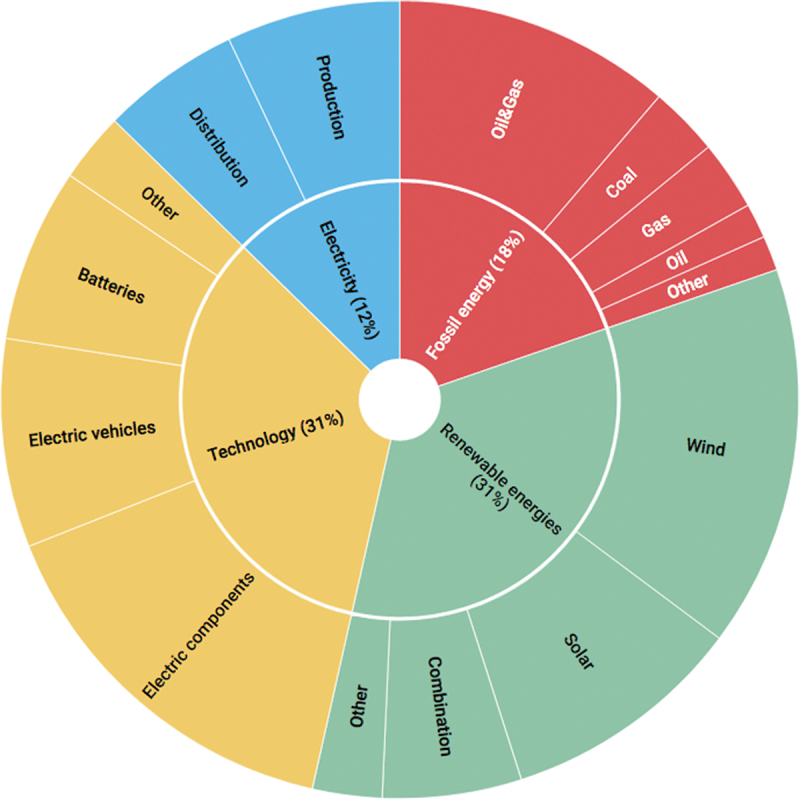
“In the context of the energy transition, with its growing focus on digitalization, security concerns have recently further expanded from energy production, supply, and infrastructure (e.g., energy grids, power plants) to energy technologies (e.g., batteries, electric vehicles, lightening or semi-conductors) (cf. Rajavuori and Huhta 2020, see also Figure 2).”
§ The EU Energy Transition in a Geopoliticizing World > Foreign Investment in Energy Infrastructure and Green Technology
What the sources say
- Supportedcites Rajavuori and Huhta 2020 matched to “Investment screening: Implications for the energy sector and energy security” (2020) source
Section 3.1 states that traditional notions of energy security (availability of primary energy sources, energy independence) 'are increasingly augmented with the protection of energy technology development capabilities, including in renewables, as well as fears over wrongful use of big data', and Section 3.2 says FDI screening 'leak[s] additional components into the energy security discourse and alter[s] the scope of what is understood as included in energy security', particularly 'due to the development of new technologies and the application of these technologies to the energy sector'. The Conclusions restate the same trajectory explicitly as a move away from the past focus on 'exploration, production, transmission and supply of energy' toward 'widening definitions of critical technologies' and data, and Sections 3.3–3.5 organise the paper as critical infrastructures → critical energy technologies (batteries, semiconductors, renewables) → data-driven/digitalised technologies, matching the citing sentence's ordering and its digitalization framing. The illustrative examples ('batteries, electric vehicles, lightning or semi-conductors') go slightly beyond the paper's own list (it names battery developers, semiconductors/key enabling technologies, wireless charging stations), but they are parenthetical glosses rather than the attributed point. (LLM, conf=0.87)
plainstates a cause- Asserted: passes — The authors put it forward as true.
- Checkable: passes — It can be checked against evidence.
- Load-bearing: unclear — It is unclear whether the paper’s conclusions depend on it.
- Based: passes — The paper gives a reason why it holds.
- Supported
None of the sources cited for this claim have been checked yet.
In the paper
“Interestingly, the problematization of foreign investment by the three Member States was less focused on security concerns as such and more on wider strategic considerations, mainly the consequences of the lack of reciprocity and level-playing field for the EU’s competitiveness and ‘strategic interests’ broadly defined.”
§ The EU Energy Transition in a Geopoliticizing World > Foreign Investment in Energy Infrastructure and Green Technology
plain- Asserted: passes — The authors put it forward as true.
- Checkable: passes — It can be checked against evidence.
- Load-bearing: passes — The paper’s conclusions depend on it.
- Based: passes — The paper gives a reason why it holds.
A result the paper states — it cites no source for it, so there is none to check. The quote shows it is in the paper.
In the paper
“However, towards the end of the 2010s, debates on foreign investment, including in the energy sector, made a turn.”
§ The EU Energy Transition in a Geopoliticizing World > Foreign Investment in Energy Infrastructure and Green Technology
plain- Asserted: passes — The authors put it forward as true.
- Checkable: passes — It can be checked against evidence.
- Load-bearing: unclear — It is unclear whether the paper’s conclusions depend on it.
- Based: passes — The paper gives a reason why it holds.
None of the sources cited for this claim could be matched to a paper, so there is nothing to check it against.
In the paper
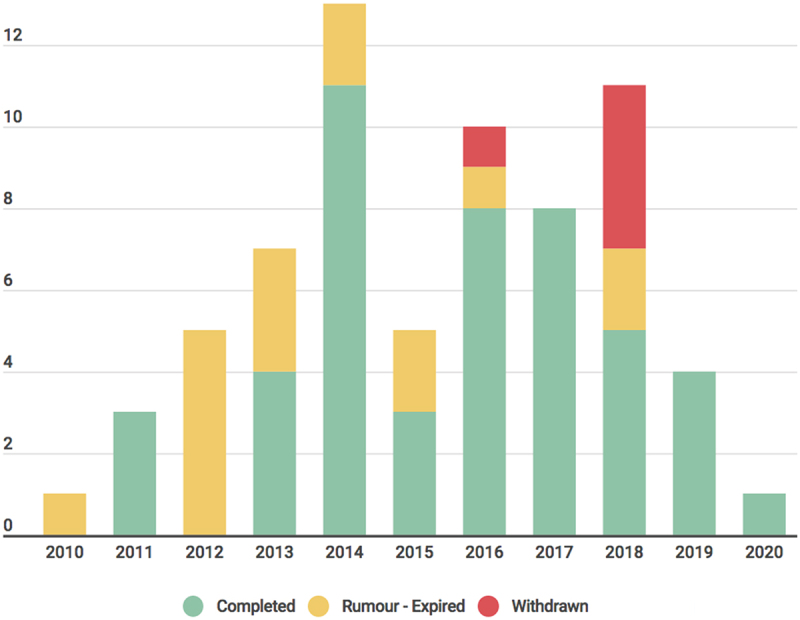
“For example, Chinese Stated Owned Enterprises (SOEs) such as State Grid Corporation of China (SGCC), China Investment Corporation (CIC), or Three Gorges Dam Corporation (CTG) could successfully acquire stakes in the electricity transmission networks of Portugal (25% of REN in 2012 and 49% in EDP in 2017), Italy (35% of CDP Reti in 2014), Greece (24% of Public Power Corporation in 2016 and 75% of C”
§ The EU Energy Transition in a Geopoliticizing World > Foreign Investment in Energy Infrastructure and Green Technology
What the sources say
- Not matchedcites Mazzucchi 2018
An author–year citation the paper’s reference list doesn’t settle. We don’t search these by name.
- Not matchedcites Zephyr database
This doesn’t read as a citation we can look up.
hedged- Asserted: passes — The authors put it forward as true.
- Checkable: passes — It can be checked against evidence.
- Load-bearing: passes — The paper’s conclusions depend on it.
- Based: passes — The paper gives a reason why it holds.
- Not matched
74 more claims
Create a free account to see all 167 claims and to verify the 36 references still open.
- It may state two separate claims as one. 45
- Probably not a substantial claim. 55
Claims other papers make about this one
Each is checked against this paper’s own text: does it say what the citing paper says it does?
In the citing paper
“The energy sufficiency strategies, alongside the protective measures undertaken by the EU, further highlight a return to such methods, as these strategies actively encourage EU member states to source energy and raw materials from the global south, while actively investing and pursuing their drive towards net zero and green societies (Herranz-Surralles 2024).”
From The Securitization and Eurocentric Narratives in the European Union's Climate Policy and Diplomacy (2025) · cites this paper as Herranz-Surralles 2024
In the citing paper
“The Securitization of energy within the EU is increasingly being deeply embedded within Eurocentric paradigms of threat construction, policy prioritization and external engagement with the Global South (Herranz-Surralles 2024).”
From The Securitization and Eurocentric Narratives in the European Union's Climate Policy and Diplomacy (2025) · cites this paper as Herranz-Surralles 2024
Citations
Cites
Security: A New Framework for Analysis
Hampson, F. O., Buzan, B., Waever, O., & Wilde, J. D. (1998) · International Journal · doi:10.2307/40203739 · Cited by 6,530
Security: A New Framework for Analysis
Buzan, B., Wæver, O., & de Wilde, J. (1997) · doi:10.1515/9781685853808 · Cited by 1,692
Zürn, M. (2018) · Oxford Scholarship Online · doi:10.1093/oso/9780198819974.001.0001 · Cited by 801
Renewable energy and geopolitics: A review
Vakulchuk, R., Overland, I., & Scholten, D. (2020) · Renewable and Sustainable Energy Reviews · doi:10.1016/j.rser.2019.109547 · Cited by 653
International authority and its politicization
Zürn, M., Binder, M., & Ecker-Ehrhardt, M. (2012) · International Theory · doi:10.1017/s1752971912000012 · Cited by 612
Introduction: the differentiated politicisation of European governance
de Wilde, P., Leupold, A., & Schmidtke, H. (2015) · West European Politics · doi:10.1080/01402382.2015.1081505 · Cited by 590
Tuathail, G. Ó., & Agnew, J. (1992) · Political Geography · doi:10.1016/0962-6298(92)90048-x · Cited by 545
McCauley, D., Ramasar, V., Heffron, R. J., Sovacool, B. K., Mebratu, D., & Mundaca, L. (2019) · Applied Energy · doi:10.1016/j.apenergy.2018.10.005 · Cited by 511
The geopolitics of energy system transformation: A review
Blondeel, M., Bradshaw, M. J., Bridge, G., & Kuzemko, C. (2021) · Geography Compass · doi:10.1111/gec3.12580 · Cited by 341
Kuzemko, C., Blondeel, M., Dupont, C., & Brisbois, M. C. (2022) · Energy Research & Social Science · doi:10.1016/j.erss.2022.102842 · Cited by 339
Research works printed but not linked: 13
- Council of the EU. (2020). Council conclusions on “A recovery advancing the transition towards a more dynamic, Resilient and Competitive European Industry”. November 16, 2020.
- Council of the EU. 2021. Council conclusions on Climate and Energy Diplomacy - delivering on the external dimension of the European Green Deal, 5263/21. January, 21 2021.
- European Commission. 2020b. Guidance to the member states concerning foreign direct investment and free movement of capital from third countries, and the protection of Europe’s strategic assets, ahead of the application of Regulation (EU) 2019/452 (FDI Screening Regulation). C final, 20.03.2020.
- European Commission. (2022a). “European Commission and U.S. Department of Energy Support Collaboration Between the European Battery Alliance and U.S. Li-Bridge Alliance to Strengthen Supply chain”. Press Release, 14.05.2022.
- European Commission and High Representative. (2021). Renewed partnership with the southern neighbourhood. JOIN(2021) 2 final, 09.02.2021.
- European Parliament. 2019. Framework for screening of foreign direct investments into the European union (debate), 13.02.2019.
- Kadras, S. 2023. “A nuclear energy truce: Why EU states should stop bickering and build renewables”, ECFR Commentary. https://ecfr.eu/article/a-nuclear-energy-truce-why-eu-states-should-stop-bickering-and-build-renewables/.
- Luttwak, E. N. 1990. From geopolitics to geo-economics: Logic of conflict, grammar of commerce. The National Interest 20: 17– 23.
- Mazzucchi, N. 2018. China and European electricity networks: Strategy and issues. In Note, Vol. 17, Paris: Fondation pour la recherche strategique. https://www.frstrategie.org/en/publications/notes/china-european-electricity-networks-strategy-issues-2018.
- Packroff, J. 2023. Von der Leyen faces pushback for Chinese electric vehicle investigation. Euractiv 13.09. https://www.euractiv.com/section/electric-cars/news/von-der-leyen-faces-pushback-for-chinese-electric-vehicle-investigation/.
- Renard, T. 2017. Business vs. Security: The conundrum of Chinese Investments in Belgium. In Chinese investment in Europe. A country-level approach, ed. J. Seaman, M. Huotari, and M. Otero-Iglesias, pp. 31– 39. Paris/Madrid/Berlin: IFRI, Elcano Royal Institute.
- Tagliapietra, S., and R. Veugelers. 2020. A green industrial policy for Europe. Brussels: Bruegel. https://www.bruegel.org/book/green-industrial-policy-europe.
- Vanheukelen, M. (2021) Address during the conference “the geopolitics of the green deal”, Bruegel, Accessed March 2, 2021, https://www.bruegel.org/events/the-geopolitics-of-the-green-deal/
Cited by
The Geoeconomic Turn of the Single European Market? Conceptual Challenges and Empirical Trends
Herranz‐Surrallés, A., Damro, C., & Eckert, S. (2024) · JCMS Journal of Common Market Studies · doi:10.1111/jcms.13591 · Cited by 163
Domingues, A. M., de Souza, R. G., & Luiz, J. V. R. (2024) · Energy Research & Social Science · doi:10.1016/j.erss.2024.103756 · Cited by 42
Geoeconomics of the transition to net-zero energy and industrial systems: A framework for analysis
Quitzow, R., & Zabanova, Y. (2025) · Renewable and Sustainable Energy Reviews · doi:10.1016/j.rser.2025.115492 · Cited by 34
Sivonen, M. H., & Kivimaa, P. (2023) · Environmental Sociology · doi:10.1080/23251042.2023.2251873 · Cited by 27
Politics of de-risking: how the EU confronts vulnerabilities in critical digital infrastructures
Bandemer, S., Daßler, B., Rittberger, B., Weiß, M., & Will, K. (2025) · Journal of European Public Policy · doi:10.1080/13501763.2025.2545305 · Cited by 25
Babić, M., & Mertens, D. (2024) · Regulation & Governance · doi:10.1111/rego.12634 · Cited by 20
Securitisation of EU policy: how Russia's invasion of Ukraine is changing Europe
Orenstein, M. A. (2026) · Journal of European Public Policy · doi:10.1080/13501763.2025.2497350 · Cited by 15
No Longer Neutral: The ECB’s Geopoliticization of the International Role of the Euro
Spielberger, L. (2025) · Politics and Governance · doi:10.17645/pag.8877 · Cited by 16
Meyer, T. (2024) · Geopolitics · doi:10.1080/14650045.2024.2362668 · Cited by 13
AUKUS ‘behind the scenes’: through the lens of militarised neoliberalism
Wijaya, T., & Hayes, A. (2024) · Australian Journal Of International Affairs · doi:10.1080/10357718.2024.2398745 · Cited by 11
Patents for power: Intellectual property and the geopolitics of nuclear energy technologies
Meyer, T. (2025) · Nuclear Engineering and Technology · doi:10.1016/j.net.2025.103470 · Cited by 10
Willems, M. (2025) · Journal of European Public Policy · doi:10.1080/13501763.2025.2550492 · Cited by 8
Cosmulese, C. G. (2026) · Geopolitics under Globalization · doi:10.21511/gg.07(1).2026.01 · Cited by 9
It’s not just geopolitics, stupid! Development, retroliberalism, and the EU’s Global Gateway
Carbone, M. (2026) · Journal of European Integration · doi:10.1080/07036337.2026.2714068 · Cited by 8
Дугінець, Г., Генералов, О., & Ніжейко, К. (2025) · Економіка та суспільство · doi:10.32782/2524-0072/2025-76-108 · Cited by 9
Herdlitschka, T., Luo, A., & Leipold, S. (2026) · Communications Earth & Environment · doi:10.1038/s43247-026-03593-x · Cited by 7
Green Superpowers: China, the European Union, and the United States in the Global Energy Transition
Prontera, A. (2024) · doi:10.1093/9780191987304.001.0001 · Cited by 10
The Union's Westphalian mirage: geopolitics and EU foreign policy
Tonra, B. (2025) · European Politics and Society · doi:10.1080/23745118.2025.2565202 · Cited by 7
Conflict Management and the Future of EU Foreign and Security Policy: Relational Power Europe
Alcaro, R., & Bargués, P. (2025) · Routledge eBooks · doi:10.4324/9781003559467 · Cited by 7
Linking geoeconomic and financial de-risking in European energy infrastructure
Ruck, J., & Bieling, H. (2026) · Globalizations · doi:10.1080/14747731.2026.2622149 · Cited by 7
Encounters of hesitant politics and an unwavering energy transition. Media reflections in Romania
Gavriș, A., & Popescu, C. (2024) · Journal of Cleaner Production · doi:10.1016/j.jclepro.2024.143870 · Cited by 6
Framing the European Green Deal: political and media energy discourses in Czechia and Sweden
Dubský, Z., Votoupalová, M., & Vitkova, A. (2025) · Humanities and Social Sciences Communications · doi:10.1057/s41599-025-04557-w · Cited by 8
Azzam, B., & Dijkstra, H. (2026) · Geopolitics · doi:10.1080/14650045.2026.2626267 · Cited by 5
The Securitization and Eurocentric Narratives in the European Union's Climate Policy and Diplomacy
Mishra, A. (2025) · Contemporary European Politics · doi:10.1002/cep4.70019 · Cited by 4
The Political Economy of the EU's New Green Industrial Policy: A Framework for Analysis
Cruz, R. D. L., Ville, F. D., Rogissart, S., & de Graaf, T. V. (2026) · JCMS Journal of Common Market Studies · doi:10.1111/jcms.70116 · Cited by 4
Geopolitical Implications of the Global Energy Transition for the EU
Proedrou, F. (2025) · Environmental Politics and Theory · doi:10.1007/978-3-031-81584-3_4 · Cited by 5
Sanahuja, J. A. (2025) · Springer eBooks · doi:10.1007/978-3-031-80216-4_18 · Cited by 4
Market Power Europe and the research agenda on geopoliticisation and economic security
Damro, C. (2025) · European Politics and Society · doi:10.1080/23745118.2025.2576708 · Cited by 3
Narrating power: the European Commission and the geopolitics of the energy transition
Dubský, Z., & Zemanová, Š. (2026) · European Security · doi:10.1080/09662839.2025.2599239 · Cited by 5
Structural resilience of climate regime in the global conflicts
Guan, C., Meng, J., & Xu, Q. (2025) · Environmental Research Communications · doi:10.1088/2515-7620/ada5b6 · Cited by 3
Dumitrescu, L. (2024) · EURINT · doi:10.47743/eurint-2024-dum · Cited by 4
Political impact of the EU energy transition: A geopolitical analysis
Brovina, F. (2025) · FOREIGN AFFAIRS · doi:10.59214/2663-2675.35(3).2025.18 · Cited by 2
A Quantitative Approach to Modeling the Overconsumption of Energy in Healthcare Buildings
Prieto-Fernández, A., Sánchez‐Barroso, G., González‐Domínguez, J., Botejara-Antúnez, M., & García‐Sanz‐Calcedo, J. (2025) · Journal of Engineering · doi:10.1155/je/4812122 · Cited by 2
EU actor-centered geopoliticization: an introduction
Andrione‐Moylan, A., Raube, K., & Wolfs, W. (2026) · European Politics and Society · doi:10.1080/23745118.2025.2612539 · Cited by 2
Cerioli, L. (2026) · Geopolitics · doi:10.1080/14650045.2026.2659603 · Cited by 2
La Unión Europea y el nuevo paradigma energético en la transición hacia la neutralidad climática.
Heras, B. P. D. L. (2024) · IUS ET SCIENTIA · doi:10.12795/iestscientia.2024.mon.01 · Cited by 4
Gonzalez-Parias, C. H., Bedoya, J. C. M., Bustamante, P. P., & Muñoz-Muñoz, J. P. (2025) · Revista Científica General José María Córdova · doi:10.21830/19006586.1419 · Cited by 2
EU climate diplomacy and the geopolitics of the Anthropocene
Bremberg, N., Earsom, J., & Petri, F. (2025) · European Politics and Society · doi:10.1080/23745118.2025.2576710 · Cited by 3
Leenders, E., Smeets, S., Liefferink, D., & Mastenbroek, E. (2025) · JCMS Journal of Common Market Studies · doi:10.1111/jcms.70060 · Cited by 1
Betti, A., & Serban, I. D. (2026) · Cambridge Review of International Affairs · doi:10.1080/09557571.2026.2622957 · Cited by 1
de Jong, M. (2026) · Journal of Contemporary European Studies · doi:10.1080/14782804.2026.2646645 · Cited by 1
Geopolitical Upheaval Through Climate Measures: IMO and EU Decisions for International Shipping
Dikaios, G., Terezaki, M., & Gavalas, D. (2026) · Ocean and Society · doi:10.17645/oas.11894 · Cited by 1
Przedworska, K., Hadasik, B., Krawczyńska, D., Ryczko, A., & Kubiczek, J. (2025) · International Journal of Management and Economics · doi:10.2478/ijme-2025-0021 · Cited by 1
Mao, T., Xue, T., & Gu, W. (2026) · Resources Environment and Sustainability · doi:10.1016/j.resenv.2026.100366 · Cited by 2
China: The Unexpected and Contested Green Giant
Prontera, A. (2024) · Oxford University Press eBooks · doi:10.1093/9780191987304.003.0003 · Cited by 1
Green Foreign Energy Policy: A Framework for the Analysis
Prontera, A. (2024) · Oxford University Press eBooks · doi:10.1093/9780191987304.003.0002 · Cited by 1
Proedrou, F. (2025) · Environmental Politics and Theory · doi:10.1007/978-3-031-81584-3_3 · Cited by 1
The United States: A Reluctant Follower or a Re-emerging Leader?
Prontera, A. (2024) · Oxford University Press eBooks · doi:10.1093/9780191987304.003.0005 · Cited by 1
Müller, T. W. (2026) · Institutional Repository of Leibniz Universität Hannover (Leibniz Universität Hannover) · doi:10.15488/21391 · Cited by 1
KIRHASANOĞLU, Ş., & ÖZDEMİR, M. (2024) · Muhasebe ve Finansman Dergisi · doi:10.25095/mufad.1464037
Prontera, A. (2024) · Oxford University Press eBooks · doi:10.1093/9780191987304.003.0001
Prontera, A. (2024) · Oxford University Press eBooks · doi:10.1093/9780191987304.003.0007
Prontera, A. (2024) · Oxford University Press eBooks · doi:10.1093/9780191987304.002.0005
The European Union: The Would-Be Green Leader
Prontera, A. (2024) · Oxford University Press eBooks · doi:10.1093/9780191987304.003.0004
Prontera, A. (2024) · Oxford University Press eBooks · doi:10.1093/9780191987304.002.0004
China, the European Union, and the United States: A Comparative Perspective
Prontera, A. (2024) · Oxford University Press eBooks · doi:10.1093/9780191987304.003.0006
Proedrou, F. (2025) · Environmental Politics and Theory · doi:10.1007/978-3-031-81584-3_5
Proedrou, F. (2025) · Environmental Politics and Theory · doi:10.1007/978-3-031-81584-3_1
The Euro-Latin American Space in Time of Social and Geopolitical Contestation: Partners of Choice
Domínguez, R., & Sanahuja, J. A. (2025) · Springer eBooks · doi:10.1007/978-3-031-80216-4_33
Jimenez Herrera, E. (2025) · KTH Publication Database DiVA (KTH Royal Institute of Technology)
Dejonghe, M. (2025) · Ghent University Academic Bibliography (Ghent University)
Greiçevci, L. (2025) · Springer eBooks · doi:10.1007/978-3-031-99513-2_3
The Issue of Renewable Energy as a Subject of Performance Audit — The Case of Romania
Bostan, I., & LAZAR, C. M. (2025) · Futurity of Social Sciences. · doi:10.57125/fs.2025.12.20.12
Energy Transition and Its Implications for the Structure of the National Economy
Judijanto, L., & Zaidah, F. (2026) · Nomico. · doi:10.62872/fv14g191
Narrating the energy transition: A critical geopolitical analysis of Czech media discourse
Dubský, Z., Zemanová, Š., Kristek, T., & Blahušová, A. (2026) · Energy Policy · doi:10.1016/j.enpol.2026.115265
Geo Political Aspects Concerning AI and Green Investment With Reference to International Relations
Ray, S., Goswami, A. K., & Chandra, S. (2026) · Advances in computational intelligence and robotics book series · doi:10.4018/979-8-2600-1308-3.ch002
Taking the EU Seriously: Dual Security Management in the New Geopolitics
Daßler, B., & Weiß, M. (2026) · Global Studies Quarterly · doi:10.1093/isagsq/ksag075
Balt, M. (2026) · EUR Research Repository (Erasmus University Rotterdam)
Evolution of risk in global flows of energy transition
Radosavljević, S. (2026) · International May Conference on Strategic Management (IMCSM) · doi:10.5937/imcsm26386r
Between norms and power: Implicit geopoliticisation of the eastern partnership through energy
Kočí, K., Votoupalová, M., & Dubský, Z. (2026) · Energy Research & Social Science · doi:10.1016/j.erss.2026.104821
Evropski zeleni dogovor in energetski prehod na Zahodnem Balkanu
Mavrič, M. (2026) · Repository of the University of Ljubljana (University of Ljubljana)
Eyselein, G., & Herdlitschka, T. (2026) · Journal für Entwicklungspolitik · doi:10.20446/jep-2414-3197-42-2-42
Saes-Louarn, A. N. (2026) · Political Research Exchange · doi:10.1080/2474736x.2026.2693565
EU Geopolitics: Borders, Crises and Security in the Post-Liberal Era
Proedrou, F. (2026) · Routledge eBooks · doi:10.4324/9781003782001
Naouri, M., & Alaoui, A. E. (2026) · African Scientific Journal · doi:10.5281/zenodo.22250919
Müller, P. N. (2026) · Institutional Repository of Leibniz Universität Hannover (Leibniz Universität Hannover) · doi:10.15488/22500
Epasto, S. (2026) · U-PAD Unimc - Open Digital Publications (University of Macerata) · doi:10.5281/zenodo.22644231
Baleha, A., Taliian, I., & Mukhanov, Z. (2026) · European Politics and Society · doi:10.1080/23745118.2026.2734585
Mota, C. R. (2026) · Boletim de Economia e Política Internacional · doi:10.38116/bepi44art3
Merilahti, X. (2026) · UTUPub (University of Turku)
Kruck, A., & Sommer, L. (2026) · Journal of European Public Policy · doi:10.1080/13501763.2026.2746008
Zhang, B. (2026) · New Political Economy · doi:10.1080/13563467.2026.2751104
Strategic Autonomy and Critical Raw Materials in EU Energy Policy
Bakos, A. (2026) · Springer eBooks · doi:10.1007/978-981-92-2412-8_19-1
Metadata
- Authors
- Herranz-Surralles, A.
- Affiliations
- Political Science Department, Faculty of Arts and Social Sciences, Maastricht University, Maastricht, Netherlands
- Venue
- Geopolitics
- Publisher
- Informa UK Limited
- Published
- 2024-01-02
- Volume
- 29
- Issue
- 5
- Pages
- 1-31
- ISSN
- 1465-0045 (ISSN-L)
- 1557-3028
- PMC
- PMC11418900
- OpenAlex
- W4390542643
- Cited by
- 77
- References
- 55
- Citations by year
- 2026: 29 · 2025: 27 · 2024: 20
- FWCI
- 20.14
- Type
- journal article
- Language
- en
- Open access
- hybrid
- doi.org
- Licence
- Locations
- Geopolitics (publishedVersion, cc-by-nc-nd)
- PubMed Central (publishedVersion, cc-by-nc-nd)
- PubMed (publishedVersion)
- Research Publications (Maastricht University) (publishedVersion, cc-by-nc-nd)
- Funders
- Dutch Research Council
- Topics
- Physical Sciences › Energy › General Energy › Global Energy Security and Policy
- Social Sciences › Political Science and International Relations › European Politics and Security
- Physical Sciences › Energy › Renewable Energy, Sustainability and the Environment › Renewable Energy and Sustainability
- Keywords
- energy transition, EU energy policy, international energy relations, foreign investment in energy, global value chains, politicization, securitization, low-carbon energy systems, energy security
About these checks
Registry, retraction, Cites and statistics results are computed, not judged, with one exception: a printed reference that no index lists is read once by a model before it counts as a citation error. Claims are extracted by a model and kept only when their quote appears verbatim in the text; each cited source is then checked, with a model’s help, for whether it says what the claim relies on. Those verdicts can be wrong — read the claim’s quote and the cited source before relying on one.
A language model drew the claims from the paper on 2026-11-16, under version 3 of the claim definition (model deepseek-v4.1-flash, prompt extract-v3).
A second model labelled each claim on 2026-11-16 (model jev-1.13-20260917, definition revision gold-guideline-v0.2).
Cited sources are checked with a language model’s help (qwen3.8-omni-flash).
Statistics and arithmetic are recomputed, not judged.
Confidence bands are shown only for fields calibrated on our annotated test set. None is calibrated yet, so no band is shown.
What counts as a claim ›How we measure confidence ›How we check this ›
Are you an author, or do you see a problem with this page? Request a review
Data sources
Bibliographic data: Semantic Scholar, OpenAlex, Crossref.
Contains information from the Semantic Scholar Academic Graph Datasets, made available under the ODC Attribution License (ODC-BY 1.0).
Semantic Scholar’s data is described in: Kinney, R., et al. (2023). The Semantic Scholar Open Data Platform. arXiv:2301.10140.
