

The EU Energy Transition in a Geopoliticizing World
Open accessThe DOI matches its Crossref record; 53 of the 55 references it cites were found in a registry or an index, and 1 are not checked yet; 2 of the 80 sources its claims cite were checked for support.
Abstract
Amidst heightened global power rivalries, the geopolitical aspects of the energy transition are taking centre stage, with even liberal-minded countries growing wary about foreign investment in the energy sector and the dependencies created by global value chains of green technologies. Building on current debates on the 'geopoliticization' of foreign economic policies, this paper sets out a conceptual framework to assess the extent to which the energy transition is becoming geopoliticized in the European Union (EU) and its impact on international energy relations. Theoretically, the paper makes the case for considering geopoliticization as a missing link in the study of politicization and securitization in International Relations, allowing for a more fine-grained diagnosis of current trends and their likely evolution. Empirically, the analysis identifies structural geopoliticizing dynamics in the EU's framing of the energy transition, although to different degrees depending on the concrete issue at hand. While demands for factoring in the geopolitical consequences of the energy transition are ever louder, normatively, the paper raises a note of caution against the adverse consequences geopoliticization may have for the global transition to low-carbon energy systems.
Verified 2026-11-22 · 1 reference not checked yet
Overview
CoChat Summary
TL;DR
The paper conceptualizes geopoliticization as a missing link between politicization and securitization and applies it to the EU energy transition. It finds EU external energy policy increasingly geopoliticized, with foreign investment dominated by a geopoliticizing frame while renewable energy production remains a mix of politicizing, geopoliticizing, and securitizing frames.
Key findings
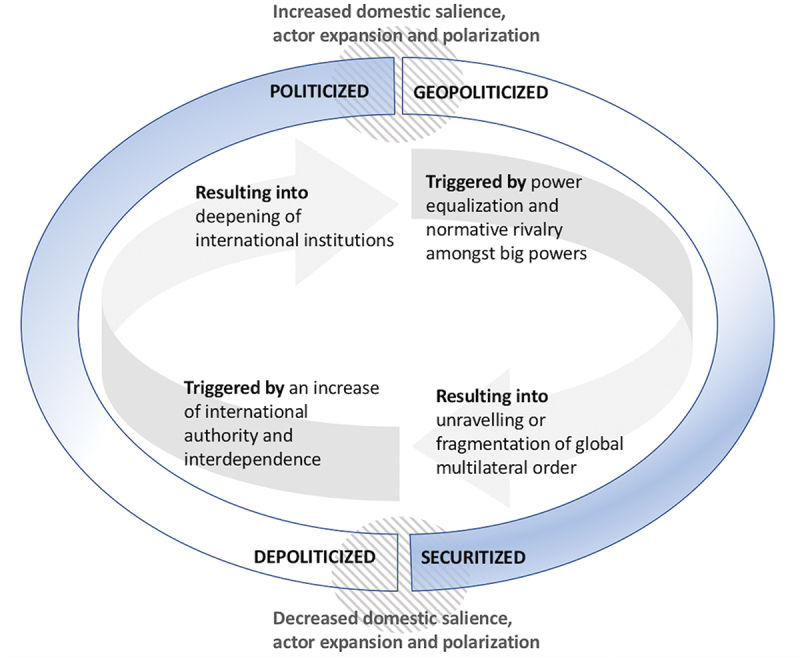
- Geopoliticization is defined as framing a social phenomenon as a matter of international power competition, distinct from but bridging politicization and securitization; it can co-occur with politicization and intensify into securitization.
- The EU’s energy transition framing is mostly geopoliticizing, leading to geoeconomic instruments such as FDI screening, green industrial policy, and strategic partnerships. By 2023, 22 EU Member States had FDI screening mechanisms, up from 17 when Regulation (EU) 2019/452 came into force; in at least 9 of the 22, energy is explicitly a sensitive domain, while 20 Member States already had other controls on foreign acquisitions in energy.
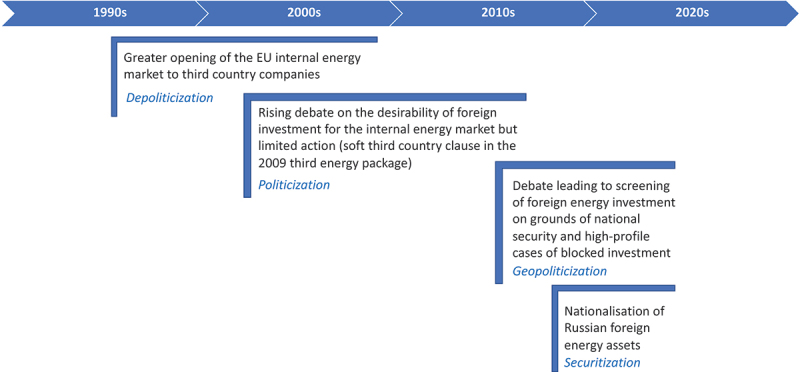
- In foreign investment in energy infrastructure and green technology, a geopoliticizing frame has dominated since the mid-2010s, with a securitizing turn after Russia’s 2022 invasion of Ukraine: Nord Stream 2 certification was halted, Gazprom Germania was placed under German fiduciary control, and Chinese overall FDI in Europe fell to its lowest level since 2013 in 2022, with only one large energy acquisition.
- In renewable energy production and technology, frames co-occur: REPowerEU proposed raising the 2030 renewable target to 45%, more than doubling the 20% goal reached in 2020, and replacing 40% (150 billion cubic metres) of EU gas imports, but contestation remains over hydrogen and nuclear. Of Global Gateway 2023 flagship projects, 20 out of 28 in Latin America and 15 out of 17 in Asia relate to the energy transition.
Methods
- Conceptual framework treating geopoliticization as a policy frame with four dimensions: problematization, institutional/policy-making structures, policy instruments, and expected international cooperation outcomes; operationalized for the energy transition in Table 1.
- Case study of EU external energy policy in two domains: foreign investment in energy infrastructure and green technology, and renewable energy development and production; analysis focuses on developments since 2010.
- Data include documentary analysis of primary sources such as European Commission communications, European parliamentary debates, and member states’ positions; own-gathered data on EU inward foreign investment and EU energy assistance between 2010 and 2020; complemented by reports from international institutions, think-tank analyses, and specialised media. The analysis is interpretive and qualitative.
Limitations
- Stated in the paper: detailed examinations of how the energy transition is actually approached in different jurisdictions are less common, and this study addresses the EU as a single case; the two empirical domains serve as an illustration of slightly different geopoliticization dynamics.
- Stated in the paper: it is still early to provide aggregate data on development assistance for the 2021–2027 period, so the Global Gateway discussion relies on flagship project counts; the analysis is interpretive rather than based on word frequencies.
- Evident from the text: the single-case EU design and two-domain focus limit generalizability, and the paper does not causally identify the effects of geopoliticization on international cooperation or conflict; the normative caution against geopoliticization is the author’s assessment.
Model-written summary. Check it against the paper before relying on it.
Integrity signals
Registry
Cites
Statistics
Figures
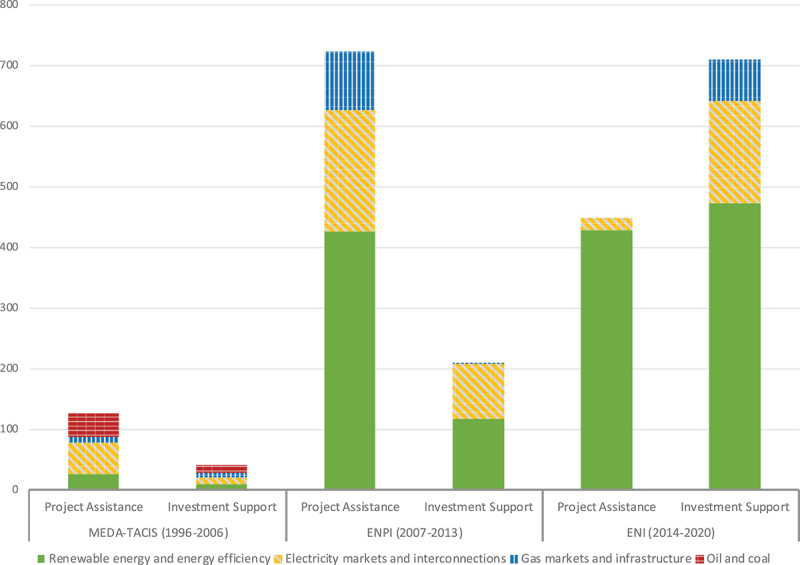
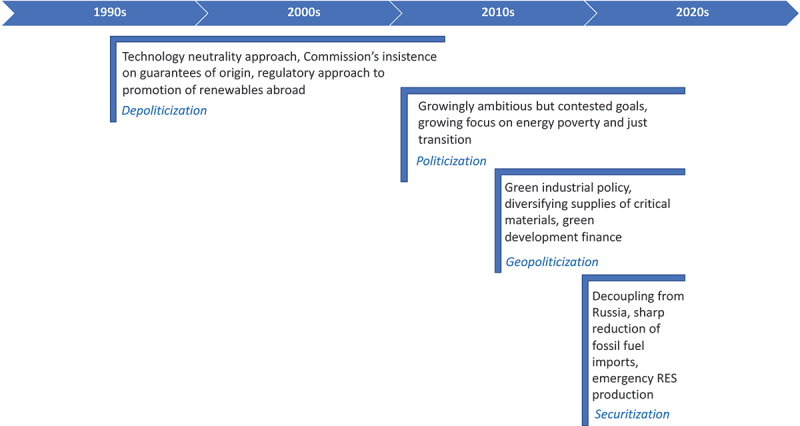
Verification
Claims the paper makes
2 Valid · 4 Not valid · 70 Not checked · 91 Own results and interpretations
Every source the paper cites for this claim was checked and supports it.
In the paper
“Therefore, external energy policy seems increasingly difficult to isolate from the emerging ‘geoeconomic order’ characterised by ‘heightened concern over the security risks posed by economic interdependence and digital connectivity, strong competition over technological development, and increased invocations of security exceptions’ (Roberts, Moraes, and Ferguson 2019, 657).”
§ The EU Energy Transition in a Geopoliticizing World > Introduction
What the sources say
- Supportedcites Roberts, Moraes, and Ferguson 2019 matched to “Toward a Geoeconomic Order in International Trade and Investment” (2019) source
The citation is attached to the quoted characterisation of the emerging order, and our copy states that almost verbatim in Section I (p. 657 area): 'The new order is marked by ... heightened concern over the security risks posed by economic interdependence and digital connectivity, strong competition over technological development, and increased invocations of security exceptions'. The paper's 'Logic of the Emerging Geoeconomic Order' section (pp. 657-660) further supports the difficulty of isolating policy from this order, noting that expanding invocations of national security 'to sectors that previously were not considered to be strategic ... makes it hard to draw a clear line between protection and protectionism'. The energy-policy framing ('Therefore, external energy policy...') is the citing authors' own inference and is not attributed to this source; the paper does not discuss energy policy as such, but the content it is credited with — the definition of the geoeconomic order — is fully present. (LLM, conf=0.88)
hedgedstates an association- Asserted: passes — The authors put it forward as true.
- Checkable: passes — It can be checked against evidence.
- Load-bearing: passes — The paper’s conclusions depend on it.
- Based: passes — The paper gives a reason why it holds.
- Supported
Every source the paper cites for this claim was checked and supports it.
In the paper
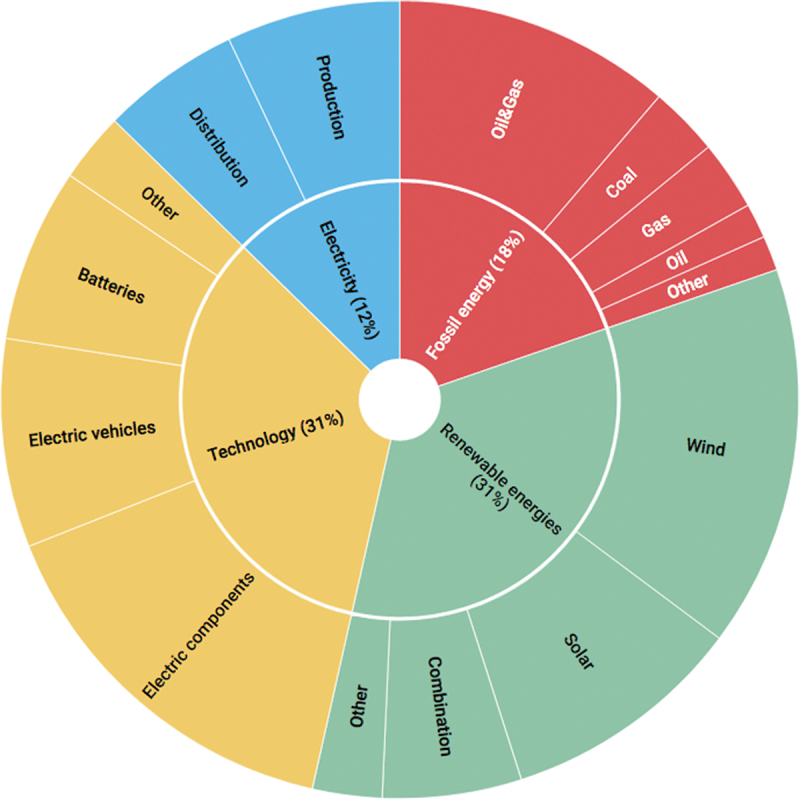
“In the context of the energy transition, with its growing focus on digitalization, security concerns have recently further expanded from energy production, supply, and infrastructure (e.g., energy grids, power plants) to energy technologies (e.g., batteries, electric vehicles, lightening or semi-conductors) (cf. Rajavuori and Huhta 2020, see also Figure 2).”
§ The EU Energy Transition in a Geopoliticizing World > Foreign Investment in Energy Infrastructure and Green Technology
What the sources say
- Supportedcites Rajavuori and Huhta 2020 matched to “Investment screening: Implications for the energy sector and energy security” (2020) source
Section 3.1 states that traditional notions of energy security (availability of primary energy sources, energy independence) 'are increasingly augmented with the protection of energy technology development capabilities, including in renewables, as well as fears over wrongful use of big data', and Section 3.2 says FDI screening 'leak[s] additional components into the energy security discourse and alter[s] the scope of what is understood as included in energy security', particularly 'due to the development of new technologies and the application of these technologies to the energy sector'. The Conclusions restate the same trajectory explicitly as a move away from the past focus on 'exploration, production, transmission and supply of energy' toward 'widening definitions of critical technologies' and data, and Sections 3.3–3.5 organise the paper as critical infrastructures → critical energy technologies (batteries, semiconductors, renewables) → data-driven/digitalised technologies, matching the citing sentence's ordering and its digitalization framing. The illustrative examples ('batteries, electric vehicles, lightning or semi-conductors') go slightly beyond the paper's own list (it names battery developers, semiconductors/key enabling technologies, wireless charging stations), but they are parenthetical glosses rather than the attributed point. (LLM, conf=0.87)
plainstates a cause- Asserted: passes — The authors put it forward as true.
- Checkable: passes — It can be checked against evidence.
- Load-bearing: unclear — It is unclear whether the paper’s conclusions depend on it.
- Based: passes — The paper gives a reason why it holds.
- Supported
None of the sources cited for this claim have been checked yet.
In the paper
“Interestingly, the problematization of foreign investment by the three Member States was less focused on security concerns as such and more on wider strategic considerations, mainly the consequences of the lack of reciprocity and level-playing field for the EU’s competitiveness and ‘strategic interests’ broadly defined.”
§ The EU Energy Transition in a Geopoliticizing World > Foreign Investment in Energy Infrastructure and Green Technology
plain- Asserted: passes — The authors put it forward as true.
- Checkable: passes — It can be checked against evidence.
- Load-bearing: passes — The paper’s conclusions depend on it.
- Based: passes — The paper gives a reason why it holds.
A result the paper states — it cites no source for it, so there is none to check. The quote shows it is in the paper.
In the paper
“However, towards the end of the 2010s, debates on foreign investment, including in the energy sector, made a turn.”
§ The EU Energy Transition in a Geopoliticizing World > Foreign Investment in Energy Infrastructure and Green Technology
plain- Asserted: passes — The authors put it forward as true.
- Checkable: passes — It can be checked against evidence.
- Load-bearing: unclear — It is unclear whether the paper’s conclusions depend on it.
- Based: passes — The paper gives a reason why it holds.
None of the sources cited for this claim could be matched to a paper, so there is nothing to check it against.
In the paper
“For example, Chinese Stated Owned Enterprises (SOEs) such as State Grid Corporation of China (SGCC), China Investment Corporation (CIC), or Three Gorges Dam Corporation (CTG) could successfully acquire stakes in the electricity transmission networks of Portugal (25% of REN in 2012 and 49% in EDP in 2017), Italy (35% of CDP Reti in 2014), Greece (24% of Public Power Corporation in 2016 and 75% of C”
§ The EU Energy Transition in a Geopoliticizing World > Foreign Investment in Energy Infrastructure and Green Technology
What the sources say
- Not matchedcites Mazzucchi 2018
An author–year citation the paper’s reference list doesn’t settle. We don’t search these by name.
- Not matchedcites Zephyr database
This doesn’t read as a citation we can look up.
hedged- Asserted: passes — The authors put it forward as true.
- Checkable: passes — It can be checked against evidence.
- Load-bearing: passes — The paper’s conclusions depend on it.
- Based: passes — The paper gives a reason why it holds.
- Not matched
74 more claims
Create a free account to see all 167 claims and to verify the 36 references still open.
- It may state two separate claims as one. 45
- Probably not a substantial claim. 55
Claims other papers make about this one
Each is checked against this paper’s own text: does it say what the citing paper says it does?
In the citing paper
“The energy sufficiency strategies, alongside the protective measures undertaken by the EU, further highlight a return to such methods, as these strategies actively encourage EU member states to source energy and raw materials from the global south, while actively investing and pursuing their drive towards net zero and green societies (Herranz-Surralles 2024).”
From The Securitization and Eurocentric Narratives in the European Union's Climate Policy and Diplomacy (2025) · cites this paper as Herranz-Surralles 2024
In the citing paper
“The Securitization of energy within the EU is increasingly being deeply embedded within Eurocentric paradigms of threat construction, policy prioritization and external engagement with the Global South (Herranz-Surralles 2024).”
From The Securitization and Eurocentric Narratives in the European Union's Climate Policy and Diplomacy (2025) · cites this paper as Herranz-Surralles 2024
Citations
Cites
Security: A New Framework for Analysis
Hampson, F. O., Buzan, B., Waever, O., & Wilde, J. D. (1998) · International Journal · doi:10.2307/40203739 · Cited by 6,530
Security: A New Framework for Analysis
Buzan, B., Wæver, O., & de Wilde, J. (1997) · doi:10.1515/9781685853808 · Cited by 1,692
Zürn, M. (2018) · Oxford Scholarship Online · doi:10.1093/oso/9780198819974.001.0001 · Cited by 801
Renewable energy and geopolitics: A review
Vakulchuk, R., Overland, I., & Scholten, D. (2020) · Renewable and Sustainable Energy Reviews · doi:10.1016/j.rser.2019.109547 · Cited by 653
International authority and its politicization
Zürn, M., Binder, M., & Ecker-Ehrhardt, M. (2012) · International Theory · doi:10.1017/s1752971912000012 · Cited by 612
Introduction: the differentiated politicisation of European governance
de Wilde, P., Leupold, A., & Schmidtke, H. (2015) · West European Politics · doi:10.1080/01402382.2015.1081505 · Cited by 590
Tuathail, G. Ó., & Agnew, J. (1992) · Political Geography · doi:10.1016/0962-6298(92)90048-x · Cited by 545
McCauley, D., Ramasar, V., Heffron, R. J., Sovacool, B. K., Mebratu, D., & Mundaca, L. (2019) · Applied Energy · doi:10.1016/j.apenergy.2018.10.005 · Cited by 511
The geopolitics of energy system transformation: A review
Blondeel, M., Bradshaw, M. J., Bridge, G., & Kuzemko, C. (2021) · Geography Compass · doi:10.1111/gec3.12580 · Cited by 341
Kuzemko, C., Blondeel, M., Dupont, C., & Brisbois, M. C. (2022) · Energy Research & Social Science · doi:10.1016/j.erss.2022.102842 · Cited by 339
Securitization Theory: How Security Problems Emerge and Dissolve
(2010) · Routledge eBooks · doi:10.4324/9780203868508 · Cited by 334
After Geopolitics? From the Geopolitical Social to Geoeconomics
Cowen, D., & Smith, N. (2009) · Antipode · doi:10.1111/j.1467-8330.2008.00654.x · Cited by 331
Toward a Geoeconomic Order in International Trade and Investment
Roberts, A., Choer Moraes, H., & Ferguson, V. (2019) · Journal of International Economic Law · doi:10.1093/jiel/jgz036 · Cited by 269 · cited 4×
“In the economic realm, the boundaries between geopoliticiza-tion and securitization are often difficult to demarcate, as illustrated by the fact that the ‘securitization of economic policy’ is considered one of the main traits of a geoeconomic order (Roberts, Moraes, and Ferguson 2019).”
BackgroundInfluentialEnergy democracy as a process, an outcome and a goal: A conceptual review
Szulecki, K., & Overland, I. (2020) · Energy Research & Social Science · doi:10.1016/j.erss.2020.101768 · Cited by 246
DOMESTIC SOURCES OF FOREIGN POLICY
Israel, J. (1968) · Historical Methods Newsletter · doi:10.1080/00182494.1968.10593861 · Cited by 242
The Geopolitics of the Global Energy Transition
(2020) · Lecture Notes in Energy · doi:10.1007/978-3-030-39066-2 · Cited by 234
European energy politics after Ukraine: The road ahead
Osička, J., & Černoch, F. (2022) · Energy Research & Social Science · doi:10.1016/j.erss.2022.102757 · Cited by 228
The Geopoliticization of European Trade and Investment Policy
Meunier, S., & Nicolaidis, K. (2019) · JCMS: Journal of Common Market Studies · doi:10.1111/jcms.12932 · Cited by 226
The geopolitics of renewables: New board, new game
Scholten, D., Bazilian, M., Overland, I., & Westphal, K. (2020) · Energy Policy · doi:10.1016/j.enpol.2019.111059 · Cited by 214
Europe’s others and the return of geopolitics
Diez, T. (2004) · Cambridge Review of International Affairs · doi:10.1080/0955757042000245924 · Cited by 210
Geopolitics versus geoeconomics: the case of Russia's geostrategy and its effects on the EU
Wigell, M., & Vihma, A. (2016) · International Affairs · doi:10.1111/1468-2346.12600 · Cited by 173
Model and manage the changing geopolitics of energy
Bazilian, M., Bradshaw, M., Goldthau, A. C., & Westphal, K. (2019) · Nature · doi:10.1038/d41586-019-01312-5 · Cited by 140
White, J. (2015) · Political Studies · doi:10.1111/1467-9248.12072 · Cited by 136
Soft power with a hard edge: EU policy tools and energy security
Goldthau, A., & Sitter, N. (2015) · Review of International Political Economy · doi:10.1080/09692290.2015.1008547 · Cited by 112
Protect global supply chains for low-carbon technologies
Goldthau, A., & Hughes, L. (2020) · Nature · doi:10.1038/d41586-020-02499-8 · Cited by 100
The Geopoliticisation of the EU’s Eastern Partnership
Cadier, D. (2018) · Geopolitics · doi:10.1080/14650045.2018.1477754 · Cited by 91
Party politics at the water’s edge: Contestation of military operations in Europe
Wagner, W., Herranz-Surrallés, A., Kaarbo, J., & Ostermann, F. (2018) · European Political Science Review · doi:10.1017/s1755773918000097 · Cited by 89
Geoeconomic Analysis and the Limits of Critical Geopolitics: A New Engagement with Edward Luttwak
Vihma, A. (2017) · Geopolitics · doi:10.1080/14650045.2017.1302928 · Cited by 87
Geopolitics and the ‘New’ State Capitalism
Alami, I., Dixon, A. D., Gonzalez-Vicente, R., Babic, M., Lee, S.-O., Medby, I. A., & Graaff, N. D. (2022) · Geopolitics · doi:10.1080/14650045.2021.1924943 · Cited by 83
An emerging EU Energy Diplomacy? Discursive shifts, enduring practices
Herranz-Surrallés, A. (2016) · Journal of European Public Policy · doi:10.1080/13501763.2015.1083044 · Cited by 79
Introduction: the politicisation of permanent crisis in Europe
Voltolini, B., Natorski, M., & Hay, C. (2020) · Journal of European Integration · doi:10.1080/07036337.2020.1792460 · Cited by 77
Siddi, M. (2017) · Geopolitics · doi:10.1080/14650045.2017.1416606 · Cited by 74
Contested energy transition? Europeanization and authority turns in EU renewable energy policy
Sandoval, I. S., & Jörgens, H. (2020) · Journal of European Integration · doi:10.1080/07036337.2019.1708342 · Cited by 74
Lauber, V., & Schenner, E. (2011) · Environmental Politics · doi:10.1080/09644016.2011.589578 · Cited by 70
Globalization, deglobalization and reglobalization: adapting liberal international order
Paul, T. V. (2021) · International Affairs · doi:10.1093/ia/iiab072 · Cited by 62
Chinese investments in Europe's energy sector: Risks and opportunities?
Conrad, B., & Kostka, G. (2016) · Energy Policy · doi:10.1016/j.enpol.2016.12.016 · Cited by 53
Investment screening: Implications for the energy sector and energy security
Rajavuori, M., & Huhta, K. (2020) · Energy Policy · doi:10.1016/j.enpol.2020.111646 · Cited by 46
When geopolitics and religion fuse: A historical perspective
Dijkink, G. (2006) · Geopolitics · doi:10.1080/14650040600598403 · Cited by 42
Sovereign Wealth Fund investments in Europe as an instrument of Chinese energy policy
Kamiński, T. (2016) · Energy Policy · doi:10.1016/j.enpol.2016.09.033 · Cited by 42
Editorial: Politicization of EU Trade Policy Across Time and Space
Biévre, D. D., García-Durán, P., Eliasson, L. J., & Costa, O. (2020) · Politics and Governance · doi:10.17645/pag.v8i1.3055 · Cited by 33
The European Union and the Energy Transition
Eyl-Mazzega, M.-A., & Mathieu, C. (2020) · Lecture Notes in Energy · doi:10.1007/978-3-030-39066-2_2 · Cited by 28
EU Internal Energy Market Policy: Achievements and Hurdles
Eikeland, P. O. (2011) · Palgrave Macmillan US eBooks · doi:10.1057/9780230119819_2 · Cited by 26
Assessing the EU’s Evolving Position in Energy Geopolitics under Decarbonisation
Giuli, M., & Oberthür, S. (2023) · The International Spectator · doi:10.1080/03932729.2023.2199648 · Cited by 24
Geoeconomics, Globalisation and the Limits of Economic Strategy in Statecraft: A Response to Vihma
Sparke, M. (2018) · Geopolitics · doi:10.1080/14650045.2017.1326482 · Cited by 22
Goron, C. (2018) · China-EU Law Journal · doi:10.1007/s12689-018-0080-z · Cited by 21
Herranz‐Surrallés, A. (2016) · West European Politics · doi:10.1080/01402382.2016.1240406 · Cited by 21
Australia and the Rise of Geoeconomics
Wesley, M. (2016) · ANU Open Research (Australian National University) · Cited by 20
Globalization, international mobility and the liberal international order
Money, J. (2021) · International Affairs · doi:10.1093/ia/iiab118 · Cited by 19
Belarus, Russia, and the escape from geopolitics
Kazharski, A., & Makarychev, A. (2021) · Political Geography · doi:10.1016/j.polgeo.2021.102377 · Cited by 13
An energy transition amidst great power rivalry
Scholten, D., Criekemans, D., & de Graaf, T. V. (2019) · Ghent University Academic Bibliography (Ghent University) · Cited by 11
Herranz-Surrallés, A. (2020) · Politics and Governance · doi:10.17645/pag.v8i1.2651 · Cited by 7
The Geopolitics of the EU’s Decarbonization Strategy
Casier, T. (2015) · Palgrave Macmillan UK eBooks · doi:10.1057/9781137406835_8 · Cited by 5
(2007) · HAL
(2019)
Beyond the Green Deal: upgrading the EU's energy diplomacy for a new era
Pastukhova, M., Pepe, J., Westphal, K., & Politik, S. W. U. (2020) · Stiftung Wissenschaft und Politik, German Institute for International and Security Affairs · doi:10.18449/2020c31
Research works printed but not linked: 13
- Council of the EU. (2020). Council conclusions on “A recovery advancing the transition towards a more dynamic, Resilient and Competitive European Industry”. November 16, 2020.
- Council of the EU. 2021. Council conclusions on Climate and Energy Diplomacy - delivering on the external dimension of the European Green Deal, 5263/21. January, 21 2021.
- European Commission. 2020b. Guidance to the member states concerning foreign direct investment and free movement of capital from third countries, and the protection of Europe’s strategic assets, ahead of the application of Regulation (EU) 2019/452 (FDI Screening Regulation). C final, 20.03.2020.
- European Commission. (2022a). “European Commission and U.S. Department of Energy Support Collaboration Between the European Battery Alliance and U.S. Li-Bridge Alliance to Strengthen Supply chain”. Press Release, 14.05.2022.
- European Commission and High Representative. (2021). Renewed partnership with the southern neighbourhood. JOIN(2021) 2 final, 09.02.2021.
- European Parliament. 2019. Framework for screening of foreign direct investments into the European union (debate), 13.02.2019.
- Kadras, S. 2023. “A nuclear energy truce: Why EU states should stop bickering and build renewables”, ECFR Commentary. https://ecfr.eu/article/a-nuclear-energy-truce-why-eu-states-should-stop-bickering-and-build-renewables/.
- Luttwak, E. N. 1990. From geopolitics to geo-economics: Logic of conflict, grammar of commerce. The National Interest 20: 17– 23.
- Mazzucchi, N. 2018. China and European electricity networks: Strategy and issues. In Note, Vol. 17, Paris: Fondation pour la recherche strategique. https://www.frstrategie.org/en/publications/notes/china-european-electricity-networks-strategy-issues-2018.
- Packroff, J. 2023. Von der Leyen faces pushback for Chinese electric vehicle investigation. Euractiv 13.09. https://www.euractiv.com/section/electric-cars/news/von-der-leyen-faces-pushback-for-chinese-electric-vehicle-investigation/.
- Renard, T. 2017. Business vs. Security: The conundrum of Chinese Investments in Belgium. In Chinese investment in Europe. A country-level approach, ed. J. Seaman, M. Huotari, and M. Otero-Iglesias, pp. 31– 39. Paris/Madrid/Berlin: IFRI, Elcano Royal Institute.
- Tagliapietra, S., and R. Veugelers. 2020. A green industrial policy for Europe. Brussels: Bruegel. https://www.bruegel.org/book/green-industrial-policy-europe.
- Vanheukelen, M. (2021) Address during the conference “the geopolitics of the green deal”, Bruegel, Accessed March 2, 2021, https://www.bruegel.org/events/the-geopolitics-of-the-green-deal/
Cited by
The Geoeconomic Turn of the Single European Market? Conceptual Challenges and Empirical Trends
Herranz‐Surrallés, A., Damro, C., & Eckert, S. (2024) · JCMS Journal of Common Market Studies · doi:10.1111/jcms.13591 · Cited by 163
Domingues, A. M., de Souza, R. G., & Luiz, J. V. R. (2024) · Energy Research & Social Science · doi:10.1016/j.erss.2024.103756 · Cited by 42
Geoeconomics of the transition to net-zero energy and industrial systems: A framework for analysis
Quitzow, R., & Zabanova, Y. (2025) · Renewable and Sustainable Energy Reviews · doi:10.1016/j.rser.2025.115492 · Cited by 34
Sivonen, M. H., & Kivimaa, P. (2023) · Environmental Sociology · doi:10.1080/23251042.2023.2251873 · Cited by 27
Politics of de-risking: how the EU confronts vulnerabilities in critical digital infrastructures
Bandemer, S., Daßler, B., Rittberger, B., Weiß, M., & Will, K. (2025) · Journal of European Public Policy · doi:10.1080/13501763.2025.2545305 · Cited by 25
Metadata
- Authors
- Herranz-Surralles, A.
- Affiliations
- Political Science Department, Faculty of Arts and Social Sciences, Maastricht University, Maastricht, Netherlands
- Venue
- Geopolitics
- Publisher
- Informa UK Limited
- Published
- 2024-01-02
- Volume
- 29
- Issue
- 5
- Pages
- 1-31
- ISSN
- 1465-0045 (ISSN-L)
- 1557-3028
- PMC
- PMC11418900
- OpenAlex
- W4390542643
- Cited by
- 77
- References
- 55
- Citations by year
- 2026: 29 · 2025: 27 · 2024: 20
- FWCI
- 20.14
- Type
- journal article
- Language
- en
- Open access
- hybrid
- doi.org
- Licence
- Locations
- Geopolitics (publishedVersion, cc-by-nc-nd)
- PubMed Central (publishedVersion, cc-by-nc-nd)
- PubMed (publishedVersion)
- Research Publications (Maastricht University) (publishedVersion, cc-by-nc-nd)
- Funders
- Dutch Research Council
- Topics
- Physical Sciences › Energy › General Energy › Global Energy Security and Policy
- Social Sciences › Political Science and International Relations › European Politics and Security
- Physical Sciences › Energy › Renewable Energy, Sustainability and the Environment › Renewable Energy and Sustainability
- Keywords
- energy transition, EU energy policy, international energy relations, foreign investment in energy, global value chains, politicization, securitization, low-carbon energy systems, energy security
About these checks
Registry, retraction, Cites and statistics results are computed, not judged, with one exception: a printed reference that no index lists is read once by a model before it counts as a citation error. Claims are extracted by a model and kept only when their quote appears verbatim in the text; each cited source is then checked, with a model’s help, for whether it says what the claim relies on. Those verdicts can be wrong — read the claim’s quote and the cited source before relying on one.
A language model drew the claims from the paper on 2026-11-16, under version 3 of the claim definition (model deepseek-v4.1-flash, prompt extract-v3).
A second model labelled each claim on 2026-11-16 (model jev-1.13-20260917, definition revision gold-guideline-v0.2).
Cited sources are checked with a language model’s help (qwen3.8-omni-flash).
Statistics and arithmetic are recomputed, not judged.
Confidence bands are shown only for fields calibrated on our annotated test set. None is calibrated yet, so no band is shown.
What counts as a claim ›How we measure confidence ›How we check this ›
Are you an author, or do you see a problem with this page? Request a review
Data sources
Bibliographic data: Semantic Scholar, OpenAlex, Crossref.
Contains information from the Semantic Scholar Academic Graph Datasets, made available under the ODC Attribution License (ODC-BY 1.0).
Semantic Scholar’s data is described in: Kinney, R., et al. (2023). The Semantic Scholar Open Data Platform. arXiv:2301.10140.
