

Flavonoids and Acid-Hydrolysis derivatives of Neo -Clerodane diterpenes from Teucrium flavum subsp. glaucum as inhibitors of the HIV-1 reverse transcriptase–associated RNase H function
Open accessThe DOI matches its Crossref record; 43 of the 43 references it cites were found in a registry or an index.
Abstract
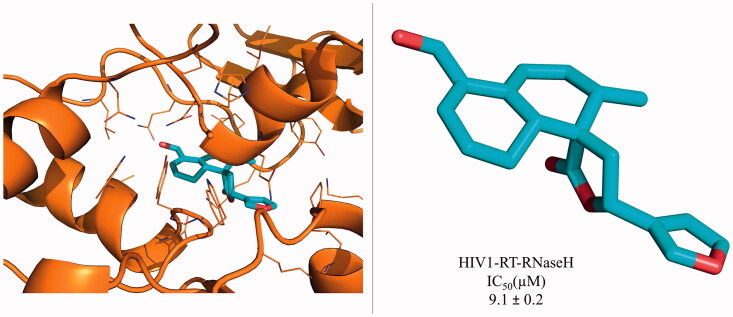
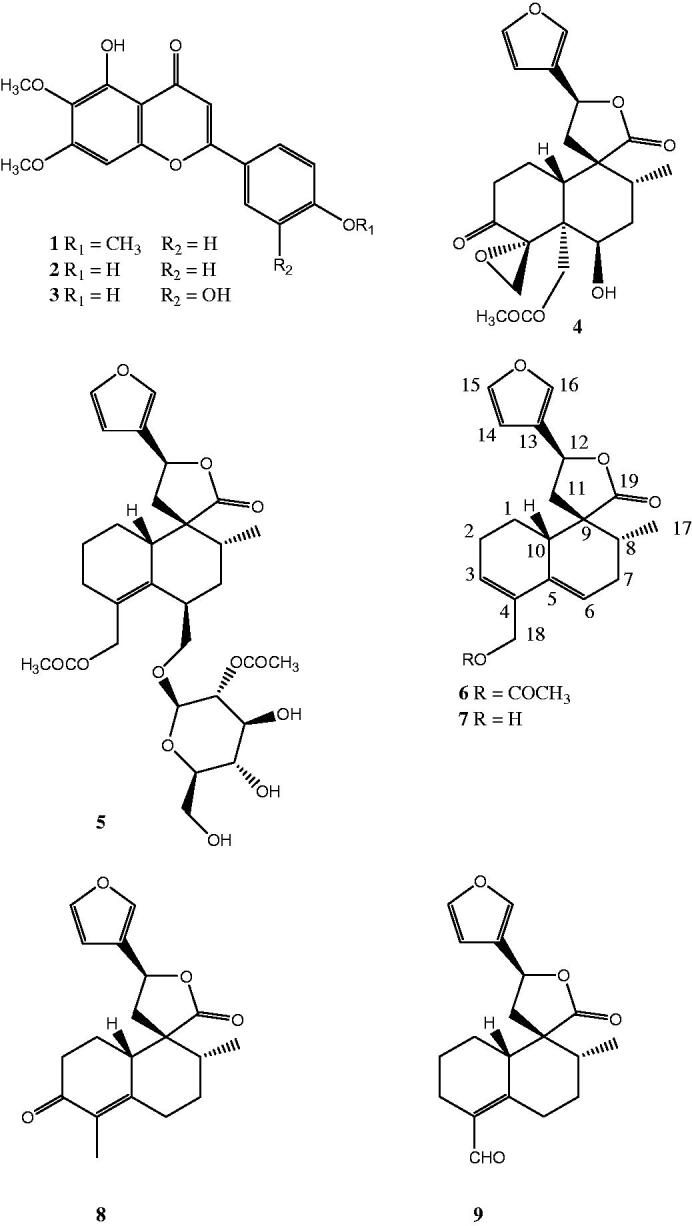
Bioassay-guided fractionation of the ethyl acetate extract from Teucrium flavum subsp. glaucum, endowed with inhibitory activity towards the HIV-1 reverse transcriptase–associated RNase H function, led to the isolation of salvigenin (1), cirsimaritin (2) and cirsiliol (3) along with the neo-clerodanes teuflavin (4) and teuflavoside (5). Acid hydrolysis of the inactive teuflavoside provided three undescribed neo-clerodanes, flavuglaucins A-C (7-9) and one known neo-clerodane (10). Among all neo-clerodanes, flavuglaucin B showed the highest inhibitory activity towards RNase H function with a IC50 value of 9.1 μM. Molecular modelling and site-directed mutagenesis analysis suggested that flavuglaucin B binds into an allosteric pocket close to RNase H catalytic site. This is the first report of clerodane diterpenoids endowed with anti-reverse transcriptase activity. Neo-clerodanes represent a valid scaffold for the development of a new class of HIV-1 RNase H inhibitors.
Overview
The claims and statistics of this paper haven’t been checked yet.
Free: it reads the open-access text and checks the first 5 claims that cite a source we can check. Create a free account to check every claim.
Integrity signals
Registry
Cites
Statistics
Figures
Verification
Claims the paper makes
The claims and statistics of this paper haven’t been checked yet.
Free: it reads the open-access text and checks the first 5 claims that cite a source we can check. Create a free account to check every claim.
Claims other papers make about this one
Each is checked against this paper’s own text: does it say what the citing paper says it does?
The check wasn’t confident either way, so it gives no verdict — never disputed.
In the citing paper
“Further, mutagenesis studies and hydrogen-exchange experiments indicate a long-range structural change at the RNH domain upon NNRTI interaction in the polymerase domain [102,104].”
From Retroviral RNase H: structure, mechanism, and inhibition (2021) · cites this paper as [104]
Experimental — accuracy not yet measured
Self-check
Percentages, sums and reported differences re-computed from the paper’s own numbers.
The self-check needs the paper’s full text.
Citations
Cites
Jorgensen, W. L., Maxwell, D. S., & Tirado-Rives, J. (1996) · Journal of the American Chemical Society · doi:10.1021/ja9621760 · Cited by 15,409
Mohamadi, F., Richards, N. G. J., Guida, W. C., Liskamp, R., Lipton, M., Caufield, C., Chang, G., Hendrickson, T., & Still, W. C. (1990) · Journal of Computational Chemistry · doi:10.1002/jcc.540110405 · Cited by 3,757
Semianalytical treatment of solvation for molecular mechanics and dynamics
Still, W. C., Tempczyk, A., Hawley, R. C., & Hendrickson, T. (1990) · Journal of the American Chemical Society · doi:10.1021/ja00172a038 · Cited by 3,643
Halgren, T. A. (1996) · Journal of Computational Chemistry · doi:10.1002/(sici)1096-987x(199604)17:5/6<520::aid-jcc2>3.0.co;2-w · Cited by 1,130
High resolution structures of HIV-1 RT from four RT–inhibitor complexes
Ren, J., Esnouf, R., Garman, E., Somers, D., Ross, C., Kirby, I., Keeling, J., Darby, G., Jones, Y., Stuart, D., et al. (1995) · Nature Structural & Molecular Biology · doi:10.1038/nsb0495-293 · Cited by 502
Gupta, R. K., Gregson, J., Parkin, N., Haile-Selassie, H., Tanuri, A., Andrade Forero, L., Kaleebu, P., Watera, C., Aghokeng, A., Mutenda, N., et al. (2018) · The Lancet Infectious Diseases · doi:10.1016/s1473-3099(17)30702-8 · Cited by 414 · cited 5×
“glaucum, endowed with inhibitory activity towards the HIV-1 reverse transcriptase–associated RNase H function, led to the isolation of salvigenin (1), cirsimaritin (2) and cirsiliol (3) along with the neo-clerodanes teuflavin (4) and teuflavoside (5).”
BackgroundMethodInfluentialAn improved force field (MM4) for saturated hydrocarbons
Allinger, N. L., Chen, K., & Lii, J.-H. (1996) · Journal of Computational Chemistry · doi:10.1002/(sici)1096-987x(199604)17:5/6<642::aid-jcc6>3.0.co;2-u · Cited by 366
Gregson, J., Tang, M., Ndembi, N., Hamers, R. L., Rhee, S.-Y., Marconi, V. C., Diero, L., Brooks, K. A., Theys, K., Rinke de Wit, T., et al. (2016) · The Lancet Infectious Diseases · doi:10.1016/s1473-3099(15)00536-8 · Cited by 267 · cited 6×
“Acid hydrolysis of the inactive teuflavoside provided three undescribed neo-clerodanes, flavuglaucins A-C (7-9) and one known neo-clerodane (10).”
BackgroundMethodInfluentialNovel approaches to inhibiting HIV-1 replication
Adamson, C. S., & Freed, E. O. (2010) · Antiviral Research · doi:10.1016/j.antiviral.2009.09.009 · Cited by 144 · cited 3×
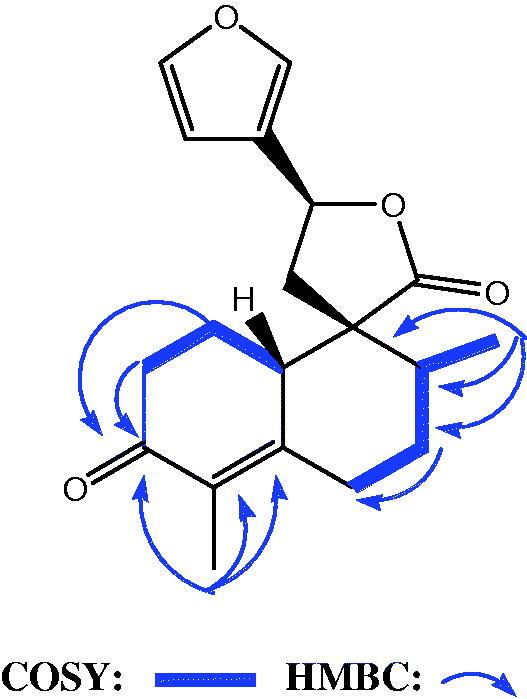
“Flavuglaucin C (8): amorphous solid; [a](20)D þ 38 (c 0.”
BackgroundHimmel, D. M., Sarafianos, S. G., Dharmasena, S., Hossain, M. M., McCoy-Simandle, K., Ilina, T., Clark, A. D., Knight, J. L., Julias, J. G., Clark, P. K., et al. (2006) · ACS Chemical Biology · doi:10.1021/cb600303y · Cited by 140
Vernekar, S. K. V., Liu, Z., Nagy, E., Miller, L., Kirby, K. A., Wilson, D. J., Kankanala, J., Sarafianos, S. G., Parniak, M. A., & Wang, Z. (2015) · Journal of Medicinal Chemistry · doi:10.1021/jm501132s · Cited by 137
Xu, L., Grandi, N., Vecchio, C. D., Mandas, D., Corona, A., Piano, D., Esposito, F., Parolin, C., & Tramontano, E. (2015) · The Journal of Microbiology · doi:10.1007/s12275-015-4652-0 · Cited by 92
Self-citationFifty Years in Search of Selective Antiviral Drugs
Clercq, E. D. (2019) · Journal of Medicinal Chemistry · doi:10.1021/acs.jmedchem.9b00175 · Cited by 91 · cited 2×
“TLC analysis of the crude product revealed different spots and, as consequence, the mixture was separated by column chromatography and semi-preparative HPLC (RP HPLC) to give one known (9) and three new (6–8) clerodane diterpenes (Figure 1).”
BackgroundAdvances toward Curing HIV-1 Infection in Tissue Reservoirs
Henderson, L. J., Reoma, L. B., Kovacs, J. A., & Nath, A. (2019) · Journal of Virology · doi:10.1128/jvi.00375-19 · Cited by 86 · cited 3×
“Indeed, removing the hydroxyl group from C-30 position of cirsiliol (3) lead to cirsimaritin (2) with a decrease in the activity of 10 folds.”
BackgroundCuzzucoli Crucitti, G., Métifiot, M., Pescatori, L., Messore, A., Madia, V. N., Pupo, G., Saccoliti, F., Scipione, L., Tortorella, S., Esposito, F., et al. (2015) · Journal of Medicinal Chemistry · doi:10.1021/jm501799k · Cited by 81
Self-citationCorona, A., Di Leva, F. S., Thierry, S., Pescatori, L., Cuzzucoli Crucitti, G., Subra, F., Delelis, O., Esposito, F., Rigogliuso, G., Costi, R., et al. (2014) · Antimicrobial Agents and Chemotherapy · doi:10.1128/aac.03605-14 · Cited by 68
Self-citationSonar, V. P., Corona, A., Distinto, S., Maccioni, E., Meleddu, R., Fois, B., Floris, C., Malpure, N. V., Alcaro, S., Tramontano, E., et al. (2017) · European Journal of Medicinal Chemistry · doi:10.1016/j.ejmech.2017.02.054 · Cited by 65
Self-citationDistinto, S., Esposito, F., Kirchmair, J., Cardia, M. C., Gaspari, M., Maccioni, E., Alcaro, S., Markt, P., Wolber, G., Zinzula, L., et al. (2012) · European Journal of Medicinal Chemistry · doi:10.1016/j.ejmech.2012.01.056 · Cited by 64
Self-citationThe Role of HIV-1 Drug-Resistant Minority Variants in Treatment Failure
Stella-Ascariz, N., Arribas, J. R., Paredes, R., & Li, J. Z. (2017) · The Journal of Infectious Diseases · doi:10.1093/infdis/jix430 · Cited by 62 · cited 3×
“The natural neoclerodanes teuflavin (4) and teuflavoside (5) resulted inactive up to the concentration of 100 mM.”
BackgroundMethodWendeler, M., Lee, H.-F., Bermingham, A., Miller, J. T., Chertov, O., Bona, M. K., Baichoo, N. S., Ehteshami, M., Beutler, J., O’Keefe, B. R., et al. (2008) · ACS Chemical Biology · doi:10.1021/cb8001039 · Cited by 59
Corona, A., Meleddu, R., Esposito, F., Distinto, S., Bianco, G., Masaoka, T., Maccioni, E., Menéndez-Arias, L., Alcaro, S., Le Grice, S. F. J., et al. (2016) · PLOS ONE · doi:10.1371/journal.pone.0147225 · Cited by 56
Self-citationVenditti, A., Frezza, C., Sciubba, F., Serafini, M., Bianco, A., Cianfaglione, K., Lupidi, G., Quassinti, L., Bramucci, M., & Maggi, F. (2018) · Industrial Crops and Products · doi:10.1016/j.indcrop.2018.03.056 · Cited by 56
Costi, R., Métifiot, M., Chung, S., Cuzzucoli Crucitti, G., Maddali, K., Pescatori, L., Messore, A., Madia, V. N., Pupo, G., Scipione, L., et al. (2014) · Journal of Medicinal Chemistry · doi:10.1021/jm5001503 · Cited by 55
Self-citationPescatori, L., Métifiot, M., Chung, S., Masoaka, T., Crucitti, G. C., Messore, A., Pupo, G., Madia, V. N., Saccoliti, F., Scipione, L., et al. (2015) · Journal of Medicinal Chemistry · doi:10.1021/acs.jmedchem.5b00159 · Cited by 53
Ribonuclease H, an unexploited target for antiviral intervention against HIV and hepatitis B virus
Tramontano, E., Corona, A., & Menéndez-Arias, L. (2019) · Antiviral Research · doi:10.1016/j.antiviral.2019.104613 · Cited by 53 · cited 1×
“Acid hydrolysis of the inactive teuflavoside provided three undescribed neo-clerodanes, flavuglaucins A-C (7-9) and one known neo-clerodane (10).”
BackgroundSelf-citationWang, X., Gao, P., Menendez-Arias, L., Liu, X., & Zhan, P. (2018) · Current Medicinal Chemistry · doi:10.2174/0929867324666170113110839 · Cited by 49
Corona, A., Leva, F. S. D., Rigogliuso, G., Pescatori, L., Madia, V. N., Subra, F., Delelis, O., Esposito, F., Cadeddu, M., Costi, R., et al. (2016) · Antiviral Research · doi:10.1016/j.antiviral.2016.09.008 · Cited by 45
Self-citationMessore, A., Corona, A., Madia, V. N., Saccoliti, F., Tudino, V., Leo, A. D., Scipione, L., Vita, D. D., Amendola, G., Maro, S. D., et al. (2020) · ACS Medicinal Chemistry Letters · doi:10.1021/acsmedchemlett.9b00617 · Cited by 43
Self-citationMolecular Aspects of the RT/drug Interactions. Perspective of Dual Inhibitors
Distinto, S., Maccioni, E., Meleddu, R., Corona, A., Alcaro, S., & Tramontano, E. (2013) · Current Pharmaceutical Design · doi:10.2174/1381612811319100009 · Cited by 42
Self-citationAwad, B. M., Habib, E. S., Ibrahim, A. K., Wanas, A. S., Radwan, M. M., Helal, M. A., ElSohly, M. A., & Ahmed, S. A. (2017) · Medicinal Chemistry Research · doi:10.1007/s00044-017-1918-6 · Cited by 36
Christen, M. T., Menon, L., Myshakina, N. S., Ahn, J., Parniak, M. A., & Ishima, R. (2012) · Chemical Biology & Drug Design · doi:10.1111/cbdd.12010 · Cited by 35
Esposito, F., Mandrone, M., Vecchio, C. D., Carli, I., Distinto, S., Corona, A., Lianza, M., Piano, D., Tacchini, M., Maccioni, E., et al. (2017) · Pathogens and Disease · doi:10.1093/femspd/ftx065 · Cited by 29
Self-citationOuyang, X., Wei, L., Pan, Y.-M., Huang, S.-W., Wang, H., Begonia, G. B., & Ekunwe, S. I. N. (2012) · Medicinal Chemistry Research · doi:10.1007/s00044-012-0113-z · Cited by 27
Corona, A., Schneider, A., Schweimer, K., ROSCH, P. J., Wöhrl, B. M., & Tramontano, E. (2014) · Antimicrobial Agents and Chemotherapy · doi:10.1128/aac.00056-14 · Cited by 27
Self-citationCombo of two HIV vaccines fails its big test
Cohen, J. (2020) · Science · doi:10.1126/science.367.6478.611 · Cited by 27 · cited 3×
“Indeed, removing the hydroxyl group from C-30 position of cirsiliol (3) lead to cirsimaritin (2) with a decrease in the activity of 10 folds.”
BackgroundA neo-clerodane glucoside and neo-clerodane diterpenoids from Teucrium flavum subsp. Glaucum
Savona, G., Piozzi, F., Servettaz, O., Rodríguez, B., Fernández‐Gadea, F., & Martín‐Lomas, M. (1984) · Phytochemistry · doi:10.1016/s0031-9422(00)85039-6 · Cited by 26
Meleddu, R., Cannas, V., Distinto, S., Sarais, G., Vecchio, C. D., Esposito, F., Bianco, G., Corona, A., Cottiglia, F., Alcaro, S., et al. (2014) · ChemMedChem · doi:10.1002/cmdc.201402015 · Cited by 26
Self-citationSchneider, A., Corona, A., Spöring, I., Jordan, M. A., Buchholz, B. M., Maccioni, E., Santo, R. D., Bodem, J., Tramontano, E., & Wöhrl, B. M. (2016) · Nucleic Acids Research · doi:10.1093/nar/gkw060 · Cited by 26 · cited 2×
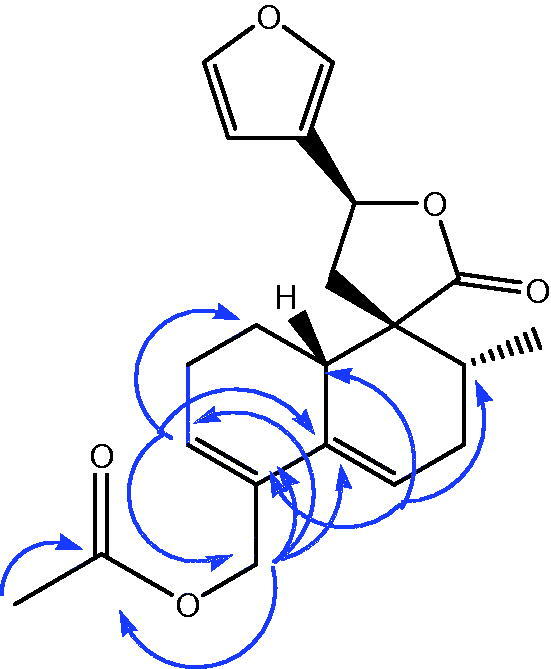
“Flavuglaucin A (6): amorphous solid; [a](20)D þ 48.”
BackgroundSelf-citationCorona, A., Ballana, E., Distinto, S., Rogolino, D., Vecchio, C. D., Carcelli, M., Badía, R., Riveira‐Muñoz, E., Esposito, F., Parolin, C., et al. (2020) · Viruses · doi:10.3390/v12070729 · Cited by 24
Self-citationChung, S., Miller, J. T., Johnson, B. C., Hughes, S. H., & Le Grice, S. F. J. (2012) · Journal of Biological Chemistry · doi:10.1074/jbc.m111.314781 · Cited by 23
Fois, B., Bianco, G., Sonar, V. P., Distinto, S., Maccioni, E., Meleddu, R., Melis, C., Marras, L., Pompei, R., Floris, C., et al. (2017) · Journal of Natural Products · doi:10.1021/acs.jnatprod.7b00648 · Cited by 23
Self-citationMassari, S., Corona, A., Distinto, S., Desantis, J., Caredda, A., Sabatini, S., Manfroni, G., Felicetti, T., Cecchetti, V., Pannecouque, C., et al. (2019) · Journal of Enzyme Inhibition and Medicinal Chemistry · doi:10.1080/14756366.2018.1523901 · Cited by 19
Self-citationInhibitory effects of flavonoids on human immunodeficiency virus type-I integrase
Tewtrakul, S., Miyashiro, H., Hattori, M., Yoshinaga, T., Fujiwara, T., Tomimori, T., Kizu, H., & Miyaichi, Y. (2001) · 和漢医薬学雑誌 · Cited by 18
Cited by
Retroviral RNase H: structure, mechanism, and inhibition
(2021) · The Enzymes · doi:10.1016/bs.enz.2021.07.007 · Cited by 13
Maccioni, A., Falconieri, D., Sanna, C., Porcedda, S., Piras, A., & Maxia, A. (2021) · Plants · doi:10.3390/plants10071359 · Cited by 12
“Recently, from the ethyl acetate extract obtained from Sardinian samples, several compounds with inhibitory activity towards the HIV-1 reverse transcriptase-associated RNase H function have been isolated [63].”
BackgroundGuzzo, F., Russo, R., Sanna, C., Celaj, O., Caredda, A., Corona, A., Tramontano, E., Fiorentino, A., Esposito, F., & D’Abrosca, B. (2021) · Molecules · doi:10.3390/molecules26164777 · Cited by 12
Self-citationAntiviral properties of diterpenes and their derivatives
Yarovaya, О. I., Laev, S. S., & Salakhutdinov, N. F. (2023) · Russian Chemical Reviews · doi:10.57634/rcr5056 · Cited by 11
Corona, A., Meleddu, R., Delelis, O., Subra, F., Cottiglia, F., Esposito, F., Distinto, S., Maccioni, E., & Tramontano, E. (2023) · Frontiers in Cellular and Infection Microbiology · doi:10.3389/fcimb.2023.1193280 · Cited by 5
“Allosteric inhibition of RNase H/RDDP has been described for scaffolds characterized by variously substituted aromatic portions linked by a functionalized spacer containing groups capable of donating or accepting hydrogen bonds, whether linear or made from heterocyclic rings (Distinto et al., 2013; Meleddu et al., 201…”
BackgroundSelf-citation
Metadata
- Authors
- Fois, B., Corona, A., Tramontano, E., Distinto, S., Maccioni, E., Meleddu, R., Caboni, P., Floris, C., & Cottiglia, F.
- Affiliations
- University of Cagliari (IT)
- Corresponding author
- Cottiglia, Filippo
- ORCID
- Venue
- Journal of Enzyme Inhibition and Medicinal Chemistry
- Publisher
- Informa UK Limited
- Published
- 2021-01-01
- Volume
- 36
- Issue
- 1
- Pages
- 749-757
- ISSN
- 1475-6366 (ISSN-L)
- 1475-6374
- PMC
- PMC7952052
- OpenAlex
- W3133994977
- Semantic Scholar
- f3a6b0e28bc8a3e7180ac1bc85776dc4928e35a1
- Cited by
- 7
- References
- 42
- Citations by year
- 2026: 1 · 2023: 2 · 2021: 4
- FWCI
- 0.47
- Type
- journal article
- Language
- en
- Open access
- gold
- doi.org
- Licence
- Locations
- Journal of Enzyme Inhibition and Medicinal Chemistry (publishedVersion, cc-by)
- PubMed Central (publishedVersion, cc-by)
- PubMed (publishedVersion)
- Figshare (submittedVersion, cc-by)
- DOAJ (DOAJ: Directory of Open Access Journals) (submittedVersion, cc-by-sa)
- UNICA IRIS Institutional Research Information System (University of Cagliari) (submittedVersion, other-oa)
- Figshare (cc-by)
- Topics
- Physical Sciences › Chemistry › Organic Chemistry › Bioactive Natural Diterpenoids Research
- Physical Sciences › Chemistry › Organic Chemistry › Biological Activity of Diterpenoids and Biflavonoids
- Life Sciences › Agricultural and Biological Sciences › Plant Science › Phytochemistry and Biological Activities
- Keywords
- neo-clerodane diterpenoids, HIV-1 reverse transcriptase, RNase H inhibition, salvigenin, cirsimaritin, cirsiliol, anti-HIV activity, allosteric binding, flavonoids, acid hydrolysis
- MeSH terms
- Dose-Response Relationship, Drug, Flavonoids, Hydrogen-Ion Concentration, Hydrolysis, Models, Molecular, Molecular Conformation, Plant Extracts, Structure-Activity Relationship, Mutagenesis, Site-Directed, Ribonuclease H, Reverse Transcriptase Inhibitors, Teucrium, Diterpenes, Clerodane, HIV Reverse Transcriptase
About these checks
Registry, retraction, Cites and statistics results are computed, not judged, with one exception: a printed reference that no index lists is read once by a model before it counts as a citation error. Claims are extracted by a model and kept only when their quote appears verbatim in the text; each cited source is then checked, with a model’s help, for whether it says what the claim relies on. Those verdicts can be wrong — read the claim’s quote and the cited source before relying on one.
Statistics and arithmetic are recomputed, not judged.
Confidence bands are shown only for fields calibrated on our annotated test set. None is calibrated yet, so no band is shown.
What counts as a claim ›How we measure confidence ›How we check this ›
Are you an author, or do you see a problem with this page? Request a review
Data sources
Bibliographic data: Semantic Scholar, OpenAlex, Crossref.
Contains information from the Semantic Scholar Academic Graph Datasets, made available under the ODC Attribution License (ODC-BY 1.0).
Semantic Scholar’s data is described in: Kinney, R., et al. (2023). The Semantic Scholar Open Data Platform. arXiv:2301.10140.
