

VERITAC-2: a Phase III study of vepdegestrant, a PROTAC ER degrader, versus fulvestrant in ER+/HER2- advanced breast cancer
Open accessThe DOI matches its Crossref record; 25 of the 25 references it cites were found in a registry or an index.
Abstract
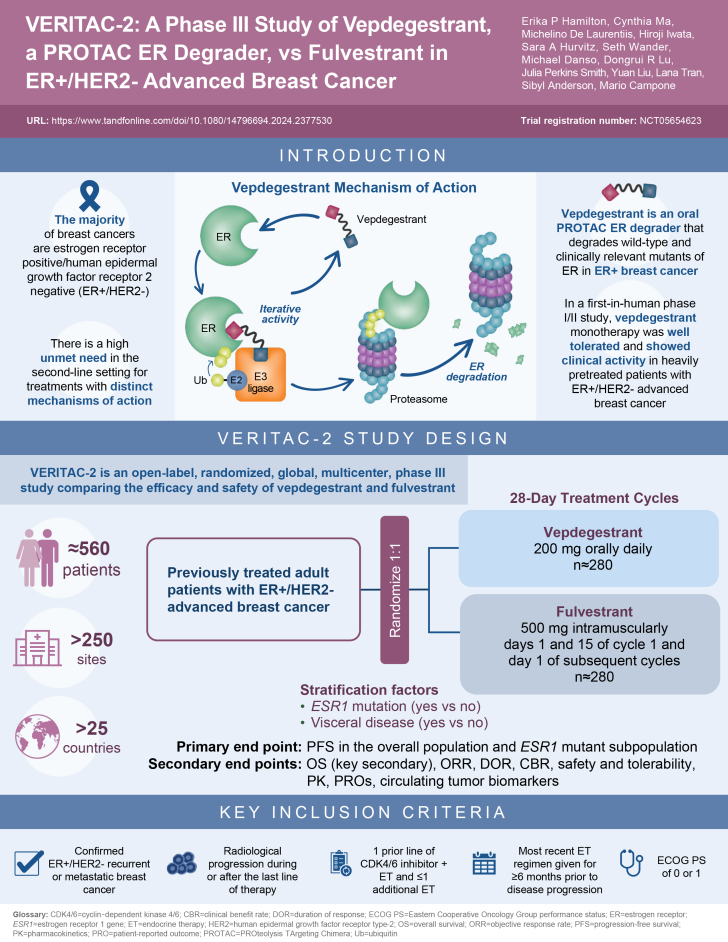
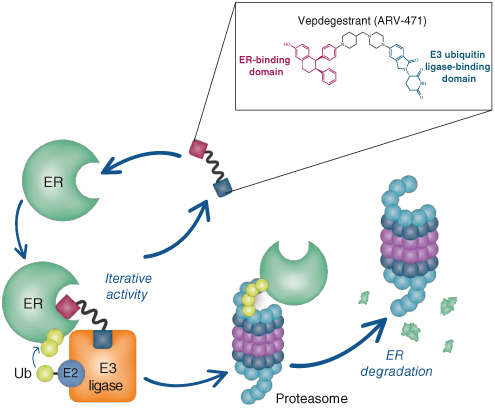
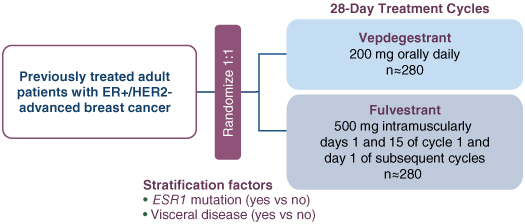
Vepdegestrant (ARV-471) is an oral PROTAC ER degrader that binds an E3 ubiquitin ligase and ER to directly trigger ubiquitination of ER and its subsequent proteasomal degradation. In a first-in-human Phase I/II study, vepdegestrant monotherapy was well tolerated with clinical activity in pretreated patients with ER+/HER2- advanced breast cancer. The global, randomized Phase III VERITAC-2 study compares efficacy and safety of vepdegestrant versus fulvestrant in adults with ER+/HER2- advanced breast cancer after treatment with a CDK4/6 inhibitor plus endocrine therapy. Progression-free survival by blinded independent central review (primary end point) will be assessed in the intention-to-treat population and ESR1 mutation-positive subpopulation. Secondary end points include overall survival, tumor response, safety, pharmacokinetics, patient-reported outcomes, and circulating tumor DNA biomarkers.Clinical trial registration: NCT05654623 (ClinicalTrials.gov)
Overview
The claims and statistics of this paper haven’t been checked yet.
Free: it reads the open-access text and checks the first 5 claims that cite a source we can check. Create a free account to check every claim.
Integrity signals
Registry
Cites
Statistics
Figures
Verification
Claims the paper makes
The claims and statistics of this paper haven’t been checked yet.
Free: it reads the open-access text and checks the first 5 claims that cite a source we can check. Create a free account to check every claim.
Claims other papers make about this one
Each is checked against this paper’s own text: does it say what the citing paper says it does?
The cited source says what the claim attributes to it.
In the citing paper
“A prime example that has reached the clinic is ARv-471, an estrogen receptor-targeting PROtAc, now in Phase iii trials for eR+ metastatic breast cancer (Nct05654623) (Hamilton et al. 2024).”
From From serendipity to strategy: molecular glue degraders in cancer therapeutics (2025) · cites this paper as Hamilton et al. 2024
Self-check
Percentages, sums and reported differences re-computed from the paper’s own numbers.
The self-check needs the paper’s full text.
Citations
Cites
PROTAC targeted protein degraders: the past is prologue
Békés, M., Langley, D. R., & Crews, C. M. (2022) · Nature Reviews Drug Discovery · doi:10.1038/s41573-021-00371-6 · Cited by 3,395 · cited 2×
“PROt eoly sis TArgeting Chimera (PROTAC) protein degraders are small molecules that harness the cell’s natural protein disposal machinery, the ubiquitin-prot easome sy st em, t o induc e deg radation of a target prot ein of int erest [ 24 , 25 ].”
BackgroundSakamoto, K. M., Kim, K. B., Kumagai, A., Mercurio, F., Crews, C. M., & Deshaies, R. J. (2001) · Proceedings of the National Academy of Sciences · doi:10.1073/pnas.141230798 · Cited by 2,609
3rd ESO–ESMO International Consensus Guidelines for Advanced Breast Cancer (ABC 3)
Cardoso, F., Costa, A., Senkus, E., Aapro, M., André, F., Barrios, C. H., Bergh, J., Bhattacharyya, G., Biganzoli, L., Cardoso, M. J., et al. (2017) · Annals of Oncology · doi:10.1093/annonc/mdw544 · Cited by 2,033
Gennari, A., André, F., Barrios, C. H., Cortés, J., de Azambuja, E., DeMichele, A., Dent, R., Fenlon, D., Gligorov, J., Hurvitz, S. A., et al. (2021) · Annals of Oncology · doi:10.1016/j.annonc.2021.09.019 · Cited by 1,417
Self-citation5th ESO-ESMO international consensus guidelines for advanced breast cancer (ABC 5)
Cardoso, F., Paluch-Shimon, S., Senkus, E., Curigliano, G., Aapro, M. S., André, F., Barrios, C. H., Bergh, J., Bhattacharyya, G. S., Biganzoli, L., et al. (2020) · Annals of Oncology · doi:10.1016/j.annonc.2020.09.010 · Cited by 1,369
Bidard, F.-C., Kaklamani, V. G., Neven, P., Streich, G., Montero, A. J., Forget, F., Mouret-Reynier, M.-A., Sohn, J. H., Taylor, D., Harnden, K. K., et al. (2022) · Journal of Clinical Oncology · doi:10.1200/jco.22.00338 · Cited by 777 · cited 1×
“SERDs pr imar ily immobilize ER in the cytoplasm limiting ER-directed gene transcription, and they have also been shown to indirectly lead to ER degradation secondary to conformational changes and/or immobilization of ER [ 13– 15 ].”
Wander, S. A., Cohen, O., Gong, X., Johnson, G. N., Buendia-Buendia, J. E., Lloyd, M. R., Kim, D., Luo, F., Mao, P., Helvie, K., et al. (2020) · Cancer Discovery · doi:10.1158/2159-8290.cd-19-1390 · Cited by 429
Self-citationBrett, J. O., Spring, L. M., Bardia, A., & Wander, S. A. (2021) · Breast Cancer Research · doi:10.1186/s13058-021-01462-3 · Cited by 414
Self-citationFulvestrant: an oestrogen receptor antagonist with a novel mechanism of action
Osborne, C. K., Wakeling, A., & Nicholson, R. I. (2004) · British Journal of Cancer · doi:10.1038/sj.bjc.6601629 · Cited by 414
Rugo, H. S., Lerebours, F., Ciruelos, E., Drullinsky, P., Ruiz-Borrego, M., Neven, P., Park, Y. H., Prat, A., Bachelot, T., Juric, D., et al. (2021) · The Lancet Oncology · doi:10.1016/s1470-2045(21)00034-6 · Cited by 345
Research works printed but not linked: 2
- Hurvitz SA, Schott AF, Ma C, et al. Updated results from VERITAC evaluating vepdegestrant, a PROteolysis TArgeting Chimera (PROTAC) estrogen receptor (ER) degrader, in ER-positive/human epidermal growth factor receptor 2 (HER2)-negative advanced breast cancer. Oral presentation at: San Antonio Breast Cancer Symposium. San Antonio, TX; 2023 December 5–9; Presentation PO3-05-08. •• Updated results from the VERITAC Phase II expansion cohort of the first-in-human Phase I/II of vepdegestrant.
- Hamilton EP, Jeselsohn R, Hurvitz SA, et al. Vepdegestrant, a PROteolysis TArgeting Chimera (PROTAC) estrogen receptor degrader, plus palbociclib in estrogen receptor-positive/human epidermal growth factor receptor 2-negative advanced breast cancer: Phase IB cohort. Oral presentation at: San Antonio Breast Cancer Symposium. San Antonio, TX; 2023 December 5–9; Presentation PS15-03.
Cited by
Targeted protein degradation for cancer therapy
Hinterndorfer, M., Spiteri, V. A., Ciulli, A., & Winter, G. E. (2025) · Nature Reviews Cancer · doi:10.1038/s41568-025-00817-8 · Cited by 210
Vepdegestrant, a PROTAC Estrogen Receptor Degrader, in Advanced Breast Cancer
Campone, M., De Laurentiis, M., Jhaveri, K., Hu, X., Ladoire, S., Patsouris, A., Zamagni, C., Cui, J., Cazzaniga, M., Cil, T., et al. (2025) · New England Journal of Medicine · doi:10.1056/nejmoa2505725 · Cited by 161
Self-citationTargeting ubiquitination in disease and therapy
Yang, X., Lan, T., Zhang, B., Tao, X., Qi, W., Xie, K., Cai, Y., Liu, C., Han, J., & Wu, H. M. (2025) · Signal Transduction and Targeted Therapy · doi:10.1038/s41392-025-02392-8 · Cited by 70
Lessons learned in linking PROTACs from discovery to the clinic
Pike, A., Lee, E. C. Y., Michaelides, I. N., Schade, M., Sharma, A., Scott, J. S., & Srivastava, A. (2025) · Nature Reviews Chemistry · doi:10.1038/s41570-025-00784-6 · Cited by 66
“In the case of the ER-targeting PROTAC ARV-471 , the phase III dose (200 mg once-daily 71 ) is greater than that of the selective ER modulator tamoxifen (typically 20–40 mg once-daily 72 ).”
Proteolysis‐Targeting Chimera (PROTAC): Current Applications and Future Directions
Fan, G., Chen, S., Zhang, Q., Yu, N., Shen, Z., Liu, Z., Guo, W., Tang, Z., Yang, J., & Liu, M. (2025) · MedComm · doi:10.1002/mco2.70401 · Cited by 62
“Representative molecule ARV-471 has entered Phase III clinical trials [181], demonstrating promising oral pharmacokinetics and degradation activity.”
InfluentialUnleashing the Power of Covalent Drugs for Protein Degradation
Fu, M., Jin, H., Wang, S., Shen, L., Liu, H., Liu, Y., Zheng, Y., & Dai, X. (2025) · Medicinal Research Reviews · doi:10.1002/med.22101 · Cited by 34
Self-citationRej, R. K., Hu, B., Chen, Z., Acharyya, R. K., Wu, D., Metwally, H., McEachern, D., Wang, Y., Jiang, W., Bai, L., et al. (2024) · Journal of Medicinal Chemistry · doi:10.1021/acs.jmedchem.4c01401 · Cited by 28
Acharyya, R. K., Rej, R. K., Hu, B., Chen, Z., Wu, D., Lü, J., Metwally, H., McEachern, D., Wang, Y., Jiang, W., et al. (2024) · Journal of Medicinal Chemistry · doi:10.1021/acs.jmedchem.4c01521 · Cited by 24
Hamilton, E. P., Jeselsohn, R. M., Vahdat, L. T., & Hurvitz, S. A. (2025) · Targeted Oncology · doi:10.1007/s11523-025-01137-5 · Cited by 32
Self-citationAnaya, Y. A., Barragan, M., Bracho, R. P., Shaham, S. H., Bandyopadhyay, D., George, E., Nguyen, D. D. T., & Tripathi, M. K. (2025) · Cancer · doi:10.1002/cncr.70132 · Cited by 30
“3 provides details of the PROTAC molecules, 18–20”
The Peptide PROTAC Modality: A New Strategy for Drug Discovery
Zhu, Y., Dai, Y., & Tian, Y. (2025) · MedComm · doi:10.1002/mco2.70133 · Cited by 27
Strategies to Overcome Resistance to Osimertinib in EGFR-Mutated Lung Cancer
Romaniello, D., Morselli, A., & Marrocco, I. (2025) · International Journal of Molecular Sciences · doi:10.3390/ijms26072957 · Cited by 24
“For instance, the ER degrader vepdegestrant showed clinical activity and a safety profile in a phase 1/2 study, and it is currently under clinical evaluation in the VERITAC-2 phase 3 trial in pretreated patients with ER+/HER2-advanced breast cancer [126].”
Nuclear receptors in metabolism and diseases: Mechanistic and therapeutic insights
Zhu, C.-Y., Yu, P., Sun, Q., Hong, D., Yang, C., & Naranmandura, H. (2025) · Pharmacological Research · doi:10.1016/j.phrs.2025.107862 · Cited by 19
Saha, T., & Lukong, K. E. (2025) · Frontiers in Oncology · doi:10.3389/fonc.2025.1513225 · Cited by 23
Weldert, A. C., Frey, A. F., Krone, M. W., Krähe, F., Kuhn, H., Kersten, C., & Barthels, F. (2025) · RSC Medicinal Chemistry · doi:10.1039/d5md00359h · Cited by 18
Pogash, S., & Fletcher, S. (2025) · RSC Medicinal Chemistry · doi:10.1039/d5md00095e · Cited by 19
Tang, C., Tian, B., Zhang, B., Zhang, Y., Ke, C., Chen, M., Wei, M., Wang, W., Deng, X., Zhang, Q., et al. (2026) · ChemMedChem · doi:10.1002/cmdc.202501111 · Cited by 16
“By virtue of its PROTAC mechanism, vepdegestrant offers several advantages over conventional ER-directed agents such as tamoxifen (a SERM) and fulvestrant (a SERD) [38].”
Current Therapeutic Opportunities for Estrogen Receptor Mutant Breast Cancer
Palaniappan, M. (2024) · Biomedicines · doi:10.3390/biomedicines12122700 · Cited by 15
Sandhof, C. A., Murray, H. F. B., Silva, M. C., & Haggarty, S. J. (2024) · Neurotherapeutics · doi:10.1016/j.neurot.2024.e00499 · Cited by 14
Recent advances in PROTAC-based antiviral and antibacterial therapeutics
Zhou, C., Yang, S., Wang, J. J., Pan, W., Yao, H., Li, G., & Niu, M. (2025) · Bioorganic Chemistry · doi:10.1016/j.bioorg.2025.108437 · Cited by 13
Advancing target validation with PROTAC technology
Spitz, M. L., Kashkush, A., & Benhamou, R. I. (2025) · Expert Opinion on Drug Discovery · doi:10.1080/17460441.2025.2490248 · Cited by 14
“From its initial introduction less than 25 years ago to the first clinical trials in 2019, PROTACs have shown major clinical successes in a relatively short time frame [5,17].”
Kuriyama, M., Wang, C. F., Nagase, T., Sohma, Y., Kanai, M., Hori, Y., & Tomita, T. (2025) · Neurotherapeutics · doi:10.1016/j.neurot.2025.e00548 · Cited by 12
From serendipity to strategy: molecular glue degraders in cancer therapeutics
Darling, S., Bajrami, I., & West, S. C. (2025) · Critical Reviews in Biochemistry and Molecular Biology · doi:10.1080/10409238.2025.2564068 · Cited by 9
“…has reached the clinic is ARv-471, an estrogen receptor-targeting PROtAc, now in Phase iii trials for eR+ metastatic breast cancer (Nct05654623) (Hamilton et al. 2024). the versatility of cRl4 cRBN , combined with novel celMoD compounds, positions cRBN as a master effector in targeted protein…”
An update on promising and emerging protein kinase B/AKT inhibitors for breast cancer
Asnaghi, R., Antonarelli, G., Battaiotto, E., Castellano, G., Guidi, L., Izzo, D., Zagami, P., Trapani, D., & Curigliano, G. (2025) · Expert Opinion on Pharmacotherapy · doi:10.1080/14656566.2025.2454290 · Cited by 12
“In a preclinical study, the oral ER-directed PROTAC Vepdegestrant (ARV-471) [92] showed greater in vivo ER degradation (≥90”
Lu, X., Sabbasani, V. R., Hassan, B. A., Swenson, R. E., & Walters, K. J. (2025) · Journal of Biological Chemistry · doi:10.1016/j.jbc.2025.108520 · Cited by 10
Yang, D. Z., Zhou, L., Winton, J. A., Matschke, K. T., Kantaridis, C., Doyle, K., Lee, K. C., Chen, N., Zhang, Y., & Tan, W. (2025) · British Journal of Clinical Pharmacology · doi:10.1002/bcp.70198 · Cited by 10
Nafie, M. S., Diab, M. K., Yassen, A. S. A., Elshamy, A. M., Tohamy, M. R. E., Tawfik, H. O., & Fahmy, S. A. (2025) · Drug Development Research · doi:10.1002/ddr.70192 · Cited by 10
Inganäs, E., Lavén, H., Caraballo, R., Klingegård, F., Eklund, M., Andersson, L., Hilgendorf, C., & Matsson, P. (2025) · Journal of Medicinal Chemistry · doi:10.1021/acs.jmedchem.5c01499 · Cited by 9
Tran, L., Winton, J. A., Matschke, K. T., Stouffs, A., Lee, K. C., Zhang, Y., & Tan, W. (2026) · Clinical Therapeutics · doi:10.1016/j.clinthera.2025.12.007 · Cited by 9
Self-citationHe, Y., Liao, T., Wang, X., Xiao, Q. H., Wang, H., He, R. R., Zhao, C., Tian, X., Gao, Q., & Hao, L. (2025) · Bioorganic Chemistry · doi:10.1016/j.bioorg.2025.108846 · Cited by 13
Bazzacco, A., Mercorelli, B., & Loregian, A. (2025) · FEMS Microbiology Reviews · doi:10.1093/femsre/fuaf046 · Cited by 14
PROTAC delivery systems: Innovative approaches for cancer treatment
Arenas-Moreira, M., Ocaña, A., Bravo, I., & Alonso‐Moreno, C. (2025) · Biomedicine & Pharmacotherapy · doi:10.1016/j.biopha.2025.118892 · Cited by 11
Buonaiuto, R., Botticelli, A., Criscitiello, C., Dieci, M. V., Fusco, N., Gerratana, L., Lambertini, M., Malapelle, U., Malorni, L., & Angelis, C. D. (2025) · Cancer Treatment Reviews · doi:10.1016/j.ctrv.2025.102972 · Cited by 8
Montisci, F., Friggeri, L., Burusco, K. K., McCabe, P., Popovic, B., & Cole, J. C. (2025) · Journal of Chemical Information and Modeling · doi:10.1021/acs.jcim.5c00880 · Cited by 7
Narvaez, D. P., & Cescon, D. W. (2025) · International Journal of Molecular Sciences · doi:10.3390/ijms262110366 · Cited by 7
Güren, A. K., Kırcalı, M. F., Köstek, O., & Demircan, N. C. (2025) · Expert Review of Anticancer Therapy · doi:10.1080/14737140.2025.2593540 · Cited by 11
“In the ESR1-mutant subgroup, median PFS was 5 months with vepde-gestrant and 2.1 months with fulvestrant (HR = 0.57, 95% CI 0.42–0.77, p 0.001) [28].”
InfluentialTargeting pregnane X receptor with a potent agonist-based PROTAC to delay colon cancer relapse
Bansard, L., Laconde, G., Delfosse, V., Huet, T., Ayeul, M., Rigal, É., Donati, Q., Gerbal‐Chaloin, S., Daujat‐Chavanieu, M., Brunel, L., et al. (2025) · Oncogenesis · doi:10.1038/s41389-025-00573-2 · Cited by 8
“Synthesis procedure of compound JMV7048 is illustrated in Scheme S1.”
Opportunities and challenges of PROTAC in the treatment of protein-driven diseases
Zhou, Z., Liu, P., Li, Y., Liu, X., & Li, J. (2026) · Results in Chemistry · doi:10.1016/j.rechem.2026.103234 · Cited by 8
Matsuhisa, K., Sato, S., & Kaneko, M. (2025) · Biomedicines · doi:10.3390/biomedicines13040854 · Cited by 6
“A phase III clinical trial is currently in progress [106].”
Recent advances in degraders engaging lysosomal pathways and related nanomedicine
Lu, R., Ni, X., Diao, S., Wu, Y., & Zhang, L. (2025) · European Journal of Medicinal Chemistry · doi:10.1016/j.ejmech.2025.117701 · Cited by 6
Boosting bioavailability of PROTACs for ovarian cancer: From chemistry to clinical translation
Rejili, M. S., Hussain, M. S., Haouala, F., Khan, Y., Maqbool, M., & Gupta, G. (2025) · Bioorganic Chemistry · doi:10.1016/j.bioorg.2025.109097 · Cited by 6
Vepdegestrant for the treatment of HR+/HER2– breast cancer
Mukohara, T. (2025) · Expert Opinion on Pharmacotherapy · doi:10.1080/14656566.2025.2488456 · Cited by 5
“…in patients with ER+/HER2– advanced breast cancer in the 2 nd / 3 rd -line setting; patients must have had one line of prior treatment with a CDK4/6i in combination with ET and no more than one additional line of ET wherein the most recent ET was given for ≥6 months before disease progression [33].”
InfluentialTargeted protein degradation: species, diseases and efficient utilization
Yue, T., He, J., & Hou, J. (2025) · Journal of Translational Medicine · doi:10.1186/s12967-025-07610-z · Cited by 5
“Notably, it demonstrated a manageable safety profile, with most treatment-related adverse events (TRAEs) being Grade 1/2, Grade ≥ 3 TRAEs occurred in 23.4%, and discontinuation due to TRAEs was only 2.9% [118].”
InfluentialThomas, S. R., Iellici, T., Park, M., Klaus, E., Bileck, A., Gerner, C., Meier, S. M., & Casini, A. (2026) · ACS Chemical Biology · doi:10.1021/acschembio.5c00860 · Cited by 5
Kirmani, N., Fernández, N. D. L., Rodriguez-Parra, J. D., Ghanem, L., Hakkeem, B., Briceño-Morales, C., & Briceño-Morales, X. (2026) · Cancer Treatment Reviews · doi:10.1016/j.ctrv.2026.103093 · Cited by 6
Wang, H. F., Winton, J. A., Matschke, K. T., Stouffs, A., Lee, K. C., Zhang, Y., Qiao, W., & Tan, W. (2026) · British Journal of Clinical Pharmacology · doi:10.1002/bcp.70482 · Cited by 6
Beyond CDK4/6 Inhibition: Current Strategies in Hormone Receptor-Positive Metastatic Breast Cancer
Çetin, B., Erdem, D., Karaman, İ., & Gümüşay, Ö. (2026) · Current Treatment Options in Oncology · doi:10.1007/s11864-026-01391-3 · Cited by 4
“Vepdegestrant (ARV-471), an oral PROTAC ER degrader, directly binds both E3 ubiquitin ligase and the ER to trigger ubiquitination of ER and its subsequent proteasomal degradation [ 29, 30].”
Palbociclib as an Antitumor Drug: A License to Kill
Łupicka‐Słowik, A., Cossu, F., & Sieńczyk, M. (2024) · Molecules · doi:10.3390/molecules29225334 · Cited by 6
“There is currently an ongoing VERITAC-2 phase III clinical trial (ClinicalTrials.gov ID: NCT05654623, Pfizer), which is intended to indicate the effectiveness of vepdegestrant versus fulvestrant in people with metastatic breast cancer who were previously treated with endocrine-based therapy [121].”
Hanl, M., Feller, F., Honin, I., Tan, K., Miranda, M., Schäker‐Hübner, L., Bückreiß, N., Schiedel, M., Gütschow, M., Bendas, G., et al. (2025) · ACS Pharmacology & Translational Science · doi:10.1021/acsptsci.5c00247 · Cited by 5
Incidence of ESR1 gene mutations among patients with endometrioid endometrial cancer
Jang, M., Dagher, C., Gysler, S., Ko, E. M., Giuntoli, R. L., Martin, L. P., Kim, S. H., & Nasioudis, D. (2025) · International Journal of Gynecological Cancer · doi:10.1016/j.ijgc.2025.102816 · Cited by 3
Development of Prostate-Specific Lysosome-Targeting Degraders
Cai, D., Chen, X., Zhou, Y., Idrissou, M. B., Hernandez, R. T., & Tang, W. (2026) · Journal of the American Chemical Society · doi:10.1021/jacs.5c18594 · Cited by 3
PROTAC technology: clinical applications, future challenges, and innovative strategies
Liu, F., Zhang, Y., Xu, Y., & Xishan, W. (2026) · Bioorganic Chemistry · doi:10.1016/j.bioorg.2026.110045 · Cited by 4
Advancing PROTAC therapeutics through chemistry-guided design of smart delivery systems
Yao, T., Zhou, Z., Wang, G., Zhu, Z., & Li, X.-N. (2026) · Acta Pharmacologica Sinica · doi:10.1038/s41401-026-01853-2 · Cited by 6
Targeted delivery of proteolysis-targeting chimeras (PROTAC) and molecular glue degraders (MGD)
Banerjee, M., Detappe, A., & Lammers, T. (2026) · Advanced Drug Delivery Reviews · doi:10.1016/j.addr.2026.115922 · Cited by 4
PROTACs in cancer immunotherapy: a minireview
Köckenberger, J., Cárdenas, S., T., C. E., Gutkind, J. S., & Ferguson, F. M. (2025) · Biochemical Society Transactions · doi:10.1042/bst20253065 · Cited by 5
Opposing roles of YY1 and RKIP in cancer progression and therapy resistance
Rigopoulos, C. P., Baritaki, S., Georgakopoulos‐Soares, I., Bonavida, B., & Zaravinos, A. (2025) · Biochimica et Biophysica Acta (BBA) - Reviews on Cancer · doi:10.1016/j.bbcan.2025.189488 · Cited by 4
Targeted protein degradation as a novel therapeutic strategy against infectious diseases
Birkholtz, L., Olivier, T., Welcome, T., & Strauss, E. (2026) · Current Opinion in Chemical Biology · doi:10.1016/j.cbpa.2026.102655 · Cited by 2
Rodrigues, L. L. C., Silveira, L. D. H. J., de Almeida, L. F. C., Freitas, B. G., Filho, V. O. C., Noronha, M. M., Yabrude, A. T. Z., Morales, R. G., de Melo, A. C., da Silva, J. L., et al. (2026) · Breast Cancer Research and Treatment · doi:10.1007/s10549-026-07962-0 · Cited by 2
Rugo, H. S., Curigliano, G., Cescon, D. W., Penault-Llorca, F. M., Harbeck, N., Im, S., Park, Y. H., Barrios, C., Modi, S., Tolaney, S. M., et al. (2026) · The Breast · doi:10.1016/j.breast.2026.104831 · Cited by 2
Sato, S., Matsukawa, M., Takemoto, M., Okamoto, T., Saito, A., Omura, I., Matsuhisa, K., Ikeda, H., Imaizumi, K., & Kaneko, M. (2025) · Biochemical and Biophysical Research Communications · doi:10.1016/j.bbrc.2025.151370 · Cited by 2
Emerging pharmacology of targeted protein degraders
Barghout, S. H., & Eldeeb, M. A. (2025) · Journal of Pharmacology and Experimental Therapeutics · doi:10.1016/j.jpet.2025.103694 · Cited by 2
Computational approaches to aid PROTAC drug discovery
Chakraborti, S., & McAulay, K. (2025) · Elsevier eBooks · doi:10.1016/b978-0-443-29808-0.00004-2 · Cited by 2
Transcription factor degraders
Wang, M., Wei, Y., & Ma, X. (2025) · Elsevier eBooks · doi:10.1016/b978-0-443-21816-3.00006-3 · Cited by 1
PROTACs and Glues: Striking Perspectives for Engineering Cancer Therapy À La Carte
Ferrero, J.-M., Gal, J., Mograbi, B., & Milano, G. A. (2025) · Pharmaceuticals · doi:10.3390/ph18091397 · Cited by 3
“The domain of PROTACs and glues is potentially well-suited to addressing this unmet need, and drugs representative of this therapeutic class are nearing market release [24,25].”
Nuclear receptors as therapeutic targets in metabolic and cardiovascular disorders
Li, F., Chen, Q., Dai, Y., & Lu, L. (2025) · iScience · doi:10.1016/j.isci.2025.114042 · Cited by 1
Photocleavable PROTACs as tools for dynamic regulation of protein function
Xu, H., Yokoo, H., & Demizu, Y. (2025) · Bioorganic & Medicinal Chemistry · doi:10.1016/j.bmc.2025.118491 · Cited by 1
Sculpting Cell Fate: The Expanding Universe of Nondegradative Proximity‐Inducing Tools
Xiao, H., Wang, L., Chen, M., Zhen, T., Chen, Y., & Sun, H. (2026) · ChemMedChem · doi:10.1002/cmdc.202501088 · Cited by 2
“This agent is intended to treat patients with ESR1-mutated, estrogen receptor (ER)-positive, HER2-negative (ER + /HER2 − ) advanced or metastatic breast cancer [5].”
Liu, J.-Y., Quan, Y., Wang, Y.-L., Nie, W.-Z., Cui, C.-M., Zhao, B., Cui, N.-N., Lian, Q.-B., Li, G., & Shen, Q. (2026) · European Journal of Medicinal Chemistry · doi:10.1016/j.ejmech.2026.118697 · Cited by 2
Wang, B., Li, Y., Yao, T., Shen, X., Li, H., Jiang, W., Li, X., & Zhu, Z. (2026) · RSC Medicinal Chemistry · doi:10.1039/d5md00963d · Cited by 3
Huang, Q., Mu, Q., Liu, N., Liu, G., & Liu, C. (2026) · Advanced Interventional Materials · doi:10.1016/j.advim.2026.100015 · Cited by 4
The Multifaceted Legacy of Thalidomide: Chemistry and Biology Driving Modern Drug Design
Nikovia, K., Kapsalis, M., Georgoulakis, M., Panousis, A., & Neochoritis, C. G. (2026) · ChemMedChem · doi:10.1002/cmdc.202501105 · Cited by 3
Bellerophon: An Automated Tool for PROTAC Decomposition
Apprato, G., Bertola, M., LOCATELLI, A., Caron, G., Mauri, A., & Ermondi, G. (2026) · ACS Medicinal Chemistry Letters · doi:10.1021/acsmedchemlett.5c00769 · Cited by 1
Sweileh, M. W. (2026) · Journal of Cancer Research and Clinical Oncology · doi:10.1007/s00432-026-06482-0 · Cited by 1
“At the same time, the presence of medicine/ oncology subject area indicates that TPD research is moving toward translational applications (Berkley et al. 2025; Hamilton et al. 2025, 2024; Cai et al. 2025).”
Targeting ERα Coregulator Networks to Overcome Endocrine Resistance in ER + Breast Cancer
Bar, M., Widłak, W., & Vydra, N. (2026) · International Journal of Cancer · doi:10.1002/ijc.70522 · Cited by 2
“The ongoing Phase III VERITAC-2 trial (NCT05654623) is comparing it with fulves-trant, with early data indicating favorable efficacy, particularly in patients with ESR1 mutations [58, 59].”
Mao, H., Zhang, Y., Liu, M., Yao, Y., Peng, Y., Zhou, X., Huang, H., Fei, W., Zheng, C., & Ye, Y. (2026) · Drug Delivery · doi:10.1080/10717544.2026.2679844 · Cited by 2
Tran, L., Chen, N., Winton, J. A., Matschke, K. T., Goodman, S. P., Lee, K. S., Zhang, Y., & Tan, W. (2026) · British Journal of Clinical Pharmacology · doi:10.1002/bcp.70636 · Cited by 1
Self-citationMaurya, A. K., Padrela, L., Agrawal, A. K., Kumar, A., & Kumar, D. M. (2026) · Expert Opinion on Drug Delivery · doi:10.1080/17425247.2026.2697992 · Cited by 2
“Vepdegestrant is also being evaluated in conjunction with abemaciclib, ribociclib, everolimus, samuracicilib and Pfizer’s investigational novel CDK4 inhibitor, PF-07220060 [157].”
Qin, S., Peng, R., Zhang, G., Yan, S., Xiao, J., Liu, Z., Tan, Z., Xie, Q., Li, S., Luo, W., et al. (2026) · Smart Molecules · doi:10.1002/smo2.70089 · Cited by 2
Hanl, M., Feller, F., Honin, I., Tan, K., Miranda, M., Schäker-Hübner, L., Bückreiß, N., Schiedel, M., Gütschow, M., Bendas, G., et al. (2025) · bioRxiv (Cold Spring Harbor Laboratory) · doi:10.1101/2025.03.31.646177
Targeted Protein Degradation of Metalloenzymes
O’Herin, C., & Cohen, S. M. (2025) · Wiley eBooks · doi:10.1002/0471266949.bmc303
Role and therapeutic potential of the NEDD4 family in breast cancer
Zhang, X., & Li, S. (2025) · Frontiers in Pharmacology · doi:10.3389/fphar.2025.1587675
Degraders of proteins involved in transcription nuclear hormone receptors
Luan, X., & Wu, Y. (2025) · Elsevier eBooks · doi:10.1016/b978-0-443-21816-3.00005-1
Rajan, T., & Akhade, A. (2025) · Indian Journal of Medical and Paediatric Oncology · doi:10.1055/s-0045-1810005
“15 In the ESR1-mutant subgroup, vepdegestrant improved PFS (5.0 vs. 2.1 months; HR: 0.58; p < 0.001), but the overall population did not meet signi fi cance (HR: 0.83; p ¼ 0.07).”
InfluentialLapuk, A. V., Furman, B. L. S., Feijão, P., Baran, E., Brahmbhatt, S., Chan, B., Nip, K. M., Kense, A., Murphy, B., Miller, R., et al. (2025) · Current Oncology · doi:10.3390/curroncol33010018
“Other SERDs are currently being investigated in clinical trials [53], with LBx-based ESR1 testing serving as a valuable tool to guide treatment [54].”
Strategic Treatment Sequencing and Novel Approaches in 2L+ ER+/HER2- Metastatic Breast Cancer
Scott, B. (2026) · EMJ Oncology · doi:10.33590/emjoncol/gfwm9676
Mahtani, R. L., Korytowsky, B., Rose, C. G., Jakobsson, M., Cappelleri, J., Lewis, K., Lambert, A., Hammond, C., & Criscitiello, C. (2026) · The Breast · doi:10.1016/j.breast.2026.104732 · Cited by 1
Advances in protein ubiquitination modification and immune evasion of breast cancer
Wu, Y., Jin, J., Cheng, X., Fu, Z., & Xie, H. (2026) · Frontiers in Cell and Developmental Biology · doi:10.3389/fcell.2026.1795272
“In a phase I/II clinical trial, the single-agent treatment with ARV-471 showed good tolerability and promising anti-tumor activity, especially in the ER+/HER2− advanced BC patients who had received prior CDK4/6 inhibitor and endocrine therapy (Hamilton et al., 2024).”
Wang, X., Song, J., Zhao, Y., Li, W., Li, J., Xu, X., Liu, W., Tao, F., & Xu, Y. (2026) · Pharmacological Research · doi:10.1016/j.phrs.2026.108239 · Cited by 3
Peng, X., Hossain, A., Ma, P., Guo, S., Mottamal, M., Zhang, C., 郑时龙, Kang, B., & Wang, G. (2026) · European Journal of Medicinal Chemistry · doi:10.1016/j.ejmech.2026.118956
Proteolysis targeting chimeras (PROTAC) for targeting Alzheimer’s disease
Singh, A., Rani, A., & Mazumder, A. (2026) · Discover Neuroscience · doi:10.1186/s13064-026-00276-3 · Cited by 1
Microneedle‐Assisted Systems for the Delivery of Proteolysis Targeting Chimeras (PROTACs)
Tiwary, P., Oswal, K., Shirke, A., Maithania, H. V., Varghese, R., & Vora, L. K. (2026) · Advanced Therapeutics · doi:10.1002/adtp.70158
“…increasingly directed toward targeting oncogenic proteins involved in both solid tumors and hematological malignancies, such as breast cancer [97], prostate cancer [98], lung cancer [99], colorectal cancer [100], chronic myelogenous leukemia (CML), and chronic lymphocytic leukemia (CLL)…”
Vepdegestrant for ESR1-mutated breast cancer
MacLeod, R. S., & Liu, C.-J. (2026) · Trends in Pharmacological Sciences · doi:10.1016/j.tips.2026.06.009
Protein Synthesis, Folding, and Turnover
Minden, A. (2026) · Springer eBooks · doi:10.1007/978-3-032-20529-2_8
Metal–organic frameworks: from porous material to next-generation biomaterials
Harjeet, Yadav, K., Snehlata, Ruchi, & Srivastava, S. (2026) · Journal of Materials Science · doi:10.1007/s10853-026-13369-5
Torres, J. E. G., Frey, N., & Rangrez, A. Y. (2026) · MedComm · doi:10.1002/mco2.70892
Zhang, Y.-Y., Long, X.-Y., Wang, K.-J., Tian, J., Xu, J., & Luo, X. (2026) · Acta Pharmacologica Sinica · doi:10.1038/s41401-026-01904-8
Xu, B., Yang, J., Zhang, P., Wang, W., Zhang, L., Zhao, X., Guan, F., Chen, N., Zhao, H., & Fei, C. (2026) · Cancer Chemotherapy and Pharmacology · doi:10.1007/s00280-026-04921-w · Cited by 2
Metadata
- Authors
- Hamilton, E. P., Ma, C., De Laurentiis, M., Iwata, H., Hurvitz, S. A., Wander, S. A., Danso, M., Lu, D. R., Perkins Smith, J., Liu, Y., Tran, L., Anderson, S., & Campone, M.
- Affiliations
- Sarah Cannon (US)
- Washington University in St. Louis (US)
- Department of Breast & Thoracic Oncology, Istituto Nazionale Tumori IRCCS “Fondazione G. Pascale,” Naples, 80131, Italy
- Nagoya City University (JP)
- University of Washington (US)
- Harvard University (US)
- Virginia Oncology Associates (US)
- Pfizer (United States) (US)
- Clinical Development, Pfizer, Inc., New York, NY 10017, USA
- Arvinas (United States) (US)
- Institut de Cancérologie de l'Ouest (FR)
- Corresponding author
- Hamilton, Erika P
- ORCID
- Venue
- Future Oncology
- Publisher
- Informa UK Limited
- Published
- 2024-07-29
- Volume
- 20
- Issue
- 32
- Pages
- 2447-2455
- ISSN
- 1479-6694 (ISSN-L)
- 1744-8301
- PMC
- PMC11524203
- OpenAlex
- W4401093107
- Semantic Scholar
- a2e522b86f7ddc88da97330f41d08ecc9614294e
- Cited by
- 116
- References
- 25
- Citations by year
- 2026: 56 · 2025: 55 · 2024: 5
- FWCI
- 33.70
- Type
- journal article
- Language
- en
- Open access
- hybrid
- doi.org
- Licence
- Locations
- Future Oncology (publishedVersion, cc-by-nc-nd)
- PubMed Central (publishedVersion, cc-by-nc-nd)
- PubMed (publishedVersion)
- Digital Commons@Becker (Washington University School of Medicine) (submittedVersion, cc-by-nc-nd)
- Funders
- Pfizer, Inc.
- Arvinas Estrogen Receptor, Inc.
- Topics
- Health Sciences › Medicine › Oncology › Advanced Breast Cancer Therapies
- Life Sciences › Biochemistry, Genetics and Molecular Biology › Molecular Biology › Protein Degradation and Inhibitors
- Life Sciences › Biochemistry, Genetics and Molecular Biology › Cancer Research › Breast Cancer Treatment Studies
- Keywords
- vepdegestrant, PROTAC degraders, estrogen receptor degradation, fulvestrant, ESR1 mutations, CDK4/6 inhibitors, endocrine therapy, progression-free survival, E3 ubiquitin ligase, oral targeted therapy
- MeSH terms
- Fulvestrant, Adult, Breast Neoplasms, Female, Humans, Middle Aged, Receptors, Estrogen, Multicenter Studies as Topic, Randomized Controlled Trials as Topic, Clinical Trials, Phase III as Topic, Receptor, ErbB-2, Erb-b2 Receptor Tyrosine Kinases, Estrogen Receptor alpha
About these checks
Registry, retraction, Cites and statistics results are computed, not judged, with one exception: a printed reference that no index lists is read once by a model before it counts as a citation error. Claims are extracted by a model and kept only when their quote appears verbatim in the text; each cited source is then checked, with a model’s help, for whether it says what the claim relies on. Those verdicts can be wrong — read the claim’s quote and the cited source before relying on one.
Statistics and arithmetic are recomputed, not judged.
Confidence bands are shown only for fields calibrated on our annotated test set. None is calibrated yet, so no band is shown.
What counts as a claim ›How we measure confidence ›How we check this ›
Are you an author, or do you see a problem with this page? Request a review
Data sources
Bibliographic data: Semantic Scholar, OpenAlex, Crossref.
Contains information from the Semantic Scholar Academic Graph Datasets, made available under the ODC Attribution License (ODC-BY 1.0).
Semantic Scholar’s data is described in: Kinney, R., et al. (2023). The Semantic Scholar Open Data Platform. arXiv:2301.10140.
