

VERITAC-2: a Phase III study of vepdegestrant, a PROTAC ER degrader, versus fulvestrant in ER+/HER2- advanced breast cancer
Open accessThe DOI matches its Crossref record; 25 of the 25 references it cites were found in a registry or an index.
Abstract
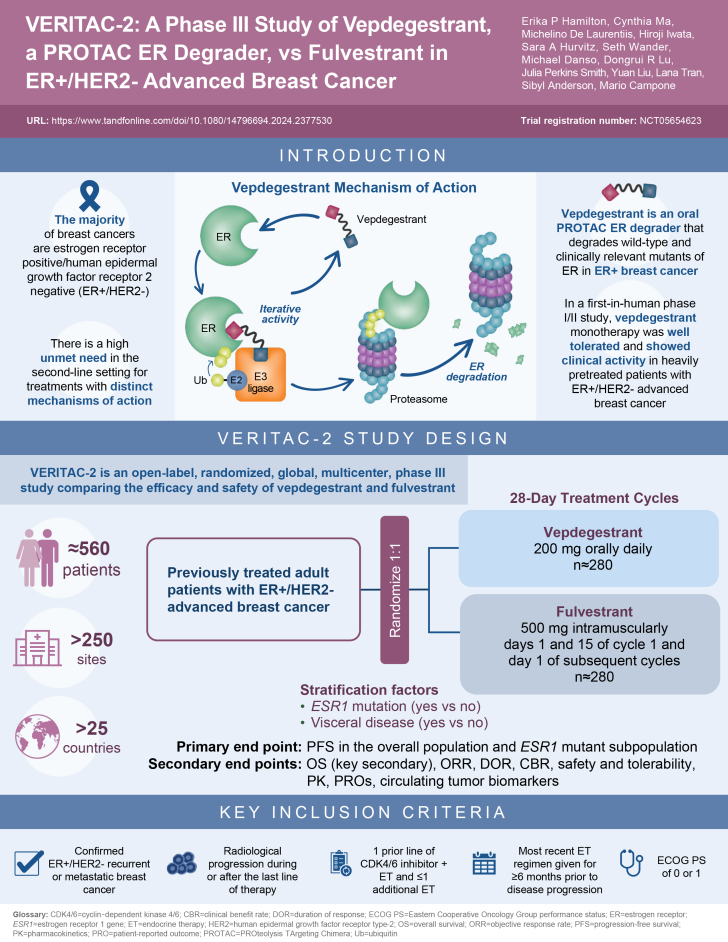
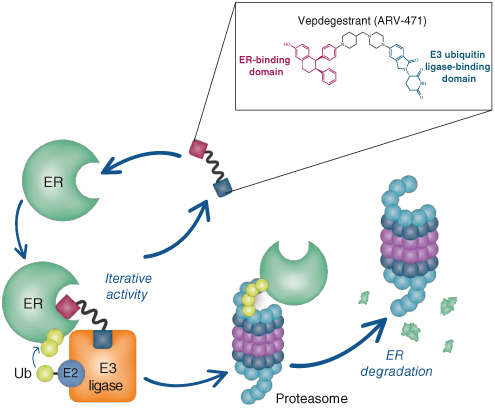
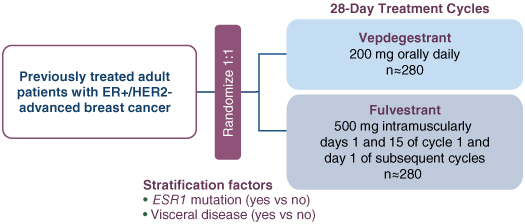
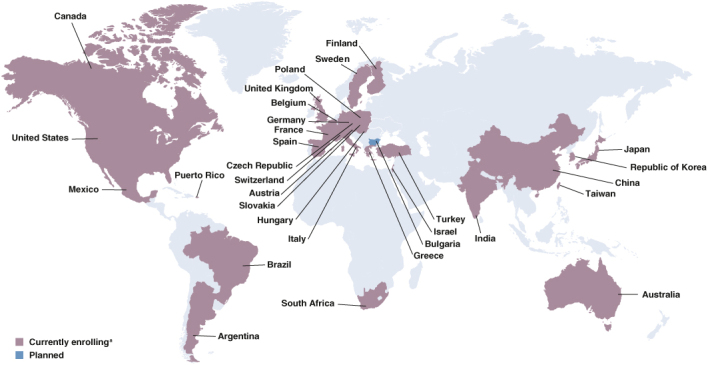
Vepdegestrant (ARV-471) is an oral PROTAC ER degrader that binds an E3 ubiquitin ligase and ER to directly trigger ubiquitination of ER and its subsequent proteasomal degradation. In a first-in-human Phase I/II study, vepdegestrant monotherapy was well tolerated with clinical activity in pretreated patients with ER+/HER2- advanced breast cancer. The global, randomized Phase III VERITAC-2 study compares efficacy and safety of vepdegestrant versus fulvestrant in adults with ER+/HER2- advanced breast cancer after treatment with a CDK4/6 inhibitor plus endocrine therapy. Progression-free survival by blinded independent central review (primary end point) will be assessed in the intention-to-treat population and ESR1 mutation-positive subpopulation. Secondary end points include overall survival, tumor response, safety, pharmacokinetics, patient-reported outcomes, and circulating tumor DNA biomarkers.Clinical trial registration: NCT05654623 (ClinicalTrials.gov)
Overview
The claims and statistics of this paper haven’t been checked yet.
Free: it reads the open-access text and checks the first 5 claims that cite a source we can check. Create a free account to check every claim.
Integrity signals
Registry
Cites
Statistics
Figures
Verification
Claims the paper makes
The claims and statistics of this paper haven’t been checked yet.
Free: it reads the open-access text and checks the first 5 claims that cite a source we can check. Create a free account to check every claim.
Claims other papers make about this one
Each is checked against this paper’s own text: does it say what the citing paper says it does?
The cited source says what the claim attributes to it.
In the citing paper
“A prime example that has reached the clinic is ARv-471, an estrogen receptor-targeting PROtAc, now in Phase iii trials for eR+ metastatic breast cancer (Nct05654623) (Hamilton et al. 2024).”
From From serendipity to strategy: molecular glue degraders in cancer therapeutics (2025) · cites this paper as Hamilton et al. 2024
Self-check
Percentages, sums and reported differences re-computed from the paper’s own numbers.
The self-check needs the paper’s full text.
Citations
Cites
PROTAC targeted protein degraders: the past is prologue
Békés, M., Langley, D. R., & Crews, C. M. (2022) · Nature Reviews Drug Discovery · doi:10.1038/s41573-021-00371-6 · Cited by 3,395 · cited 2×
“PROt eoly sis TArgeting Chimera (PROTAC) protein degraders are small molecules that harness the cell’s natural protein disposal machinery, the ubiquitin-prot easome sy st em, t o induc e deg radation of a target prot ein of int erest [ 24 , 25 ].”
BackgroundSakamoto, K. M., Kim, K. B., Kumagai, A., Mercurio, F., Crews, C. M., & Deshaies, R. J. (2001) · Proceedings of the National Academy of Sciences · doi:10.1073/pnas.141230798 · Cited by 2,609
3rd ESO–ESMO International Consensus Guidelines for Advanced Breast Cancer (ABC 3)
Cardoso, F., Costa, A., Senkus, E., Aapro, M., André, F., Barrios, C. H., Bergh, J., Bhattacharyya, G., Biganzoli, L., Cardoso, M. J., et al. (2017) · Annals of Oncology · doi:10.1093/annonc/mdw544 · Cited by 2,033
Gennari, A., André, F., Barrios, C. H., Cortés, J., de Azambuja, E., DeMichele, A., Dent, R., Fenlon, D., Gligorov, J., Hurvitz, S. A., et al. (2021) · Annals of Oncology · doi:10.1016/j.annonc.2021.09.019 · Cited by 1,417
Self-citation5th ESO-ESMO international consensus guidelines for advanced breast cancer (ABC 5)
Cardoso, F., Paluch-Shimon, S., Senkus, E., Curigliano, G., Aapro, M. S., André, F., Barrios, C. H., Bergh, J., Bhattacharyya, G. S., Biganzoli, L., et al. (2020) · Annals of Oncology · doi:10.1016/j.annonc.2020.09.010 · Cited by 1,369
Bidard, F.-C., Kaklamani, V. G., Neven, P., Streich, G., Montero, A. J., Forget, F., Mouret-Reynier, M.-A., Sohn, J. H., Taylor, D., Harnden, K. K., et al. (2022) · Journal of Clinical Oncology · doi:10.1200/jco.22.00338 · Cited by 777 · cited 1×
“SERDs pr imar ily immobilize ER in the cytoplasm limiting ER-directed gene transcription, and they have also been shown to indirectly lead to ER degradation secondary to conformational changes and/or immobilization of ER [ 13– 15 ].”
Wander, S. A., Cohen, O., Gong, X., Johnson, G. N., Buendia-Buendia, J. E., Lloyd, M. R., Kim, D., Luo, F., Mao, P., Helvie, K., et al. (2020) · Cancer Discovery · doi:10.1158/2159-8290.cd-19-1390 · Cited by 429
Self-citationBrett, J. O., Spring, L. M., Bardia, A., & Wander, S. A. (2021) · Breast Cancer Research · doi:10.1186/s13058-021-01462-3 · Cited by 414
Self-citationFulvestrant: an oestrogen receptor antagonist with a novel mechanism of action
Osborne, C. K., Wakeling, A., & Nicholson, R. I. (2004) · British Journal of Cancer · doi:10.1038/sj.bjc.6601629 · Cited by 414
Rugo, H. S., Lerebours, F., Ciruelos, E., Drullinsky, P., Ruiz-Borrego, M., Neven, P., Park, Y. H., Prat, A., Bachelot, T., Juric, D., et al. (2021) · The Lancet Oncology · doi:10.1016/s1470-2045(21)00034-6 · Cited by 345
Research works printed but not linked: 2
- Hurvitz SA, Schott AF, Ma C, et al. Updated results from VERITAC evaluating vepdegestrant, a PROteolysis TArgeting Chimera (PROTAC) estrogen receptor (ER) degrader, in ER-positive/human epidermal growth factor receptor 2 (HER2)-negative advanced breast cancer. Oral presentation at: San Antonio Breast Cancer Symposium. San Antonio, TX; 2023 December 5–9; Presentation PO3-05-08. •• Updated results from the VERITAC Phase II expansion cohort of the first-in-human Phase I/II of vepdegestrant.
- Hamilton EP, Jeselsohn R, Hurvitz SA, et al. Vepdegestrant, a PROteolysis TArgeting Chimera (PROTAC) estrogen receptor degrader, plus palbociclib in estrogen receptor-positive/human epidermal growth factor receptor 2-negative advanced breast cancer: Phase IB cohort. Oral presentation at: San Antonio Breast Cancer Symposium. San Antonio, TX; 2023 December 5–9; Presentation PS15-03.
Cited by
Items 101–116 of 116
A nuclear-targeted PROTAC enables subcellular-selective degradation of AURKA
Qian, B., Liu, F., Liu, Q., Zhou, F., Zhu, D., Lei, X., Wen, S., Hou, Z., & Liu, Q. (2026) · Biochemical and Biophysical Research Communications · doi:10.1016/j.bbrc.2026.154458
Integrative Proteomics and Ubiquitomics Reveal on-Targets and off-Targets of PROTAC dBET1
Wen, H., Liu, H., Liu, J., Yang, B., Dai, J., Chang, L., Li, Y., Zhang, Y., Yu, L., & Xu, P. (2026) · Analytical Chemistry · doi:10.1021/acs.analchem.6c00787
A guide to transcriptional cyclin‐dependent kinases in cancer
Devlin, J. R., Kyheröinen, S., & Johnstone, R. W. (2026) · FEBS Journal · doi:10.1111/febs.70731
Lü, M., Xia, L., Chutake, Y. K., Dey, J., & Hoffman, R. (2026) · Leukemia · doi:10.1038/s41375-026-03163-2
First demonstration of benzosultam CRBN ligand-mediated PROTACs for BTK and BRD4 degradation
Park, H., Jeun, M., Choi, J. U., Bang, Y., Park, C. H., & Kim, P. (2026) · RSC Medicinal Chemistry · doi:10.1039/d6md00815a
Diao, C., Zhao, Z., Lu, X., Zang, K., Dong, Y., Dong, C., & Ren, J. (2026) · Analytical Chemistry · doi:10.1021/acs.analchem.6c03494
ESR1 alterations in breast cancer: Mechanisms, detection, and therapeutic implications
Shen, M., Yao, X., Zhao, X., Gong, Y., Yang, L., Feng, M., Shao, M., Wei, B., Bu, H., & Zhang, Z. (2026) · Chinese Medical Journal · doi:10.1097/cm9.0000000000004327
Wang, T., Ji, C., & Zhao, T. (2026) · Frontiers in Medicine · doi:10.3389/fmed.2026.1967704
“When repeated biopsies are impractical, molecular imaging, circulating tumor DNA, cerebrospinal fluid biomarkers, or downstream protein signatures may be used, but their quantitative relationship to tissue degradation must be established (51, 57, 301, 302).”
Wu, J., Liu, X., & Wu, G. (2026) · Journal of Holistic Integrative Pharmacy · doi:10.1016/j.jhip.2026.09.001
Shen, T., Li, H., Zhang, X., & Zhou, Q. (2026) · Frontiers in Oncology · doi:10.3389/fonc.2026.1983430
“The phase III VERITAC-2 trial compared vepdegestrant with fulvestrant in patients with ER+/HER2 − advanced breast cancer previously treated with a CDK4/6 inhibitor and endocrine therapy (57).”
Harnessing the ubiquitin-proteasome system: advances and challenges of PROTACs in breast cancer
Fanai, H. L., Babu, B., Rajagopal, K., & Byran, G. (2026) · Molecular Biology Reports · doi:10.1007/s11033-026-12830-7
Degradation-coupled antibody conjugates for precision cancer therapy
Zhuang, X., Lin, L., Zhang, Y., Wang, Y., & Pan, L. (2026) · Trends in Molecular Medicine · doi:10.1016/j.molmed.2026.09.014
Rana, N., & Patel, A. (2026) · Expert Opinion on Drug Metabolism & Toxicology · doi:10.1080/17425255.2026.2752978
Metadata
- Authors
- Hamilton, E. P., Ma, C., De Laurentiis, M., Iwata, H., Hurvitz, S. A., Wander, S. A., Danso, M., Lu, D. R., Perkins Smith, J., Liu, Y., Tran, L., Anderson, S., & Campone, M.
- Affiliations
- Sarah Cannon (US)
- Washington University in St. Louis (US)
- Department of Breast & Thoracic Oncology, Istituto Nazionale Tumori IRCCS “Fondazione G. Pascale,” Naples, 80131, Italy
- Nagoya City University (JP)
- University of Washington (US)
- Harvard University (US)
- Virginia Oncology Associates (US)
- Pfizer (United States) (US)
- Clinical Development, Pfizer, Inc., New York, NY 10017, USA
- Arvinas (United States) (US)
- Institut de Cancérologie de l'Ouest (FR)
- Corresponding author
- Hamilton, Erika P
- ORCID
- Venue
- Future Oncology
- Publisher
- Informa UK Limited
- Published
- 2024-07-29
- Volume
- 20
- Issue
- 32
- Pages
- 2447-2455
- ISSN
- 1479-6694 (ISSN-L)
- 1744-8301
- PMC
- PMC11524203
- OpenAlex
- W4401093107
- Semantic Scholar
- a2e522b86f7ddc88da97330f41d08ecc9614294e
- Cited by
- 116
- References
- 25
- Citations by year
- 2026: 56 · 2025: 55 · 2024: 5
- FWCI
- 33.70
- Type
- journal article
- Language
- en
- Open access
- hybrid
- doi.org
- Licence
- Locations
- Future Oncology (publishedVersion, cc-by-nc-nd)
- PubMed Central (publishedVersion, cc-by-nc-nd)
- PubMed (publishedVersion)
- Digital Commons@Becker (Washington University School of Medicine) (submittedVersion, cc-by-nc-nd)
- Funders
- Pfizer, Inc.
- Arvinas Estrogen Receptor, Inc.
- Topics
- Health Sciences › Medicine › Oncology › Advanced Breast Cancer Therapies
- Life Sciences › Biochemistry, Genetics and Molecular Biology › Molecular Biology › Protein Degradation and Inhibitors
- Life Sciences › Biochemistry, Genetics and Molecular Biology › Cancer Research › Breast Cancer Treatment Studies
- Keywords
- vepdegestrant, PROTAC degraders, estrogen receptor degradation, fulvestrant, ESR1 mutations, CDK4/6 inhibitors, endocrine therapy, progression-free survival, E3 ubiquitin ligase, oral targeted therapy
- MeSH terms
- Fulvestrant, Adult, Breast Neoplasms, Female, Humans, Middle Aged, Receptors, Estrogen, Multicenter Studies as Topic, Randomized Controlled Trials as Topic, Clinical Trials, Phase III as Topic, Receptor, ErbB-2, Erb-b2 Receptor Tyrosine Kinases, Estrogen Receptor alpha
About these checks
Registry, retraction, Cites and statistics results are computed, not judged, with one exception: a printed reference that no index lists is read once by a model before it counts as a citation error. Claims are extracted by a model and kept only when their quote appears verbatim in the text; each cited source is then checked, with a model’s help, for whether it says what the claim relies on. Those verdicts can be wrong — read the claim’s quote and the cited source before relying on one.
Statistics and arithmetic are recomputed, not judged.
Confidence bands are shown only for fields calibrated on our annotated test set. None is calibrated yet, so no band is shown.
What counts as a claim ›How we measure confidence ›How we check this ›
Are you an author, or do you see a problem with this page? Request a review
Data sources
Bibliographic data: Semantic Scholar, OpenAlex, Crossref.
Contains information from the Semantic Scholar Academic Graph Datasets, made available under the ODC Attribution License (ODC-BY 1.0).
Semantic Scholar’s data is described in: Kinney, R., et al. (2023). The Semantic Scholar Open Data Platform. arXiv:2301.10140.
