

Hispanic/Latinx STEM Majors Applying to Graduate School: The Role of Family, Peers, and Undergraduate Research Programs in Facilitating Community Cultural Wealth
Open accessThe DOI matches its Crossref record; 48 of the 49 references it cites were found in a registry or an index; 2 of the 17 sources its claims cite were checked for support.
Abstract
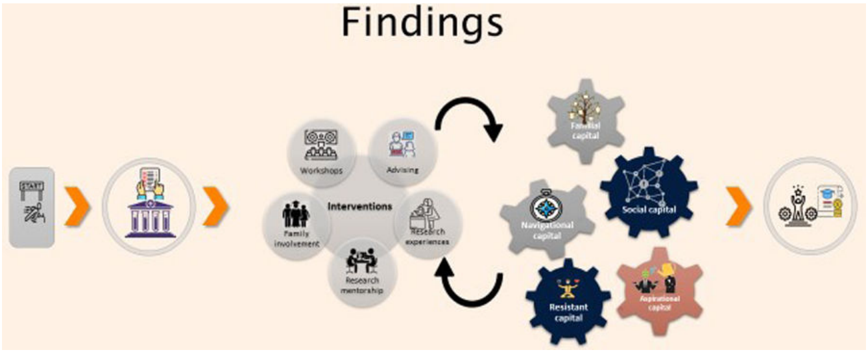
This paper examines the critical transition from undergraduate to graduate biomedical education and focuses on Hispanic/Latinx students who participated in a biomedical undergraduate research program at a Hispanic-Serving Institution located on the US-Mexico border. We use the community cultural wealth (CCW) framework (Yosso, 2005) to analyze 13 qualitative interviews about students' experiences applying to graduate school in biomedical fields and how different program activities allowed students to navigate the graduate school application process. Our findings suggest that different programmatic activities (research experiences, research mentorship, workshops, family involvement, and advising) facilitated students' graduate school application process by enhancing different types of cultural capital: aspirational, familial, social, navigational, and resistant.
Overview
CoChat Summary
TL;DR
This qualitative study used community cultural wealth (CCW) to examine how 13 Hispanic/Latinx biomedical undergraduate research program participants at a Hispanic-Serving Institution on the US-Mexico border experienced the graduate school application process. It found that program activities enhanced familial, navigational, social, aspirational, and resistant capital, while linguistic capital was not discussed.
Key findings
- Students drew on five forms of CCW—familial, navigational, social, aspirational, and resistant—when applying to graduate school; the paper reports that students did not talk about using linguistic capital in the application process.
- Familial capital operated through supportive but concerned parents; EXCEL parent trainings/information sessions helped families understand biomedical research and support students, and siblings also served as sources of capital (e.g., Estefan relied on his sister).
- Navigational and social capital came from summer research experiences, graduate-school workshops, research mentors, and peer networks; examples include Mariana feeling practiced at writing statements, Luciana feeling prepared for interviews, and Sara and peers supporting each other through applications.
- Aspirational and resistant capital were built when mentors/advisors encouraged students to apply to prestigious programs despite self-doubt, and when students rejected deficit comments; Pablo applied to four Ivy League schools after mentor encouragement, and Sara was accepted after dismissing others’ doubts.
Methods
- Qualitative interview study with 13 students from the first cohort of the EXCEL biomedical undergraduate research program at an HSI on the U.S.-Mexico border; all 13 identified as Latinx/Hispanic; 6 interviews were in person and 7 by phone; interviews lasted approximately 1 hour, were recorded/transcribed, and used pseudonyms.
- Participants’ majors were biochemistry (1), chemistry (2), biological sciences (3), cellular and molecular biochemistry (2), psychology (2), and mechanical engineering with a biomedical engineering minor (1); 3 were first-generation college students, 8 were not, and 2 did not answer; 7 were first-generation graduate students, 4 were not, and 2 did not answer.
- Data were analyzed with a cyclical coding process using open and focused codes; the first two authors coded all transcripts, the team met for consensus, and NVivo was used, searching for instances of community cultural wealth in the graduate school application process.
Limitations
- Stated: only the first cohort was interviewed, so findings are not intended to be generalizable; adopting all EXCEL features may be complicated for other programs because it requires funding and resources; the paper notes overlaps among capitals (e.g., social and navigational) that need further examination and recommends future interviews with family members, program advisors, and faculty mentors.
- Evident: the study is a small qualitative sample (13) from a single undergraduate research program at one HSI, relying on self-reported interview accounts without a comparison group or broader longitudinal tracking; the absence of student discussion of linguistic capital leaves its role in academic application unexamined.
Model-written summary. Check it against the paper before relying on it.
Integrity signals
Registry
Cites
Statistics
Figures
Verification
Claims the paper makes
2 Valid · 2 Not valid · 12 Not checked · 71 Own results and interpretations
The cited sources support only part of this claim — read each source’s verdict below.
In the paper
“Research also suggests that after participation in an undergraduate research program, students report more interest in attending graduate school (Carpi et al., 2017;Eagan et al., 2013;Gonzalez-Espada & LaDue, 2006;Russell et al., 2007).”
§ Hispanic/Latinx STEM Majors Applying to Graduate School: The Role of Family, Peers, and Undergraduate Research Programs in Facilitating Community Cultural Wealth > Introduction
What the sources say
- Supportedcites Carpi et al., 2017 matched to “Cultivating minority scientists: Undergraduate research increases self-efficacy and career ambitions for underrepresented students in STEM: MENTORED UNDERGRADUATE RESEARCH AT A MSI” (2017) source
The 'Career Choice Behavior' section reports that among PRISM survey respondents with no prior graduate-school intentions, 23 students (68%) 'developed an interest in pursuing graduate school during the course of their PRISM experience,' alongside a concurrent rise in graduates attending graduate school (Figure 3). The Literature on the Impacts of Undergraduate Research section frames the study question as whether 'undergraduate research lead[s] to new interest among students in pursuing a graduate degree,' and the concluding sections describe PRISM as exposing students to graduate school as a possibility. The finding rests on a self-report survey of 47 students/alumni at a minority-serving institution (John Jay College), so the population is narrower than the citing sentence's generic 'students,' but the paper plainly reports increased interest in graduate school after participation. (LLM, conf=0.85)
- Not matchedcites Eagan et al., 2013
An author–year citation the paper’s reference list doesn’t settle. We don’t search these by name.
- Not matchedcites Gonzalez-Espada & LaDue, 2006
An author–year citation the paper’s reference list doesn’t settle. We don’t search these by name.
hedgedstates an association- Asserted: passes — The authors put it forward as true.
- Checkable: passes — It can be checked against evidence.
- Load-bearing: passes — The paper’s conclusions depend on it.
- Based: passes — The paper gives a reason why it holds.
- Supported
Every source the paper cites for this claim was checked and supports it.
In the paper
“Primary findings from our study show that students utilized five sources of capital from Yosso's (2005) framework: familial, navigational, social, aspirational, and resistant capital.”
§ Hispanic/Latinx STEM Majors Applying to Graduate School: The Role of Family, Peers, and Undergraduate Research Programs in Facilitating Community Cultural Wealth > Discussion
What the sources say
- Supportedcites Yosso (2005) matched to “Whose culture has capital? A critical race theory discussion of community cultural wealth” (2005) source
Yosso's (2005) framework is stated in 'Challenging racism, revealing cultural wealth' (p. toward Fig. 2): Communities of Color 'nurture cultural wealth through at least 6 forms of capital such as aspirational, navigational, social, linguistic, familial, and resistant capital,' and each of the five named in the citing sentence is defined there as a distinct form (aspirational #1, familial #3, social #4, navigational #5, resistant #6). The citing sentence's own empirical result ('students utilized') is the citing authors' finding, not an attribution; what is attributed to Yosso is the set of capital forms, which our copy supports. Only caveat: the framework is 'at least 6' forms, so the five listed are a subset rather than the whole (linguistic capital is also part of it). (LLM, conf=0.88)
plain- Asserted: passes — The authors put it forward as true.
- Checkable: passes — It can be checked against evidence.
- Load-bearing: passes — The paper’s conclusions depend on it.
- Based: passes — The paper gives a reason why it holds.
- Supported
A result the paper reports from its own data — it cites no other source for it, so there is none to check. The quote shows it is in the paper.
In the paper
“For all these students, going away from home to attend graduate school was the first time that they moved away from home for more than ten weeks (the length of the EXCEL summer research programs) since they lived with their parents during their undergraduate years.”
§ Hispanic/Latinx STEM Majors Applying to Graduate School: The Role of Family, Peers, and Undergraduate Research Programs in Facilitating Community Cultural Wealth > Familial Capital: Learning Together
plain- Asserted: passes — The authors put it forward as true.
- Checkable: passes — It can be checked against evidence.
- Load-bearing: unclear — It is unclear whether the paper’s conclusions depend on it.
- Based: passes — The paper gives a reason why it holds.
A result the paper reports from its own data — it cites no other source for it, so there is none to check. The quote shows it is in the paper.
In the paper
“Our findings suggest that different programmatic activities (research experiences, research mentorship, workshops, family involvement, and advising) facilitated students' graduate school application process by enhancing different types of cultural capital: aspirational, familial, social, navigational, and resistant.”
- Also stated in: § Findings · plain
“These forms of capital were enhanced by the program's activities and the research program benefits from the students.”
- Also stated in: § Findings · plain
“Their narratives show how different aspects of the program enhanced their capitals and thus helped them with the application process.”
§ Hispanic/Latinx STEM Majors Applying to Graduate School: The Role of Family, Peers, and Undergraduate Research Programs in Facilitating Community Cultural Wealth > Abstract
plainstates a cause- Asserted: passes — The authors put it forward as true.
- Checkable: passes — It can be checked against evidence.
- Load-bearing: passes — The paper’s conclusions depend on it.
- Based: passes — The paper gives a reason why it holds.
- Rests on an assumption not shown here.
- Also stated in: § Findings · plain
The paper states this without a source or data behind it here, so there is nothing to check it against. The quote shows it is in the paper.
In the paper
“Furthermore, students have utilized the community cultural wealth they acquired during their participation in the research program to challenge feeling like an outsider in their graduate environment.”
§ Hispanic/Latinx STEM Majors Applying to Graduate School: The Role of Family, Peers, and Undergraduate Research Programs in Facilitating Community Cultural Wealth > Conclusion
plainstates a cause- Asserted: passes — The authors put it forward as true.
- Checkable: passes — It can be checked against evidence.
- Load-bearing: passes — The paper’s conclusions depend on it.
- Based: unclear — It is unclear why the paper says it holds.
43 more claims
Create a free account to see all 87 claims and to verify the 7 references still open.
- Probably not a substantial claim. 18
- It may state two separate claims as one. 29
- The quote only partly states this claim. 3
Self-check
Percentages, sums and reported differences re-computed from the paper’s own numbers.
Each contradiction between two passages listed here was confirmed by an independent check.
Rated minor: it would not touch a result — a value no result rests on, a p-value that stays on the same side of the significance level, or a conflict that is clerical, resolved elsewhere in the paper, or outside its own findings.
In the paper
§ Hispanic/Latinx STEM Majors Applying to Graduate School: The Role of Family, Peers, and Undergraduate Research Programs in Facilitating Community Cultural Wealth > Discussion
“There were some overlaps between the aspirational and social capital, supporting Yosso's (2015) statement "Various forms of capital are not mutually exclusive or static, but rather are dynamic processes that build on one another" (p.77).”
§ Hispanic/Latinx STEM Majors Applying to Graduate School: The Role of Family, Peers, and Undergraduate Research Programs in Facilitating Community Cultural Wealth > Theoretical Framework
“While there are definitions for each form of capital, Yosso (2005) notes that they are "not mutually exclusive or static, but rather are dynamic processes that build on one another as part of community cultural wealth" (p.77).”
Rated minor: it would not touch a result — a value no result rests on, a p-value that stays on the same side of the significance level, or a conflict that is clerical, resolved elsewhere in the paper, or outside its own findings.
In the paper
“Table 2 shows the demographic information of the 13 students who were interviewed.Their majors were as follows (number of students in parenthesis): biochemistry (1), chemistry (2), biological sciences (3), cellular and molecular biochemistry (2), psychology (2), and mechanical engineering with a biomedical engineering minor (1).”
§ Hispanic/Latinx STEM Majors Applying to Graduate School: The Role of Family, Peers, and Undergraduate Research Programs in Facilitating Community Cultural Wealth > Participants & Procedure
Reported 13 · recomputed 11
Citations
Cites
Whose culture has capital? A critical race theory discussion of community cultural wealth
Yosso *, T. J. (2005) · Race Ethnicity and Education · doi:10.1080/1361332052000341006 · Cited by 8,663 · cited 8×
“There were some overlaps between the aspirational and social capital, supporting Yosso’s (2005) statement “Various forms of capital are not mutually exclusive or static, but rather are dynamic processes that build on one another” (p. 77).”
BackgroundMethodInfluentialBenefits of Undergraduate Research Experiences
Russell, S. H., Hancock, M. P., & McCullough, J. (2007) · Science · doi:10.1126/science.1140384 · Cited by 1,380 · cited 2×
“After belonging to an undergraduate research program, a high percentage of students reported a higher likelihood of STEM degree retention (Doerschuk et al., 2016) and intent to attend graduate school (Carpi et al., 2017; Doerschuk et al., 2016; Russell et al., 2007).”
BackgroundSeymour, E., Hunter, A., Laursen, S. L., & DeAntoni, T. (2004) · Science Education · doi:10.1002/sce.10131 · Cited by 1,332 · cited 1×
“These programs have been successful at increasing students’ science self-efficacy (Junge et al., 2010), and personal and professional gains (Hunter et al., 2007; Seymour et al., 2004).”
BackgroundHunter, A., Laursen, S. L., & Seymour, E. (2007) · Science Education · doi:10.1002/sce.20173 · Cited by 1,324 · cited 1×
“These programs have been successful at increasing students’ science self-efficacy (Junge et al., 2010), and personal and professional gains (Hunter et al., 2007; Seymour et al., 2004).”
BackgroundSolorzano, D. G. (1998) · International Journal of Qualitative Studies in Education · doi:10.1080/095183998236926 · Cited by 1,132 · cited 1×
“…ideology claiming racial objectivity, meritocracy, colorblindness, and equal opportunity; (3) commitment to social justice and racial emancipation; (4) recognition of the strength of experiential knowledge of people of color; and (5) utilization of a transdisciplinary perspective (Solorzano, 1998).”
BackgroundDiversity in clinical and biomedical research: a promise yet to be fulfilled
Oh, S. S., Galanter, J., Thakur, N., Pino-Yanes, M., Barcelo, N. E., White, M. J., de Bruin, D. M., Greenblatt, R. M., Bibbins-Domingo, K., Wu, A. H. B., et al. (2015) · PLOS Medicine · doi:10.1371/journal.pmed.1001918 · Cited by 585 · cited 2×
“There is currently a national shortage of biomedical researchers in the US, and the inclusion of underrepresented minorities (URM) is still far too low (Oh et al., 2015).”
BackgroundCarpi, A., Ronan, D. M., Falconer, H. M., & Lents, N. H. (2017) · Journal of Research in Science Teaching · doi:10.1002/tea.21341 · Cited by 394 · cited 2×
“After belonging to an undergraduate research program, a high percentage of students reported a higher likelihood of STEM degree retention (Doerschuk et al., 2016) and intent to attend graduate school (Carpi et al., 2017; Doerschuk et al., 2016; Russell et al., 2007).”
Background“Am I going crazy?!”: A Critical Race Analysis of Doctoral Education
Gildersleeve, R. E., Croom, N. N., & Vasquez, P. L. (2011) · Equity & Excellence in Education · doi:10.1080/10665684.2011.539472 · Cited by 336 · cited 2×
“There are a few research studies focused on underrepresented minorities concerning their graduate school choice (Ramirez, 2011, 2013) or experiences in their first year of graduate school (Gildersleeve et al., 2011; González, 2006; Ramirez, 2014).”
BackgroundThiry, H., Laursen, S. L., & Hunter, A.-B. (2011) · The Journal of Higher Education · doi:10.1080/00221546.2011.11777209 · Cited by 328 · cited 1×
“Researchers have found that successful mentoring relationships can affect students decisions to continue in research (Thiry & Laursen, 2011; Thiry et al., 2011).”
BackgroundThiry, H., & Laursen, S. L. (2011) · Journal of Science Education and Technology · doi:10.1007/s10956-010-9271-2 · Cited by 270 · cited 3×
“Researchers have found that successful mentoring relationships can affect students decisions to continue in research (Thiry & Laursen, 2011; Thiry et al., 2011).”
Background
Research works printed but not linked: 1
- Saldaña J (2016). The Coding Manual for Qualitative Researchers (3rd. edition). SAGE.
Cited by
Contribution of Microlearning in Basic Education: A Systematic Review
Silva, E. S., da Costa, W. P., de Lima, J. C., & Ferreira, J. C. (2025) · Education Sciences · doi:10.3390/educsci15030302 · Cited by 96
Ro, H. K., Aguilar-Smith, S., Anderson, S. Y., Rodriguez, T., Ramon, E. J., & Javier, D. (2024) · International Journal of STEM Education · doi:10.1186/s40594-024-00489-0 · Cited by 36
Cononelos, T. (2024) · Journal of Latinos and Education · doi:10.1080/15348431.2024.2379875 · Cited by 11
“…et al., 2023; Matos, 2023), 2) family support was vital to the success of all students (Kolluri, 2023a; Spencer & Wilson, 2023), and 3) bridge programs provided valuable resources and fostered beneficial relationships regardless of institutional type (Monarrez et al., 2022; O’Connell, 2023).”
Vela, J. C., Guerra, F., Zamora, E., & Pérez, E. (2024) · Journal of Multicultural Counseling and Development · doi:10.1002/jmcd.12293 · Cited by 10
Clayton, A. B., Breeden, R. L., & Davis, T. J. (2023) · Journal of College Student Retention Research Theory & Practice · doi:10.1177/15210251231182683 · Cited by 7
“One recent case study focused on Hispanic/Latinx STEM students ’ experiences in a similar undergraduate research program, EXCEL, and found that the program helped students apply to graduate school and increased their various forms of capital (Monarrez et al., 2022).”
Metadata
- Authors
- Monarrez, A., Frederick, A., Morales, D. X., Echegoyen, L. E., & Wagler, A.
- Affiliations
- Department of Mathematical Sciences, The University of Texas at El Paso
- The University of Texas at El Paso (US)
- Department of Urban Studies, Worchester University
- Venue
- Journal of Latinos and Education
- Publisher
- Informa UK Limited
- Published
- 2022-09-12
- Volume
- 23
- Issue
- 1
- Pages
- 205-219
- ISSN
- 1534-8431 (ISSN-L)
- 1532-771X
- PMC
- PMC10795465
- OpenAlex
- W4297883882
- Cited by
- 25
- References
- 49
- Citations by year
- 2026: 9 · 2025: 9 · 2024: 5 · 2023: 2
- FWCI
- 3.70
- Type
- journal article
- Language
- en
- Open access
- hybrid
- doi.org
- Licence
- Locations
- Journal of Latinos and Education (publishedVersion, cc-by-nc-nd)
- PubMed (publishedVersion)
- PubMed Central (acceptedVersion)
- Funders
- National Institute of General Medical Sciences of the National Institutes of Health under linked award numbers (RL5GM118969, TL4GM118971, and UL1GM118970)
- Topics
- Social Sciences › Education › Higher Education Research Studies
- Social Sciences › Psychology › Applied Psychology › Career Development and Diversity
- Social Sciences › Sociology and Political Science › Critical Race Theory in Education
- Keywords
- Hispanic/Latinx students, community cultural wealth, Hispanic-serving institutions, family involvement, peer support, research mentorship, cultural capital, social capital, academic advising, U.S.-Mexico border
About these checks
Registry, retraction, Cites and statistics results are computed, not judged, with one exception: a printed reference that no index lists is read once by a model before it counts as a citation error. Claims are extracted by a model and kept only when their quote appears verbatim in the text; each cited source is then checked, with a model’s help, for whether it says what the claim relies on. Those verdicts can be wrong — read the claim’s quote and the cited source before relying on one.
A language model drew the claims from the paper on 2026-11-17, under version 3 of the claim definition (model deepseek-v4.1-flash, prompt extract-v3).
A second model labelled each claim on 2026-11-17 (model jev-1.13-20260917, definition revision gold-guideline-v0.2).
Cited sources are checked with a language model’s help (qwen3.8-omni-flash).
Statistics and arithmetic are recomputed, not judged.
Confidence bands are shown only for fields calibrated on our annotated test set. None is calibrated yet, so no band is shown.
What counts as a claim ›How we measure confidence ›How we check this ›
Are you an author, or do you see a problem with this page? Request a review
Data sources
Bibliographic data: Semantic Scholar, OpenAlex, Crossref.
Contains information from the Semantic Scholar Academic Graph Datasets, made available under the ODC Attribution License (ODC-BY 1.0).
Semantic Scholar’s data is described in: Kinney, R., et al. (2023). The Semantic Scholar Open Data Platform. arXiv:2301.10140.
