

Performance-enhancing effects of caffeine and L-Theanine among Iranian elite wrestlers: a focus on cognitive and specific physical performance
Open accessThe DOI matches its Crossref record; 51 of the 52 references it cites were found in a registry or an index.
Abstract
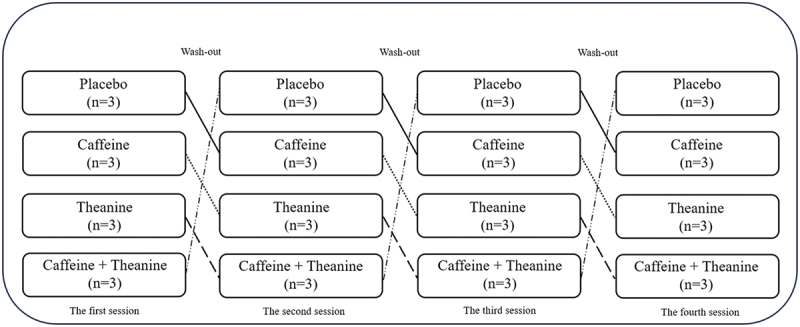
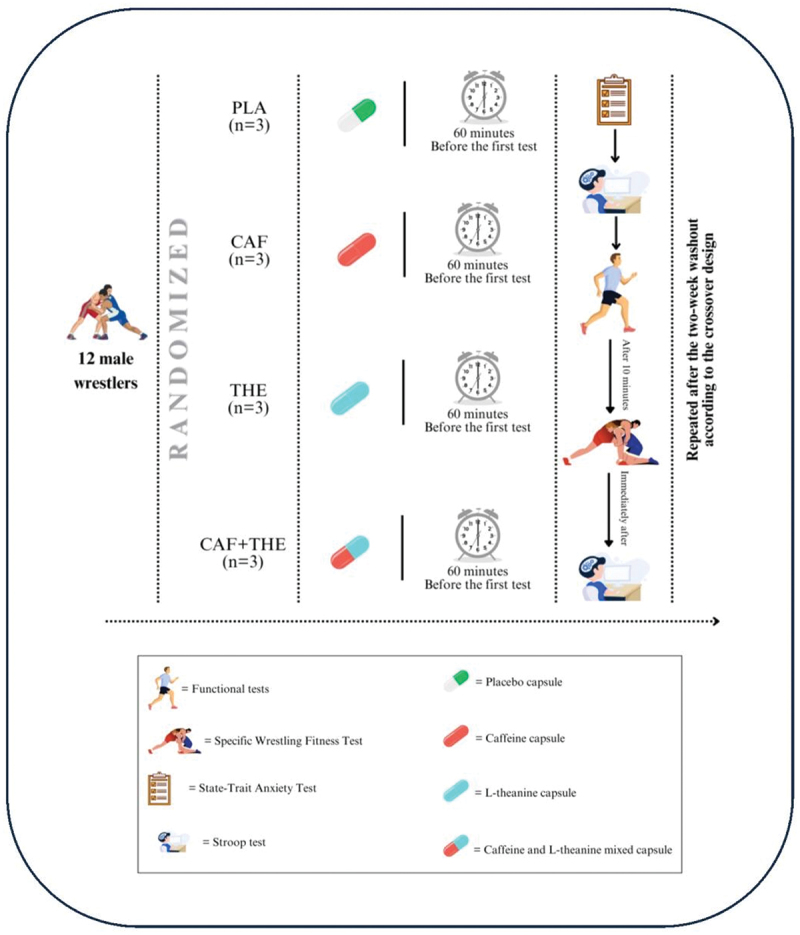
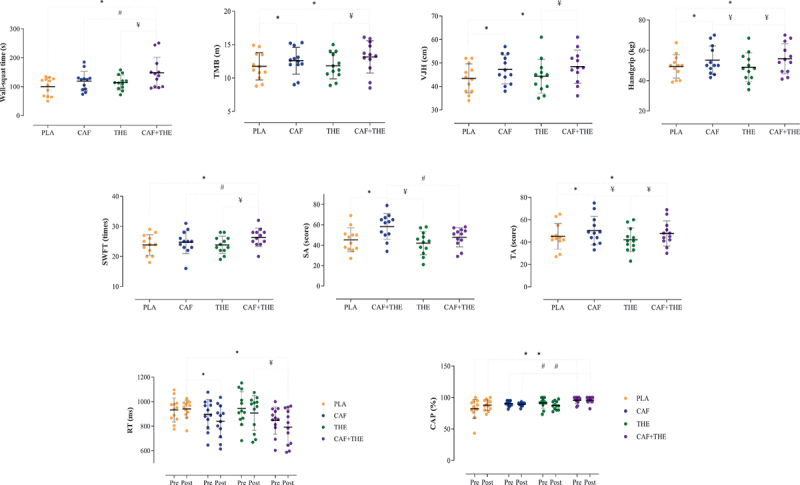
Background Caffeine is a well-known ergogenic aid that can enhance physical and cognitive performance. However, it often induces side effects, such as anxiety and overstimulation, which can be problematic in high-pressure sports like wrestling. L-theanine, a non-stimulant amino acid found in tea, may help mitigate these effects by promoting a calm yet focused mental state. This study aimed to investigate the acute effects of caffeine, L-theanine, and their combination on physical performance, cognitive function, and anxiety in elite male wrestlers.Methods In a double-blind, placebo-controlled, crossover design, 12 elite male wrestlers (21.8 ± 2.1 years) completed four test sessions under randomized conditions: placebo (PLA), caffeine (CAF; 3 mg/kg), L-theanine (THE; 3 mg/kg), and caffeine + L-theanine (CAF+THE; 3 mg/kg each). After 60 minutes, athletes performed the wall-squat test, vertical jump height (VJH), medicine ball throw (MBT), handgrip strength, and the Specific Wrestling Fitness Test (SWFT). Cognitive function was assessed pre- and post-SWFT using a computerized Stroop test. Anxiety was assessed using the State-Trait Anxiety Inventory (STAI), and side effects were recorded.Results CAF+THE outperformed PLA in wall-squat time (p = 0.001), MBT (p = 0.005), VJH (p = 0.011), and grip strength (p = 0.004). SWFT throw count was highest in CAF+THE versus all other conditions (p < 0.001). Post-SWFT Stroop reaction time was faster in CAF+THE than PLA (p = 0.004) and THE (p = 0.036), and accuracy was also higher (p = 0.009 vs PLA). CAF alone increased state anxiety compared to PLA (p = 0.021), while CAF+THE reduced anxiety to below placebo levels (8% incidence vs 33%). Trait anxiety was lower in CAF+THE compared to CAF (p = 0.018). The prevalence of caffeine-induced tachycardia (92%) was notably reduced under CAF+THE (17%).Conclusion CAF+THE (3 mg/kg each) enhances elite wrestlers’ strength, endurance, cognitive speed, and accuracy while reducing anxiety and physiological side effects commonly associated with caffeine alone. This combination represents a safe, practical supplement strategy for combat sports athletes who must maintain explosive performance and mental control under stress. Coaches are encouraged to trial CAF+THE protocols during training to personalize timing and dosage.
Overview
The claims and statistics of this paper haven’t been checked yet.
Free: it reads the open-access text and checks the first 5 claims that cite a source we can check. Create a free account to check every claim.
Integrity signals
Registry
Cites
Statistics
Figures

Verification
Claims the paper makes
The claims and statistics of this paper haven’t been checked yet.
Free: it reads the open-access text and checks the first 5 claims that cite a source we can check. Create a free account to check every claim.
Claims other papers make about this one
Each is checked against this paper’s own text: does it say what the citing paper says it does?
The source backs part of the claim, not all of it — or backs it for a different population, condition or comparison.
In the citing paper
“In addition, there is evidence that L-theanine may be able to buffer some of the adverse effects that can occur as a result of caffeine consumption, such as sleep disturbance and increases in anxiety (26, 55), consistent with findings reported in pre-clinical studies (56–58).”
From Effects of L-theanine on cognition, mood and sleep: evidence from human trials (2026) · cites this paper as [26]
Experimental — accuracy not yet measuredThe cited source says what the claim attributes to it.
In the citing paper
“Individual studies have, however, suggested that co-ingestion of caffeine and L-theanine may have an additive effect, with additional benefits noted compared to when each is administered in isolation (20–27), although such findings have been somewhat inconsistent (28, 29) and would benefit from further behavioral and mechanistic evaluation.”
From Effects of L-theanine on cognition, mood and sleep: evidence from human trials (2026) · cites this paper as [26]
The cited source says what the claim attributes to it.
In the citing paper
“indicating that this plant-derived amino acid may provide a broad spectrum of benefits for human health and performance.”
From Effects of L-theanine on cognition, mood and sleep: evidence from human trials (2026) · cites this paper as [26]
Self-check
Percentages, sums and reported differences re-computed from the paper’s own numbers.
The self-check needs the paper’s full text.
Citations
Cites
Faul, F., Erdfelder, E., Lang, A.-G., & Buchner, A. (2007) · Behavior Research Methods · doi:10.3758/bf03193146 · Cited by 65,971 · cited 1×
“The required sample size was determined using G*Power software (3.1.9.7) [20], based on a significance level of α = 0.05 (two-tailed) and a statistical power (1 − β) of 0.80.”
InfluentialStatistical Power Analysis for the Behavioral Sciences
Cohen, J. (2013) · doi:10.4324/9780203771587 · Cited by 25,373
Studies of interference in serial verbal reactions
Stroop, J. R. (1935) · Journal of Experimental Psychology · doi:10.1037/h0054651 · Cited by 18,622
Roberts, H. C., Denison, H. J., Martin, H. J., Patel, H. P., Syddall, H., Cooper, C., & Sayer, A. A. (2011) · Age and Ageing · doi:10.1093/ageing/afr051 · Cited by 3,001 · cited 1×
“This procedure followed standardized protocols to ensure accuracy and reliability [31].”
International Society of Sports Nutrition Position Stand: Caffeine and Exercise Performance
Guest, N. S., VanDusseldorp, T. A., Nelson, M. T., Grgic, J., Schoenfeld, B. J., Jenkins, N. D. M., Arent, S. M., Antonio, J., Stout, J. R., Trexler, E. T., et al. (2021) · Journal of the International Society of Sports Nutrition · doi:10.1186/s12970-020-00383-4 · Cited by 665 · cited 10×
“Acute caffeine ingestion, typically within the range of 3–9 mg/kg body mass about 60 minutes pre-exercise, enhances fat oxidation, spares glycogen, and stimulates the central nervous system, thereby delaying fatigue and improving overall performance [4,6].”
Influentiall-theanine reduces psychological and physiological stress responses
Kimura, K., Ozeki, M., Juneja, L. R., & Ohira, H. (2007) · Biological Psychology · doi:10.1016/j.biopsycho.2006.06.006 · Cited by 349 · cited 6×
“Additionally, it may promote parasympathetic activation and nitric oxide – mediated vasodilation, mitigating caffeine-induced vasoconstriction [9,10].”
InfluentialAssociation between A2a receptor gene polymorphisms and caffeine-induced anxiety
Alsene, K., Deckert, J., Sand, P., & de Wit, H. (2003) · Neuropsychopharmacology · doi:10.1038/sj.npp.1300232 · Cited by 334 · cited 1×
“Furthermore, individual variation in caffeine sensitivity – potentially driven by ADORA2A gene polymorphisms – may explain the heightened anxiety observed in some athletes following caffeine alone [51].”
The Effects of L-Theanine, Caffeine and Their Combination on Cognition and Mood
Haskell, C. F., Kennedy, D. O., Milne, A. L., Wesnes, K. A., & Scholey, A. B. (2008) · Biological Psychology · doi:10.1016/j.biopsycho.2007.09.008 · Cited by 280 · cited 1×
“These results align with previous studies showing that the combination of caffeine and L-theanine improves mood and cognitive performance while reducing anxiety and overstimulation [9,17,50].”
Maximum Strength-Power-Performance Relationships in Collegiate Throwers
STONE, M. H., SANBORN, K., OʼBRYANT, H. S., HARTMAN, M., STONE, M. E., PROULX, C., WARD, B., & HRUBY, J. (2003) · Journal of Strength and Conditioning Research · doi:10.1519/00124278-200311000-00019 · Cited by 254
Revised Physical Activity Readiness Questionnaire.
Adams, R. (1999) · PubMed · Cited by 209
Research works printed but not linked: 1
- Stockbrugger BA, Haennel RG. Contributing factors to performance of a medicine ball explosive power test: a comparison between jump and nonjump athletes. J Strength Cond Res. 2003; 17(4): 768– 774. doi: 10.1519/00124278-200311000-00023 14636108 · DOI · Paper page
Cited by
Suzuki, K., Wu, C., & Ma, S. (2025) · Foods · doi:10.3390/foods14234025 · Cited by 12
“In elite wrestlers, combining L-theanine ( ≈ 3 mg/kg) with caffeine ( ≈ 3 mg/kg) enhanced strength, endurance, and Stroop test performance while lowering anxiety and side effects compared to caffeine alone, suggesting this blend more reliably preserves both cognitive and physical performance [83].”
Gautam, H., Das, J., & Jakhar, R. (2026) · International Journal of Physiology Sports and Physical Education · doi:10.33545/26647710.2026.v8.i3a.222 · Cited by 10
Tuncer, S. Y., Özdenk, S., Yıldırım, U. C., Erkan, D., Sarı, C., Gundem, M. C., Şar, H., Yilmaz, B., Karakulak, İ., & Firat, A. K. C. A. (2026) · Frontiers in Nutrition · doi:10.3389/fnut.2025.1751673 · Cited by 4
Yi, Z. (2026) · Food Science & Nutrition · doi:10.1002/fsn3.71819 · Cited by 1
Ma, X., Yang, X., Liu, X., Zhao, W., Zhang, L., Cheng, S., & Du, M. (2026) · Trends in Food Science & Technology · doi:10.1016/j.tifs.2026.106028 · Cited by 1
Effects of L-theanine on cognition, mood and sleep: evidence from human trials
Cotter, J., & Kilpatrick, H. E. (2026) · Frontiers in Nutrition · doi:10.3389/fnut.2026.1922819
Can pre-workout supplements benefit your workouts?
Roberts, J., Lillis, J. B., & Naclerio, F. (2026) · The Conversation · doi:10.64628/ab.udjccgfre
Chudasama, M. H., Khan, A., & Pradhan, R. C. (2026) · Current Food Science and Technology Reports · doi:10.1007/s43555-026-00080-4
Theanine: a phytochemical candidate for neural protection
Qiang, Y., Luo, Q., Zhang, J., Ming, C., Chong, X., Huang, F., Gui, A., Wang, J., Yin, H., Ahmad, M. Z., et al. (2026) · Journal of the Science of Food and Agriculture · doi:10.1002/jsfa.70740 · Cited by 1
Skrzypek, E., Łącki, J., Czechowska, M., Rogozińska, A., Kasznicki, M., Beśka, W., Jackowiak, K., Micek, N., Kalisiak, M., & Kamela, M. (2026) · Quality in Sport · doi:10.12775/qs.2026.66.74051
Unno, K., Kameoka, Y., & Nakamura, Y. (2026) · Molecules · doi:10.3390/molecules31162934
“Furthermore, studies examining combinations of theanine (3 mg/kg to 200 mg) and caffeine (3 mg/kg to 160 mg) have reported improvements in motor performance and inhibitory control, with superior effects observed relative to monotherapy, particularly in cognitive domains [64,65].”
Acute caffeine strategies for improving performance in combat sports: a structured narrative review
Fan, J., Li, Y., Dongchen, L., Li, H., & Zhang, G. (2026) · Frontiers in Physiology · doi:10.3389/fphys.2026.1877799
Niu, J., Li, H., Wang, Z., Xu, L., Liu, L., Liu, J., Li, J., & Cao, Y. (2026) · Frontiers in Nutrition · doi:10.3389/fnut.2026.1888658
Zhang, A., Ni, Y., Zhang, Z., Wang, J., Chen, W., Chang, F., Cui, H., Yuan, C., Hang, D., & Li, L. (2026) · Frontiers in Nutrition · doi:10.3389/fnut.2026.1950050
Metadata
- Authors
- Razazan, R., Hemmatinafar, M., Imanian, B., Jahaniboushehri, N., Rezaei, R., & Nazemzadegan, G.
- Affiliations
- Shiraz University (IR)
- Corresponding author
- Hemmatinafar, Mohammad
- Venue
- Journal of the International Society of Sports Nutrition
- Publisher
- Informa UK Limited
- Published
- 2025-09-22
- Volume
- 22
- Issue
- 1
- Pages
- 2564238-2564238
- ISSN
- 1550-2783 (ISSN-L)
- PMC
- PMC12456047
- OpenAlex
- W4414390350
- Cited by
- 11
- References
- 52
- Citations by year
- 2026: 10 · 2025: 1
- FWCI
- 6.22
- Type
- journal article
- Language
- en
- Open access
- gold
- doi.org
- Licence
- Locations
- Journal of the International Society of Sports Nutrition (publishedVersion, cc-by-nc)
- Europe PMC (PubMed Central) (publishedVersion, cc-by-nc)
- PubMed (publishedVersion)
- PubMed Central (publishedVersion, cc-by-nc)
- DOAJ (DOAJ: Directory of Open Access Journals) (submittedVersion, cc-by-sa)
- Topics
- Health Sciences › Medicine › Pharmacology (medical) › Coffee research and impacts
- Health Sciences › Medicine › Orthopedics and Sports Medicine › Sports Performance and Training
- Social Sciences › Psychology › Developmental and Educational Psychology › Sport Psychology and Performance
- Keywords
- caffeine, theanine, ergogenic aids, wrestlers, cognitive performance, state anxiety, trait anxiety, tachycardia, wall squat, vertical jump, medicine ball throw, grip strength, Stroop task, acute supplementation, elite athletes, reaction time
- MeSH terms
- Adult, Anxiety, Caffeine, Cognition, Double-Blind Method, Glutamates, Humans, Iran, Male, Wrestling, Cross-Over Studies, Hand Strength, Athletic Performance, Young Adult, Athletes, Performance-Enhancing Substances
About these checks
Registry, retraction, Cites and statistics results are computed, not judged, with one exception: a printed reference that no index lists is read once by a model before it counts as a citation error. Claims are extracted by a model and kept only when their quote appears verbatim in the text; each cited source is then checked, with a model’s help, for whether it says what the claim relies on. Those verdicts can be wrong — read the claim’s quote and the cited source before relying on one.
Statistics and arithmetic are recomputed, not judged.
Confidence bands are shown only for fields calibrated on our annotated test set. None is calibrated yet, so no band is shown.
What counts as a claim ›How we measure confidence ›How we check this ›
Are you an author, or do you see a problem with this page? Request a review
Data sources
Bibliographic data: Semantic Scholar, OpenAlex, Crossref.
Contains information from the Semantic Scholar Academic Graph Datasets, made available under the ODC Attribution License (ODC-BY 1.0).
Semantic Scholar’s data is described in: Kinney, R., et al. (2023). The Semantic Scholar Open Data Platform. arXiv:2301.10140.
