

Health equity and migrants in the Greater Mekong Subregion
Open accessThe DOI matches its Crossref record; 38 of the 38 references it cites were found in a registry or an index.
Abstract
BACKGROUND: Migrant health is receiving increasing international attention, reflecting recognition of the health inequities experienced among many migrant populations and the need for health systems to adapt to diverse migrant populations. In the Greater Mekong Subregion (GMS) there is increasing migration associated with uneven economic integration and growth, socio-economic vulnerabilities, and disparities between countries. There has been limited progress, however, in improving migrant access to health services in the Subregion. This paper examines the health needs, access barriers, and policy responses to cross-border migrants in five GMS countries. METHODS: A review of published literature and research was conducted on migrant health and health service access in Cambodia, Lao People's Democratic Republic, Myanmar, Thailand, and Viet Nam, as well as analysis of current migration trends and universal health coverage (UHC) indicators in the Subregion. The review included different migrant types: i.e. migrant workers, irregular migrants, victims of trafficking, refugees and asylum seekers, and casual cross-border migrants. RESULTS: There is substantial diversity in the capacity of GMS health systems to address migrant populations. Thailand has sought to enhance migrant health coverage, including development of migrant health policies/programs, bilateral migrant worker agreements, and migrant health insurance schemes; Viet Nam provides health protection for emigrant workers. Overall, however, access to good quality health care remains weak for many citizens in GMS countries let alone migrants. Migrant workers - and irregular migrants in particular - face elevated health risks yet are not adequately covered and incur high out-of-pocket (OOP) payments for health services. CONCLUSIONS: UHC implies equity: UHC is only achieved when everyone has the opportunity to access and use good-quality health care. Efforts to achieve UHC in the GMS require deliberate policy decisions to include migrants. The emergence of the UHC agenda, and the focus on migrant health among policy makers and partners, present an opportunity to tackle barriers to health service access, extend coverage, and strengthen partnerships in order to improve migrant health. This is an opportune time for GMS countries to develop migrant-inclusive health systems.
Overview
The claims and statistics of this paper haven’t been checked yet.
Free: it reads the open-access text and checks the first 5 claims that cite a source we can check. Create a free account to check every claim.
Integrity signals
Registry
Cites
Statistics
Figures
Verification
Claims the paper makes
The claims and statistics of this paper haven’t been checked yet.
Free: it reads the open-access text and checks the first 5 claims that cite a source we can check. Create a free account to check every claim.
Claims other papers make about this one
Each is checked against this paper’s own text: does it say what the citing paper says it does?
In the citing paper
“Thailand aims to cover health insurance for all migrants with the Social Security Scheme and Health Insurance Card Scheme (HCIS), the latter of which is applicable for undocumented migrants (Kunpeuk et al., 2020, McMichael and Healy, 2017).”
From Migrant women’s experience of antenatal care in an urban and rural setting in north and North-West Thailand: A cross sectional survey (2025) · cites this paper as McMichael and Healy, 2017
In the citing paper
“It is theoretically possible in Thailand for migrants to receive the same care as the residents, which is unique compared to other countries (McMichael and Healy, 2017, Sanchez et al., 2023).”
From Migrant women’s experience of antenatal care in an urban and rural setting in north and North-West Thailand: A cross sectional survey (2025) · cites this paper as McMichael and Healy, 2017
Self-check
Percentages, sums and reported differences re-computed from the paper’s own numbers.
The self-check needs the paper’s full text.
Citations
Cites
Correspondence - Tranexamic acid for traumatic brain injury
(2005) · London School of Economics and Political Science Theses Online (London School of Economics and Political Science) · doi:10.1016/s0140-6736 · Cited by 11,894
United Nations Population Division
(2010) · Handbook of Disease Burdens and Quality of Life Measures · doi:10.1007/978-0-387-78665-0_6852 · Cited by 982
Migration and Health: A Framework for 21st Century Policy-Making
Zimmerman, C., Kiss, L., & Hossain, M. (2011) · PLoS Medicine · doi:10.1371/journal.pmed.1001034 · Cited by 655
Does progress towards universal health coverage improve population health?
Moreno-Serra, R., & Smith, P. C. (2012) · The Lancet · doi:10.1016/s0140-6736(12)61039-3 · Cited by 636
Jacobs, B., Ir, P., Bigdeli, M., Annear, P. L., & Van Damme, W. (2012) · Health Policy and Planning · doi:10.1093/heapol/czr038 · Cited by 548
ASEAN Economic Community Blueprint
(2009) · ISEAS Publishing eBooks · doi:10.1355/9789812309150 · Cited by 461
Monitoring Progress towards Universal Health Coverage at Country and Global Levels
Boerma, T., Eozenou, P., Evans, D., Evans, T., Kieny, M.-P., & Wagstaff, A. (2014) · PLoS Medicine · doi:10.1371/journal.pmed.1001731 · Cited by 424 · cited 1×
“promotion, leading to increasing inequities in health [59,63,65].”
BackgroundMalaria in the Greater Mekong Subregion: heterogeneity and complexity.
Cui, L., Yan, G., Sattabongkot, J., Cao, Y., Chen, B., Chen, X., Fan, Q., Fang, Q., Jongwutiwes, S., Parker, D., et al. (2012) · Acta Tropica · doi:10.1016/j.actatropica.2011.02.016 · Cited by 277
Tangcharoensathien, V., Mills, A., & Palu, T. (2015) · BMC Medicine · doi:10.1186/s12916-015-0342-3 · Cited by 266 · cited 1×
“pay more attention to the broader goal of health equity [4,5].”
BackgroundPromoting health equity: WHO health inequality monitoring at global and national levels
Hosseinpoor, A. R., Bergen, N., & Schlotheuber, A. (2015) · Global Health Action · doi:10.3402/gha.v8.29034 · Cited by 240
Effective Coverage: A Metric for Monitoring Universal Health Coverage
Ng, M., Fullman, N., Dieleman, J. L., Flaxman, A. D., Murray, C. J. L., & Lim, S. S. (2014) · PLoS Medicine · doi:10.1371/journal.pmed.1001730 · Cited by 212
The basic principles of migration health: Population mobility and gaps in disease prevalence
Gushulak, B. D., & MacPherson, D. W. (2006) · Emerging Themes in Epidemiology · doi:10.1186/1742-7622-3-3 · Cited by 201
Health systems strengthening, universal health coverage, health security and resilience
Kutzin, J., & Sparkes, S. P. (2016) · Bulletin of the World Health Organization · doi:10.2471/blt.15.165050 · Cited by 191
Carrara, V. I., Lwin, K. M., Phyo, A. P., Ashley, E., Wiladphaingern, J., Sriprawat, K., Rijken, M., Boel, M., McGready, R., Proux, S., et al. (2013) · PLoS Medicine · doi:10.1371/journal.pmed.1001398 · Cited by 185
Edelenbos, C. (2005) · Refugee Survey Quarterly · doi:10.1093/rsq/hdi088 · Cited by 184
International Migration, Health and Human Rights
(2004) · PsycEXTRA Dataset · doi:10.1037/e569712006-004 · Cited by 143 · cited 1×
“The GMS is experiencing increasing migration associated with rapid and uneven regional economic integration and economic growth, socio-economic vulnerabilities, and demographic disparities between countries [20,21].”
BackgroundUniversal health coverage in ‘One ASEAN’: are migrants included?
Guinto, R. L. L. R., Curran, U. Z., Suphanchaimat, R., & Pocock, N. S. (2015) · Global Health Action · doi:10.3402/gha.v8.25749 · Cited by 110 · cited 7×
“frameworks yet comprise some of the most vulnerable migrant groups [29].”
BackgroundInfluentialRodney, A. M., & Hill, P. S. (2014) · International Journal for Equity in Health · doi:10.1186/s12939-014-0072-8 · Cited by 109 · cited 1×
“pay more attention to the broader goal of health equity [4,5].”
BackgroundDebate: Limitations on universality: the "right to health" and the necessity of legal nationality
Kingston, L. N., Cohen, E. F., & Morley, C. P. (2010) · BMC International Health and Human Rights · doi:10.1186/1472-698x-10-11 · Cited by 100 · cited 3×
“lised ethnic groups, and second-generation migrants without citizenship also resort to irregular migration [6,25].”
BackgroundMigration in the Asia-Pacific Region
Castles, S., de Haas, H., & Miller, M. J. (2014) · doi:10.1007/978-0-230-36639-8_7 · Cited by 80 · cited 1×
“of human trafficking, especially women and children trafficked for forced labour and the sex industry [21,23,24].”
BackgroundThe Kingdom of Cambodia Health System Review
Annear, P. L., Jacobs, B., & Nachtnebel, M. (2015) · Cited by 77
Universal access: making health systems work for women
Ravindran, T. S. (2012) · BMC Public Health · doi:10.1186/1471-2458-12-s1-s4 · Cited by 57
Achieving universal health coverage
Wong, J. (2015) · Bulletin of the World Health Organization · doi:10.2471/blt.14.149070 · Cited by 49 · cited 1×
“Many of the world’s poor, particularly irregular migrants, are ‘invisible’ and not counted in official statistics [44]; for example, migrant populations are seldom men-”
BackgroundMalaria situation in the Greater Mekong Subregion.
Hewitt, S., Delacollette, C., & Chavez, I. (2013) · PubMed · Cited by 31
Demographic Changes in Myanmar since 1983: An Examination of Official Data
Spoorenberg, T. (2013) · Population and Development Review · doi:10.1111/j.1728-4457.2013.00593.x · Cited by 22 · cited 1×
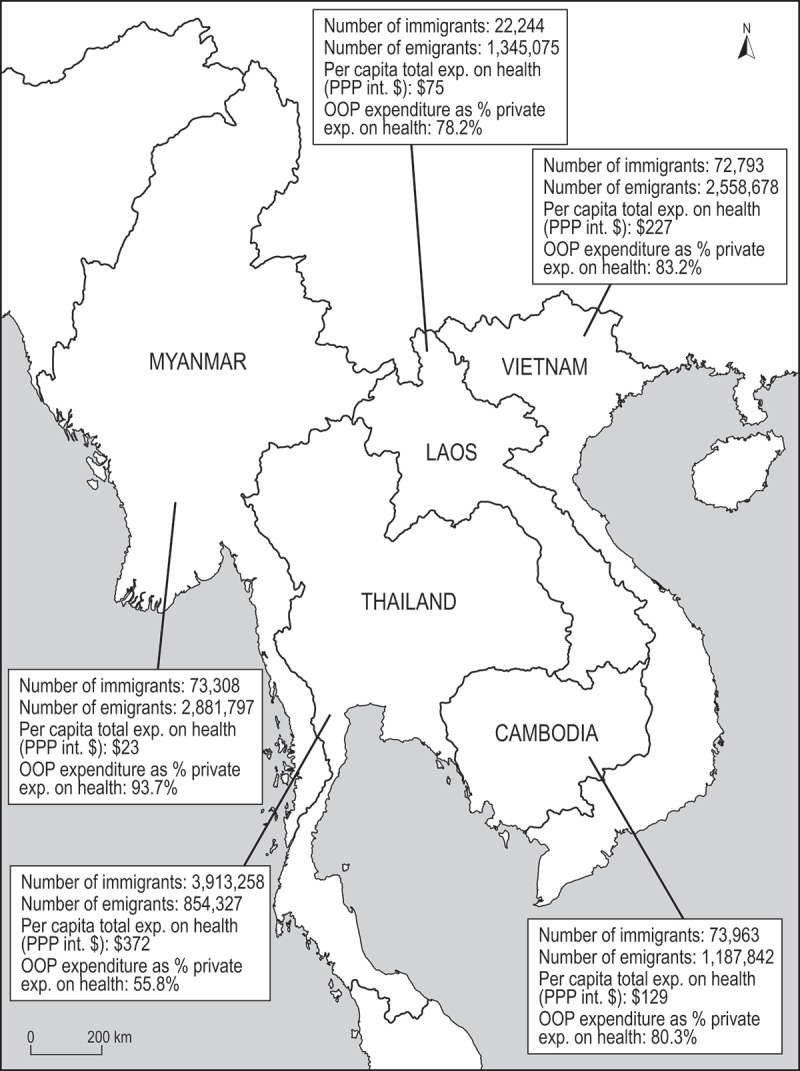
“Estimated number of emigrants [11,12] 1,187,842 1,345,075 2,881,797 2,558,678 854,327”
Migrant Workers in Asia Pacific and Their Rights to Health
Low, W. Y., Tong, W. T., & Binns, C. W. (2015) · Asia Pacific Journal of Public Health · doi:10.1177/1010539515600007 · Cited by 20
Monitoring Progress towards Universal Health Coverage at Country and Global Levels
Boerma, T., Eozenou, P., EVANS, D. B., Evans, T., Kiény, M.-P., & Wagstaff, A. R. (2014) · PLoS eBooks · doi:10.1596/23553 · Cited by 19
LABOUR MIGRATION FROM COLOMBO PROCESS COUNTRIES: GOOD PRACTICES, CHALLENGES AND WAYS FORWARD
Aghazarm, C. (2012) · Cited by 14
ASEAN integration and health services
Sriratanaban, J. (2015) · Global Health Action · doi:10.3402/gha.v8.27199 · Cited by 13 · cited 1×
“In addition, many displaced people live in border areas surrounding the refugee ‘camp’ areas in Thailand.”
BackgroundIncluding migrant populations in health impact assessments
Miramontes, L., Pottie, K. C., Jandu, M. B., Welch, V. A., Miller, K., James, M., & Roberts, J. H. (2015) · Bulletin of the World Health Organization · doi:10.2471/blt.14.142315 · Cited by 12 · cited 1×
“tioned in health impact assessments [10,45].”
Creating a supportive legal environment for universal health coverage
Clarke, D. J., Rajan, D., & Schmets, G. (2016) · Bulletin of the World Health Organization · doi:10.2471/blt.16.173591 · Cited by 9 · cited 1×
“health laws and legal frameworks are required in order to extend social protection and health coverage, including for migrants [58].”
BackgroundAccelerating and disseminating across Asia
Beyrer, C. (2001) · The Washington Quarterly · doi:10.1162/016366001561483 · Cited by 7
Will current health reforms in south and east Asia improve equity?
Hipgrave, D. B., & Hort, K. (2014) · The Medical Journal of Australia · doi:10.5694/mja13.10870 · Cited by 6
Ramı́rez, M. G., & Hatzidimitriadou, E. (2009) · International Journal of Migration Health and Social Care · doi:10.1108/17479894200900001 · Cited by 5
Delivering Health Services in Diverse Societies
Healy, J., & McKee, M. (2004) · Oxford University Press eBooks · doi:10.1093/acprof:oso/9780198516187.003.0018 · Cited by 5 · cited 1×
“substantial risks to migrants, the surrounding population, and beyond [60,61].”
BackgroundSelf-citationWill current health reforms in south and east Asia improve equity?
Hipgrave, D. B., & Hort, K. (2014) · The Medical Journal of Australia · doi:10.5694/mja14.00996 · Cited by 4
Barbero (2014) · doi:10.1016/j · Cited by 1
(2018) · Digital Commons@Becker (Washington University School of Medicine) · doi:10.1371/journal
Research works printed but not linked: 19
- [6] IOM. Regional strategy for Asia and the Pacific 2012 -2015. Bangkok: International Organization for Migration Regional Office for Asia and the Pacific; 2010. -
- [13] Akkhavong K, Paphassarang C, Phoxay C, et al. The Lao people ' s democratic republic health system review (Health Systems in Transition, Vol. 4 No. 1). Manila: World Health Organization (Asia Pacific Observatory on Health Systems and Policies); 2014. -
- [15] Jongudomsuk P, Srithamrongsawat S, Patcharanarumol W, et al. The Kingdom of Thailand health system review (Health Systems in Transition, Vol 5 No 5). Manila: World Health Organization (Asia Pacific Observatory on Health Systems and Policies); 2015. -
- [16] Sein TT, Myint P, Tin L, et al. The Republic of the Union of Myanmar: health systems in transition. Vol. 4 No. 3. Manila: World Health Organization (Asia Pacific Observatory on Health Systems and Policies); 2014. -
- [19] World Health Organization Regional Office for the Western Pacific (McMichael C, Healy J). Cross-border migration in the Greater Mekong Subregion (GMS) and health service access. Manila (Philippines): World Health Organization Regional Office for the Western Pacific; Forthcoming. -
- [20] ADB. Climate change and migration in Asia and the Pacific: draft edition. Manila (Philippines): Asian Development Bank; 2012. -
- [21] ADB. Facilitating safe labor migration in the Greater Mekong Subregion. Manila (Philippines): Asian Development Bank; 2013. -
- [23] Frederico S. Migration in the Greater Mekong Subregion. Manila (Philippines): Asian Development Bank; 2009. (Background Paper). -
- [33] Marin M. When crossing borders: recognising the sexual and reproductive health and rights of women migrant workers. Arrows Change. 2013;19:2 -5. -
- [36] Chaikittiporn C, Laohaudomchok W, Weik K. Thailand Myanmar migrant workers in Thailand. Asian-Pacific Newsl Occup Health Saf. 2012;19:10 -13. -
- [39] WHO. The World Health Report 2013: research for universal health coverage. Geneva: World Health Organization; 2013. -
- [41] Annear PL, Comrie-Thomson L, Dayal P. The challenge of extending universal coverage to lowand middleincome countries in Asia Policy Brief. Asia Pacific Observatory Health Systems Policies. 2015;4(3):1 -50. -
- [46] ASEAN/JUNIMA. Multi-stakeholder dialogue on migrants ' health and access to HIV services in the ASEANregion - meeting report. Bangkok: ASEAN; 2011. -
- [48] IOM. Healthy migrants, healthy Thailand: a migrant health program model. Bangkok: International Organization for Migration and the Thai Ministry of Public Health; 2009. -
- [50] EJF. Slavery at sea: the continued plight of trafficked migrants in Thailand ' s fishing industry. London: Environmental Justice Foundation; 2014. -
- [52] World Vision International. Tackling human trafficking in the Greater Mekong Subregion. Bangkok: World Vision International; 2013. -
- [56] WHO. Emergency response to artemisinin resistance in the Greater Mekong Subregion: regional framework for action 2013 -15. Geneva (Switzerland): World Health Organization; 2013. -
- [61] Fortier J. Migrant-sensitive health systems. In: LópezAcuña D, Mosca D, Pace P, Fortier J, Rijks B, Weekers J, editors. Health of migrants: the way forward. Madrid: World Health Organization; 2010. p. 61 -70. (Report of a global consultation). -
- [62] García-Ramirez M, Hatzidimitriadou E. User involvement and empowerment in health care practices with ethnic minority and migrant groups: a community approach. Int J Migration Health Soc Care. 2009;5:2 -4. -
Cited by
The UCL–Lancet Commission on Migration and Health: the health of a world on the move
Abubakar, I., Aldridge, R. W., Devakumar, D., Orcutt, M., Burns, R., Barreto, M. L., Dhavan, P., Fouad, F. M., Groce, N., Guo, Y., et al. (2018) · The Lancet · doi:10.1016/s0140-6736(18)32114-7 · Cited by 941
Lim, M. Y., Kamaruzaman, H. F., Wu, O., & Geue, C. (2023) · Archives of Public Health · doi:10.1186/s13690-023-01159-3 · Cited by 103
“As a result of fragmented health insurance schemes as opposed to a unifying and non-discriminatory scheme, vulnerable groups like stateless people who do not possess formal documentation are deprived of their right to access healthcare [30, 31, 40].”
BackgroundQuality of care in the context of universal health coverage: a scoping review
Yanful, B., Kirubarajan, A., Bhatia, D., Mishra, S., Allin, S. M., & Ruggiero, E. D. (2023) · Health Research Policy and Systems · doi:10.1186/s12961-022-00957-5 · Cited by 84
“Studies also emphasized the importance of integrating equity as an explicit component in the measurement and monitoring of UHC through for example, disaggregation of data by key socioeconomic and demographic variables including place of residence, occupation, religion, ethnicity and migration status [18, 27, 30, 35].”
BackgroundHealth Inequality between Migrant and Non-Migrant Workers in an Industrial Zone of Vietnam
Pham, K. T. H., Nguyen, L. H., Vuong, Q., Ho, T. M., Vuong, T., Nguyen, H. T., Vu, G. T., Nguyen, H. L. T., Tran, B. X., Latkin, C. A., et al. (2019) · International Journal of Environmental Research and Public Health · doi:10.3390/ijerph16091502 · Cited by 46
“Given continuing migration and uneven economic integration and growth, ensuring the detection of health issues and timely provision of health services in migrant workers is crucial to national health equity [34].”
BackgroundWangdi, K., Pasaribu, A. P., & Clements, A. (2021) · Asia & the Pacific Policy Studies · doi:10.1002/app5.315 · Cited by 52
Metadata
- Authors
- McMichael, C., & Healy, J.
- Affiliations
- The University of Melbourne (AU)
- Australian National University (AU)
- Corresponding author
- McMichael, Celia
- Venue
- Global Health Action
- Publisher
- Informa UK Limited
- Published
- 2017-01
- Volume
- 10
- Issue
- 1
- Pages
- 1271594-1271594
- ISSN
- 1654-9716 (ISSN-L)
- 1654-9880
- PMC
- PMC5328359
- OpenAlex
- W2584678375
- Cited by
- 53
- References
- 35
- Citations by year
- 2026: 4 · 2025: 4 · 2024: 5 · 2023: 8 · 2022: 11 · 2021: 8 · 2020: 1 · 2019: 7 · 2018: 1 · 2017: 3
- FWCI
- 1.00
- Type
- journal article
- Language
- en
- Open access
- gold
- doi.org
- Licence
- Locations
- Global Health Action (publishedVersion, cc-by)
- Europe PMC (PubMed Central) (publishedVersion, cc-by)
- PubMed Central (publishedVersion, cc-by)
- PubMed (publishedVersion)
- DOAJ (DOAJ: Directory of Open Access Journals) (submittedVersion, cc-by-sa)
- Minerva Access (University of Melbourne) (submittedVersion, cc-by)
- ANU Open Research (Australian National University) (submittedVersion, cc-by)
- Funders
- World Health Organization
- National Institute on Minority Health and Health Disparities
- Topics
- Social Sciences › Sociology and Political Science › Migration, Identity, and Health
- Social Sciences › Law › Migration, Racism, and Human Rights
- Social Sciences › Psychology › Clinical Psychology › Migration, Health and Trauma
- Keywords
- migrant health, health equity, cross-border migration, migrant workers, irregular migrants, refugees and asylum seekers, trafficking victims, universal health coverage, health care access, out-of-pocket costs, migrant health policy, Greater Mekong Subregion, Cambodia, Laos, Myanmar, Thailand, Vietnam
- MeSH terms
- Health Equity, Asia, Southeastern, Health Expenditures, Health Services, Health Services Accessibility, Humans, Quality of Health Care, Transients and Migrants, Universal Health Insurance, Needs Assessment, Policy
About these checks
Registry, retraction, Cites and statistics results are computed, not judged, with one exception: a printed reference that no index lists is read once by a model before it counts as a citation error. Claims are extracted by a model and kept only when their quote appears verbatim in the text; each cited source is then checked, with a model’s help, for whether it says what the claim relies on. Those verdicts can be wrong — read the claim’s quote and the cited source before relying on one.
Statistics and arithmetic are recomputed, not judged.
Confidence bands are shown only for fields calibrated on our annotated test set. None is calibrated yet, so no band is shown.
What counts as a claim ›How we measure confidence ›How we check this ›
Are you an author, or do you see a problem with this page? Request a review
Data sources
Bibliographic data: Semantic Scholar, OpenAlex, Crossref.
Contains information from the Semantic Scholar Academic Graph Datasets, made available under the ODC Attribution License (ODC-BY 1.0).
Semantic Scholar’s data is described in: Kinney, R., et al. (2023). The Semantic Scholar Open Data Platform. arXiv:2301.10140.
